
Banba (p. 39): “Banba, the queen of one of the three Dedannan princes, who ruled the land, sent a swarm of meisa, or phantoms, which froze the blood of the invaders (the Milesians) with terror.”—Joyce’s Social History of Ancient Ireland.
Bog-cured Cheese (p. 72): “Masses of cheese have been found in bogs, of which some specimens may be seen in the National Museum.”—Joyce’s Social History.
Book of the Dun Cow (p. 14): “One of the most ancient collections of Irish historical and legendary material, curiously named for the color of the cow in whose tanned skin it was bound.”—Joyce.
Brehon Law (p. 44): “A judge was called a Brehon.... The Brehons had absolutely in their hands the interpretation of the laws and the application of them to individual cases.”—Joyce.
Cromm Cruach (p. 11): “Cromm Cruach, covered with gold and silver, and twelve other idols covered with brass about him.”—Tripartite Life of St. Patrick.
“And the earth swallowed up the twelve other images as far as their heads, and they stand thus in token of the miracle.”—Book of Armagh.
Dedannan Furies (p. 22): “A mythical race of powerful, demoniac and dangerous elves.”—Joyce.
Demons, Wizards, Druids (p. 24): All the ancient accounts agree that while the Druids were the only educators in the Ireland of their time, they were also magicians and wizards, and could command the services of demons and fairies, good and bad.—Tr.
“The demons used to show themselves unto their worshippers in visible forms: they often attacked the people, and they were seen flying in the air and walking on the earth, loathsome and horrible to behold.”—Joyce.
“God protect me from the spells of women (Druidesses) and Smiths, and Druids.”—St. Patrick’s Hymn.
Dubthach mac na Lugair (p. 42): Here the Legend does not quite agree with the authorities. Instead of being attached to the court of the King of Connaught, he was royal poet and shanachy at Tara during the greater part of Laeghaire’s reign as Over-King of Ireland.—Tr.
Ethne the Fair, and Fedelm the Ruddy (p. 9): In the “Tripartite Life of St. Patrick” and in the “Book of Armagh,” these two daughters of King Laeghaire are mentioned as being under the instruction of the Druid priests, Caplait and Lucat-Moel, at the time when Patrick overthrew Cromm Cruach and the twelve smaller idols and made Christian converts of the entire royal family.—Tr.
Finola of the White Shoulder (p. 16): A heroine of the “Book of Armagh.” Evidently the Legend mistakes her for Cruimthiris, mentioned in the “Tripartite Life” as one of the three embroideresses in Patrick’s household.
(P. 79): The reference to the four sons of Finola of the White Shoulder is clearly legendary.—Tr.
Fasting to Collect a Debt (p. 42): “The plaintiff, having served due notice, went to the house of the defendant, and, sitting before the door, remained there without food; and as long as he remained, the defendant was also obliged to fast.”—Joyce.
Geis (p. 62): “A geis was something forbidden. It was believed to be very dangerous to disregard these prohibitions.”—Joyce.
Glanngalt (p. 48): “There is a valley in Kerry called Glanngalt, the glen of the galts, or lunatics.”—Joyce.
Here the Legend, by locating Glanngalt in Roscommon, is palpably in error.—Tr.
Handstone (p. 20): “It was the custom at that time, every champion they killed in single combat, to take the brains out of their heads and mix lime with them till they were formed into hard balls.”—Book of Leinster.
Inns (p. 26): The hospitable custom of maintaining inns for the free entertainment of travellers is mentioned by nearly all authorities regarding the social life of the ancient Irish. A most interesting account is contained in “Joyce’s Social History.”—Tr.
Laeghaire (p. 9): Modern form, Leary; he was the Irish Over-King when Patrick landed at Wicklow and began his missionary labors in Ireland, A.D. 432. All the characters in the Legend are historic, and the names are spelled as originally derived from the Gaelic.—Tr.
Mac Maragh, Keth (p. 14): Evidently confused with Keth Magach, a famous warrior and champion of that time, whose exploits are narrated in the “Book of Armagh.”—Tr.
Macc Cairthinn (p. 20): In the “Tripartite Life” Macc Cairthinn is named as Patrick’s Strong Man. Evidently the Legend confuses him with Keth Magach.
(P. 21): According to the “Tripartite Life,” it was Patrick’s Strong Man, Macc Cairthinn, who became a bishop, not Keth Magach.—Tr.
Metheglin (p. 47): Also called mead, “was made chiefly from honey: it was a drink in much request, and was considered a delicacy.... It was slightly intoxicating.”—Joyce.
Population (p. 25): “For the people were very numerous in Ireland at that time, and so great were their numbers that the land could afford but thrice nine ridges to each man in Erin: viz., nine of bog, nine of field and nine of wood.”—Book of Hymns (Todd).
Presbiter Bescna (p. 13): Named, with all the members of Patrick’s household, in the “Tripartite Life.”—Tr.
Red Branch Knights (p. 20): According to Joyce and other authorities, this was an order created by Concobar Mac Nessa, a very ancient king of Ulster, and whose greatest commander was Cuculainn, the mightiest hero of Irish romance.—Tr.
Shanachy (p. 26): “The people ... took delight in listening to poetry, history and romantic stories, recited by professional poets and shanachies.”—Joyce.
Standards of Value (p. 44): As in many other countries in ancient times, a cow, or an ox, was the standard of value. It seems probable, therefore, that the Legend is correct in using sheep, pigs and geese for the “fractional currency” of the period.—Tr.
Strong Man (p. 14): These Strong Men, or champions, like the smiths and other metal-workers, appear frequently in the old annals as distinguished also for their knowledge of law and history, and for their story-telling ability.—Tr.
Tara (p. 10): Seat of the Irish Over-Kings. Old Erin’s centre of government, of learning and of chivalry. Then, as now, the most eloquent of all words descriptive of Ireland’s ancient glory. In poetry, imperishable in the line: “The harp that once thro’ Tara’s halls.” The scene of St. Patrick’s first efforts to redeem Ireland from paganism.—Tr.
Tobernagalt (p. 48): “Drinking of the water of Tobernagalt (the lunatics’ well), and eating of the cresses that grew along the little stream, the poor wanderers get restored to sanity.... There is a well called Stroove Bran, which was thought to possess the same virtue as Tobernagalt.”—Joyce.
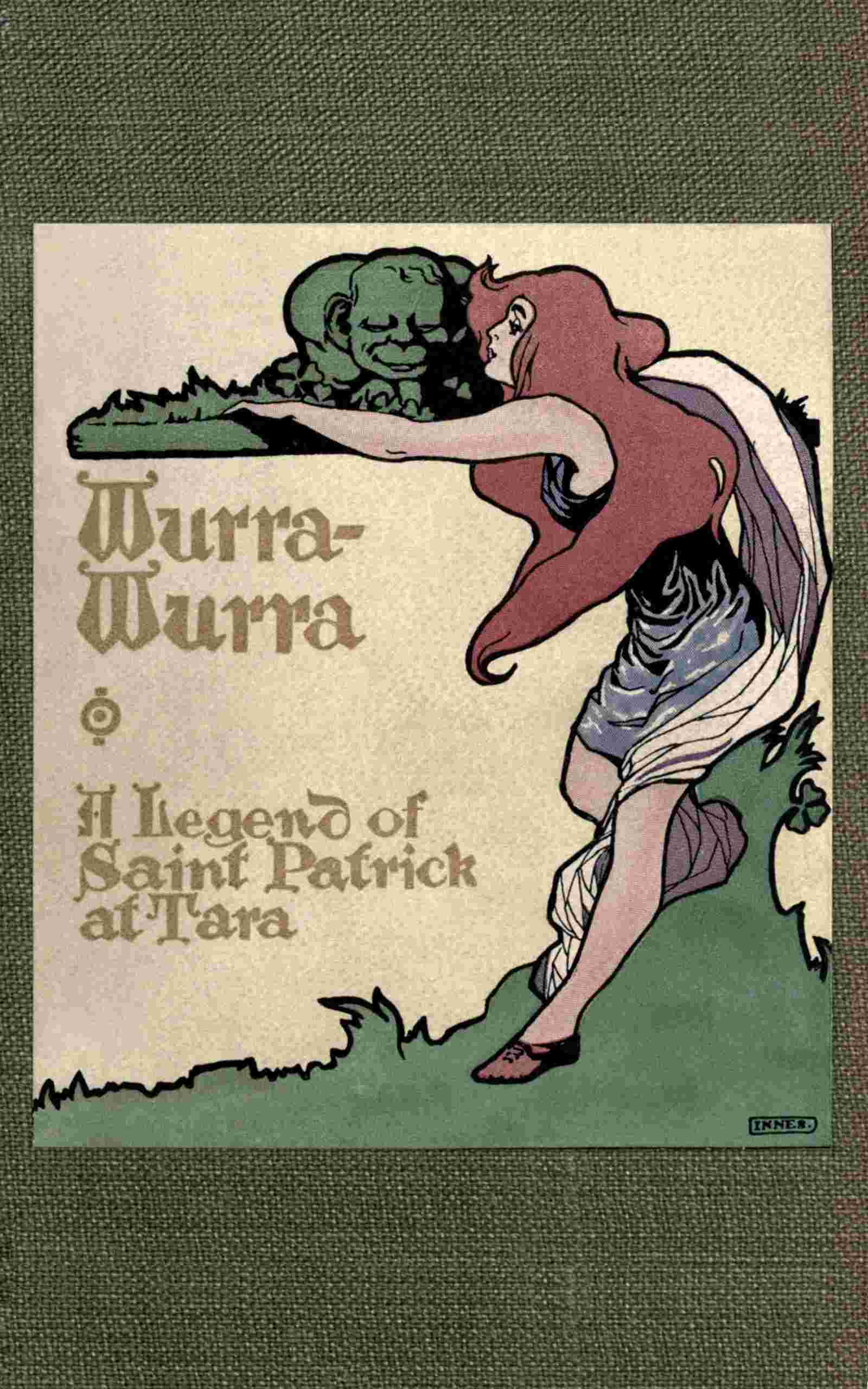
Wurra-Wurra (p. 18): The authorities do not specifically mention the existence of an idol having that name; but they agree that idols were worshipped in all parts of ancient Ireland.—Tr.
The Irish up to that time (St. Patrick’s) “had worshipped only idols and abominations.”—St. Patrick’s Confession.
“The destruction of idols in various parts of the country was an important part of St. Patrick’s lifework.”—Joyce.
(P. 80): Some Gaelic scholars hold that the familiar exclamation, “Wurra-wurra!” is the nearest approach in that tongue to the conventional invocation of the Blessed Virgin. The Legend, however, makes it, in that sense, an adaptation—evidently intending a tribute to St. Patrick’s well-known policy of harmonizing his teachings, as far as possible at the start, with ancient customs and beliefs.—Tr.