
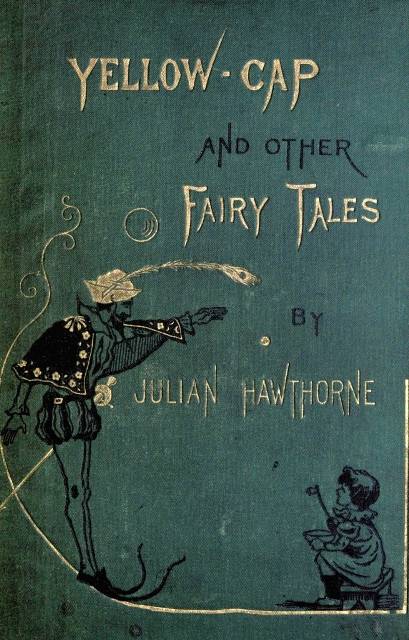
The Project Gutenberg eBook of Yellow-Cap and Other Fairy-Stories For Children
Title: Yellow-Cap and Other Fairy-Stories For Children
Author: Julian Hawthorne
Release date: March 27, 2010 [eBook #31795]
Language: English
Credits: Produced by David Edwards and the Online Distributed
Proofreading Team at http://www.pgdp.net (This file was
produced from images generously made available by The
Internet Archive)
YELLOW-CAP
&c.
LONDON: PRINTED BY
SPOTTISWOODE AND CO., NEW-STREET SQUARE
AND PARLIAMENT STREET
YELLOW-CAP
AND OTHER FAIRY-STORIES FOR CHILDREN
BY
JULIAN HAWTHORNE
LONDON
LONGMANS, GREEN, AND CO.
1880
All rights reserved
CONTENTS.
| YELLOW-CAP. | ||
| CHAPTER | PAGE | |
| I. | An Appanage of Royalty | 3 |
| II. | The Golden Pledge | 11 |
| III. | The Golden Dwarf | 23 |
| IV. | The Talisman | 35 |
| V. | The King's Favour | 43 |
| VI. | Donkey-back | 51 |
| VII. | The Dark Passage | 57 |
| VIII. | The Magic Eye | 65 |
| IX. | On the Stage | 83 |
| X. | An Absolute Monarch | 102 |
| XI. | The Grand Transformation Scene | 113 |
| RUMPTY-DUDGET. | ||
| I. | The Palace and the Tower | 129 |
| II. | The Aunt, the Cat, and the Dwarf | 134 |
| III. | The Ways of the Wind | 145 |
| IV. | No Time To Be Lost | 154 |
| V. | The Queen of the Air | 161 |
| VI. | The King of the Gnomes | 170 |
| VII. | The Enchanted Fire | 179 |
| VIII. | The Golden Ivy | 186 |
| CALLADON. | ||
| I. | Abracadabra | 197 |
| II. | The Law of the Lamp | 204 |
| III. | Callia and the Mirror | 209 |
| IV. | The Outer Rooms | 214 |
| V. | Regeneration | 224 |
| THEEDA. | ||
| I. | The Book and the Vase | 237 |
| II. | Oscar Inside Out | 243 |
| III. | The Pearl-shell's Gift | 250 |
| IV. | The Crab | 260 |
| V. | A Stranger | 267 |
| VI. | The Secret of the Waves | 279 |
YELLOW-CAP.
CHAPTER I.
AN APPANAGE OF ROYALTY.
A good many years ago—before Julius Cæsar landed at Dover, in fact, and while the architect's plans for Stonehenge were still under consideration—England was inhabited by a civilised and prosperous people, who did not care about travelling, and who were renowned for their affability to strangers. The climate was warm and equable; there were no fogs, no smoke, no railways, and no politics. The Government was an absolute monarchy; one king, who was by birth and descent an Englishman, lived in London all the year round; and as for London, it was the cleanest, airiest, and most beautiful city in the whole world.
A few miles outside of the city walls lay a small village called Honeymead. It had some fifteen or twenty thatched cottages, each with its vegetable garden and its beehives, its hencoop and its cowshed. Around this village fertile meadows spread down to the river banks, bringing forth plenteous crops for the support of the honest and thrifty husbandmen who tilled them. There was only one public-house in the place, and the only drink to be had there was milk. A case of drunkenness was, consequently, seldom heard of; though, on the other hand, women, girls, and even small children might be seen lingering about the place as well as men.
This public-house was called the Brindled Cow, and it was kept by a young woman whose name was Rosamund. She was the prettiest maiden in the village, as well as the most good-natured and the thriftiest; though she had a keen tongue of her own when occasion demanded. As might be supposed, all the young men in the neighbourhood were anxious to marry her; but she gave them little or no encouragement. She used to tell them that she was well able to take care of herself, so what good would a husband be to her? She didn't want to support him, and she didn't need his support. It was better as it was. As for falling in love, that was a thing she couldn't pretend to understand; but her maiden aunt had once told her that it was more bother than it was worth, and she thought it very likely. Moreover, if by any accident she should one day happen to fall in love, she would take great care that it should not be suspected, because the man she loved would then become so puffed up with conceit there'd be no bearing him!
Such was Rosamund's declared opinion upon matrimony; and it caused gloom to dwell in the heart of many a love-sick swain. But (what was strange) the more love-sick they grew the fatter and rosier they became. The reason probably was that they were for ever going to the Brindled Cow under pretence of being thirsty—but in reality to feast their eyes on Rosamund's lovely face; and since, thirsty or not, she insisted upon their drinking, as long as they stayed, at the rate of a pint of rich unskimmed milk every ten minutes, you will easily understand that it soon became possible to measure the ardour of their affection in pounds avoirdupois. So that by-and-by, when the elders of the village would see their sons waxing great of girth and blowzy of visage, they would shake their heads and murmur sadly—
'Ah! poor lad, how healthy he's getting! 'Tis plain he's in love with Mistress Rosamund!'
There was one young fellow, however, who was seldom seen among the tipplers at the Brindled Cow. He was a slender youth, rather pale, with straight black eyebrows and large thoughtful eyes, which always seemed to be gazing at something far away. There was a romantic story about him, which you shall hear. When he was a small child, only three years old, his mother (who took in washing, and would be called a laundress nowadays) was up to her elbows one Tuesday afternoon in soapsuds and shirts; and Raymond—that was the child's name—was sitting beside the washing-tub, blowing soap-bubbles. All of a sudden the tramp of a horse was heard in the street without, and the woman, looking up from her scrubbing-board had a glimpse through the window of a magnificent horseman, in silk and velvet, with rosettes on his shoulders, and wearing a gold cap with a tall peacock's feather in it. He got off his horse; and in another moment he had opened the cottage door and walked into the washing-room.
The poor woman was at first vastly frightened, for she thought this must be the King, and that he was going to cut off her head because she used chemicals in her washing—though she had never done such a thing except when she was very much pressed for time, or when the water was so hard that the soap would not make suds. However, like a wise woman as she was, she made up her mind not to ask for mercy until she had heard her accusation; so she dropped half a dozen curtseys, and begged to know what his Gracious Royal Majesty's Highness wanted.
Meanwhile, the little boy, from his seat beside the wash-tub, stared and stared at the magnificent stranger, and was sure he never could stare at him enough. The stranger was tall, thin, and as straight as a hop-pole; had a huge aquiline nose, with a pair of long moustachios jutting out beneath it and curling up to his eyes; and on his chin was a sharp-pointed beard. The steam from the wash-tub filled the little room and swam in misty clouds round this singular figure; while the last soap-bubble which the little boy had blown from his pipe rose in the air and circled round and round the yellow cap like a planet round the sun. Altogether he looked like an Eastern genie in an English court-dress—an uncommon sight in the times I write of.
This personage now made two profound obeisances, one to the washerwoman and one to the little boy. This done, he threw back his silk-lined cloak, and taking from the pocket of his doublet a bundle of something done up in gold paper, he opened his mouth and said—
'O yez! O yez! O yez! Whereas his Transparent Majesty King Ormund, Emperor of Great Britain, France, and Ireland, Defender of the Faith, and so forth, and so forth, did, while riding through this village called Honeymead, splash with mud his left Transparent stocking: now, therefore, O washerwoman, it is his gracious will and pleasure that you do hereby wash the same, with all due and proper diligence and despatch, and with the smallest possible amount of unnecessary procrastination. Long live his Transparency King Ormund!'
In fact, the gold paper contained a fine pink silk stocking, with embroidered clocks, a hole in the toe, and seven spots of mud spattered over it. The washerwoman had understood very little of the speech, but she could see that the stocking needed washing; so without more ado she plunged it into the soapsuds, and in five minutes it was as clean as the day it came out of the shop, and was dried before the fire. All this time the stranger had stood bolt upright in the centre of the little room, swathed in the steam, and with the soap-bubble still revolving round his head like a planet; and the little boy still stared up at him, as if he never could stare enough.
When the stocking was quite dry the washerwoman rolled it up again in the gold paper and gave it to the stranger, who put it back in the pocket of his doublet. Then he took from the purse that hung at his belt a new spade guinea, gave it a fillip into the air, and down it fell in the little boy's lap. Then, with a third profound obeisance, he made a long step back towards the door.
Up jumped the little boy in a great hurry and excitement.
'If you please, sir,' he cried out, 'who are you?'
The stranger stopped; and as the steam from the wash-tub wound around him more and more, and the soap-bubble burst on the bridge of his aquiline nose, he replied—
'Little boy, I am an Appanage of Royalty!'
'Please will you give me your yellow cap?' asked Raymond again.
'Not to-day,' said the Appanage of Royalty, with a queer smile.
'To-morrow, then?' demanded Raymond.
'Some day—perhaps!' the other replied, still with that queer smile. And then he disappeared; but whether he dissolved into steam, or exploded like a soap-bubble, or went out by the door in the regular way, the little boy could never be quite sure. It was enough for him that an Appanage of Royalty had said that some day, perhaps, he would give him his gold cap. And Raymond never forgot this adventure; and as a kind of pledge of its reality he ever afterwards wore the spade guinea round his neck by a silken string. He believed that sooner or later it would be the means of bringing him fame and greatness.
CHAPTER II.
THE GOLDEN PLEDGE.
One fine May morning, while Rosamund was churning in the dairy-room of the Brindled Cow, she heard some one walk into the bar. The step was not that of any one of her familiar suitors. It was neither short plump Armand, nor tall bulky Osmund, nor red-haired broad-cheeked Phillimund, nor short-legged thick-necked Sigismund, who drank six quarts of milk last Saturday; nor short-breathed apoplectic Dorimund, who sang sentimental songs with a voice like a year-old heifer's. No, none of these had a step like this step—sauntering, light, and meditative. Nevertheless, it was a step which Rosamund loved to hear.
She stopped churning, and moved softly to where a brightly-polished tin pan was set up on the shelf. It was Rosamund's looking-glass. Before this she smoothed her rumpled hair, straightened the pink bow at her throat, and snatched off her dirty apron. She was provoked to see how red the churning had made her cheeks, and she wished she were paler; but the wish only seemed to make her rosier than before. She told herself that she was a coarse-looking ugly girl; and yet when, only that morning, Dorimund had told her that she was as beautiful as a fairy, she had taken it quite as a matter of course. It was tiresome—the way people could grow ugly all in a moment—and in the wrong moment too!
All this happened during the two or three minutes after the light-stepping visitor had come into the bar; and now this person tapped twice or thrice on the counter. Rosamund, on hearing the tap, began to hum a little song, in an unconcerned sort of way, and walked up and down the dairy a few times, as if she were putting things in order; and when, at last, she came out to the bar, it was with the air of a very busy young woman, who does not like to be disturbed at her churning.
'Oh, is it you?' she said to the person who was leaning on the counter. 'How do you do? I hope you're thirsty?'
The person smiled. He was a handsome young fellow, with dark hair and a pale face, and he looked at Rosamund with a pair of thoughtful eyes. His dress was plain and rather the worse for wear; but round his neck a bright spade guinea was hung by a silken string. It did not seem different from any other spade guinea, yet there must have been something peculiar about it. For it gave a kind of dignity to the young man's aspect, so that if you fixed your eyes upon the coin you forgot the wearer's shabbiness, and almost fancied him to be a noble and opulent personage. Whether the owner were aware of this or not is another question; but, as a general thing, young people seldom know what it is about them that makes them attractive.
'I hope you are thirsty?' Rosamund repeated, in a business-like tone, as she leaned against the other side of the counter, and looked up at the young man with her lovely blue eyes.
'I am not thirsty, Rosamund,' he replied, 'but I am tired.'
'I've always heard that doing nothing was tiresome. Perhaps you'd like to take a chair and sit down? I really must go on with my churning.'
'It isn't that kind of tired that I mean,' said he; 'but if you'll let me sit down in the dairy I don't mind.' Rosamund made no objection, so he vaulted over the counter and they went into the dairy together. 'I'm so tired waiting!' he added, with a sigh.
'And what are you waiting for, may I ask?'
'For something great to happen!'
'Oh! Then why don't you make it happen?'
'I wish I could!' sighed the young man.
Rosamund tied her apron on again, and laid hold of the churn-handle.
'What do you call great?' she asked, beginning to work it up and down.
The young man took his gold coin meditatively between his thumb and forefinger and twisted it on its silken string.
'Greatness is everything that I have not, and want to have,' he said.
'Oh, power and wealth, and to be above other men, and to have them look up to me and obey me. That is greatness.'
'Pooh!' exclaimed Rosamund, working her churn vigorously. 'I shouldn't care about such greatness as that.'
'Not care about it, Rosamund?'
'Not so much as a pat of butter, Raymond. What do you want of wealth? Are you hungry, pray, or thirsty? I will give you as much of the best milk, fresh from the cow, as you can drink; and all the wealth in the world couldn't help you to drink more. As for power—however high it brought you, it couldn't make you yourself higher by so much as a single inch: you would still be the same Raymond you are now, even if you were an emperor—yes, or that Appanage of Royalty you've been thinking and talking about all these dozen years or more. Why do you want people to look up to you and obey you, I should like to know? Can't you see that it's not you they would look up to, but your ermine robe and silk stockings——'
'Ah! my mother once washed one of the King's silk stockings—the left one,' murmured Raymond; 'and the Appanage of Royalty said that some day, perhaps, he would give me his yellow cap——'
'And golden crown,' continued Rosamund, not noticing the interruption. 'You silly boy! they would obey the crown, not you, though you might happen to be wearing it. If you think it would be yourself they cared for, just go to London as you are now and order them about! But if I were you I'd rather be truly loved by one—person than be obeyed by one hundred thousand.'
'But if you were I, Rosamund, you'd be a man; and men are different.'
'So it seems.'
'What a noise that churn makes! Rosamund, I've felt all my life long that I was destined to be great. Why else did my mother wash the King's stocking; or the Appanage of Royalty promise me the cap?'
'You've been dreaming, you silly boy!'
'But can a dream that I've been dreaming all my life fail to come true? I don't say that to sit on a throne and rule a kingdom would be the happiest lot in the world; but, just as an experience, it would be good fun; and if one is predestined to it, you know—— Besides——'
'Well, your majesty—besides what?'
'Well, for instance, how would you like to be a queen?'
Rosamund stopped churning, wiped her hands on her apron, and tossed up her pretty chin with a saucy air.
'A queen, indeed! I beg to inform you, Master Raymond, that I am a queen already, and I have reigned longer and more despotically than ever you will, I fancy. Pray, has the Queen of England any subjects more devoted to her than my Osmund and Dorimund and Phillimund and Sigismund and Armand, and twenty others, are to me? Honeymead is my kingdom, and I do really reign, because my power is in myself; and fifty giants to march before me, and a hundred dwarfs to carry my train, wouldn't make me a bit more of a queen than I am now. So—thank you for nothing, Master Raymond!'
Raymond sat erect, with a great deal more animation in his look than he had yet shown.
'Listen to me, Rosamund,' he cried. 'It is true you are Queen of Honeymead. But what is Honeymead compared with London? And why should not you be as much a queen in London as you are here? You would be none the worse for a crown, and dwarfs and giants, though you might not need them: because no man could look at you and not be your faithful subject ever afterwards. And—Rosamund——'
He hesitated, and his cheeks were quite red. Rosamund glanced up at him and thought, 'How handsome he is!'
'Rosamund, I ask you this: if I become king will you sit beside me on the throne, and rule over Great Britain, France, and Ireland?'
Rosamund looked very grave.
'Do you mean to ask me to be your wife, Raymond?' she asked.
'I would have asked you long before, dearest Rosamund, but I waited hoping to be able to offer you a kingdom along with my love.'
'Well, it is a very kind offer,' said she, with a little smile and a sigh, 'and I thank you. But I must say no.'
'If I were your wife I should have no time to attend to the duties of the Court; and if I were your queen I should have no time to attend to you. And I am so jealous that I could not let you neglect me for your kingdom; and yet I'm so ambitious that I couldn't let you neglect your kingdom for me. So it would not do either way; and, if you please, we won't talk any more about it.'
But as she said this her voice trembled, and tears were in her eyes. Then Raymond's heart overflowed with tenderness, and he went to her and took her hand.
'I could not be happy on a throne without you, Rosamund,' said he; 'but I could be happy, if you would marry me, without a throne.'
And because it cost him a good deal to make this sacrifice (even of something he had not got) his voice trembled a little too.
When Rosamund heard that she could resist no longer. She smiled such a smile as Dorimund and the rest would have given their farms to win from her; and said she—
'Oh, Raymond! I am a greater queen in having your love than——'
And then Raymond kissed her just on the place that the next word was coming out of, so the rest of the sentence was lost.
'But are you quite sure, dear Raymond, that you will be content to live here always?' she asked, when they had had a little more conversation of this kind.
Raymond smiled down on her, but he said nothing. Perhaps, in his secret heart, he was thinking that Destiny (which had appeared to him in the shape of the Appanage of Royalty so long ago) might still have some splendid gift in store for him and Rosamund, whereof the yellow cap would be but the symbol. And, if so, it would be foolish in them to bind themselves beforehand not to take advantage of it. So Raymond smiled at Rosamund in a way to show that, at all events, he loved her. And he did love her, no doubt.
'Poor boy!' said Rosamund, after another pause, smiling back rather mischievously, 'to think that you have been wearing this spade guinea all these years, and it has brought you nothing better than me at last!'
'If guineas could buy girls like you, my dear,' replied Raymond, 'the Mint would be kept working day and night. But I'll tell you what use we will make of this—we'll chop it in two, and each of us will wear a half, in token that we belong to one another. And then, no matter how long we may be separated, or what changes come over us, we should always recognise each other by these bits of gold.'
'But you don't think that changes will come over us, or that we shall be separated, Raymond?'
'Certainly not; but we may as well be on the safe side. For instance, if I were to go out and meet with an enchanter, and he were to turn me into a dwarf, and then I were to come back to you, how would you know me except by my half of the guinea?'
'I should trust my heart for that,' said Rosamund, softly. 'Still, we will wear the halves, so that everyone may see that we are but half ourselves when we are not together.'
This being settled, Rosamund fetched a hatchet, and Raymond put the guinea on a stool, and, with one strong blow, made it fly into two exact halves. Then he drilled a hole through Rosamund's half, and hung it round her neck by a piece of pink ribbon; and as for his own half, he strung it on the silken cord that he had always worn. So their betrothal was confirmed.
Just at this moment half a dozen of Rosamund's old suitors came trooping into the bar, and began calling for milk like a herd of calves. Then the lovers looked in each other's faces and smiled, and bade each other farewell very tenderly. Raymond went out through the cowyard; and Rosamund returned to the bar, where she served out fresh milk and thought about the half-guinea that was hidden in her bosom.
CHAPTER III.
THE GOLDEN DWARF.
Raymond strolled away towards the river. He wanted to think it all over. His betrothal was a sort of surprise to him. He had loved Rosamund, in a meditative way, so long that he had got used to not expecting anything more; but now, on the spur of the moment, he had told his love and received the pledge of hers, and it was all settled. He was happy, of course, for he believed Rosamund to be the prettiest and the best girl in the world. Still, he did not wish quite to give up the hope that something might happen to make their life more splendid. He said to himself that it was only for Rosamund's sake he hoped this. Perhaps that was the reason he hoped it so much.
The path down to the river was narrow and winding; it lay between hawthorn hedges white with blossoms. It ended at the ford, where willow trees bowed down over the current. One of these trees had been cut down on the day Raymond was born. The stump made a sort of chair, in which Raymond had spent many a summer hour, musing over the flowing water, or lifting his eyes to gaze thoughtfully at the distant city. He called the willow-stump his throne; and in the stream that hurried beneath he imagined he saw the march of mighty nations passing before his feet to do him homage. To-day all such imaginations must end; and it was more habit than anything else that had brought him to the spot. He did not come, as formerly, half in fear and half in delight, hoping to meet with some beneficent fairy or other, who would grant him the three wishes which all fairies have in their gift. No; he came to take a last look at that world of dreams in which he had lived from childhood, and to make up his mind to living henceforth in the matter-of-fact world which common people inhabited.
It was afternoon when he came to the willow-stump throne and sat down upon it. The sky was thronged with stately clouds—phantom mountains, with castles on their tops—castles wherein Raymond's fancy had often dwelt. The air was soft and warm, sweet with fragrance of lilac and apple-blossoms, and bright with bird-songs. The bending willows swept the river surface with slender green ringers, startling the trout and grayling that quivered and darted in the pools and shallows. Life and beauty and happiness were everywhere; and far to the eastward, piled high against the horizon, rose the white marble walls and towers of mighty London. They looked less real than the clouds. Sunlight sparkled on the gilded domes, and cast afar the tender purple shadows of royal palaces. And amidst green meadow-banks, and past gleaming wharves populous with delicate masts and rainbow sails, swept the azure curves of the translucent Thames towards the fair city. London was, indeed, at this time, the most magnificent city in the world; and Camelot, which was built hundreds of years afterwards, was never anything to compare with it. What wonder, then, if Raymond eyed its distant splendours with some regret, remembering that they were lost to him for ever?
'But I have Rosamund,' he murmured to himself.
'So much the more fool you!' spoke a metallic voice close behind him.
Raymond looked round. Whence had come that grotesque figure which was standing within a couple of yards of him, and which gazed at him with an expression at once so quizzical and so penetrating? Had he ever seen it before? No—and yet—had he?
The figure was that of a man about three feet high, with a body shaped like a sack of potatoes, supported by short and crooked legs that bent beneath its weight. The arms were so long that the hands (like great curved claws) hung down nearly to the ground; and the fingers made a continual movement as if clutching something. The head of this creature was large, and had no neck; the nose was aquiline, the eyes bright and sharp. On the chin was a pointed beard, and a pair of long moustachios curled up over the cheekbones. The creature was dressed in rich and costly clothes, which, however, bore an unaccountable resemblance to Raymond's own threadbare attire. On the head was a yellow cap, apparently made of woven gold, which glowed and sparkled in the sunlight. Certainly there was something familiar about that cap and those moustachios!
'Where did you come from?' Raymond asked.
'I was here before you,' replied the dwarf.
'I saw no one.'
'People do overlook me sometimes,' rejoined the other, with a chuckle; 'but they are more apt to spend their lives in trying to find me. Once in a great while I appear without being asked—as I do now!'
'Where have I seen you before?'
'Ask yourself.'
'Who are you?'
The dwarf made a low bow. 'I am an Appanage of Royalty!' said he.
'Then it was you who brought the King's silk stocking to be washed! But were you not a great deal taller then than now?'
'What of that? Were not you a great deal shorter?'
'That is true,' murmured Raymond, struck by the justness of the remark.
'True as gold!' added the dwarf, with another chuckle. 'And so you want to go to London?' he continued suddenly.
Raymond started. 'I have been thinking of it,' he said; 'but now——'
'Nonsense! You want to go now as much as before you went to the Brindled Cow, and I am the only person in the world that can help you do it.'
'But how did you know——'
'Pooh! I know everything. Weren't you thinking of me at the very moment you kissed her? There—no more words! Are you ready to start? Speak up.'
But Raymond drew back, startled and mystified. Seeing this, the dwarf altered his tone, and from being abrupt and overbearing became friendly and familiar.
'Come, my dear boy,' he said, laying his great claw on Raymond's arm. 'Men must be men; we mustn't let ourselves be ordered about by a parcel of women. Would you let a few kisses and keepsakes stand in the way of your ambition? How many years has she waited for you? Let her wait twenty-four hours longer. Besides, if you don't go now you will never go at all. Rosamond—trust me—will like you none the less when she sees you the greatest man in England. Come, now. I can put in your hands a power before which the whole world bows: will you take it or not? I shan't offer it twice.'
Now, Raymond had a secret suspicion that something was wrong in all this; for why should a stranger be so anxious to confer an inestimable boon upon him? And yet London was but seven miles off. He could get back that very night if need be. It would be a pity to lose this chance after having waited for it so long. It could do no harm; it was worth trying. 'I think I will,' passed through Raymond's mind.
'I knew you would!' exclaimed the dwarf at once, as if Raymond had spoken aloud. 'But we must lose no time, for you must be in London by five; that is the hour when the Seven Brethren assemble. So—off with your doublet!'
'Why must I take my doublet off?'
'To exchange with me. Mine is the same as yours—the only difference is in the lining. Try it.'
'But it's too small,' objected Raymond.
'It will fit whomsoever is lucky enough to get it,' said the dwarf, wagging his big head confidently. 'Let me help you—first this arm—then this—and there you are.' And there Raymond was, sure enough, as neatly fitted as if he had been to the Court tailor.
'And now, my dear Raymond,' continued the dwarf affably, 'I must trouble you to carry me across the ford. One—two—and there we are!' And before the astonished young man had time to remonstrate his new friend had sprang upon his shoulders, wound his long arms about his neck, and was urging him into the water.
Well, it would not be so much of a job to carry over so small a creature, Raymond thought. Besides, since putting on the dwarf's doublet he had felt less his own master than before. If his soul were still his own his doublet was not; and a very small compromise of freedom sometimes goes a long way. So Raymond (like his contemporary Sindbad the Sailor) set forth meekly with his burden on his back.
The River Thames was, in those days, very clear and transparent, with a sandy bottom, and with frequent shallows or fords. The Honeymead ford was reckoned an especially good one; and Raymond, expecting an easy passage, stepped into the eddying current with confidence.
But before he had gone far he thought there must be a mistake somewhere: either he was not so strong as he had supposed or else the dwarf was uncommonly heavy. Twice or thrice he staggered and almost lost his footing. By the time he had got to the middle of the stream every muscle in his body ached, his legs trembled under him, and the sweat stood on his forehead. The water, too, rose high above his waist, and seemed to flow with unusual swiftness. If he had been carrying a sack of gold on his shoulders, instead of a dwarf, it could not have felt heavier.
'You're not tired?' asked the dwarf, as Raymond laid hold of a rock that rose partly out of the water and panted as if his lungs would burst.
'What on earth are you made of?' gasped the young man.
'Of all things conducive to worldly prosperity,' said the other, with his odd metallic chuckle. 'But now, as we are at the middle of the river, let us settle the terms of our bargain. I will give you my cap—you have wanted it ever since that day in the washing-room—in exchange for yours.' Having made this exchange (which Raymond was, of course, powerless to prevent his doing, even had he been so inclined), the dwarf continued: 'You now possess the most precious talisman in the world. By making a proper use of that cap you may reach any height of fortune. Does it fit you comfortably?'
'Not at all!' cried Raymond: 'it makes my head ache. Take it off again.'
'Pooh! my good Raymond, is not unbounded wealth worth a headache? Besides, you will get used to it after a while. Meantime listen to this couplet, which contains much wisdom in small space:—
Cap on—cap and knee!
Cap off—who is he?
Can you remember that?'
'What if I can?' groaned Raymond, clinging to the rock. 'We shall both be drowned in another minute!'
'Not at all,' answered the dwarf with composure. 'My left foot is a trifle wet; but what of that? By-the-by, I shall be passing through Honeymead again this evening; shall I drop in at the Brindled Cow and tell Rosamund that you are all right?'
'I am not all right. I wish I were at the Brindled Cow myself.'
'Tut! tut! Ambition should not be so easily damped. Well, I'll make a point of calling on the young lady. But, stay; I must carry some token to prove that I am an authorised messenger. What shall it be? Ah! this will do—this half of a spade guinea that you wear at your neck. Permit me to remove it,' And he began to fumble with the silken string.
'Stop! that is my betrothal pledge—you can't have that!' cried Raymond, putting up his hand to withhold the dwarf's claw.
'And who was it gave it to you, in the first place, I should like to know?' exclaimed the dwarf tartly. 'Fie! have you so little confidence in your friends? It is for your own good that I must have the token. Give it me at once.'
The place in which this discussion was carried on was so inconvenient to Raymond, he was getting so exhausted, both in body and mind, and the dwarf had spoken the last sentence so imperiously, that Raymond thought he had better yield. Moreover, the yellow cap squeezed his brain just in those places where the proper arguments lay, and thus prevented his using them. The end of it was that he said—
'I suppose you'd better take it, but——'
He never finished his sentence. The dwarf whipped the silken string over his head, and the golden pledge was gone. The next moment Raymond was floundering headlong in the stream. How he reached the opposite bank he never knew—he seemed to be under the water half the time. At last he got his hands on a bush growing beside the margin and pulled himself out.
Where was the dwarf? He had vanished. Had he fallen off and been drowned? What was that echo of a metallic chuckle in the air? Raymond groaned and pressed his hands to his aching head, on which the yellow cap stuck fast.
CHAPTER IV.
THE TALISMAN.
After a while he got up and looked about him. The river was much swollen, and was hurrying past its banks with such fury that it was useless to think of returning as he had come. No, he must go on. His head was confused, so that he could not think clearly about Honeymead, and still less about Rosamund. She seemed far away and indistinct. Did she love him? Did he love her? At all events, it was better to fix his mind on London now. He looked thither, but the clouds had gathered over the sky, and the sunlight no longer gleamed upon the golden pinnacles. The city did not seem so alluring as from the other side of the river. However, time was flying, and London was seven miles away. Raymond set forth.
By and by he came to a milestone, on which he sat down to rest, and to wonder how he was to make his fortune in London when he got there. It was true that he had a talisman, but how was that to help him? A yellow cap! It was, indeed, woven of golden thread, and might be sold for a guinea; but a guinea was not a kingdom. Meanwhile the cap made his head ache so that he pulled it off. It was certainly a fine cap. It was lined with the best yellow satin, and a peacock's feather was stuck in the band. On the band some letters were embroidered. Raymond spelt them out, and found that they made the following couplet:—