
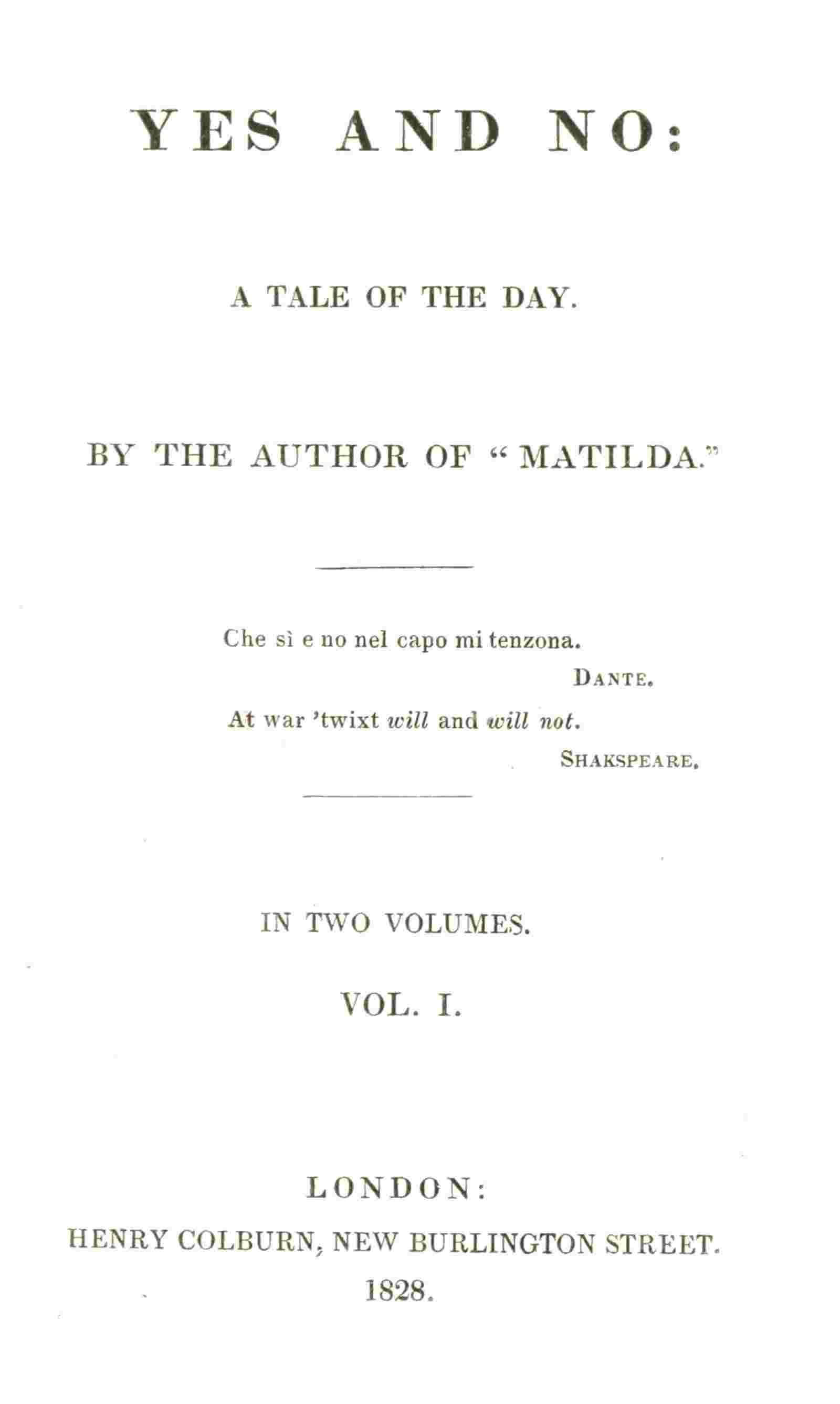
Shakspeare.
“And bring wax candles,” said the tallest and apparently the youngest of the two travellers, who had just alighted from that almost obsolete mode of conveyance, a hack post-chaise, at the door of a small but celebrated country inn, on one of the great posting roads of England.
There was nothing in the mode of this arrival which had called for particular care of the new comers from any of the busy inmates of the inn, nor had it therefore broken in upon their regular routine of bustling inattention.
One of the travellers had thrown himself upon a most uninviting sofa, and if his present position could for a moment have been mistaken for repose, it afforded the most conclusive evidence of the dislocating discomforts of the hack chaise, after which it was considered a welcome change.
His companion, (the tall gentleman mentioned above,) continued pacing the small apartment to stretch his legs, an unnecessary task, as, compass-like, two strides measured its limits backwards and forwards.
Upon the next appearance of a waiter, loaded with writing-boxes, dressing-cases, &c., he repeated his former order in a more authoritative tone—“Take away these,” (with a contemptuous intonation,) “and bring wax candles.” This order evidently excited the attention of the waiter towards him who gave it; the idea of a hack post-chaise being generally connected in the mind of the knight of the napkin with such gregarious animals as little boys going to school with a single guinea for pocket-money, or briefless barristers going the circuit without the remotest hope even of that single guinea. Hastening to execute the first part of the command, the scrutiny which he still continued of him from whom he received it, prevented that perpendicular precision which could alone render the removal of the culprit “mutton-fats” perfectly inoffensive. And “Boots,” laden with portmanteaus and travelling-bags, meeting them on the threshold of the door, the gentle zephyrs by which he was accompanied, caused their sudden extinction, and carried back their odour as far as the upturned nostrils of the gentleman on the sofa, who had hitherto taken no part in the arrangement.
“So like you, Germain!” he exclaimed, as he started up.
“What’s like me,” replied the other, laughing, “an awkward waiter, or a nasty smell?”
“No—that restless vanity which gives you such an unhealthy craving for the good word of all alike who cross your path, however unimportant or worthless their opinion may be. You could not bear that even in an inn, you should be confounded with the common herd, and were impatient to buy distinction at the price of a pair of wax candles. This is what is so like you—‘seeking the bubble reputation even in a waiter’s mouth.’”
This tirade was borne by the other with an imperturbable placidity, which habitual experience of the like must have joined with constitutional good-humour to produce.
“My dear Oakley,” he replied, “do for once drop the cynic this last night; remember, though constant fellowship has given you the right to say whatever you please to me, that our complete separation is about to take away your power of doing so—and I would fain hope that some little regret at what the future will deprive you of, might soften the exercise of the privilege the past has given you.”
He paused a moment; and Oakley, who really liked him better than any one else in the world, seeming silenced by this appeal, and not showing any inclination to resume his attack, Germain continued:—
“Besides, I really don’t see how the no very uncommon peculiarity of preferring wax candles to tallow, should subject one to have one’s whole character dissected.”
“Germain,” resumed Oakley, quietly, but almost solemnly, “you have alluded to our long fellowship through boyhood and youth: you are right in having done so, for the kindly feelings which that has ripened, will, I trust, long survive our present separation; when, had it been the kindred ties of cousinship alone which coupled our names, the black coat on the back of the one, for the death of the other, would probably have first reminded the survivor that the deceased had ever existed. For as different as our characters, are likely to be our pursuits. Indeed, so strange to me seem all professions of regard, that I may as well resume a tone of reproof, or you will already be unable to recognise your old friend. But call it by what name you like, it is sincere regard for you which induces me to tell you, once again, Germain, that you have a most unhappy facility of character which will lead you to spend your fortune in acquiring things you don’t want, and waste your time in doing things you don’t like; and that, in over anxiety for other people’s approbation, you will soon forfeit your own.”
“However I may feel convinced I am in the right, I never could get the better of the argument with you: perhaps that very quality which you call facility, (meaning weakness,) and which I call candour, predisposes me whilst I am listening to you, to acknowledge there is some truth in what you are saying, and your firmness of character which some might mistake for obstinacy, prevents your ever yielding a tittle. But I will put it fairly to you, whether any one would have supposed the sentiments you have just uttered, to be those of a young man of one-and-twenty, and whether you think it was any advantage at that age to have acquired the character you did last month at Paris, where, as we were always seen together, they compared us to English summer weather. I was the smiling sunshiny morning, and you were the cold cloudy evening that followed.”
“There,” interrupted Oakley, “that is what I complain of: it is never your own opinion upon any subject. What people said at Paris you repeat. But that can make no impression upon me, though it is all in confirmation of my argument that it does but too much upon you.” And as he said this, he began stirring the fire violently, perhaps instinctively, at the mention of an English summer’s evening, for it was the 10th of August, and the weather was truly national.
“There,” said Germain, “as you have interrupted me, I must interrupt you. Look! you have put out the fire with your violence; that is what I complain that you do in society, which you enter, as stiff and as cold as a poker, and attempt to carry all by storm. Now I should have insinuated myself gently, and have soon been received with reviving warmth, and partaken of its influence. Much as you know, you have yet to learn the magic of manner.”
“The gilding that makes falsehood and folly pass current,” muttered Oakley, as the entrance of the landlady herself with the first dish prevented further reply. This unusual condescension on the part of the portly dame towards travellers in a chatter-box, (as a post-chaise is denominated by its familiars,) was entirely produced by that order of Germain’s which had originated the late discussion between himself and his friend. They had at first been considered as common-place guests, every-day sort of customers, but the wax candles threw a new light upon their characters; and as soon as it was promulgated in the bar that the gentlemen in “the Sun” had asked for wax lights, then the possibility that they might be greater men than had been at first supposed, seemed to break at once on the whole establishment. The landlady, even at the sacrifice of her papillottes, prepared to head the enlivening procession. The landlord looked out for one of the illegitimate offspring, born of the clandestine connexion of sloe-juice and raspberry vinegar, in hopes that claret would next be asked for, and the waiter prepared to throw away a random shot or two of “my Lord,” and “your Lordship,” which he thought could do no harm, whether they hit the right mark or not. The visits of the landlord and landlady were “few and far between,” and could not be felt as interruptions, but the waiter seemed determined, if possible, to gratify his curiosity at the expense of the patience of its objects. Nothing could get him out of the room.
In the mean time, our travellers found occupation enough before them to prevent their unbroken silence from being irksome. But when in despair at their taciturnity, the waiter at length took his leave, Germain broke out.
“It may be your taste to go through life as if every man’s hand was against you, and yours equally against every man; but I don’t see how it can ever be a reproach to any one to be able hereafter to say, ‘I have bought golden opinions from all sorts of people.’”
“What an accidentally apt quotation!” retorted Oakley. “You may well say ‘golden’ opinions, for yours are bought, and that with gold. It is such golden opinions that will continue to procure for you attachment like that of Mademoiselle Zephyrine, friendship like that of Monsieur Partout.”
Towards the conclusion of Oakley’s last sentence, the waiter had returned with a second instalment of mutton-chops, followed by an assistant with the reserve of mashed potatoes.
“Hush—hush!” interrupted Germain, who had particular reasons for not wishing the point last mentioned to be argued in open court.
The fact alluded to was this:—Every one knows that there is always a “rage” at Paris, and this—be it hero or man-monkey—book or bonnet—singer or monster—supersedes in its ephemeral existence every other object of attraction. This rage of the moment when Germain first went to Paris was Mademoiselle Zephyrine, première danseuse at the Grand Opéra. The list of her admirers comprised all, and every degree. As was once said or sung by a witty friend of mine of a celebrated English actress,
It was absolutely necessary for every one who had any pretensions to taste, to be to a certain point in love with her; but Germain, who was always very susceptible, passed this certain point, and committed, accordingly, manifold follies.
At this time, however, a useful and ornamental acquaintance of his, Monsieur Partout, came to his assistance. This convenient friend had previously endeavoured to initiate him into the mysteries of the Salon, at appreciating the charms of which he had found him rather slow, and he now came to communicate the pleasing intelligence that Zephyrine admired his “maintien” and “air noble,” that she had quite a sentiment for him, in short, that she preferred him decidedly to all her other admirers. It never occurred to Germain that any part of that decided preference could be at all attributed to the very handsome settlement obscurely hinted at by Partout, and immediately executed by him; till the illusion was dispersed by hearing, one fine morning, that this fidus Achates, this faithful friend, had gone bodkin between settlement and sentiment in a chaise de poste on a provincial professional trip to Bordeaux. His vanity had been deeply wounded by the ridicule of the whole transaction—it had hastened his departure from Paris, and any allusion to it was still disagreeable.
Oakley and Germain had been (as indeed they have stated for themselves) educated almost like brothers. They were both orphans, and related on the female side, their mothers having been sisters. Germain had inherited an ample, if not splendid, paternal property. Oakley had very great expectations from a maternal uncle; his mother (who had made an imprudent match) being the elder sister of the two. His present destination was to answer the first summons of his uncle to visit him. He and Germain had just returned from a continental tour, had dropped carriages and couriers at Calais, and it being the dead time of year in London, had passed through that smoky wilderness without stopping. Germain had resisted Oakley’s request that he would accompany him to their joint uncle, partly because the old gentleman, whom he had never seen, had the reputation of being a gloomy recluse, and no one had a more instinctive horror than Germain of putting himself in a situation to be bored; and partly because he could not bear the appearance of interfering with what had always been considered as Oakley’s expectations in that quarter: and as the character of this unknown uncle was notoriously capricious, there was no telling what fancies he might take if his two nephews presented themselves together.
Germain’s present intention therefore was to take the opportunity of paying a visit to an old private tutor of his, Mr. Dormer, who lived at a pretty pastoral parsonage, about fifty miles from the spot where he and his friend were about to separate.
It was with this person, and at this parsonage, that he had passed almost the only period during his education, that he had been divided from Oakley. For when they both left school, he not being considered steady enough to be trusted at college so soon as his friend, had therefore been sent to this intermediate purgatory, as at the time he called it—yet afterwards, he found his time pass pleasantly enough there; and whilst he gave to Oakley, as a reason for his visit, that “it was a proper attention to the best old fellow in the world,” there came into his calculations of the expediency of it, certain recollections of one Fanny Dormer, whose unbounded admiration of him, during his stay there, had been by no means unwelcome, and had called for a return in kind from him. In short, when he went away, he had felt as if actually in love—and though the time that had intervened, and other impressions which had interposed, had occasionally caused him a little to doubt, upon recollecting some of the boyish couplets in which he used to celebrate her charms, whether there might not be almost as much imagination in the facts, as poetry in the metre, yet the thought of seeing her again caused a pleasing sensation as he called to mind the cheerful eye, the fresh fair skin, and the frequent display of the most brilliantly white teeth in the world, which followed the ever-ready laugh at the worst of his jokes. And when the friends separated for the night, though the ample justice done to the late supper might have been supposed likely to make disagreeable impressions survive upon a restless pillow, yet it was upon the fancied form, not of Mademoiselle Zephyrine, but of Fanny Dormer, that his eyes closed, as he slowly dropped asleep.