
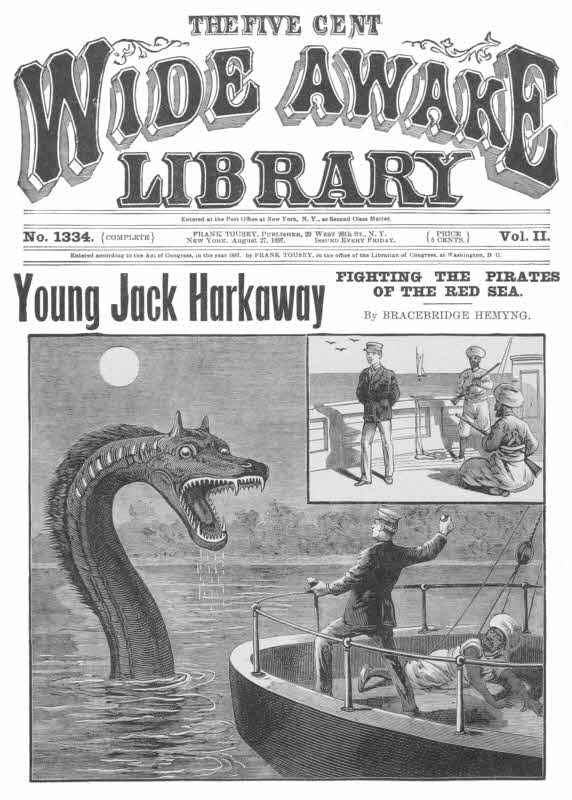
CHAPTER II.
ON THE RED SEA—THE DEEP SEA SNAKE—A DEADLY FIGHT.
“Hello!” cried Harry, sleepily; “what’s up now? Have they sighted the pirates?”
“Not yet, sah. She well ahead,” answered Kardofan. “It is something worse than that. Me tell you. The wind gone down. Sails flap against masts. In this bay where we are, there is a deep sea snake.”
“A sea serpent?” remarked Harry.
“Yes, sir. One of the wonders of Arabia. He comes up and pulls ships down.”
“Nonsense.”
“It is a fact, sah.”
“I won’t believe it,” Harry exclaimed, firmly.
“Jes’ you like, sah. I speakin’ de trufe,” rejoined Kardofan. “Him got a head an’ mouf like a ’pottomus, and a body, one—two hundred feet long.”
“I’d like to see this monster. If he’s good to eat we will have him for dinner.”
“Yah! Yah!”
“What you laughing at?”
“De snake more likely to eat you.”
“Will he?” asked Harry Girdwood, with a smile. “I am rather partial to eels. One rib of him, I suppose, would last a large family for a week.”
“Feed a village for de month, massa.”
“Have you seen him lately? My life is not insured; nor is the ship.”
“He’ll come up twice, jes’ ter have a look round.”
“What next?”
“De third time he hab the lot ob us. Draw us down. Swallow ship and all.”
“Can’t it be stopped?”
“White man may,” replied Kardofan; “Arab not able to do anything.”
“I will come on deck.”
Harry Girdwood followed the pilot up.
Often had he heard of sea serpents and Norway krakens, but he did not believe in their existence, although there was no reason why in any sea a huge eel might not exist and come occasionally to the surface.
There was also the octopus, the polypus, the squid with its long arms and its inky discharge.
The sea serpent, however, was a different kind of submarine reptile altogether.
If what Kardofan stated was true, there was some terrible danger in store for them.
It was moonlight.
The ship was lying idly in a small bay, not very far from Pilgrim’s Rest, where the pirate Koosh and his associates, with Young Jack Harkaway in their custody, were supposed to be hiding.
The crew were lounging about the deck; it was too warm to stay in the forecastle.
Some were lying down, others were sitting on bits of matting and smoking cheroots.
The captain and mate were below.
Harry Girdwood and Kardofan were alone on the after deck.
They had two purposes in view.
The first was to look out for the sea serpent, and the second was to rescue Young Jack Harkaway from the pirates of the Red Sea.
Harry had been experimenting lately in the construction of dynamite shells.
He had invented some of small size, but great explosive power, which could be carried in the coat pocket.
If the deep sea snake made its appearance he determined to use some of these shells upon it.
But this resolve he kept from his companion.
The latter was very voluble.
“Once,” he said, “a black serpent pull down a vessel and eat up thirteen men.”
“That must have been a long time ago,” Harry remarked, he being somewhat incredulous.
“Only last year. My brudder one ob de crew.”
The moon was nearly full.
It hung like a ball of polished silver in the Heavens.
All at once the sea became agitated; it broke into foam and a dark object rose to the surface.
This soon became clearly defined as to its outline.
It was a snake with an ugly head, the eyes being large and the mouth capacious.
It had two projecting horns and a long mane.
This enabled it to progress through the water, which it lashed with its sinuous tail.
The sea serpent, for such it was, made straight for the Flying Fish.
Kardofan was greatly astonished.
His agitation was shared by Harry.
“Look, massa!” cried the Arab. “What dis chile tell you? There is the debbil!”
“I see him.”
“He is coming straight for us. Allah be good! What shall we do?”
This was a question more easily put than answered.
The snake reared itself up, disclosing a double row of serrated teeth.
Kardofan crouched down in dismay, mingled with despair.
It was truly a terrible situation to be placed in.
Seizing the woodwork in its mouth, it tore a part of the ship’s bulwarks to splinters.
Its mane was erected, and its rage terrific to witness.
“By the beard of the prophet, we are done for!” observed Kardofan.
Harry Girdwood thought not.
He had a different opinion on the matter entirely.
The snake now bent its hideous visage toward Harry.
It really looked as if he was going to make one short, quick, sharp snap.
This would bite Harry’s head off.
Or he might swallow him whole, as the whale in the Bible did Jonah.
The cavernous jaws opened wide.
There was a hissing sound like a locomotive blowing off steam.
Now Harry saw his chance.
He was not slow in taking it.
Extracting two dynamite shells from his coat pocket, he cast them one after the other into the snake’s mouth.
“Now, you quit,” he said.
The result was immediate and tremendous.
In a moment the dynamite shells exploded, and the huge head of the sea serpent was blown to atoms.
It may be imagined that, however big a snake is, he is of no use without a head.
The long, thick body began to wriggle and twist, and turn and swirl in the sea.
“Vellee good, sahib,” cried the sailors.
Roused by the explosion they were all on their feet.
A spectacle of the decapitated sea serpent was extremely attractive to them.
A portion of its lower jaw bone had been cast on the deck near Harry.
He scrutinized it.
The teeth in the monster’s jaws were three inches long.
Mr. Mole and Monday arrived on the scene just in time to see the snake sink to the bottom.
“Golly, Mast’ Harry!” exclaimed Monday; “you kill the jabber-wock.”
“It is St. George and the Dragon over again,” remarked Mole, “although I always had my doubts respecting that legend or myth.”
He cleared his voice.
This was a sure sign that he was going to deliver a short lecture.
“Of course,” he continued, “every country has its folk lore. St. Patrick chased snakes out of Ireland, so they say, but as a matter of dry natural history fact, snakes never existed there.”
“Don’t be an iconoclast, sir, and do away with all our traditions,” said Harry.
“Wait a bit,” replied the professor; “let us go back to ancient Rome, glorious still in its ruins. The Rome of the Cæsars, the via sacra, the Colisseum of Horace, Virgil, Maecenas; not the Rome of to-day with its emasculated Corso, its——”
“Hark, back, sir,” interrupted Harry.
“Ah! yes. I was going to remark that Hercules performed a lot of extraordinary things. There was the clearing of the augean stable. That and other exploits started the Dragon and giant killing stories, but I will admit that you are a hero, because you have really slain this Ichthyosaurus beast.”
“It was not an easy thing to do,” said Harry, “but I happened to have some of my patent snake killers, and sent down his gullet a couple of dynamite scorchers, sir.”
“They do not seem to have agreed with his digestion.”
The last portion of the snake now foundered.
It went down like a shot or a stone.
“That is the funeral,” observed Harry. “I hope no member of the family will come to attend it.”
As a matter of course one snake cannot exist without another.
As one had been blown up, it was not fair to suppose that no others were at the bottom of the sea.
Their anxiety was relieved by the rising of the wind.
The sails which had been lying idle, began to fill up, and the Flying Fish forged ahead.
Night fell.
When the morning came, Harry was early on deck. He was afraid of Arabs. They are proverbially treacherous.
It was necessary to see what was going on all the time.
Kardofan was by his side as soon as he appeared.
He seldom let himself out of his sight for a moment.
“How far are we from ‘Pilgrim’s Rest’ now?” inquired Harry Girdwood.
“About twenty-five miles,” was the reply. “It is on the right hand side.”
They were steering near the land. Here and there was a glimpse of little villages, of the tall, graceful palm, and luxuriant vegetation.
In the distance, over the expanse of water to the left, they saw long lines of black smoke.
These came from steamers going to or coming from the Suez Canal.
That short cut of De Lesseps’ to the Mediterranean has made the Red Sea busy.
All at once they noticed a schooner, drifting and tossing on the waves.
Her sails were torn; there was no one at the helm.
All that could be seen were two men stretched out on the deck apparently dead.
“What do you make out of that?” inquired Harry.
“Dat’s de pirates, sah. Koosh, Kassala and the Catamaran been here sure.”
“Do they attack little ships like that?”
“Sometimes small vessels carry more money than big ones. This one been carrying fruit. Plenty money in that kind of business.”
Harry reflected.
He had asked a foolish question. As a matter of course the pirates would fly at small game.
Of what benefit would it be to them to attack ocean going steamers like those of the Orient Line, or the splendid Peninsular and Oriental?
The P. and O. boats could laugh at a pirate unless he came ironclad.
Harry ordered a boat to be lowered. It was rowed by two men. Kardofan was with it.
The sea being delightfully calm and restful, there was no difficulty in making the derelict.
They climbed on board.
Blood stained the deck in every direction. It splashed the masts; it was everywhere.
One of the two men lived—let us say breathed, for it was not much more.
He had a wound in his throat from a kreese, which is a worse weapon to be struck with than a machete.
“What has happened to you, my poor fellow?” inquired Harry, kindly.
The man looked up with lack luster eyes.
“We were seven men all told. This morning I am the only one left.”
“Who did it?”
“The pirates of the Red Sea. I had disposed of a cargo of fruit at Pilgrim’s Rest. The money was paid and on board. I sailed to get some more merchandise.”
“You were overhauled?”
“That’s it, sahib, exactly. By Allah, you have said it! Pearls of wisdom fall from your lips.”
“You flatter me, and I don’t care for that kind of thing. It may interest you, but it does not me, I can assure you; but if there is anything I can do to help you in your desperate situation, rely on me.”
“Sahib,” replied the skipper, in a melancholy tone, “you can do nothing to aid me; my race is run.”
“Poor fellow! Do you know the pirates who robbed your ship and killed your crew, wounding you to death?”
The man paused a moment.
It seemed as if he could not collect his senses in a hurry.
“Yes, yes!” he murmured. “It was Koosh.”
“I have heard of him.”
“He is the curse of the Red Sea from Aden to Suez. Everyone will tell you that.”
“You are not far wrong.”
“Am I a fool? Call me a liar!”
“Not for an instant,” replied Harry. “You have an ugly hole in your neck and you are bleeding too fast,” said Harry.
“That is true enough.”
“I will tie you up, and you shall have your wished-for revenge on Koosh.”
“Will you promise me that?”
The wounded trader looked up eagerly, his pale face being full of subdued energy.
Harry had a slight knowledge of surgery. He had been in an ambulance corps and knew how to give first aid to the wounded, which was something.
Going below he procured a sheet from a berth and tore it into bandages.
The wound was bound up, but the Arab was too far gone to recover.
A slight stimulant revived him for a time.
It was only a brief, fleeting space, however.
His last hour had come.
And he knew it.
“The pirates,” he murmured, “have a white man on board.”
“It must be Young Jack,” said Harry.
“I know not his name.”
“What about him?”
“They are going to kill him if he does not give them a certain sum of money. I heard all about it.”
“Will he do it?”
“He is temporizing; he expects friends to come to his rescue shortly.”
“That is I and my party.”
“In addition to that,” said the trader, “I heard that Koosh, the pirate, is becoming more daring than ever.”
“What is he going to do now?”
“The Benares, a large steamer, is coming to Pilgrim’s Rest. He intends to be her destroyer, but he cannot do anything except by a subterfuge.”
“A villainous trick.”
“Precisely.”
“When is she expected to arrive?”
“To-night some time,” replied the Arab. “The Benares is to be wrecked.”
“Where?”
“A few miles up the coast, above the ‘Rest;’ false lights will decoy her.”
“Bring her on the rocks?” asked Harry.
“Yes, she will become a perfect wreck; all on board will be drowned, and the pirates will do what they like with the cargo and treasure.”
“A good scheme if they can push it along, but if I can see the Benares I will stop it.”
The Arab was gradually but surely sinking.
Again Harry put a small flask to his lips and administered some brandy.
But it did him no good.
“He is dying fast,” remarked Kardofan, looking at his glazed eyes.
“Yes,” replied Harry; “he is going to the unknown land from which there is no return ticket.”
“We all got to go there some day, sahib.”
“That is a well-known fact, but we don’t want to hurry about the last journey.”
“Koosh is a bad man; so is his lieutenant, Kassala. Me like to make them both gasp.”
“Their time will come.”
“The sooner the better!”
It was not long before the unfortunate Arab expired.
Harry and Kardofan got into their boat and returned to the Flying Fish.
The trading vessel was a derelict on the broad bosom of the ocean.
It was a proof of what injury one section of humanity can do to another.
Sad, sad! The millennium and the federation of the world is yet far off.
The wind fell, a mist arose, and the vessel was becalmed, the air being full of enervating moisture.
Lunch was served, but no one had any appetite. A biscuit and a glass of claret was enough.
Clara declared that she could exist on a rose leaf or a violet.
Mr. Mole was, as the French say, “between two wines,” his thirst was always insatiable, and the heat of the Red Sea intensified it.
Monday was in high spirits.
He came from a hot climate, and the warmer it was the more he liked it.
“I think I will go on deck,” said the professor; “the balmy breeze of ocean will revive me.”
“You won’t find any wind, sir,” replied Harry; “all is fog and calm.”
“I am under the weather.”
He rose and stumbled, his wooden leg gave way, and he measured his length on the floor.
“Confound it,” he exclaimed. “It is a funny thing you should tell me there is no wind.”
“Indeed there is not a capful.”
“The ship is rolling; if not, why did I fall down?”
“That is best known to yourself. The sea is like a mill pond.”
“Don’t tell me. I know better. Monday!”
“Yes, sah.”
“You black thief, help me into my berth. I will lie down until the storm is over.”
“Best stay where you are, sah. Berry comfortable as you are.”
“Imp of Etna, ghoul of Vesuvius, forbear. If you insult me, I’ll—I’ll spiflicate you.”
“What that, Massa Mole?”
“Knock you into smithereens.”
“Me take your wooden leg, sah, and baste the bear with it.”
“Rather give me some ice to cool my head. These storms always affect me.”
“Ice am a luxury in dese parts where it nebber freezes. Wrap a wet towel round um head.”
“Do that and I will forgive you.”
Monday lifted him up, sat the old man in a chair, and applied a wet towel to his cranium.
“Now um gentleman enjoy him dear self,” he remarked. “Massa Mole always like himself. Yah! yah! Well, there’s on’y one ob him—why shouldn’t he do it?”
Clara and Harry began to talk about the prospect of finding Jack.
“This calm and fog is very annoying,” said Clara. “How long will it last?”
“That is impossible to tell,” answered Harry. “I have been told that in the Red Sea and Indian Ocean they last for days, even weeks.”
“Not an encouraging prospect.”
“No; it may be a long time before we reach Pilgrim’s Rest.”
“Poor Jack! What can we do for him?”
“He can buy himself off. The letter he sent proves that. Kassala betrayed him to Koosh.”
“Then they have no grudge against him?”
“None whatever. It is simply a money making game on the part of Koosh and Kassala, though Hunston may turn up later on.”
“It is wrong to wish anybody dead—but that man—how I hate him!”
“He is a bad egg, yet we have to regard him as a mono-maniac.”
“You mean he is not quite right.”
“Most decidedly. He is off his balance.”
“I always thought so.”
“There is no doubt of it.”
Suddenly Kardofan entered the cabin, wearing a troubled expression.
“Anything wrong?” asked Harry.
“Yes, sahib, considerably so. The mist very thick. Can’t see your hand before your face. Call your lady friend, and look out.”
Clara had sunk to sleep again in a rocker.
In a moment Harry roused her.
“What is it?” she asked, with a weary air.
“Danger,” he replied.
She was on her feet in a moment. So was Monday. So was Mole.
“I hear the beat of engines in the distance,” continued Kardofan.
His hearing was very acute.
Not the slightest sound ever escaped him.
“Is it a steamer approaching?” inquired Harry.
“Yes, sahib, and a big one, too.”
This was a serious announcement.
In such a dense fog nothing could be seen. It was useless to hang up lamps.
There was danger of a collision between the huge steamer and the little schooner.
Where would the Flying Fish be in such an emergency?
That was the question.
All hearts began to beat high.