
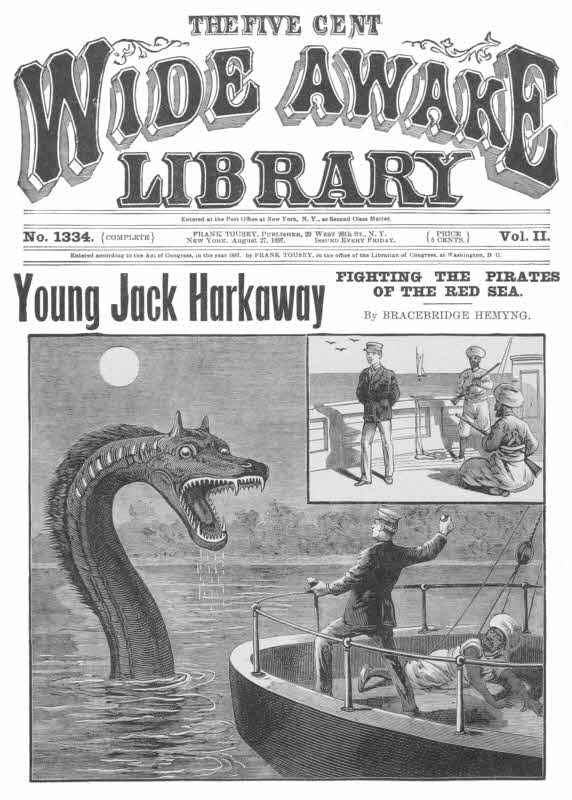
CHAPTER IV.
YOUNG JACK ESCAPES ONE DANGER ONLY TO FALL INTO ANOTHER.
Finding that Harry Girdwood made no response to his letter and did not come to his rescue, Young Jack resolved to make terms with Koosh and Kassala.
He would pay his ransom.
Liberty and freedom of action was what he wanted.
He was tired of being kept a prisoner on board the pirate craft, Catamaran, lying off the little town of Pilgrim’s Rest.
Not for a moment did he blame Harry for lukewarmness.
His letter might have miscarried, or Harry had not been able to find him.
The situation was galling, and the suspense intense.
A day before the pirates made the attack upon the Orient Line steamer, Koosh sought an interview with his captive.
About a quarter of a mile from the low lying, palm clad shore, the Catamaran was anchored.
Everything looked calm and peaceful.
There were not more than a dozen houses in the town.
These were supplemented by a quantity of huts.
A straggling building, dignified with the name of the Calabar Hotel, stood near the shore.
It was kept by a Frenchman, named Pierre Leronge, who came from Marseilles.
In him was a mixture of French and Italian blood.
He had been a desperado in his time, having to fly from his country.
As a criminal he had an extensive record.
Where he had settled down, being a deserter from a ship, the inhabitants were afraid of him.
Pierre Leronge was a noted man and a character not to be despised.
In addition to his caravanserai he had a large general store.
Natives from the interior did a large trade with him, and at least twice a month ships called and brought him supplies from Suez.
Jack had a note-book and a pencil.
When Koosh came in to his cabin he was writing. Behind the pirate chief was Kassala.
These two always worked together.
“What is it to be?” asked the pirate; “life or death? You find that your case is hopeless.”
“How much do you want for my release?” Young Jack inquired.
The pirate mentioned a sum in an Arabic currency which amounted to one hundred thousand dollars.
This to Jack was only a flea bite.
He could give a check for the amount and not miss it at all.
His credit at a bank in Mecca was good for ten times the amount.
The pirates knew that.
He had only to put his signature to a piece of printed paper, and the money required would be paid on sight to bearer.
These were the instructions he gave with his letters of credit.
Identification was unnecessary.
He had made these arrangements because he fancied that he might want money when many miles away.
“I will give you half,” he said.
“No,” replied Koosh, firmly; “I cannot take less.”
“That or nothing!”
“By the beard of the prophet, that is my ultimatum!”
“All right; it is a deal.”
Koosh and Kassala smiled.
They had triumphed.
Providing him with pen and ink, he was compelled to sign a draft for the sum mentioned.
Both of them, who were well known in Mecca, witnessed it, and Kassala undertook to go to the city and get it cashed.
Koosh had other work to attend to.
The foremost with him was the wreck of the mail steamship.
What became of Harkaway he did not care.
A boat was lowered from the Catamaran, and Jack was rowed to the shore.
Glad indeed he was when he landed at Pilgrim’s Rest.
It was not the traveling season, and there were no people about except the residents.
The Hotel Calabar was empty.
Pierre Leronge, the landlord, was on the veranda, and received him cordially.
“Welcome, Effendi!” he exclaimed; “do you come from afar? Are you for Mecca, or do you stay long? A caravan starts to-morrow. Are you a merchant or simply a traveler? No matter. I will make you comfortable for a day or a month. Oui, by gar!”
“I am a traveler,” replied Jack, “and require accommodation at your hostelry for a time.”
“Very good. My charges reasonable. These Arabs who are orthodox Mahometans, do not drink, but I have a cellar of wine and spirits for Europeans.”
“Give me a bottle of champagne and fricassee a chicken!” exclaimed Jack. “Show me your dining-room and let me have some cigars.”
“You shall have everything, Milor, except the daily paper, which is a thing we do not indulge in here.”
“You may arrive at that some day when you have railroads, tram cars and the electric light.”
“Ah, sapristi, we have flying machines before those things come here.”
Jack was ushered into a large room, facing the sea, and was provided with what he required.
“How is trade? Sit down and join me,” said he.
“With much pleasure; trade is bad. Sacre, the plague is about.”
“That keeps the pilgrims away.”
“Certain. Ah! they are a bad lot to entertain. I do not like them at all, but”—he shrugged his shoulders—“I am here, and what am I to do!”
“Do the Arabs trouble you?”
“Not at all,” answered Leronge. “They are peaceable, so are the pilgrims. When they come, little money I get out of them. Poor—live on rice and lobscouth, which is a kind of Bouilabaise, which we have at Marseilles. Those I am afraid of are the pirates, but you know them.”
He looked at Jack suspiciously.
The “Catamaran” was well known to him.
He had seen Young Jack landed from it.
“My acquaintance with them has been an expensive one,” replied Jack.
“Ah! Do you not belong to them?”
“Far from it.”
“Mon ami, will you tell me your story?”
“With pleasure,” said Jack.
He related all that had happened to him, and Leronge sympathized with him.
“Monsieur,” he exclaimed, earnestly, “you have had a bitter experience and a narrow escape. These sacre pirates of the Red Sea are capable of any villainy. I should like to have you as a guest for weeks—months—years, but though it will be my loss, I advise you strongly to get away.”
“I do not know where to go.”
“Have you friends in Mecca?”
“Yes, but they are possibly on the sea searching for me.”
“You are puzzled.”
“Dreadfully so. I cannot make up my mind how to act.”
“The pirates will get your money and capture you again to obtain more if you stay here.”
“Will you help me?”
“Mon Dieu, what can I do? They burn my house to the ground.”
“The pirates are not numerous. Cannot we hire some Arabs to fight and form a garrison?”
Pierre Leronge considered.
“Yes,” he said, at length, “that could be done.”
“I will pay you well for it.”
In an inside pocket of his coat Jack had a quantity of money.
The pirates had not robbed him because they had no idea that he had any money about him.
He put the whole of it in the hands of Leronge.
“That is for you,” he observed.
“Ver good,” replied the Frenchman, fully satisfied. “I will hire twenty Arabs; they shall bring their rifles with them. I have plenty of cartridges.”
“Then we shall be safe.”
“Maybe killed, but ma foi, got to die some day.”
“That is so.”
“Still, Sainte Marie, we do not want to go to the next world too soon.”
The engagement of the Arabs was arranged.
Leronge went away to see about it.
At that moment Jack, who was looking out of the window, saw two travel-stained travelers approaching the Hotel Calabar.
He altered a cry of delight.
They were Harry Girdwood and Monday.
Here was a glad surprise.
Harry ran forward over the sand, and cried: “Hello, Jack, old sport! How are you?”
“First-rate. Welcome!” was the reply.
“Are you free?”
“Yes, but it has cost me a pretty penny. Did not you get my letter?”
“Certainly.”
“Why did you not come before?”
“I could not.”
“You would have saved me some expense.”
“Circumstances over which I had no control prevented me,” replied Harry.
“If I keep on getting captured, and paying ransom, I shall be ruined in time.”
“It will be a long while first, you old miser. Aren’t you rich enough?”
“Can’t grumble,” said Young Jack.
“If you get plugged by a bullet or have your throat cut what good will your bullion do you?”
“That’s a problem. I might exist in the future on the memory of it!”
“Massa Jack!” exclaimed Monday, coming up breathless and panting. “How you was to-morrow?”
“To-day you mean.”
“All de same, sah.”
“How is my wife?” inquired Jack, anxiously.
“She berry well; so Massa Mole, considering all that has happen us.”
“Come right inside. Eat, drink and make merry——”
“Don’t finish the biblical quotation—you know what it is,” said Harry.
“For to-morrow we die,” supplemented Jack; “don’t be a death’s head at the banquet. I did not mean to suggest that, although in this country we never know from one day to the other what is going to occur.”
Harry and Monday joined him, sitting down and partaking of some refreshment.
There was a splendid view of the sea, and here and there were the waving palms.
“Not a bad crib, this,” said Harry, drinking a glass of wine and eating some cold chicken.
“Berry good tack,” remarked Monday, filling his capacious mouth.
“When you ravenous beings have finished eating,” answered Jack, “perhaps you will have the kindness to relate your adventures.”
“We have had an odyssey,” exclaimed Harry; “Ulysses could scarcely beat it, nor Jason, when he went in search of the Golden Fleece.”
“That is interesting; let me hear your story.”
In a few words Harry Girdwood related his experiences, winding up with the terrible scene on board the P. & O. steamship.
Jack seemed to hear the savage whoops of the pirates, and to see the brave men fighting for life on board the unfortunate vessel.
“By Jove! You have had a lucky get out,” replied Jack; “but why did you not bring Clara and old Mole on with you?”
“We started out to explore.”
“That’s so, sah. How we know where we comin’ to? Had to leab Missy Clara and ole Mole with the rest of the saved.”
“Have you got a camp?”
“Not up to much, sah. The people from the ship stop dar ’cos they don’t know where to go. All starve soon.”
“But my wife and Mole must be brought on here.”
“Me go and get ’em,” said Monday. “I won’t let the others know where we are coming. There would be a rush and they eat the place up.”
“That is all very well, but as Christians we can’t allow them to starve.”
Monday said nothing.
“The passengers will be surrounded by Arabs soon,” exclaimed Harry.
“What then?”
“They will rob them of all they possess, which is not much. Some money—some jewelry—and then they will somehow come on here.”
“Do you think so?”
“There is another way to look at it—Koosh and his pirates may kill the lot.”
“If a holocaust like that is threatened,” said Jack, “the spot in a very short time will become a golgotha, or place of skulls. I must go with you, Monday.”
“No pressure, sah.”
“Yes, yes; she needs me and wants my help.”
“You trust me,” answered Monday. “I always do my duty by you, sah. Me bring Missy Clara to you mighty quick, and tote de old man Mole along too, wooden leg and all.”
“It wouldn’t be well for you if he heard you talk.”
“Who care for him?”
“Well, cut along,” replied Jack. “Hurry up! I have never found you fail me yet, Monday, and we have known one another for some time.”
“Always the same old reliable.”
“I am depending on you for something I hold dearer than my life.”
“Dat all right, sah!” said Monday, putting on his hat and walking off with the air of a cotton planter.
He had gone to bring back Clara and Mole.
Would he succeed?
Who could tell?
It all depended upon his getting back to the palm grove before the pirates could do any bloodthirsty work.
He knew well of what they were capable.
Koosh and Kassala would stick at nothing.
Leaving Young Jack and Harry Girdwood together, the faithful Monday started on his errand.
Though getting older, and falling into the sere and yellow leaf—shall we say blacker—he had plenty of energy left in him.
The distance he had to go was not very trying, being only a few miles.
When he got near the camp he heard the sound of firing.
This was followed by shrieks and groans.
Right in front of him was the palm grove where those who had survived the wreck had located themselves.
On the left was the sea.
The remains of the Peninsular and Oriental Company’s vessel were visible above the rock on which she had stranded.
But there was not a sign of life on her.
Yes—we make a slight mistake.
The captain, Mr. Nares, had a favorite collie dog.
This animal could be seen on the deck.
A faint bark could be heard at intervals as the wind blew towards the shore.
The dog was alone.
It is well known that a dog is a man’s friend, and hates a solitary existence.
As a matter of fact, animals like human beings, are gregarious.
Sometimes you may find a rogue elephant or a solitary buffalo living alone.
Why?
Simply because through their viciousness they have been driven from the herd.
Monday hid behind a clump of bushes.
He was afraid.
Something terrible was going on.
What it was he did not know and could only conjecture.
Scarcely had he hidden himself than two people came right into his shelter.
They were, to his utter astonishment, Mrs. Harkaway and Mr. Mole.
Their countenances were indicative of great fright and alarm.
Clara came in first and crouched down like a startled fawn.
Mole stumped in a few moments later on his wooden appendage.
“Oh! Monday, my dear, good fellow!” said Clara, in a low voice.
“What de matter, Missy?” asked Monday.
“The pirates are massacring all the passengers who escaped the wreck!”
“How did you get away?”
“Entirely through Mr. Mole’s sagacity. He saw Koosh and his bloodthirsty tigers approaching. With commendable alacrity he advised me to fly with him. We did so, little thinking that we should come in contact with you in the cane brake.”
“I’se pretty near eberywhere when there’s anything goin’ on, Missy,” replied Monday.
“Have you seen anything of Jack?” asked Clara.
“Yes, ma’am, he up side ob de country, lilly way, at hotel called ‘Calabar,’ at Pilgrim’s Rest. Harry with him, and eberyting comfortable. He got release from pirates by paying out money.”
“That is good.”
“You glad to hear that?”
“Yes, my good old friend. I have been worried nearly to death about him.”
“He was awful mad to come along and find you, but I tell him I do the biz.”
“It is very kind of you, Monday, and I appreciate the situation.”
“Lie low, ma’am, don’t move; don’t say a word above a whisper.”
“Why not?”
“The pirates find us.”
“Do you think they will attack Jack again!”
“Certain, sure, if they get half a chance.”
“I will help fight them.”
“No occasion for that, ma’am; he engage Arabs to defend the hotel. We got a garrison.”
Mr. Mole lifted his hand.
“I shall be there, too,” he said, “and that is what will knock the persimmons!”
“Go ’long,” replied Monday. “You nebber see a persimmon in your life!”
“What a pity.”
“Whar you been?”
“In Virginia, Alabama and the Carolinas, you silly coon!”
“Gimme a rest, sah!”
“What do you know, boy? Keep your place. Respect your superiors.”
“Dis chile nebber found any yet!”
“You’ve a high opinion of yourself.”
“Got a right to hab! Me, one time, Prince of Limbi, sah!”
“Imp of darkness now and a castaway in Arabia! That is what you are!”
“You mean that?”
“Take it straight.”
It seemed as if there was going to be a fall out between Mole and Monday.
They had forgotten their threatening surroundings.
At this moment some shots whistled over their heads.
Both were silent.
They crouched down in the thick brush and high growing grass.
It was not a novel experience.
At the same time it was very trying.
“Not a word,” said Mole, under his breath.
“Not a move,” whispered Monday.
Clara was lying like a log under an acacia tree.
She scarcely dared to breathe.
Koosh and Kassala, with their attendant pirates, were indulging in a wholesale massacre of the passengers.
After robbing them they killed them.
Shot down like rabbits they were.
In a little while the shots and cries ceased. Not a sound was to be heard.
It was the eternal silence of the tomb.
Monday climbed up a tree.
He was good at that.
Old as he was, he could shin up a palm as well as a youngster.
What did he see?
To begin with, a heap of dead bodies scattered about in every direction.
Secondly, the wreck of the P. & O. steamer, set on fire.
It was burning to the water’s edge.
Thirdly, the cowardly, dastardly pirates going in two boats to the Catamaran.
They had done their foul and deadly work.
Their next move was a mystery.
It was not likely that they would leave the neighborhood for some time.
The draft on the bank at Mecca, given by Young Jack, had to be cashed.
It would take the messenger some while to go there and back.
There was danger at every turn for Jack.
Monday descended from the tree.
“It am all ober,” he said; “the pirates kill everybody, then they go to their ship. Now we skip jes’ soon as you are ready.”
“Good boy,” replied Mole. “We’re on the job; lead the way.”
“You tired, sah, ob shipwreck and pirates?”
“I’ve had a genteel sufficiency. Young Jack leads us into something. I wonder what the next fake will be.”
Monday looked out of the cane brake.
The line of country was clear.
They felt a great sense of relief because they were safe, but it was melancholy to contemplate the sacrifice of life.
Those poor wretches who had escaped from the wreck of the ship, and thought they might be happy and ultimately reach their destination, had been robbed and killed by the pirates.
Out of the whole crowd only Mole and Clara had escaped.
It was too sad to contemplate.
The pirates had gained their ship.
Sail was set and she proceeded along the coast.
What her destination was no one could tell.
That remained to be discovered.
Feeling that the danger was over, Monday suggested a move, and the three walked on.
After all the excitement and worry it was a weary tramp to Pilgrim’s Rest.
Very glad indeed were they to reach the Hotel Calabar.
Clara was faint and exhausted.
Her feet were sore and blistered; her face was burnt by the sun as were her hands.
She fairly tottered as Jack, seeing her from the window, advanced to meet her and caught her in his arms.
Tenderly he carried her into a private room which Leronge dignified with the name of the ladies’ parlor.
He placed her on a couch, gave her wine and sweetmeats and indulged in sweet converse.
They had been separated for some time, and at one time it seemed as if they were fated never to meet again.
There were a quantity of sea birds flitting about the shore.
Being of a restless disposition and fond of killing something—we may say anything, from a rhinoceros to a gull—Harry had gone out with his revolver.
Mole and Monday sat down on a divan in the dining-room and slaked their thirst.
“This is O. K., sah,” said Monday. “Now we’s enjoyin’ de benefits ob de higher civilization.”
“And I am putting up for the champagne,” replied Mole. “You’re a mean cuss, Monday.”
“What for?”
“You never pay for anything. I call you a confounded white haired old sponge!”
“What’s de use ob paying when I travel with a capitalist like you?”
“You’ve got money, you black thief! It’s your principal I complain of!”
“If you call me out of my name, Massa Mole, again, dis chile fire um glass at you!”
“I dare you to do it!”
Mole glared at him.
Unabashed at his threatening demeanor, Monday hurled his glass at the professor’s head.
With the utmost celerity Mole ducked.
The glass flew across the room and struck a man who had just entered.
It made a cut on his right cheek, and the blood began to flow slightly.
“Hello!” he cried, “two can play at that game! If you want a row, directly you see me you can have it!”
They looked at the intruder.
It was Hunston.
“You here?” exclaimed Mole.
“I guess I have as much right in the hotel as you. It’s open to the public of all nations.”
“We can do without your company.”
“I have no wish to interfere with you. All I ask is to be let alone.”
“Keep yourself to yourself!”
“Did I attack you?” asked Hunston.
“No; certainly not.”
“Why, then, did you show hostility by throwing a glass at me directly I made my appearance?”
“We are a family party, and you are no friend of the family,” replied Mole. “Yet what you speak about was an accident entirely.”
“How is that?”
“Monday and I were having a few words.”
“As per usual.”
“That is no particular business of yours that I know of.”
“Well, go on. I’ll listen, though I know you to be a lying old bum.”
“Thank you. I take your insults as compliments. What I was about to remark is this. Monday threw the glass at me. He missed. You entered and received the benefit of the doubt.”
“Look here, Mole; you and I know one another. I don’t believe a word of your story.”
“Why not?”
“It was a deliberate attack on me. If you want to quarrel I am good and ready.”
Monday rose.
His black blood was up to the boiling point.
“What for you want to interfere with us?” he demanded. “Wherever we go you follow. That am not right.”
“I go where I please.”
“You shall not.”
“Do you think I am obliged to ask a black swab like you!” cried Hunston.
“Keep out of our way.”
“Never until my revenge is gratified.”
“Dis chile give it you in the neck.”
Saying this, Monday drew a long dangerous-looking knife and brandished it.
The weapon flashed in the fierce sun-light.
“Clear out of here,” he yelled. “You don’t stay in this hotel long, sah.”
“Do you run it?” asked Hunston with a sneer.
“I’ll stab you sure.”
“Will you?”
Huston produced his revolver.
“Take care of yourself,” he said. “I’ve got you covered; back or you are a dead man.”
Mole came to the rescue.
He too flourished a revolver, which he presented at Hunston’s head.
“No, you don’t!” he cried. “I’m an old man, but I can hit a mark.”
Hunston hesitated.
“What you do to him, I will do to you,” continued Mole.
“Shoot if you dare.”
The odds were against Hunston.
If he killed Monday, it was certain that Mole would perforate him.
It was ignominious to retreat.
Yet he had to do so.
“I go,” he said, “but by Heaven, I will have your man Harkaway!”
At this juncture Young Jack appeared.
Clara had fallen asleep, and he had come out to see what was going on.
“Who is talking about me?” he demanded.
Huston was now between two fires.
“Ha!” Jack went on, “you have turned up like a bad penny. Have you any business with me?”
“The same as before,” was the calm, indifferent reply.
“Don’t you think it will be best for you to keep away from me altogether?”
“I shall please myself about that.”
“You ought to be tarred and feathered, finally skinned, have your flesh removed, and walk about in your bones.”
“Perhaps you think that very funny?”
“Not at all. It would be grim and real.”
Hunston carelessly lighted a cigar.
At the same time he kept a firm hold on his revolver.
“What do you think of the weather?” he asked.
“You will find it hot, if you don’t get away from here.”
“Not so sultry as the place I intend to send you to some of these days.”
“Don’t talk like a fool, man. Are you crazy?”
“Say, it runs in the family.”
“I have no doubt of it.”
With a sudden movement Jack snatched the revolver from his hand.
“What are you doing?” asked Hunston.
“Rendering you defenseless.”
“Coward!”
“Go away; we don’t want any bloodshed here,” answered Jack. “If you stay you may get hurt.”
Hunston gnashed his teeth.
He moved towards the door.
“You shall hear from me again,” he said, “and it will not be long, either.”
With these words he strode away.
They watched him go down to the beach.
A sailing ship had just anchored in the bay.
She hoisted a flag, on which was written in large letters, black on white—“Catamaran.”
It was the pirate ship.
Hunston waved his hand.
This was a signal.
In some mysterious way he was connected with the piratical crew.
A boat was instantly lowered.
It was rowed rapidly towards the shore.
When it arrived on the beach he stepped in, sat down in the stern sheets and shook hands with the coxswain.
This was Kassala.
The boat was immediately rowed back to the Catamaran.
Hunston went on board.
His movements had been closely watched by Jack, Mole and Monday.
“This means mischief,” remarked Jack, “for it shows distinctly that the rascal is hand and glove with the pirate band.”
“Without question,” replied Mole.
“It was a pity, Mast’ Jack, you did not give him de lead,” said Monday.
“It would only have brought trouble on us. These Arabs have a sheriff, a staff of police, and a prison. Crime is punished here as well as elsewhere.”
“You right, sah; didn’t think ob dat!”
Jack began to think deeply.
Leronge, the landlord of the Calabar, had promised to organize a defensive force.
In fact, he was engaged on that business now.
The situation was serious in the extreme.
He had missed the caravan, which had started for Mecca that morning.
There was nothing to keep him at Pilgrim’s Rest.
It was an abominable sandy, flat, stifling malarial spot, which had nothing to recommend it.
One thing he had ascertained.
A steamer from Aden to Suez would arrive in three days’ time.
They could embark on that and get to Egypt.
But during the interval what might not happen?
Hunston and Koosh made a formidable combination with Kassala thrown in.
Suppose they attacked the caravanserai?
This would complicate matters considerably.
There would be heavy fighting on both sides.
Which would come out victorious was problematical.
While Jack was deliberating, Harry Girdwood came in with Pierre Leronge.
Harry had shot several birds, but they were not good to eat, as they lived upon fish.
He had met Leronge on his way back.
“I see the pirate ship is in the bay,” exclaimed Leronge, “and her appearance justifies your apprehensions.”
“My enemy is on board,” replied Jack.
“Have you seen him?”
“Yes; and he threatened me.”
“The Catamaran has run up the black flag.”
“What does that mean?”
“Just this. Take care of yourselves. Look out!” answered the Frenchman.
“Have you hired the Arabs?”
“Twenty good men and true will be here to defend the hotel in an hour’s time.”
“Can you barricade the doors and windows?”
“That is impossible; the house is so large. I have nothing but wooden shutters.”
“What will you do?”
“When you get the Arabs,” said Leronge, “and Koosh lands with the pirates, you must lead them.”
“Then the battle must take place on the beach.”
“That is it exactly, monsieur.”
Jack saw what the Frenchman meant.
He didn’t want his hotel burned; nor did he intend to risk his life.
He had engaged some wild predatory Arabs for the fight and intended to do no more.
If he offended Koosh he might be afflicted with a terrible vengeance.
In his heart he devoutly wished that Harkaway had never come near him.
Still he hoped the pirates would be beaten, and then he would get the money promised him.
Koosh was nothing to his house.
When he and his wild followers came to the Calabar they ate and drank of the best.
For their accommodation and carousals they paid nothing.
It was to his interest to see them exterminated as soon as possible.
Therefore he supported Young Jack to the best of his ability and as far as he dared.
Dinner was served. It consisted of soup, fish, mutton cutlets, roast and boiled fowl, eggs, several kinds of vegetables and a salad.
Butter and cheese there was none. The climate was too warm for such things.
Every Frenchman is a born cook.
Therefore it need not be said that the dinner was well served in every respect.
The usual “naperie,” however, was absent. There was no tablecloth, and serviettes were conspicuous by their absence.
You cannot expect everything in Arabia.
Pilgrims to the shrine take nothing in the way of baggage with them.
They start in one suit of clothes, one set of under linen, and return home in the same.
Many weeks they are worn, and washing is not thought of.
The Moslem pilgrims are very religious, but at the same time the veracious historian must admit that they are extremely dirty.
A Hadji, after a journey to the holy shrine of the Prophet Mahomet, ought to live in a Turkish bath for at least forty-eight hours.
This duty he owes, not only to his wife and family, if he has one, but to society at large.
The pilgrim ought to adopt as his crest a flea rampant—or any other creeping thing—and have for his motto the Latin word “Oleo.”
This being interpreted gently implies “I am malodorous.”
When dinner was ended, Jack conducted Clara back to her room.
“If you hear anything do not be alarmed, darling,” he said.
“Do you expect any fighting?” she asked.
“I reckon we shall be attacked by the pirates.”
“But you have paid them.”
“If not I should not be a free man here.”
“What have you to dread?”
“Hunston is with them; they have hoisted the black flag, and we have everything to be afraid of.”
“Having tasted blood, they want more.”
“That is so; appetite grows by what it feeds on.”
Clara wrung her hands passionately.
“Cannot we get away from here?” she asked.
“Not for three days, when the steamer for Suez calls here.”
“Do get home; cease these wanderings; the incessant worry is killing me—it may be fun for you. I can no longer participate in it.”
“Be patient.”
“Think of it, Jack. I am a woman.”
“You’re a brick. You have got all the grit of the new woman in you, still you have had enough of roughing it. What we are going through is not like riding a bicycle in bloomer costume. You shall have your wish as soon as possible.”
“Fix a date.”
“Haven’t I said three days from hence when the homeward bound steamer calls?”
“In the meantime——”
“Fight. Kiss me, love. I trust in Providence and the justice of my cause.”
Their lips met.
They shook hands, and Jack returned to his companions.
He had uphill work to perform.
But as usual he did not flinch.