
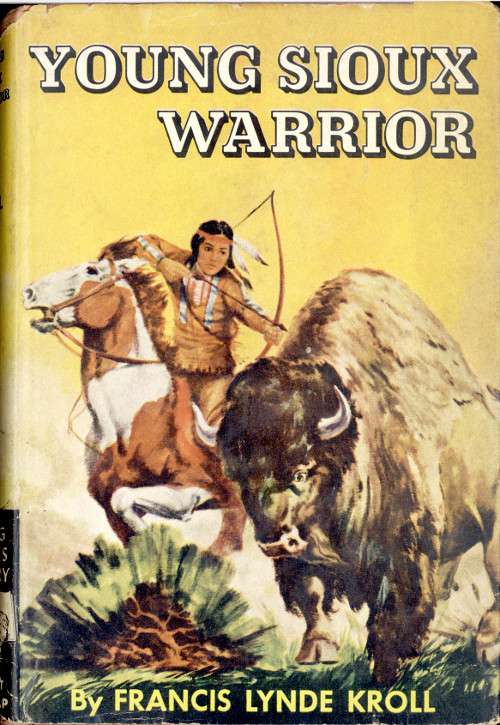
The Project Gutenberg eBook of Young Sioux Warrior
Title: Young Sioux Warrior
Author: Francis Lynde Kroll
Illustrator: Charles Geer
Release date: May 3, 2019 [eBook #59426]
Language: English
Credits: Produced by Stephen Hutcheson and the Online Distributed
Proofreading Team at http://www.pgdp.net
FRANCIS LYNDE KROLL
YOUNG
SIOUX
WARRIOR
ILLUSTRATED BY CHARLES H. GEER
GROSSET & DUNLAP
NEW YORK
Copyright 1952 by Lantern Press, Inc.
MANUFACTURED IN THE UNITED STATES OF AMERICA
To L.L.C. whose firm, kind guidance of another young warrior long ago is gratefully remembered. F.L.K.
Contents
- CHAPTER ONE 13
- CHAPTER TWO 30
- CHAPTER THREE 49
- CHAPTER FOUR 65
- CHAPTER FIVE 82
- CHAPTER SIX 96
- CHAPTER SEVEN 113
- CHAPTER EIGHT 130
- CHAPTER NINE 144
- CHAPTER TEN 165
- CHAPTER ELEVEN 178
List of Illustrations
- He tried to find words to thank his grandfather 19
- He went slowly and fearfully towards the roaring falls 103
- With a fire in front it made a comfortable shelter 136
- Little Bear picked out a young, fat cow 173
YOUNG SIOUX WARRIOR
CHAPTER ONE
Little Bear sat far back in the great wigwam. The warriors formed a circle around the council fire in front of him. Little Bear had listened to the long debate wishing he dared speak. Plainly two of the older warriors wanted this small hunting party to return to the main Sioux camp. He bent forward to listen as Big Buffalo, one of those two warriors, stood up to speak.
“It is foolish to stay longer.” Big Buffalo spoke slowly. “The Pawnees have driven the buffalo from our hunting grounds. Next they will attack this small party.”
The moment Big Buffalo sat down, Flying Arrow leaped to his feet.
“Let’s drive the Pawnees out,” he roared.
Little Bear had to clap his hands over his mouth to keep from shouting his approval. With deep disappointment he saw the heads around the circle shake in disagreement. Even the young warriors, whom he would have expected to approve Flying Arrow’s words, shook their heads. Little Bear’s eyes lighted with hope when he saw his grandfather, Great Bear, get to his feet.
“The Pawnees on the other side of the river are many,” Great Bear pointed out. “We are too few to attack them. We could send to the main camp for more warriors, but that would take long. Yet, if we are alert, we can get meat to take back to the main camp.”
When Great Bear sat down, Rain-Maker got to his feet.
“Great Bear spoke words of wisdom,” Rain-Maker agreed. “We can hunt buffalo on our way back to the main camp. We may get much meat.”
Little Bear looked expectantly at his grandfather. He knew this wasn’t the plan Great Bear had in his mind. The old warrior would never suggest they should run from the Pawnees. Little Bear expected Grandfather to jump up and angrily deny that this was his plan. But Grandfather made no move to get to his feet. Instead, he waited to give others a chance to speak.
“He meant we’d hunt buffalo here and not run from the Pawnees.” Little Bear was frightened when he realized he had spoken aloud.
He drew his blanket over his head and huddled down to make himself as small as possible. He wanted to stand up and dash out of the wigwam, but that would be still worse. A Sioux boy must wait and follow the warriors. He held himself quiet. He had spoken, in the warriors’ council without permission. He must stay and take his punishment.
“The small one with the big mouth has spoken truly.” Flying Arrow had stood and was talking. “Great Bear would not counsel us to run from the Pawnees.”
Little Bear hung his head in shame. He had been called “the small one with the big mouth.” He knew he deserved the name. It would not have seemed quite so bad if someone other than Flying Arrow had given it to him.
Nevertheless from then on, the discussion changed. There was no more talk of starting back to the main camp without meat. The warriors agreed the Pawnees were not likely to attack while the Sioux were on their own hunting grounds. They decided they would stay and hunt buffalo. When they had enough meat, they would start for the main camp. Even though they were sure the Pawnees would not attack, they decided they would have outriders, scouts, and sentinels on every hunting trip.
When the council was over, Great Bear was among the first to leave the council wigwam. Little Bear waited until every warrior had stepped through the flap before he left. As soon as he was out of the wigwam, he hurried to catch Grandfather. His hope that Grandfather would let him go with the warriors on tomorrow’s hunting trip made him forget he would be scolded for speaking in the council.
Great Bear reached his tepee before Little Bear caught up with him. The old warrior went into the tepee without stopping. Little Bear knew his grandfather would want to make medicine before tomorrow’s hunt. There was nothing he could do except wait outside until Grandfather came out.
Time dragged slowly. It seemed to Little Bear the sun had stopped in the western sky and wasn’t trying to sink to rest in the west. At last there was a faint rustle at the flap of the tepee. Little Bear looked up to see Great Bear step outside. For some time Great Bear stood looking silently at him.
“You spoke in the council today,” Great Bear said sternly. “It was a great honor to a boy to be allowed to enter the council tent with the warriors. Speaking without permission was poor repayment of an honor.”
“I know, Grandfather.” Little Bear spoke hesitantly with his eyes upon the ground. “I am ashamed.”
“You earned a new name. One which will be hard to live down.”
There was a hint of a smile in the old warrior’s eyes.
“I am ashamed,” Little Bear repeated.
Without another word Grandfather turned and reached inside the tepee. He straightened up with a bow in his hand.
“Tomorrow you will be twelve summers,” Great Bear told him. “It is time you learned to use a good Sioux bow. I made this for you.”
Little Bear took the bow Grandfather held out to him. He tried to find words to thank his grandfather, but there was a lump in his throat. For a terrible moment he thought he was going to cry. Any warrior in the Sioux camp would be proud to own a bow Great Bear had made. He held the bow towards his grandfather.
He tried to find words to thank his grandfather
“Keep it, Grandfather,” he said slowly, “until I earn the right to have it.”
“Nonsense.” Great Bear spoke sharply. “Even Sioux warriors make mistakes. The bow is yours. Tomorrow we shall have a lesson in its use.”
“Thank you, Grandfather.” Little Bear smiled happily. Then he understood the meaning of Grandfather’s words. “Tomorrow we shall have a lesson? Aren’t we going with the hunting party?”
“No.” Great Bear shook his head. “The Great Spirit warned me I should stay in camp. You and I and the two old ones will stay while the others hunt.”
The next morning Little Bear was up early. He carried his new bow as he went to watch the hunting party leave camp. By the time the hunters had ridden out of sight, Little Bear was feeling less disappointed. Grandfather was going to give him lessons in the use of the bow. That would be almost as good as the excitement of a buffalo hunt.
“First you and I will scout to the river to see if any Pawnees are near,” Great Bear told him.
Grandfather took two arrows from his quiver and handed them to Little Bear. As he followed his grandfather out of camp, Little Bear felt he was almost a warrior. As soon as they were out of camp, Great Bear moved as carefully as he could. At each step he made sure he didn’t tread on a stick that might snap under his foot. Little Bear followed carefully behind him, stepping in Grandfather’s tracks. Instead of following the most direct route to the river, Great Bear took advantage of all cover.
When they were near the river, Great Bear got to his hands and knees and then stretched out on his stomach. Little Bear needed no signal to follow his example. They inched forward until they were near the river’s bank. Here they lay silently watching the opposite bank for any sign of their enemies. A big ant crawled across Little Bear’s shoulders, but he made no move to brush it off. Slowly the sun climbed high in the sky, and yet Great Bear continued to watch. Finally he began to edge back from the river bank. They crawled back many paces before Great Bear got to his feet.
“The Pawnees must have moved upstream,” he decided.
Little Bear thought of the Sioux hunting party riding upstream on their own side of the river.
“Shouldn’t we warn our hunters?” he asked.
“If they have scouts ahead and a sentinel behind as we agreed,” Grandfather explained, “they can’t be surprised.”
When they were well back from the river, Great Bear stopped. He took Little Bear’s bow and aimed an arrow at a sapling about twenty paces away. Little Bear watched closely. Great Bear pulled the bow string back and let the arrow fly. There was a sharp thud as the arrow struck. It split the sapling in two. Grandfather handed the bow to Little Bear.
“Put an arrow in that sapling next to the one I hit,” he directed.
The other sapling was larger than the one Great Bear had hit. Little Bear had used a bow and arrow before. He had owned a small bow as long as he could remember. This large bow was better made than his small one and would shoot much straighter. He fitted an arrow to the string and aimed just as Grandfather had done. He fired for the sapling. The arrow whizzed past it.
“I missed,” he exclaimed disappointedly.
“That was close,” Grandfather encouraged him. “Let’s get the arrows and you can try again.”
It took some time to find the arrow Little Bear had shot. When they did find it, he started practicing again. Grandfather watched him and showed him better ways of holding the bow and taking aim. Although few of Little Bear’s arrows hit the sapling, most of them came close.
“Practice every time you have a chance,” Great Bear advised. “You are doing very well.”
The sun was almost straight overhead when they returned to camp. Little Bear wondered at Grandfather’s restlessness. Plainly he was worried about something. As soon as he had eaten, Little Bear started towards the meadow to see about their horses. The warriors had been sure no Pawnee would dare try to steal horses so near a Sioux camp and they had left no guards. Little Bear was sure the warriors were right, but he knew Grandfather would expect him to look anyway.
He climbed the low hill to the north of the camp. From the top of it he could look down into the small valley where the horses were grazing. He gave a little gasp of dismay. Great Bear’s best horse wasn’t with the rest of the herd. Little Bear felt a tremendous relief when a group of horses, standing close together, moved apart and he saw Great Bear’s horse was there after all. Next he turned his attention to a roan colt owned by Flying Arrow. The colt was not yet two summers old, but he was almost large enough to begin his training. Little Bear wanted to own that colt. It was going to grow into a fine horse, but Flying Arrow prized it highly, too. He would want a tremendous price for it.
“I’m going to find a way to own that horse,” Little Bear promised himself.
He turned back towards the camp. When he came within sight of their tepee, he saw that Grandfather was waiting for him. He increased his speed.
“The horses are all right, Grandfather,” he reported.
“Good.” Grandfather nodded. “I am glad you went to look at them without waiting to be told. A good warrior looks after his horse.”
Little Bear glowed with pleasure. Grandfather was quick to scold when he did wrong, but he was equally quick to praise when Little Bear did well.
Great Bear went into the tepee to rest. Little Bear sat outside to wait. He would have liked to take his bow and go hunting. However, Grandfather hadn’t told him to go. Perhaps it would be better to wait until Great Bear was ready to go with him.
He had sat in front of the tepee for some time when he became aware of a faint drumming sound. He listened carefully. The sound was too faint for him to be sure, but it did seem to be that of a horse ridden at full gallop. He stepped away from the tepee in order to hear better. Now the sound was quite plain.
Little Bear had heard no sound from the tepee, but there was Grandfather standing beside him. They had stood together for only a few breaths when the rider raced into view.
“It’s Flying Antelope,” Great Bear exclaimed.
It was Flying Antelope, one of the hunters, charging into camp as though the whole Pawnee nation were chasing him. The other two warriors who had stayed in camp came hurrying towards them as Flying Antelope pulled his horse to a sliding stop.
“The Pawnees have our hunting party cornered in Buffalo Trap Canyon,” Flying Antelope gasped. “I must ride to the main camp for help.”
“It is a long journey,” Great Bear protested. “Help will be too late.”
“It is my only chance,” Flying Antelope insisted.
Great Bear looked at the other two warriors. They shook their heads. They had no other plan to offer.
“Then you must have a fresh horse,” Great Bear decided. “Little Bear, bring one of my horses for Flying Antelope.”
Almost before Great Bear had finished speaking, Little Bear was racing up the hill towards the meadow where the horses were grazing. As soon as he crossed the hill, he slowed to a walk. He didn’t want to startle the horses. He gave a low, shrill whistle. His own horse raised its head. When Little Bear repeated the whistle, the horse started towards him. He noticed that Flying Arrow’s roan colt took a few steps towards him, and he thought how easily the colt could be trained.
In a moment Little Bear had mounted his own horse. It took him only a short time to catch one of Grandfather’s horses. Then, sure that Great Bear would want a horse for his own use, he caught another one.
As soon as Little Bear returned to camp, Flying Antelope mounted one of the horses and sped out of camp.
“He will be too late,” Great Bear said, shaking his head.
CHAPTER TWO
Little Bear watched silently as Grandfather moved restlessly about the camp. He seemed to be studying, trying to find some plan by which he could rescue the hunters from the Pawnees. Little Bear had decided he might as well take the horses back to the meadow when Grandfather spoke.
“Flying Antelope will be too late,” Great Bear repeated. “I will ride to Buffalo Trap Canyon. Perhaps I can find a plan to save our warriors.”
Little Bear waited, hoping Grandfather would tell him to come, too. But Great Bear mounted his horse without another word.
“Suppose you want to send a message back?” Little Bear asked. “You have no one to bring it, Grandfather.”
A brief smile touched the corners of Great Bear’s mouth.
“You were going to offer to go with me and be my messenger?” he asked. He shook his head. “It is too dangerous.”
“I am a Sioux.” Little Bear drew himself up proudly. “Many times you have told me, ‘A Sioux’s first duty is to his tribe.’”
Still Great Bear hesitated. At last he nodded.
“I can trust you to obey orders,” he agreed. “I will have you stay behind, as much out of danger as possible. I may need a messenger.”
Great Bear turned his horse to the west, and Little Bear followed him. Little Bear wanted to ride as fast as their horses could go. He was afraid the Pawnees might start an attack before he and Great Bear could get to Buffalo Trap Canyon. But Grandfather kept his horse at a steady, ground-eating lope. Despite his impatience, Little Bear knew Grandfather was right. When they reached the canyon, their horses would not be too tired to run.
He watched anxiously as the sun climbed across the sky. It seemed to Little Bear they must have ridden far enough to reach the place where the sun went to rest at night. At last Great Bear pulled his horse to a stop in a small valley.
“Buffalo Trap Canyon is not far ahead,” Grandfather explained. “You watch the horses. I will go to the top of the hill and see what is happening.”
“And if you need a messenger, Grandfather?” Little Bear asked.
Grandfather hesitated.
“I am old and slow,” he admitted. “We might need speed. You follow me. If anything happens to me, you are to run to our horses and ride to our camp. You will wait there until help comes from the main camp.”
Great Bear led the way up the hill. Near the top he got on his hands and knees and crawled forward. Little Bear followed his lead. It was slow work as they had to be careful not to make the least sound. The top of the hill was flat with a few small trees scattered about. It was covered with thick, dry grass.
Now they had to be doubly careful. They had to get through the dry grass without making a sound and at the same time keep a sharp watch for enemies. The Pawnees might be careful enough to have a lookout on this hill. They edged forward to the rim of the hill. The last few yards they lay on the ground and wriggled forward like snakes. When Little Bear parted the grass and looked down, he could see a small valley with a little stream running through it. Across the stream a large party of Pawnees was waiting at the mouth of Buffalo Trap Canyon.
“That is the only way out of Buffalo Trap Canyon,” Great Bear whispered. “Our men can’t escape.”
“We must help them,” Little Bear whispered fiercely.
“What can two of us do against all those Pawnees?” Great Bear asked hopelessly.
“Perhaps we could give the Sioux war cry,” Little Bear suggested. “They might think a war party was coming to help our hunters.”
“The Pawnees aren’t very smart,” Great Bear answered, “but they are too smart to be fooled so easily.”
For a time they watched the Pawnees in silence. It soon became plain the Pawnees were ready to go into action. Whatever the two of them would try to do to save the hunters, they would have to do soon. There were four mounted warriors at the entrance to Buffalo Trap Canyon. Now one of them wheeled his horse and raced up to the main group of Pawnees. He waved his bow and shouted something to the other warriors. Immediately they began to gather their bows and equipment. They were ready to start their attack!
“This isn’t a very good plan,” Little Bear whispered, “but if I can get down this hill without being seen, it may work.”
Quickly he outlined his plan to Great Bear. He pointed out the tall grass next to the stream as he spoke. Great Bear looked where Little Bear pointed. He studied the hiding places the hillside offered. He turned his glance towards the Pawnees. They had hesitated and were talking together. At last Great Bear nodded.
“It might work,” he agreed. “Only I shall go and you will stay here.”
“That wouldn’t work, Grandfather,” Little Bear pointed out. “I am small. I can bend over and go rapidly. If the Pawnees see the grass moving, they will think I am some kind of animal. Besides, if I have to run, your bow will protect me.”
Great Bear hesitated for so long a time that Little Bear was sure he was not going to give his consent.
“We must try, Grandfather,” Little Bear insisted.
“Yes.” Grandfather nodded grimly. “You may be able to do it. Be sure your first arrow only scares a horse. As soon as you shoot, turn and run this way.”
Now that it was time for action, Little Bear was thoroughly frightened. He could feel his heart pounding against his ribs. It took all of the power of his will to force his legs to shove him forward across the rim of the hill. The top part of the slope was almost bare of grass. If a Pawnee warrior looked that way, he would be sure to see Little Bear. It seemed to Little Bear it took hours for him to wriggle forward until he was in grass high enough to cover him.
A bit farther on he came to grass high enough so that he could get on his hands and knees. Now he could go faster. As the grass bent in front of him, he was able to watch the Pawnees. One of them turned towards him. Little Bear came to a complete halt, holding his breath. The Pawnee took a step in his direction. Little Bear could see the warrior so plainly that it seemed impossible the warrior would fail to see him. Another warrior spoke to the one watching. The watcher turned towards the speaker. Little Bear let his breath out in a sigh of relief.
The warrior did not turn back towards Little Bear. With new hope Little Bear started forward. He kept his eyes on the Pawnees and was not able to watch where he put his hands and knees. Sharp stones cut into his hands and through his leggings. He saw the warriors were ready to start for their horses. He moved ahead more rapidly.
When he reached the grass at the side of the stream, he found it wasn’t as high as it had looked from the top of the hill. He didn’t dare stand erect. He fitted an arrow to his bow and, still kneeling, took careful aim. The Pawnees were moving towards their horses. They were sure to see the arrow and mark the spot from which it came. This first one had to be exactly right. There would be no chance to fire a second one. Little Bear drew the bow back and let the arrow fly.
It was an almost perfect shot. The arrow scraped across the back of one of the Pawnee horses, just enough to hurt and frighten it. The horse gave a squeal of terror and lunged forward. Instantly the whole herd of horses stampeded.
The Pawnees had seen the arrow almost the moment it left Little Bear’s bow. Two of them whirled towards him, drawing their bow strings back as they turned. One of them sent an arrow flying towards Little Bear, but before the other one could shoot, an arrow from the top of the hill knocked him to the ground.
For a moment the Pawnees were in complete confusion. Little Bear sent an arrow towards them and then slipped downstream in the tall grass. He moved so carefully that the Pawnees could not tell he had left his hiding place. Arrows struck where he had been hiding moments before. He lay quiet, hoping they would think that they had hit him.
He raised his head enough to get a look at the war party. Their leader had taken charge. He had called the mounted men from the entrance to Buffalo Trap Canyon and sent them after the horses. Two warriors were starting up the hill towards Great Bear and two more were coming towards Little Bear. The rest of the party were running to try to help recapture their horses.
Little Bear hesitated only a moment. He knew he would have no chance against two Pawnee warriors. If the Sioux warriors would come charging out of the canyon while the Pawnees were scattered, all of them could escape. But evidently the Pawnees had kept the hunters so far back in the canyon that they couldn’t see what was going on outside. Little Bear knew there was only one chance for him to escape. He leaped to his feet giving the Sioux war cry.
The two Pawnees, taken by surprise, hesitated. Little Bear turned and started running up the steep hill. He heard Great Bear echo the war cry. Then he gave all of his attention to escaping his pursuers. He ran in a zig-zag course to make it harder for them to hit him. He saw Great Bear stand and saw his arrow come whizzing by. There was a cry behind him. Great Bear had stopped one of the pursuers.
Little Bear risked a backward glance. Great Bear’s arrow had knocked down one of the Pawnees. The other warrior was bending over the one on the ground. The two warriors who had been going towards Great Bear had stopped. Both of them were sighting arrows towards Great Bear. Little Bear gave a warning cry, but Great Bear was too slow. Little Bear saw the Pawnee’s arrow strike and Great Bear crumple to the ground. Little Bear stopped and turned towards the Pawnees. But their leader had seen the danger of the Sioux hunters charging from the canyon. He was roaring orders at the Pawnee warriors. The two who had started towards Great Bear turned back. They went over and helped carry the warrior Great Bear had hit.
The Pawnees, who were afoot, formed a compact squad and moved away from the canyon mouth. At first they moved slowly, but when Little Bear again raised the Sioux war cry, they broke into a run. Little Bear didn’t wait to see if the hunters came out of the canyon to pursue the Pawnees. He turned and dashed up the hill to Great Bear.
As Little Bear ran up to him, Great Bear was just struggling to a sitting position. The Pawnee arrow had grazed the side of his head. It had made a deep cut in the skin, which was bleeding badly. Little Bear examined the cut quickly.
“I’m all right,” Great Bear assured him. “It just knocked me down.”
He got to his feet. Little Bear again gave the Sioux war cry, and Great Bear joined him. They saw a Sioux warrior carefully edge out of the entrance to the canyon. Both of them waved at the warrior. He saw them and returned the signal. Then he darted back into the canyon. A few minutes later the whole Sioux hunting party charged out of the canyon. They crossed the stream and raced towards Little Bear and his grandfather.
When the hunters were safely on top of the hill, all of them turned to look towards the Pawnees. It was plain that the stampeded horses had not yet been caught. A rider had come back to get the wounded warriors. The others were still plodding away from the canyon.
“They won’t be back,” Big Buffalo stated.
“What became of their horses?” Flying Arrow asked.
“Stampeded,” Great Bear answered. “Big Buffalo is right. By the time they catch their horses, they won’t want any more fighting.”
“You have saved our lives, Great Bear,” Flying Arrow said.
“Not I,” Great Bear answered quickly. “Little Bear stampeded their horses.”
Flying Arrow turned to Little Bear.
“In the council I said you had a big mouth.” He spoke slowly and gravely. “Now I say I was wrong. You shoot well. You have a strong right arm.”
There were grunts of approval from the other warriors. Flying Arrow held up his hand for silence.
“Since you have saved my life,” he went on, “I want to give you a present. I know you want my roan colt. He is yours.”
Little Bear gave a choked gasp of pleasure. He had the bow Grandfather had made for him and now the young horse he wanted. He searched his mind for words with which to thank Flying Arrow. His glance moved to his grandfather. Great Bear was watching him intently. There was some question in Grandfather’s sober eyes, but Little Bear couldn’t decide what it was. He wished he could ask Grandfather. Then he remembered something Great Bear had told him about when it was proper to accept gifts from friends. Slowly he turned towards Flying Arrow.
“I thank you.” He spoke as gravely as Flying Arrow had. “I cannot accept my friend’s horse for doing what any Sioux should do. But if my friend should care to give me something he has made with his own hands, I would treasure it.”
A chorus of approval ran around the circle of warriors. Little Bear saw the pleased look on Great Bear’s face. He heard one of the warriors say, “Spoken like a Sioux warrior.”
Flying Arrow smiled at him.
“Sometime I will repay you, Little Bear,” he promised. “I see Great Bear has made you a bow. Take this quiver I made. May it always hold arrows that fly true!”
Flying Arrow took his quiver from around his neck. He tied his arrows with a thong and handed the quiver to Little Bear. It was a beautiful piece of leather. On it, Flying Arrow had carved a warrior chasing a buffalo. He had worked the top with beads. As soon as Flying Arrow had handed Little Bear the quiver, each of the warriors selected his straightest arrow and put it in the quiver.
As Little Bear was trying to find the right words to express his thanks, Flying Arrow glanced towards Great Bear.
“We must have buffalo fat for Great Bear’s wound,” the warrior said. “Bring one of the fat young buffalo we killed.”
“That was a large party of Pawnees,” Rain-Maker reminded him. “They may come back to attack us.”
“I don’t believe they will,” Flying Arrow answered. “However, the wind is blowing from the north. When you get across the stream, set the grass afire. They will have to flee from a prairie fire.”
Rain-Maker and another young warrior mounted horses and rode towards Buffalo Trap Canyon. As soon as they were across the stream, they stopped and set the grass afire. Then they raced into the canyon to be out of the path of the fire. When they returned, they were carrying the meat they had taken from the carcass of a young buffalo. Some of the hunters had built a fire. While Flying Arrow tied buffalo fat across Great Bear’s wound, others cooked meat for their meal. Little Bear stood and watched the fire Rain-Maker and his companion had started. It had already burned across the valley below and was sweeping over the hill. Any Pawnees in front of it would have to run for their lives.
As soon as they had eaten, the hunters returned to Buffalo Trap Canyon. They removed the meat from the buffaloes they had slain, wrapped it in buffalo hides, and loaded it on the extra horses. When the party was ready to leave, two young warriors were sent ahead. They were to ride in front and stop any war party that might be coming from the main Sioux camp. There was no longer any danger from the Pawnees.
The sun was down and it was almost dark when the party rode into camp. The warriors dismounted and unloaded the meat from the pack horses. Then Little Bear drove all of the horses across the hill to the meadow. At the top of the hill he dismounted and let his own horse go with the others.
He hurried back to Grandfather’s tepee and crawled into his blankets. Soon he was fast asleep, dreaming he was training the roan colt Flying Arrow had wanted to give him.
CHAPTER THREE
Little Bear was out of the tepee the next morning before the sun had started up the eastern sky. Early as he was, Great Bear was already broiling buffalo steaks over a low fire.
“You are early this morning, Grandfather,” Little Bear greeted him.
“It seemed the Great Spirit was trying to warn me,” Great Bear explained. “He wouldn’t let me sleep. I feel there is danger.”
Little Bear had no thought of laughing at his grandfather. Many times Grandfather had thought the Great Spirit was trying to warn him of danger, and danger had appeared soon afterwards. No, if Great Bear was afraid of danger, danger must be near.
“Bring me a horse,” Great Bear ordered. “I’ll make a scouting trip before the others are ready to break camp.”
“Have our hunters decided to return to the main camp?” Little Bear asked.
“It is time for Old-Man-of-the-North to send snow,” Great Bear answered. “We will join the other Sioux and move with them to the winter camp.”
Little Bear opened his mouth to make a request, but thought better of it and remained silent. Grandfather noticed his hesitation.
“Bring your horse, too.” He smiled. “You may as well learn about scouting. Besides, you were a great help yesterday.”
Little Bear looked at the wound on the side of Great Bear’s head. Great Bear had removed the bandage. The wound had healed remarkably overnight and now seemed only a deep scratch.
“Your wound is healing well,” Little Bear said.
“It was just a scratch.” Great Bear snorted. “Off with you.”
Little Bear didn’t want Grandfather to change his mind about the scouting trip. He turned and hurried away towards the meadow. As usual, when he came within sight of the horses, Little Bear slowed to a walk. As he neared the herd, he gave that low whistle.
He knew at once something was wrong. He saw his own horse lift its head and look towards him. He repeated the whistle, still looking carefully at the herd. He was sure some of the horses were gone. He gave a gasp of dismay. Flying Arrow’s roan colt was gone. Impatiently he whistled again. His horse left the herd and trotted towards him. As he was waiting for his own horse, Little Bear saw the roan colt come out of the brush to the west and join the rest of the herd. At least it wasn’t gone.
He mounted his horse and rode into the herd. He had been right. Some of the horses were gone. Grandfather’s best buffalo horse, the black one, wasn’t there. Flying Arrow’s Blazed Face and some of the other horses were missing, too. He turned his horse and rode around the herd to the place where he had seen the colt coming out of the underbrush. There he found tracks leading from the meadow.
Little Bear was careful to keep his horse away from the trail the other horses had left. If the horses had been stolen, he wanted to leave all possible signs for the trackers to read. He followed the trail some distance, but he didn’t find the missing horses. He pulled his horse to a stop and sat motionless, trying to decide what to do. If the horses had merely wandered from the herd, the sooner he hunted for them, the easier it would be to find them. But it didn’t seem likely that a few of the horses had wandered off and the others remained. Far more likely the missing ones had been stolen. He should notify Great Bear and the other warriors at once.
He swung his horse around and rode back to the herd. It would save time if he brought the horses into camp for the warriors. He drove most of the herd ahead of him into camp. Grandfather and several other warriors heard him coming. They were waiting for him beside Great Bear’s tepee.
“Some of our horses were stolen during the night,” Little Bear reported.
“The Pawnees wouldn’t dare,” Red Cloud growled. “The horses have strayed away.”
“I hunted for them,” Little Bear explained. “Their trail showed they had gone fast. If they had strayed, they would have stopped often to graze.”
“The Pawnees had their lesson yesterday,” Red Cloud insisted. “They wouldn’t dare come back that close to our camp.”
“Others besides Pawnees like Sioux ponies,” Great Bear observed.
The warriors looked questioningly at Great Bear.
“Crows steal Sioux horses, too,” he explained.
Flying Arrow nodded excitedly. “Let’s follow their trail and get our horses back,” he exclaimed.
“It may not be so easy,” Great Bear warned. “Whoever stole our horses has a long start. Perhaps he was careful to leave a poor trail. Little Bear, take us to the trail.”
Little Bear led the way back to the place where he had found the trail. The other warriors waited while Great Bear got down and examined the tracks. He studied them carefully. At last he turned to the other warriors.
“It was a Crow,” he told them, “and only one. He got our horses soon after our camp went to sleep. He has almost a sun’s start on us, and you may be sure he will try to hide his trail as soon as he is away from our camp.”
“We must follow at once,” Flying Arrow insisted. “We won’t let him steal our horses.”
“Some of us must stay and guard the meat,” Red Cloud objected. “The chiefs will be expecting us to bring it to the main camp.”
“The chiefs will be angry if we delay the tribe’s start to winter camping grounds,” Limping Fox warned. “It will not be long until Old-Man-of-the-North sends snow flying.”
“Red Cloud and Limping Fox have spoken wisely,” Great Bear agreed. “We must take our meat to the main tribe at once, but I will not lose my horses to a thieving Crow. While the rest of you return to camp, I will go after the horses.”