
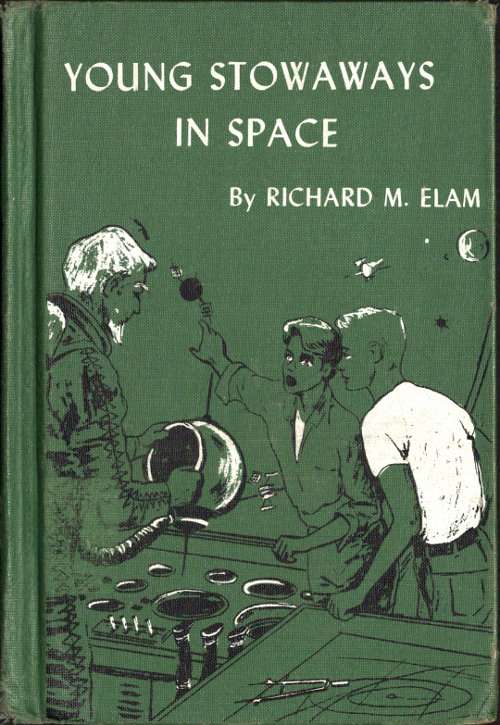
The Project Gutenberg eBook of Young Stowaways in Space
Title: Young Stowaways in Space
Author: Richard M. Elam
Illustrator: Gerald McCann
Release date: April 14, 2017 [eBook #54547]
Most recently updated: October 23, 2024
Language: English
Credits: Produced by Stephen Hutcheson and the Online Distributed
Proofreading Team at http://www.pgdp.net
YOUNG
STOWAWAYS
IN SPACE
By RICHARD M. ELAM
Author of Young Readers Science Fiction Stories, etc.
ILLUSTRATED BY GERALD MC CANN
LANTERN PRESS, INC., PUBLISHERS
257 PARK AVENUE SOUTH
NEW YORK 10, N. Y.
Copyright © 1960 by Lantern Press, Inc.
LIBRARY OF CONGRESS CATALOG CARD NUMBER: 60-13785
PUBLISHED SIMULTANEOUSLY IN CANADA BY
GEORGE J. MC LEOD, LTD., TORONTO
MANUFACTURED IN THE UNITED STATES OF AMERICA
CONTENTS
- 1. Space Ship Orion 9
- 2. Blast-off 16
- 3. Stowaways in Space 25
- 4. Adrift in the Deeps 36
- 5. A “Flying Tin Can” 47
- 6. A Carefree World 56
- 7. A Shock in the Night 65
- 8. Garry Has a Scare 75
- 9. Satellite Zone 85
- 10. The Lady Goes Wild 94
- 11. A Friend Is Lost 107
- 12. A Startling Discovery 116
- 13. Abandon Ship! 124
- 14. First Hours on Luna 133
- 15. A Dark Outlook 142
- 16. A Sad Parting 150
- 17. Dark Peril 160
- 18. Strange Discovery 169
- 19. A New Life 181
YOUNG
STOWAWAYS
IN SPACE
1. SPACE SHIP ORION
The orphanage dormitory was locked in the stillness of slumber. Light from the full moon filtered through the large window which ran the entire length of the boys sleeping quarters.
Twenty cots filled the dormitory, and all but one held its sleeper. Dark-haired Garry Coleman was standing beside his cot, quietly dressing. Every now and then he would cast an anxious glance toward the darkened door at the end of the dormitory. Above all, he must not disturb the charge-of-quarters, or all would be lost.
As he sat on the edge of the cot to put on his shoes, Garry heard a squeak from one of the cots. He stiffened, his heart thumping fearfully.
Then Garry breathed easily. He saw that it was only Patch, who occupied the bunk next to his.
“Hey, Garry, where are you going?” Patch asked interestedly.
Patch was short and towheaded. He was Garry’s best friend, and so Garry did not mind telling him.
“I’m going to the spaceport and watch the Orion blast off for the Von Braun Space Station. Want to go?”
“Sure thing!” Patch said.
“You’ll have to take the same chance that I do,” Garry reminded him.
“That’s okay by me.” Patch grinned. “If we do get caught, we’ll just be restricted to the grounds for two weeks. That won’t keep us out of the science lab where we spend a lot of time anyhow.”
It was a warm April night. The sky was thick with stars as bright as diamond dust.
“I’d give anything to be out there in the deeps among the planets,” Garry said, as they hurried across the newly sprouting lawn of the orphanage a few minutes later. “The life of a spaceman must be the most exciting thing in the world.”
“Yeah,” Patch agreed. “But I guess we’ll never make it, Garry, at least not for many years. And they say you sure have to know science and navigation. That takes a lot of study.”
“I wouldn’t care what it takes,” Garry said. “I’d be willing to study for as long as it would take, because the reward would be worth the effort.”
Their rapid steps took them onto one of the main streets of the city where moving sidewalks, called “Ped-A-Rides,” were operating. The sidewalk was a continuous belt, about six feet wide, and there were benches located at intervals upon it where the pedestrians could sit. A railing was on both sides of the Ped-A-Ride, but at intervals of about half a block there were gates where pedestrians could enter.
Patch and Garry went to the nearest gate, and Garry pulled the lever which slowed the sidewalk down so that they could board it. When Garry had deposited their fare in the meter, a bar slid away so that they could enter. It was about 2230 o’clock, an hour and a half before midnight, and not many people were on the Ped-A-Ride.
The boys took seats, and the sidewalk carried them along into the night.
As the Ped-A-Ride topped the crest of a hill, Garry pointed into the distance.
“There she is, Patch—the Orion, smoking and straining like a race horse, just as if she can’t wait to get going!”
“She sure is a beauty,” Patch agreed. “The earth-bound ships are a whole lot trimmer and better looking than the ships that never touch down.”
“The earth-bound ships have to be streamlined so that they can slide smoothly through the earth’s atmosphere,” Garry said, “but the ships that remain in space look like a bunch of globes and girders, because they never meet the friction of any planet’s atmosphere and they don’t need the sturdiness and rocket power.”
Patch laughed. “You sound like one of our schoolbooks, Garry,” he said.
As the Ped-A-Ride neared the spaceport, the brilliant lights of the busy area merged into a hazy glare that brightened the night until it was almost as light as day. The slim prow of the Orion reached higher into the sky than any other object on the vast field, even loftier than the giant control tower.
“They say the Orion is more space scarred than any other ship in the Space Service,” Garry remarked. “Meteor dust has grooved her sides so much that they look like the scratches on a rifle bullet.”
“I knew she was one of the oldest crafts in the Service,” Patch said. “I guess she’s carried many a person to the Von Braun Station on their way to Luna and the other planets.”
The Ped-A-Ride had nearly reached the gate of the spaceport when Garry said to his friend, “Patch, we’d better move down among those people ahead of us. It looks like they’re going to get off at the port.”
“Why?”
“If one of the port police spots us, he might get suspicious seeing a couple of kids alone at this time of night. If we mingle with the crowd, the police may think we are with them.”
They got up and began walking forward along the moving platform. Then they took seats behind a man who wore the uniform of the Space Service. He had several bags, and it seemed likely that he was going to board the Orion.
As the Ped-A-Ride neared the port gate, Garry closely studied the stalwart young man seated before them. Garry wondered at the many experiences that must have been encountered by this spaceman during his career.
Garry leaned over and touched the spaceman on the shoulder.
“Excuse me, Sir,” he said. “Are you boarding the Orion?”
Garry saw a pleasant but deeply lined face turned upward toward his own.
“Yes,” the astronaut replied, then asked, “Are you?”
“Er, no, Sir,” Garry replied. “We—my friend and I—we just want to see her blast off.”
The spaceman smiled. “Guess you are pretty interested in space to be coming all the way to the port just to see an old crate like the Orion blast off.”
“Yes, we are, Sir,” Garry replied. “I’m very interested in it. I hope to be a spaceman someday.”
“I think you will be, too,” the man said confidently. “I can see the enthusiasm in your eyes.”
“Thanks,” Garry returned. “Have you made many trips spaceward?”
“A dozen or so,” was the reply. “The number is not important, though, you must understand. Usually, one voyage can last quite a while.”
The spaceman extended a big, sunburned hand to Garry. “I’m First Space Officer Mulroy. What’s your name?”
“Garry, Sir. Garry Coleman. My friend here is Patrick Foster, but he’s called Patch for short.”
As the Ped-A-Ride neared the gate of the spaceport, Garry had an idea by which he and Patch might get inside without being questioned by the port police.
“Mr. Mulroy,” Garry said, “I notice that you have some baggage. I wonder if Patch and I could help you carry it—maybe aboard the Orion.”
The officer smiled. “You want to see what she looks like, eh? Okay, it’s a deal.”
“Thank you, Sir,” Garry said.
Presently Officer Mulroy stood up. “Here we are, fellows,” he said. “Let’s get our things together quickly. I can’t afford to miss my blast-off on the Orion. I have a sailing date for Mars in a few weeks, and the stars wait for no man!”
2. BLAST-OFF
Once inside the gate, Mr. Mulroy spoke to a uniformed officer, who saluted. The officer turned a tiny dial on a lapel button he wore and spoke into it. Garry knew this to be a subminiature radio transmitter which was in wide use.
Presently, a square little “T-Car,” or tote car, drove up. It was painted green and white, streamlined, and had seats inside. It had a convertible top which was opened now because of the pleasant weather.
The baggageman put the spaceman’s things in the compartment, then invited his passengers to enter at the door he held open. Garry and Patch felt very important as Officer Mulroy motioned them in ahead of himself. They felt even more important as they sank down into the soft seats and were joined a moment later by this high-ranking officer of the Space Service.
The swift little car whisked them off to the Operations Building, to which Officer Mulroy had to report before his flight.
When the baggage had been unloaded outside and the T-Car had moved off, the spaceman said to the boys, “Wait out here, until I sign up and get my instructions. Then we’ll carry my things aboard the Orion.”
While they waited, they turned their attention to the space craft some distance away. Its blue, satiny sides reflected the glow of thousands of lights on the field. Red smoke still curled up into the night, warning of the approach of blast-off time. And yet there was still a little while to go, for the spiderwebs of the gantry cranes still hugged the sides of the three-stage space vessel. Workmen were swarming all over the platforms, making last-minute checks on the ship.
There was a high wire fence around the Orion and only one entrance through it. A uniformed official was checking tickets as the passengers went through the gate. The official checked Officer Mulroy’s ticket, and Mr. Mulroy told him it would be all right for the boys to help him carry his baggage aboard.
The boys’ new friend took them down some steps into a concrete tunnel that led to the launching pad. On the way they stopped at a little room where Mr. Mulroy was weighed.
“Weight is a very important factor on a space ship,” Mr. Mulroy said, as they were on their way again.
The tunnel led to an elevator that ran up the side of the rocket. The elevator cab rose and rose, high into the black night. Finally, Officer Mulroy pressed a button and said this was where they were to get off.
Garry and Patch followed their friend out into a corridor of the space ship. Officer Mulroy searched the doors they passed, then recognized his own, Stateroom 17. He drew out a key and unlocked the door, then preceded the boys into the room.
“Gee, what a tiny room!” Patch exclaimed.
“It has to be this small,” Mr. Mulroy said. “Every inch of area on a space ship is at a premium, you know. For most travelers, the Von Braun Space Station is only a stopover on a longer trip into space. Sometimes the layover is for several days or even a week or two. Since rooms aboard the space station are very limited, most of the passengers are quartered in staterooms in the rocket in which they left earth.”
Suddenly, a voice came over a speaker in the room: “Blast-off in ten minutes. All nonpassengers are requested to leave the ship.”
“That’s us,” Garry said unhappily.
How he envied Officer Mulroy on his coming trip into the deeps of space! He wanted to go so badly that his heart ached. But he realized that not for many years could his fondest dream come true.
Officer Mulroy noticed Garry’s reluctance to leave, and placed a friendly arm around his shoulder. “Don’t take it so hard, Garry,” he said. “Be the very best student you can. The years will go by fast, and then one day you will wake up to find that you are eligible to be a spaceman.”
“Thanks,” Garry said, trying to smile convincingly, although he did not feel happy. The idea of the future did not interest him now, but only the present, because the queen of the spaceways was about to blast off, and he wanted so desperately to remain aboard her.
“Let’s go, Garry,” Patch said. “We don’t want to get Officer Mulroy into trouble by us being caught aboard at blast-off.”
“That’s right,” Officer Mulroy said with a smile. “Being a stowaway on a rocket is really a serious matter. You see, for every pound of pay load on a rocket, there must be many more pounds of fuel, so if an extra person remained aboard, the ship might not be able to reach its destination.”
“Thank you for letting us come aboard with you, Mr. Mulroy,” Garry said. “And I’ll remember what you told me.”
The space officer insisted on tipping the boys, and it was a generous tip at that. As the two left the room he called to them, “Good-by, fellows. I’ll send you a post card from Mars. That’s a promise.”
Garry and Patch said good-by and followed the directions that Officer Mulroy had given them for leaving the ship.
Garry pressed the button of the elevator in which they had ridden earlier. As the doors parted and he and Patch went in, he said to his friend, “Gee, I hate to leave. I don’t know what’s the matter with me, Patch. Maybe I’m just tired of having to do the same thing every day, over and over.”
“I feel kind of the same way, Garry,” Patch admitted, “but I guess we’ll just have to sweat out the old grind for a few more years.”
They had no sooner started to descend than the light in the elevator went off, and then the elevator itself stopped.
“Hey, what’s going on!” Garry exclaimed.
“The power’s off!” Patch said.
Presently, the light came on again, and the boys felt a lot better.
“Whew, for a minute I was scared!” Patch said.
“Me too. Hey, we’re still not moving, though!” Garry pressed harder on the button, but the elevator refused to move.
“We’re stuck here, Garry!” Patch burst out.
Garry started banging furiously on the walls of the elevator. “We’ve just got to make ourselves heard, Patch!” he cried.
The din was very loud in the cramped compartment, as both boys hammered on the wall.
No one came to their rescue, but then a voice spoke over the public-address speaker in the ceiling of the elevator: “Don’t be alarmed, folks. A short circuit in the fuel-pump relay caused us to lose electric power momentarily. But everything has been restored to normalcy. Warning: Three minutes to blast-off.”
“It hasn’t been restored!” Garry burst out desperately.
The boys pounded on the metal walls until their knuckles hurt.
In a final desperate action, Garry slammed his closed fist against the stubborn power button. Instantly, he felt the elevator throb underfoot and begin to descend once more.
“Thank goodness!” Garry breathed prayerfully. “But we’ve still got to hurry in order to get off in time! No telling how long we’ve been stuck in this thing!”
When the elevator stopped, the doors slid open and the boys ran out. But they found themselves in a strange corridor.
“We’re not out of the ship yet!” Garry exclaimed. “We’ve only gone down a deck or two. The elevator must still be fouled up.”
“What’ll we do now?” Patch asked in desperation.
“Go back into the elevator and try to get to the ground. We’ll have to hurry! The elevator is part of the gantry crane, and it’ll be rolled away any moment!”
They rushed back to the closed doors of the elevator. But a sign in red lights on the door read: “DO NOT ENTER. ELEVATOR REMOVED.”
“They’ve already taken it away!” Patch said in dismay.
“We’ve got to find a place to strap down, or every bone in our bodies will be broken on the blast-off!” Garry said.
A speaker along the corridor next gave out with the dread words: “Blast-off in ninety seconds, ladies and gentlemen. Secure your seat harness and listen to the instructions of the stewards. Failure to obey directions could cost you your lives. In the first few moments of acceleration in a rocket ship, there is a crushing blow to the human body. This jolt will occur twice more as the second and third stages blast off. For that reason, it is absolutely necessary that everyone be strapped down securely to his G-couch.”
Patch grabbed his friends arm in a fierce grip. “Garry, we’re going to die! We’re going to die!” he cried.
Garry shook off Patch and desperately began throwing open doors along the corridor, looking into one room after another. “There must be some G-couches along here,” he said. “I read somewhere that space law says there must be emergency couches on all decks of a rocket ship.”
Patch tagged along after Garry, complaining. Garry could not afford to be sympathetic now. Both their lives depended on what he did within the next minute.
Then Garry found it. Printed on the door was the heartening word: “G-COUCHES.”
He flung open the door and saw a row of six S-shaped reclining seats.
Garry grabbed the arm of his quaking friend in a tight grip and told him, “Listen to me, Patch, and do what I tell you. Jump on a couch just as fast as you can and don’t waste a second getting those buckles fastened across your chest, body, and legs. Now get going!”
Garry helped him along with a shove, then dove for one of the couches close by.
As he hastily fastened his own straps in place, Garry cast worried glances at his friend, who was fumbling as best he could in his nervous state.
A speaker warned of the passing moments: “Zero minus twenty seconds, nineteen, eighteen, seventeen, sixteen....”
A few seconds more, and Garry’s straps were securely fastened. He twisted his head to see how Patch was doing. Patch had almost all his straps in place, but he could not seem to get the chest buckle tightened.
“Hurry, Patch, please hurry!” Garry cried.
“I—I’m doing the best I can,” Patch said, and Garry could see the streams of sweat trickling down his round face.
Then, with a final lucky tug, Patch had it. Turning his weakly smiling face to Garry, he murmured, “Garry, I guess I just barely did....”
Garry never heard the rest of the words, for at that moment the Orion shook herself like a big dog, began a slow tug upward into the black night, and then, a few seconds later, with a deafening roar tore free of her earthly bonds and flung herself into space.
3. STOWAWAYS IN SPACE
Garry had read about the rough effects of blast-off, but the real thing was even worse than he had imagined. He felt like one of those characters in movie cartoons who gets flattened to the thickness of paper when run over. His lungs felt as though they had collapsed, and he could suck in only the barest trace of breath.
But the discomfort did not last long. His body seemed to fill out like an inflated balloon, although he still felt the ache of having been nearly squashed. His stomach felt as though it had been stirred up with an egg beater, and his head swam.
But no sooner had he recovered from the first violent thrust than it came again as the rocket’s second stage began firing. Then the crushing pressure eased once more, only to return once again as the third stage, the occupied section of the Orion, began firing away. When this force let up, Garry knew it was the last.
The ship did not appear to be moving, but Garry knew it must be traveling many thousands of miles an hour.
Garry’s shaky hands groped for the belts of the harness that snugly fitted his body. He worked the buckles loose from his upper body and sat up on his G-couch. He did not release his legs, because he was already feeling the dizzying effects of weightlessness. He looked across at Patch on the next couch.
Patch was still lying flat, and his face was pasty white. His eyes were closed, and this alarmed Garry.
“Patch!” Garry called, repeating the name over and over.
Patch had blacked out, but after a few minutes he came back to consciousness.
“Wh—what happened?” Patch asked in a weak voice.
“We’re in space, Patch,” Garry replied. “They’ll probably think we’re stowaways and send us to jail. Maybe Officer Mulroy will get in trouble too.”
But this was the least of Patch’s worries right now. He put his hand to his head, complaining, “Gee, I feel terrible. Everything’s going around! And I had the worst nightmare all night long!”
Garry had to grin at this. “We haven’t been here all night, just a few minutes. It just seems like a long time.”
Patch fumbled loose his upper straps and struggled to a sitting position, but fell back down onto his contour seat. “Wow, I can’t make it!” he said thickly.
“There’s no use trying to get up,” Garry said. “We’re weightless and would never be able to get about. It’s funny how I wanted so terribly to go into space, but now that I’m out here I’m not enjoying it. I guess it’s because I’m afraid of what’s coming.”
Garry wondered what they should do. Should they turn themselves in and take their chances on being believed that their being aboard the Orion was due to an accident? But if they did this, then Mr. Mulroy might be held responsible for not seeing that the boys had left the ship. And yet, Garry realized, he and Patch could not stay in hiding indefinitely. Sooner or later they must be found out. If they did not turn themselves in, and they were discovered, they would surely be regarded as stowaways.
Then a new fear came to Garry. What if his and Patch’s combined weight was over the ship’s allowable limit? What if their being aboard would keep them from reaching the space station and, instead, cause the earth’s gravity to pull the Orion back down? In that case the two of them could possibly cost the space-ship line a new rocket worth millions, not to mention the lives of all the persons aboard in case a safe landing could not be made!
Garry was occupied with these grave thoughts until he heard the public-address system saying: “We are now in braking orbit.”
Garry knew this meant that the ship had reached the vicinity of the space station and was beginning to circle the station while the braking rockets were cut in. This procedure would slow down the Orion so that she would be moving at the same orbital speed as the space station. Then it would be easy for her to slip into dock.
Garry and Patch felt the tug of the ship’s gradually diminishing speed, but this was not nearly as rough as the blast-off had been. As the Orion moved into dock, the boys felt their weight returning. This was due to the station’s rotation and artificial gravity.
“Well, it looks like the ship has made it all right,” Patch said, relieved. “They must not have had a full load.”
The boys heard the technical language of the docking procedure. Garry listened closely, even though he could not understand much of it. But this was all part of the spaceman’s education, and he was eager to learn it, even at such a crucial moment as this.
Yet as he listened, he had another unpleasant thought. Now that he and Patch had the blot of “stowaway” against them, would this misconduct prevent them from realizing their dream of being future spacemen?
Finally, the ship’s motion stopped altogether. The Orion had nestled into her dock on the big Von Braun Space Station, named after the great space scientist of the past century.
“Now where do we go from here?” Patch asked, as the two removed their harness straps and got to their feet. “Garry, I’m scared, plenty scared! Wow, I’m a little wobbly too!”
“Let’s stay put until we hear further announcements over the speaker,” Garry suggested. “It’ll give us time to think this through a little longer.”
“We’re just stalling, that’s what we’re doing, aren’t we, Garry? We don’t want to turn ourselves in because we’re afraid of what will happen to us,” Patch said.
Garry hung his head. “I guess that’s what it does amount to, Patch. I keep thinking what this will do to our hopes of being spacemen. I’m afraid we’ll never make it now.”
They stayed in hiding for another half hour. Then Garry said: “We’ve got to have something to live on until we make up our minds what we’re going to do, Patch. I think space ships have emergency-ration compartments located along the corridors. I’m in favor of looking for one.”
“That’s better than just waiting here and doing nothing,” Patch agreed.
“I’ll look out and see if the coast is clear,” Garry said.
He looked around outside and then motioned to Patch. They started off quietly down the corridor, but after a moment they heard footsteps approaching from around the corner behind them.
“Garry, we’ve got to hide!” Patch whispered urgently. “Somebody’s coming!”
Garry saw a door up ahead. “That leads into an air lock, Patch. We may be safe in there.”
Garry turned a wheel on the door, and it swung open. They found themselves in a short tunnel, at the other end of which was another door. The air lock was used for entering and leaving the ship while it was in space. The spaceman would enter the chamber and wait for the air pressure to equalize before he left the air lock.
Garry quickly turned another wheel on the inside of the door, closing it.
“We can’t stay in here very long without air,” Garry said. “The other end of this air lock probably leads directly into the space station. Shall we try it?”
“This running and hiding has got to end somewhere,” Patch replied with discouragement. “Lead on.”
Garry checked the pressure gauge on the far door and saw that there was normal pressure on the other side. He turned the wheel on the door, and it swung open. The boys went through, and Garry wheeled the door shut behind them.
They were in a huge enclosed dock of the space station. Lined up ahead were several space taxis, or fliers, which were used for trips outside the station and also doubled as lifeboats in time of emergency.
“Gee, it’s cold in here!” Patch said.
“The main thing, though, is that there’s no one around,” Garry said. “It’ll give us time to collect our thoughts.”
“That’s what you think,” Patch whispered, tugging at Garry’s arm. “There come a couple of men down that corridor across the way!”
Garry moved quickly and quietly, pulling Patch along. As the men entered the dock, the boys ducked out of sight behind one of the space fliers.
The men approached the flier next to the outer door of the dock and pressed a button on the taxi’s surface. Its door sprang open, and the men entered the flier.
They were in there for fully five minutes. During that time, Garry began to shiver, but it was not from fright so much as it was the coldness of the dock. Garry felt Patch shaking beside him and knew his friend was just as uncomfortable as he. But they had to stay put. There was no other place they could go at this moment.
Finally, the men came out of the space taxi, closed the door, and, to the relief of Garry and Patch, disappeared up the corridor.
Garry stood up and hugged himself.
“Garry, I—I’m freezing to death,” Patch chattered.
“So am I. We sure can’t stay here like this,” Garry replied.
“Why don’t we try getting into one of these ships?” Patch suggested. “Maybe they’ve got heaters inside.”
Garry pressed the button of the ship which they had been hiding behind, but the door did not open.
“The power is off or something,” Garry groaned.
“Maybe the first one will open,” Patch said. “It worked for those men.”
Garry went over to the first craft and pressed the door button. Instantly, the door sprang open. A tiny air-lock chamber faced them.
“Thank goodness,” Patch murmured. “Let’s go in.”
“What if the men come back?” Garry cautioned. “They may be preparing for a trip.”
“There are windows facing the corridor,” Patch said. “We can keep an eye out for them and duck for cover again if they return. Gee, let’s try it anyhow, Garry! I feel like a penguin that’s lost all its feathers!”
Garry agreed and entered the flier, Patch climbing in behind. A second door led from the air lock chamber into the flier proper. Besides the pilot’s seat, there were six other seats, three on a side. It was warmer in here than outside, and Garry felt heat gently blowing. This made him suspect that the men had just turned it on and that they were going to return for a trip in the craft.
“I’m afraid we won’t have long to stay in here,” Garry told his friend and mentioned his suspicion to him.
“I guess you’re right,” Patch agreed. “Where will we go from here? Garry, I’m tired of running. And I’m getting more scared by the minute because of what we’re doing. Why don’t we just turn ourselves in and face the music, whatever it is?”
Through a window of the taxi, Garry was watching the corridor for signs of the returning men. “I guess you’re right, Patch,” he said. “We’ll give ourselves up when those men return.”
“I don’t think we should wait until then,” Patch objected. “It will go a lot easier for us if we give ourselves up voluntarily instead of looking as if we had been caught.”
Once again Garry agreed, but, as he was reaching for the button to open the door, he heard a click.
“What was that?” Patch asked in alarm. “What did you do?”
“Nothing,” Garry said. “Something was operating all by itself.”
A soft purring sound began to be heard inside the craft, and Garry felt the little ship vibrating ever so softly.
“Patch,” Garry said tensely, “I don’t like this.” He tried the door button, but it would not work.
“What’s happening?” Patch asked, and there was fright in his voice.
A movement outside in the dock caught the boys’ eyes. Through the wide front port of the ship, they watched a big door slide open, revealing a dark air-lock tunnel—a tunnel large enough to hold the craft which they were occupying!
“Garry,” Patch repeated, “what’s happening!”
Garry slumped into one of the seats, fear numbing his heart.
“Now I know what kind of ship this is, Patch,” he murmured. “It’s remote controlled, guided by an operator inside the space station. We’re heading straight out into space, Patch!”
4. ADRIFT IN THE DEEPS
Trapped within the space taxi, Garry and Patch watched the darkness of space enlarge before their eyes as the ship emerged from the air-lock tunnel of the space station. The stars about them were countless lights, some packed so closely together that they trailed across the sky like distant streaming veils. But the boys had no eye for their beauty at this time.
“Garry,” Patch asked in a dismal voice, “what’s going to happen to us?”
“As long as they have control of the ship, I guess we’ll be all right,” Garry replied. “Maybe they are just sending the ship out on a practice run or possibly to pick someone up.”
“Pick someone up?” Patch asked, puzzled.
“I was thinking of satellite workers or repairmen. The skies out here are flooded with satellites, you know. They must have men working on them all the time,” Garry explained.
Garry heard a hissing sound. He found a slit in the wall from which it was coming. Near the opening was a gauge.
“That’s an oxygen mixture coming in,” Garry said. “It’s probably automatic. It turns on whenever the air pressure drops or becomes fouled.”
“That’s something in our favor,” Patch said grudgingly.
Garry found his feet beginning to lift weightlessly off the floor. His body sagged off balance, and he had to hold onto a handle on one of the seats.
“Garry, what’ll we do?” Patch exclaimed frantically. “We’re going weightless!”
“Let’s look for a wardrobe compartment,” Garry suggested. “Since these fliers are used as lifeboats sometimes, there must be space suits and things. Maybe we’ll find magnetic shoes, too.”
“How’ll we ever get around in here to look for anything?” Patch sputtered. By now he was floating, his legs and arms flailing helplessly like a bug on its back.
Using the handles on the backs of the seats, Garry worked his way across to a cabinet set in the wall. Then he moved from the last seat handle to the wall rail and worked himself down it to the plastic case. Through the clear window Garry could see space suits and accessories. He pressed a button, and the door popped open.
“We’re in luck, Patch,” Garry reported. “There are magnetic shoes in here. I hope the gravity plates in the floor are working.”
Garry managed to pick up two pairs of the shoes, tucking one pair under one arm. That left one hand holding the second pair and the other hand free.
Even then, it took quite some doing for him to work his way across to Patch, who looked like a pennant floating in the breeze as he hung crossways in the air, one hand tightly clutching a seat handle.
“Garry, I don’t feel so good,” Patch complained. “Everything in me feels like its pushing upward. Even my brain seems to be floating.”
“It’s lack of gravity doing that,” Garry said. “You are used to gravity always pulling down on you. When that pull is gone, it makes you feel as if your body is moving up. At least that’s what all the books say. And I believe them, because I feel that way myself. Here are your shoes. They’re pretty big, but they’ll be better than nothing.”
“Garry, how’ll I ever get them on?” Patch protested.
“I’ll hold onto you while you put them on,” Garry offered. “That’ll make it easier—I guess.”
Garry got behind Patch and held him by the collar. Then began Patch’s struggles with the shoes. It was comical for Garry to see his friend having such a hard time, but he knew Patch would have the laugh on him later.
It took them both a good while to get the shoes on. When the floor current of the gravity plates finally held them down, the boys laughed at each other in their oversized equipment.
“I guess we look like snowshoe rabbits with our big feet!” Patch said with a laugh. “Good thing those straps pulled up tight, or we’d never be able to keep them on.”
The craft had been moving along smoothly, but before long it began to shudder irregularly.
“The jets have cut out, Patch,” Garry said. “We’re coasting. Without any air friction out here in space, we could coast along forever.”
“Garry, don’t say that!” Patch gasped.
But Garry found out that his guess was wrong, and he was glad that it had been. Presently, twin jets of flame were seen pouring from the front of the craft.
“Garry, we’re on fire!” Patch shouted.
“No, they’re the braking jets,” Garry corrected. “We’re being slowed down, Patch! I think we’ll find out very soon now what our destination is.”