By B. B. ADAMS, Jr.
The Typical Railroad Man—On the Road and at Home—Raising the Moral Standard—Characteristics
of the Freight Brakeman—His Wit the Result of Meditation—How
Slang is Originated—Agreeable Features of his Life in Fine Weather—Hardships
in Winter—The Perils of Hand-brakes—Broken Trains—Going back to Flag—Coupling
Accidents—At the Spring—Advantages of a Passenger Brakeman—Trials
of the Freight Conductor—The Investigation of Accidents—Irregular Hours
of Work—The Locomotive Engineer the Hero of the Rail—His Rare Qualities—The
Value of Quick Judgment—Calm Fidelity a Necessary Trait—Saving Fuel on a
Freight Engine—Making Time on a Passenger Engine—Remarkable Runs—The
Spirit of Fraternity among Engineers—Difficult Duties of a Passenger-train Conductor—Tact
in Dealing with Many People—Questions to be Answered—How
Rough Characters are Dealt with—Heavy Responsibilities—The Work of a Station
Agent—Flirtation by Telegraph—The Baggage-master's Hard Task—Eternal Vigilance
Necessary in a Switch-tender—Section-men, Train Despatchers, Firemen,
and Clerks—Efforts to Make the Railroad Man's Life Easier.
The typical railroad man "runs on the road;" he
is not the one whose urbane presence adorns the
much-heralded offices of the railroad companies on
Broadway, where the gold letters on the front window
are each considerably larger than the elbow-room
allowed the clerks inside; nor, indeed, is he,
generally speaking, the one with whom the public or
the public's drayman comes in contact when visiting
a large city station to ship or receive freight. These and others,
whose part in the complex machinery of transportation is in a degree
auxiliary, are indeed largely imbued with the esprit de corps
which originates in the main body of workers; but their duties are
such that their interest is not especially lively. Even the men
employed at stations in villages and large towns acquire a share
of their railroad spirit at second hand, as life on a train is necessary
to get the experience which embodies the true fascination
which so charms Young America.
The railroad man's home-life is not specially different from
other people's. There have been Chesterfields among conductors,
and mechanical geniuses have grown up among the locomotive
engineers, but these were products of an era now past. Station-men
are a part of the communities where their duties place
them. Trainmen and their families occupy a modest though
highly respectable place in the society they live in. Trainmen
who live in a city generally receive the same pay that is given to
their brothers, doing the same work, whose homes are in the
country. The families of the latter therefore enjoy purer air, lessened
expenses, and other advantages which are denied the
former.
On most railroads the freight trainmen—engineers, conductors,
brakemen, and firemen—are the most numerous and prominent
class, as the number of freight trains is generally larger than
that of passenger trains; and among these men there are more
brakemen than anything else, because there are two or more on
every train, while there is but one of each of the other classes.
And as the ranks of the passenger-train service are generally recruited
from the freight trainmen, it follows that the freight brakeman
impresses his individuality quite strongly upon not only the
circles in which he moves but the whole train-service as well.
Freight conductors are promoted brakemen, and most (though
not by any means all) passenger conductors are promoted freight
conductors; so that the brakeman's prominent traits of character
continue to appear throughout the several grades of the service.
As he is promoted he of course improves. The general character
of the personnel of the freight-train service has undergone a considerable
change in the last twenty years. Whiskey drinkers have
been weeded out, and pilferers with them. Improved discipline
has effected a general toning up, raising the moral standard perceptibly.
One reforming superintendent, a few years ago, on undertaking
an aggressive campaign found himself compelled to discharge
three-fifths of all his brakemen before he could regard the
force as reasonably cleared of the rowdy element.
The brakeman, like the "drummer," is a characteristic American
product. Each has his wits sharpened by peculiar experiences,
and, while important lines of intellectual training are almost
wholly neglected, there is contact with the world in various directions,
which develops qualities that tend to elevate the individual
in many ways. Although freight brakemen do not have any intercourse
with the public, they somehow learn the ways of the
world very quickly, and the brightest ones among them need very
little training to fit them for a place on a passenger train where
they are expected to deal with gentle ladies and fastidious millionaires,
and bear themselves with the grace of a hotel clerk.
Perhaps one reason why brakemen impress their characteristics
on the whole personnel of the service is because they have abundance
of opportunity for meditation. Many of them have a superfluity
of hours and half-hours when they have nothing to do but
ride on the top of a car and keep a general watch of the train, and
they have ample time to think twice before speaking once. Even
a circus clown or the vender of shoestrings or ten-cent watches
has to study the arts of expression; why should not the intelligent
trainman, who wishes to let people know that he is of some account
in the world? If he wants a favor from a superior he knows
just the best way of approach to secure success. If he deems it
worth while to complain of anything, he formulates his appeal in a
way that is sure to be telling. Everyone knows the old story of
the brakeman who was refused a free pass home on Saturday
night with the argument that his employer, if a farmer, could not
be reasonably expected to hitch up a horse and buggy for such a
purpose. The reply that, admitting this, the farmer who had his
team already harnessed up and was going that way with an empty
seat would be outrageously mean to refuse his hired man a ride,
is none too 'cute to be characteristic. The brakeman who is not
able to puncture the sophistries of narrow-souled or disingenuous
superiors is the exception and not the rule.
The brakeman gives the prevailing tone to the "society" of
despatchers' lobbies and other lounging places which he frequents.
If he be profane or fault-finding or sour, he can easily spread the
influence of these unpleasant traits. A lazy brakeman becomes
more lazy, because his work is in many respects easy. Having
little to do he demands still less. A foul-mouthed one gives himself
free rein because many usual restraints are absent. The
prevalence of profanity, which, aside from the question of sinfulness,
hampers a man in any aspirations he may have toward more
elevating society, is perhaps the worst blot on the reputation of
brakemen as a class. Many worthy men among them, and especially
among conductors and engineers, have, however, done much
to improve the tone of conversation in trainmen's haunts, and on
the better disciplined roads decorum is the rule, and rowdyism the
exception. There is abundance of humor and spirit, however. The
brakeman originates whatever slang may be deemed necessary to
give spice to the talk of the caboose and round-house. He calls a
gravel train a "dust express," and refers to the pump for compressing
air for the power-brakes as a "wind-jammer." The fireman's
prosaic labors are lightened by being poetically mentioned as the
"handling of black diamonds," and the mortification of being called
into the superintendent's office to explain some dereliction of duty
is disguised by referring to the episode as "dancing on the carpet."
The disagreeable features of a freight brakeman's life are chiefly
those dependent upon
the weather. If he
could perform his duties
in Southern California
or Florida in
winter, and in the
Northern States in
summer, his lot would
ordinarily be a happy
one, though the annoyance
of tramps is
almost universal in
mild climates, and in
many cases takes the
shape of positive danger.
These vagabonds
persist in riding
on or in the cars, while
the faithful trainman
must, according to his instructions, keep them off. In some sections
of the country they will board a train in gangs of a dozen, armed
with pistols, and dictate where a train shall carry them. Not long
ago in Chicago a conductor, while ejecting a tramp from the caboose,
was shot and killed by the ruffian.
The hardships of cold and stormy weather are serious, both because
of the test of endurance involved and the added difficulties in
handling a train. The Westinghouse automatic air-brake, which
has served so admirably on passenger trains for the past fifteen
years, has only recently been adapted and cheapened so as to make
it available for long freight trains, but it is now so perfected that
in a few years the brakeman who now has to ride on the outside of
cars in a freezing condition for an hour at a time will be privileged
to sit comfortably in his caboose while the speed of the train is
governed by the engineer through the instantaneous action of the
air-brake. On the steep roads of the Rocky Mountains, and a
few other lines, this brake is already in use.
But "braking by hand" is still the rule. In running on ascending
grades or at slow speeds, the brakemen can ride under
cover, but in descending grades, or on levels when the speed is
high, they must be on the tops of the cars ready to instantly apply
the brakes, for the reason that there are generally only three or
four men to a long train weighing from 500 to 1,000 tons, whose
momentum cannot be arrested very quickly. In descending steep
grades, only the most constant and skilful care prevents the train
from rushing at breakneck speed to the foot of the incline, or to a
curve, where it would be precipitated over an embankment and
crushed into splinters. One of the mountain roads in Colorado
which now uses air-brakes is said to be lined its whole length with
the ruins of cars lying in the gorges, where they were wrecked in
the former days of hand-brakes. Even on grades much less steep
than those in Colorado the danger of this sort of disaster is one
that has to be constantly guarded against. Take the case of a
40-car train descending a 1½ per cent. grade (792/10 feet per mile).
Before all of the cars have passed over the summit and commenced
to descend, the forward part of the train will have increased its velocity
very perceptibly and will thus by its weight exert a strong
pull on the rear portion, "yanking" it very roughly sometimes, and
if one of the couplings between the cars chances to be weak it
breaks, separating the train into two parts. Mishaps of this kind
are frequent, and two or more breakages often occur at the same
time, dividing the train so that one of the parts—between the two
end portions—is perhaps left with no brakeman upon it. The
engineman then has the choice of slackening his speed and allowing
the unmanageable cars to violently collide with his portion, or
of increasing his own speed to such a rate that he is soon in danger
of suddenly overtaking a train ahead of him. To avoid this breaking-in-two
the brakemen must be wide awake on the instant and
see that their brakes are tightened before the speed even begins
to elude control. As soon as the whole train has got beyond the
summit, and the speed is reduced to a proper rate by the application
of the brakes on, say, one-third or one-half the cars, it will
perhaps be found that one or two brakes too many have been put
on and that the train is running
too slowly. Some of them must
then be loosened. Or perhaps some are set so tightly that the
friction heats the wheels unduly or causes them to slide along the
track instead of rolling; then those brakes must be released and
some on other cars applied instead; and all this must be done
(sometimes for an hour) when the temperature is 20 degrees below
zero, or the wind is blowing a gale, just as under more favorable
circumstances. A train moving at 20 miles an hour against a wind
with a velocity of 30 miles increases the latter to 50, so far as the
brakeman is concerned; and if rain or sleet is falling, the force of
it on his hands and face is very severe. If we add to this the danger
attendant upon stepping from one car to another over a gap of
27 to 30 inches, in a dark night, when the cars are constantly moving
up and down on their springs and are swaying to one side or
the other every few seconds, we get some idea of, though we cannot
realize, the sensations that must at such times fill the minds of
the men whose pleasant berth seems so enjoyable on a mild summer's
day. And this is not an overdrawn picture or the worst that
might be given; for rain and snow combined often coat the roofs
of cars so completely and solidly that they are worse than the
smoothest skating-pond, and moving upon them is attended with
danger at every step. Jumping—it cannot be called walking—from
one car to another is in such cases positively reckless. The brake-apparatus
will in a snow-storm be coated with ice so rapidly that
vigorous action is required to keep it in working condition. Even
a wind alone, in dry weather, sometimes compels the men to crawl
from one car to another, grasping such projections as they may.
The brakeman who forgets to take his rubber coat and overalls
sometimes suffers severely from sudden changes of temperature.
In spring or fall a lively shower will be encountered in a sheltered
valley, and the clothing be completely drenched, and then within
perhaps half an hour the ascent of a few hundred feet brings the
train into an atmosphere a few degrees below the freezing point, so
that with the aid of the wind, fanned by the speed of the train, the
clothes are very soon frozen stiff.
Another feature which often involves discomfort, and occasionally
positive suffering and danger, is "going back to flag." When
a train is unexpectedly stopped upon the road, the brakeman at
the rear end must immediately take his red flag or lantern and go
back a half-mile or more to give the "stop" signal to the engine-men
of any train that may be following. This rule is sometimes
disregarded in clear weather on straight lines, and is even evaded
by lazy or unfaithful brakemen where the neglect is positively dangerous,
but still many a faithful man has to go out and stand for a
long time in a severe snow-storm or risk his life in walking several
miles to a station. The record of individual perils and heroisms
in the New York blizzard of March, 1888, are paralleled, or at least
repeated, on a slightly milder scale, by brakemen every winter.
Even in the blizzard country of the Northwest, where a half hour's
exposure is often fatal, the system of train-running is such that
the stopping of a train at an unexpected place involves danger of
collision if the brakeman does not at once go back and stay back.
A "tail-end" brakeman has various anxieties, which cannot be detailed
here. Often there is a possibility that the advancing engineer
will not see his red lantern. One brakeman in New Brunswick
several years ago ignominiously deserted his post, leaving
his train to look out for itself, because of a visit from a huge bear
whose residence was in the woods near the point on the railroad
where the brakeman
was keeping his lonely
night-vigil.
The danger of sudden
accidental death
or maiming is constant
and great, and the
bare record of the numerous
cases is acutely
suggestive of inexpressible
suffering;
but, strange to say, it
does not worry the
average brakeman
much. Though probably a thousand trainmen are killed in this
country every year, and four or five thousand injured, by collisions
and derailments, in coupling cars, falling off trains, striking low
overhead bridges, and from other causes, not one brakeman, from
what he sees in his own experience, realizes the danger very vividly.
As in other dangers which are constant but inevitable, familiarity
breeds carelessness which is closely akin to contempt. Falling
from trains is really a serious danger, because the most
ceaseless caution—next to impossible for the average man to
maintain—is necessary to avoid missteps. This will be practically
abolished when the long-wished-for air-brake comes into use, as
that will obviate the necessity of riding on the tops of the cars.
Coupling accidents are practically unavoidable because, although
the necessary manipulations can be made without going
between the cars or placing the hands in dangerous situations, the
men as a general thing prefer to take the risk of the more dangerous
method. With the ordinary freight-car apparatus (which,
however, is destined to be superseded by an automatic coupler)
the link by which the cars are connected is retained by a pin in
the drawbar of either car; as one car approaches another at considerable
speed, this link, which hangs loosely down at an angle of
thirty degrees, must be lifted and guided into the opening in the
opposite drawbar. This operation must, according to the regulations
of most roads, be performed by the aid of a short stick; but,
disregarding the regulation, partly to save time and partly because
of fear of the ridicule that would be called out by the exhibition
of a lack of dexterity, the average brakeman uses his fingers.
He must lift the link and hold it horizontally until the end enters
the opening, and then withdraw his hand before the heavy drawbars
come together. A delay of a fraction of a second would
crush the hand or finger as under a trip-hammer. And, in point
of fact, this delay does, for various reasons, frequently happen, and
the number of trainmen with wounded hands to be found in every
large freight-yard is sad evidence of the fact. But again, assuming
that this part of the operation is accomplished in safety, there
is another and worse danger in the possibility of being crushed
bodily. Cars are built with projecting timbers on their ends at or
near the centre, for the purpose of keeping the main body of each
car twelve or fifteen inches from its neighbor; but cars of dissimilar
pattern sometimes meet in such a way that the projections on
one lap past those on the other, and the space which should afford
room for the man to stand in safety is not maintained. If the
brakeman, in the darkness of night or the hurry of his work, fails
to note the peculiarities of the cars, he is mercilessly crushed, the
ponderous vehicles often banging together with a force of many
tons. A constant danger in coupling and uncoupling is the liability
to catch the feet in angles in the track.[33] Freight conductors
are peculiarly liable to this, as the duty of uncoupling (pulling out
the coupling-pin) generally devolves upon them, and must be
done while the train is in motion. Walking rapidly along, in the
dark, with the right hand holding a lantern and grasping the car,
while the left is tugging at a pin which sticks, involves perplexities
wherein a moment's hesitation may prove fatal.
The dangers here recounted are those which only brakemen
(or those acting as brakemen) have to meet. The liability of all
trainmen to be killed by the cars tumbling down a bank, colliding
with another train, and a hundred other conditions, is also considerable.
The horror which the public feels on the occurrence of
such a disaster as that at Chatsworth, Ill., in the summer of 1887,
or the half-dozen other terrible ones within the past few years,
could reasonably be repeated every month if railroad employees
instead of passengers were considered. There are no accurate
official statistics kept of the train accidents in the country, but the
accounts compiled monthly by the Railroad Gazette always show
a large number of casualties to railroad men from causes beyond
their own control (collisions, running off the track, etc.), no mention
being made of the larger number resulting from the victims'
own want of caution. In the month of March, 1887, in which
occurred the terrible Bussey Bridge disaster, near Boston, 25 passengers
were killed in the United States; but the same month
recorded 34 employees killed. At Chatsworth 80 passengers were
killed; but in that and the following month the number of employees
killed in the country reached 97. In both of these comparisons
the number of passengers is exceptional, while that of
employees is ordinary. But, as already intimated, these dangers
and discouragements are distributed over such a large territory
and among such a large number of individuals that the general
serenity of the brakeman's life is not much disturbed by them. In
spite of them all, he enjoys his work and, if he is adapted to the
calling, he sticks to it.
The Pleasant Part of a Brakeman's Life.
The brakeman must be on hand promptly at the hour of his
train's preparation for departure, and generally he must do his
part in 15, 30, or 60 minutes' lively work in assembling cars from
different tracks, changing them from the front to the rear or middle
of the train, and setting aside those that are broken or disabled;
but, once on the road, by far the greater portion of his time
is his own, for his own enjoyment, almost as fully as that of the passenger
who travels for the express purpose of entertaining himself.
In mild weather and in daylight, life on the top of a freight train is
almost wholly devoid of unpleasant features, and it takes on the
nature of work only for the same reason that any routine becomes
more or less irksome after a time. Much of the time there are a
few bushels of cinders from the engine flying in the air, which a
novice can get into his eyes with great facility, but the brakeman
gets used to them. He sees every day (on many roads) the
beauties of nature in great variety. Much of the scenery of the
adjoining country is 500 per cent. more enjoyable from the brakeman's
perch on the roof than from the car windows, for the reason
that the increased height gives such an enlarged horizon. This
education from nature is an element in railroad men's lives not to
be despised. The trainman whose daily trips take him past the
panoramic charms of the Connecticut Valley in summer, through
the gorgeous-hued mountain-foliage along the Erie in autumn, or
the perennial grandeur of the Rocky Mountains in Colorado, certainly
enjoys a privilege for which many a city worker would gladly
make large sacrifices. But to trainmen the refining influence of
these surroundings is often an unconscious influence, and with the
majority of them is perhaps generally so, because of the prosaic
round of every-day thoughts filling their minds. There are also
some other advantages, not wholly unæsthetic, which a millionaire
might almost envy the freight trainman. Every twenty miles or
so the engine must stop for water, and it often happens that this
is in a cool place where the men can at the same time refresh
themselves with spring water whose sparkling purity is unknown
in New York or Chicago. Though brakemen who love beer are
not by any means scarce, an accessible spring or well of pure water
along the line always finds appreciative users during warm weather;
and the Kentuckian who sojourned six months in Illinois without
thinking to try the water there is not represented in the ranks of
level-headed brakemen. A certain railroad president regales himself
in summer on spring water brought in jugs from 100 miles
up the road by trainmen who find in this service an opportunity to
"make themselves solid" at headquarters. Freight trainmen get
all the delicious products of the soil at first hands. In their stops
at way-stations they get acquainted with the farmers, and can make
their selection of the best things at low prices, thus (if they keep
house) living on fruits, vegetables, etc., of a quality fit for a king.
At the Spring.
The passenger-train brakeman differs from the freight trainman
chiefly in the fact that he must deal with the public, and so
must have a care for his personal appearance and behavior, and in
the fact that he is not a brakeman, the universal air-brake relieving
him of all work in this line. His chief duties are those of a
porter, though the wide-awake American brakeman, with an eye
to future promotion to a conductorship, maintains his dignity and
is not by any means the servile call-boy that the English railway
porter is. The wearing of uniforms has been introduced here from
England and is, in the main, a good feature, though some roads,
whose discipline is otherwise quite good, allow their men to appear
in slovenly and even ragged clothes. Superintendents should give
more care to this matter, as it is not an unimportant one. It
affects the men's self-respect and influences their usefulness in other
ways. The frugal brakeman cannot
wear his blue suit on Sunday
or a-visiting, and his Sunday
suit when old cannot
be used up by week-day
wear, so he naturally
concludes that his
employer is guilty of a little
undue severity toward him. Brakemen on the modern "limited"
trains (a three hours' run without a stop constituting a day's
work) have in some respects too easy a task, and their minds are
more likely to rust out than to wear out. They have a constant
care, to be sure, and sometimes must "go back to flag," the same
as a freight trainman, but, in the main, their berth would about fill
the ideal of the Irish shoveller who confided to his fellow-workman
that "for a nice, clane, aisy job" he would like to be a bishop.
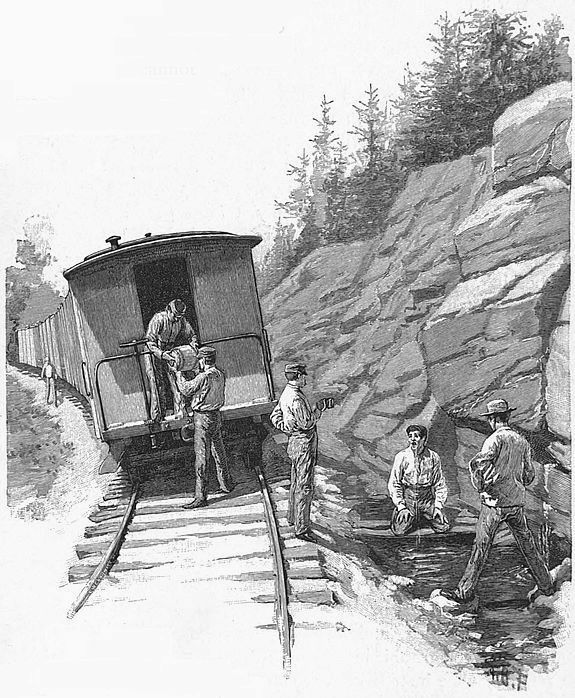
At the Spring.
The passenger-train brakeman differs from the freight trainman
chiefly in the fact that he must deal with the public, and so
must have a care for his personal appearance and behavior, and in
the fact that he is not a brakeman, the universal air-brake relieving
him of all work in this line. His chief duties are those of a
porter, though the wide-awake American brakeman, with an eye
to future promotion to a conductorship, maintains his dignity and
is not by any means the servile call-boy that the English railway
porter is. The wearing of uniforms has been introduced here from
England and is, in the main, a good feature, though some roads,
whose discipline is otherwise quite good, allow their men to appear
in slovenly and even ragged clothes. Superintendents should give
more care to this matter, as it is not an unimportant one. It
affects the men's self-respect and influences their usefulness in other
ways. The frugal brakeman cannot
wear his blue suit on Sunday
or a-visiting, and his Sunday
suit when old cannot
be used up by week-day
wear, so he naturally
concludes that his
employer is guilty of a little
undue severity toward him. Brakemen on the modern "limited"
trains (a three hours' run without a stop constituting a day's
work) have in some respects too easy a task, and their minds are
more likely to rust out than to wear out. They have a constant
care, to be sure, and sometimes must "go back to flag," the same
as a freight trainman, but, in the main, their berth would about fill
the ideal of the Irish shoveller who confided to his fellow-workman
that "for a nice, clane, aisy job" he would like to be a bishop.
Brakemen have had the reputation of doing a good deal of
flirting, and many a country-girl has found a worthy husband
among them; but there is not so much of this method of diversion
as formerly; both passenger and freight men now have to attend
more strictly to business, and they cannot conveniently indulge in
side play. There are still, however, enough short branch-lines
and slow-going roads in backwoods districts to insure that flirting
shall not become a lost art in this part of the world.
The freight conductor is simply a high grade of brakeman.
His work is almost wholly supervisory and clerical, and so, after
several years' service, he becomes more sober and business-like in
his bearing, the responsibilities of his position being sufficient to
effect this change; but he generally retains his sympathies with his
old associates who have become subordinates. His duties are to
keep the record of the train, the time, numbers of cars, etc.; to see
that the brakemen regulate the speed when necessary, and to keep
a general watch. The calculations necessary to make a 75-mile
trip and get over the line without wasting time are often considerable,
and an inexperienced conductor can easily keep himself in a
worry for the whole trip. Often he cannot go more than ten miles
after making way for a passenger train before another overtakes
him; so that he must spend a good share of his time sitting in his
caboose with the time-table in one hand and his watch in the other,
calculating where and when to side-track the train. On single-track
roads perplexities of this kind are generally more numerous
than on double lines, because trains both in front and behind must
be guarded against, and because the regulations are frequently
modified by telegraphic instructions from headquarters. A mistake
in reading these instructions, which are written in pencil, often by
a slovenly penman, and on tissue-paper, may, and occasionally does,
cause a disastrous collision. These duties of conductors are especially
characteristic of trains that must keep out of the way of passenger
trains, so that in this particular line it will be seen that
the passenger conductor has much the easier berth. The freight
and "work-train" conductor must really be a better calculator, in
many ways, than the wearer of gilt badges and buttons, though the
latter receives the higher pay.
The bête noire of the freight conductor is an investigation at
headquarters concerning delinquencies in which the blame is divided.
A typical case of this kind is that of a freight train which
has stopped at some unusual place and been run into by a following
train, doing some hundreds of dollars damage, if not killing or injuring
persons. "Strict adherence to rules will avert all such
accidents," the code says; but they do happen, and the inquiry as
to whether the conductor used due diligence in sending a man with
a red flag to warn the oncoming train, or the engineer of the
latter was heedless, or what was the trouble, is the occasion of
much anxiety.
Conductors, concerning whose life I have only noted a few of
the duties and perplexities, are not so much subject to the vicissitudes
of cold and wet weather, and therefore have in many respects
better opportunities than the brakemen to avail themselves
of the enjoyments of a trainman's life. The risk to life and limb
from coupling cars, etc., is also somewhat less, though many a
faithful conductor has lost his life in the performance of a dangerous
duty which he had assumed out of generous consideration for
an inexperienced or overworked subordinate. The beneficial influences
on health, mind, and morals coming from contact with nature
are, as before remarked, largely unconscious influences, because
of the counteracting effect of the immediate surroundings.
The irregular hours are unfavorable to health. The crews run in
turn; if there are forty crews and forty trains daily, each crew will
start out at about the same hour each day. But if on Monday
there are forty trains, on Tuesday thirty, and on Wednesday fifty,
it will be seen that the starting time must be very irregular. Ten
of the crews which worked on Monday will have nothing to do on
Tuesday, but on Wednesday or Thursday will have to do double
service. The first trip will be all in the daytime, and the next all
in the night, perhaps. This irregularity is constant, and it is impossible
to tell on Monday morning where one will be on Wednesday.
All the week's sleep may have to be taken in the daytime
or all at night. There may be five days' work to do between
Monday morning and the following Monday morning, or there
may be nine. The trainman has to literally board in his "mammoth"
dinner-pail, and his wife or boarding mistress knows less
about his whereabouts than if he were on an Arctic whaling vessel.
The locomotive engineer is the popular "hero of the rail," and
the popular estimate in this respect is substantially just. Others
have to brave dangers and perform duties under trying circumstances;
but the engine-runner has to ride in the most dangerous
part of the train, take charge of a steam-boiler that may explode
and blow him to atoms, and of machinery that may break and kill
him, and try to keep up a vigilance which only a being more than
human could successfully maintain. He must be a tolerably skilful
machinist—he cannot be too good—and have nerves that will
remain steady under the most trying circumstances. If running a
fast express through midnight darkness over a line where a similar
train has been tipped off a precipice (and a brother runner
killed) by train-wreckers the night before, he must dash forward
with the same confidence that he would feel in broad daylight on
an open prairie. But he does not "heroically grasp the throttle"
in the face of danger, when the throttle has been already shut,
nor does he "whistle down brakes," in order to add a stirring element
to the reporter's tale, when by the magic of the air-brake he
can, with a turn of his hand, apply every brake in the train with
the grip of a vise in less time than it would take him to reach the
whistle-pull. When there is danger ahead there is generally just
one thing to do, and that is to stop as soon as possible. An instant
suffices for shutting off the steam and applying the brake.
With modern trains this is all that is necessary or can be done.
Reversing the engine is necessary on many engines, and formerly
was on all; this would, in fact, be done instinctively by old runners,
in any case, but this also is done in a second. After taking
these measures there is nothing for the engineman to do but look
out for his own safety. In some circumstances, as in the case of
a partially burned bridge which may possibly support the train
even in a weakened condition, it may be best to put on all steam.
The runner is then in a dilemma, and a right decision is a matter
of momentary inspiration. Many lives have been saved by
quick-witted runners in such cases, but there is no ground for
censure of the engineer who, in the excitement of the moment, decides
to slacken instead of quicken his speed. The rare cases of
this kind are what show the value of experience, and of men of
the right temperament and degree of intelligence to acquire experience-lessons
readily. The writer recalls an instance several
years ago where an alert, steady, and experienced runner found
himself on the crossing of another railroad with a heavy train rushing
toward him on the transverse track at uncontrollable speed.
It was too late to retreat, and in less than ten seconds the oncoming
train would crash broadside into his cars, filled with passengers.
A frantic effort to increase the speed and clear the crossing
would have either broken the weak couplings then in use or
would have simply whirled the driving-wheels with such excessive
force as to slacken the speed of the train rather than accelerate it.
In point of fact, the rear car just escaped being struck by the ponderous
engine bearing down upon it at the rate of twenty or thirty
feet a second; and the preservation of the lives of the passengers
was due to the fact that the engineer was well-balanced, quick to
act, and not excitable. What did he do? He instantly put on
more steam, but with unerring judgment opened the valve just far
enough and no more.
But the terrible cloud constantly hanging over the engineer and
fireman of a fast train is the chance of encountering an obstacle
which cannot possibly be avoided, and which leaves them no alternative
but to jump for their lives, if, indeed, it does not take away even
that. To the fact that this cloud is no larger than it is, and that
these men have sturdy and courageous natures, must be attributed
the lightness with which it rests upon them. On one road or another,
from a washout, or inefficient management, or a collision
caused by an operator's forgetfulness, or some one of a score of
other causes, there are constantly occurring cases of men heroically
meeting death under the most heart-rending circumstances.
Every month records a number of such, though happily they are
not frequent on any one road. The case of Engineer Kennar, a
year or more ago, is a typical one. Precipitated with his engine
into a river by a washout which the roadmaster's vigilance had
failed to discover, his first thought, as zealous hands tried to rescue
him, was for the safety of his train; and, forgetting his own
anguish, he warned those about him to attend first to the sending
of a red lantern to warn a following train against a collision. The
significance of facts like this is not so much in the service to humanity
done at the time, or even in the example set for those who
shall meet such crises in the future, but rather in the evidence they
give of the firm and lofty conscientiousness that inspires the every-day
conduct of thousands of engineers all over the land. As has
already been said, the critical occasions on which engineers are
supposed to be heroic often allow them no chance at all to be
either heroic or cowardly, and their heroism must be, and is, manifested
in the calm fidelity with which they, day after day and year
after year, perform their exacting and often monotonous round of
duties while all the time knowing of the possibilities before them.
On the best of roads a freight train wrecked by a broken wheel
under a borrowed car may be thrown in the path of a passenger
train on another track, just as the latter approaches. This has
happened more than once lately. No amount of fidelity or forethought
(except in the maker of the wheels) can prevent this kind
of disaster. There is constant danger, on most roads, of running
off the track at misplaced switches, many switches being located
at points where the runner can see them only a few seconds before
he is upon them; but the chance is so small—perhaps one in ten
or a hundred thousand—that the average runner forgets it, and it
is only by severe self-discipline that he can hold himself up to compliance
with the rule which requires him to be on the watch for
every switch-target as long before reaching it as he possibly can.
He finds the switches all right and the road perfectly clear so regularly,
day after day and month after month, that he may easily
fall into the snare of thinking that they will always be so. But,
like other trainmen, the engineman finds enough more agreeable
thoughts to fill his mind, and reflects upon the hazards of his vocation
perhaps too little.
The freight engineman's every-day thoughts are largely about
the care of his engine and the perplexities incident to getting out
of it the maximum amount of work with the minimum amount of
fuel. The constant aim of his superiors is to have the engine draw
every pound it possibly can. To haul a train up a long and steep
grade when the cars are so heavily loaded that a single additional
one would bring the whole to a dead stand-still requires a knack
that can be appreciated only by viewing the performance on the
spot. Failure not only wastes
time and fuel (it may necessitate
a return to the foot
of the hill or going to
the top with only
half the load), but
it raises a suspicion
that some other
runner might
have succeeded
better. The runner
whose engine
"lays down on the
road" (fails to draw
its load because of
insufficient fire and
consequent low
steam-pressure) is
liable to the jeers of his comrades on his return home, if not to
some sharp inquiries from his superior.
The passenger runner's greatest concern is to "make time."
Some trains are scheduled so that the engineman must keep his locomotive
up to its very highest efficiency over every furlong of its
journey in order to arrive at his destination on time. A little carelessness
in firing, in letting cold water into the boiler irregularly, or
in slackening more than is necessary where the right to the track is
in doubt for a few rods; these and a score of similar circumstances
may make five minutes' delay in the arrival at the terminus and
necessitate an embarrassing interview with the trainmaster. A
trip on a crowded line may involve watching for danger-signals
every quarter of a mile and the maintenance of such high speed
that they must be obeyed the instant they are espied in order to
avoid the possibility of collision.[34]
The passenger runner finds himself now and then with a disabled
engine on his hands, and two or three hundred passengers
standing around apparently ready to eat him up if he does not
remedy the difficulty in short order. Often in such cases he is in
doubt himself whether the repairs necessary to enable his engine
to proceed will occupy fifteen minutes or an hour. This, with
the knotty question of where the nearest relief engine is, causes
the brow to knit and the sweat to start, and to the young runner
proves an experience which he long remembers.
Stories of fast running are common but unreliable; and when
truthful, important considerations are often omitted. There are
so many elements to be considered, that usually the verdict can be
justly rendered only after a careful comparison with previous records.
Most regular runs include a number of stops, and are subject
to numerous slackenings of the speed, thus dimming the lustre
of the record of the trip as a whole. Frequently, quick runs which
have been reported as noteworthy have had favoring circumstances
not told of. The most remarkable single run on record was that
of Jarrett & Palmer's special train chartered to carry their theatrical
company from New York to San Francisco (Jersey City to
Oakland), June 1–4, 1876, which is well known to all Americans.
Perhaps the fastest long run ever made in this country was that of
a special train over the West Shore Railroad from East Buffalo to
Frankfort, N. Y., two hundred and one miles, on July 9, 1885,
which ran this distance in four hours, including several stops.
This train ran thirty-six miles in thirty minutes, and ran many single
miles in forty-three seconds each. An engine with two cars ran
over the Canada Southern Division of the Michigan Central from
St. Clair Junction to Windsor, Ont., on November 16, 1886, a distance
of one hundred and seven miles, in ninety-seven minutes;
and this included two or three stops. The average rate of speed
was about sixty-nine miles an hour, and in places it rose to seventy-five
and over. The engineers and their firemen, and all connected
with the handling of the trains, certainly deserve credit for performances
like these, and they receive it; but the supplying of the
perfect machine, the smooth and safe roadway comparatively clear
of other trains, and other conditions, is so manifestly beyond their
control, while at the same time constituting such an important factor
in the result, that praise should be given discriminatingly. An
engineer who makes a specially quick trip feels proud of his engine,
and of the honor of having been chosen for an important run,
and he shares with the passengers the exhilaration produced by
such a triumph of science and skill in annihilating space; but in
the matter of credit to himself for experience and judgment, patience
and forethought, he feels and knows that many a trip in his
every-day service is worthy of greater recognition. Many a runner
has to urge his engine, day after day, with a load twenty-five per
cent. heavier than it was designed for, over track that is fit only
for low speeds, at a rate which demands the most constant care.
He must run fast enough over the better portions of the track to
allow of slackening where prudence demands slackening. The
tracks of many roads are rendered so uneven by the action of
frost in winter that with an unskilful runner the passengers would
be half-frightened by the unsteady
motion of the cars.
This condition is not common
on the important trunk-lines,
of course; but it does prevail
on roads that carry a great
many passengers, nevertheless;
and engineers who
guide trains over such difficult
journeys, gently luring
the passengers, with the aid
of the excellent springs under
the cars, into the belief
that they are riding over a
track of uniform smoothness,
should not be forgotten in
any estimate of the fraternity
as a whole.