1 P. M.
He sits before me as I write,
And talks of this and that,
And all my thoughts are put to flight
By his infernal chat.
I came to write a tender rhyme
To Phyllis or to Mabel,
And chose in this retired café
The most secluded table.
He came before I’d time to fly,
And ere I could refuse,
Had filled the very chair that I
Was keeping for the muse!
Then came the deluge—down it came
In one unceasing pour—
Of science, crops, photography,
Religion, soups, and war.
1.30—Forsooth the flood of words that flows
From this secluded table
Will soon be great enough to swamp
A dozen towers of Babel.
2.30—And still he stays, and still the flood
Is rising as before;
3— The world is now a sea of words
3.30— Without a sign of shore.
6— Great Scott! He’s going!
“No, must you go?
Don’t tear yourself away!
What have I written? Oh, some trash—
A sort of Fairy-lay,
Of how a dreadful ogre
Caught a luckless youth one day,
And drowned him in a flood of—well,
If you must go—good day!”
ENVOY.
Phyllis—or Mabel! pray forgive—
I had to pay him out;
I’ll write that tender rhyme to you
Some other day, no doubt.
Once a Tiger for a freak,
Fell in love
With a Lily, pure and meek
And as timid, white, and weak
As a dove.
Yet withal a wee bit chilly,
Just enough the Tiger’s silly
Pride to pique.
By and by the Lily cold,
Felt the charm;
Learned, tho’ dreadful to behold,
That the Tiger, fierce and bold,
Meant no harm.
And she smiled upon him shyly,
Till at length the Tiger wily
Was consoled.
So in time the Beauty grew
To adore
The Royal Beast who came to woo,
Loved him for his golden hue—
For his roar;
All for him with blushes burning,
To a Tiger-lily turning,
Golden too.
But alas, the luckless Lily
Loved in vain;
For a painted daffodilly
Came between them, and the Lily,
Pale with pain,
In a dark pool, drooped and pining,
Drowned herself, and rose a shining
Water-lily.
child at school who fails to pass
Examination in his class
Of Natural History will be
So shaky in Zoölogy,
That, should he ever chance to go
To foreign parts, he scarce will know
The common Mus Ridiculus
From Felis or Caniculus.
And what of boys and girls is true
Applies to other creatures, too,
As you will cheerfully admit
When once I’ve illustrated it.
child at school who fails to pass
Examination in his class
Of Natural History will be
So shaky in Zoölogy,
That, should he ever chance to go
To foreign parts, he scarce will know
The common Mus Ridiculus
From Felis or Caniculus.
And what of boys and girls is true
Applies to other creatures, too,
As you will cheerfully admit
When once I’ve illustrated it.
Once on a time a young Giraffe
(Who when at school devoured the chaff,
And trampled underneath his feet
The golden grains of Learning’s wheat)
Upon his travels chanced to see
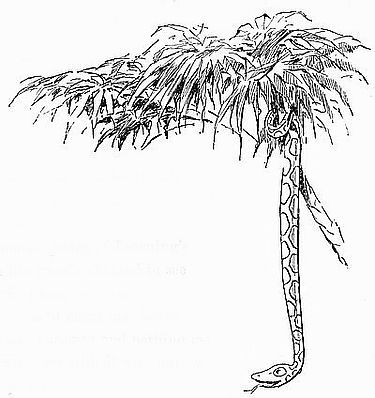
A Python hanging from a tree,
A thing he’d never met before.
All neck it seemed and nothing more;
And, stranger still, it was bestrown
With pretty spots much like his own.
“Well, well! I’ve often heard,” he said,
“Of foolish folk who lose their head;
But really it’s a funnier joke
To meet a head that’s lost its folk.

Once on a time a young Giraffe
(Who when at school devoured the chaff,
And trampled underneath his feet
The golden grains of Learning’s wheat)
Upon his travels chanced to see
A Python hanging from a tree,
A thing he’d never met before.
All neck it seemed and nothing more;
And, stranger still, it was bestrown
With pretty spots much like his own.
“Well, well! I’ve often heard,” he said,
“Of foolish folk who lose their head;
But really it’s a funnier joke
To meet a head that’s lost its folk.
“Dear me! Ha! ha! It makes me laugh.
Where has he left his other half?
If he could find it he would be
A really fine Giraffe, like me.”
The Python, waking with a hiss,
Exclaimed, “What kind of snake is this?
Your spots are really very fine,
Almost as good in fact as mine,
But with those legs I fail to see
How you can coil about a tree.
Take away half, and you would make
A very decent sort of snake—
Almost as fine a snake as I;
Indeed, it’s not too late to try.”
A something in the Python’s eye
Told the Giraffe ’t was best to fly,
Omitting all formality.
And afterward, when safe at home,
He wrote a very learned tome,
Called, “What I Saw beyond the Foam.”
Said he, “The strangest thing one sees
Is a Giraffe who hangs from trees,
And has—(right here the author begs
To state a fact) and has no legs!”
The book made a tremendous hit.
The public all devoured it,
Save one, who, minding how he missed
Devouring the author—hissed.