
In dialects farther south, while the initials differ from those of the dictionaries, the consonantal terminations of the short tone are all clearly marked, and are in harmony with the ancient system. Thus we are led to the conclusion, that in regard to initials, the Kiáng-nan and Cheh-kiáng pronunciation agrees best with the written pronunciations as given in the native tables. But in reference to finals, Kiáng-sí and the southern provinces best represent them. Kiáng-sí appears to be the province that contains within its limits, the greatest number of the peculiarities in question.
In K’áng-hí’s second table, the distinction between the finals, m and n is neglected; e.g. 三 is spelt not sam but san. Further all words in the short tone are spelt with vowel finals; k, t, p, not being recognized, except as secondary forms retained out of respect to the old system. They are cut in small circles. No change is made in the tones or initials, except that words in 下平 are many of them placed in the aspirate column.
The spelling of many words in w with an initial v, and of others in y with ng or n, will be found explained in Part I. section IV. With respect to the two columns headed ch and tsh, which are the same to our ears, it may be observed, that at Sú-cheú words under the former heading are pronounced ch, and under the latter ts, indicating a natural separation between the two columns.
The resumé of this appendix, and of what was said on the Dictionary tables in the sections on the sounds at the commencement of the present work may be stated thus:—
1. The peculiarities of the tabulated initials, finals and tones are all explained, by bringing the different dialects of the three Kiáng provinces together; the aspirated f column being the only prominent anomaly that has not been illustrated.
2. The peculiarities of mandarin pronunciation, such as the interchange of some initial consonants, the prefixing of ng to many words in the upper tones (v. page 51), the coalescing of the upper and lower tones in all cases except that of the p’ing shung, the uniform occurrence of the aspirate after k, t, p, in the hiá‘ p’ing, and the loss of the short tone in the northern provinces, are all unnoticed in the old tables, while they are all recognized in modern works on sounds.
It may be remarked generally on the two systems that the tendency of words in mandarin is to coalesce in sound, while in the other system, the tendency is to more minute subdivision. The mandarin is the most widely spread, embracing two thirds of the 18 provinces.
It appears plain from the Corean and Japanese transcriptions of Chinese sounds made contemporaneous with the dictionaries, that the north of China must then have had the same dialect as that now prevailing in the kiang provinces.
A. The circumflex tones in page 9, may be further divided. The bend of the voice may be upward or downward. Perhaps the Sháng-hái fifth tone may be best described, as sometimes a low slow falling circumflex, (l.s.f.c.) and at other times as a low even tone (l.s.e.). There would with this extension of the natural tones mentioned in section 2. be seven starting from the same key, viz. The even, rising, falling, rising circumflex, falling circumflex, rising short, and falling short tones. If subdivided into an upper and lower key, they become fourteen, and if considered according to their time as quick or slow, we have in all (the short tones not admitting of this subdivision) 24 natural tones.
B. If Roman numerals i to viii be used for the eight tones, the changes of tone occurring in combination in our dialect may be represented as follows:—In the groups v—i, and viii—i, i become v. In ii—ii; ii—vi, vi—vi and vi—ii, the last tone often becomes i, or else former becomes iii or vii. In iii—iii, iii—vii, the former becomes ii. In v—v, iv—v, v does not change, but in other cases v becomes i.
Transcriber’s Notes.
- Footnotes have been numbered and placed at the end of the associated grammar article.
- Obvious typographical errors have been corrected in this text.
- Hyphenation variations are unchanged.
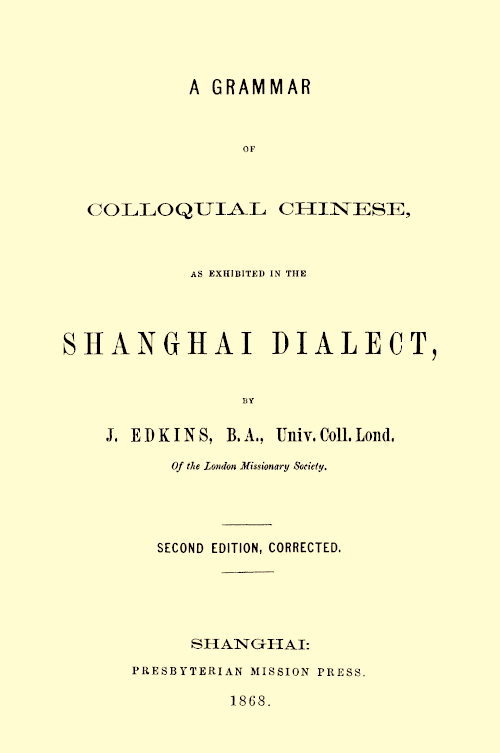
- The cover/title page image has been retouched to remove flaws.
- This book contains some rarely used forms of Chinese characters. Any eReader should contain as full a set of fonts as possible.
- The original book is available at the HathiTrust Digital Library.
Page 5: The "Fifteen vowels" and "Thirty three consonants" were one table. They are split here for ease of layout.