
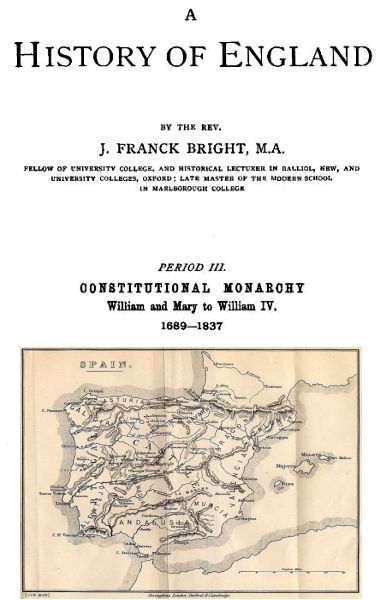
The Project Gutenberg eBook of A History of England, Period III. Constitutional Monarchy
Title: A History of England, Period III. Constitutional Monarchy
Author: J. Franck Bright
Release date: December 26, 2014 [eBook #47759]
Most recently updated: October 24, 2024
Language: English
Credits: Produced by Stephen Hope, Jane Robins and the Online
Distributed Proofreading Team at http://www.pgdp.net
A HISTORY OF ENGLAND
CONSTITUTIONAL MONARCHY
1689-1837
A HISTORY OF ENGLAND.
By the Rev. J. Franck Bright, M.A., Fellow of University College, and Historical Lecturer in Balliol, New, and University Colleges, Oxford; late Master of the Modern School in Marlborough College.
With numerous Maps and Plans. New Editions. Crown 8vo.
This work is divided into three Periods of convenient and handy size, especially adapted for use in Schools, as well as for Students reading special portions of History for local and other Examinations.
Period I.—Mediæval Monarchy: The Departure of the Romans, to Richard III. From A.D. 449 to A.D. 1485. 4s. 6d.
Period II.—Personal Monarchy: Henry VII. to James II. From A.D. 1485 to A.D. 1688. 5s.
Period III.—Constitutional Monarchy: William and Mary to the Present Time. From A.D. 1689 to A.D. 1837. 7s. 6d.
[All rights reserved.]
A
History of England
BY THE REV.
J. FRANCK BRIGHT, M.A.
FELLOW OF UNIVERSITY COLLEGE, AND HISTORICAL LECTURER IN BALLIOL, NEW, AND
UNIVERSITY COLLEGES, OXFORD; LATE MASTER OF THE MODERN SCHOOL
IN MARLBOROUGH COLLEGE
PERIOD III.
CONSTITUTIONAL MONARCHY
William and Mary to William IV.
1689-1837
With Maps and Plans
RIVINGTONS
WATERLOO PLACE, LONDON
Oxford and Cambridge
MDCCCLXXX
[Third Edition]
A LIST OF SOME USEFUL AUTHORITIES.
General Histories.
Macaulay's History of England, 1600-1702. Macaulay's Essays. Mahon's History of England, 1713-1783. Massey's History of England, 1745-1802. Martineau's History of the Peace, 1800-1848. Erskine May's Constitutional History, 1760-1860. Ralph's History of England, 1689-1727. Pauli's Geschichte Englands, from 1814.
Books of General Reference.
Cobbett's Parliamentary History, to 1803. Hansard's Debates, from 1803. The Monthly Mercury, from 1690. The Annual Register, from 1758. State Tracts. Anderson's History of Commerce. Maculloch's Commercial Dictionary. Eden's State of the Poor. Howell's State Trials. Macpherson's State Papers, 1688-1714. Hardwicke's State Papers, to 1727.
Foreign Histories.
Documens inédits sur l'Histoire de France (for the Spanish succession). Sismondi or Martin's Histoire de France, to 1789. Von Sybel's French Revolution. Lanfrey's Histoire de Napoleon. Ranke's History of Prussia. Bancroft's History of the United States. Mill's History of India. Grant Duff's History of the Mahrattas. The Despatches of Wellesley and Cornwallis. Froude's The English in Ireland, to 1800.
William III.
Burnet's History of his Own Time, 1660-1713. Kennett's History of England, vol. iii. Defoe's Works are instructive as to the state of England at this time.
Anne.
Stanhope's Reign of Queen Anne. Coxe's Life of Marlborough. Marlborough's Letters and Despatches, 1702-1712. Bolingbroke's Correspondence. Life of Sacheverel.
George I.
Swift's Drapier's Letters, etc. The Stuart Papers, edited by Glover. Coxe's Life of Walpole. Boyer's Political State of Great Britain.
George II.
Hervey's Memoirs of the Reign of George II., 1727-1742. Horace Walpole's Memoirs of the Reign of George II., 1751-1760. Doddington's Diary, 1749-1761. Waldegrave's Memoirs, 1754-1758. Southey's Life of Wesley. Philip's Life and Times of Whitfield. Johnstone's Memoirs of the Rebellion of 1745.
George III.
Horace Walpole's Memoirs of the Reign of George III., 1760-1771. The Letters of Junius. The Grenville Papers. The Bedford Correspondence. Buckingham's Memoirs of the Court and Cabinet of George III. Russell's Life of Fox. Thackeray's Life of Chatham. Stanhope's Life of Pitt. Wilberforce's Life. Malmesbury's Diary and Correspondence. The Cornwallis Correspondence, 1770-1805. Napier's Peninsula War. Life of Bamford the Radical. Lord Dudley's Letters, 1814-1823. Bell and Stapleton's Lives of Canning.
It is not, however, necessary to give a detailed list of authorities, which would be little more than a catalogue of the lives, letters, and memoirs of most of the important men of the time. Of these the number is constantly being augmented, and it is from them and the contemporary tracts, monographs, pamphlets, and fugitive writings that the details of the History must be drawn.
CONTENTS.
WILLIAM AND MARY. 1689-1702.
| PAGE | |
| 1689 The Declaration of Right, | 806 |
| Character of the Revolution, | 806 |
| Personal unpopularity of William, | 807 |
| Discontent of the clergy and the army, | 807 |
| The Convention turned into a Parliament, | 808 |
| William's difficulties in forming a ministry, | 808 |
| Settlement of the revenue, | 810 |
| Settlement of the Church, | 810 |
| Oaths of allegiance and supremacy, | 811 |
| The European war breaks out, | 811 |
| Devastation of the Palatinate, | 812 |
| State of Ireland, | 812 |
| Panic among the Englishry, | 813 |
| Londonderry and Enniskillen garrisoned, | 813 |
| Negotiations with Tyrconnel, | 813 |
| James goes to Ireland, | 814 |
| Character of the Irish Jacobites, | 814 |
| Siege of Londonderry, | 815 |
| Wild legislation of the Irish Parliament | 815 |
| Its effect on the English Jacobites, | 816 |
| Battle of Newton Butler, | 816 |
| Character of the Revolution in Scotland, | 817 |
| Contrast of the letters from James and William, | 818 |
| Highland politics, | 819 |
| Dundee in the Highlands, | 820 |
| Battle of Killiecrankie, | 820 |
| Mackay concludes the war, | 821 |
| Factions of the English Parliament, | 821 |
| William threatens to leave England, | 824 |
| 1690 William dissolves Parliament, and undertakes the Irish war, | 824 |
| Tory reaction in the new Parliament, | 824 |
| Cause of the venality of Parliament, | 824 |
| Settlement of the revenue, | 825 |
| The Act of Grace, | 825 |
| Discovery of a Jacobite plot, | 825 |
| Battle of Beachy Head, | 826 |
| Battle of the Boyne, | 827 |
| James's flight from Ireland, | 828 |
| Siege of Limerick, | 828 |
| William returns to England, | 828 |
| 1691 Siege of Athlone, | 829 |
| Battle of Aghrim, | 830 |
| Second siege of Limerick, | 830 |
| End of the Irish war, | 830 |
| The Revolution completed in Scotland, | 830 |
| Jacobite plots in England, | 831 |
| William's successful policy abroad, | 831 |
| First crisis of the war over, | 832 |
| James's hopes upheld by the treason of the ministry, | 832 |
| 1692 Marlborough, suspected of treason, deprived of his offices, | 833 |
| The Queen's quarrel with her sister, | 834 |
| Massacre of Glencoe, | 834 |
| Threatened invasion of England, | 836 |
| Battle of La Hogue, | 837 |
| Second crisis of the war over, | 838 |
| Fall of Namur, | 838 |
| Battle of Steinkirk, | 838 |
| The discontent of Parliament, | 839 |
| 1693 Montague's financial measures, | 839 |
| Disastrous campaign, | 840 |
| Battle of Landen, | 841 |
| Loss of the Smyrna fleet, | 841 |
| Factions in Parliament necessitate the gradual formation of a united Whig ministry, | 842 |
| 1694 Establishment of the Bank of England, | 843 |
| The Triennial Act passed, | 844 |
| Death of Queen Mary, | 844 |
| 1695 Expulsion of Trevor and Caermarthen for venality, | 845 |
| 1694 Success abroad, | 846 |
| Treachery of Marlborough at Brest, | 846 |
| 1695 Campaign in Flanders, | 847 |
| Surrender of Namur, | 848 |
| William's triumphant return, | 848 |
| New Whig Parliament, | 848 |
| 1696 Re-establishment of the currency, | 848 |
| William's want of money, | 851 |
| Failure of the Land Bank scheme, | 851 |
| The Bank of England supplies the money, | 852 |
| The credit of England restored, | 853 |
| The Assassination plot, | 853 |
| Trial of Sir John Fenwick, | 855 |
| 1697 Complete triumph of the Whigs, | 856 |
| Treaty of Ryswick, | 858 |
| The Parliament reduces the standing army, | 859 |
| 1698 Coalition of the rival East India Companies, | 861 |
| William's attention directed to the Spanish succession, | 862 |
| First Partition Treaty, | 863 |
| The Country Party in the new Parliament, | 864 |
| 1699 William's grief at the dismissal of the Dutch guards, | 864 |
| Rivalry between the two Houses, | 865 |
| The Darien scheme, | 865 |
| Question of Irish forfeitures, | 868 |
| 1700 The Resumption Bill passed, | 868 |
| Second Partition Treaty, | 869 |
| Unpopularity of William and the ministry, | 870 |
| New Tory ministry, | 870 |
| 1701 New Parliament, | 870 |
| The Succession Act, | 871 |
| Impeachments against the Whigs, | 871 |
| The Kentish Petition, | 872 |
| The Legion Memorial, | 872 |
| The Grand Alliance, | 873 |
| Death of James II., | 873 |
| Louis rouses English patriotism by acknowledging the Pretender, | 873 |
| 1702 New Parliament and changes in the ministry, | 874 |
| Death of William, | 874 |
ANNE. 1702-1714.
| PAGE | |
| Marlborough's power | 875 |
| Work of the first Parliament, | 876 |
| Tory ministry, | 876 |
| Beginning of the war | 877 |
| Marlborough's first campaign, | 878 |
| Position of Holland, | 878 |
| 1703 Savoy and Portugal join the coalition, | 880 |
| 1704 Critical position of Austria, | 882 |
| Battle of Blenheim, | 885 |
| Progress of the war in Spain, the Cevennes, and Italy, | 887 |
| 1705 Failure of Marlborough's plans, | 888 |
| Peterborough's success in Spain, | 889 |
| 1706 Battle of Ramillies, | 892 |
| Results of the victory, | 893 |
| French disasters make Louis desire peace, | 894 |
| Marlborough rejects his terms, | 894 |
| 1707 The tide of victory turns, | 895 |
| 1708 Threatened invasion of Scotland, | 896 |
| Battle of Oudenarde, | 898 |
| Siege of Lille, | 900 |
| Capture of Port Mahon, | 901 |
| 1709 Louis offers to negotiate, | 902 |
| He rejects the high demands of the allies, | 903 |
| Battle of Malplaquet, | 903 |
| 1702 Summary of political parties, | 905 |
| Marlborough seeks the support of all parties for the war, | 905 |
| Tory Parliament, | 906 |
| 1703 Dismissal of Rochester, | 906 |
| Occasional Conformity Bill rejected, | 906 |
| The Methuen Treaty, | 907 |
| 1704 Disputes on the Aylesbury election, | 908 |
| Dismissal of Nottingham, Jersey, and Seymour, | 908 |
| 1705 Gradual introduction of Whig ministers, | 910 |
| 1707 Weakness of the composite ministry, | 911 |
| Harley's intrigues against Marlborough, | 911 |
| 1708 Harley and his colleagues resign, | 912 |
| A Whig ministry, | 913 |
| 1709 Insecurity of Marlborough's position, | 913 |
| 1710 Fall of the Whigs, | 914 |
| Dr. Sacheverell's sermons, | 914 |
| Dismissal of Sunderland and Godolphin, | 914 |
| Harley's Tory ministry, | 915 |
| Conference at Gertruydenberg, | 915 |
| The war in Spain, | 915 |
| Harley's policy, | 916 |
| 1711 Peace negotiations, | 917 |
| Attack on Marlborough in Parliament, | 919 |
| 1712 Ormond given command of the army, | 920 |
| 1713 Peace of Utrecht, | 921 |
| Conduct of Harley and Bolingbroke on the succession question, | 922 |
| 1714 New Tory Parliament, | 922 |
| Jacobite intrigues, | 923 |
| The Queen's death, | 924 |
| 1702 Lengthened negotiations for the Union of England and Scotland, | 924 |
| 1707 The Union completed, | 928 |
GEORGE I. 1714-1727.
| PAGE | |
| 1714 Probability of a restoration of the Stuarts, | 929 |
| Council of Regency, | 930 |
| Peaceful accession of the King, | 930 |
| New Whig ministry, | 931 |
| The Hanoverian succession a Whig triumph, | 931 |
| Riots in the country, | 931 |
| 1715 Impeachment of the late ministers, | 932 |
| The Jacobite rebellion, | 932 |
| Disaffection in Scotland, | 933 |
| Failure of the Jacobite hopes of French help, | 933 |
| Mar organizes the insurrection in Scotland, | 934 |
| Vigorous measures of the Government, | 935 |
| Mar's success in the Highlands, | 935 |
| Forster defeated at Preston, | 936 |
| Mar defeated at Sheriffmuir, | 937 |
| 1716 The Pretender arrives, but shortly withdraws again, | 937 |
| Punishment of the rebels, | 938 |
| The Septennial Act, | 938 |
| First signs of the disruption of the ministry, | 940 |
| George goes to Hanover with Stanhope, | 940 |
| Negotiations with France, | 940 |
| Hanover threatened by Charles XII., | 941 |
| Dismissal of Townshend, | 942 |
| 1717 The Triple Alliance, | 942 |
| Stanhope's ministry, | 942 |
| Threatening state of Europe, | 942 |
| Danger to England from Charles XII., | 943 |
| And from Alberoni, | 944 |
| 1718 The Quadruple Alliance, | 945 |
| 1719 Fall of Alberoni, | 946 |
| 1720 European peace, | 946 |
| 1717 Stanhope's home policy, | 946 |
| Constant opposition of Walpole, | 946 |
| Trial of Oxford, | 947 |
| 1719 Repeal of the Schism Act, | 947 |
| Rejection of the Peerage Bill, | 947 |
| 1720 Strength of the ministry. Walpole joins it, | 948 |
| The South Sea Bubble, | 949 |
| 1711 Formation of the South Sea Company, | 950 |
| 1720 The South Sea Scheme, | 950 |
| Competition of other companies, | 951 |
| The rage for stock-jobbing, | 952 |
| Bursting of the bubble, | 953 |
| 1721 Punishment of the directors, | 953 |
| Supremacy of Walpole, | 953 |
| Revival of Jacobite hopes, | 954 |
| 1722 Bishop Atterbury's plot, | 954 |
| 1723 Quarrel between Carteret and Walpole, | 956 |
| 1724 Excitement in Ireland, | 957 |
| 1725 Disturbances in Scotland, | 957 |
| Spanish difficulties, | 958 |
| Intrigues of Ripperda, | 959 |
| Treaty of Vienna, | 960 |
| The secret treaty, | 960 |
| 1726 The Treaty of Hanover, | 961 |
| Excitement of Europe, | 961 |
| 1727 Preliminaries of peace signed at Paris, | 962 |
| Opposition to Walpole headed by Bolingbroke, | 962 |
| The King's death, | 963 |
| Review of the reign, | 963 |
| Increased importance of England abroad, | 963 |
| Private and public immorality, | 963 |
| Influence of the Hanoverian courtiers, | 964 |