
The Project Gutenberg eBook of A History of Epidemics in Britain, Volume 1 (of 2)
Title: A History of Epidemics in Britain, Volume 1 (of 2)
Author: Charles Creighton
Release date: May 11, 2013 [eBook #42686]
Most recently updated: October 23, 2024
Language: English
Credits: Produced by The Online Distributed Proofreading Team at
http://www.pgdp.net (This file was produced from images
generously made available by The Internet Archive.)
A HISTORY OF EPIDEMICS IN BRITAIN.
London: C. J. CLAY and SONS,
CAMBRIDGE UNIVERSITY PRESS WAREHOUSE,
AND
H. K. LEWIS,
136, GOWER STREET, W.C.
Cambridge: DEIGHTON, BELL AND CO.
Leipzig: F. A. BROCKHAUS.
New York: MACMILLAN AND CO.
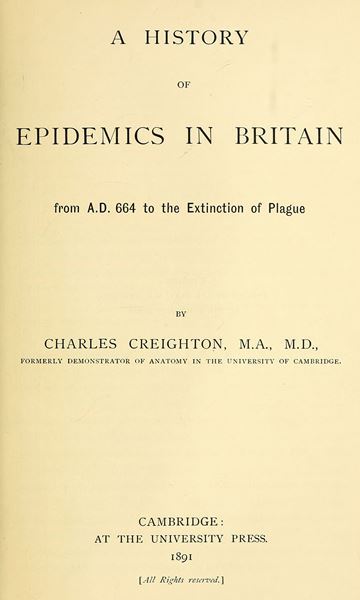
A HISTORY
OF
EPIDEMICS IN BRITAIN
from A.D. 664 to the Extinction of Plague
BY
CHARLES CREIGHTON, M.A., M.D.,
FORMERLY DEMONSTRATOR OF ANATOMY IN THE UNIVERSITY OF CAMBRIDGE.
CAMBRIDGE:
AT THE UNIVERSITY PRESS.
1891
[All rights reserved.]
Cambridge:
PRINTED BY C. J. CLAY, M.A. AND SONS,
AT THE UNIVERSITY PRESS.
PREFACE.
The title and contents-table of this volume will show sufficiently its scope, and a glance at the references in the several chapters will show its sources. But it may be convenient to premise a few general remarks under each of those heads. The date 664 A.D. has been chosen as a starting-point, for the reason that it is the year of the first pestilence in Britain recorded on contemporary or almost contemporary authority, that of Beda’s ‘Ecclesiastical History.’ The other limit of the volume, the extinction of plague in 1665-66, marks the end of a long era of epidemic sickness, which differed much in character from the era next following. At or near the Restoration we come, as it were, to the opening of a new seal or the outpouring of another vial. The history proceeds thenceforth on other lines and comes largely from sources of another kind; allowing for a little overlapping about the middle of the seventeenth century, it might be continued from 1666 almost without reference to what had gone before. The history is confined to Great Britain and Ireland, except in Chapter XI. which is occupied with the first Colonies and the early voyages, excepting also certain sections of other chapters, where the history has to trace the antecedents of some great epidemic sickness on a foreign soil.
The sources of the work have been the ordinary first-hand sources of English history in general. In the medieval period these include the monastic histories, chronicles, lives, or the like (partly in the editions of Gale, Savile, Twysden, and Hearne, and of the English Historical Society, but chiefly in the great series edited for the Master of the Rolls), the older printed collections of State documents, and, for the Black Death, the recently published researches upon the rolls of manor courts and upon other records. From near the beginning of the Tudor period, the Calendars of State Papers (Domestic, Foreign, and Colonial), become an invaluable source of information for the epidemiologist just as for other historians. Also the Reports of the Historical Manuscripts Commission, together with its Calendars of private collections of papers, have yielded a good many facts. Many exact data, relating more particularly to local outbreaks of plague, have been found in the county, borough, and parish histories, which are of very unequal value for the purpose and are often sadly to seek in the matter of an index. The miscellaneous sources drawn upon have been very numerous, perhaps more numerous, from the nature of the subject, than in most other branches of history.
Medical books proper are hardly available for a history of English epidemics until the Elizabethan period, and they do not begin to be really important for the purpose until shortly before the date at which the present history ends. These have been carefully sought for, most of the known books having been met with and examined closely for illustrative facts. In the latter part of the seventeenth century the best English writers on medicine occupied themselves largely with the epidemics of their own time, and the British school of epidemiology, which took a distinguished start with Willis, Sydenham and Morton, was worthily continued by many writers throughout the eighteenth century; so that the history subsequent to the period here treated of becomes more and more dependent upon medical sources, and of more special interest to the profession itself.
Reference has been made not unfrequently to manuscripts; of which the more important that have been used (for the first time) are a treatise on the Sweating Sickness of 1485 by a contemporary physician in London, two original London plague-bills of the reign of Henry VIII., and a valuable set of tables of the weekly burials and christenings in London for five years (almost complete) from 1578 to 1583, among the Cecil papers—these last by kind permission of the Marquis of Salisbury.
Collecting materials for a British epidemiology from these various sources is not an easy task; had it been so, it would hardly have been left to be done, or, so far as one knows, even attempted, for the first time at so late a period. Where the sources of information are so dispersed and casual it is inevitable that some things should have been overlooked: be the omissions few or many, they would certainly have been more but for suggestions and assistance kindly given from time to time by various friends.
The materials being collected, it remained to consider how best to use them. The existing national epidemiologies, such as that of Italy by Professor Corradi or the older ‘Epidemiologia Española’ of Villalba, are in the form of Annals. But it seemed practicable, without sacrificing a single item of the chronology, to construct from the greater events of sickness in the national annals a systematic history that should touch and connect with the general history at many points and make a volume supplementary to the same. Such has been the attempt; and in estimating the measure of its success it may be kept in mind that it is the first of the kind, British or foreign, in its own department. The author can hardly hope to have altogether escaped errors in touching upon the general history of the country over so long a period; but he has endeavoured to go as little as possible outside his proper province and to avoid making gratuitous reflections upon historical characters and events. The greater epidemic diseases have, however, been discussed freely—from the scientific side or from the point of view of their theory.
It remains to acknowledge the liberality of the Syndics of the Cambridge University Press in the matter of publication, and the friendly interest taken in the work by their Chairman, the Master of Peterhouse.
November, 1891.
CONTENTS.
| PAGE | |
| CHAPTER I. | |
| PESTILENCES PREVIOUS TO THE BLACK DEATH, CHIEFLY FROM FAMINES. | |
| The plague of 664-684 described by Beda, and its probable relation to the plague of Justinian’s reign, 542- | 4 |
| Other medieval epidemics not from famine | 9 |
| Chronology of Famine Sicknesses, with full accounts of those of 1194-7, 1257-9, and 1315-16 | 15 |
| Few traces of epidemics of Ergotism; reason of England’s immunity from ignis sacer | 52 |
| Generalities on medieval famines in England | 65 |
| CHAPTER II. | |
| LEPROSY IN MEDIEVAL BRITAIN. | |
| Medieval meanings of lepra | 69 |
| Biblical associations of Leprosy | 79 |
| Medieval religious sentiment towards lepers | 81 |
| Leprosy-prevalence judged by the leper-houses,—their number in England, special destination, and duration | 86 |
| Leper-houses in Scotland and Ireland | 99 |
| The prejudice against lepers | 100 |
| Laws against lepers | 106 |
| Things favouring Leprosy in the manner of life—Modern analogy of Pellagra | 107 |
| CHAPTER III. | |
| THE BLACK DEATH OF 1348-9. | |
| Arrival of the Black Death, and progress through Britain, with contemporary English and Irish notices of the symptoms | 114 |
| Inquiry into the extent of the mortality | 123 |
| Antecedents of the Black Death in the East—Overland China trade—Favouring conditions in China | 142 |
| The Theory of Bubo-Plague | 156 |
| Illustrations from modern times | 163 |
| Summary of causes, and of European favouring conditions | 173 |
| CHAPTER IV. | |
| ENGLAND AFTER THE BLACK DEATH, WITH THE EPIDEMICS TO 1485. | |
| Efforts to renew the war with France | 177 |
| Direct social and economic consequences in town and country | 180 |
| More lasting effects on farming, industries and population | 190 |
| Epidemics following the Black Death | 202 |
| Medieval English MSS. on Plague | 208 |
| The 14th century chronology continued | 215 |
| The public health in the 15th century | 222 |
| Chronology of Plagues, 15th century | 225 |
| Plague &c. in Scotland and Ireland, 1349-1475 | 233 |
| CHAPTER V. | |
| THE SWEATING SICKNESS, 1485-1551. | |
| The First invasion of the Sweat in 1485 | 237 |
| The Second outbreak in 1508 | 243 |
| The Third Sweat in 1517 | 245 |
| The Fourth Sweat in 1528 | 250 |
| Extension of the Fourth Sweat to the Continent in 1529 | 256 |
| The Fifth Sweat in 1551 | 259 |
| Antecedents of the English Sweat | 265 |
| Endemic Sweat of Normandy | 271 |
| Theory of the English Sweat | 273 |
| Extinction of the Sweat in England | 279 |
| CHAPTER VI. | |
| PLAGUE IN THE TUDOR PERIOD. | |
| Chronology of the outbreaks of Plague in London, provincial towns, and the country generally, from 1485 to 1556 | 282 |
| The London Plague of 1563 | 304 |
| Preventive practice in Plague-time under the Tudors | 309 |
| Sanitation in Plantagenet and Tudor times | 322 |
| The disposal of the dead | 332 |
| Chronology of Plague 1564-1592—Vital statistics of London 1578-1583 | 337 |
| The London Plague of 1592-1593 | 351 |
| Plague in the Provinces, 1592-1598 | 356 |
| Plague in Scotland, 1495-1603—Skene on the Plague (1568) | 360 |
| Plague in Ireland in the Tudor period | 371 |
| CHAPTER VII. | |
| GAOL FEVERS, INFLUENZAS, AND OTHER FEVERS IN THE TUDOR PERIOD. | |
| The Black Assizes of Cambridge, 1522 | 375 |
| Oxford Black Assizes, 1577 | 376 |
| Exeter Black Assizes, 1586 | 383 |
| Increase of Pauperism, Vagrancy, &c. in the Tudor period | 387 |
| Influenzas and other “strange fevers” and fluxes, 1540-1597 | 397 |
| CHAPTER VIII. | |
| THE FRENCH POX. | |
| Meagreness of English records | 414 |
| Evidence of its invasion of Scotland and England, in 1497 and subsequent years | 417 |
| English writings on the Pox in the Elizabethan period, with some notices for the Stuart period | 423 |
| The circumstances of the great European outbreak in 1494—Invasion of Italy by Charles VIII. | 429 |
| CHAPTER IX. | |
| SMALLPOX AND MEASLES. | |
| First accounts of Smallpox in Arabic writings—Nature of the disease | 439 |
| European Smallpox in the Middle Ages | 445 |
| Measles in medieval writings—Origin of the names “measles” and “pocks” | 448 |
| First English notices of Smallpox in the Tudor period | 456 |
| Great increase of Smallpox in the Stuart period | 463 |
| Smallpox in Continental writings of the 16th century | 467 |
| CHAPTER X. | |
| PLAGUE, FEVER AND INFLUENZA FROM THE ACCESSION OF JAMES I. TO THE RESTORATION. | |
| Growth of London in the Tudor and Stuart periods | 471 |
| The London Plague of 1603 | 474 |
| Annual Plague in London after 1603 | 493 |
| Plague in the Provinces, Ireland and Scotland, in 1603 and following years | 496 |
| Malignant Fever preceding the Plague of 1625 | 504 |
| The London Plague of 1625 | 507 |
| Plague in the Provinces in 1625 and following years | 520 |
| The London Plague of 1636 | 529 |
| Fever in London and in England generally to 1643 | 532 |
| War Typhus in Oxfordshire &c. and at Tiverton, 1643-44 | 547 |
| Plague in the Provinces, Scotland and Ireland during the Civil Wars | 555 |
| Fever in England 1651-52 | 566 |
| The Influenzas or Fevers of 1657-59 | 568 |
| CHAPTER XI. | |
| SICKNESSES OF EARLY VOYAGES AND COLONIES. | |
| Scurvy in the early voyages, north and south | 579 |
| The remarkable epidemic of Fever in Drake’s expedition of 1585-6 to the Spanish Main | 585 |
| Other instances of ship-fevers, flux, scurvy, &c. | 590 |
| Scurvy &c. in the East India Company’s ships: the treatment | 599 |
| Sickness of Virginian and New England voyages and colonies | 609 |
| Early West Indian epidemics, including the first of Yellow Fever—The Slave Trade | 613 |
| The epidemic of 1655-6 at the first planting of Jamaica | 634 |
| CHAPTER XII. | |
| THE GREAT PLAGUE OF LONDON, AND THE LAST OF PLAGUE IN ENGLAND. | |
| Literature of the Great Plague | 646 |
| Antecedents, beginnings and progress of the London Plague of 1665 | 651 |
| Mortality and incidents of the Great Plague—Characters of the disease | 660 |
| Plague near London and in the Provinces, 1665-66 | 679 |
| The Plague at Eyam 1665-66 | 682 |
| The Plague at Colchester, 1665-66, and the last of Plague in England | 688 |
ERRATA.
At p. 28 line 4, for “for” read “at.” At p. 126 line 2 for “1351” read “1350;” same change at p. 130, lines 6 and 9. At p. 185 note 1 read “Ochenkowski.” At p. 264 line 18, and at p. 554 line 11 from bottom, read “pathognomonicum.” At p. 401, note 3 for “1658” read “1558.” At p. 420, line 17, for “Henry IV.,” read “Henry V.” At p. 474, line 4, for “more” read “less.” At p. 649 line 22 omit “Hancock.”
CHAPTER I.
PESTILENCES PREVIOUS TO THE BLACK DEATH, CHIEFLY FROM FAMINES.
The Middle Age of European history has no naturally fixed beginning or ending. The period of Antiquity may be taken as concluded by the fourth Christian century, or by the fifth or by the sixth; the Modern period may be made to commence in the fourteenth, or in the fifteenth or in the sixteenth. The historian Hallam includes a thousand years in the medieval period, from the invasion of France by Clovis to the invasion of Italy by Charles VIII. in 1494. We begin, he says, in darkness and calamity, and we break off as the morning breathes upon us and the twilight reddens into the lustre of day. To the epidemiologist the medieval period is rounded more definitely. At the one end comes the great plague in the reign of Justinian, and at the other end the Black Death. Those are the two greatest pestilences in recorded history; each has no parallel except in the other. They were in the march of events, and should not be fixed upon as doing more than their share in shaping the course of history. But no single thing stands out more clearly as the stroke of fate in bringing the ancient civilization to an end than the vast depopulation and solitude made by the plague which came with the corn-ships from Egypt to Byzantium in the year 543; and nothing marks so definitely the emergence of Europe from the middle period of stagnation as the other depopulation and social upheaval made by the plague which came in the overland track of Genoese and Venetian traders from China in the year 1347. While many other influences were in the air to determine the oncoming and the offgoing of the middle darkness, those two world-wide pestilences were singular in their respective effects: of the one, we may say that it turned the key of the medieval prison-house; and of the other, that it unlocked the door after eight hundred years.
The Black Death and its after-effects will occupy a large part of this work, so that what has just been said of it will not stand as a bare assertion. But the plague in the reign of Justinian hardly touches British history, and must be left with a brief reference. Gibbon was not insensible of the part that it played in the great drama of his history. “There was,” he says, “a visible decrease of the human species, which has never been repaired in some of the fairest countries of the globe.” After vainly trying to construe the arithmetic of Procopius, who was a witness of the calamity at Byzantium, he agrees to strike off one or more ciphers, and adopts as an estimate “not wholly inadmissible,” a mortality of one hundred millions. The effects of that depopulation, in part due to war, are not followed in the history. So far as Gibbon’s method could go, the plague came for him into the same group of phenomena as comets and earthquakes; it was part of the stage scenery amidst which the drama of emperors, pontiffs, generals, eunuchs, Theodoras, and adventurers proceeded. Even of the comets and earthquakes, he remarks that they were subject to physical laws; and it was from no want of scientific spirit that he omitted to show how a plague of such magnitude had a place in the physical order, and not less in the moral order.
A new science of epidemiology has sprung up since the time of Gibbon, who had to depend on the writings of Mead, a busy and not very profound Court physician. More particularly the Egyptian origin of the plague of the sixth century, and its significance, have been elucidated by the brilliant theory of Pariset, of which some account will be given at the end of the chapter on the Black Death. For the present, we are concerned with it only in so far as it may have a bearing upon the pestilences of Britain. The plague of the sixth century made the greatest impression, naturally, upon the oldest civilized countries of Europe; but it extended also to the outlying provinces of the empire, and to the countries of the barbarians. It was the same disease as the Black Death of the fourteenth century, the bubo-plague; and it spread from country to country, and lasted from generation to generation, as that more familiar infection is known to have done[1].
Renewals of it are heard of in one part of Europe or another until the end of the sixth century, when its continuity is lost. But it is clear that the seeds of pestilence were not wanting in Rome and elsewhere in the centuries following. Thus, about the year 668, the English archbishop-elect, Vighard, having gone to Rome to get his election confirmed by the Pope Vitalianus, was shortly after his arrival cut off by pestilence, with almost all who had gone with him[2]. Twelve years after, in 680, there was another severe pestilence in the months of July, August and September, causing a great mortality at Rome, and such panic at Pavia that the inhabitants fled to the mountains[3]. In 746 a pestilence is said to have advanced from Sicily and Calabria, and to have made such devastation in Rome that there were houses without a single inhabitant left[4]. The common name for all such epidemics is pestis or pestilentia or magna mortalitas, so that it is open to contend that some other type than bubo-plague, such as fever or flux, may have been at least a part of them; but no type of infection has ever been so mortal as the bubo-plague, and a mortality that is distinguished by a chronicler as causing panic and devastation was presumably of that type.
Pestilence in England and Ireland in the Seventh Century.
It is more than a century after the first great wave of pestilence had passed over Europe in the reign of Justinian, before we hear of a great plague in England and Ireland. Dr Willan, the one English writer on medicine who has turned his erudition to that period, conjectures that the infection must have come to this country from the continent at an earlier date. From the year 597, he says, the progress of conversion to the Christian religion “led to such frequent intercourse with Italy, France and Belgium, that the epidemical and contagious disease prevailing on the continent at the close of the sixth century must necessarily be communicated from time to time through the Heptarchy[5].” Until we come to the Ecclesiastical History of Beda, the only authorities are the Irish annals; and in them, the first undoubted entry of a great plague corresponds in date with that of Beda’s history, the year 664. It is true, indeed, that the Irish annals, or the later recensions of them, carry the name that was given to the plague of 664 (pestis ictericia or buide connaill) back to an alleged mortality in 543, or 548, and make the latter the “first buide connaill”; but the obituary of saints on that occasion is merely what might have occurred in the ordinary way, and it is probable, from the form of entry, that it was really the rumour of the great plague at Byzantium and elsewhere in 543 and subsequent years that had reached the Irish annalist[6].
The plague of 664 is the only epidemic in early British annals that can be regarded as a plague of the same nature, and on the same great scale, as the devastation of the continent of Europe more than a century earlier, whether it be taken to be a late offshoot of that or not. The English pestilence of 664 is the same that was fabled long after in prose and verse as the great plague “of Cadwallader’s time.” It left a mark on the traditions of England, which may be taken as an index of its reality and its severity; and with it the history of epidemics in Britain may be said to begin. It was still sufficiently recent to have been narrated by eyewitnesses to Beda, whose Ecclesiastical History is the one authentic source, besides the entry in the Irish annals, of our information concerning it.
The pestilence broke out suddenly in the year 664, and after “depopulating” the southern parts of England, seized upon the province of Northumbria, where it raged for a long time far and wide, destroying an immense multitude of people[7]. In another passage Beda says that the same mortality occurred also among the East Saxons, and he appears to connect therewith their lapse to paganism[8].
The epidemic is said to have entered Ireland at the beginning of August, but whether in 664 or 665 is not clear. According to one of those vague estimates which we shall find again in connexion with the Black Death, the mortality in Ireland was so vast that only a third part of the people were left alive. The Irish annals do, however, contain a long list of notables who died in the pestilence[9].
Beda follows his general reference to the plague by a story of the monastery of Rathmelsigi, identified with Melfont in Meath, which he heard many years after from the chief actor in it. Egbert, an English youth of noble birth, had gone to Ireland to lead the monastic life, like many more of his countrymen of the same rank or of the middle class. The plague in his monastery had been so severe that all the monks either were dead of it or had fled before it, save himself and another, who were both lying sick of the disease. Egbert’s companion died; and he himself, having vowed to lead a life of austerity if he were spared, survived to give effect to his vow and died in the year 729 with a great name for sanctity at the age of ninety.
The plague of 664 is said, perhaps on constructive evidence[10], to have continued in England and Ireland for twenty years; and there are several stories told by Beda of incidents in monasteries which show, at least, that outbreaks of a fatal infection occurred here or there as late as 685. Several of these relate to the new monastery of Barking in Essex, founded for monks and nuns by a bishop of London in 676. First we have a story relating to many deaths on the male side of the house[11], and then two stories in which a child of three and certain nuns figure as dying of the pestilence[12]. Another story appears to relate to the plague in a monastery on the Sussex coast, seemingly Selsea[13]. Still another, in which Beda himself is supposed to have played a part, is told of the monastery of Jarrow, the date of it being deducible from the context as the year 685.
Of the two Northumbrian monasteries founded by Benedict, that of Wearmouth lost several of its monks by the plague, as well as its abbot Easterwine, who is otherwise known to have died in March, 685. The other monastery of Jarrow, of which Ceolfrith was abbot, was even more reduced by the pestilence. All who could read, or preach, or say the antiphonies and responses were cut off, excepting the abbot and one little boy whom Ceolfrith had brought up and taught. For a week the abbot conducted the shortened services by himself, after which he was joined by the voice of the boy; and these two carried on the work until others had been instructed. Beda, who is known to have been a pupil of Ceolfrith’s at Jarrow, would then have been about twelve years old, and would correspond to the boy in the story[14].
The nature of these plagues, beginning with the great invasion of 664, can only be guessed. They have the look of having been due to some poison in the soil, running hither and thither, as the Black Death did seven centuries after, and remaining in the country to break out afresh, not universally as at first, but here and there, as in monasteries. The hypothesis of a late extension to England and Ireland of the great European invasion of bubo-plague in 543, would suit the facts so far as we know them. The one medical detail which has been preserved, on doubtful authority, that the disease was a pestis ictericia, marked by yellowness of the skin, and colloquially known in the Irish language as buide connaill, is not incompatible with the hypothesis of bubo-plague, and is otherwise unintelligible[15].
For the next seven centuries, the pestilences of Britain are mainly the results of famine and are therefore of indigenous origin. So strongly is the type of famine-pestilence impressed upon the epidemic history of medieval England that the chroniclers and romancists are unable to dissociate famine from their ideas of pestilence in general. Thus Higden, in his reference to the outbreak of the Justinian plague at Constantinople, associates it with famine alone[16]; and the metrical romancist, Robert of Brunne, who had the great English famine of 1315-16 fresh in his memory, describes circumstantially the plague of 664 or the plague of Cadwallader’s time, as a famine-pestilence, his details being taken in part from the account given by Simeon of Durham of the harrying of Yorkshire by William the Conqueror, and in part, doubtless, from his own recent experience of a great English famine[17]. But before we come to these typical famine-pestilences of Britain, which fill the medieval interval between the foreign invasion of plague in Beda’s time and the foreign invasion of 1348, it remains to dispose in this place of those outbreaks on English soil which do not bear the marks of famine-sickness, but, on the other hand, the marks of a virulent infection arising at particular spots probably from a tainted soil. These have to be collected from casual notices in the most unlikely corners of monastic chronicles; but it is just the casual nature of the references that makes them credible, and leads one to suppose that the recorded instances are only samples of epidemics not altogether rare in the medieval life of England.
Early Epidemics not connected with Famine.
The earliest of these is mentioned in the annals of the priory of Christ Church, Canterbury. In the year 829, all the monks save five are said to have died of pestilence, so that the monastery was left almost desolate. The archbishop Ceolnoth, who was also the abbot of the monastery, filled up the vacancies with secular clerks, and he is said to have done so with the consent of the five monks “that did outlive the plague.” The incident comes into the Canterbury MS. of the Anglo-Saxon Chronicle[18] under the year 870, in connexion with the death of Ceolnoth and the action of his successor in expelling the seculars and completing the original number of regulars. So far as the records inform us, that great mortality within the priory of Christ Church two centuries after it was founded by Augustine, was an isolated event; the nearest general epidemic to it in the Anglo-Saxon Chronicle was a great mortality of man and beast about the year 897 following the Danish invasion which Alfred at length repelled.
That such deadly intramural epidemics in monasteries were not impossible is conclusively proved by the authentic particulars of a sudden and severe mortality among the rich monks of Croyland at a much more recent date—between the years 1304 and 1315. In the appendix to the chronicle of Ramsey Abbey[19] there is printed a letter from Simon, abbot of Croyland, without date but falling between the years above given, addressed to his neighbours the abbots of Ramsey, Peterborough and Thorney, and the prior of Spalding. The letter is to ask their prayers on the occasion of the sudden death of thirteen of the monks of Croyland and the sickness of others; that large number of the brethren had been cut off within fifteen days—“potius violenter rapti quam fataliter resoluti[20].” The letter is written from Daddington, whither abbot Simon had doubtless gone to escape the infection.
These are two instances of deadly epidemics within the walls of English monasteries. In the plague-years 664-685, and long after in the Black Death, the mortalities among the monks were of the same degree, only there was an easy explanation of them, in one if not in both cases, as being part of an imported infection universally diffused in English soil. What the nature of the occasional outbreaks in earlier times may have been, we can only guess: something almost as deadly, we may say, as the plague itself, and equally sudden. The experience was not peculiar to England. An incident at Rome almost identical with that of Vighard in 668 is related in a letter sent home in 1188, by Honorius the prior of Canterbury, who had gone with others of the abbey on a mission to Rome to obtain judgment in a dispute between the archbishop and the abbey, that the whole of his following was stricken with sickness and that five were dead. John de Bremble, who being also abroad was ordered to go to the help of the prior, wrote home to the abbey that when he reached Rome only one of the brethren was alive, and he in great danger, and that the first thing he had to do on his arrival was to attend the cook’s funeral[21].
There is no clue to the type of these fatal outbreaks of sickness within monastic communities. One naturally thinks of a soil-poison fermenting within and around the monastery walls, and striking down the inmates by a common influence as if at one blow. There are in the medieval history previous to the Black Death a few instances of local pestilences among the common people also, which differ from the ordinary famine-sicknesses of the time. The most significant of these is a story told by William of Newburgh at the end of his chronicle and probably dating from the corresponding period, about the year 1196[22]. For several years there had been, as we shall see, famine and fever in England; but the particular incident does not relate to the famine, although it may join on to it. It is the story of a ghost walking, and it comes from the village of Annan on the Solway, having been related to the monk of Newburgh in Yorkshire by one who had been an actor in it. A man who had fled from Yorkshire and taken refuge in the village under the castle of Annan, was killed in a quarrel about the woman whom he had married, and was buried without the rites of the church. His unquiet ghost walked, and his corpse tainted the air of the village; pestilence was in every house, so that the place which had been populous looked as if deserted, those who escaped the plague having fled. William of Newburgh’s informant had been in the midst of these calamities, and had taken a lead in mitigating them; he had gone to certain wise men living “in sacra dominica quae Palmarum dicitur,” and having taken counsel with them, he addressed the people: “Let us dig up that pestilence and let us burn it with fire” (effodiamus pestem illam et comburamus igni). Two young men were, accordingly, induced to set about the task. They had not far to dig: “repente cadaver non multa humo egesta nudaverunt, enormi corpulentia distentum, facie rubenti turgentique supra modum.”
The story, like others of the kind with a mixture of legend in them, is more symbolical than real. The wise men of Annan may have been in error in tracing the plague of their village to a single corpse, but they were probably on the right lines of causation. It is curious to observe in another chronicler of the same period, Ralph of Coggeshall in Essex, and in a part of his chronicle which relates to the last years of Richard I., and first years of John, a comment upon the action of Pope Innocent III. (about 1200 A.D.) in interdicting all Christian rites save baptism by the clergy in France: “O how horrible ... to refuse the Christian rite of burial to the bodies of the dead, so that they infected the air by their foetor and struck horror into the souls of the living by their ghastly looks[23].” The same pope’s interdict of decent burial and of other clerical rites extended to England in 1208, the famous Interdict of the reign of John. It was the papal method of checkmating the kingdoms of this world; that it was subversive of traditional decency and immemorial sanitary precaution was a small matter beside the assertion of the authority of Peter.
Rightly or wrongly, taught by experience or misled by fancy, the medieval world firmly believed that the formal and elaborate disposal of the dead had a sanitary aspect as well as a pious. The infection of the air, of which we shall hear much more in connexion with the plague, was a current notion in England for several centuries before the Black Death. Especially does the dread of it find expression where corpses were unburied after a battle, massacre, or calamity of nature. The exertions made in these circumstances to bury the dead, even when all pious and domestic feeling was hardened to the barest thought of self-preservation, are explained in set terms as instigated by the fear of breeding a pestilence. The instinct is as wide as human nature, and there is clear evidence in our own early writers that its sanitary meaning was recognised. One such instance may be quoted from the St Albans annalist of the time of John and first years of Henry III.[24] In the year 1234, an unusually savage raid was made by the Welsh as far as Shrewsbury; they laid waste the country by fire and sword; wayfarers were horrified at the sight of naked and unburied corpses without number by the road sides, preyed on by ravenous beasts and birds; the foetor of so much corruption infected the air on all sides, so that even the dead slew the living. The chronicler’s language, “quod etiam homines sanos mortui peremerunt,” is marked by the perspicacity or correctness which distinguishes him. When the bubo-plague came to be domesticated in English soil more than a century later, the disposal of the dead became a sanitary question of obvious importance. But even in the centuries before the Black Death, and most of all in the times when the traditional practices of decent burial were interdicted by Popes or turned to mercenary purposes by clergy[25], we shall perhaps not err in looking for one, at least, of the causes of localised outbreaks of pestilence in the tainting of the soil and the air by the corruption of corpses insufficiently buried and coffined.
There still remains, before we come to famine-sickness as the common type of pestilence in medieval England, to discover from the records any evidence of pestilence due to war and invasion. The domestic history from first to last is singularly free from such calamities. The whole history of Mohammedan conquest and occupation is a history of infection following in the train of war; and in Western Europe, at least from the invasion of Italy by Charles VIII., when the medieval period (according to Hallam) closes, the sieges, battles, and campaigns are constantly associated with epidemic sickness among the people as well as among the troops. There is only one period in the history of England, that of the civil wars of the Parliament and the Royalists, in which the people had a real taste of the common continental experience. The civil wars of York and Lancaster, as we shall see, touched the common people little, and appear to have bred no epidemics.
Apart from civil war, there were invasions, by the Welsh and Scots on the western and northern marches, and by the Danes. One instance of pestilence following a Welsh raid in the thirteenth century has been given from Roger of Wendover. A single instance is recorded in the history of the Danish invasions. It has been preserved by several independent chroniclers, with some variation in details; and it appears to have been distinguished by so much notice for the reason that it illustrates the magnanimity, sanctity, and miraculous power of St Elphege, archbishop of Canterbury.
In the year 1010 (or 1011 according to some), the Danes had stormed Canterbury, burnt the fair city, massacred the inhabitants, or carried them captive to their ships at Sandwich. The archbishop Elphege was put on board a small vessel and taken (doubtless by the inland channel which was then open from the Stour to the Thames) to Greenwich, where he was imprisoned for seven months[26]. A council had assembled in London for the purpose of raising forty thousand pounds to buy off the invaders. According to the account used by Higden[27], Elphege refused to sanction the payment of a ransom of three thousand pounds for his own person: he was accordingly taken from prison, and on the 13th of the Calends of May, 1010, was stoned to death by the Danes disappointed of his ransom. Therefore a pestilence fell upon the invaders, a dolor viscerum, which destroyed them by tens and twenties so that a large number perished. The earlier narrative of William of Malmesbury[28] is diversified by the introduction of a miracle, and is otherwise more circumstantial. While the archbishop was held in durance, a deadly sickness broke out among the Danes, affecting them in troops (catervatim), and proving so rapid in its effects that death ensued before they could feel pain. The stench of their unburied bodies so infected the air as to bring a plague upon those of them who had remained well. As the survivors were thrown into a panic, “sine numero, sine modo,” Elphege appeared upon the scene, and having administered to them the consecrated bread, restored them to health and put an end to the plague.
Disregarding what is fabulous, we may take these narratives to establish the fact that a swift and fatal pestilence did break out among the Danes in Kent. It had consisted probably of the same forms of camp sickness, including dysentery (as the name dolor viscerum implies), which have occurred in later times. It is the only instance of the kind recorded in the early history.
Medieval Famine-pestilences.
The foregoing are all the instances of pestilence in early English history, unconnected with famine, that have been collected in a search through the most likely sources. The history of English epidemics, previous to the Black Death, is almost wholly a history of famine sicknesses; and the list of such famines with attendant sickness, without mentioning the years of mere scarcity, is a considerable one.
TABLE OF FAMINE-PESTILENCES IN ENGLAND.