
The Project Gutenberg eBook of Birds of the National Parks in Hawaii
Title: Birds of the National Parks in Hawaii
Author: William W. Dunmire
Illustrator: Ronald L. Walker
Release date: May 1, 2019 [eBook #59398]
Language: English
Credits: Produced by Stephen Hutcheson and the Online Distributed
Proofreading Team at http://www.pgdp.net
UNITED STATES DEPARTMENT OF THE INTERIOR
NATIONAL PARK SERVICE
PUBLISHED IN COOPERATION WITH THE NATIONAL PARK SERVICE
HAWAII VOLCANOES NATIONAL PARK
HALEAKALA NATIONAL PARK
copyright 1961
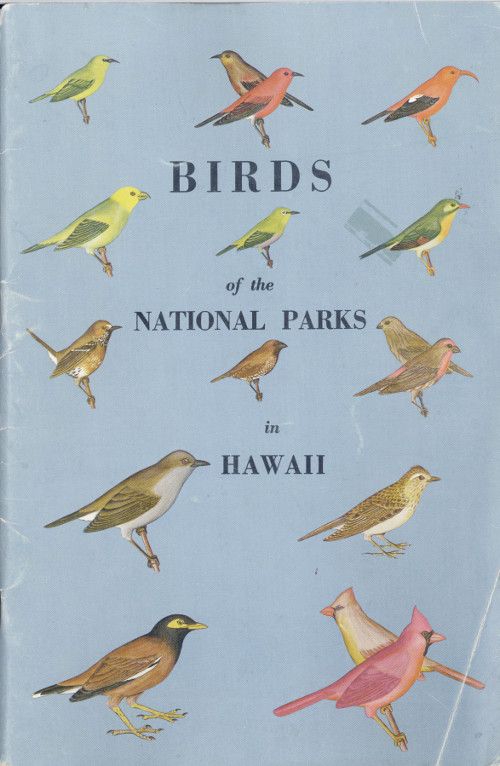
cover by Ronald L. Walker
(see center plate for identification)
BIRDS
of the
NATIONAL PARKS
in
HAWAII
by
William W. Dunmire
Park Naturalist, Hawaii National Park
Illustrated by Ronald L. Walker
District Biologist, State Division of Fish & Game
HAWAII NATURAL HISTORY ASSOCIATION
1961
Trail Through Kipuka Puaulu (Bird Park)
Table of Contents
- Page
- Introduction 2
- How the Birds Came 3
- The Decline of Native Birds 4
- Where to See the Birds 5
- The National Parks 8
- About This Booklet 8
- The Birds
- Petrels: Family Procellariidae 11
- Tropic-birds: Family Phaëthontidae 11
- Geese: Family Anatidae 13
- Hawks: Family Accipitridae 15
- Quails, Partridges, Pheasants: Family Phasianidae 15
- Plovers, Turnstones: Family Charadriidae 19
- Sandpipers: Family Scolopacidae 20
- Terns: Family Laridae 20
- Doves: Family Columbidae 21
- Owls: Family Strigidae 22
- Larks: Family Alaudidae 22
- Babbling Thrushes: Family Timeliidae 23
- Mockingbirds: Family Mimidae 24
- Thrushes: Family Turdidae 25
- Old World Flycatchers: Family Sylviidae 26
- Starlings: Family Sturnidae 27
- White-eyes: Family Zosteropidae 27
- Hawaiian Honeycreepers: Family Drepaniidae 28
- Weaver Finches: Family Ploceidae 32
- Finches, etc.: Family Fringillidae 33
- Other Birds 34
- Index 35
INTRODUCTION
When the Hawaiian Islands were first studied by ornithologists in the nineteenth century, they were a bird paradise. The forests abounded with many of the most unusual birds known to the world—some with enormous sickle-shaped bills, some resembling parrots, a goose that spent most of its life on barren lava flows, a tiny flightless rail, and a sea bird that nested within the vents of the active volcanoes. Most of these island birds were found nowhere else in the world.
Today many of the original island species are extinct, while others are barely managing to hold their own. With more and more land being cleared for agriculture and homesites, virgin forests here are becoming scarce. Thus, protected areas like Hawaii Volcanoes and Haleakala National Parks take on great significance as reserves where the native birds will continue to survive. If you wish to learn about Hawaiian birdlife, you will certainly want to spend some time in Hawaii Volcanoes National Park and visit Haleakala National Park on the island of Maui. This booklet is meant to be an aid to your trips in the field.
Fern jungle—Thurston Lava Tube trail
HOW THE BIRDS CAME
Geologically the Hawaiian Islands are considered to be fairly young, probably no more than 20 million years old. The islands are also extremely isolated from any other land masses; it is more than 2,000 miles to the nearest continent. Before any resident birdlife could exist here, plants had to become established. Seeds arrived by various means from distant lands, and one by one new kinds of plants began to grow on the volcanoes—at first only a few primitive types could get a foothold on the barren lava, but in time those early plants decayed and combined with the basalt rock to produce a soil that could support a complex vegetation.
Endemics
We have no way of knowing what kind of land bird was the first to take up residence here, for that early species has certainly been greatly altered through the workings of evolution. In fact today nearly all the resident native birds are types that are now found nowhere else in the world. Birds such as these are called endemic; they have undergone gradual change over the millennia to become completely new forms, different from any birds found elsewhere.
Many of Hawaii’s endemic species belong to the Hawaiian honeycreeper family (Drepaniidae) and are thought to have evolved from a single bird prototype that possibly arrived here from Central or South America. Explosive bursts of evolutionary change followed, and the resulting new forms did not much resemble each other. Present day park representatives of the Hawaiian honeycreepers include the apapane, iiwi, and amakihi.
Besides the Hawaiian honeycreeper stock several other early migrants made their residence in Hawaii and evolved into endemic forms. In the park they include a Hawaiian race of the (North American) short-eared owl, the io (a hawk), the nene (a goose), the omao (a thrush), and the elepaio (an Old World flycatcher).
Migrants and Sea Birds
While the endemic species have acquired full residence on the islands, other birds live here for only part of the year, usually returning to the north during summer to breed. In the park the best known of these migrants is the American golden plover which spends almost 10 months of the year in Hawaii and only 2 months on its travels to the Aleutian Islands.
Migration patterns for certain of the sea birds are virtually unknown. Some, like the white-tailed tropic-bird, may remain near the islands throughout the year, while others, such as the dark-rumped petrel, migrate inland only during their breeding season.
Exotics
The most recent additions to Hawaii’s avifauna are birds brought in since 1855 by man. There are various reasons for the introductions; the mynah, for example, was brought here from India in 1865 to combat the army worm and other insect pests. Perhaps most of the exotics were introduced because people wanted to see birds that reminded them of their former homes. Birds like the cardinal from the eastern United States and the white-eye from Japan are in this category. For years the Hui Manu, a local bird club, was active in releasing new birds on the islands. Game birds constitute another type of introduction. The first to arrive was the California quail more than a hundred years ago. Pheasants and chukars among others have also become established in the park from importations.
THE DECLINE OF NATIVE BIRDS
In no area in the world have native birds fared more poorly than in Hawaii during the past century. The causes of the decimation of numbers and species are probably multiple; certainly no single factor alone can be cited. Possibly some of the most specialized forms had already begun a decline in numbers before the arrival of Western man. It is unlikely that feather gathering for leis as practiced by the ancient Hawaiians had much to do with the decline. On the other hand, the clearing of land, which began early in the 1800’s, must have had a devastating effect on those birds that had become so specialized—they simply were forced into new environments and were unable to adapt. The introduction of new plants, especially grasses, and the establishment of feral mammals (goats, sheep, and pigs), and insects played a subtle but possibly even more destructive role in altering the over-all environment.
Introduction of exotic birds must have been the final blow to many of the native species. Unfortunately until recently there was no adequate control over importing and releasing new birds in Hawaii. The delicate balance of nature was rudely upset when some of the more aggressive exotic birds were released indiscriminately on the islands. Exotic birds such as the white-eye became so plentiful that direct competition for food with the natives must have occurred. Furthermore, bird diseases new to Hawaii, such as avian malaria (probably brought to the islands with some introduced bird from the Orient), would have been a great killer. With a few exceptions, however, it does seem that the remaining Hawaiian native birds are now holding their own.
WHERE TO SEE THE BIRDS
You will probably be amazed at the extremes of climate in Hawaii, especially on Kilauea Volcano. This is one of the rare places in the world where you can walk a few hundred yards from an area of heavy rainfall to one of striking dryness. The change is due to prevailing trade winds which force moisture laden clouds up over the mountain masses from the northeast, then allow the clouds to dissipate on the leeward side of the mountains. By taking the Crater Rim drive at Kilauea, you will pass through lush fern jungle on one side of the crater and barren desert on the other.
Birds are very sensitive to these differences in climate. Most of the species you find at Thurston Lava Tube will never be seen at Halemaumau, less than 3 miles away. The same thing is true at Haleakala, although less dramatically so. To help you locate the most rewarding sites for bird study in the park, here are a few suggestions:
Kilauea-Mauna Loa
Thurston Lava Tube. This is the heart of Hawaii’s tree-fern jungle and an excellent habitat for several native species, such as the apapane, iiwi, and amakihi. Spend a few moments looking for these at the exhibit overlook, then take the quarter-mile loop path that leads through the lava tube. On the other side of the lava tube parking area a trail descends into Kilauea Iki, the site of the 1959 eruption. This delightful walk also passes through fern jungle. Be on the lookout for the io (Hawaiian hawk) in Kilauea Iki.
Grass slopes on the Mauna Loa Strip
Halemaumau. A most unlikely place for birds; however, there are almost always a few white-tailed tropic-birds soaring within the pit.
Kipuka Puaulu. A popular name for this area is “Bird Park” and for good reason, for this kipuka, a hundred acre island of well developed vegetation surrounded by a recent lava flow, harbors 11 or more species. The commonest here are the white-eye, red-billed leiothrix, and house finch—all exotics. When the ohia trees are in bloom, and usually there are at least a few, large numbers of iiwis and apapanes are attracted to the kipuka. Other interesting birds often seen here are the elepaio, Japanese blue pheasant, and cardinal.
Mauna Loa Strip. More kinds of birds (18) have been recorded from the koa parkland along the Mauna Loa Strip road than from any other locality in the park, but you are not likely to see large numbers in any one place along the strip. The road ascends the lower slopes of Mauna Loa from 4,000 feet at Kipuka Puaulu to 6,663 feet. Several introduced game birds—Japanese blue pheasant, California quail, and chukar—may be flushed as you drive up the road. Skylarks and house finches are fairly common along the grassy flats, and you are almost sure to see an amakihi in the koa grove at the end of the road. If you are lucky you might be rewarded with a glimpse of a nene somewhere on these upper slopes.
Haleakala
Hosmer Grove and Paliku. These two localities are about the only densely wooded areas in Haleakala National Park and both attract a variety of birdlife. The apapane, iiwi, and amakihi as well as several exotic birds can be seen at either place. A delightful self-guiding nature trail that identifies many of the plants and trees winds through the Hosmer Grove.
Road to Haleakala Summit. As you drive up to the Observatory from Park Headquarters you will probably be surprised at the number of ring-necked pheasants and chukars that flush along the road. Golden plovers and skylarks are also plentiful, and mockingbirds may be seen occasionally.
Visitor cabin at Paliku, Haleakala
THE NATIONAL PARKS
Hawaii Volcanoes National Park and Haleakala National Park are two of more than 180 different areas administered by the National Park Service for your enjoyment. The two areas, Haleakala on Maui and Kilauea-Mauna Loa on Hawaii, were set aside, as one park, by Congress in 1916 mainly because of the three great volcanoes. In July 1961 Haleakala became a separate national park. In recent years the unique flora and fauna found in the parks have become an increasingly important part of the park story. Thus you will find several interesting exhibits at the Kilauea headquarters museum dealing with the ecology of the park with emphasis on the birdlife.
One of the guiding principles for any national park is that all native species of plants and animals are rigidly protected. In places like Hawaii, where so much of the land has been altered through clearing and planting, the park becomes a particularly important sanctuary for birds and other animals. Please help do your share in protecting this area by observing park regulations.
ABOUT THIS BOOKLET
The purpose of this booklet is to help anyone who cares to learn about the birdlife of the national parks in Hawaii. Many of you, here in Hawaii for the first time, will not recognize most of our birds; however, the species are so few (32 described here) that it will not be too hard to narrow your identification to the correct one. The little perching birds are likely to give the most trouble, and the commonest of these are shown on the color plate. You will probably want to refer to the plate first when identifying a small bird. Descriptions in the text refer to similar species also, so if you see a bird that appears somewhat, but not exactly, like one of the illustrations, look up the illustrated species in the text for clues.
Hawaiian names, when known, are used as the common name for each bird, except for species that range elsewhere (e.g., all the sea birds and introduced birds). The A.O.U. Checklist of North American Birds has been used as the authority of nomenclature wherever applicable, otherwise the Checklist and Summary of Hawaiian Birds by E. H. Bryan, Jr., has been followed. For every description, length from the tip of the bill to the end of the tail is given in inches. The stated distributions are for the park only and they emphasize accessible places that you are most likely to visit.
The serious bird student will want to have books that include Hawaiian birds outside the park. The latest edition of Peterson’s A Field Guide to Western Birds includes a section on Hawaii and will prove invaluable.
In preparing the text for this booklet frequent reference was made to George C. Munro, 1944, Birds of Hawaii and Hawaii Audubon Society, 1959, Hawaiian Birds. The most important current references for the Hawaiian honeycreeper group are Dean Amadon’s (1950) monograph, The Hawaiian Honeycreepers and Annual Cycle, Environment and Evolution in the Hawaiian Honeycreepers by Paul H. Baldwin (1953). Baldwin, a former Assistant to the Superintendent of Hawaii National Park, has authored several other important papers on birdlife here. The Game Birds in Hawaii by Charles W. and Elizabeth R. Schwartz is an invaluable reference on gamebirds.
The author wishes to acknowledge helpful suggestions made by E. H. Bryan, Jr., of the Bernice P. Bishop Museum; Robert L. Barrel, Robert W. Carpenter, and Robert T. Haugen of Hawaii National Park; and Ronald L. Walker and David H. Woodside of the State Division of Fish and Game. The Bishop Museum generously loaned study specimens for the drawings.
The black and white and color drawings are by Ronald L. Walker, and all photographs are by the author except where noted.
Haleakala Crater, breeding grounds for the dark-rumped petrel
PHOTO BY FRANK RICHARDSON
Dark-rumped petrel
DARK-RUMPED PETREL Pterodroma phaeopygia
(Hawaiian name—uau)
DESCRIPTION: 15″. Underparts, forehead, and cheeks, white; back, upper wings, and upper tail, dark. The crown is black.
PARK DISTRIBUTION: This petrel is a sea bird that nests in the mountains of the Hawaiian group; it is the nesting birds that may be seen or heard within the park between May and November. Kilauea—Status unknown; the cliffs of Kilauea Crater may be used for nesting. Haleakala—Many birds nest in the walls of the crater. The cliffs behind Kapalaoa and Holua Cabins are the best places to hear them at night.
VOICE: As the birds fly overhead seeking their burrows after dusk, the air is filled with their strange calls, some of which sound like the barking of a small dog. A common pattern of notes is oooo-wéh, ooo-wéh, oo-wéh, oo-wéh, etc., with the first notes drawn out and the last run together in rapid succession.
Dark-rumped Petrels spend most of their life at sea, but in April and May they begin their nightly flights inland to burrows they have established high on the cliffs of Hawaiian volcanoes. A single egg is laid near the end of the horizontal cavity that may be more than 6 feet deep in the rocks. For the next 6 months the adults will fly in from the ocean each night to tend the nest, arriving about an hour after sundown. It is while they are circling in search of the burrows that you can hear their mysterious barking sounds. The calling may continue for 2 hours or more. Imagine the problems that each petrel must face trying to find its own burrow 20 miles from the ocean on a foggy, moonless night—perhaps the continuous calling back and forth helps orient it. The adults return to the ocean before sunrise.
In the early days nesting birds were common on all the main Hawaiian Islands; however, for a time it was feared that they were becoming extinct. Hawaiians used to dig out the downy young petrels for food, and introduced mongooses and cats also took a heavy toll, especially where nests were at lower elevations. Now, with known breeding colonies high on Haleakala and Mauna Kea and probably on Mauna Loa and Kilauea, the future of this interesting species seems assured.
WHITE-TAILED TROPIC-BIRD Phaëthon lepturus
(Hawaiian name—koae)
DESCRIPTION: 30″-32″. Unmistakable as a large white bird with two fantastically long tail plumes, soaring around rocky cliffs such as in Halemaumau. There is some black on the upper wings and around the face.
PARK DISTRIBUTION: Kilauea—Uncommon, except locally. There are nearly always a few birds soaring in Halemaumau, around the pit craters in the Kau Desert, and near Hilina Pali. They are occasionally seen along the coast. Haleakala—Some can usually be seen in the crater, especially around the ruggedest cliffs such as behind Holua and Paliku Cabins.
VOICE: High pitched rasping cries.
Halemaumau—What a strange place for a sea bird! Yet these fish-eating birds have nested in the Kilauea area for as long as we have records. In recent years Halemaumau has been their favorite haunt, except when volcano fumes drive them away, such as during the time when heavy sulphur gasses filled the pit in June 1960. When Halemaumau erupts the birds may become trapped by rapidly rising hot gas; in 1952 several of them perished, falling into the molten lava below. For a meal the Halemaumau birds must make at least a 10-mile flight to the ocean.
EXHIBIT AT THE PARK MUSEUM
White-tailed tropic-bird
Nene—the native Hawaiian goose
NENE Branta sandvicensis
(also Hawaiian goose)
DESCRIPTION: 23″-28″. The only ducklike bird apt to be seen in the park. A medium sized goose with striking head and neck markings. The face, crown, and top of the neck are black, the throat and neck sides are cream colored, and the remainder of the body is mottled and dark.
PARK DISTRIBUTION: Formerly abundant in Hawaii and probably Maui. Now extinct on Maui, while a few wild birds remain on Hawaii. Kilauea—Occasionally seen on the slopes of Mauna Loa usually between 6,000 and 7,500 feet.
VOICE: Various thin, creaky notes. Often gives a high-pitched honking in flight.
Because of recent studies, the habits of the nene are probably better understood than those of any other native Hawaiian bird. The most amazing thing about their life is the way they have forsaken water in favor of rough, clinkery lava. All other ducks and geese rear their young partly in water, but today the breeding grounds for the nene, high on the barren slopes of Mauna Loa, are far from the nearest open water. Here during the winter months the geese raise their broods of two to five young. Berries, herbs, and grass growing in kipukas (islands of vegetation surrounded by more recent lava flows) comprise the diet. At present the nene is one of the rarest birds in the world and has been near extinction in recent years.
The story of the nene’s decline is a sad one but it may yet have a happy ending. Early visitors to the islands described the large flocks of nene geese in the interior of Hawaii, but by 1900 a great decline in numbers had occurred and in 1940 the entire population was estimated at 30 to 50 wild birds. Clearing of the land, introduction of such exotic mammals as rats, pigs, dogs, and mongooses, and man himself through hunting—all must share the blame for the nene decimation. Happily, the State of Hawaii has taken vigorous recognition of this situation and a restoration program was begun in 1949. The plan is to study the remaining wild birds to learn how the decimating factors may be controlled. Also nene raised in captivity have been released on Mauna Loa to intermix with the wild flocks, and it is hoped that some day visitors to Hawaii will again be assured of seeing these wonderful geese.
PHOTO BY GEORGE C. RUHLE
Nene Nest
IO Buteo solitarius
(also Hawaiian hawk)
DESCRIPTION: 16″-18″. The only hawklike bird to be seen on the islands, except for accidental migrants. This small Buteo has both light and dark color phases. Can be distinguished from the Pueo, Hawaii’s diurnal owl, by a smaller head and more soaring flight.
PARK DISTRIBUTION: Found only on the island of Hawaii. Kilauea—Occasional throughout the park. Individuals are often seen soaring around the forested craters such as Kilauea Iki and Makaopuhi, or in the more open areas such as along the Mauna Loa Strip road.
VOICE: A medium-pitched, but fairly soft, scream.
The io is certainly one of the rarest hawks in the world, as its range is limited to the island of Hawaii, and even here it is not common. It feeds on rats, mice, and large insects and spiders, and occasionally will catch birds, but today birds comprise a minor part of the diet. It tends to be tamer than mainland hawks, perhaps because it has not been harassed as much in recent years, and sometimes you can approach a perched io quite closely. Because of its rodent diet, the io is a very beneficial bird to Hawaii.
California quail (male and female)
CALIFORNIA QUAIL Lophortyx californicus
DESCRIPTION: 9½″-10½″. The distinctive curved head plume identifies this plump quail. Males have a black and white face pattern beneath the brown crown, while females are duller and lack the striking facial pattern. The bill is short and black.
PARK DISTRIBUTION: Introduced from California before 1855 to all major islands. Kilauea—Moderately common along the Mauna Loa Strip and south and west of Kilauea Crater, for example Kipuka Nene. Haleakala—Fairly common on slopes outside the crater up to about 8,000 feet.
VOICE: Both sexes issue a three noted ka-kér-ko, also clucking notes tek-tek, etc.
Although the California quail has been in the islands for a long time, it has not spread much in the park, probably because there is no available open water. In this situation the birds must rely on dewfall, berries, or succulent vegetation for their moisture requirements. They shun heavy forests and do best where small grassy openings are interspersed with dense brush thickets.
CHUKAR Alectoris graeca
DESCRIPTION: 15″. A heavy ground dwelling partridge, brownish with buffy, black, and rusty markings. A black band extends through each eye and joins the lower throat. Distinguished from the quail by lighter color, lack of a head plume, and a red-orange bill.
Chukar
PARK DISTRIBUTION: Introduced on Hawaii in 1949, on Maui in 1953. Kilauea—Occasional on the slopes of Mauna Loa, descending as far as the rim of Kilauea Crater. Haleakala—Common in open lava slopes inside and out of the crater but especially along the drive to the summit.
VOICE: Chickenlike cackles and clucks, sometimes quite loud.
They are well camouflaged to blend with Hawaii’s gray lava and are not usually seen until one or more flushes from an open or even bare slope. Then they will fly downslope, sometimes for hundreds of yards, land, and again merge invisibly with the somber background.
During the breeding season in late spring and summer the birds pair up; at other times of the year you may encounter coveys of a dozen or more.
RING-NECKED PHEASANT Phasianus colchicus torquatus
(also Chinese pheasant)
DESCRIPTION: Male 33″-36″; female 20″. Male: A rich chestnut-brown bird with a conspicuous white collar at the base of a dark green neck, and an extremely long pointed tail. Hybridizes freely with the Japanese blue pheasant, producing various combinations of ring-necked and blue plumage. Female: Dull brown with a shorter tail than the male, similar to the Japanese blue hen.
Ring-necked pheasant cock
PARK DISTRIBUTION: Introduced from China about 1865, now widely distributed on all main islands. Kilauea—Pure ring-necks are quite rare but Japanese blue hybrids are not uncommon in grassy openings, especially along the Mauna Loa Strip road. Haleakala—One of the most common birds of the park, both inside and out of the crater.
VOICE: The cocks crow throughout the breeding season (January-July) with a violent staccato koor-káck.
Optimum pheasant habitat is large open grassy areas interspersed with brush cover, and since this condition prevails on the slopes of Haleakala and along the Mauna Loa Strip road, these birds are found in both sections of the park. Your first view of one will likely be when it flushes out with a great flurry of wingbeats alongside a road or trail in these grasslands. Family broods with as many as 10 chicks may be seen from April through August.
JAPANESE BLUE PHEASANT Phasianus colchicus versicolor
(also versicolor or green pheasant)
DESCRIPTION: Male about 27″, female 20″. Male: Has a blue-green back, iridescent green or purple breast, and long tail feathers. Appears darker than the ring-necked pheasant and lacks the white collar. Female: Brownish birds with long tails, indistinguishable from the ring-necked hen.
PARK DISTRIBUTION: Introduced from Japan prior to 1900. Has lost its identity on most islands due to hybridization with the ring-neck. Kilauea—The park includes perhaps the best habitat in the islands for this species. Pure Japanese blue males are common along the Mauna Loa Strip road and occasional on the Chain of Craters road or the Crater Rim drive and to the west. Hybrids will also be seen. Haleakala—Nearly all are ring-necked pheasants here.
VOICE: The cock-crow is similar to that of the ring-neck, but somewhat higher in pitch.
This species has adapted to the moist open-forest and grassland, while the ring-neck prefers drier areas. Blues seem to have established a niche on the southern slopes of Mauna Loa between 4,000 and 7,000 feet elevation where mists are frequent, sometimes for days at a time.
| KEY TO PLATE | ||
|---|---|---|
| AMAKIHI (male) | APAPANE (immature and adult) | IIWI |
| OU (male) | WHITE-EYE | RED-BILLED LEIOTHRIX |
| ELEPAIO | RICEBIRD | HOUSE FINCH (female and male) |
| OMAO | SKYLARK |
| MYNAH | CARDINAL (female and male) |
American golden plover in winter plumage
AMERICAN GOLDEN PLOVER Pluvialis dominica
(Hawaiian name—kolea)
DESCRIPTION: 10″-11″. A medium sized shore bird with a straight, inch-long bill. Winter plumage—mottled brown spotted with gold; buffy breast. Summer plumage—striking pattern; back spotted with gold, black undersides, and a white band over the forehead and down the sides of the neck and breast. Plovers don their summer colors in April or May before migration and may still retain them when they return in early August. The only shore bird likely to be seen in the interior of either park.
PARK DISTRIBUTION: Winter migrant to the islands. Kilauea—Fairly common locally from August to June. To be seen around Park Headquarters and on the west side of Kilauea Crater or along the Mauna Loa Strip. Haleakala—Common from August to June in open areas both inside and out of the crater.
VOICE: A clear whistle queep, or quee-leép, etc., usually uttered as the bird is flushed.
Like other migrants to Hawaii, golden plovers make a 2,000-mile (one way) flight to and from their breeding grounds in Alaska or Siberia each year. The trip requires about 48 hours, spent mostly over the open ocean. When they arrive in Hawaii in the fall, individuals seem to establish remarkably small territories—one bird may live during its entire stay here in an area not much bigger than a large lawn. Here they will feed on insects and berries until it is time for the annual migration to the north.
RUDDY TURNSTONE Arenaria interpres
(Hawaiian name—akekeke)
DESCRIPTION: 9″. A chunky, medium sized shore bird with flashy black, white, and russet-red markings and short orange legs. The contrasty black and white pattern shows best in flight.
PARK DISTRIBUTION: Winter migrant to islands. Kilauea—Except for summer, when they have migrated to Alaska, flocks are often found at rocky beach areas around Halape, but they are uncommon elsewhere along the rugged coast within park boundaries. Large flocks were formerly recorded inland as far as Kilauea Crater. Haleakala—Absent from the park.
VOICE: A rapidly repeated chut-a-chut.
A flock of 8 or 10 turnstones will behave almost as though it was controlled by one mind: in flight they dip and turn precisely together; when they land it is a simultaneous action. The name turnstone comes from their habit of flipping over small rocks with their bills to get at the insects and other lower forms of life beneath.
WANDERING TATTLER Heteroscelus incanum
(Hawaiian name—ulili)
DESCRIPTION: 11″. A large sandpiper with uniformly dark gray upper parts and a long (1½ inches) straight bill. The belly is lighter, and there is an indistinct white line over the eye. The long legs and the feet are yellow.
PARK DISTRIBUTION: Winter migrant to islands. Kilauea—Uncommon along the southern rocky shoreline. Absent in summer when it migrates to Alaska. Haleakala—Absent from the park.
VOICE: A high clear whee-we-we-we usually uttered as the bird takes flight.
Individuals feed on crabs and other marine life among the rocks. They never appear inland in the park.
WHITE-CAPPED NODDY Anoüs tenuirostris
(Hawaiian name—noio)
DESCRIPTION: 14″. A dark gray tern restricted to the rocky coastline. The forehead and crown are lighter gray than the rest of the body.
PARK DISTRIBUTION: The only common bird to be seen flying just off shore. In the park, restricted to the coastline of the Kilauea Section.
Look for these along the ocean at the Kalapana end of the park. They flutter over the water picking up small fish, but usually they stay close to shore. The noddies nest in sea cliffs and caves in this area.
SPOTTED DOVE Streptopelia chinensis
(also laceneck or Chinese dove)
DESCRIPTION: 12″. A gray-brown dove with a long rounded tail showing white in the corners, and a broad collar of black with white spots on the neck.
PARK DISTRIBUTION: Introduced before 1900; now common below 4,000 feet on all islands. Kilauea—Fairly common around the crater and at lower elevations such as on the Chain of Craters and Hilina Pali roads. Haleakala—Absent from the park.
VOICE: Typical dove-like coos; often coo-coó-coo.
Like the barred dove, this species does not much penetrate the native rain forest, but rather seems restricted to areas where man has altered the vegetation. Both species feed on seeds and some fruit.
Spotted dove—Barred dove
BARRED DOVE Geopelia striata
DESCRIPTION: 8″-9″. Much smaller than the spotted dove and lacks the lacy white neck. Has white outer tail feathers.
PARK DISTRIBUTION: Introduced to the islands in 1922; still spreading on the island of Hawaii since its arrival here in 1935 from Asia. Kilauea—Rare—at elevations below 3,000 feet. Haleakala—Absent from the park.
VOICE: A rapid ringing phrase, higher pitched and faster than for the spotted dove, often wheeédle-de-wer.
The range for this dove on Hawaii is continuing to increase. It is now abundant along the Kona coast and has spread in both directions around the island. Look for it within the park on the Hilina Pali road or on the Kalapana road.
PUEO Asio flammeus
(also Hawaiian short-eared owl)
DESCRIPTION: 14″-15″. A medium-sized owl of buffy brown color and with small ear tufts. In flight it appears big-headed and neckless compared to the io.
PARK DISTRIBUTION: Kilauea—Occasional around the crater and in grassy areas on the Mauna Loa Strip. Haleakala—Occasional near meadows inside the crater such as at Paliku; also on the lower slopes, especially just below Park Headquarters. They are frequently seen on the drive up to the park.
VOICE: Rarely heard muffled barking sounds.
You may be surprised to see an owl soaring hawklike over grassy openings in full daylight. However, this Hawaiian race of the mainland short-eared owl is often diurnal. It will hover over one spot until a mouse or rat ventures out into the open, then with a swoop the pueo captures its meal.