
“He might use my alpenstock, and make it all right,” said Dumplin’, trying to seem cheerful as he saw the rest leaving him. “I’ll watch for you, and have hot supper ready,” he added, waving his hand.
“Good old Dump!” Bennie said, as they moved out on the pumice. “Too bad he can’t come along.”
“He’ll be all right in a year or two, after we get the fat off him, and get him hardened up. He’s grown too fast,” said Uncle Billy.
Whether it was because they were now more used to the trick, or because Dumplin’ was not on the rope to hold them back, or because the steps had not entirely melted away since the day before yesterday, making the doctor’s work easier, or because of all three reasons, they made faster time than before, and didn’t need to rest so long or so often. But they had four rock chutes to cross instead of two. The one which had been started by the big lava chunk which nearly hit them was now four feet deep, and a fourth one had been ploughed, also. But nothing was coming down them yet, for they reached the traverse long before the sun’s rays got in on that side. They were up on the northwest shoulder at 10:30, and at the base of the pinnacle at noon.
Once at the foot of that terrific incline, both the scouts felt suddenly weak in the knees.
“Like the looks of it?” the doctor asked.
“I do not!” Bennie answered. “I’d about as soon try to climb the outside of the Washington Monument. But if you say people have done it, I guess we can. It’s a fight, and I ain’t licked yet!”
The doctor let them rest before they tackled the pinnacle, and gave his orders. “I’ll go ahead and cut the steps. You, Bennie, will anchor, and play me out the rope, and don’t you come on a step till I tell you. Then Stone will play you out till you get to the platform I’ve made for you. Then Spider plays him out, then Norman plays Spider out. We won’t have more than one of the five of us moving at any one time, in other words.”
The doctor rose, and began to hack steps into the snow, in front of his face, on the precipitous incline. He had to cut them deep, to get a firm footing, and it was slow work. Before he was quite played out on his twenty feet of rope, he cut an extra large step, like a little platform, and then moved up a couple of steps, and told Bennie to climb to the platform. Bennie did so, while Mr. Stone played him out. Then Bennie anchored firmly on the platform, and let his uncle cut his way up fifteen or twenty feet farther. Bennie then stepped up two steps, and let Mr. Stone climb to the first platform. Once on it, Mr. Stone played Bennie up, till he was on a second little platform, just behind the doctor. Then the doctor moved ahead twenty feet higher, Bennie moved, Mr. Stone climbed to platform number two, and they all anchored hard, and waited till Spider reached platform number one. In this way, only one man ever climbing at a time, with the rest anchored, they crept slowly up the wall of icy snow. In two places, it was, in fact, not snow but actual ice, and the doctor had to hack out the steps and could not use his stock as he climbed. He had to depend on the spikes in his boots entirely, because he carried no ice ax. Bennie, below him, watched with terror in his heart, and clung to his alpenstock with a rigid grip. If his uncle slipped, nothing would save him but that stock! If Bennie’s grip gave way, they would both go, and maybe pull down all the rest! Here was a battle indeed, here was a fight with the mountain where every single step you took had to be just right, or you were gone! Bennie didn’t dare look down. He kept his eyes fixed on his uncle’s boot soles above him, and refused even to look off to right and left. He didn’t dare.
They climbed steadily, and in silence, except for the orders to each man when he was to advance. Their faces were set and grim. Bennie felt the strain. He was getting tired rapidly, not from the physical effort, which wasn’t really great except for the doctor, but from the mental effort, the incessant concentration on every step he took. At last, after an hour and a half, the doctor went over the top, and shouted back a loud “Hurrah!” Bennie followed him over, and one by one the rest came on, to fall at once down on the snow.
After a long moment, Bennie sat up and looked around him. At first he felt as if he were riding in an airship in the sky. The summit cap of snow was small, and on every side ended in a sharp edge—the edge of a precipice!
“Look at old Hood up there!” his uncle cried, pointing north. “Seems near enough to touch today, and it’s fifty miles off.”
“I don’t want to look at it,” Bennie answered. “I don’t want to look at anything. Gosh, I don’t like this place!”
“I don’t care for it much myself,” Mr. Stone confessed. “You could roll over twice here, and commit suicide with the greatest ease.”
“But we got here!” Spider exclaimed. “I’m glad we got here! We’ve beat the old mountain!”
“Now you’re talking,” said Uncle Billy. “You’ll all like it better when we are down again. Well, come on, let’s start then, if you don’t care for my view.”
They now reversed positions on the rope, Norman going first, and facing in against the cliff almost as you descend a ladder, crawled down as slowly as they had crawled up. But it was even more trying to Bennie, because he had to look down for each step, and he had to watch the man descending below him, when he was anchored, in order to brace extra firmly in case of a slip. He didn’t get dizzy, but at every step he had to fight a kind of nausea, as if he was going to be sick, especially when he was obliged to lower himself over the two ice walls, with only his spikes to hold him, and the rope, played out by the man above. When they were all at the bottom again, he felt faint, and sat down on the snow a moment, to get back the strength in his legs.
“Well, boys,” he heard his uncle say, “you’ve done what mighty few people do any one season. But we’re not through yet. We’ve got to get home, you know.”
Bennie got up quickly. “I’m all right,” he said. “Lead the way!”
At half-past four o’clock they were back again at the point on the shoulder where they lunched two days before, and here they rested fifteen minutes, and ate the small portions of food they had brought. Nobody was really hungry, however, and soon they were starting down the drift where Dumplin’ slipped. Out across the traverse they went, got over the chutes without accident, though twice they were barely over when great toboggans of ice came whizzing down, and at seven o’clock reached the southwest shoulder. Far below, at timber line, they saw Dumplin’ building up the fire, and they saw, too, his tracks up here in the snow.
“He was up here watching us crossing the traverse,” Bennie said. “He beat it down to cook supper. Good old Dump—wish he could have been with us.”
Off came the rope now, and with wet boots and cracked faces and aching backs and smarting eyes, they half ran, half tumbled, down the last snow-field to the camp, and walked into the odor of boiling coffee and sizzling bacon, while Jeff, released from his tether, came yelping to meet them.
“I saw you on top!” Dumplin’ said. “I spent half the day up on the shoulder. I couldn’t see you climb the pinnacle, but I saw you on top. You didn’t stay there long.”
“Bennie didn’t like it,” his uncle laughed.
“I’ll say I didn’t!” Bennie cried. “Gee, Dump, I’m not fat like you, and I guess I’m in pretty good condition, but I kept feeling all the way up and down that old pinnacle as if I was going to be dizzy the next minute.”
“That’s not a matter of condition with you—it’s a matter of nerves,” said his uncle.
“I felt so, too,” Spider put in. “Whenever I looked down, and couldn’t help thinking what would happen if I fell, then I got kind of sick inside. But when I was just thinking about my next step, I was all right.”
“And nothing happened,” the doctor added. “Climbing is safe enough if you know how to climb, if you are in good physical condition, and if you can control your nerves. But you can no more tackle a climb like this safely without a guide who knows the technique than you can fly an aeroplane without practice. The accidents happen either to people who try to climb without knowing the tricks, or to people who aren’t in good shape for the hard work, or to people who can’t keep their nerves under control and take each step slowly, carefully and firmly.”
“What made me so tired at the top?” Bennie asked. “I was twice as tired then as I am now. Was it the altitude?”
“No,” said his uncle. “Ten thousand five hundred feet wouldn’t bother you a bit. It was because you are still a green climber and you were fighting your nerves all the way up the pinnacle. Nothing is such hard work as fighting your own nerves.”
“Well, I’ll tell the world my old nerves put up a good scrap, then!” Bennie laughed. “Anyhow, Spider and I aren’t so green as we were three days ago. I wish the Boy Scouts gave merit badges for mountain climbing. I bet we could get one.”
“Why don’t they give badges for that, I wonder?” Mr. Stone said.
The doctor shook his head. “Too dangerous,” was his comment. “How many scout masters could you find who are really skilled mountain climbers? Think what would probably happen if a green climber tried to take a bunch of scouts up Jefferson. They’d all land down in the cañon. And rock climbing is just as dangerous.”
“How would you get up the pinnacle if it was all ice, the way it was in a couple of places?” Spider asked. “I mean, so hard, you couldn’t drive your stock in, and the man below you couldn’t either?”
“You’d have to use ice axes,” the doctor replied. “An ice ax has a long handle, and on the back of the blade is a long, sharp, slightly curved point, like a railroad spike. You cut your steps with the blade, and then you use this point, driven in above you, to anchor with. That’s what they use in the Alps, where so much of the climbing is on glacier ice.”
“Well, Spider, we’ll have to go to Switzerland next, and climb some old glaciers,” Bennie grinned.
“And a few spitzes,” Spider answered.
It was bitter cold again that night, and soon after supper they all crawled into their sleeping bags. They were so weary, however, that even the cold could not keep them awake.
CHAPTER XXIV
Back Over the Divide—A Horse Turns Three Somersaults Down the Snow Slope
The doctor, as usual, was first up. He rose at dawn, got the fire and the breakfast started, and then routed out the rest. The peak of Jefferson above them was hidden in mist, and Hunt’s Cove below was filled with white cloud, also. In fact, they looked out over a billowing sea of white, with the sharp lava spires of Three Fingered Jack to the south, rising up like an island.
“Looks like a phantom ship,” said Bennie.
They were scarcely through breakfast, when they heard horses coming up through the timber, and soon the guide appeared, leading a couple of pack animals to take the luggage down. An hour later they were once more in Hunt’s Cove. The luggage was repacked, the boys unscrewed the spikes from their boots and mounted into the saddle again, and Norman led the way almost due south, following a trail up the head wall, instead of trying to get back as they had entered across Grizzly Flats.
“We can get back to the cars this afternoon this way—if we can cross at all,” he said. “But I won’t promise we can cross, doctor. A week ago you couldn’t get up on the other side.”
“Just the same, we’ll try it,” the doctor replied. “Bennie needs some exercise.”
For the next few miles they traveled through woods and across open upland meadows, riding on deep snow. In the hot glare of the sun, they had to put on their glasses again, and repaint their faces. Their lips once more cracked open, and their noses were burnt a still brighter brick red. Then they came to the crest of the Divide, below the long south shoulder of Jefferson, and started down. They realized at once why Norman said it was impossible a week ago to climb up here. There was a drop of a couple of hundred feet where the trail was completely buried in a huge drift, which, Norman said, a week before had an overhang at the top, completely preventing any horse getting over. But this cornice had now melted and collapsed. They dismounted, grasped their horses by the bridles, and started down, taking the slope at an angle to lessen the pitch. The saddle horses got down well enough, but the pack horses, with the top-heavy loads on their backs, could not keep their footing so well, and half-way down one of them fell. He turned three complete somersaults as he pitched headlong. At first the load held, but at the second somersault the hitch slipped, and out burst the load, scattering and tobogganing in all directions—two rolled-up sleeping bags, a tent, alpenstocks, a dunnage bag, a coffee-pot, and what canned goods were still left in their provision supply.
Crossing the Divide near Mount Jefferson on July 25th. Three Fingered Jack in the Distance.
The terrified animal landed in a small fir tree at the bottom, scrambled to his feet apparently unhurt—and made a dash right back up the slope! His fall, his snorts, his sudden dash, threw a scare into the other horses. The saddle horses, of course, were being led, and couldn’t get away, but the pack horses dashed after him.
“Quick!” shouted Norman, “give all the saddle horses’ bridles to one man, and then head ’em off!”
Everybody led his horse quickly to the cook, who tied the bridles to a tree, and then the men and boys ran up the slope as fast as they could, some going to the right, some to the left, in order to surround and get ahead of the runaways, and drive them back.
It was hard work. The snow was deep and soft and wet, the slope very steep, and a frightened horse, with four legs, can climb faster than a man with two. Jeff didn’t help any. He merely dashed wildly around, barking loudly, without sense to head the horses back.
“Call off that chickadee hound!” panted the doctor to Bennie.
The first horse, minus his load, actually got back to the top, and scrambled over, before he could be headed. Norman and Bennie followed him, sneaking on either side through the trees, for a quarter of a mile before he stopped abruptly at a spot where the snow was melted, and began to eat grass. Then they crept up on him, got hold of his rope bridle, and led him back.
By the time the train was rounded up again, everybody was reeking wet with perspiration from their knees up, and soaking wet with snow water from their knees down.
“My head is burning, and my feet freezing, and oh, boy, for a drink!” Bennie exclaimed.
The scattered luggage was collected, the horse repacked, and they moved on. In less than a mile of rapidly dropping trail the snow ceased entirely. The trail grew dry and dusty. The yellow pines began to appear again, and they came to a little lake at the head of a cañon—and everybody, horses and men and boys, drank and drank and drank.
After that there was no more snow, and before long the trail was in a forest of yellow pines, and wide as a country road, and all except the rustler and the cook, who had to look after the pack horses, broke into a trot.
In a couple of hours they reached a fine, clear, racing brook, and a Forest Service camp ground. Across the brook was a real road. The doctor and Mr. Stone trotted on three or four miles to get the cars, while the rest waited for the pack horses, and when they arrived got the packs off and sorted.
When the cars came back, the baggage was transferred to them, the boys said good-bye to Norman, Bennie made the cook shake hands with Jeff, and sinking back into the cushions of the motor cars, the boys sighed with the sudden sense of luxury.
“Beats the saddle of an old cayuse, when you’re tired,” Dumplin’ called from his father’s car.
“Just the same, I’m awful sorry it’s all over,” said Bennie. “I never have worked so hard in all my life—and I never had such a wonderful time.”
“Me, too,” said Spider.
“You’ve got a good time coming, and in about one hour, or less,” said Uncle Billy. “I don’t know whether you’ve noticed that lunch was pretty sketchy today.”
“Sketchy is the word,” Bennie answered. “Gee, it’s three o’clock, and we haven’t had a thing since five A. M.”
“You wait,” laughed the doctor. “I’ve got a surprise for you.”
In a short time he stopped the car at a ranch house beside the great springs of the Metolius River, which gush right up out of the open ground of a green meadow in the heart of the forest, irrigating the whole meadow and making a rich oasis of grass and crops in the arid soil.
“Dinner ready?” he called to a woman on the porch.
“All ready,” she answered.
“How did you order dinner here?” demanded Bennie.
“Radio,” the doctor grinned.
“He telephoned from the Ranger Station when he went for the car, you poor fish,” Spider said.
The two men and three boys washed up and went into the dining-room. There, on a table with a real cloth, was a huge dinner—steak, fried potatoes, green vegetables, hot biscuit, berries. They ate and ate, and when the food was gone the woman of the house reappeared bearing a huge lemon pie, with browned meringue three-quarters of an inch thick, all covered with little golden drops like honey.
“Wow!” yelled Dumplin’. “Lemon pie!”
“Oh,” sighed Bennie, “why did I eat so much steak!”
“I’ll take Bennie’s piece, then,” said Mr. Stone.
“I’d like to see you try!” Bennie answered.
When the pie was gone, everybody sat back and sighed with content.
“That pie was almost as wonderful as Mount Jefferson,” Bennie declared.
“And it didn’t make me dizzy,” said Dumplin’.
“It’s the kind Mother made,” said Mr. Stone.
“Gosh, I wish my mother could!” Spider exclaimed.
“It was a good pie,” said the doctor, “but don’t forget you’ve lived on camp fare for a week. It would have seemed pretty good if it hadn’t been as good as it was.”
“Don’t try to run that pie down, Billy,” Mr. Stone declared. “I will defend that pie with my last breath.”
“All I can say is this——” Bennie began impressively.
“Yes?” the rest prompted.
“I am satisfied with Oregon,” he finished.
“It’s the lemon pie!” laughed Dumplin’.
They rolled into Bend at nine that evening, Jeff was left to sleep in the car at the garage, and for the next hour there was a grand splashing in bathtubs, a washing of clothes, a shaving by the two men, who hadn’t shaved for a week, a patching of burnt noses and cracked lips with salve, and a general clean-up and overhauling.
“Oh, dear!” sighed Bennie, “it’s almost over! I wish we hadn’t been able to get over the Divide today, so’s we’d been forced to go back over Grizzly Flats. That would have kept us out three days more. I don’t want to sleep in an old bed, with sheets!”
“I guess it won’t keep you awake,” laughed Spider. “If it does, I’ll set up the sodas tomorrow.”
But he didn’t have to.
CHAPTER XXV
Bennie Loses Jeff, but Brings Home Something Else to Last Him Many Years
The doctor routed everybody out at five the next morning.
“It’s the last time, boys,” he said. “But we’ve got to get an early start today. I must make The Dalles tonight, and Portland tomorrow night. My vacation is over then.”
“Don’t go back on my account,” said Bennie. “I’ll stick around the mountains another week or two with you, if you really want me to.”
“Yes, and I’ll stick, too,” Spider laughed.
“I wish we could,” Uncle Billy answered. “But while we’re getting hard and healthy, a lot of folks up in Portland are getting sick, so you see I have to be back. Hustle along, boys. No time to lose!”
It was so early that they had to get breakfast at an all-night lunch room, where Bennie bought some meat scraps for Jeff, who was still on the job. He had slept in the car that night.
“Good gracious, are you really going to take that mutt back with you?” his uncle demanded. “All the way East?”
“You’ve said it. Why, I bet he’d follow the train, if I didn’t take him. He appreciates me at my true value, this blooded collie does, don’t you, Jeff, old thing?”
Jeff responded by leaping up and licking his face.
They were off at six, and rode all day northward through the “desert” country, sometimes down in the bottom of bare, desolate looking cañons, sometimes up on the plateau where nothing but endless miles of sage brush lay between them and the Cascades. In the morning Jefferson was the nearest mountain, and they could see the whole eastern face, snow-white and precipitous, with the summit pinnacle looking from this distance like a tiny little white button on top. Later they had to descend by a long, winding road cut out of the bank, without any guard rails, into the Deschutes Cañon, across the river on a bridge, and climb out on the other side. As afternoon came on, Jefferson dropped behind them, and Mount Hood grew nearer, 11,225 feet of snow, shaped like an almost perfect pyramid.
Again they descended into a cañon, and climbed out of it for six miles by a road so steep that they had to keep in low speed all the way, so narrow Bennie prayed they wouldn’t meet anybody, and without any sign of a guard rail, or fence, or wall, to keep a car from skidding off into the hole below.
“Say, if I drove a car out here much, I’d have nervous prostration,” Spider said, as Uncle Billy crawled past a descending Ford, with his right wheels about eight inches from the rim of the cañon.
“And if I had to drive down Fifth Avenue, I’d probably have it,” the doctor laughed.
The sun was setting as they finally came into a region of orchards and endless grain fields, hit a good road, and whizzed rapidly down hill, steeper and steeper, into the gorge of the Columbia River, and ran right into a thriving, lively town called The Dalles.
While the cars were being looked after in a garage, Bennie went to a butcher’s shop to get some more food for Jeff, fed him, and put him up in the car again, for the night. Then they all went to the hotel, registered, got the dust off their faces and clothes, and went in to dinner.
The next morning Jeff was not in the car. The garage man said he stayed there a while the night before, and then, when nobody was looking, evidently jumped out and ran away.
“Oh, gee, he was looking for me!” Bennie cried. “I ought to have tied him. Poor old Jeff, he’s just hunting for me, all over this town!”
“Too bad,” said Uncle Billy. “But he’ll find a home somewhere—he seems to make friends easily, and your mother’ll be awful glad.”
“Well, I got to find him. Please drive around town while I look for him!”
“But I have to be back in Portland, Bennie. I’ve got to be at the hospital tomorrow morning.”
“Aw, just ten minutes! Please!”
“Well, we’ll take a look. Get in.”
They started slowly down a residential street, Bennie hanging out of the car and whistling. One block, two blocks, three blocks they went, turned a corner, and began on another street.
Suddenly Spider gave a yell. “Hi, Bennie, there’s your pup!”
The doctor stopped. Sure enough, in a yard beside a small house, playing with a boy of ten, was Jeff!
Bennie jumped out, ran to the gate, and whistled.
Jeff cocked his ears, looked toward Bennie, wagged his tail, took three jumps toward the fence—and then turned around and went back to the small boy!
“Sure, Bennie, that dog would follow your train all the way to Chicago,” laughed Spider.
“He appreciates you at your true worth,” called Uncle Billy.
“Just the same, he’s my dog, and I’m going to have him!” Bennie said, angrily, laying his hand on the gate.
“Hold on,” said his uncle. “Is he your dog? Where did you get him? Seems to me he has most to say about whose dog he is. He chose you, so’s he could get a trip to the mountains, and now you’ve quit camping, he’s chosen this kid.”
“Well, he chose me first.”
“Come here, son,” the doctor called to the small boy, who came to the gate, Jeff at his heels. “Where did you get this dog?”
“He followed me home from the store last night,” said the boy. “He’s a fine dog. Is he yours?”
“He’s mine,” said Bennie, sternly. “Come here, Jeff!”
At the sound of his angry voice, Jeff got behind the small boy’s legs.
“I didn’t do nothin’ to make him follow me,” the little fellow said. “Honest, I didn’t. He just came. Ma said I could keep him. I—I never had a dog.”
He was almost in tears, both because he thought he was being accused of stealing Jeff, and because he feared they were going to take his new pet away.
“Have a heart, Bennie,” Spider said. “He wants the pup worse than you do.”
Bennie hesitated, but his fondness for Jeff was too much. “No, sir, he’s my dog,” he declared.
“Let Jeff decide it,” said Uncle Billy. “He doesn’t really belong to either one of you. That’s fair, isn’t it?”
“Yes, I guess so,” Bennie confessed.
“Now, you go ten feet up the sidewalk. Son, you walk down as far as that tree. Spider, hold Jeff till they are set. Now, both of you, call him!”
“Here, Jeff! Here, Jeff!” called Bennie.
“Come here, Buster, Buster!” called the little boy.
Spider released Jeff as they called—and the pup jumped up and licked Spider’s face!
“Gee whiz, he’s my dog!” Spider shouted, while the doctor sat in the car and roared with laughter.
“Try again,” he said, after a second.
The two boys called once more, and Jeff, without hesitating longer, sprang to the little fellow, nearly knocking him down.
“All right, you keep him,” Bennie declared. “He’s a fool pup. I won’t guarantee he’ll not run away from you tomorrow.”
“I bet he won’t!” the little chap declared, throwing his arms around Jeff’s neck.
Bennie didn’t look back.
“Yes,” Uncle Billy mused, “Jeff certainly regarded you at your true worth, Bennie. He was certainly a one-man dog, too, true to his master till death.”
“Aw, quit it,” Bennie pleaded. “I always really knew he was a mutt, but I—I was kind o’ fond of him, just the same.”
“Never mind,” said Spider, “you’ve done your good turn for today. You’ve given him to that kid.”
“Yes, I have!” said the honest Bennie. “He did the good turn, I’ll say. He gave himself to the kid. A lot I had to do with it!”
They picked up the Stone car at the garage again, and set off at last for Portland, down the Columbia Highway, which is one of the finest motor roads in the world. It is laid out beside the great green river, sometimes down on the bank, beside the railroad, sometimes climbing up a thousand feet to the top of the cliffs, sometimes cut out of the sides of the cliffs, sometimes having to go right through a headland of lava by a tunnel. All the way through the Columbia gorge, from The Dalles nearly to Portland, the car rolled along the wide macadam highway, with the green river on one side, and the towering cliffs and waterfalls on the other, or else climbed up and down these cliffs by cleverly engineered grades.
The highest waterfall they passed was Multnomah, which dropped hundreds and hundreds of feet over the cliff, almost on the very road. And near it were several superb basaltic lava pinnacles, towering 2,000 feet above the car.
“Oh, Uncle Billy, haven’t we time to stop and have a try at that one?” Bennie cried, pointing to a great dome-like pinnacle which jutted out from the cliff like the tower at the front of a church.
“That’s St. Peter’s Dome,” his uncle said. “We wouldn’t have time to climb that if we had a year. Nobody has ever succeeded in getting up it.”
“Why not?”
“Because a couple of hundred feet or so below the top, it is not only perpendicular all around, but the wall overhangs a shade. Nobody can climb an overhung precipice. I suppose we could carry up a coast guard mortar, and shoot a rope over the top, and then hoist you up in a breeches buoy, maybe. But I’m afraid there won’t be time to do that today.”
“You folks out here have it pretty soft, I’ll say,” Bennie commented.
“How’s that?”
“Why, all you have to do is get in a car and drive out a few miles on a macadam road, and there you are right at the foot of rock climbs so hard nobody has ever climbed ’em! Out East, we either have to sail to Europe and tackle the—the Spitzes, or else ride 3,000 miles across the U. S. A. when we want a climb. I’m going to get a job in Oregon when I get through school.”
“So you’re satisfied with Oregon?” his uncle laughed.
“I’ll tell the world I am!” Bennie answered.
Saint Peter’s Dome and Columbia River. Mount Adams in Far Distance.
They rolled into Portland in time for dinner, which they all ate at Dumplin’s house. The next day the scouts spent in packing their trunks, and seeing the city with Dumplin’ for a guide. They took the evening limited for home. The doctor took them to the depot, and Mr. Stone and Dumplin’ came down to see them off. The depot was full of men and women, in khaki clothes, with packs and alpenstocks. They were members of the Mazamas, going to take another train to get them to Diamond Peak, for a week’s climbing.
“If one of them spoke a kind word to me, I’d swap my ticket East in three and four-fifths seconds, and go with ’em,” Bennie declared. “I don’t want to go home, Uncle Billy.”
“Don’t you want to see your father and mother?” the doctor asked.
“And get your little old Algebra out and nicely dusted?” added Dumplin’.
“’Course I want to see the folks, but I don’t want to leave these old mountains,” Bennie answered. “I guess Spider and I will never forget old Jefferson. And say, Mr. Stone, don’t you forget you’re going to send us the movie films when they’re printed. We’ll have ’em at the Town Hall, for the benefit of the Boy Scouts.”
“I won’t forget. And don’t you forget you’re coming back some day.”
“A swell chance of forgetting that!” laughed Bennie. “And don’t forget, Dump, that you’re coming East to college, with Spider and me.”
The train was made up now. The boys shook hands and shouted a dozen more messages of farewell as they went through the gates and climbed aboard.
It was dark when the train got up into the Columbia gorge. They saw no more of the Cascade Mountains. The next ones they saw were the Rockies. There was little snow left now, in mid-August, on the Rockies.
“Give me the old Cascades,” said Bennie.
“Just the same, I’d like to stop off a few days and climb the Rockies, and see Glacier Park, and Yellowstone Park, and the Grand Canyon, and——”
“Did you say a few days?” Bennie laughed. “Spider, you and I have got to get busy the next few years, and make a bunch of money, so’s we can really see America.”
“We’ve done pretty well for one summer, at that,” Spider answered. “And I’ll tell you one thing, it’s up to us to do something to pay for it. I’ve got a scheme, too.”
As they traveled homeward, Spider developed his scheme. It was to raise some money for the scouts by showing Mr. Stone’s movies, and with the money have a lot of signs made, to mark trails with. Then Spider and Bennie and the scout master, maybe, would lead the scouts in opening up footpaths for trampers over the highest hills and cliffs around Southmead. Some of these trails used to exist, but they had long since grown over, and the summer boarders were always getting lost trying to find them. But many of the wildest places, the spots where there were the best views, had no trails at all.
“We’ll make trails,” Spider declared.
“Yes, and we’ll build some shelter lean-tos where we can go and spend the night,” Bennie offered.
“Sure, and we’ll make some easy trails, and some hard ones, with cliff climbs in ’em.”
“Sure, and put warning signs on the bad ones—‘Dangerous—only for experienced climbers.’”
“Like us,” Spider laughed. “Seriously, though, I bet we can do a lot to help the scouts and the town, and everybody, and have a lot of fun, and you and I can survey and map out the trails first, and get our merit badges in hiking that way, at the same time!”
“Great!” cried Bennie.
They continued to lay their plans all the way home, but they forgot them for a day or two in the excitement of greetings, and seeing their parents, and the old town, and all their fellow scouts. Bennie spent half his time for the next few days trying to cut up wood and weed the drive, while half a dozen boys stood around, making him tell them about Crater Lake, and the climb up Llao Rock, and how Dumplin’ fell on Jefferson.
But after the first week was over, and they had settled back into the life of Southmead, Spider and Bennie got together with Mr. Rogers, the scout master, and outlined their trail plans. He was enthusiastic about them, and they set to work at once, with the help of his suggestions. They went out every afternoon till school opened, hiking through the woods and up the small 2,000-foot mountains around Southmead, surveying practical routes for paths, and making sketch maps. After school opened, they had to abandon the daily trips, but got in long ones on Saturdays. By October they had enough work planned out to keep the scout troop busy for months, and the task of opening the trails with scout axes, brush hooks, and pruning shears began.
The first trail opened was an old, steep path, long since overgrown by laurel and other bushes and small trees, up the mountain to the top of the cliffs the boys had climbed the previous winter. It took them five Saturdays, working with a gang of ten scouts, to get this trail, two miles long, cleaned out. By that time, Mr. Stone’s pictures had come, and the scouts made twenty-five dollars by exhibiting them at the Town Hall, so that everybody could see what the Oregon mountains were like. Mr. Rogers kept the money, and the first use made of it was to have three or four white signs made, to mark the newly-cut trail. Every sign carried, in black letters, the name of the trail—“Cliff Path to Monument Mountain,” and, below, the name of the organization erecting it—“Southmead Boy Scouts.”
As soon as these signs were ready, the troop took them out and put them at the proper places—at each end, and at the points where old wood roads crossed, to make confusion.
During the winter, Spider and Bennie hiked on snowshoes many miles, over all the surrounding hills, trail planning, and visited the scouts in the next town, planning with them a foot-trail over the long, rocky ridge of wooded hills between the two villages. When spring came, this work, too, was started, the two troops working from their respective ends. They finally met at the town boundary, erected a shelter there, and had a big camp fire and celebration.
By the end of the summer, Bennie and Spider saw real results—not so many as they had planned, but yet enough to cause the local Board of Trade to get out a little trail map for summer visitors, which Spider was asked to draw, and to cause the summer visitors to hike in larger numbers than ever before. And wherever they hiked, on the new trails, they saw the neat signs to guide them, posted by the Boy Scouts.
“It’s fine work, boys,” said Mr. Rogers, after the two scouts had passed their examinations for merit badges in hiking. “We’ve got a long trail to the next town, we’ve got one up Monument, we’ve cleaned the old path to Eagle Rock, and we’ve built one to the Cave. If we keep these cleared out, and add one new one a year, we’ll soon have Southmead the best town for tramping in the United States!”
“Just the same,” said Bennie, a little wistfully, “I wish I was going to climb old Jefferson tomorrow, where there isn’t any trail at all!”
“If you hadn’t climbed him, though, you wouldn’t have been so keen for this work we’ve been doing,” Spider said. “It’s because we got into the real wilderness that made us want to help folks around here to get out and hike.”
“Right—as usual,” Bennie laughed. “I’m not kicking. It’s great stuff, making trails. I like it. But some day!—Oh, you Crater Lake, I’m going back to you!”
“We might get in shape for it by taking a crack at the Monument cliffs tomorrow,” Spider laughed. “We haven’t climbed them since spring.”
“You’re on,” said Bennie. “Let’s carry packs and blanket rolls, and hike on down the other side, and spend the night at Wilson Pond.”
“That’s only fourteen miles—I’m your man,” cried Spider.
“’Course, it isn’t much, but it’ll keep us in condition,” Bennie declared, with great pretended airiness of manner. “We’ll hike back home in time for breakfast.”
Mrs. Rogers, who overheard this conversation, came out on the porch when the boys had gone.
“Bennie’s a great joker,” she laughed.
“He is—and he isn’t,” the scout master answered. “As a matter of fact, it is fourteen miles to Wilson Pond, over the mountain, and as a matter of fact, those two boys will get up tomorrow at four, have a swim, and be home for breakfast at half-past seven or eight.”
“Now you’re the joker,” his wife laughed.
“You take a climb with them once, and see how much of a joke it is,” said he.
THE END
Every boy will want
FRANK H. CHELEY’S
The Boys’ Book of Camp Fires
This is the most complete book of boys’ camp activities ever written. It contains suggestions for camp cooking and for stunts of all kinds, handicraft work, camp songs and stories which help toward the fullest enjoyment of out-of-door life. The author stands among the highest authorities on camp life.
By the same author
- Camp Fire Yarns
- The Mystery of Chimney Rock
- The Job of Being a Dad
The Boys’ Bookshelf
Which have you read?
- By Walter P. Eaton
- Scouting
- The Boy Scouts of Berkshire
- The Boy Scouts in the Dismal Swamp
- Boy Scouts in the White Mountains
- Boy Scouts of the Wildcat Patrol
- Peanut—Cub Reporter
- Boy Scouts in Glacier Park
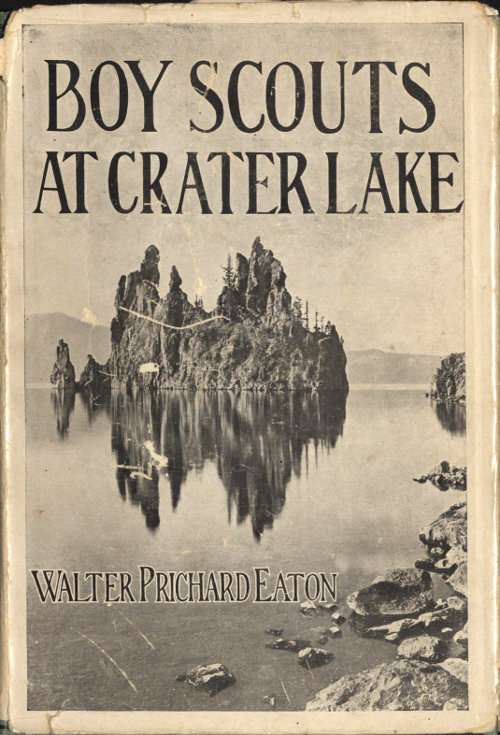
- Boy Scouts at Crater Lake
- Boy Scouts on Katahdin
- By Lewis E. Theiss
- Radio Series
- The Wireless Patrol at Camp Brady
- The Secret Wireless
- The Hidden Aerial
- The Young Wireless Operator Afloat
- The Young Wireless Operator—as a Fire Patrol
- The Young Wireless Operator with the Oyster Fleet
- The Young Wireless Operator with the U. S. Secret Service
- The Young Wireless Operator with the U. S. Coast Guard
“The finest radio stories ever written—interesting and informational”
- The Flume in the Mountains
- Aloft in the Shenandoah II
“Every red-blooded boy will devour such splendid books”
- By Capt. Edward L. Beach, U. S. N.
- Stories of the American Navy
- Ralph Osborn—Midshipman at Annapolis
- Midshipman Ralph Osborn at Sea
- Ensign Ralph Osborn
- Lieutenant Ralph Osborn Aboard a Torpedo Boat Destroyer
“The best set of American Naval Stories ever written for boys”
- By Frank H. Cheley
- The Job of Being a Dad
- Camp Fire Yarns
- The Mystery of Chimney Rock
- The Boys’ Book of Camp Fires
“Boys and fathers, too, will revel in these”
W. A. WILDE COMPANY
BOSTON CHICAGO
Transcriber’s Notes
- Copyright notice provided as in the original—this e-text is public domain in the country of publication.
- Silently corrected palpable typos; left non-standard spellings and dialect unchanged.
- In the text versions, delimited italics text in _underscores_ (the HTML version reproduces the font form of the printed book.)