
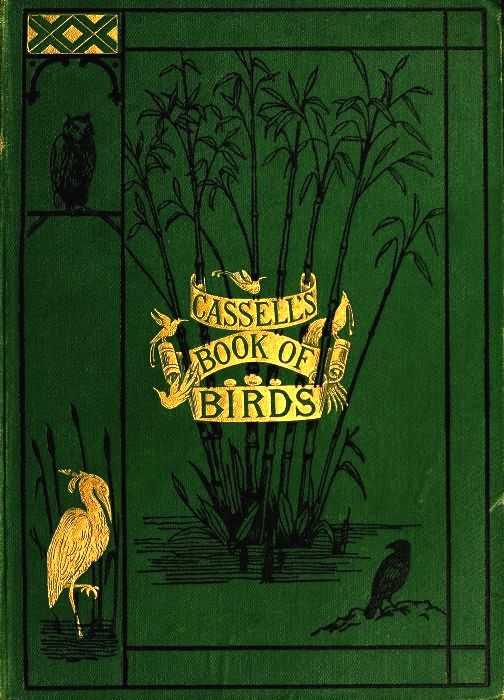
The Project Gutenberg eBook of Cassell's book of birds; vol. 3
Title: Cassell's book of birds; vol. 3
Author: Alfred Edmund Brehm
Translator: Thomas Rymer Jones
Release date: September 7, 2019 [eBook #60254]
Most recently updated: October 17, 2024
Language: English
Credits: Produced by Jane Robins and the Online Distributed
Proofreading Team at http://www.pgdp.net (This file was
produced from images generously made available by The
Internet Archive)
Plate 21, Cassell's Book of Birds
THE BLUE GRANDALA ____ Grandala Coelicolor
about 2⁄3 Nat. size
CASSELL'S
BOOK OF BIRDS.
FROM THE TEXT OF DR. BREHM.
BY
THOMAS RYMER JONES, F.R.S.,
PROFESSOR OF NATURAL HISTORY AND COMPARATIVE ANATOMY IN KING'S COLLEGE, LONDON.
WITH UPWARDS OF
Four Hundred Engravings, and a Series of Coloured Plates.
IN FOUR VOLUMES.
VOL. III.
LONDON:
CASSELL, PETTER, AND GALPIN;
AND NEW YORK
CONTENTS.
——♦——
THE SEARCHERS (Investigatores).
PAGE
THE CLIMBERS. The CLIMBING BIRDS (Scansor):—The Tenuirostral. The FLOWER BIRDS (Certhiola). The BLUE BIRDS (Cæreba):—The Sai, or Blue Caereba. The PITPITS (Certhiola):—The Banana Quit, or Black and Yellow Creeper. The HONEYSUCKERS (Nectarinia):—The Abu-Risch. The FIRE HONEYSUCKERS (Æthopyga):—The Cadet. The BENT-BEAKS (Cyrtostomus):—The Australian Blossom Rifler. The SPIDER-EATERS (Arachnothera). The HALF-BILLS (Hemignathus):—The Brilliant Half-bill. The HANGING BIRDS (Arachnocestra):—The True Hanging Bird. The HONEY-EATERS (Meliphaga). The TRUE HONEY-EATERS (Myzomela):—The Red-headed Honey-eater. The TUFTED HONEY-EATERS (Ptilotis):—The Yellow-throated Tufted Honey-eater. The BRUSH WATTLE BIRDS (Melichæra):—The True Brush Wattle Bird—The Poe, or Tui. The FRIAR BIRDS (Tropidorhyncus):—The "Leatherhead." The HOOPOES (Upupa):—The Common Hoopoe. The TREE HOOPOES (Irrisor):—The Red-beaked Tree Hoopoe 1–15THE TREE CLIMBERS (Anabata). The BUNDLE-NESTS (Phacellodomus):—The Red-fronted Bundle-nest, or Climbing Thrush. The OVEN BIRDS (Furnarius):—The Red Oven Bird. The GROUND WOODPECKERS (Geositta):—The Burrowing Ground Woodpecker. The STAIR-BEAKS (Xenops);—The Hairy-cheeked Stair-beak. THE NUTHATCHES (Sitta)—The Common Nuthatch—The Syrian Nuthatch. The CREEPERS (Sittella):—The Bonneted Creeper. The WALL CREEPERS (Tichodroma):—The Alpine or Red-winged Wall Creeper. The TRUE TREE CREEPERS (Certhia):—The Tree Peckers. TREE CLIMBERS (Scandentes):—The Common Tree Creeper—The Sabre-bill—The Woodpecker Tree-chopper. The WOODPECKERS (Picida). The BLACK WOODPECKERS (Dryocopus):—The European Black Woodpecker. The GIANT WOODPECKERS (Campephilus):—The Imperial Woodpecker—The Ivory-billed Woodpecker. The BLACK WOODPECKERS (Melanerpes):—The Red-headed Black Woodpecker—The Ant-eating Black Woodpecker. The VARIEGATED WOODPECKERS (Picus):—The Great Spotted Woodpecker—The Harlequin Woodpecker—The Three-toed Woodpecker. The GREEN WOODPECKERS (Cecinus):—The Green Woodpecker. The CUCKOO WOODPECKERS (Colaptes):—The Golden-winged Woodpecker—The Red-shafted or Copper Woodpecker—The Field Woodpecker. The SOFT-TAILED WOODPECKERS (Picumnus):—The Dwarf Woodpecker. The WRY-NECKS (Yunx):—The Wry-neck 15–45
HUMMING BIRDS. The HUMMING BIRDS (Stridor). The GIANT GNOMES (Eustephanus):—The Giant Humming Bird—The Sword-bill Humming Bird. The GNOMES (Polytmus):—The Saw-bill—The Sickle-billed Humming Bird. The SUN BIRDS (Phäetornis):—The Cayenne Hermit. The MOUNTAIN NYMPHS (Oreotrochilus):—The Chimborazian Hill-star. The SABRE-WINGS (Campylopterus):—De Lattrei's Sabre-wing. The TRUE SABRE-WINGS (Platystylopterus):—The Fawn-coloured Sabre-wing. The JEWEL HUMMING BIRDS (Hypophania):—The Crimson Topaz Humming Bird—The Black-capped Humming Bird. The WOOD NYMPHS (Lampornis):—The Mango Humming Bird—The Ruby and Topaz Wood Nymph. The FLOWER NYMPHS (Florisugus):—The Brazilian Fairy. The FLOWER SUCKERS (Florisuga):—The Pied Jacobin. THE FAIRIES (Trochilus):—The Ruby-throated Fairy Humming Bird. The AMETHYST HUMMING BIRDS (Calliphlox):—The Amethyst Humming Bird. The WOODSTARS (Calothorax, or Lucifer):—Mulsant's Wood-star. The ELVES (Lophornithes). The PLOVER-CRESTS (Cephalolepis):—De Laland's Plover-crest. The COQUETTES (Lophornis):—The Splendid Coquette. The AMAZONS (Bellatrix):—The Royal Amazon. The SUN GEMS (Heliactinus):—The Horned Sun Gem. The SYLPHS (Lesbiæ). The RACKET-TAILED SYLPHS (Steganurus):—The White-footed Racket-tail. The COMETS (Sparganura):—The Sappho Comet. The MASKED HUMMING BIRDS (Microrhamphi):—The Sharp-bearded Masked Humming Bird—The Columbian Thornbill. The HELMET CRESTS (Oxypogon):—Linden's Helmet Crest 45–75
THE LIGHT-BEAKS (Levirostres). The BEE-EATERS (Meropes):—The Common Bee-eater—The Bee-wolf—The Bridled Bee-eater—The Swallow Bee-eater—The Australian Bee-eater. The NOCTURNAL BEE-EATERS (Nyctiornis):—The Sangrok. The ROLLERS (Coracii):—The Blue Roller. The DOLLAR BIRDS (Eurystomus):—The Australian Dollar Bird—The Oriental Dollar Bird. The SAW-BILL ROLLERS (Prionites):—The Mot-mot. The BROAD-THROATS (Eurylaimus):—The Sumatran Trowel-beak. The TRUE BROAD-THROATS (Eurylaimus):—The Java Broad-throat—The Raya. The TODIES (Todi):—The Tody, or Green Flat-bill 75–87
THE KINGFISHERS (Alcedines):—The European Kingfisher. The PURPLE KINGFISHERS (Ceyx):—The Purple Kingfisher. The GREY KINGFISHERS (Ceryle):—The Grey Kingfisher 87–91
THE ALCYONS (Halcyones). The TREE ALCYONS (Halcyones):—The Red-breasted Tree Alcyon. The WOOD ALCYON (Todiramphus):—The Yellow-headed Wood Alcyon—The Blue Alcyon. The GIANT ALCYONS (Paralcyon, or Dacelo):—The Laughing Jackass, or Settler's Clock. The PARADISE ALCYONS (Tanysiptera):—The True Paradise Alcyon. The SAW-BEAKED ALCYONS (Syma):—The Poditti. The SLUGGARDS (Agornithes). The JACAMARS (Galbulæ):—The True Jacamars—The Green Jacamar 91-96
THE BUCCOS (Buccones). The SLEEPERS (Nystalus):—The Tschakuru. The TRAPPISTS (Monasta):—The Dusky Trappist, or Bearded Cuckoo. The DREAMERS (Chelidoptera):—The Dark Dreamer. The TOURACOS, or TROGONS (Trogones). The FIRE TOURACOS (Harpactes):—The Karna, or Malabar Trogon. The FLOWER TOURACOS (Hapaloderma):—The Narina. The TROGONS PROPER (Trogon):—The Surukua, or Touraco—The Pompeo—The Tocoloro. The BEAUTIFUL-TAILED TROGONS (Calurus):—The Peacock Trogon—The Beautiful Trogon—The Quesal, or Resplendent Trogon 96–105
THE CUCKOOS (Cuculidæ). The HONEY GUIDES (Indicator):—The White-beaked Honey Guide. The CUCKOOS (Cuculus):—The Common Cuckoo. The JAY CUCKOOS (Coccystes):—The Jay Cuckoo. The KOELS (Eudynamys):—The Koel, or Kuil. The GOLDEN CUCKOOS (Chrysococcyx):—The Didrik, or Golden Cuckoo. The GIANT CUCKOOS (Scythrops):—The Giant Cuckoo, or Channel-bill. The BUSH CUCKOOS (Phœnicophæi):—The Kokil, or Large Green-billed Malkoha. The RAIN CUCKOOS (Coccygi):—The Rain or Yellow-billed Cuckoo—The Rain Bird. The LONG-TAILED CUCKOOS (Pyrrhococcyx):—The Long-tailed Cuckoo. The TICK-EATERS (Crotophagæ). The TRUE TICK-EATERS (Crotophaga):—The Coroya—The Ani, or Savanna Blackbird—The Wrinkled-beaked Tick-eater. The COUCALS, or SPURRED CUCKOOS (Centropodes):—The Egyptian Coucal. The CROW PHEASANTS (Centrococcyx):—The Hedge Crow. The PHEASANT COUCALS (Polophilus):—The Pheasant Coucal. The BARBETS (Capitones):—The Pearl Bird—The Golden Barbet—The Toucan Barbet 105–127
THE HORNBILLS (Bucerotidæ). The TOUCANS (Ramphastidæ). The ARASSARIS (Pteroglossus):—The Arassari. The TOUCANS PROPER (Ramphastus):—The Toco Toucan—The Kirima, or Red-billed Toucan—The Tukana. The HORNBILLS PROPER (Bucerotes). The SMOOTH-BEAKED HORNBILLS (Rhynchaceros):—The Tok. The TWO-HORNED HORNBILLS (Dichoceros):—The Homray—The Djolan, or Year Bird—The Abbagamba, or Abyssinian Hornbill 127–140
GALLINACEOUS BIRDS (Gallinæ).
PIGEONS (Gyratores). The FRUIT PIGEONS (Trerones):—The Parrot Pigeon. The DOVES (Columbæ):—The Ring-dove, Wood Pigeon, or Cushat—The Stock Dove—The Rock Dove. The CUCKOO PIGEONS (Macropygiæ):—The Passenger Pigeon, or Carolina Turtle-dove. The TURTLE-DOVES (Turtures):—The Turtle-dove. The INDIAN RING-DOVES (Streptopeleia):—The Indian Ring-dove—The Dwarf Pigeon. The GROUND PIGEONS. The AMERICAN GROUND PIGEONS (Zenaidæ). The SINGING DOVES (Melopeleia):—The Kukuli. The SPARROW PIGEONS (Pyrgitœnas):—The Sparrow Pigeon, or Ground Dove. The SPARROW-HAWK PIGEONS (Geopeleia):—The Striped Sparrow-hawk Pigeon—The Speckled or Wedge-tailed Turtle-dove. The RUNNING PIGEONS (Geotrygones):—The Partridge Dove. The BRONZE-WINGED PIGEONS (Phapes):—The Crested Bronze-wing. The TRUE BRONZE-WINGS (Phaps):—The Common Bronze-wing 141–166
THE QUAIL PIGEONS (Geophaps):—The Partridge Bronze-wing. The WHITE-FLESHED PIGEONS (Leucosarcia):—The Wonga-Wonga Pigeon—The Hackled Ground Pigeon. The CROWNED PIGEONS (Gouræ):—The Crowned Pigeon—The Victoria Crowned Pigeon—The Didunculus, or Toothed Pigeon 166–172
TRUE GALLINACEOUS BIRDS. The SAND GROUSE (Pteroclæ):—The Ganga, or Large Sand Grouse—The Large Pin-tailed Grouse, or Khata—The Common Sand Grouse—The Striped Sand Grouse—Pallas's Sand Grouse. The GROUSE TRIBE (Tetraonidæ). The GROUSE PROPER (Tetraones):—The Capercali. The HEATH COCKS (Lyrurus):—The Black Cock—The Hybrid Grouse—The Hazel Grouse—The Prairie Hen, or Pinnated Grouse 172-195
THE PTARMIGANS (Lagopus):—The Willow Ptarmigan—The Alpine or Grey Ptarmigan—The Red Grouse, Brown Ptarmigan, or Gar Cock 195–202
THE PARTRIDGES (Perdices). The SNOW PARTRIDGES (Tetraogallus):—The Caspian Snow Partridge—The Himalayan Snow Cock, or Snow Pheasant. The RED-LEGGED PARTRIDGES (Caccabis):—The Greek Partridge—The Chuckore—The Red-legged Partridge—The Barbary Partridge—The Common Partridge. The FRANCOLINS (Francolinus):—The Black Partridge. The BARE-NECKED PHEASANTS (Pternistes):—The Red-necked Pheasants. The AMERICAN PARTRIDGES (Odontophori):—The Capueira Partridge—The Virginian or American Partridge. The CALIFORNIAN PARTRIDGE (Lophortyx Californianus) and GAMBEL'S PARTRIDGE (Lophortyx Gambelii):—The Californian Partridge—Gambel's Partridge. The QUAILS (Coturnices):—The Common Quail. The DWARF QUAILS (Excalfactoria):—The Chinese Quail. The BUSH QUAIL (Turnices):—The Black-breasted Bustard Quail—The African Bush Quail—The Collared Plain-wanderer 202–228
THE PHASIANIDÆ. The TUFTED PHEASANTS (Lophophori):—The Monaul or Impeyan Pheasant—Lhuys' Pheasant. The TRAGOPANS, or HORNED PHEASANTS (Ceriornis):—The Sikkim Horned Pheasant—The Jewar, or Western Horned Pheasant. The JUNGLE FOWLS (Galli):—Kasintu, or Red Jungle Fowl—The Jungle Fowl of Ceylon—The Javanese Jungle Fowl—The Sonnerat Jungle Fowl, or Katakoli. The MACARTNEY PHEASANTS (Euplocamus):—The Siamese Fireback—The Sikkim Kaleege, or Black Pheasant—The Kelitsch, or White-crested Kaleege Pheasant—The Silver Pheasant. The PHEASANTS PROPER (Phasiani):—The Common Pheasant—The Chinese Ring-necked Pheasant—The Japanese Pheasant—Soemmerring's Pheasant—Reeves' Pheasant. The GOLDEN PHEASANTS (Thaumalea):—The Golden Pheasant—Lady Amherst's Pheasant. The EARED PHEASANTS (Crossoptilon):—The Chinese Eared Pheasant—The Argus Pheasant, or Kuau. The PEACOCK PHEASANTS (Polyplectron):—The Chinquis, or Assam Peacock Pheasant. The PEACOCKS (Pavones):—The Common Peacock—The Black-winged Peacock—The Japan Peacock. The GUINEA FOWLS (Numidæ). The ROYAL GUINEA FOWLS (Acryllium):—The Vulturine Royal Guinea Fowl 228–257
THE TUFTED GUINEA FOWLS (Guttera):—Pucheran's Tufted Guinea Fowl. The GUINEA FOWLS (Numida):—The Common Guinea Fowl—The Mitred Pintado—The Tuft-beaked Pintado. The TURKEYS (Meleagrides):—The Puter, or Wild Turkey. The AUSTRALIAN JUNGLE FOWLS (Megapodinæ). The TALLEGALLI (Tallegalli). The BRUSH TURKEYS (Catheturus):—The Brush Turkey, or Wattled Tallegallus—The Maleo—The Ocellated Leipoa. The MEGAPODES (Megapodii):—The Australian Megapode 256–275
THE CURASSOWS, or HOCCOS (Cracidæ). The TRUE CURASSOWS, or HOCCOS (Craces):—The Common or Crested Curassow—The Wattled Curassow—The Red Curassow—The Galeated Curassow—The Mountain Curassow, or Lord Derby's Guan. The GUANS (Penelopæ):—The Supercilious Guan—The Pigmy, or Piping Guan—The Aracuan—The Hoactzin, or Stink Bird. The TINAMOUS (Crypturidæ):—The Tataupa—The Inambu 275–285
THE AMERICAN QUAILS (Nothura):—The Lesser Mexican Quail—The Macuca. The SPUR-FOWLS (Galloperdices):—The Painted Spur-fowl 285–286
SHORT-WINGED CURSORIAL BIRDS (Brevipennes).
THE OSTRICH (Struthio camelus). The NANDUS (Rhea):—The Nandu, or American Ostrich—The Long-billed Nandu—The Dwarf Nandu 287–299
THE EMUS (Dromæus):—The Emu—The Spotted Emu 300–302
THE CASSOWARIES (Casuarii):—The Helmeted Cassowary—The Mooruk—The Australian Cassowary. The KIVIS (Apteryges):—The Kivi-Kivi—Mantell's Apteryx—Owen's Apteryx 302–312
LIST OF ILLUSTRATIONS.
——♦——
COLOURED PLATES
| PLATE | XXI.—THE BLUE GRANDALA. |
| " | XXII.—THE WHISKERED FANTAIL. |
| " | XXIII.—THE CRIMSON TOPAZ. |
| " | XXIV.—THE EUROPEAN BEE-EATER. |
| " | XXV.—THE BEAUTIFUL TROGON. |
| " | XXVI.—THE TOUCAN. |
| " | XXVII.—THE ROCK PIGEON. |
| " | XXVIII.—THE PTARMIGAN. |
| " | XXIX.—THE SANGUINE FRANCOLIN. |
| " | XXX.—THE HASTINGS TRAGOPAN. |
WOOD ENGRAVINGS.
| FIG. | PAGE | |
| 1. | The Sai, or Blue Caereba (Cæreba cyanea) | 3 |
| 2. | The Banana Quit (Certhiola flaveola) | 4 |
| 3. | The Abu-Risch (Hedydipna metallica) | 5 |
| 4. | The Hanging Bird (Arachnocestra longirostris) | 9 |
| 5. | The Poe, or Tui (Prosthemadera circinata) | 13 |
| 6. | The Hoopoe (Upupa epops) | 16 |
| 7. | The Red Oven Bird (Furnarius rufus) | 17 |
| 8. | The Hairy-cheeked Stair-beak (Xenops genibarbis) | 20 |
| 9. | The Common Nuthatch (Sitta cæsia) | 21 |
| 10. | The Alpine Wall-creeper (Tichodroma muraria) | 24 |
| 11. | The Common Tree-creeper (Certhia familiaris) | 25 |
| 12. | The Woodpecker Tree-chopper, (Dendraplex picus) | 28 |
| 13. | The European Black Woodpecker (Dryocopus martius) | 29 |
| 14. | The Ivory-billed Woodpecker (Campephilus principalis) | 32 |
| 15. | The Red-headed Black Woodpecker (Melanerpes erythrocephalus) | 33 |
| 16. | The Green Woodpecker (Gecinus viridis) | 40 |
| 17. | The Golden-winged Woodpecker (Colaptes auratus) | 41 |
| 18. | The Wry-neck (Yunx torquilla) | 44 |
| 19. | The Giant Humming Bird (Patagona gigas) | 48 |
| 20. | The Sword-bill Humming Bird (Docimastes ensifer) | 49 |
| 21. | The Sickle-billed Humming Bird (Eutoxeres aquila) | 52 |
| 22. | The Chimborazian Hill-star (Oreotrochilus Chimborazo) | 53 |
| 23. | The Crimson Topaz Humming Bird (Topaza pella) | 56 |
| 24. | The Brazilian Fairy (Heliothrix auriculata) | 61 |
| 25. | The Amethyst Humming Bird (Calliphlox amethystina) | 65 |
| 26. | The Splendid Coquette (Lophornis ornata) | 67 |
| 27. | The Horned Sun-gem (Heliactinus cornutus) | 68 |
| 28. | The White-footed Racket-tail (Steganurus Underwoodii) | 69 |
| 29. | The Sappho Comet (Sparganura Sappho) | 72 |
| 30. | Humming Birds | 73 |
| 31. | The Bee-wolf (Melittotheres nubicus) | 77 |
| 32. | The Australian Bee-eater (Cosmäerops ornatus) | 80 |
| 33. | The Blue Roller (Coracias garrulus) | 81 |
| 34. | The Mot-mot (Prionites momota) | 84 |
| 35. | The Java Broad-throat (Eurylaimus Javanicus) | 85 |
| 36. | The European Kingfisher (Alcedo ispida) | 88 |
| 37. | Grey Kingfishers (Ceryle rudis) | 92 |
| 38. | The Laughing Jackass (Paralcyon gigas, or Dacelo gigantea) | 93 |
| 39. | The Green Jacamar (Galbula viridis) | 97 |
| 40. | The Dusky Trappist, or Bearded Cuckoo (Monasta fusca) | 99 |
| 41. | The Narina (Hapaloderma narina) | 101 |
| 42. | Quesals, or Resplendent Trogons (Calurus paradiseus, or C. resplendens) | 104 |
| 43. | The Cuckoo (Cuculus canorus) | 108 |
| 44. | The Jay Cuckoo (Coccystes glandarius) | 109 |
| 45. | The Didrik, or Golden Cuckoo (Chrysococcyx auratus) | 112 |
| 46. | The Giant Cuckoo, or Channel-bill (Scythrops Novæ-Hollandiæ) | 113 |
| 47. | The Kokil, or Large Green-billed Malkoha (Zanclostomus tristis) | 115 |
| 48. | The Ani, or Savanna Blackbird (Crotophaga ani) | 120 |
| 49. | The Wrinkled-beaked Tick-eater (Crotophaga rugirostris) | 121 |
| 50. | The Pheasant Coucal (Polophilus phasianus) | 124 |
| 51. | The Pearl Bird (Trachyphonus margaritatus) | 125 |
| 52. | The Arassari (Pteroglossus aracari) | 128 |
| 53. | The Toco Toucan (Ramphastus toco) | 129 |
| 54. | The Tok (Rhynchaceros erythrorhynchus) | 133 |
| 55. | The Homray (Dichoceros bicornis) | 136 |
| 56. | The Djolan, or Year Bird (Rhyticeros plicatus) | 137 |
| 57. | The Abbagamba, or Abyssinian Hornbill (Bucorax Abyssinicus) | 139 |
| 58. | Nestlings of The Abbagamba | 140 |
| 59. | The Parrot Pigeon (Phalacroteron Abyssinica) | 144 |
| 60. | The Ring-dove, or Wood Pigeon (Palumbus torquatus) | 145 |
| 61. | The Passenger Pigeon (Ectopistes migratorius) | 148 |
| 62. | Turtle Doves | 156 |
| 63. | Dwarf Pigeon (Chalcopeleia Afra) | 157 |
| 64. | The Kukuli (Melopeleia meloda) | 160 |
| 161. | The Striped Sparrow-hawk Pigeon (Geopeleia striata) | 161 |
| 66. | The Crested Bronze-wing (Ocyphaps lophotes) | 164 |
| 67. | The Bronze-winged Pigeon (Phaps chalcoptera) | 165 |
| 68. | The Hackled Ground Pigeon (Callœnas Nicobarica) | 168 |
| 69. | The Victoria Crowned Pigeon (Goura Victoria) | 169 |
| 70. | Sand Grouse | 173 |
| 71. | The Khata (Pterocles alchata) | 176 |
| 72. | The Common Sand Grouse (Pterocles exustus) | 177 |
| 73. | Pallas's Sand Grouse, or Sand Grouse of The Steppes | 180 |
| 74. | The Capercali (Tetrao urogallus) | 184 |
| 75. | The Black Cock (Lyrurus tetrix) | 185 |
| 76. | Hybrid Grouse (Tetrao medius) | 188 |
| 77. | Hazel Grouse (Bonasia sylvestris) | 189 |
| 78. | The Prairie Hen (Cupidonia Americana) | 192 |
| 79. | The Willow Ptarmigan (Lagopus albus) | 197 |
| 80. | The Alpine Ptarmigan (Lagopus Alpinus), in Summer plumage | 200 |
| 81. | The Alpine Ptarmigan (Lagopus Alpinus), in Winter plumage | 201 |
| 82. | The Red-legged Partridge (Caccabis rubra) | 208 |
| 83. | The Common Partridge (Perdix cinerea, or Starna cinerea) | 209 |
| 84. | The Virginian Partridge (Ortyx Virginianus) | 217 |
| 85. | The Californian Partridge (Lophortyx Californianus) | 220 |
| 86. | The Common Quail (Coturnix communis) | 221 |
| 87. | The Chinese Quail (Excalfactoria Chinensis) | 224 |
| 88. | The African Bush Quail (Turnix Africanus, or T. Gibraltariensis) | 228 |
| 89. | The Monaul, or Impeyan Pheasant (Lophophorus resplendens, refulgens, or Impeyanus) | 229 |
| 90. | The Sikkim Horned Pheasant (Ceriornis Satyra) | 233 |
| 91. | The Kaleege, or Black Pheasant (Euplocamus-Gallophasis-melanotus) | 240 |
| 92. | The Silver Pheasant (Nycthemerus argentatus, or Euplocamus nycthemerus) | 241 |
| 93. | Reeves' Pheasant (Phasianus Reevesii, or P. veneratus) | 244 |
| 94. | The Golden Pheasant (Thaumalea picta) | 245 |
| 95. | The Chinese Eared Pheasant (Crossoptilon auritum) | 248 |
| 96. | The Argus Pheasant, or Kuau (Argus giganteus) | 249 |
| 97. | The Chinquis, or Assam Peacock Pheasant (Polyplectron chinquis) | 252 |
| 98. | The Common Guinea Fowl (Numida meleagris) | 257 |
| 99. | The Ocellated Turkey (Meleagris ocellata) | 260 |
| 100. | The Brush Turkey (Catheturus Lathami) | 265 |
| 101. | The Maleo (Megacephalon Maleo) | 269 |
| 102. | The Crested Curassow (Crax alector) | 277 |
| 103. | The Hoactzin, or Stink Bird (Opisthocomus cristatus) | 281 |
| 104. | The Inambu (Rhynchotus rufescens) | 284 |
| 105. | The Ostrich (Struthio camelus) | 288 |
| 106. | An Ostrich Hunt | 292 |
| 107. | Nandus (Rhea Americana), with Nest and Eggs | 293 |
| 108. | The Nandu, or American Ostrich (Rhea Americana) | 297 |
| 109. | The Emu (Dromæus Novæ-Hollandiæ) | 300 |
| 110. | Cassowary (Casuarius galeatus) | 304 |
| 111. | The Kivi-Kivi (Apteryx Australis) | 308 |
| 112. | The Nandu, or Rhea | 312 |