
WeRead Powered by ReaderPub
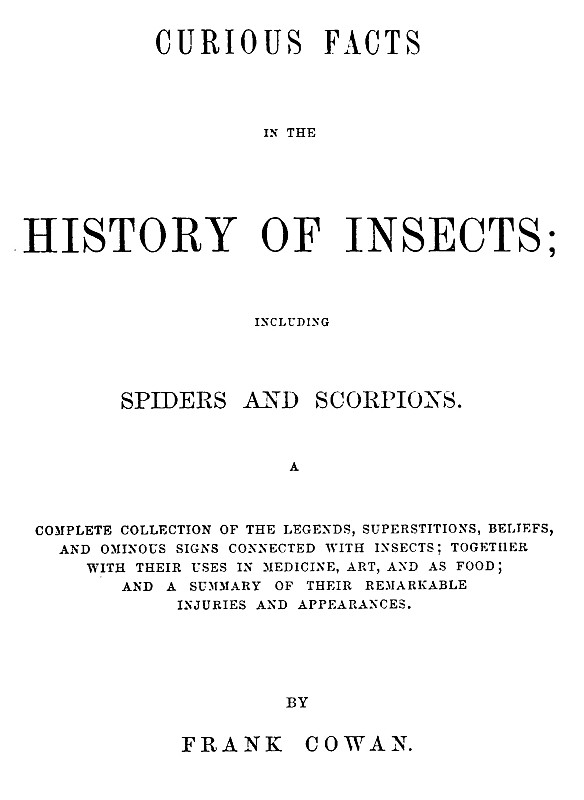
Curious Facts in the History of Insects; Including Spiders and Scorpions. / A Complete Collection of the Legends, Superstitions, Beliefs, and Ominous Signs Connected with Insects; Together with Their Uses in Medicine, Art, and as Food; and a Summary of Their Remarkable Injuries and Appearances. cover

Curious Facts in the History of Insects; Including Spiders and Scorpions. / A Complete Collection of the Legends, Superstitions, Beliefs, and Ominous Signs Connected with Insects; Together with Their Uses in Medicine, Art, and as Food; and a Summary of Their Remarkable Injuries and Appearances.

Chapter 25: Galerucidæ—Turnip-fly, etc.
Open in WeRead

About This Book

A compilation of historical, folkloric, and practical material concerning insects, spiders, and scorpions, drawn from chronicles, travel narratives, and scientific sources. Organized by taxonomic groups, it presents legends, superstitions, omens, and anecdotes alongside accounts of medicinal, artistic, and culinary uses and descriptions of injuries or nuisances attributed to particular species. Numerous authorities are cited to document cultural beliefs and remedies connected to specific insects. Emphasizing curious and documentary facts rather than detailed anatomy or classification, the collection surveys human interactions with and attitudes toward many insect families across diverse times and places.

Galerucidæ—Turnip-fly, etc.

The striped Turnip-beetle, Haltica nemorum, commonly called the Turnip-fly, Turnip-flea, Earth-flea-beetle, Black-jack, etc., is a well known species from the ravages the perfect insect commits upon the turnip. In Devonshire, England, in the year 1786, the loss caused by these insects alone was valued at £100,000 sterling. And in the spring of 1837, the vines in the neighborhood of Montpellier were attacked to so great an extent by another species, Haltica oleracea, in the perfect state, that fears were entertained for the plants, and religious processions were instituted for the purpose of exorcising the insects.236

Anatolius says that if the seeds of radishes, turnips, and other esculents be sown in the hide of a tortoise, the plants when grown will not be eaten by the fly, nor hurt by noxious animals or birds.237 Paladius has also related the method of drying the seeds in the hide of this animal,238 and of sowing them.239