
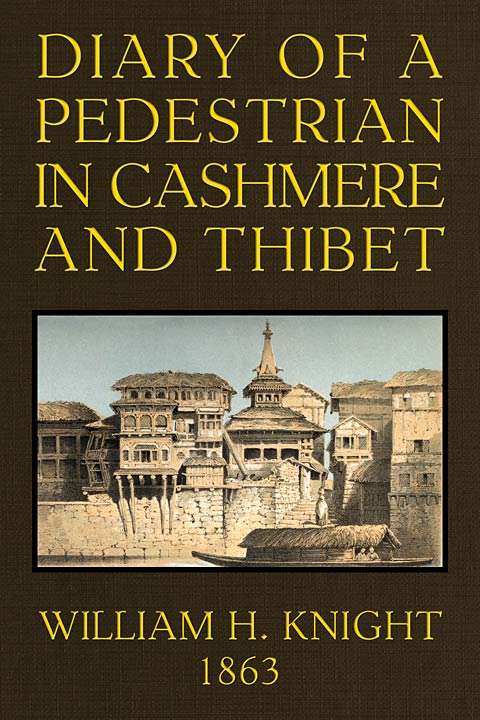
Appendix A.
The Temples of Cashmere.
Extract from “An Essay on the Arian Order of Architecture, as exhibited in the Temples of Kashmír,” by Capt. A. Cunningham. “Journal of the Asiatic Society,” Vol. XVII.
The architectural remains of Kashmír are perhaps the most remarkable of the existing monuments of India, as they exhibit undoubted traces of the influence of Grecian art. The Hindú temple is generally a sort of architectural pasty, a huge collection of ornamental fritters, huddled together with or without keeping; while the “Jain” temple is usually a vast forest of pillars, made to look as unlike one another as possible, by some paltry differences in their petty details.
On the other hand, the Kashmirian fanes are distinguished by the graceful elegance of their outlines, by the massive boldness of their parts, and by the happy propriety of their decorations.
They cannot, indeed, vie with the severe simplicity of the Parthenon, but they possess great beauty—different, indeed, yet quite their own.
The characteristic features of the Kashmirian architecture are its lofty pyramidal roofs, its trefoiled doorways, [352]covered by pyramidal pediments, and the great width of the intercolumniations.
Most of the Kashmirian temples are more or less injured, but more particularly those at Wantipúr, which are mere heaps of ruins. Speaking of these temples, Trebeck says: “It is scarcely possible to imagine that the state of ruin to which they have been reduced has been the work of time, or even of man, as their solidity is fully equal to that of the most massive monuments of Egypt. Earthquakes must have been the cause of their overthrow.” In my opinion, their overthrow is too complete to have been the result of an earthquake, which would have simply prostrated the buildings in large masses. But the whole of the superstructure of these temples is now lying in one confused heap of stones, totally disjointed from one another.
I believe, therefore, that I am fully justified in saying, from my own experience, that such a complete and disruptive overturn could only have been produced by gunpowder.
The destruction of the Kashmirian temples is universally attributed, both by history and by tradition, to the bigoted Sikander. (A.D. 1396.) He was reigning at the period of Timúr’s invasion of India, with whom he exchanged friendly presents, and from whom, I suppose, he may have received a present of the villainous saltpetre.
As it would appear that the Turks had metal cannon at the siege of Constantinople in 1422, I think it no great stretch of probability to suppose that gunpowder itself had been carried into the East, even as far as Kashmír, at least ten or twenty years earlier—that is, about A.D. 1400 to 1420, or certainly during the reign of Sikander, who died in 1416. [353]
Even if this be not admitted, I still adhere to my opinion, that the complete ruin of the Wantipúr temples could only have been effected by gunpowder; and I would, then, ascribe their overthrow to the bigoted “Aurungzíb.”
“Ferishta” attributed to Sikander the demolition of all the Kashmirian temples save one, which was dedicated to Mahadeo, and which only escaped “in consequence of its foundations being below the surface of the neighbouring water.”
In A.D. 1580, “Abul Fazl” mentions that some of the idolatrous temples were in “perfect preservation;” and Ferishta describes many of these temples as having been in existence in his own time, or about A.D. 1600.
As several are still standing, though more or less injured, it is certain that Sikander could not have destroyed them all. He most likely gave orders that they should be overturned; and I have no doubt that many of the principal temples were thrown down during his reign.
But, besides the ruthless hand of the destroyer, another agency, less immediate, but equally certain in its ultimate effects, must have been at work upon the large temples of Kashmír. The silent ravages of the destroyer, who carries away pillars and stone, for the erection of other edifices, has been going on for centuries. Pillars, from which the architraves have been thus removed, have been thrown down by earthquakes, ready to be set up again for the decoration of the first Musjid that might be erected in the neighbourhood. Thus every Mahomedan building in Kashmír is constructed either entirely or in part of the ruins of Hindú temples. [354]
Takt I Sulíman.
The oldest temple in Kashmír, both in appearance and according to tradition, is that upon the hill of “Takt i Sulíman,” or Solomon’s Throne. It stands 1,000 feet above the plain, and commands a view of the greater part of Kashmír.
The situation is a noble one, and must have been amongst the first throughout the whole valley which was selected as the position of a temple. Its erection is ascribed to Jaloka, the son of Asoka, who reigned about 220 B.C.
The plan of the temple is octagonal, each side being fifteen feet in length. It is approached by a flight of eighteen steps, eight feet in width, and inclosed between two sloping walls. Its height cannot now be ascertained, as the present roof is a modern plastered dome, which was probably built since the occupation of the country by the Sikhs. The walls are eight feet thick, which I consider one of the strongest proofs of the great antiquity of the building.
Pándrethán.
This name means the old capital, or ancient chief town. The name has, however, been spelt by different travellers in many different ways. “Moorcroft” calls it Pándenthán, “Vigne” Pandrenton, and “Hugel” Pandriton.
The building of this temple is recorded between A.D. 913 and 921; and it is afterwards mentioned between the years 958 and 972, as having escaped destruction when the King Abhimanyú—Nero-like—set fire to his own capital. [355]
As this is the only temple situated in the old capital, there can be very little, if any, doubt that it is the very same building which now exists. For as it is surrounded by water, it was, of course, quite safe amid the fire, which reduced the other buildings to mere masses of quicklime.
Baron Hugel calls the Pándrethán edifice a “Buddhist temple,” and states that there are some well-preserved Buddhist figures in the interior. But he is doubly mistaken, for the temple was dedicated to Vishnú, and the figures in the inside have no connexion with Buddhism.
Trebeck swam into the interior, and could discover no figures of any kind; but as the whole ceiling was formerly hidden by a coating of plaster, his statement was, at that time, perfectly correct.
The object of erecting the temples in the midst of water must have been to place them more immediately under the protection of the Nágas, or human-bodied and snake-tailed gods, who were zealously worshipped for ages through Kashmír.
Márttand.
Of all the existing remains of Kashmirian grandeur, the most striking in size and situation is the noble ruin of Márttand.
This majestic temple stands at the northern end of the elevated table-land of “Matan,” about three miles to the eastward of Islámabád.
This is undoubtedly the finest position in Kashmír. The temple itself is not now (1848) more than forty feet in height, but its solid walls and bold outlines towering [356]over the fluted pillars of the surrounding colonnade give it a most imposing appearance.
There are no petty confused details; but all are distinct and massive, and most admirably suited to the general character of the building.
Many vain speculations have been hazarded regarding the date of the erection of this temple and the worship to which it was appropriated.
It is usually called the “House of the Pandús” by the Brahmins, and by the people “Mattan.”
The true appellation appears to be preserved in the latter, Matan being only a corruption of the Sanscrit Márttand मार्त्तण्ड, or the sun, to which the temple was dedicated.
The true date of the erection of this temple—the wonder of Kashmír—is a disputed point of chronology; but the period of its foundation can be determined within the limits of one century, or between A.D. 370 and 500.
The mass of building now known by the name of Matan, or Márttand, consists of one lofty central edifice, with a small detached wing on each side of the entrance, the whole standing on a large quadrangle surrounded by a colonnade of fluted pillars, with intervening trefoil-headed recesses. The central building is sixty-three feet in length, by thirty-six in width.
As the main building is at present entirely uncovered, the original form of the roof can only be determined by a reference to other temples, and to the general form and character of the various parts of the Márttand temple itself.
The angle of the roof in the Temple of Pándrethán, and in other instances, is obtained by making the sides of the pyramid which forms it parallel to the sides of the [357]doorway pediment, and in restoring the Temples of Patrun and Márttand I have followed the same rule.
The height of the Pándrethán temple—of the cloistered recesses, porch pediments, and niches of Márttand itself—were all just double their respective widths. This agreement in the relative proportions of my restored roof of Márttand with those deduced from other examples, is a presumptive proof of the correctness of my restoration. The entrance-chamber and the wings I suppose to have been also covered by similar pyramidal roofs. There would thus have been four distinct pyramids, of which that over the inner chamber must have been the loftiest, the height of its pinnacle above the ground being about seventy-five feet.
The interior must have been as imposing as the exterior. On ascending the flight of steps—now covered by ruins—the votary of the sun entered a highly-decorated chamber, with a doorway on each side covered by a pediment, with a trefoil-headed niche containing a bust of the Hindú triad, and on the flanks of the main entrance, as well as on those of the side doorways, were pointed and trefoil niches, each of which held a statue of a Hindú divinity.
The interior decorations of the roof can only be conjecturally determined, as I was unable to discover any ornamented stones that could with certainty be assigned to it. Baron Hugel doubts that Márttand ever had a roof; but, as the walls of the temple are still standing, the numerous heaps of large stones that are scattered about on all sides can only have belonged to the roof.
I can almost fancy that the erection of this sun-temple was suggested by the magnificent sunny prospect which its position commands. It overlooks the finest view in Kashmír, and perhaps in the known world, Beneath it [358]lies the paradise of the East, with its sacred streams and cedarn glens, its brown orchards and green fields, surrounded on all sides by vast snowy mountains, whose lofty peaks seem to smile upon the beautiful valley below. The vast extent of the scene makes it sublime; for this magnificent view of Kashmír is no petty peep into a half-mile glen, but the full display of a valley sixty miles in breadth and upwards of a hundred miles in length, the whole of which lies beneath “the ken of the wonderful Márttand.”
The principal buildings that still exist in Kashmír are entirely composed of a blue limestone, which is capable of taking the highest polish—a property to which I mainly attribute the beautiful state of preservation in which some of them at present exist.
Even at first sight one is immediately struck by the strong resemblance which the Kashmirian colonnades bear to the classic peristyles of Greece. Even the temples themselves, with their porches and pediments, remind one more of Greece than of India; and it is difficult to believe that a style of architecture which differs so much from all Indian examples, and which has so much in common with those of Greece, could have been indebted to chance alone for this striking resemblance.
One great similarity between the Kashmirian architecture and that of the various Greek orders is its stereotyped style, which, during the long flourishing period of several centuries, remained unchanged. In this respect it is so widely different from the ever-varying forms and plastic vagaries of the Hindú architecture that it is impossible to conceive their evolution from a common origin.
I feel convinced myself that several of the Kashmirian forms, and many of the details, were borrowed from the temples of the Kabúlian Greeks, while the arrangements [359]of the interior and the relative proportions of the different parts were of Hindú origin. Such, in fact, must necessarily have been the case with imitations by Indian workmen, which would naturally have been engrafted upon the indigenous architecture. The general arrangements would still remain Indian, while many of the details, and even some of the larger forms, might be of foreign origin.
As a whole, I think that the Kashmirian architecture, with its noble fluted pillars, its vast colonnades, its lofty pediments, and its elegant trefoiled arches, is fully entitled to be classed as a distinct style. I have therefore ventured to call it the Arian order—a name to which it has a double right; first, because it was the style of the Aryas, or Arians, of Kashmír; and, secondly, because its intercolumniations are always of four diameters—an interval which the Greeks called Araiostyle.
Extract from Vigne’s “Travels in Kashmír.”
The Hindú temple of Márttand is commonly called the House of the Pandús. Of the Pandús it is only necessary to say that they are the Cyclopes of the East. Every old building, of whose origin the poorer class of Hindús in general have no information, is believed to have been the work of the Pandús. As an isolated ruin, this deserves, on account of its solitary and massive grandeur, to be ranked not only as the first ruin of the kind in Kashmír, but as one of the noblest among the architectural relics of antiquity that are to be seen in any country. Its noble and exposed situation at the foot of the hills reminded [360]me of that of the Escurial. It has no forest of cork-trees and evergreen-oaks before it, nor is it to be compared, in point of size, with that stupendous building; but it is visible from as great a distance. And the Spanish sierra cannot for a moment be placed in competition with the verdant magnificence of the mountain-scenery of Kashmír.
Few of the Kashmirian temples, if any, I should say, were Buddhist. Those in or upon the edge of the water were rather, I should suppose, referable to the worship of the Nágas, or snake-gods. The figures in all the temples are almost always in an erect position, and I have never been able to discover any inscription in those now remaining.
I had been struck with the great general resemblance which the temple bore to the recorded disposition of the Ark and its surrounding curtains, in imitation of which the Temple at Jerusalem was built; and it became for a moment a question whether the Kashmirian temples had not been built by Jewish architects, who had recommended them to be constructed on the same plan for the sake of convenience merely. It is, however, a curious fact, that in Abyssinia, the ancient Ethiopia, which was also called “Kush,” the ancient Christian churches are not unlike those of Kashmír, and that they were originally built in imitation of the temple, by the Israelites who followed the Queen of Sheba, whose son took possession of the throne of Kush, where his descendants are at this moment Kings of Abyssinia.
Without being able to boast, either in extent or magnificence, of an approach to equality with the temple of the sun at Palmyra, or the ruins of the palace at Persepolis, Márttand is not without pretensions to a locality of [361]scarcely inferior interest, and deserves to be ranked with them as the leading specimen of a gigantic style of architecture that has decayed with the religion it was intended to cherish, and the prosperity of a country it could not but adorn.
In situation it is far superior to either. Palmyra is surrounded by an ocean of sand, and Persepolis overlooks a marsh; but the temple of the sun in Márttand is built upon a natural platform at the foot of some of the noblest mountains, and beneath its ken lies what is undoubtedly the finest and the most prononcé valley in the known world.
We are not looking upon the monuments of the dead. We step not aside to inspect a tomb, or pause to be saddened by an elegy. The noble pile in the foreground is rather an emblem of age than of mortality; and the interest with which we perambulate its ruins is not the less pleasurable because we do not know much that is certain of its antiquity, its founders, or its original use. [362]
Appendix B.
The Mystic Sentence of Thibet.
Explication et origine de la formule bouddhique:—“Om mani padmè hoûm” Par M. Klaproth. “Nouveau Journal Asiatique.”
Les Tubétains et les Mongols ont perpétuellement cette prière dans la bouche. Les mots de cette inscription sont Sanscrits, et donnent un sens complet dans cette langue. En voici la transcription en devanagri:—
ओं मणि पद्मे हुं
“Om” est, chez les Hindous, le nom mystique de la divinité, par lequel toutes les prières commencent. Cette particule mystique équivaut à l’interjection, oh! prononcée avec emphase et avec une entière conviction religieuse. Mani signifie le joyau; Padma le lotus. Enfin Hoûm est une particule qui équivaut à notre “Amen.” Le sens de la phrase est très clair; “Om mani padmè hoûm” signifie “Oh! le joyau dans le lotus, Amen.” Malgré ce sens indubitable, les Bouddhistes du Tubet se sont évertués à chercher un sens mystique à chacune des six syllabes qui composent cette phrase. Ils ont rempli des livres entiers de ces explications imaginaires. [363]
Cette formule est particulière aux Bouddhistes du Tubet.
Selon l’histoire de ce pays la formule Om mani padmè hoûm, y a été apportée de l’Inde vers la moitié du 7e siècle de notre ère.
La legende suivante traduite du Mongol contient des détails sur la conversion du Tubet par le dieu Padmá pani,1 et sur l’origine des six syllabes sacrées, Om mani padmè hoûm. Ce dieu est appelé en Sanscrit “Avalokites’ vara” ou “le maître qui contemple avec amour;” ce que les Tubétains ont rendu par “le tout-voyant aux mille mains et aux mille yeux:” Les Chinois on traduit le nom par “celui qui contemple les sous du inonde.”
“Autrefois, quand le ‘glorieux-accompli’ (Sakya mouni ou Buddh) séjournait dans la forêt ‘d’Odma,’ il advint un jour, qu’étant entouré de ses nombreux disciples un rayon de lumière de cinq couleurs sortit tout-à-coup entre ses deux sourcils, forma un arc-en-ciel, et se dirigea du côté de l’Empire septentrional de neige (Thibet). Les regards du Bouddha suivaient ce rayon, et sa figure montra un sourire de joie inexprimable. Un de ses disciples lui demanda [364]de lui en expliquer la raison, et sur sa prière le glorieux-accompli lui dit:
“ ‘Fils d’illustre origine! dans le pays qu’aucun Bouddha des trois âges n’a pu convertir, et qui est rempli d’une foule d’êtres malfaisans, la loi se lèvera comme le soleil et s’y répandra dans les temps futurs.
“ ‘L’apôtre de cet Empire de neige âpre et sauvage, sera le Khoutoukhtou’ (Padmá páni).
“Après que ‘Sakya mouni’ eut prononcé ces paroles, un rayon de lumière, éclatant comme un lotus blanc, sortit de son coeur et illumina toutes les régions du monde et se plongea dans le coeur du Bouddha infiniment resplendissant. Alors un autre éclat de lumière sortit du Bouddha resplendissant et se plongea dans la mer des fleurs de Padmá (lotus), et y transmit cette pensée du Bouddha, qu’il s’en élèverait et qu’il en naitrait un Khoubilkhan2 divin, destiné à la conversion de l’Empire de neige.
“Le Roi Dehdou qui était parvenu à participer à la béatitude de l’empire de Soukhawatee, voulant un jour offrir au Bouddha un sacrifice des fleurs, dépêcha quelques-uns des siens aux bords de la mer des Padmá (Lotus), pour y cueillir de ces fleurs. Ses envoyés aperçurent dans la mer une très grande tige de Lotus au milieu de laquelle il y avait un bouton colossal entouré d’une foule de grandes feuilles, et jetant des rayons de lumière de différentes couleurs. Les envoyés en firent leur rapport au roi, qui, rempli d’étonnement, se rendit avec sa cour sur un grand radeau à la place de la mer où se trouvait cette tige merveilleuse.
“Y’étant arrivé, il présenta ses offrandes et prononça la bénédiction; le bouton s’ouvrit alors des quatre cotés, et [365]au milieu apparut l’apôtre de l’empire de neige, né comme ‘Khoubilkhan.’ Il y était assis, les jambes croisées, avait mi visage et quatre mains; les deux mains antérieures étaient jointes devant le cœur, la troisième de droite tenait un rosaire de cristal, et la quatrième à gauche une fleur de Lotus blanche, qui penchait vers l’oreille.
“Sur sa figure, dont l’éclat se répandait vers les dix régions du monde, se montrait un sourire qui pénétra dans tous les cœurs.
“Le roi et sa suite portèrent le ‘Khoubilkhan’ au palais, en poussant des cris de joie et entonnant des hymnes. Le roi se rendit devant le Bouddha éternel et lui demanda la permission d’adopter pour fils, le ‘Khoubilkhan’ né dans la mer de lotus. Mais sa demande ne fut pas agréé et il apprit, la véritable origine de ce ‘Khoubilkhan.’ Le Bouddha infiniment resplendissant posa alors sa main sur la tête de celui-ci et dit ‘Fils d’illustre origine! Les êtres qui habitent l’âpre empire de la neige, qu’aucun Bouddha des temps passés n’a pu convertir, qu’aucun du temps futurs ne convertira, et qu’aucun du temps présent n’a converti, le seront par la force et la bénédiction de ton vœu. C’est excellant; c’est excellant! Khoutoukhtou!3
“ ‘Aussitôt que les habitans de l’âpre empire de neige te verront et qu’ils entendront le son des six syllabes (Om mani padmè hoûm) ils seront délivrés des trois naissances de mauvaise nature, et trouveront la béatitude par la renaissance comme êtres d’une nature supérieure. Les esprits malfaisans de l’âpre empire de neige, ainsi que tous les êtres donnant des maladies ou la mort, aussitôt, Khoutoukhtou, qu’ils te verront et qu’ils entendront le [366]son des six syllabes, ils quitteront la fureur et la méchanceté qui les anime, et deviendront compatissans.
“ ‘Les tigres, les panthères, les loups, les ours et autres animaux féroces, aussitôt, O Khoutoukhtou! qu’ils te verront et entendront le son des six syllabes ils adouciront leurs hurlemens, et leur fureur sanguinaire se changera en douceur bienveillante. Khoutoukhtou! ta figure et le son des six syllabes rassaiseront les affamés et calmeront la soif des altérés; il tombera comme une pluie d’eau bénite, et elle remplira tous leurs desirs. Khoutoukhtou! tu es l’être gracieux destiné à annoncer la volonté du Bouddha à cet empire de neige.
“ ‘Selon ton example, un grand nombre de Bouddhas s’y montreront, dans les temps futurs, et y répandront la foi.
“ ‘Les six syllabes sont le sommaire de toute doctrine et l’âpre empire de neige, sera rempli de cette doctrine par la force de ces six syllabes—
Om ma ni pad me houm.’
“Après cette consécration, le Khoutoukhtou s’agenouilla devant le Bouddha, joignit les mains et prononça le vœu suivant: ‘Puissé-je être en état de pouvoir faire parvenir à la béatitude les six espèces d’êtres vivans dans les trois royaumes! Puissé-je, avant tout, conduire sur le chemin du bonheur, les êtres vivans de l’empire de neige (Thibet).
“ ‘Loin de moi le désir de retourner dans mon Empire de joie, avant d’avoir achevé l’œuvre si difficile de la conversion de ces êtres. Si une telle pensée, produite par le dégoût et la mauvaise humeur, s’empare de moi, que ma tête se fende en dix parties, et mon corps, comme cette fleur de lotus, en mille.’
“Après ces mots, il se rendit dans le royaume de l’enfer, prononça les six syllabes et détruisit les peines des enfers [367]frois et chauds. De là il s’éleva au royaume des animaux, prononça les six syllabes et détruisit la peine que leur produit la chasse. Puis il se rendit dans l’empire des hommes, prononça les six syllabes et détruisit la peine de la naissance, de l’âge, des maladies et de la mort. Il s’éleva après à l’empire des génies du ciel, prononça les six syllabes et détruisit l’envie qui les tourmente pour se disputer et se combattre. Enfin, il aborda le grand Royaume de neige (le Tubet).
“Ici, il aperçut la mer d’ ‘Otang’ comme un enfer terrible, et il vit que derechef, plusieurs millions d’êtres y’étaient, bouillis, brûlés, et martyrisés.
“Le Khoutouktou se rendit au bord de la mer et dit: ‘Oh! que tant de milliers d’êtres qui se trouvent dans cette mer, où ils souffrent des tourmens inexprimables par la chaleur, le froid, la faim, et la soif, puissent rejeter loin d’eux leur enveloppe funeste et renaître dans mon paradis commes êtres supérieures. Om mani padme houm!’
“A peine le ‘Khoutoukhtou’ avait-il prononcé ces mots que les tourmens des damnés cessèrent; leur esprit fut tranquillisé, et ils se virent transportés sur le chemin du Bouddha. Le Khoutoukhtou ayant ainsi rendu propres à la délivrance les six espèces des êtres vivans dans les trois royaumes du monde, se trouva fatigué, se reposa et tomba dans un état de contemplation intérieure!
“Après quelques temps il vit qu’à peine la centième partie des habitans de l’empire de neige avaient été conduits sur le chemin de la délivrance. Son âme en fut si douloureusement affectée qu’il eut le désir de retourner dans son paradis. A peine l’avait-il conçu, qu’ensuite de ce vœu, sa tête se fendit en dix et son corps en mille pièces.
“Le Bouddha infiniment resplendissant lui apparût dans [368]le même moment, guérit la tête et le corps fendus du Khoutoukhtou, le prit par la main et lui dit: “Fils d’illustre origine! Vois les suites inévitables de ton vœu; mais parce que tu l’avais fait pour l’illustration de tous les Bouddhas, tu as été guéri sur-le-champ. Ne sois donc plus triste, car quoique ta tête se soit fendue en dix pièces, chacune aura, par ma bénédiction, une face particulière, et au-dessus d’elles sera placé mon propre visage rayonnant. Cet onzième visage de l’infiniment resplendissant, placé au-dessus de tes dix autres, te rendra l’objet de l’adoration.
“ ‘Quoique ton corps se soit fendu en mille morceaux, ils deviendront, par ma bénédiction, mille mains qui représenteront les mille Bouddhas d’un âge complet du monde (en sanscrit Kalpa),4 et qui te rendront l’objet le plus digne d’adoration.’ ”
Cette légende nous explique, non seulement l’extrême importance que les Bouddhistes du Tubet attachent à la formule “Om mani padmè hoûm,” mais elle nous démontre aussi que son véritable sens est celui que j’ai donné plus haut: Oh! le joyau dans le lotus; Amen! Il est évident qu’elle se rapporte à “Avalokites’ vara” ou “Padma pani” lui-même, qui naquit dans une fleur de lotus.5 [369]
Ûm Mani Panee.
As will be seen by the foregoing extract from M. Klaproth’s explanation, the mystic sentence, instead of being as I have represented it, is in reality, “Om mani padme houm,” or, in a form of spelling more English, if not more intelligible, “Om muni pudmay hoom,” and the meaning, supposing its derivation from the Sanscrit to be beyond doubt, would, as therein translated, be, “Oh the jewel in the Lotus, Amen!” Almost every traveller who has mentioned the inscription in question appears to have followed M. Klaproth’s pronunciation as above; but this, although the one actually given by the value of the Thibetian letters, is certainly not that in use by the people among whom it is chiefly, if not alone, to be found. This I can vouch for, as the words were so incessantly in the mouths of all to whom I applied for information, that I had ample opportunity of hearing and remembering their sound; and having written them on the spot in the Persian character, the pronunciation would not be open to the misapprehension or uncertainty to which, after the sounds themselves had been forgotten, the English form of spelling might have rendered them liable.6
A form, however, different from both these, is given by one who, with the exception perhaps of M. Hue, had better opportunities than most others for ascertaining the meaning of the words and hearing their actual pronunciation: this was Captain Turner, who was nominated by [370]Warren Hastings, in the year 1783, to undertake an embassy to the Court of Thibet, at Lassa.
He, however, makes no mention of the Sanscrit translation above given, and confesses his inability to obtain, even at the head-quarters of Thibetian Buddhism, a satisfactory explanation of the origin or import of the sentence. The following account, taken from Captain Turner’s Report on his Mission, may be of interest, as it explains the circumstances under which an event so unusual as an embassy to the Court of Thibet was agreed to by the Grand Lama.
In 1772, a frontier warfare having broken out between the “Booteas,” dependants of Thibet, and the English Government, in consequence of the aggression of the former, Teshoo Lama, at the time regent of Thibet and guardian of the Delai Lama, his superior in religious rank, united in his own person the political authority and the spiritual hierarchy of the country, subservient only to the Emperor of China. The Lama, interested for the safety of Bootan, sent a deputation to Calcutta, with a letter addressed to the governor, of which the following is a translation:—“The affairs of this quarter in every respect flourish. I am, night and day, employed in prayers for the increase of your happiness and prosperity. Having been informed, by travellers from your country, of your exalted fame and reputation, my heart, like the blossoms of spring, abounds with satisfaction, gladness, and joy.
“Praise be to God that the star of your fortune is in its ascension! Praise be to Him that happiness and ease are the surrounding attendants of myself and family! Neither to molest, nor persecute, is my aim. It is even the characteristic of our sect to deprive ourselves of the [371]necessary refreshment of sleep, should an injury be done to a single individual; but in justice and humanity, I am informed, you far surpass us.
“May you ever adorn the seat of justice and power, that mankind may, in the shadow of your bosom, enjoy the blessings of peace and affluence.”
The Lama then enters into the subject of the disturbances between his dependants and the British Government, and concludes:—“As to my part, I am but a Fakeer; and it is the custom of my sect, with the rosary in our hands, to pray for the welfare of all mankind, and especially for the peace and happiness of the inhabitants of this country; and I do now, with my head uncovered, intreat that you will cease from all hostilities in future. In this country the worship of the Almighty is the profession of all. We poor creatures are in nothing equal to you. Having, however, a few things in hand, I send them to you as tokens of remembrance, and hope for your acceptance of them.”7
The Lama being in this unusually agreeable frame of mind, the British Government yielded without hesitation to his intercession.
The governor himself readily embraced the opportunity, which he thought the occurrence afforded, of extending the British influence to a quarter of the world but little known, and with which we possessed hardly any commercial connexion.
In 1774 a deputation was sent to carry back an answer to the Lama, and to offer him suitable presents. It was [372]furnished also with a variety of articles of English manufacture, to be produced as specimens of the trade in which the subjects of the Lama might be invited to participate. The result was, that in 1779, when the Lama visited the Emperor of China at Pekin, desirous of improving his connexion with the Government of Bengal, he desired the British envoy to go round by sea to Canton, promising to join him at the capital. The Emperor’s promise was at the same time obtained to permit the first openings of an intercourse between that country and Bengal, through the intermediate channel furnished by the Lama.
The death of both the Lama and the envoy, however, which happened nearly at the same time, destroyed the plans thus formed.
Soon after the receipt of the letters announcing the Lama’s death, intelligence arrived of his reappearance in Thibet! His soul, according to the doctrines of their faith, had passed into and animated the body of an infant, who, on the discovery of his identity by such testimony as their religion prescribes, was proclaimed by the same title as his predecessor.
Warren Hastings then proposed a second deputation to Thibet, and Captain Turner was accordingly nominated on the 9th January, 1783.
His mention of the sculptured stones and inscription is as follows:—
“Another sort of monument is a long wall, on both faces of which near the top are inserted large tablets with the words ‘Oom maunee paimee oom’ carved in relief. This is the sacred sentence repeated upon the rosaries of the Lamas, and in general use in Tibet. Of the form of words to which ideas of peculiar sanctity are annexed by [373]the inhabitants, I could never obtain a satisfactory explanation. It is frequently engraven on the rocks in large and deep characters, and sometimes I have seen it on the sides of hills; the letters, which are formed by means of stones fixed in the earth, are of so vast a magnitude as to be visible at a very considerable distance.”
M. Hue’s account of an explanation of the formula, which he received from the highest authority at Lassa, is as follows:—“Living beings are divided into six classes—angels, demons, men, quadrupeds, birds, and reptiles. These six classes of beings correspond to the syllables of the formula, ‘Om mani padmè houm.’ Living beings by continual transformations, and according to their merit or demerit, pass about in these six classes until they have attained the apex of perfection, when they are absorbed and lost in the grand essence of Buddha. Living beings have, according to the class to which they belong, particular means of sanctifying themselves, of rising to a superior class, of obtaining perfection, and of arriving in process of time at the period of their absorption. Men who repeat very frequently and devotedly ‘Om mani padmè houm,’ escape falling after death into the six classes of animate creatures, corresponding to the six syllables of the formula, and obtain the plenitude of being, by their absorption into the eternal and universal soul of Buddha.”
One traveller only I have been able to find who mentions the sentence as I have done. M. Jacquemont writes, in his “Letters from Cashmere and Thibet,” in 1830:—“I am returned from afar; I have often been very cold; I have had a hundred and eighteen very bad dinners: but I think myself amply recompensed for these trans-Himalayan miseries by the interesting observations and vast collections [374]which I have been able to make in a country perfectly new. The Tartars are a very good sort of people. It is true that to please them I made myself a little heathen after their fashion, and joined without scruple in the national chorus, ‘Houm mâni pani houm.’ ”
Judging by the system of spelling he has adopted in other instances in his letters, this would be nearly—as regards the two main words—the same pronunciation as I have given. He however, in another part, follows it still more closely, and at the same time shows that he is aware of a translation which, although probably the true one, has no connexion whatever with the words as he himself actually represents them.
He says—“In Thibet they sing a good deal also—that is, one or two inhabitants per square league—but only a single song of three words—‘Oum mani pani;’ which means, in the learned language, ‘Oh, diamond water-lily!’ and leads the singers direct into Buddha’s paradise.
“But, though composed of three Thibetian words, it is evidently of Indian origin, and I have proved it botanically. The lotus is a plant peculiar to the lukewarm and temperate waters of India and Egypt. There is not one of its genus, or even of its family, in Thibet.”
The words, however, are not, as M. Jacquemont says, Thibetian, but Sanscrit; and, although one of the characters in which they are clothed is the current Thibetian, it would appear that neither their true pronunciation nor actual meaning is known to the people who thus make such frequent use of them.
The sentence itself is in the mouths of all. In the monastery of Hemis alone, probably as many as a hundred wheels are in continual motion, bearing it within their folds not less than 1,700,000 times. The [375]very stones by the wayside present its well-known characters in countless numbers, and the hills repeat it, and yet to those into whose daily religious observances it thus so largely enters, it comes but as a vain and empty sound, without either sense or signification. The Lamas themselves, no doubt, believe that the doctrine contained in these marvellous words is immense, and the higher dignitaries of the Church may know their derivation; but, to the great majority, even the mystic meaning and dim legendary history which the true pronunciation and rightful origin of the words would bring to their minds, are unknown, and they are thus deprived of that large amount of comfort and consolation which they would otherwise derive from the glowing and all-powerful sentence—
“Oh, the jewel in the lotus, Amen!” [376]
1 Padmà pâni, fils céleste du Bouddha divin du monde actuel, est, dans cette qualité, entré en fonction depuis la mort du Bouddha terrestre Sakya mouni, comme son remplaçant, chargé d’être après lui le protecteur constant, le gardien et le propagateur de la foi bouddhique renouvelée par Sakya. C’est pour cette raison qu’il ne se borne pas à une apparition unique comme les Bouddhas, mais qu’il se soumet presque sans interruption à une série de naissances qui dureront jusqu’à l’avénement de Maitreya, le futur Bouddha.
On croit aussi qu’il est incarné dans la personne du “Dalai Lama,” et qu’il paraîtra en qualité de Bouddha, le millième de la période actuelle du monde.
Le Tibet est sa terra de prédilection; il est le père de ses habitants, et la formule célèbre: Om mani padmè hom, est un de ses bienfaits.—Rélation des Royaumes Bouddhiques, par Chy Fa Hian, traduit par M. Remusat. ↑
4 Le plus petit “Kalpa” est de seize millions huit cent mille ans, et le grand “Kalpa” est d’un milliard trois cents quarante-quatre millions d’années. ↑
Appendix C.
A Sketch of the History of Cashmere.
A Mahomedan Writer, “Noor ul deen,” who begins the history of Cashmere with the Creation, affirms that the valley was visited by Adam after the Fall; that the descendants of Seth reigned over the country for 1,110 years; and that, after the deluge, it became peopled by a tribe from Turkistan.
The Hindoo historians add, that, after the line of Seth became extinct, the Hindoos conquered the country, and ruled it until the period of the deluge; and that the Cashmerians were afterwards taught the worship of one God by “Moses;” but, relapsing into Hindoo idolatry, were punished by the local inundation of the province, and the conversion of the valley into a vast lake.
It would appear, from chronicles actually existing, that Cashmere has been a regular kingdom for a period far beyond the limits of history in general. From the year B.C. 2666 to A.D. 1024 it seems to have been governed (according to these authorities) by Princes of Hindoo and Tartar dynasties, and their names, to the number of about a hundred, have been duly handed down to posterity. [377]Of the titles of these worthies, “Durlabhaverddhana” and “Bikrumajeet” will perhaps be sufficient as specimens. During these years, the religion seems at first to have been the worship of snakes, and afterwards Hindooism.
In the reign of Asoca, about the 4th century before Christ, Buddhism was introduced, and after remaining for some time, under Tartar princes, the religion of the country, was again succeeded by Hindooism.
The first Mahomedan king of Cashmere is believed to be “Shahmar,” who came to the throne in A.D. 1341, and during the succeeding reigns Thibet appears to have been first subdued, and was annexed for a time to the kingdom.
The next monarch, who appears notably on the stage, was “Sikunder,” who, influenced by a certain Syud Alee Humudanee and other religious fanatics recently arrived in the country, began to destroy the Hindoo temples and images by fire, and to force the people to abjure idolatry. Previous to this influx of zealots, the country was in a transition state as regards religion and Mahomedanism then began to make some head in the valley.
After this period nothing of very great importance occurred in the kingdom of Cashmere until the year 1584, when the great Akbar summoned the then king “Yûsûf Shah” to present himself in person at the court of Lahore. Finding his orders not complied with, he despatched an army of 50,000 men to enforce obedience, and Yûsûf Shah, preferring apparently to die than fight, delivered himself up, and was sent to Lahore.
The imperial army was afterwards, however, repulsed in attempting to subdue the country, and it was not finally conquered for two years, when Akbar, overcoming all resistance, took possession of the province. [378]
The purity of the emperor’s motives in annexing the territory, and his opinion of his conquest, are amusingly shown in the following letter to his minister Abdûllah Khan:—
“On the mirror of your mind, which bears the stamp of Divine illumination, be it manifest and evident, that at the time when my imperial army happened to be in the territories of the Punjab, although I at first had no other views than to amuse myself with sports and hunting in this country, yet the conquest of the enchanting kingdom of Cashmere, which has never yet been subdued by monarchs of the age, which for natural strength and inaccessibility is unrivalled, and which, for beauty and pleasantness, is a proverb among the most sagacious beholders, became secretly an object of my wishes, because I received constantly accounts of the tyranny of the rulers of that region. Accordingly, in a very short time, my brave warriors annexed that kingdom to my dominions. Though the princes of that country were not remiss in their exertions, yet, as my intentions were established on the basis of equity, it was completely conquered.
“I myself also visited that happy spot, the possession of which is a fresh instance of the Divine favour, and offered up my praise and thanksgiving to the supreme Lord of all things. As I found myself delighted with the romantic bowers of Cashmere, the residence of pleasure, I made an excursion to the mountains of that country and Thibet, and beheld, with the eyes of astonishment, the wonders of the picture of Nature.”
This visit was in A.D. 1588.
The emperor then appears to have entered the valley by the Peer Punjal Pass, and to have been received with every demonstration of joy by the people in whom he took [379]such a fatherly interest. The loyalty of his children, however, was but short-lived, for about the year 1591 he again writes to Abdûllah:—
“I must acquaint your Highness, that just at this time certain persons, under the predominance of an unlucky destiny, raised an insurrection in Cashmere and breathed the air of rebellion and dissatisfaction at the bounty of Providence.
“As soon as the intelligence of this tumult arrived, regardless of deluges of rain, I hastened away by forced marches, but before the troops could get through the passes and enter into that kingdom, certain Omrahs, attached to my interests, who had been obliged by compulsion to join in that rash enterprise, availing themselves of an opportunity, brought me the head of the rebel commander.
“As my forces were near, I visited a second time that ever-verdant garden, and gratified my mind and senses with the beauties of that luxuriant spot.”
With a view to keeping the capital in order, the Fort of Huree Purbut was built, about A.D. 1597, at a cost of over 1,000,000l.
Means were at the same time adopted of rendering the Cashmerians less warlike, and of breaking their independent spirit. To effect this, it is generally believed in Cashmere that the Emperor Akbar caused a change to be made in the dress of the people. Instead of the ancient, well-girdled tunic, adapted to activity and exercise, he introduced the effeminate long gown of the present day, a change which may have led to the introduction of the kangree, or pot of charcoal, now used in the valley.
During Akbar’s reign much was done towards the [380]improvement of the province. The country was adorned with palaces and gardens, and various trees and shrubs were introduced and cultivated.
About the beginning of the seventeenth century, Akbar visited Cashmere for the third and last time, being succeeded, after a reign of fifty-two years, by his son Selim, or Jehangeer, A.D. 1605.
Jehangeer, during the early part of his reign, visited Cashmere many times, and the valley having been surveyed and brought to order by Akbar, nothing remained for his successor but to enjoy the delights of the country in company with his empress, the famous Noor Jehan. In 1621, and in 1624, he repeated his visit, when he built many summer-houses and palaces at Atchabull, Shalimar, &c., and in A.D. 1627 he visited the valley for the last time. He was succeeded in that year by Shah Jehan, who, in 1634, also visited his territories; and, besides improving the country by the introduction of fruit-trees, flowers, &c. from Cabul, he invaded Thibet, and taking the Fort of Ladak, annexed the country to Cashmere.
In 1645 he again visited the valley, and also in the following years, being accompanied by many poets and savants; among the former was a certain Hajee Mahomet Jan, a Persian, who composed a poem on the country; but the difficulties of the road appear to have impressed his mind rather more than the beauties of the scenery. He compares the sharpness of the passes to “the swords of the Feringees,” and their tortuous ascents to “the curls of a blackamoor’s hair!”
In 1657, Shah Jehan, being deposed by his son Aurungzib, was confined in the Fort of Agra for life; and in the year 1664 the new emperor also paid a visit to his Cashmerian dominions. Of this magnificent expedition, [381]M. Bernier, the monarch’s state physician, gives an amusing and detailed description, purporting to be
“A relation of a voyage made in the year 1664, when the Great Mogul, Aureng-Zebe, went with his army from, Dehly to Lahor, from Lahor to Bember, and from thence to that small kingdom of Kachemere, or Cassimere, called by the Mogols the Paradise of the Indies, concerning which the author affirms that he hath a particular history of it, in the Persian tongue.”
“The weighty occasion and cause of this voyage of the Emperor’s, together with an account of the state and posture of his army, and some curious particulars observable in voyages of the Indies,” are thus given by M. Bernier:—“Since that Aureng-Zebe began to find himself in better health, it hath been constantly reported that he would make a voyage to Kachemere, to be out of the way of the approaching summer heats, though the more intelligent sort of men would hardly be persuaded, that as long as he kept his father, Chah-Jean (Shah Jehan), prisoner in the Fort of Agra, he would think it safe to be at such a distance. Yet, notwithstanding, we have found that reason of State hath given place to that of health, or rather, to the intrigues of Rauchenara Begum, who was wild to breathe a more free air than that of the Seraglio, and to have her turn in showing herself to a gallant and magnificent army, as her sister had formerly done during the reign of Chah-Jean.”
The Emperor appears to have made preparations on this occasion for a voyage of a year and a half.
He had with him, not only thirty-five thousand horse, or thereabouts, and ten thousand foot, but also “both his artilleries, the great or heavy, and the small or lighter.
For the carriage of the Emperor’s baggage and stores, [382]no less than 30,000 coolies were required, although, for fear of starving that little kingdom of Kachemere,” he only carried with him the least number of ladies and cavaliers he could manage, and as few elephants and mules as would suffice for the convenience of the former.
Crossing the Peer Punjal, some of the ladies of the Seraglio unfortunately paid the penalty of their too ardent desires to show themselves off to “a gallant and magnificent army,” for “one of the elephants fell back upon him that was next, and he upon the next, and so on to the fifteenth, so that they did all tumble to the bottom of the precipice. It was the good fortune of those poor women, however, that there were but three or four of them killed; but the fifteen elephants remained upon the place.” The historian rather ungallantly adds, “When these bulky masses do once fall under those vast burdens they never rise again, though the way be ever so fair.”
On reaching the summit of the pass after this accident, the expedition appears to have encountered more misfortunes, for “there blew a wind so cold that all people shook and ran away, especially the silly Indians, who never had seen ice or snow, or felt such cold.”
Aurungzib appears to have remained three months in the valley on this occasion.
After his death there is no mention of his successors having visited Cashmere, and the local governors became in consequence, in common with those of other provinces of the tottering Mogul throne, little short of independent rulers. Under the tender mercies of most of these, the unfortunate Cashmeeries appear to have fared but badly.
In 1745, however, a series of misfortunes from another source burst forth upon the inhabitants of the happy valley. A dreadful famine first broke out, during which it is said [383]that slaves sold for four pice (three half-pence) each. The famine produced its natural result, a pestilence, which swept away many thousands of the people; an eclipse also added to their terror, and storms of rain followed by floods carried away all the bridges.
In the year 1752, the country passed from the possession of the Mogul throne, and fell under the rule of the Dûranees, and during many years was convulsed by a series of wars and rebellions, and subject to numerous different governors. In A.D. 1801, Runjeet Singh began to come into notice, and, having consolidated the nation of the Sikhs, had, in the year 1813 become one of the recognised princes of India. In that year Futteh Shah entered into a treaty with him for a subsidiary force for the invasion of Cashmere. The price of this accommodation was fixed at 80,000l. yearly; but, before the expiration of the second year, the Lion of the Punjab, on pretence of the non-fulfilment of the treaty, invaded the valley on his own account at the head of a considerable army. He was repulsed, however, and forced to retreat to Lahore with the loss of his entire baggage. In A.D. 1819, encouraged by recent successes against Moultan, Runjeet Singh collected an army “as numerous as ants and locusts,” and invaded the valley a second time, and being successful, the country again fell under the sway of a Hindoo Sovereign.
It, however, remained for some time afterwards in a disturbed state; and for signal services against the rebellious frontier chiefs, who were averse to Runjeet Singh’s rule, Gûlab Singh (the late Maharajah) obtained possession of the territory of Jumoo, now included in the kingdom of Cashmere.
Runjeet Singh, dying in 1839, was succeeded by his son and grandson, successively, both of whom died shortly [384]after their accession; and the state of anarchy and confusion which ensued among the Sikh Sirdars was terminated by Shere Singh being installed as Maharajah of Lahore.
Under his rule, in 1842, Gûlab Singh further brought himself into notice by reducing the kingdom of little Thibet with the army under Zorawur Singh, and on the termination of the Sikh Campaign of the Sutlej—Duleep Singh being established on the throne of Lahore—he was admitted, “in consideration of his good conduct,” to the privileges of a separate treaty with the British Government.
The result of these privileges was, that he was shortly afterwards put in possession, for “a consideration,” of the entire kingdom of Cashmere.
As indemnification for the expenses of the Sikh Campaign, the British Government had demanded from the Lahore State the sum of a crore and a half of rupees, or 1,500,000l. The whole of this amount, however, was not forthcoming, and it was agreed by Article 4 of the treaty of 9th March, 1846, with the Maharajah Duleep Singh, that all the hill-country between the rivers Indus and Beas, including the province of Cashmere, should be ceded to the Honourable East India Company, in perpetual sovereignty, as an equivalent for one million sterling.
Article 12 of the same treaty guaranteed to Gûlab Singh, in consequence of his services to the Lahore State, its recognition of his independence in such territories as might afterwards be agreed upon; and on the 16th March, 1846, the British Government, by special treaty, made over for ever, in independent possession to Maharajah Gûlab Singh and the heirs male of his body, the greater part of the territories previously mentioned in Article 4. In consideration of this transfer, the Maharajah was to pay to the British Government, within the year, the sum of seventy-five [385]lakhs of rupees (750,000l.). To acknowledge the supremacy of that Government, and, in token of such supremacy, to present it annually the following tribute, viz.:—One horse, twelve perfect shawl goats of approved breed (six male and six female), and three pairs of Cashmere shawls.
Thus, “on the 16th day of March, in the year of our Lord 1846, corresponding with the 17th day of Rubbeeoolawul, 1262, Hijree, was done at Umritsur,” the treaty of ten articles, by which Gûlab Singh was raised to the rank and dignity of an independent ruler.
For seventy-five lakhs of rupees the unfortunate Cashmeeries were handed over to the tender mercies of “the most thorough ruffian that ever was created—a villain from a kingdom down to a half-penny,” and the “Paradise of the Indies,” after remaining rather less than a week a British possession, was relinquished by England for ever.
The End.
Colophon
Metadata
| Title: | Diary of a pedestrian in Cashmere and Thibet | |
| Author: | William Henry Knight | |
| Contributor: | Alexander Cunningham (1814–1893) | |
| Contributor: | Heinrich Julius Klaproth (1783–1835) | |
| Contributor: | Godfrey Thomas Vigne (1801–1863) | |
| Publication date: | 2003-01-01 | |
| Language: | English (U.K.) | |
| Original publisher: | R. Bentley | |
| Original publication place: | London | |
| Original publication date: | 1863 | |
| QR-code: | ||
Encoding
This book contains small fragments in Devanagari (Sanskrit) and Arabic script (Hindostani or Urdu). These parts are marked as below.
- देवनगारी
- ٱردُو
Known Problems:
The spelling of names is inconsistent, especially between the main text and the appendix. No changes are made to this.
Redundant start-of-line quotation-marks have been removed. (Occurs in the appendix, especially in the French text).
Where the text has been corrected, this is tagged with the corr tag, giving the source in the sic attribute. Some troublesome spots have been marked with the sic tag.
Revision History
- 1.1 2021-07-06 Added illustrations from scans available in The Internet Archive; made several minor corrections.
- 1.0 2008-01-07 Moved to 1.0 status.
- 0.9 1999-08-16 finished proofing corrections by Francis Miles. (JH)
- 0.0 1998-12-20 OCR scanned entire book (in about 8 hours, 2 hours rec.).
External References
This Project Gutenberg eBook contains external references. These links may not work for you.
Corrections
The following corrections have been applied to the text:
| Page | Source | Correction | Edit distance |
|---|---|---|---|
| xvi | Stones | Stone | 1 |
| 7 | civilisation | civilization | 1 |
| 18 | dolies | doolies | 1 |
| 33, 184, 265 | Sing | Singh | 1 |
| 51 | seem | seems | 1 |
| 67 | [Not in source] | , | 1 |
| 82 | champaigne | champagne | 1 |
| 90, 161 | [Not in source] | . | 1 |
| 94 | t’was | ’twas | 2 |
| 116 | 1612 | 1619 | 1 |
| 136 | inaccesible | inaccessible | 1 |
| 168, 331 | Koros | Kőrös | 2 / 0 |
| 178, 229, 311, 313, 346 | , | [Deleted] | 1 |
| 182 | [Not in source] | and | 3 |
| 234 | procedings | proceedings | 1 |
| 275 | who | whom | 1 |
| 282 | motly | motley | 1 |
| 285 | piu | più | 1 / 0 |
| 285 | woke | woken | 1 |
| 352 | villanous | villainous | 1 |
| 363 | . | : | 1 |
| 364, 365 | ’ ” | [Deleted] | 3 |
| 364, 364, 365, 365 | ” | [Deleted] | 1 |
| 365 | naissance | naissances | 1 |
| 366 | le | les | 1 |
| 366 | mauvaíse | mauvaise | 1 / 0 |
| 367 | dêrêchef | derechef | 2 / 0 |
| 367 | inexprimable | inexprimables | 1 |
| 367 | ’ | [Deleted] | 1 |
| 367 | Apres | Après | 1 / 0 |
| 368 | parceque | parce que | 1 |
| 368 | Ce | Cet | 1 |
| 368 | non-seulement | non seulement | 1 |
| 380 | [Not in source] | ” | 1 |
Abbreviations
Overview of abbreviations used.
| Abbreviation | Expansion |
|---|---|
| Capt. | Captain |
| Delt. | Delineavit |
| I.H.S. | [Expansion not available] |
| Lith. | Lithography |
| Q.M.G. | Quartermaster General |