
The Project Gutenberg eBook of Eire, and other poems
Title: Eire, and other poems
Author: Robin Flower
Release date: November 23, 2025 [eBook #77299]
Language: English
Original publication: London: Locke Ellis, 1910
Credits: Tim Miller, Chuck Greif and the Online Distributed Proofreading Team at https://www.pgdp.net (This file was produced from images generously made available by The Internet Archive)
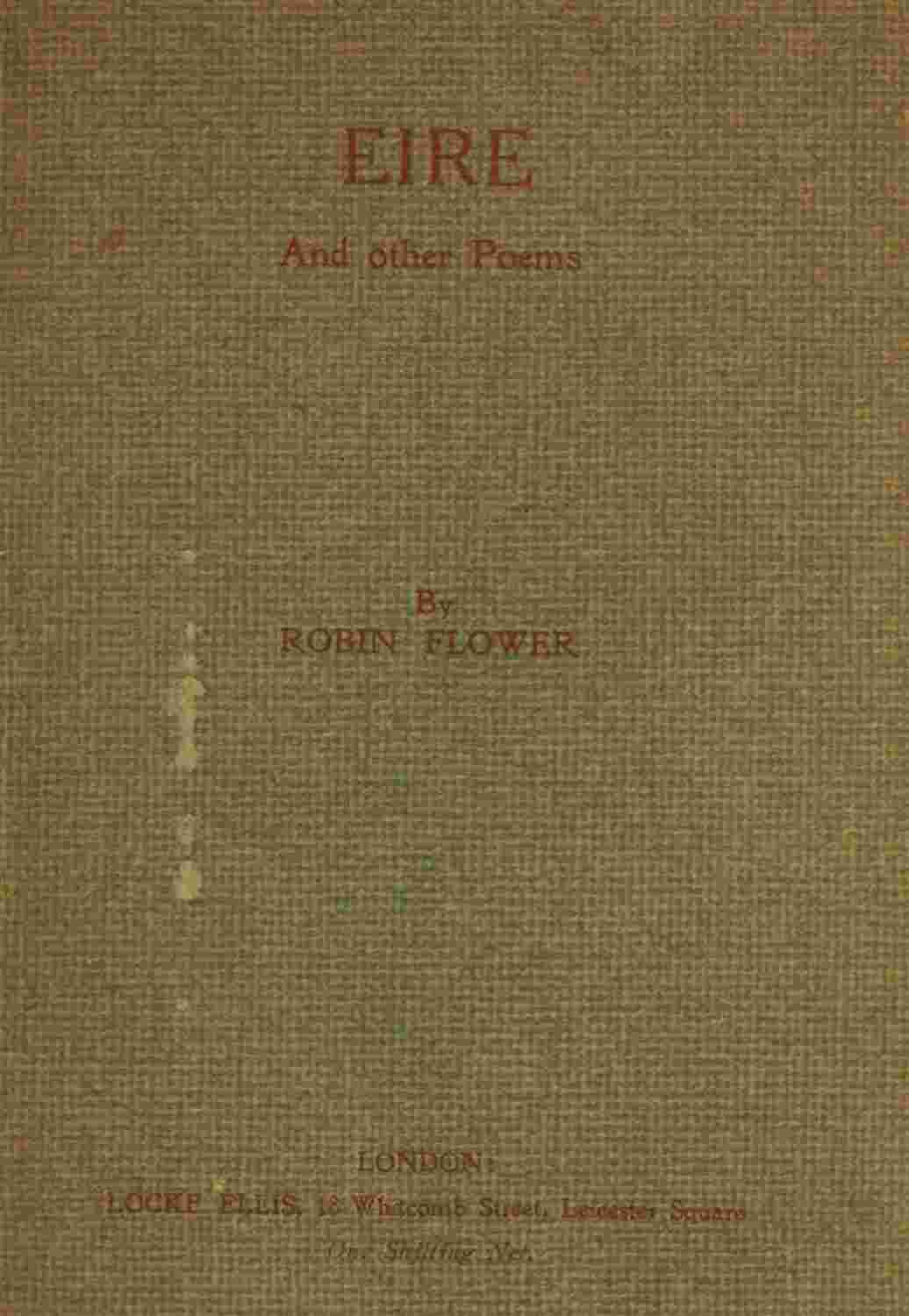
EIRE
And other Poems
By
ROBIN FLOWER
LONDON:
LOCKE ELLIS, 18 Whitcomb Street, Leicester Square
1910.
Certain of these Poems have appeared in “Country Life” and the “Academy,” and are reprinted here by the courtesy of the Editors.
I.M.S.
Has primitias.
CONTENTS.
| Eire: | Page | |
| Eire’s answer | 3 | |
| Tír na n-óg | 5 | |
| Muirnín na gruaige báine | 6 | |
| The little wee lad | 8 | |
| The Charm | 9 | |
| The Sidhe | 10 | |
| The Exile | 11 | |
| Sea-Children | 12 | |
| Old Songs | 13 | |
| Morning in Glenair | 14 | |
| The Hedge-Schoolmaster to his Love | 15 | |
| The Lake of Longing | 16 | |
| To H. I. B. | 17 | |
| Lyrics: | ||
| On Ivinghoe Beacon | 21 | |
| The Sorrow of Senchan the Lonely | 23 | |
| “Chevauchons” (To a tune of Provence) | 24 | |
| The Nightingale | 25 | |
| Joy’s immortality | 26 | |
| At Golder’s Hill | 28 | |
| The Apple Tree | 30 | |
| Desideria | 31 | |
| The Bacchante | 35 | |
| Sonnets | 41 | |
| Hymenaea | 53 | |
EIRE.
EIRE’S ANSWER.
Speak to us who are thinking long,
O Eire, Eire, mother of sorrow,
Mother of song.
True to thy hills and glens and streams;
We that the years and the seas dissever
From all but dreams,
We are made all thine till the world’s life cease;
Speak to our hopes and hearts that falter
Words of peace.
I have faced each sorrow the years renew,
For you I have laboured, for you have pondered,
Have wept for you.
The griefs that lie in your pathways strown
I, your mistress, your mother, Eire,
I, too, have known.
Than this one wisdom the days let fall,
That the heart grown stronger, the heart grown purer
Shall master all.
You shall go your ways from the dance and song,
You shall set your hands to the daily labour
The whole year long.
You shall hate no man for the times long gone,
For strifes must perish and hates must crumble,
But love lives on.
TÍR NA N-ÓG.
In the landwind and the seawind and the wind of gramarie;
For the seawind speaks in thunder and the landwind whispers low,
But the little wind of faery you scarce can hear it blow.
A low and lovely murmur like the singing of a star;
But listen, listen, listen till all things fade and fall
And the lone and luring music is master over all.
Of the life that lives for ever and the fugitives of time
Beyond the green land’s border and washing wastes of sea
In the world beyond the world’s end, where nothing is but glee.
Keep always faith with summer, and summer still is true;
There is no end of dancing and sweet unceasing song,
And eyes to eyes make answer and love with love grows strong.
MUIRNÍN NA GRUAIGE BÁINE.
(From the Irish).
In a little western town
And the sun upon the corn is not so sweet.
At the chill time of the year
On the hills where roams my dear
There is honey in the traces of her feet.
I would take her in a net
And would ease my aching sorrow for a while;
And, though all men say me nay,
I shall wed her on a day,
She my darling of the sweet and sunny smile.
And sow my seedlands now,
I must labour in the face of wind and weather;
But in rain and frost and snow,
Always as I come and go
I am thinking she and I should be together.
THE LITTLE WEE LAD.
With the glimmering boglands to left and to right,
I heard him sing loud through the whispering dark,
The little wee lad with the voice of a lark.
But still he is singing at work and at play,
And, as his glad notes o’er the heather go winging,
They set all the sorrowful solitudes singing.
And the pattering rain to his music reply,
And the clouds and the streams and the mountains are glad
To hear the sweet song of the little wee lad.
THE CHARM.
The North and the South to left and to right,
I bind to my charming the firmament o’er me,
The hosts of the day and the hosts of the night.
And all things silent, all secret things,
The winds in their stillness, the winds in their motion,
The flying wings and the folded wings.
I have spoken the words that are ill to be said;
I have turned three times and three times turning
I have cried the cry that awakes the dead.
He wakes and wonders and feels the charms
Steal into his blood. He is mine for ever,
Mine are his lips and his eyes and his arms.
His feet stir softly and take the way;
He comes by night—for a charm enthralls him—
The road he never has come by day.
THE SIDHE.
And us no sweets can cloy;
For we are of the ancient air
And brothers born of joy.
That still must dream and toil
Vainly, until they turn again
Into their mother soil.
And yet our songs can say
The secret of the elder things
That men have lost for aye.
THE EXILE.
(18th Century).
For there they laugh the kindest laughs, the sweetest songs are sung,
And here it’s bitter living by trench and mound and wall
’Neath suns that brand and blister and freezing dews that fall.
I mind the babble of the burn and every wind that blows;
The winds blow over vineyards here, and proud the rivers fare,
But O! for my brown twinkling streams and heather-scented air.
There’s little meaning in their smile and little mirth beneath;
But when they laugh in Ireland with merry lips apart,
The honey of the lips betrays the honey of the heart.
But still the Irish sorrow is fed from deeper springs,
And often they go weeping, and only they know why
For all the evil things that live and lovely things that die.
SEA-CHILDREN.
Are of the people of the sea
And restless, wind-tormented still
Have no will but the water’s will.
The tide within us ebbs and flows;
And high above us everywhere
Scream the wild gulls in the wild air.
From moaning and the ancient words
That, heard but once by night or day,
Sweep the world’s boundaries away.
Were the interpreters of woe
To the sad queens and sorrowing kings
That ruled above all human things
OLD SONGS.
(To E. J.)
The songs you gathered in the glens, the songs you sang to-day;
And maybe you’ll remember, as I’ll remember well,
The grey land, the grey sky, and the grey sea-swell.
And the foam-fringes rippling up that turned and broke and ran,
And straight in front lay Rathlin and farther yet Cantire
And all away behind us the land of your desire.
And glad with Ireland’s gladness and sad with Ireland’s toil,
A dirge for some old chieftain the snake of poison slew,
Or maybe “Cuttin’ Rushes” or “Bonnie Lads are few.”
And love and death and laughter were on your lips to-day,
And still the wind sang with you and still the sea bore part
And many joys and sorrows were mingling in your heart.
MORNING IN GLENAIR.
And the amber lights were dancing in your eyes;
The cuckoo called us from the branch, the cuckoo of Glenair,
And the lark went laughing up into the skies.
We loved and laughed and lilted as we went,
And the mists upon the valley drifted suddenly apart
And we fled into the world of our content.
And the tramping-men were singing to the day,
The dew was on our naked feet, we waded in the rills,
And to-morrow was ten thousand years away.
THE HEDGE-SCHOOLMASTER TO HIS LOVE.
Than the birds on the mountains more fleet in your fleetness,
With your hair on the wind like a stream of fine amber,
You came through the mist like the sun in September.
Like a silver swayed birch was your lithe lissom lightness,
Your hand was in mine and our hearts beat together
And little we cared for the world and its weather.
On the high hills of heaven the soft rain was falling,
The soft rain, the sweet rain, so silverly shining,
That it charmed us and lulled us till day was declining.
THE LAKE OF LONGING.
And, when among the swaying pines the little winds arise,
Across the black calm of the lake a silver ripple flies.
The sunset lingers on the hills, but darkness dwells with men;
The sun will light us up the hills and we shall rest us then.
TO H.I.B.
And in our hearts a strange desire
Of roses of no earthly bud
And flames of not an earthly fire,
But send our vagrant thoughts astray,
Where, on the walls of darkness hurled,
Die the last onsets of the day.
A muffled music strays and sings,
The last bird through the darkness calls
And winds have rest with folded wings.
LYRICS.
ON IVINGHOE BEACON.
Lifts up into the sky
A soaring shoulder out of earth,
Where swift cloud-shadows fly
And winds in the bent grasses make
A murmured minstrelsy.
The armies of the spring
Across the winter-guarded vale
Their gallant outposts fling
By Amersham and Aylesbury,
By Wendover and Wing.
These winds and suns have felt
And underneath this arch of sky
At this green altar knelt
And the same night has gathered all,
The Roman, Saxon, Celt.
Were cold against my kiss
And far behind your speech there dwelt
Strange wavering mysteries
—The patient legions of the dead
Spoke from their world to this—
My beauty like a flower,
But how, when the soft graces fade,
The magic lights lose power
And Time that did my body build
Unbuilds it hour by hour?
The seasons of desire,
And love, the tattered balladist,
Thrums on a ragged wire,
Past the grey hair and glazing eye
Discern the hearted fire?”
* * * * * *
Alone I climb the Beacon now
And watch the world outrolled,
The farms, the fields, the breadth of sky,
The wide unbroken wold,
And autumn’s traitor banners hung
Above the woods of gold.
THE SORROW OF SENCHAN THE LONELY.
Rejoicing blooms and merry birds that sing
And all the wind and wonder of the spring—
These things are good and all these things are mine.
And over earth’s low lands continually
The wind of beauty passing in the sky—
These things are good and all these things are mine.
And hear beyond these clouds and glooms that lour
The ringing clarions of the morning hour—
These things are good and all these things are mine.
And far above the mortal moment’s scope
Flung heavenward, the indomitable hope—
These things are good and all these things are mine.
“CHEVAUCHONS.”
(To a tune of Provence.)
By hedges robed in eglantine,
Until we stand
Where spring has breathed his peace divine
In lilac and laburnam land.
How morning spends his sunny store
And dew begems
The leafy walls, the grassy floor,
The willows and the chestnut stems.
The blackbirds flute a rich reply;
And down the vale
Have we not heard them, you and I,
The low sobs of the nightingale?
When song upon your lips was gold
And music made
Warm pulsing worlds of planets cold
And sunshine in a night of shade.
Has found no magic yet to bring
Lost glories back,
But, with fled blossom and flown wing,
Must travel still the appointed track.
THE NIGHTINGALE.
Of the last bells across the waters float;
The birds that sing
The silver secrets of the evening.
Pass far and far and very far away;
Saw from each farm
The silent smoke ascending into calm.
The fainting onsets of the waves of fire;
And, mist-enfurled,
The moon rose past the shoulder of the world.
Clear and confused, and strangely swift and slow,
We heard the wail
And passionate hunger of the nightingale.
And all the darkling thickets thrilled with fire;
He sang despair,
And all the woodland wept and all the air.
JOY’S IMMORTALITY.
The happy fields among,
When they were only lad and lass,
That now are dead so long.
The nesting birds would sing
As though their little hearts were mad
With the new wine of spring.
How clear and sweet and strong
The love-bedrunken nightingale
Would sing their mating song!
And rain of autumn leaves,
Nor wept that earth’s own kind should go
Where earth’s own bosom heaves.
And bade the world be white,
They went about the silent land
And carolled their delight.
The birds are singing still,
The footsteps of the wind and rain
Are silver on the hill.
The bridegroom and the bride;
The pained and mortal flesh is gone,
The immortal joys abide.
AT GOLDER’S HILL.
Rule the wide kingdom of sweet will
And catch an innocent employ
From the abundant heart of joy.
He teased the mossy-antlered stag
And taught a puppy’s tail to wag;
He made a playful ripple shake
The water-lilies in the lake;
Smelt at a rose, tiptoed to kiss
The overarching clematis,
Ran shouting up the hill to stare
And watch the dying sunset flare;
Then from his calling mother hid
And would not answer when she chid.
So glad, he seemed no human birth,
But some wild spirit of the earth,
Some rapture of delirious mood,
Not yet betrayed to flesh and blood,
But elemental, swift and free
As sunlight dancing on the sea.
Safe from the heavy mortal sleep,
Wherein we wander, having sold
A heavenly hope for earthly gold;
Then would your morning of delight
Reach far into the realms of night,
Rich with the rapture that uncloses
Your brother lilies, sister roses,
And take for its eternal treasure
This sweet simplicity of pleasure.
THE APPLE TREE.
Ere song had raised the walls of Troy;
Round me the shepherd folk renewed
With every Spring their piping joy.
My wealth of blossom showering snowed;
They had no thought of pain and death,
For life and joy unchanged abode.
Sharp tremors ran through all my leaves;
Men came about me whispering,
“Destiny some dark purpose weaves.”
My leaves began to fade and fall,
A ruddy-golden apple burned
High on the topmost branch of all.
DESIDERIA.
The song more sweet than all,
No music may re-word it,
So rich its rise and fall.
The roses red with joy,
It seemed no rain could flaw them,
Nor any wind destroy.
THE BACCHANTE.
THE BACCHANTE.
[Scene: The Eastward slopes of Cithaeron. A Bacchante with wine cup and thyrsus comes running up the hill. A youth follows her, and, as the first streaks of dawn line the sky, she turns and speaks.]