
The Project Gutenberg eBook of Encyclopedia of Diet: A Treatise on the Food Question, Vol. 3
Title: Encyclopedia of Diet: A Treatise on the Food Question, Vol. 3
Author: Eugene Christian
Release date: October 14, 2015 [eBook #50213]
Most recently updated: October 22, 2024
Language: English
Credits: Produced by Jane Robins and the Online Distributed
Proofreading Team at http://www.pgdp.net (This file was
produced from images generously made available by The
Internet Archive)
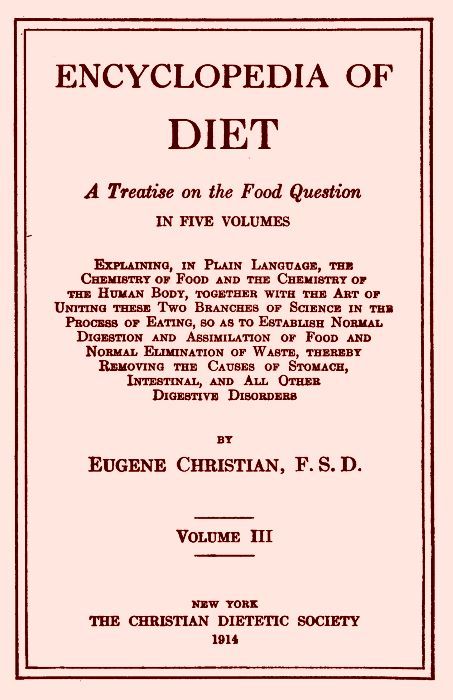
ENCYCLOPEDIA OF
DIET
A Treatise on the Food Question
IN FIVE VOLUMES
Explaining, in Plain Language, the
Chemistry of Food and the Chemistry of
the Human Body, together with the Art of
Uniting these Two Branches of Science in the
Process of Eating, so as to Establish Normal
Digestion and Assimilation of Food and
Normal Elimination of Waste, thereby
Removing the Causes of Stomach,
Intestinal, and All Other
Digestive Disorders
BY
Eugene Christian, F. S. D.
Volume III
NEW YORK
THE CHRISTIAN DIETETIC SOCIETY
1914
Copyright, 1914
BY
EUGENE CHRISTIAN
ALL RIGHTS RESERVED
Published August, 1914
CONTENTS
Volume III
| Lesson XII | Page |
|---|---|
| Harmonious Combinations of Food and Tables | |
| of Digestive Harmonies and Disharmonies | 591 |
| Chemical Changes Produced by Cooking | 593 |
| Starch Digestion--Cooked and Uncooked | 597 |
| Excuses for Cooking Our Food | 599 |
| Experiment upon Animals | 601 |
| Food Combinations | 603 |
| How to Interpret the Tables | 607 |
| Tables of Digestive Harmonies and Disharmonies | 609 |
| Lesson XIII | |
| Classification of Foods and Food Tables | 619 |
| Simple Classification of Foods Based on | |
| Principal Nutritive Substances | 621 |
| Purposes which the Different Classes of Food | |
| Serve in the Human Body | 625 |
| Purpose of Carbohydrates | 625 |
| Purpose of Fats | 626 |
| Purpose of Proteids | 626 |
| Purpose of Mineral Salts | 629 |
| Difference between Digestibility and Assimilability | 630 |
| Table showing Comparative Assimilability and | |
| Carbohydrate and Water Content of Cereals, | |
| Legumes, and Vegetables | 632 |
| Lesson XIV | |
| Vieno System of Food Measurement | 637 |
| Energy | 639 |
| Nitrogen | 641 |
| Systems of Food Measurements Compared | 642 |
| The "Old" System | 642 |
| The New or "Vieno" System | 645 |
| Necessity for a Simple System | 646 |
| Explanation of Table | 648 |
| Table of Food Measurements | 655 |
| Lesson XV | |
| Curative and Remedial Menus | 665 |
| Introduction | 667 |
| Cooking | 669 |
| Grains | 669 |
| Vegetables | 670 |
| Cooking en casserole | 671 |
| Rice and Macaroni | 672 |
| Fruits | 672 |
| Canned Goods | 673 |
| Buttermilk | 674 |
| Home-made Butter | 674 |
| The Banana | 675 |
| How to Select and Ripen Bananas | 676 |
| Baked Bananas | 677 |
| Recipes: | |
| For Coddled Egg | 677 |
| For Uncooked Eggs | 678 |
| For Baked Omelet | 678 |
| For Fish and Fowl | 678 |
| For Green Peas in the Pod | 679 |
| For Pumpkin | 680 |
| For Vegetable Juice | 680 |
| For Sassafras Tea | 681 |
| Wheat Bran | 681 |
| Bran Meal | 683 |
| Choice of Menus | 683 |
| Normal Menus | 685 |
| Introduction to Normal Menus | 685 |
| For Normal Child, 2 to 5 years | 687 |
| For Normal Youth, 5 to 10 years | 692 |
| For Normal Youth, 10 to 15 years | 696 |
| For Normal Person, 15 to 20 years | 700 |
| For Normal Person, 20 to 33 years | 704 |
| For Normal Person, 33 to 50 years | 708 |
| For Normal Person, 50 to 65 years | 712 |
| For Normal Person, 65 to 80 years | 716 |
| For Normal Person, 85 to 100 years | 720 |
| Introduction to Curative Menus | 724 |
| Curative Menus: | |
| Superacidity | 726 |
| Fermentation | 753 |
| Constipation | 761 |
| Gastritis | 763 |
| Nervous Indigestion | 784 |
| Nervousness | 789 |
| Subacidity | 801 |
| Biliousness | 809 |
| Cirrhosis of the Liver | 822 |
| Diarrhea | 832 |
| Emaciation | 845 |
LESSON XII
Harmonious Combinations of Food and
Tables of Digestive Harmonies
and Disharmonies
CHEMICAL CHANGES PRODUCED BY COOKING
The application of heat to food is comparatively of recent origin in the evolution of mankind. The use of fire involves a certain amount of mental ingenuity, and could not be practised by man's anthropoid ancestors. Anthropoid animals, whether human or ape, have a great amount of curiosity for the unusual and the new.
Man probably began his cooking experiments by soaking hard foods in warm water, then in hot water, or by warming cold foods at his camp-fire. As heat volatilizes the pleasant odorous substance present in many foods, the custom of heating them probably became popular. The habit of cooking spread, as many other novel and interesting customs have spread, from this primitive process to the French chef, regardless of whether the results were beneficial or harmful.
The question whether foods should be eaten cooked or uncooked can best be answered by examining the chemical and mechanical changes produced in the process of cooking, and their consequent physiological effects.
Cooking may be divided into two classes, namely, Moist Heat and Dry Heat. To illustrate:
Sugars are not chemically affected by boiling with water, while starch, cooked with boiling water, or steam, absorbs from three to five times its bulk of moisture, and changes into a soft, pasty, or semi-dissolved mass. Under dry heat, sugars are converted into a brown substance, known as caramel, while starch cooked under a temperature of 300° to 400° of dry heat, is changed into a dextrin, of which toast and zwieback are examples.
Fats are not changed chemically by moist heat; that is, by being boiled in water, but the globules are melted and the hot fat spreads in a film over other material which may be present. In dry heat, fats are chemically decomposed, forming irritating vapors. The odors of frying fat are due to the presence of small quantities of these decomposition products. In larger quantities, and with greater heat, these substances are exceedingly irritating to the mucous membrane of the stomach and the intestines.
The chemical changes produced by heating proteids are of much more importance than are those which take place in other foods. Simple proteids, such as albumin and globulin, are coagulated at a temperature of about 160°. This change is familiar in the coagulation of egg whites under low temperature. Other proteids undergo similar changes, governed by the degree and kind of heat (dry or moist), to which they are subjected. This change in proteid material continues with the application of prolonged heat, until the proteid, under dry heat, is converted into a dark brittle mass, wholly insoluble and indigestible.
If the student will take the white of an egg, and bake it for some time in an oven, he will observe the coagulation or hardening of the proteid. The chemical nature of this change is one of great complexity. The molecules combine with each other, forming almost indestructible substances. The combined or coagulated forms of proteid are represented in nature by horns, hoofs, finger nails, and hair.
STARCH DIGESTION—COOKED AND UNCOOKED
The student will remember the reference made in Lesson V to experiments concerning the digestibility of starch when taken in various forms. In these experiments, though conducted for the purpose of demonstrating the supposed advantage of excessive cooking, the results showed that at the time the contents of the stomach were removed, all the proteids of the uncooked grain had been digested, while the percentage of proteid digested from the various forms of cooked grain grew less as the cooking was increased. As the chief function of the gastric juice is the digestion of proteids, the real significance of the above experiments was exactly the opposite from that which was intended to be proved.
The statement is frequently made that the starch of grain cannot be digested without cooking, because the cells enclosing the starch grains have indigestible or insoluble cellulose walls. The old theory is that cooking expands the starch and ruptures or tears down these walls, freeing the contents so that the digestive juices may act upon the enclosed starch granules. This is a theory unsupported by facts. The cell walls on the interior of the grain kernel are very filmy, and in the mature grain scarcely exist at all. The analysis of wheat flour shows only a trace of cellulose fiber. Were these cellulose walls within the wheat grain, as this theory commonly teaches, flour would show a liberal quantity of cellulose. The cellulose wall theory, as a necessity for cooking starch, is an excellent illustration of the ease with which a groundless statement or theory may be used to prove or to explain some popular prejudice.
In the process of cooking, the tendency is to render the organic salts contained in food entirely inorganic. This change from organic to inorganic salts is measured by the temperature to which the foods are subjected. Many of these salts are combined with the nitrogenous constituents of food, therefore when subjected to certain degrees of heat they are of little value in the construction of the proteid molecules within the body. This is especially true of fresh or green vegetables.
EXCUSES FOR COOKING OUR FOOD
Inasmuch as the majority of people favor cooking, probably forgetting that about half of the food consumed in the world at the present time is taken in its natural or uncooked state, it may be well to mention some of the views advanced by those who believe that the present diet of cooked grain is better for modern man than an elementary diet, and who attempt to give a natural explanation. One theory is that man has subsisted so long upon cooked foods that his organs have become fitted for a cooked diet, and a cooked diet only. Another view sometimes advanced is, that while cooked foods were originally detrimental, yet by continued use man has become fitted for such a diet and unfitted for a natural diet. These are but other forms of the old belief in the inheritance of acquired characteristics. This belief, however, is steadily losing ground among evolutionists. There is no more reason to believe that a modified function of the stomach would be inherited, than there is to believe that small feet would be inherited among the Chinese women just because these organs are mutilated by local custom.
The best light of scientific knowledge now leads us to believe that the healthy child of today is, in its capacity for nutrition, essentially like the primitive child, and would thrive best upon a varied diet of natural foods.
EXPERIMENT UPON ANIMALS
While I do not claim that the methods of animal feeding apply accurately to man, yet the digestive and the assimilative processes of animals are so closely related to the human processes, that the results obtained in animal nutrition are very instructive to the student of human food science.
About thirty years ago, when the scientific study of agriculture first became prevalent, an experiment was made in cooked food for animals, upon an extensive basis. At that time it was the universal belief that man owed much of his superiority over other animals to the use of cooked food. This argument was put forth with great force and appeared quite reasonable. It was asked whether animals other than man would be benefited by changing to a cooked bill of fare.
During this agitation numerous western farmers put their hogs, chickens, cows, horses, and sheep upon a cooked bill of fare, and many enthusiastic feeders claimed beneficial results. Later the various Governmental Experimental Stations took up the subject and made many careful, complete, and comparative tests of the effects of cooked and uncooked food for animals. The result did not show the expected thing. The cooking experiments in the majority of cases proved injurious, and the general decision of the Government investigators was that cooking food for animals was useless and detrimental to the great live stock industry. Stock food cookery has now become entirely obsolete.
Man is the only animal that cooks his food, and has made great progress in civilization while subsisting on a cooked diet, but cooking is no more the cause of his advancement than silk hats and swallow-tailed coats. He has advanced only according to the degree that he has thought, studied, and experimented. Cooking has undoubtedly enabled man to utilize many things as food, that he could not and would not have used otherwise, but whether this has aided or retarded in his material progress is yet an unsolved question.
FOOD COMBINATIONS
The following tables are designed to convey, in the most condensed and simplified form, the results of my investigations in regard to food combinations.
It is somewhat difficult to give in any one table exact information concerning food combinations under the varying conditions of the body and its ever-changing requirements. The best that can be done is to lay out such groups as are fundamentally harmonious from a chemical point of view.
The particular condition of the patient often reveals certain special requirements which must be dealt with according to the symptoms given off by the body. Many of these combinations, when taken under certain conditions, may appear disagreeable, but this can be overcome by leveling the proportions and limiting the quantity. Quantity is of very great importance for the reason that the most perfect selections of food can be made and blended into perfect chemical harmony, and still disagree with the normal stomach if a quantity is taken in excess of physical demands.
The use of these tables will serve to bring to the student's attention the advantage to be gained from a health-giving and curative point of view, as well as from simplicity in diet.
In considering the chemical harmony of foods, the student should keep in mind the time required for digestion, which involves not only the question of combining foods at the same meal, but also the taking, within a few hours after eating, of other articles that may produce chemical inharmony. For example: Milk, cereals, and sweet fruits are in chemical harmony, but a lemonade introduced into the stomach an hour or two later would produce inharmony, and be almost as harmful as if it had been taken with the meal.
There are many injurious combinations which the student will learn to omit from a sense of taste and instinct, and while our instincts have in many cases ceased to guide us aright, they will rapidly return and assume command if given a fair opportunity.
The perfect meal can be made from three or four articles, and the entire menu can be changed three times a day, but to take eight, ten, or a dozen things at the same meal, puts the quantity, as well as every article composing the meal, into jeopardy.
After one has eaten a sufficient quantity of food, and the taste has signalled "ENOUGH," something sweet or pungent is introduced. This puts into activity another set of taste buds which will accept a given quantity of another food. However, the stomach has already given off one signal of "enough," hence every pennyweight taken in excess of that amount is that much more than should be eaten.
In order to simplify the making of harmonious combinations, I have grouped the foods whose use I recommend in nine different divisions. A further subdivision of vegetables and fruits might have been made, but this would have increased the number of groups, making them more complicated and less practical.
HOW TO INTERPRET THE TABLES
In order to ascertain the articles with which any special food will combine, the student should turn to the table headed with the desired article of that group. If foods from three groups are to be considered, the student will look for two of them in the first vertical column on the left-hand side of the page, and will then follow across to the vertical column for the third article.
Figure (1) means especially beneficial
Figure (2) means good combinations
Figure (3) means somewhat undesirable
Figure (4) means particularly harmful
(a) "Fats with" figure (1), under the heading Grains, first table, page 609, means that the combination of "fats with grains" would be "especially beneficial."
(b) "Fats and eggs with" figure (2), under the heading Milk, page 609, means that "fats and eggs with milk" make a good combination.
(c) "Fats and milk with" figure (3), page 609, under column headed Nuts, means a "somewhat undesirable" combination.
(d) "Fats and acid fruits with" figure (4), under heading Milk, page 609, means that this combination would be "particularly harmful," etc.
It is impractical to print ready reference tables showing the harmony of more than three articles, but the student can judge this sufficiently well for himself by comparing the respective harmonies of the several foods of the group.
TABLES OF DIGESTIVE HARMONIES AND DISHARMONIES
| 1 Especially beneficial | 3 Somewhat undesirable |
| 2 Good combinations | 4 Particularly harmful |
Fats
(Such as Butter, Salad Oils, Cream, etc.)
| Eggs | Milk | Nuts | Grains | Vegetables | Acid Fruits |
Sweet Fruits |
Sugars | |
|---|---|---|---|---|---|---|---|---|
| Fats with | 2 | 2 | 3 | 1 | 1 | 2 | 2 | 2 |
| Fats and Eggs with | — | 2 | 3 | 2 | 2 | 2 | 2 | 2 |
| Fats and Milk with | 2 | 3 | 2 | 2 | 4 | 2 | 2 | |
| Fats and Nuts with | 3 | 3 | — | 2 | 2 | 3 | 3 | 2 |
| Fats and Grains with | 2 | 2 | 2 | — | 1 | 2 | 2 | 2 |
| Fats and Veget. with | 2 | 2 | 1 | 1 | — | 3 | 2 | 2 |
| Fats and acid fruits with | 2 | 4 | 2 | 2 | 3 | — | 2 | 3 |
| Fats and sweet fruits with | 2 | 2 | 2 | 2 | 2 | 3 | — | 3 |
| Fats and Sugars with | 2 | 2 | 2 | 2 | 2 | 2 | 3 | — |
TABLES OF DIGESTIVE HARMONIES AND DISHARMONIES
| 1 Especially beneficial | 3 Somewhat undesirable |
| 2 Good combinations | 4 Particularly harmful |
Eggs
| Fats | Milk | Nuts | Grains | Vegetables | Acid Fruits |
Sweet Fruits |
Sugars | |
|---|---|---|---|---|---|---|---|---|
| Eggs with | 2 | 1 | 3 | 2 | 2 | 2 | 1 | 2 |
| Eggs and Fats with | — | 2 | 3 | 2 | 2 | 2 | 2 | 3 |
| Eggs and Milk with | 2 | — | 2 | 1 | 3 | 4 | 1 | 2 |
| Eggs and Nuts with | 3 | 2 | — | 1 | 1 | 1 | 1 | 2 |
| Eggs and Grains with | 2 | 1 | 1 | — | 2 | 2 | 2 | 2 |
| Eggs and Veget. with | 2 | 2 | 1 | 2 | — | 3 | 1 | 2 |
| Eggs and acid fruits with | 2 | 4 | 1 | 2 | 3 | — | 4 | 2 |
| Eggs and sweet fruits with | 2 | 1 | 1 | 2 | 2 | 2 | — | 3 |
| Eggs and Sugars with | 2 | 2 | 2 | 2 | 2 | 2 | 3 | — |
TABLES OF DIGESTIVE HARMONIES AND DISHARMONIES
| 1 Especially beneficial | 3 Somewhat undesirable |
| 2 Good combinations | 4 Particularly harmful |
Milk
(Including skimmed and clabbered milk, buttermilk and fresh cheese)
| Fats | Eggs | Nuts | Grains | Vegetables | Acid Fruits |
Sweet Fruits |
Sugars | |
|---|---|---|---|---|---|---|---|---|
| Milk with | 2 | 1 | 2 | 1 | 4 | 4 | 1 | 3 |
| Milk and Fats with | — | 2 | 3 | 2 | 2 | 4 | 2 | 2 |
| Milk and Eggs with | 2 | — | 2 | 1 | 2 | 4 | 1 | 2 |
| Milk and Nuts with | 3 | 2 | — | 1 | 3 | 4 | 1 | 2 |
| Milk and Grains with | 2 | 1 | 1 | — | 3 | 4 | 2 | 2 |
| Milk and Veget. with | 2 | 2 | 2 | 3 | — | 4 | 2 | 3 |
| Milk and acid fruits with | 4 | 4 | 4 | 4 | 4 | — | 4 | 4 |
| Milk and sweet fruits with | 2 | 1 | 1 | 2 | 3 | 4 | — | 2 |
| Milk and Sugars with | 2 | 2 | 2 | 2 | 3 | 4 | 2 | — |
TABLES OF DIGESTIVE HARMONIES AND DISHARMONIES
| 1 Especially beneficial | 3 Somewhat undesirable |
| 2 Good combinations | 4 Particularly harmful |
Nuts
(All common nuts except chestnuts and peanuts)
| Fats | Eggs | Milk | Grains | Vegetables | Acid Fruits |
Sweet Fruits |
Sugars | |
|---|---|---|---|---|---|---|---|---|
| Nuts with | 3 | 3 | 2 | 1 | 1 | 2 | 1 | 2 |
| Nuts and Fats with | — | 3 | 3 | 2 | 2 | 2 | 2 | 3 |
| Nuts and Eggs with | 3 | — | 2 | 1 | 2 | 2 | 1 | 2 |
| Nuts and Milk with | 3 | 3 | — | 1 | 2 | 4 | 1 | 2 |
| Nuts and Grains with | 2 | 1 | 1 | — | 1 | 3 | 1 | 1 |
| Nuts and Veget. with | 1 | 1 | 2 | 1 | — | 3 | 1 | 2 |
| Nuts and acid fruits with | 2 | 1 | 4 | 2 | 2 | — | 2 | 3 |
| Nuts and sweet fruits with | 2 | 1 | 1 | 1 | 1 | 2 | — | 2 |
| Nuts and Sugars with | 3 | 2 | 2 | 1 | 2 | 2 | 2 | — |
TABLES OF DIGESTIVE HARMONIES AND DISHARMONIES
| 1 Especially beneficial | 3 Somewhat undesirable |
| 2 Good combinations | 4 Particularly harmful |
Grains
(All cereal and starchy products)