
The Project Gutenberg eBook of English Monasteries
Title: English Monasteries
Author: A. Hamilton Thompson
Release date: August 31, 2015 [eBook #49832]
Most recently updated: October 24, 2024
Language: English
Credits: Produced by MWS and the Online Distributed Proofreading
Team at http://www.pgdp.net (This file was produced from
images generously made available by The Internet
Archive/American Libraries.)
The Cambridge Manuals of Science and Literature
ENGLISH MONASTERIES
CAMBRIDGE UNIVERSITY PRESS London: FETTER LANE, E.C. C. F. CLAY, Manager
Edinburgh: 100, PRINCES STREET
Berlin: A. ASHER AND CO.
Leipzig: F. A. BROCKHAUS
New York: G. P. PUTNAM'S SONS
Bombay and Calcutta: MACMILLAN AND CO., Ltd.
All rights reserved
Cambridge: PRINTED BY JOHN CLAY, M.A. AT THE UNIVERSITY PRESS
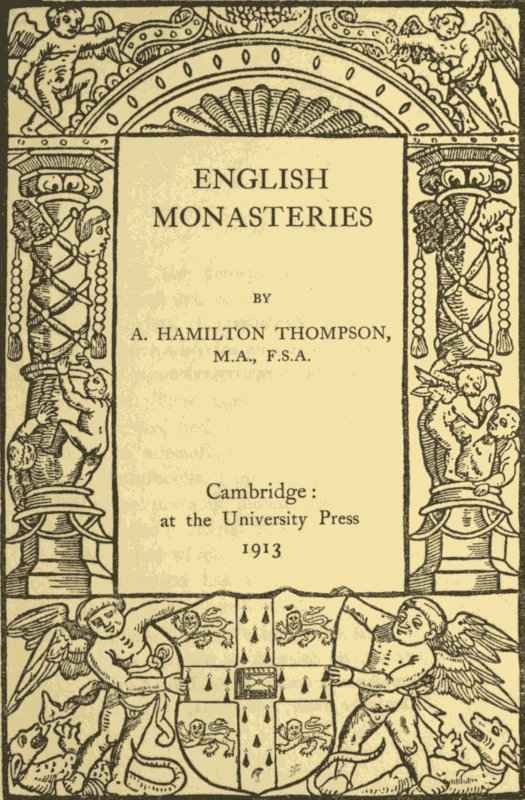
With the exception of the coat of arms at the foot, the design on the title page is a reproduction of one used by the earliest known Cambridge printer, John Siberch, 1521
PREFACE
In view of the growth of interest in medieval history and art, so conspicuous of late years, it is thought that this small volume may meet the needs of those who desire to know something about one of the most interesting sides of the life of the middle ages. There is no dearth of literature relating to monasteries, and the general facts of monastic history are accessible to the ordinary student in various handbooks. Monographs, however, which describe the plans of monasteries and the position and use of the principal buildings, exist for the most part in forms which are more difficult of access. Special attention has therefore been paid in the present case to the question of plan, and it is hoped that visitors to the remains of our English religious houses, who wish to gain some co-ordinate idea of their various parts, may find some help from this manual.
The writer desires to acknowledge gratefully the assistance of his wife, who is responsible for the plans and illustrations. The master of Emmanuel, the general editor of the series, has kindly read through the proofs and furnished valuable suggestions. The book has also had the great advantage of perusal and criticism by Mr W. H. St John Hope, Litt.D., D.C.L., to whose kindness and learning the writer is deeply indebted. Some idea of what students of English monastic life owe to Mr Hope may be gained from the bibliography at the end of this volume. Thanks are also due to the editors of the Archaeological Journal for permission to found the plan of Haughmond abbey (p. 114) on that by Mr H. Brakspear, F.S.A., in Archaeol. Journal, vol. LXVI.
A. H. T.
Gretton, Northants.
12 April, 1913.
CONTENTS
| CHAPTER I | |
| THE RELIGIOUS ORDERS | |
| § 1. The medieval monastery. 2. Growth of monachism in the east. 3. Beginnings of western monachism: Italy, Gaul and Ireland. 4. The rule of St Benedict. 5. The Benedictine order in England: early Saxon monasteries. 6. The Danish invasions and the monastic revival. 7. Monasticism after the Norman conquest. 8. Benedictine abbeys and priories. 9. Priories of alien houses. 10. The Cluniac order. 11. The Carthusian order. 12. The orders of Thiron, Savigny and Grandmont. 13. Foundation and growth of the Cistercian order. 14. Cistercian monasteries. 15. Monks and conversi. 16. Orders of canons: secular chapters. 17. Augustinian canons. 18. Premonstratensian canons. 19. The order of Sempringham. 20. Nunneries. 21. Decline of the regular orders. The friars. 22. Monastic property: parish churches. 23. Monasteries as land-owners: financial depression. 24. Moral condition of the monasteries. 25. Numbers of inmates of monasteries. 26. The suppression of the monasteries. 27. Remains and ruins of monastic buildings | 1 - 39 |
| CHAPTER II | |
| THE CONVENTUAL CHURCH | |
| § 28. Divisions of the monastery precinct: varieties of plan. 29. The plan of church and cloister: necessities governing the church-plan. 30. General arrangement of the church. 31. Eastern arm of the church: Anglo-Norman Benedictine and Cluniac plans. 32. The presbytery and quire. 33. Transept-chapels. 34. Aisled enlargements of the eastern arm. 35. The nave: processional doorways, altars and screens. 36. Parochial use of the nave. 37. The normal Cistercian plan: presbytery and transepts. 38. Cistercian aisled presbyteries. 39. Cistercian transepts. 40. Arrangement of the Cistercian nave. 41. Cistercian influence on the plan of canons' churches. 42. Aisled quires and presbyteries in canons' churches. 43. Naves with single aisles in canons' churches. 44. Aisleless naves. 45. Aisleless plans: churches of nuns, Carthusian monks, friars and Gilbertine canons | 39 - 71 |
| CHAPTER III | |
| THE CLOISTER AND ITS BUILDINGS | |
| § 46. Plan and position of the cloister. 47. The cloister-walk next the church. 48. The eastern range: the parlour. 49. The chapter-house: its uses. 50. Varieties of the chapter-house plan. 51. Sub-vault of the dorter: treasury and common-house. 52. The dorter stairs. 53. The dorter and rere-dorter. 54. Buildings opposite the church: the frater. 55. The kitchen. 56. The cloister lavatory. 57. The western range: the cellarer's building and its upper floor. 58. Exceptional uses of the western range: Worcester, Durham and Easby | 72 - 95 |
| CHAPTER IV | |
| THE CISTERCIAN CLOISTER, ETC. | |
| § 59. Plan of the eastern range: the vestry and library. 60. The Cistercian chapter-house. 61. Parlour, infirmary passage and sub-dorter. 62. Dorter, rere-dorter and day-stair. 63. The range opposite the church: plan of the frater. 64. Arrangements of the warming-house and frater. 65. The kitchen: convenience of its place in the plan. 66. The western range: cellarer's building and house of the lay brothers. 67. Later changes in the Cistercian plan: misericords in cloister. 68. Plans of houses of canons, friars, etc.: their kinship to the normal Benedictine plan. 69. Carthusian houses: the plan of Mount Grace | 95 - 113 |
| CHAPTER V | |
| THE INFIRMARY AND THE OUTER COURT | |
| § 70. Objects of the infirmary. 71. Buildings and position of the infirmary. 72. Plan and arrangement of the infirmary hall. 73. The infirmary kitchen and the misericord. 74. The abbot's lodging: Cistercian usages. 75. Abbots' and priors' lodgings in other orders. 76. The guest-houses: division of hospitality. 77. The outer court or curia: Cistercian entrance-courts. 78. The gatehouse. 79. The almonry and its uses | 113 - 132 |
| CHAPTER VI | |
| DISCIPLINE AND THE DAILY LIFE | |
| § 80. Officers of the monastery: the obedientiaries. 81. The monastic day and its divisions: the night-office. 82. Services and work of the morning in summer. 83. The day from sext to compline. 84. Arrangement of the day in winter: variations of daily custom. 85. The Carthusian day | 133 - 142 |
| Bibliography | 143 |
| Index | 149 |
LIST OF ILLUSTRATIONS
| FIG. | PAGE | |
| St Mary's abbey, York. Crossing, north transept, and north aisle of nave | Frontispiece | |
| 1. | Plan of the cathedral priory, Canterbury (after Professor Willis) | 40 |
| 2. | Croyland abbey: rood-screen and nave from S.E. | 50 |
| 3. | Plan of typical Cistercian church, shewing original form and later eastern enlargement | 56 |
| 4. | Tintern abbey: north transept and presbytery, shewing doorways to dorter and sacristy | 60 |
| 5. | Mount Grace priory: tower-arches and nave from N.E. | 69 |
| 6. | Gloucester: south walk of cloister with monks' carrels | 74 |
| 7. | Bristol: chapter-house, looking W. | 78 |
| 8. | Worcester: lavatory in west walk of cloister | 88 |
| 9. | Durham: ceiling of dorter (now the chapter library) | 93 |
| 10. | Netley abbey: south transept and south aisle of nave, shewing doorways to sacristy and dorter, and eastern processional doorway | 96 |
| 11. | Fountains abbey: plan | 102 |
| 12. | " " cellarium, looking north | 106 |
| 13. | Haughmond abbey: plan | 114 |
| 14. | Peterborough: infirmary, looking west | 118 |
| 15. | Kirkham priory: gatehouse | 130 |