
The Project Gutenberg eBook of Essays on the Microscope
Title: Essays on the Microscope
Author: George Adams
Editor: Frederick Kanmacher
Release date: January 14, 2020 [eBook #61169]
Most recently updated: October 17, 2024
Language: English
Credits: Produced by Chris Curnow, Harry Lamé and the Online Distributed Proofreading Team at
http://www.pgdp.net (This file was produced from images
generously made available by The Internet Archive)
Please see the Transcriber’s Notes at the end of this text.
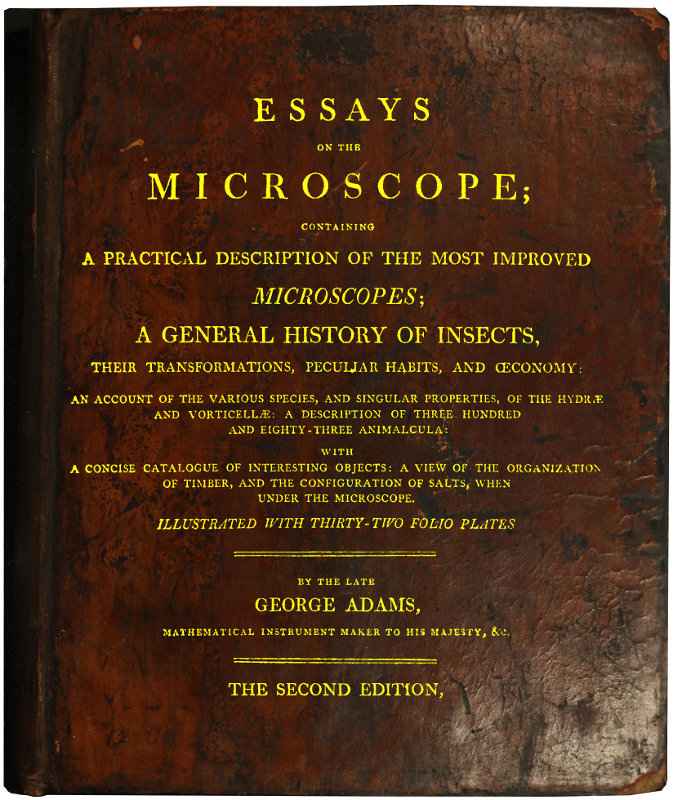
The cover image has been created for this text, and is placed in the public domain.
ESSAYS
ON THE
MICROSCOPE.
T.S. Duché pinxit
Truth discovering to Time, Science
instructing her Children in the Improvements on the Microscope.
London, Published July 1.st 1787, by Geo.e Adams, N.o 60 Fleet Street.
ESSAYS
ON THE
MICROSCOPE;
CONTAINING
A PRACTICAL DESCRIPTION OF THE MOST IMPROVED
MICROSCOPES;
A GENERAL HISTORY OF INSECTS,
THEIR TRANSFORMATIONS, PECULIAR HABITS, AND ŒCONOMY:
AN ACCOUNT OF THE VARIOUS SPECIES, AND SINGULAR PROPERTIES, OF THE HYDRÆ
AND VORTICELLÆ: A DESCRIPTION OF THREE HUNDRED
AND EIGHTY-THREE ANIMALCULA:
WITH
A CONCISE CATALOGUE OF INTERESTING OBJECTS: A VIEW OF THE ORGANIZATION
OF TIMBER, AND THE CONFIGURATION OF SALTS, WHEN
UNDER THE MICROSCOPE.
ILLUSTRATED WITH THIRTY-TWO FOLIO PLATES
BY THE LATE
GEORGE ADAMS,
MATHEMATICAL INSTRUMENT MAKER TO HIS MAJESTY, &c.
THE SECOND EDITION,
WITH CONSIDERABLE ADDITIONS AND IMPROVEMENTS, BY
FREDERICK KANMACHER, F. L. S.
LONDON:
PRINTED BY DILLON AND KEATING,
FOR THE EDITOR; AND FOR W. AND S. JONES, HOLBORN.
MDCCXCVIII.
PRICE 1l. 8s. IN BOARDS.
TO
THE KING.
SIR,
Every work that tends to enlarge the boundaries of science has a peculiar claim to the protection of Kings. He that diffuses science, civilizes man, opens the inlets to his happiness, and co-operates with the Fountain and Source of all knowledge. By science truth is advanced; and of Divine Truth Kings are the representatives.
The work which I have now the honour to present to YOUR MAJESTY, calls the attention of the reader to those laws of Divine order by which the universe is governed and supported; in it we find that the minutest beings share in the protection, and triumph in the bounty of the Sovereign of all things: that the infinitely small manifest to the astonished eye the same proportion, regularity and design, which are conspicuous to the unassisted sight in the larger parts of creation. By finding all things formed in beauty, and produced for use, the mind is raised from the fleeting and evanescent appearances of matter, to contemplate the permanent principles of truth, and acknowledge that the whole proceeds from the wisdom that originates in love.
It was by YOUR MAJESTY’S goodness and gracious patronage that I was first induced to undertake a description of mathematical and philosophical instruments, that I might thereby facilitate the attainment of those sciences that are connected with them, and by shewing what was already obtained, excite emulation, and quicken invention.
It is to the same goodness that I am indebted for this opportunity of subscribing myself,
SIR,
YOUR MAJESTY’S
Most humble,
Most obedient,
and most dutiful
Subject and Servant,
GEORGE ADAMS.
PREFACE.
In the preface to my Essays on Electricity and Magnetism, I informed the public that it was my intention to publish, from time to time, essays describing the construction and explaining the use of mathematical and philosophical instruments, in their present state of improvement. This work will, I hope, be considered as a performance of my promise, as far as relates to the subject here treated of.[1]
[1] Towards the completion of this design, our author afterwards published, 1. Astronomical and Geographical Essays; 2. Geometrical and Graphical Essays; 3. An Essay on Vision; 4. Lectures on Natural and Experimental Philosophy. He had projected other compilations, and was preparing a new edition of this work; but, alas! how uncertain are all human projects! constant attention to an extensive business and to literature, preyed on a constitution far from robust, and at length rapidly accelerated his dissolution, which happened at Southampton, on the 14th of August, 1795; aged 45. By this event, the world was prematurely deprived of the beneficial effects of his farther labours, and his friends of the conversation of a man, whose amiable and communicative disposition endeared him to all those who had the pleasure of knowing him. His life had been devoted to religious and moral duties, to the acquisition of science, and its diffusion for the benefit of mankind. To those who had no personal knowledge of Mr. Adams, his works will continue to display his merits as an author, and his virtues as a valuable member of society. Edit.
The first chapter contains a short history of the invention and improvements that have been made on the microscope, and Father Di Torre’s method of making his celebrated glass globules. The second treats of vision, in which I have endeavoured to explain in a familiar manner the reason of those advantages which are obtained by the use of magnifying lenses; but as the reader is supposed to be unacquainted with the elements of this science, so many intermediate ideas have been necessarily omitted, as must in some degree lessen the force, and weaken the perception of the truths intended to be inculcated: to have given these, would have required a treatise on optics.
In the third chapter, the most improved microscopes, and some others which are in general use, are particularly described; no pains have been spared to lessen the difficulty of observation, and remove obscurity from description; the relative advantages of each instrument are briefly pointed out, to enable the reader to select that which is best adapted to his pursuits. The method of preparing different objects for observation, and the cautions necessary to be observed in the use of the microscope, are the subjects of the fourth chapter.
When I first undertook the present essays, I had confined myself to a re-publication of my fathers work, entitled, Micrographia Illustrata; but I soon found that both his and Mr. Baker’s tracts on the microscope were very imperfect. Natural history had not been so much cultivated at the period when they wrote, as it is in the present day. To the want of that information which is now easily obtained, we may with propriety impute their errors and imperfections. I have, therefore, in the fifth chapter, after some general observations on the utility of natural history, endeavoured to remedy their defects, by arranging the subject in systematic order, and by introducing the microscopic reader to the system of Linnæus, as far as relates to insects: by this he will learn to discriminate one insect from another, to characterize their different parts, and thus be better enabled to avoid error himself, and to convey instruction to others.
As the transformations which insects undergo, constitute a principal branch of their history, and furnish many objects for the microscope, I have given a very ample description of them; the more so, as many microscopic writers, by not considering these changes with attention, have fallen into a variety of mistakes. Here I intended to stop; but the charms of natural history are so seducing, that I was led on to describe the peculiar and striking marks in the œconomy of these little creatures. And should the purchaser of these essays receive as much pleasure in reading this part as I did in compiling it; should it induce him to study this part of natural history; nay, should it only lead him to read the stupendous work of the most excellent Swammerdam, he will have no reason to regret his purchase, and one of my warmest wishes will be gratified.
In the next chapter I have endeavoured to give the reader some idea of the internal parts of insects, principally from M. Lyonet’s Anatomical and Microscopical Description of the Caterpillar of the Cossus or Goat-moth. As this book is but little known in our country, I concluded that a specimen of the indefatigable labour of this patient and humane anatomist would be acceptable to all lovers of the microscope; and I have, therefore, appropriated a plate, which, whilst it shews what may be effected when microscopic observation is accompanied by patience and industry, displays also the wonderful organization of this insect. This is followed by a description of several miscellaneous objects, of which no proper idea could be formed without the assistance of glasses.
To describe the fresh-water polype or hydra; to give a short history of the discovery of these curious animals, and some account of their singular properties, is the business of the succeeding chapter. The properties of these animals are so extraordinary, that they were considered at first to be as contrary to the common course of nature, as they really were to the received opinions of animal life. Indeed, who can even now contemplate without astonishment animals that multiply by slips and shoots like a plant? that may be grafted together as one tree to another, that may be turned inside out like a glove, and yet live, act, and perform all the various functions of their contracted spheres? As nearly allied to these, the chapter finishes with an account of those vorticellæ which have been enumerated by Linnæus. It has been my endeavour to dissipate confusion by the introduction of order, to dispose into method, and select under proper heads the substance of all that is known relative to these little creatures, and in the compass of a few pages to give the reader the information that is dispersed through volumes.
From the hydræ and vorticellæ, it was natural to proceed to the animalcula which are to be found in vegetable infusions; microscopic beings, that seem as it were to border on the infinitely small, that leave no space destitute of inhabitants, and are of greater importance in the immense scale of beings than our contracted imagination can conceive; yet, small as they are, each of them possesses all that beauty and proportion of organized texture which is necessary to its well-being, and suited to the happiness it is called forth to enjoy. A short account of three hundred and seventy-seven[2] of these minute beings is then given, agreeable to the system of the laborious Müller, enlarging considerably his description of those animalcula that are most easily met with, better known, and consequently more interesting to the generality of readers.
[2] To these, six more are now added, making the whole three hundred and eighty three. Edit.
The construction of timber, and the disposition of its component parts, as seen by the microscope, is the subject of the next chapter; a subject confessedly obscure. With what degree of success this attempt has been prosecuted, must be left to the judgment of the reader. The best treatise on this part of vegetation is that of M. Du Hamel du Monceau sur la Physique des Arbres. If either my time or situation in life would have permitted it, I should have followed his plan; but being confined to business and to London, I can only recommend it to those lovers of the works of the Almighty, who live in the country, to pursue this important branch of natural history. There is no doubt but that new views of the operations in nature, and of the wisdom with which all things are contrived, would amply repay the labour of investigation. Every part of the vegetable kingdom is rich in microscopic beauties, from the stateliest tree of the forest, from the cedar of Lebanon, to the lowliest moss and the hyssop that springeth out of the wall; all conspiring to say how much is hid from the natural sight of man, how little can be known till it receives assistance, and is benefited by adventitious aid.
From the wonderful organization of animals, and the curious texture of vegetables, we proceed to the mineral kingdom, and take a cursory view of the configuration of salts and saline substances, exhibiting a few specimens of the beautiful order in which they arrange themselves under the eye, after having been separated by dissolution; every species working as it were upon a different plan, and producing cubes, pyramids, hexagons, or some other figure peculiar to itself, with a constant regularity amidst boundless variety.
Though all nature teems with objects for the microscopic observer, yet such is the indolence of the human mind, or such its inattention to what is obvious, that among the purchasers of microscopes many have complained that they knew not what subjects to apply to their instrument, or where to find objects for examination. To obviate this complaint, a catalogue is here given, which is interspersed with the description of a few insects, and other objects, which could not be conveniently introduced in the foregoing chapters. By this catalogue it is hoped that the use of the microscope will be extended, and the path of observation facilitated.
To avoid the formal parade of quotation, and the fastidious charge of plagiarism, I have subjoined to this preface a list of the authors which have been consulted. As my extracts were made at very distant periods, it would have been impossible for me to recollect to whom I was indebted for every new fact or ingenious observation.
The plates were drawn and engraved with a view to be folded up with the work; but as it is the opinion of many of my friends that they would, by this mean, be materially injured, I have been advised to have them stitched in strong blue paper, and leave it to the purchaser to dispose of them to his own mind.
A
LIST OF THE AUTHORS
WHICH HAVE BEEN CONSULTED IN THE COMPILATION OF THE FORMER
AND PRESENT EDITION OF THESE ESSAYS.
| Adams. | Micrographia Illustrata, or the Microscope Explained. | London, 1746 and 1781. |
| Addison. | Spectator. | |
| Baker. | An Attempt towards the Natural History of the Polype. | London, 1743. |
| Baker. | The Microscope made Easy. | London, 1744. |
| Baker. | Employment for the Microscope. | London, 1753. |
| Barbut. | Genera Insectorum of Linnæus. 4to. | London, 1781. |
| Berkenhout. | Botanical Lexicon. 8vo. | London, 1764. |
| Berkenhout. | Synopsis of Natural History. 2 vols. 8vo. | London, 1789. |
| Birch. | History of the Royal Society. 4to. 4 vols. | London, 1756. |
| Blair. | Sermons. | London, 1792. |
| Bonnani. | Observationes circa Viventia, quæ in Rebus non Viventibus reperiuntur, &c. 4to. | 1691. |
| Bonnet. | Oeuvres d’Histoire Naturelle et de Philosophie. 9 tom. 4to. | Neufchatel, 1779. |
| Borellus. | De vero Telescopii Inventore. | |
| Brand. | Select Dissertations from the Amœnitates Academicæ, &c. 8vo. | London, 1781. |
| Curtis. | Instructions for Collecting and Preserving Insects. 8vo. | London, 1771. |
| Curtis. | Translation of the Fundamenta Entomologiæ. 8vo. | London, 1772. |
| Curtis. | Flora Londinensis. Folio. | London, 1777, &c. |
| Curtis. | Botanical Magazine. 8vo. | London, 1787, &c. |
| Cyclopædia. | By Dr. Rees. 4 vols. Folio. | London, 1786. |
| De Geer. | Memoires pour servir a l’Histoire des Insectes. 4to. 7 tom. | 1752. |
| Dellebarre. | Memoires sur les Differences de la Construction et des Effects du Microscope. | 1777. |
| Derham. | Physico-Theology. 8vo. | London, 1732. |
| Donovan. | History of British Insects. 8vo. | London, 1792, &c. |
| Donovan. | Treatise on the Management of Insects. 8vo. | London, 1794. |
| Du Hamel du Monceau. | La Physique des Arbres. | Paris, 1757. |
| Ellis. | Essay towards a Natural History of Corallines. 4to. | 1755. |
| Ellis. | Zoophytes, by Dr. Solander. 4to. | London, 1786. |
| Encyclopædia Britannica. | 4to. 18 vols. | Edinburgh, 1797. |
| Epinus. | Description des Nouveaux Microscopes. | |
| Fabricius. | Philosophia Entomologica. 8vo. | 1778. |
| Geoffroy. | Histoire Abregee des Insectes. 2 tom. 4to. | Paris, 1764. |
| Gleichen. | Les plus Nouvelles Deucouverts dans le Regne Vegetal, &c. Folio. | 1770. |
| Goldsmith. | History of the Earth and Animated Nature. 8vo. | London, 1774. |
| Grew. | Anatomy of Plants. Folio. | London, 1682. |
| Haller. | Physiologia. | |
| Hedwig. | Theoria Generationis et Fructificationis de Plantarum Cryptogamicarum. | Petersb. 1784. |
| Hill. | Review of the Royal Society. 4to. | London, 1751. |
| Hill. | History of Animals. Folio. | London, 1752. |
| Hill. | Essays in Natural History. 8vo. | London, 1752. |
| Hill. | The Construction of Timber explained by the Microscope. 8vo. | London, 1770. |
| Hill. | Inspector. | |
| Home. | Treatise on Ulcers, &c. 8vo. | London, 1797. |
| Hooke. | Micrographia. Folio. | London, 1665. |
| Hooke. | Lectures and Collections. 4to. | London, 1678. |
| Hooper. | Economy of Plants. 8vo. | Oxford, 1797. |
| Joblot. | Observations d’Histoire Naturelle faites avec le Microscope. 4to. 2 tom. | Paris. |
| Journal de Physique, par Rozier, &c. | ||
| Jones. | A Course of Lectures on the Figurative Language of the Holy Scriptures. 8vo. | 1787. |
| Kippis. | Biographia Britannica. Folio. | 1778, &c. |
| Ledermuller. | Microscopische Ergötzungen. 4 theile. 4to. | |
| Leeuwenhoek. | Arcana Naturæ. 4to. | Lugd. Bat. 1722. |
| Leeuwenhoek. | Opera Omnia. 4to. | Ibid. 1722. |
| Lettsom. | Naturalist’s Companion. 8vo. | London, 1774. |
| Linnean Society. | Transactions. 3 vols. 4to. | London, 1791, &c. |
| Linnæus. | Systema Naturæ. 8vo. edit. 12mo. | Holmiæ, 1766. |
| Lyonet. | Theologie des Insectes de Lesser. 2 tom. 8vo. | La Haye, 1742. |
| Lyonet. | Traite Anatomique de la Chenille qui ronge le Bois de Saule. 4to. | |
| Macquer. | Dictionary of Chemistry. | London, 1777. |
| Magny. | Journal d’Economie. | 1753. |
| Malpighi. | Opera. 4to. | Lugduni Bat. 1687. |
| Martin. | Micrographia Nova. 4to. | Reading, 1742. |
| Martin. | Optical Essays. 8vo. | London. |
| Muller. | Animalcula Infusoria Fluviatilia et Marina. 4to. | Hauniæ, 1786. |
| Nicholson. | Introduction to Natural Philosophy. 2 vols. 8vo. | 1787. |
| Nicholson. | Journal of Natural Philosophy, &c. | 1797. |
| Needham. | New Microscopical Discoveries. 8vo. | London, 1745. |
| Neuere Geschichte der Missions Anstalten. 4to. | Halle, 1796. | |
| Pallas. | Elenchus Zoophytorum. 8vo. | Hagæ Comit. 1766. |
| Parsons. | Microscopic Theatre of Seeds. 4to. | London, 1745. |
| Power. | Microscopical Observations. 4to. | 1664. |
| Priestley. | On Light, Vision, and Colours. 4to. | 1772. |
| Reaumur. | Memoires pour servir a l’Histoire des Insectes. 8vo. | Amsterdam, 1737. |
| Redi. | De Insectis. | 1671. |
| Reid. | On the Intellectual Powers of Man. | Nürnberg, 1746, &c. |
| Rosel. | Insecten Belustigung. 4 theile. 4to. | |
| Royal Society. | Philosophical Transactions. | |
| Rutherforth. | Natural Philosophy. 2 vols. 4to. | Cambridge, 1748. |
| Schirach. | Histoire Naturelle de la Reine des Abeilles. | A la Haye, 1771. |
| Shaw. | Naturalist’s Miscellany. 8vo. | London, 1790, &c. |
| Smith, R. | Optics. 2 vols. 4to. | Cambridge, 1738. |
| Smith, I. E. | English Botany. 8vo. | London, 1790, &c. |
| Spalanzani. | Opuscules de Physiques Animale et Vegetale. | Geneva, 1777. |
| Stillingfleet. | Miscellaneous Tracts. 8vo. | London, 1762. |
| Swammerdam. | The Book of Nature, revised by Hill. Folio. | London, 1758. |
| Swedenborg. | Œconomia Regni Animalis, cui accedit Introductio ad Psychologiam Rationalem. 4to. | Amsterdam, 1743. |
| Swedenborg. | Regnum Animale, Anatomice, Physice et Philosophice Perlustratum. 4to. | Hagæ Comit. 1744. |
| Trembley. | Memoires pour servir a l’Histoire des Polypes d’eau douce. | Paris, 1744. |
| Valmont de Bomare. | Dictionnaire Raisonne universal d’Histoire Naturelle. | Lyon, 1776. |
| Walker. | A Collection of Minute and Rare Shells. 4to. | London, 1784. |
| Yeats. | Institutions of Entomology. 8vo. | Ibid. 1773. |
London, Dec. 12, 1797.
The Public are hereby respectfully informed, that the Stock and Copyright of the following Works by the same Author, lately deceased, have been purchased by W. and S. Jones, Opticians, &c. and that they are now to be had at their Shop in Holborn.
I. GEOMETRICAL AND GRAPHICAL ESSAYS. This Work contains, 1. A select Set of Geometrical Problems, many of which are new, and not contained in any other Work. 2. The Description and Use of those Mathematical Instruments that are usually put into a Case of Drawing Instruments. Besides these, there are also described several New and Useful Instruments for Geometrical Purposes. 3. A complete and concise System of Surveying, with an Account of some very essential Improvements in that useful Art. To which is added, a Description of the most improved Theodolites, Plane Tables, and other Instruments used in Surveying; and most accurate Methods of adjusting them. 4. The Methods of Levelling, for the Purpose of conveying Water from one Place to another; with a Description of the most improved Spirit Level. 5. A Course of Practical Military Geometry, as taught at Woolwich. 6. A short Essay on Perspective. The Second Edition, corrected, and enlarged with the Descriptions of several Instruments unnoticed in the former Edition, by W. Jones, Math. Inst. Maker; illustrated by 35 Copper-plates, in 2 vols. 8vo. Price 14s. in Boards.
II. AN ESSAY ON ELECTRICITY, explaining clearly and fully the Principles of that useful Science, describing the various Instruments that have been contrived, either to illustrate the Theory, or render the Practice of it entertaining. To which is added, A Letter to the Author, from Mr. John Birch, Surgeon, on Medical Electricity. Fourth Edition, 8vo. Price 6s. illustrated with six Plates.
III. AN ESSAY ON VISION, briefly explaining the Fabric of the Eye, and the Nature of Vision; intended for the Service of those whose Eyes are weak and impaired, enabling them to form an accurate Idea of the State of their Sight, the Means of preserving it, together with proper Rules for ascertaining when Spectacles are necessary, and how to choose them without injuring the Sight. 8vo. Second Edition. Illustrated with Figures. Price 3s. in Boards.
IV. ASTRONOMICAL AND GEOGRAPHICAL ESSAYS, containing, 1. A full and comprehensive View of the general Principles of Astronomy, with a large Account of the Discoveries of Dr. Herschel, &c. 2. The Use of the Globes, exemplified in a greater Variety of Problems than are to be found in any other Work; arranged under distinct Heads, and interspersed with much curious but relative Information. 3. The Description and Use of Orreries and Planetaria, &c. 4. An Introduction to Practical Astronomy, by a Set of easy and entertaining Problems. Third Edition, 8vo. Price 10s. 6d. in Boards, illustrated with sixteen Plates.
V. AN INTRODUCTION TO PRACTICAL ASTRONOMY, or the Use of the Quadrant and Equatorial, being extracted from the preceding Work. Sewed, with two Plates, 2s. 6d.
VI. AN APPENDIX to the GEOMETRICAL AND GRAPHICAL ESSAYS, containing the following Table by Mr. John Gale, viz. a Table of the Northings, Southings, Eastings, and Westings to every Degree and fifteenth Minute of the Quadrant, Radius from 1 to 100, with all the intermediate Numbers, computed to the three Places of Decimals. Price 2s.
In the Press, and speedily will be Published,
LECTURES
ON NATURAL AND EXPERIMENTAL PHILOSOPHY,
In Five Volumes 8vo. The Second Edition, with upwards of Forty large Plates, considerable Alterations and Improvements; containing more complete Explanations of the Instruments, Machines, &c. and the Description of many others not inserted in the former Edition.
By W. Jones, mathematical and philosophical instrument maker.
ADVERTISEMENT.
The editor esteems it his indispensable duty, to point out the several improvements which have been made in this work, in order to render it still more acceptable to the public.
The whole has been carefully revised—many typographical errors corrected—numerous additions and emendations from the author’s own copy incorporated, and some superfluities rejected. Wherever any ambiguity occurred, the editor has endeavoured to elucidate the passage, observing due caution not to misconceive the idea which the author meant to inculcate. A more regular arrangement has been attempted, and occasional notes subjoined: in these, and in other parts of the work, it has been the editor’s primary object to ascertain facts, not to decide peremptorily. Should he in any instance have erred, he can assure the candid critic, that he shall experience a most sensible pleasure in conviction.
The principal additions are,
Accounts of the latest improvements which have been made in the construction of microscopes, particularly the lucernal.
A description of the glass, pearl, &c. micrometers, as made by Mr. Coventry, and others.
An arrangement and description of minute and rare shells.
A descriptive list of a variety of vegetable seeds.
Instructions for collecting and preserving insects, together with directions for forming a cabinet.
A copious list of objects for the microscope.
A list of Mr. Custance’s fine vegetable cuttings.
With respect to the plates, three new engravings are introduced, viz.
| Plate IV. | Exhibiting the most improved compound microscopes, with their apparatus. |
| Plate XIV. | Microscopical figures of minute and rare shells. |
| Plate XV. | Microscopical figures of a variety of vegetable seeds. |
Many additional figures have been inserted in other plates, and a number of errors in the references corrected.
A complete list of the plates and a more extensive index are also added.
It has been generally understood, that the author intended to have published this edition in octavo; but, the impropriety of adopting that mode must appear evident, for the very reason assigned by the author himself in the concluding part of his preface. If the plates are liable to sustain damage by folding them into a quarto, they would have been subjected to far greater injury by being doubled into an octavo size, besides, being extremely incommodious for reference. As the work now appears, the purchaser may either retain the plates in the separate volume, or, without much inconvenience, if properly guarded, have them bound with the letter press.
It affords the editor a pleasing satisfaction to mention, that notwithstanding the additional heavy expense incurred in the article of paper, &c. yet, by somewhat enlarging the page, and other economical regulations in the mode of printing, this edition is offered to the public at a trifling advance on the original price, though the improvements now made occupy considerably more than one-hundred pages.
Anxious, lest the reputation which the work has already acquired, should be diminished by any deficiency on his part, the editor has sedulously applied himself to render it extensively useful to the serious admirer of the wonders of the creation; whether he has succeeded, is now submitted to the decision of the intelligent part of the public. He shall only add, that conscious of the purity of his intentions, and convinced of the instability of all terrestrial attainments, he trusts that he is equally secured from the weakness of being elevated by success, or depressed by disappointment.
Apothecaries Hall, London,
Jan. 1, 1798.
CONTENTS.
CHAP. I.
A concise History of the Invention and Improvements which have been made upon the Instrument called a Microscope. p. 1.
CHAP. II.
Of Vision; of the optical Effects of Microscopes, and of the Manner of estimating their magnifying Powers. p. 26.
CHAP. III.
A Description of the most improved Microscopes, and the Method of using them. p. 64.
CHAP. IV.
General Instructions for using the Microscope, and preparing the Objects. p. 129.
CHAP. V.
The Importance of Natural History; of Insects in general, and of their constituent Parts. p. 167.
CHAP. VI.
A general View of the internal Parts of Insects, and more particularly of the Caterpillar of the Phalæna Cossus. A Description of sundry miscellaneous Objects. p. 334.
CHAP. VII.
The Natural History of the Hydra, or Fresh Water Polype. p. 357.
CHAP. VIII.
Of the Animalcula Infusoria. p. 415.
CHAP. IX.
On the Organization or Construction of Timber, as viewed by the Microscope. p. 574.
CHAP. X.
Of the Crystallization of Salts, as seen by the Microscope; together with a concise List of Objects. p. 600.
CHAP. XI.
An Arrangement and Description of minute and rare Shells. A descriptive List of a Variety of vegetable Seeds, as they appear when viewed by the Microscope. By the Editor. p. 629.
CHAP. XII.
Instructions for collecting and preserving Insects. A copious List of microscopic Objects. By the Editor. p. 665.
ADDITIONS. p. 713.
ERRATA.
Page 16, line 22, for lead read led
Page 20, line 6, for Fig. T read Fig. 1
Page 49, last line, for usefully read successfully
Page 62, last but one, for stop read stage
Page 80, line 22, after microscope add by
Page 88, three lines from bottom, for improvent read improvement
Page 95, line 2, for R read K
Page 111, two lines from bottom, for VK read VX
Page 115, line 12, for g read q
Page 125, note, for Fig. 13 read Fig. 13*
Page 145, line 17, for cast of read cast-off
Page 153, line 21, for unkown read unknown
Page 169, eight lines from bottom, for is read are
Page 188, note line 9, for preventatives read preventives
Page 195, line 7, for exagon read hexagon
Page 238, line 16, for scarc read scarce
Page 319, line 19, for rise read raise
Page 346, line 18, for bread read bred
Page 354, three lines from bottom, for Fig. 1 and 2 read Fig. 1 and 3
Page 445, line 18, for immediate read intermediate
LIST OF THE PLATES,
WITH REFERENCES TO THE PAGES WHERE THE SEVERAL
FIGURES ARE DESCRIBED.
| Plate | Page | |
|---|---|---|
| I. | Various diagrams illustrative of vision and the optical effect of microscopes | 29 |
| II. | A. Ibid.—Needle micrometer, 54.—Coventry’s pearl, &c. micrometers | 59 |
| B. | Fig. 1. Wilson’s microscope and apparatus, 115.—Fig. 2. Ditto with a scroll | 117 |
| Fig. 3, 4. Small opake microscope and apparatus | 118 | |
| III. | Fig. 1, 2, and 4. Adams’s lucernal microscope and apparatus | 64 |
| Fig. 3. Argand’s patent lamp | 69 | |
| IV. | Fig. 1. Jones’s improved compound microscope and apparatus | 92 |
| Fig. 2. Jones’s most improved ditto, ditto | 99 | |
| Fig. 3. Culpeper’s three-pillared microscope and apparatus | 104 | |
| V. | Martin’s improved solar opake and transparent microscope | 106 |
| VI. | Fig. I. Withering’s botanical microscope, 123.—Fig. 2. Pocket botanical and universal microscope | 124 |
| Fig. 3. Lyonet’s anatomical microscope | 122 | |
| Fig. 4. Transparent solar microscope and apparatus | 113 | |
| Fig. 5. Tooth and pinion microscope | ibid. | |
| Fig. 14. Common flower and insect microscope | note 125 | |
| VII. | A. Cuff’s double constructed microscope and apparatus | 89 |
| B. | Ellis’s aquatic microscope | 119 |
| VIII. | Fig. 1-6. Portable microscope and telescope with apparatus | 125 |
| Fig. 7, 8. Botanical magnifiers | ibid. | |
| IX. | Fig. 1, 2. Engine for cutting sections of wood, and appendage | 127 |
| Fig. 3, 4. Jones’s improved lucernal microscope and apparatus | 80 | |
| Fig. 5, 7. The Rev. Dr. Prince’s and Mr. Hill’s improvements on the illuminating lenses and lamp of the lucernal microscope | 84 | |
| Fig. 6. Lanthorn microscope and screen | 88 | |
| X. | Fig. 1, 2. Nest of the phalæna neustria.—Fig. 3, 4. Vertical section of ditto. | |
| Fig. 5, 6. Horizontal section | 287 | |
| Fig. 7, 8. Scales of the parrot fish, 355.—Fig. 9, 10. Scales of sea perch | 356 | |
| XI. | Fig. 1, 2, 3. Larva of the musca chamæleon | 248 |
| Fig. 4, 5. Eels in blighted wheat | 469 | |
| Fig. 6, 8, 9, 10, 11. Paste eel | 462 | |
| Fig. 7. Vinegar eel | 461 | |
| XII. | Fig. 1, 2, 3, 4. Dissection of the caterpillar of the phalæna cossus | 336 |
| Fig. 5, 6, 7. Dissection of the head of the caterpillar | 337 | |
| XIII. | Fig. 1, 2. Beard of the lepas anatifera | 344 |
| Fig. 3, 4. Collector of the bee | 182 | |
| XIV. | Fig. 1, 2. Wing of the forficula auricularia | 143 and 205 |
| Fig. 2 to 47. Magnified figures of minute and rare shells | 629 | |
| XV. | Fig. 1, 2. Wing of the hemerobius perla | 206 |
| Fig. 1 to 46. Microscopic views of a variety of vegetable seeds | 645 | |
| XVI. | Fig. 1, 2, and B, C, D, E. Proboscis of the tabanus | 188 |
| Fig. 3, 4. Cornea of the libellula | 197 | |
| Fig. 5, 6. Cornea of the lobster | ibid. | |
| Fig. 7, 8, E, F, H, I. Feathers of the wings of the sphinx stellatarum | 208 and 627 | |
| XVII. | Fig. 1, 2, 3. Leucopsis dorsigera | 347 |
| XVIII. | Fig. 1 and 6. The lobster insect | 348 |
| Fig. 2 and 7. Skin of the lump-sucker | 352 | |
| Fig. 3, 4, 5. Thrips physapus | 350 | |
| XIX. | Fig. 1-4. Feet of the monoculus apus | 354 |
| Fig. 5 and 6. Skin of the sole fish.—Fig. 7, 8. Scale of the haddock.—Fig. 9, 10. Scale of West Indian perch.—Fig. 11, 12. Scale of sole fish | 356 | |
| XX. | Fig. 1 and A. Cimex striatus, 352.—Fig. 2 and B. Chrysomela asparagi | 353 |
| Fig. 3 and C. Meloe monoceros | 354 | |
| XXI. | Fig. 1-24. Various hydræ and vorticellæ | 364 |
| XXII. | Fig. 26-40. Ditto | 392 |
| XXIII. | A. Fig. 1-13. Various hydræ, 365. B. Fig. 14-29. Ditto | 382 |
| XXIV. | A. Fig. 1-10. and B. Fig. 11-24. Ditto | 376 |
| XXV. | Fig. 1-68. A variety of animalcula infusoria | 431 |
| XXVI. | Fig. 1-23. Ditto | 548 |
| XXVII. | Fig. 1-66. Ditto | 519 |
| XXVIII. | Fig. 1, 2. Transverse section of chenopodium | 599 |
| Fig. 3, 4. Transverse section of a reed from Portugal | ibid. | |
| XXIX. | Fig. 1, 2. Transverse section of althæa frutex | ibid. |
| Fig. 3, 4. Transverse section of hazel | ibid. | |
| Fig. 5, 6. Transverse section branch of lime tree | ibid. | |
| XXX. | Fig. 1, 2. Transverse section of sugarcane. | ibid. |
| Fig. 3, 4. Transverse section of bamboo cane | ibid. | |
| Fig. 5, 6. Transverse section of common cane | ibid. | |
| XXXI. | Fig. 1, 2. Crystals of nitre | 606 |
| Fig. 3, 4. Distilled verdigrise | ibid. | |
| XXXII. | Fig. 1. Microscopical crystals of salt of wormwood | 607 |
| Fig. 2. Microscopical crystals of salt of amber | ibid. | |
| Fig. 3. Microscopical crystals of salt of hartshorn | ibid. | |
| Fig. 4. Microscopical crystals of salt of sal ammoniac | ibid. | |
N. B. The reader will find no references to the several letters which appear in the bodies of these figures, for reasons assigned by the author as above; in order not to deface the plate, they were suffered to remain.
ESSAYS
ON THE
MICROSCOPE.