
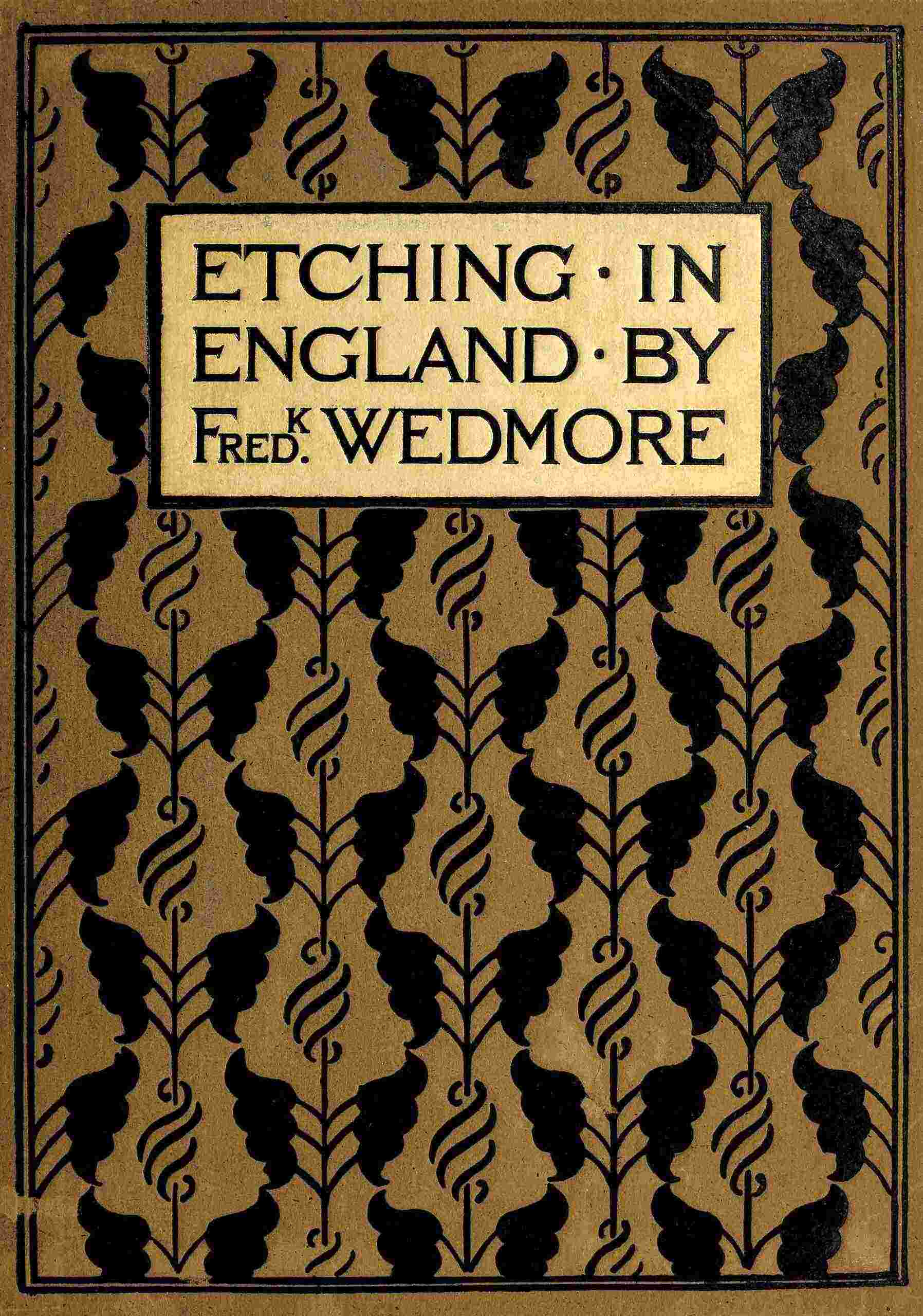
The Project Gutenberg eBook of Etching in England
Title: Etching in England
Author: Sir Frederick Wedmore
Release date: May 7, 2022 [eBook #68011]
Most recently updated: October 18, 2024
Language: English
Original publication: United Kingdom: George Bell and Sons, 1895
Credits: Charlene Taylor, Chuck Greif and the Online Distributed Proofreading Team at https://www.pgdp.net (This file was produced from images generously made available by The Internet Archive)
Etching in England
Etching in England
by
Frederick Wedmore
With 50 Illustrations
London
George Bell and Sons
1895
CHISWICK PRESS:—CHARLES WHITTINGHAM AND CO.
TOOKS COURT, CHANCERY LANE, LONDON.
PREFACE.
I READ, the other day, in a note of Abraham Haywar to his translation of “Faust,” how Schlegel wrote of Gœthe—to M. de Rémusat,—“Il imait guère à donner des explications, et il jamais voulu faire des préfaces.” It would not be seemly, perhaps, that in the present volume of brief historical and critical record, I should endeavour to imitate so august a silence.
Twenty-seven years have passed since one of the most interesting and judicial of English writers upon Fine Art published the book which did amongst us the service of popularising, in some degree at least, the knowledge of Etching. The craft of the aquafortist has, since then, become a medium of expression generally accepted, if not precisely understood; and the half-educated young woman of our period, far from considering the art of whose achievements I treat, as “a form of elegant pen-drawing,” (as she did in Mr. Hamerto first days), is likely perhaps to hold—with “Carry,” in my own little story—that there is “nothing in the world so artistic as a very large etching.” The public, if it has not become properly instructed in the technique of Etching, has at least had the opportunity of becoming so. Hence I have conceived it to be no part of my business to discourse much upon methods. For them the reader may turn now, not only to Mr. Hamerton, but to Sir Seymour Haden, with his great practical experience, his native endowments, and his finely trained taste; to Mr. Herkomer, with his frank and interesting personal record; to M. Maxime Lalanne; to Mr. Frank Short—but the list is too long for me to attempt to exhaust it.
What is done here—and done I think for the first time—is to devote a book to the survey, not of good etched work generally, nor of all etched work—all popular etched work—wrought in England, but of such work as has been wrought in England of the finer and truer kind. That has led to many omissions; for, in the last generation and before it, people were popular—as many are to-day—who were clever draughtsmen, perhaps, but bad etchers. It has led, too, to many inclusions—inclusions not possible to Mr. Hamerton. Much of the best work done in England has been done since he wrote; and a little excellent work, done long before he wrote, he happened to pass over.
This present book, then, is devoted to the best English art. It treats of the foreigner only when he has laboured much in our land, or—I am thinking perhaps of M. Helleu—has at least been much associated with it. It includes necessarily a great American—Mr. Whistler—who was amongst us for more than thirty years—and a man of French birth who has been half his life with us—M. Legros. The art of Etching is not, it may be, like the art of Water-Colour, essentially English; but I suppose that nowhere more than here has it been practised with excellence and with legitimate variety. And this I say with the full knowledge that the achievements of Rembrandt have made Holland classic ground for ever for the lover of Etching, and that the history of that art in France includes two names, at least, which are inevitably illustrious—Méryo name and Jacquemar.
F. W.
CONTENTS.
| PAGE | ||
| I. | Two Classes of Etching | 1 |
| II. | Turner | 3 |
| III. | Girton | 6 |
| IV. | Wilkie | 10 |
| V. | Geddes | 14 |
| VI. | Crome | 20 |
| VII. | Cotman | 22 |
| VIII. | Samuel Palmer | 26 |
| IX. | James McNeil Whistler | 30 |
| X. | Sir Seymour Haden | 45 |
| XI. | Alphonse Legros | 62 |
| XII. | William Strang | 71 |
| XIII. | Charles Holroyd | 87 |
| XIV. | Frank Short | 95 |
| XV. | C. J. Watson | 103 |
| XVI. | Oliver Hall | 115 |
| XVII. | Colonel Goff | 119 |
| XVIII. | D. Y. Cameron | 137 |
| XIX. | Joseph Pennell | 140 |
| XX. | Mortimer Menpes | 144 |
| XXI. | L. Raven-Hill | 148 |
| XXII. | R. W. Macbeth, Hubert Herkomer, R.A., and Axel Haig | 152 |
| XXIII. | Some Other Etchers | 159 |
| XXIV. | Helleu | 172 |
ILLUSTRATIONS.[1]
| PAGE | |||
| 1. | Twickenham (Frontispiece) | Turner | |
| 2. | Seine Bridge | Girtin | 7 |
| 3. | The Receipt | Wilkie | 11 |
| 4. | Peckham Rye | Geddes | 15 |
| 5. | Halliford on Thames | ” | 17 |
| 6. | Near Whitby | Cotman | 23 |
| 7. | The Herdsman | Samuel Palmer | 27 |
| 8. | Thames Police | Whistler | 33 |
| 9. | The Piazzetta | ” | 39 |
| 10. | Tree Study | Seymour Haden | 43 |
| 11. | Thomas Haden, after Wright of Derby | Seymour Haden | 47 |
| 12. | Kidwelly Town | ” ” | 49 |
| 13. | A Water Meadow | ” ” | 53 |
| 14. | Windmill Hill | ” ” | 55 |
| 15. | Scotch Firs | ” ” | 59 |
| 16. | Communion dans glise St. Médard | Legros | 63 |
| 17. | La Mort et le Bûcheron | ” | 67 |
| 18. | The Potato Basket | William Strang | 73 |
| 19. | The Bookstall | ” ” | 75 |
| 20. | Lord Justice Lindley | ” ” | 77 |
| 21. | Midnight Mass, Monte Oliveto | Charles Holroyd | 81 |
| 22. | Farm behind Scarborough | Charles Holroyd | 83 |
| 23. | Round Temple | ” ” | 85 |
| 24. | Wrought Nails | Frank Short | 89 |
| 25. | Sleeping till the Flood | ” ” | 91 |
| 26. | Quarter Boys | ” ” | 93 |
| 27. | Mill Bridge, Bosham | C. J. Watson | 99 |
| 28. | St. Etienne du Mont | ” ” | 101 |
| 29. | Landscape with Trees | Oliver Hall | 107 |
| 30. | Roadside Trees | ” ” | 109 |
| 31. | Trees on the Hill-side | ” ” | 111 |
| 32. | The Edge of the Forest | ” ” | 113 |
| 33. | Chain Pier, Brighton | Colonel Goff | 117 |
| 34. | Norfolk Bridge, Shoreham | ” ” | 123 |
| 35. | Pine Trees, Christchurch | ” ” | 127 |
| 36. | Border Towers | D. Y. Cameron | 131 |
| 37. | The Palace, Stirling Castle | ” ” | 133 |
| 38. | Windmills, Zandaam | ” ” | 135 |
| 39. | Le Puy en Velay | Joseph Pennell | 141 |
| 40. | Japanese Girls | Menpes | 145 |
| 41. | Wandle River | L. Raven-Hill | 149 |
| 42. | Gwenydd | Herkomer | 153 |
| 43. | The Open Window | Elizabeth Armstrong | 157 |
| 44. | At the Loom | Minna Bolingbroke | 161 |
| 45. | Dorking | Percy Thomas | 163 |
| 46. | Sunrise in Wales | W. Holmes May | 167 |
| 47. | A Hurrying Wind | Alfred East | 169 |
| 48. | Etude de Jeune Fille | Helleu | 173 |
| 49. | Femme à la Tasse | ” | 177 |
| 50. | Le Salon Blanc | ” | 181 |
ETCHING IN ENGLAND.
I.
TWO CLASSES OF ETCHING.
AS in France and America, so, very specially, in England, the productions of the etcher have to be divided broadly into two classes, one of which is the result mainly of a commercial demand, and the other, of an artistic impulse. The etcher whose employment of the etching-needle is confined wholly, or confined in the main, to the work of realizing and translating the conceptions of another, is, like the reproductive line-engraver, or the reproductive engraver in mezzotint, little more than the dexterous instrument which carries anothe message. So artistic is his process, when it is properly used, that it is preferable indeed that he be himself an artist as well as a craftsman—it is indeed essential that he shall have some measure of artistic feeling, as well as the flexibility of the executant. But our demands upon him stop, in any case, at a comparatively early point; and we find him more or less sharply cut off in our minds, and in our estimation, from the artist who, when he employs the etching-needle, is occupied with the spontaneous expression of his own thought and fancy—of the particular things of beauty and of interest which may strike him on his way through the world.
II.
TURNER.
OF fine original etchers within the confines of these realms, Turner was almost the first to appear. He was the senior, considerably, of Wilkie and Geddes, who will have to be spoken of soon after him. During twelve years of his “early middle” period—between 1807 and 1819—he wrought what were in some respects important etchings upon something like seventy plates. But his etchings differed in aim, as well as in execution, from almost all the others I shall speak of in this brief general survey of the achievements, here in England, of the etche art. They did so partly by reason of the fact that it was never intended that they should be complete in themselves. They laid the basis of an effect which had to be completed by the employment of another art. They did hardly more than record—though always with an unequalled power and an unerring skill—the leading lines of those great landscape compositions which the mezzotint of the engraver (and the engraver was often Turner himself) endowed with light and shade and atmosphere. For it was by a union of these two arts that that noble publication was produced whose business it was to surpass in variety and subtlety the “Liber Veritatis” of Claude.
It is very possible that in some of the plates of his “Liber Studiorum,” Turner did not undertake the “biting-in,” with acid, of those subjects whose draughtsmanship was his own. Probably he did in all the best of them. In an etching, the strength and the perfection of the result—the relation of part to part—is dependent so much on the biting. It is hardly conceivable that where the etchings of the “Liber Studiorum” strike us as most noble, they were not wholly—in biting as well as in draughtsmanship—Turne own.
They differ much in merit, apart, I think, from the necessary difference in interest which arises from the opportunity given by one subject and denied by another for the exercise of an etche skill. They have generally, within their proper limits, perfect freedom of handling, and an almost incomparable vigour, and a variety which liberates their author from any charge of mannerism. There are few of them which could not hold their own with any plate of Rembrand done under conditions sufficiently resembling theirs. The etching of the “Severn and Wye,” or the etching of “St. Catherin Hill, Guildford,” is carried very nearly as far as the etching of the “Cottage with White Palings,” and with a result very nearly as delightful and distinguished. And in regard to the average etching of Turner, it may fairly be said that a hand put in to pluck out of a portfolio by chance any one of the seventy, would discover that it held a print which was at least the equal of that one of Rembrand with which it is fairest of all to compare it—a print of Rembrand done, like Turne, for “leading lines” alone—I mean the famous little tour de force, the “Si Bridge.”
So much for the greatness of our English master. I pass from him with this reminder, given again for final word. Wonderful as is his etching for selection of line, wonderful for firmness of hand, we must never allow ourselves to forget that it was not intended to present, that it was not intended to be in any way concerned with, the whole of a picture.
III.
GIRTIN.
THE limitations which we have marked in Turne aim in Etching, are to be noticed just as clearly in the aim of Girtin. Nay, they are to be noticed yet more. For while Turner not infrequently gave emphasis to his work by the depth and vigour of his bitten line, Girtin, in his few and rare etchings—which, it is worth while to remember, just preceded Turne—sought only to establish the composition and the outline. He did this with a skill of selection scarcely less than Turne own, and admirable, almost as in his water-colour work, is the quiet sobriety of his picturesque record.
But though Girti etchings—many soft-ground, and about twenty—may contain some lessons for the craftsman, some indeed for the artist, they are scarcely for the portfolios of the collector. They were wrought, all of them, towards the end of Girti life, that was cut short in 1802,
when he was twenty-nine years old. They were the preparations for his aquatinted plates of Paris, against which in their completed form there is only this to be said—that the avoidance, generally, of any attempt at atmospheric effects, involves a seeming monotony of treatment, though as dignified visions of old Parisian architecture, of Parisian landscape, so to speak, in its habitual setting of wide sky and noble river, they have never been surpassed, and very seldom equalled.
The vision of Girtin, it must always be remembered—whatever be his work—is not emphatically personal. With all his charm and breadth and dignity, something of the pure architectural draughtsman lingered to the end, in his labour. He had no parti pris about the facts: no bias we forgive, no prejudice we welcome. He sought to represent simply the “view,” although no doubt the “view” was generally bettered by his artistry.
IV.
WILKIE.
A FAMOUS Scotchman, David Wilkie, and his very distinguished friend and fellow-countryman, Andrew Geddes, wrought, each of them, in the middle period of Turne life, a certain number of etchings of independent merit. Those of Sir David Wilkie, which were but few, happen to be the best known, because Wilkie, much more than Geddes, was a leader of painting. But, meritorious as are the etchings of Wilkie, in their faithful record of character and picturesque effect, they are seldom as admirable as the prints of his less eminent brother. They have, generally, not so much freedom; and, while they follow great traditions less, they are at the same time less individual. “Pope Examining a Censer” has the dignity of the designer and the draughtsman, but not much of the etche particular gift. “The Receipt”—or “A Gentleman Searching in a Bureau,”
for this second title explains the subject better—is the most successful of Wilki. It is characteristic of his simpler and less ambitious genre, and is indeed faultless, and more than faultless—charming.
V.
GEDDES.
ANDREW GEDDES etched four or five times as many plates as Wilkie. He issued ten from Brook Street, Grosvenor Square, in 1826. The dates on some of them are 1812, 1816, and 1822; and, besides these ten that were published, about thirty more, which there was no attempt to issue to the world, have to be taken account of. Some, like the excellent “Portrait of the Painte Mother”—which is so fine in illumination, in drawing, and in character—are directly suggested by the artis paintings. Others—including all the landscapes—are, apparently, studies from Nature, done with a singular appreciation of the ripest art of Rembrandt.
Geddes was very sensible of the charm of dry-point—of its peculiar quality of giving individuality to each one of the few impressions which you may safely produce from it, and of its unique capacity for rendering broad effects of light and shade.
The “Peckham Rye” shows this. Nothing can show it better. And there is at least one other plate by Geddes, “Halliford on Thames,” which proves him just as completely a master of elegance and grace of line as “Peckham Rye” shows him a decisive master of masculine effect, and curiously adept in the broad and balanced disposition of masses of light and shade.
Gedde work will not decline in value, and the connoisseur has no business whatever to forget or to ignore it. Only, if he collects the dry-points of Geddes, he had better wait for years, if necessary, for early impressions of them, and he had better repudiate altogether the unsatisfactory modern edition—the worthy Mr. David Lain volume, “Etchings by Wilkie and Geddes,” issued, with the best intentions in the world, in Edinburgh in 1875.
VI.
CROME.
IT is the splendid work of Crome among the Norfolk coppices—among the fields studded here and there with cattle, but chiefly in the tangle of the wood, or where the wood-path winds under the rustic palings, and then through undergrowth, and out into the rising meadow, to be lost at last, a thread against the horizon sky—it is this splendid tree-work, large, massive, intricate, pictorial, never narrowly faithful alone, that gives interest and value to Crom series of etchings. He did them mostly in the last years of his life (which closed in 1821), and it was always for pleasure and remembrance that he wrought them. Publication he cannot have intended, for he never did enough to be recognized a master while he lived, and his etched subjects gave him memoranda for his pictures, and were little records of places that he loved.
Their merits came slowly to be known by some few; and the etchings, carelessly printed and ill-bitten, were given, here and there, by Crome to his friends. In 1834, his widow, I am told, issued an edition, which must have been very small, and four years later they came again in a measure before the lovers of Norfolk art, re-bitten by one Mr. Ninham, re-touched by one Mr. Edwards of Bungay, and issued with a short biography by Mr. Dawson Turner—a volume which may still be stumbled on at the booksellers. These later states are of slight artistic value. They tell us little of Crome which we may not know much better from other sources he has furnished, and much of their work is not Crom at all. The early states are, at least, “signed all over” by him. Amateurish enough in biting and in printing, they are yet pleasant, characteristic records. “At Bawburgh,” and “Near Hingham” (dated 1813), and “At Woodrising” are some of those that one would like to cherish: and cherished they ought to be, for the reasons I have named. Yet to put them beside even less admirable works which have enjoyed the ordinary conditions of fair presentation—the biting adequate, the printing careful, and the paper good—is to see them, of necessity, at a disadvantage.
VII.
COTMAN.
COTMA etchings—soft ground, for the most part—are scarcely for the average collector, any more than Crom. No one, I mean, puts them carefully in the cabinet, or, with reverence, in the shrine and sanctuary of the solander box; but, in book-form, they stand, and should stand, on the shelves of some lovers of Art. One not unwieldy volume—that “Liber Studiorum,” which, in the year 1838, Cotman brought together, not perhaps without thought of Turne accomplished triumph—contains two score or so of plates which show much, not only of Cotma capacity as a draughtsman, but of his genius for ideal composition, of his faculty for dignity of line, and for so disposing masses of light and shade that they should be not only significant, but impressive. It is here seen that this glorious and original colourist could dispense with colour and yet be fine and individual. Yet, as achievements in