
The Project Gutenberg eBook of Exercises upon the Different Parts of Italian Speech, with References to Veneroni's Grammar
Title: Exercises upon the Different Parts of Italian Speech, with References to Veneroni's Grammar
Author: Ferdinando Bottarelli
Editor: Giambattista Rolandi
Release date: November 9, 2015 [eBook #50419]
Most recently updated: October 22, 2024
Language: English
Credits: Produced by Barbara Tozier, Bill Tozier and the Online
Distributed Proofreading Team at http://www.pgdp.net
TRANSCRIBER’S NOTE: Minor spelling and punctuation errors have been corrected but accents are retained as printed: inconsistently. The exception is the replacement of A’ with Á, and so on.
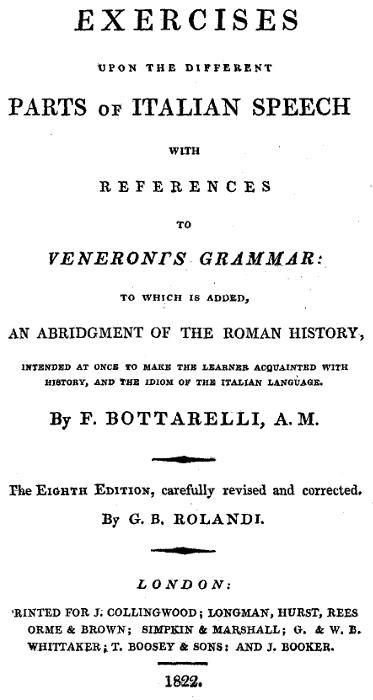
EXERCISES
UPON THE DIFFERENT
PARTS of ITALIAN SPEECH
WITH
REFERENCES
TO
VENERONI’S GRAMMAR:
TO WHICH IS ADDED,
AN ABRIDGMENT OF THE ROMAN HISTORY,
INTENDED AT ONCE TO MAKE THE LEARNER ACQUAINTED WITH
HISTORY, AND THE IDIOM OF THE ITALIAN LANGUAGE.
By F. BOTTARELLI, A. M.
The Eighth Edition, carefully revised and corrected.
By G. B. ROLANDI.
LONDON:
PRINTED FOR J. COLLINGWOOD; LONGMAN, HURST, REES
ORME & BROWN; SIMPKIN & MARSHALL; G. & W. B.
WHITTAKER; T. BOOSEY & SONS; AND J. BOOKER.
1822.
Printed by T. C. Hansard, Peterboro’-court, Fleet-street, London.
PREFACE.
Amidst the laudable endeavours for the advancement of the Italian language, it is surprising that an easy and expeditious method of teaching it has been, in a great measure, neglected; and that beginners have hitherto been left without proper assistance. Under this impression, I have composed these Exercises upon the Syntax of Veneroni’s Italian Grammar; with what success I have executed the task, must be submitted to the decision of qualified and impartial judges.
These Exercises comprehend all the difficulties, and idiomatical expressions of the Italian language; the rules and exceptions of which are exemplified after such a method, that a learner cannot fail to become master of that language who has carefully gone through them once or twice.
The examples are of three sorts; the first, immediately following the rule, are short: as nothing farther is designed by them, than to illustrate that particular rule. The second sort are longer, and in them, not only the rule to which they refer, is exemplified, but also the foregoing ones are again brought into practice, the better to imprint them on the memory: since, were it not for this contrivance, learners would forget one rule, while they were learning another; the examples of the third kind, contain all the preceding, and some of the subsequent rules promiscuously; and for these reasons, are not to be attempted, until the student has gone twice at least, through the former part (for I think it advisable they should go through it more than once).
The radical Italian words are interlined, a thing very useful and requisite in a work of this nature, as well to save the trouble of consulting Dictionaries, as to prevent the use of improper terms, and wrong spelling, otherwise unavoidable; and those who wish to learn the Italian language, will thereby be enabled to make a much quicker progress than they could possibly do by the tedious task of searching a Dictionary for the words they require.
I have frequently omitted such words as had been often mentioned before, presuming there was no occasion for such repetition; and in order to excite attention in learners, that they might recollect what they had learned, and exert both their memory and judgment, or, on memory failing them, have recourse to a Dictionary, as a last resource. For these reasons, in the latter part of the Exercises, there are scarcely any Italian words but nouns and verbs, all the other parts of speech having already been gone through.
There is added, by way of Appendix, an Abridgment of the Roman History. As history is one of the most easy and entertaining parts of literature, and as that of the ancient Romans is absolutely necessary to a proper understanding of the Classics, I hope this addition will prove highly beneficial to young beginners.
N. B. Great pains have been taken to render this new Edition of Bottarelli’s Italian Exercises more perfect than any hitherto published. In order to facilitate the Italian pronunciation, the words have been accented according to the plan of Veneroni’s Grammar; the references to Veneroni have been compared, and carefully corrected, and many new ones added, together with several Notes and Remarks. All obsolete and improper phrases have been expunged; and the Chronology of the Roman History has been improved by the addition of Dates to each respective chapter: in short, on account of the many additions, alterations, and improvements, this edition may almost be considered as a new book, and a worthy companion of the celebrated Grammar of Veneroni.
⁂ A new Edition of the Key to these Exercises is just published.
ITALIAN EXERCISES.
ON THE ACCIDENCE OF VERBS.
Regular Verbs of the First Conjugation. [See Veneroni’s Grammar, page 88.]
-
- I love,
- am-áre
- thou acquirest,
- acquist-áre
- he respects,
- rispett-áre
- we salute,
- salut-áre
- you speak,
- parl-áre
- ye pass,
- pass-áre
- they walk.
- spasseggi-áre.
-
- I did call,
- chiam-áre
- thou didst prattle,
- ciarl-áre
- he did command,
- comand-áre
- we did begin,
- cominci-áre
- you did buy,
- compr-áre
- they did confess.
- confess-áre.
-
- I confirmed,
- conferm-áre
- thou didst deliver,
- consegn-áre
- he preserved,
- preserv-áre
- we considered,
- consider-áre
- you advised,
- consigli-áre
- they contended.
- contrast-áre.
-
- I have declined,
- declin-áre
- thou hast courted,
- corteggi-áre
- he has cured,
- cur-áre
- we have crowned,
- coron-áre
- you have dedicated,
- [1]dedic-áre
- they have supped.
- cen-áre.
-
- I had wished,
- desider-áre
- thou hadst declared,
- dichiar-áre
- he had dispensed,
- dispens-áre
- we had assembled,
- radun-áre
- you had undeceived,
- disingann-áre
- they had wasted.
- scialacqu-áre.
-
- I will expect,
- aspett-áre
- thou shalt arrive,
- arriv-áre
- he will assault,
- assalt-áre
- we will assure,
- assicur-áre
- you will wish,
- augur-áre
- they shall increase.
- aument-áre.
-
- Dance,
- ball-áre
- let him change,
- cambi-áre
- let us walk,
- passeggi-áre
- sing ye,
- cant-áre
- let them certify.
- [2]certific-áre.
-
- That I might caress,
- accarezz-áre
- that thou mightest burn,
- abbruci-áre
- that he might stoop,
- [2]abbass-ársi
- that we might accept,
- accett-áre
- that you might embrace,
- abbracci-áre
- that they might mend.
- accomod-áre.
-
- That I may have lamented,
- lament-áre
- that thou mayest have invented,
- invent-áre
- that he may have governed,
- govern-áre
- that we may have tamed,
- addimestic-áre
- that you may have asked,
- domand-áre
- that they may have experienced.
- speriment-áre.
-
- That I might have formed,
- form-áre
- that thou mightest have taken away,
- lev-áre
- that he might have sent,
- mand-áre
- that we might have prepared,
- prepar-áre
- that you might have deprived,
- priv-áre
- that they might have resembled.
- rassomigli-áre.
[1] Verbs ending in care and gare, introduce h before e and i: wherefore, you must here write certifichino, not certificino. See Veneroni’s Grammar, page 92.
[2] See Gram. p. 92.
[3] Abbassarsi is for abbassare-si, see Gram. p. 148.
[4] See page 92.
Regular Verbs of the Second Conjugation. [See Grammar, p. 95.]
-
- I believe,
- créd-ere
- thou receivest,
- ricév-ere
- he sees,
- ved-ére
- we repeat,
- ripét-ere
- you beat,
- bátt-ere
- they drink.
- bév-ere.
-
- I did yield up,
- céd-ere
- thou didst owe,
- dov-ére
- he did cleave,
- fénd-ere
- we did groan,
- gém-ere
- you did feed,
- pásc-ere
- they did hang up.
- appénd-ere.
-
- I enjoyed,
- god-ére
- thou pressedst,
- prém-ere
- he reaped,
- miét-ere
- we shone,
- rilúc-ere
- you repeated,
- ripét-ere
- they sat down.
- sed-ére.
-
- I have sold,
- vénd-ere
- thou hast crept along,
- sérp-ere
- he has shrieked,
- stríd-ere
- we have feared,
- tem-ére
- you have beaten,
- bátt-ere
- they have received.
- ricév-ere.
The following Verbs of the Second Conjugation are irregular. [See Gram. p. 111.]
-
- Be silent,
- tac-ére
- let him see,
- ved-ére
- let us hold,
- ten-ére
- be ye pleased,
- compiac-érsi
- let them fall again.
- ricad-ére.
-
- That I may have,
- avére
- that thou mayest owe,
- dov-ére
- that he may fall,
- cad-ére
- that we may lie down,
- giac-ére
- that you may be able,
- pot-ére
- that they may grieve.
- dol-érsi.
-
- That I might appear,
- par-ére
- that thou mightest lie down,
- giac-ére
- that he might please,
- piac-ére
- that we might persuade,
- persuad-ére
- that you might be able,
- pot-ére
- that they might know.
- sap-ére.
-
- I should be silent,
- tac-ére
- thou shouldst be accustomed,
- [4]sol-ére
- he should be worth,
- val-ére
- we should hold,
- ten-ére
- you should see,
- ved-ére
- they should be willing.
- vol-ére.
For a full conjugation of all the verbs in ere, see Veneroni’s Grammar, p. 95.
[1] Combined with essere and not avere, in the compound tenses.
[2] See page 148.
[3] See page 122.
[4] With essere.
Regular Verbs of the Third Conjugation. [See Grammar, p. 102.]
-
- I hear,
- sent-íre
- thou followest,
- segu-íre
- he opens,
- apr-íre
- we boil,
- boll-íre
- you consent,
- consent-íre
- they convert.
- convert-íre.
-
- I departed,
- part-íre
- thou didst suffer,
- [1]soffr-íre
- he repented,
- pent-írsi
- we ascended,
- sal-íre
- you served,
- serv-íre
- they went out.part-íre
- sort-íre.
[1] Coprire, morire, and soffrire, though regular in every other respect, make in the participle passive, coperto, morto, and soferto.
The following Verbs in ire are irregular.[1] [See Veneroni’s Grammar, p. 144.]
-
- I had appeared,
- compar-íre
- thou hadst uttered,
- profer-íre
- he had buried,
- seppell-íre
- we had dared,
- ard-íre
- you had abolished,
- abol-íre
- they had understood.
- cap-íre.
-
- I shall or will abhor,
- abbor-íre
- thou shalt enrich,
- arricch-íre
- he shall blush,
- arross-íre
- we shall banish,
- band-íre
- you shall whiten,
- bianch-íre
- they shall pity.
- compat-íre.
-
- Conceive thou,
- concep-íre
- let him digest,
- diger-íre
- let us finish,
- fin-íre
- approve ye,
- grad-íre
- let them bloom.
- fior-íre.
-
- That I may suffer,
- pat-íre
- that thou mayest grow mad,
- impazz-íre
- that he may languish,
- langu-íre
- that we may dispatch,
- sped-íre
- that you may unite,
- un-íre
- that they may obey.
- obbed-íre.
-
- That I might colour,
- color-íre
- that thou mightest flourish,
- fior-íre
- that he might sharpen,
- inacerb-íre
- that we might animate,
- anim-áre
- that you might harden,
- indur-íre
- that they might bellow.
- mugg-íre.
-
- I would strike,
- colp-íre
- thou wouldst banish,
- band-íre
- he would abhor,
- abborr-íre
- we would abolish,
- abbol-íre
- you would enrich,
- arricch-íre
- they would comprehend.
- cap-íre.
For the formation of compound tenses, see Veneroni’s Grammar, p. 77, 82, and 88.
[1] They make isco in the present and corresponding tenses; as comparisco, proferisco, &c. instead of comparo, profero, &c.
Other Verbs of the Second Conjugation that are irregular only in some Tenses and Persons. [See Grammar, p. 125, and the following.]
-
- I belong,
- apparten-ére
- thou kindlest,
- accénd-ere
- he takes,
- prénd-ere
- we perceive,
- accorg-érsi
- you kill,
- uccíd-ere
- they burn.
- árd-ere.
-
- I did hide,
- nascónd-ere
- thou didst oppress,
- opprím-ere
- he did sprinkle,
- aspérg-ere
- we did divide,
- divíd-ere
- you did absolve,
- assólv-ere
- they did absorb.
- assórb-ere.
-
- I assumed,
- [1]assúm-ere
- thou offeredst,
- porg-ere
- he demanded,
- richiéd-ere
- we plucked up,
- divell-ere
- you shut,
- chiud-ere
- they engraved.
- incid-ere.
-
- I have granted,
- conced-ere
- thou hast run,
- corr-ere
- he has decided,
- decid-ere
- we have believed,
- cred-ere
- you have boiled,
- cuoc-ere
- they have decided.
- decid-ere.
-
- I had deluded,
- delud-ere
- thou hadst oppressed,
- opprim-ere
- he had defended,
- difend-ere
- we had expressed,
- esprim-ere
- you had sprinkled,
- asperg-ere
- they had known.
- sap-ére.
-
- I shall, or will grieve,
- dol-érsi
- thou shalt erect,
- erg-ere
- he shall exclude,
- esclud-ere
- we shall require,
- esig-ere
- you shall expel,
- espell-ere
- they shall extinguish.
- estingu-ere.
-
- Melt thou,
- fond-ere
- let him drive in,
- figg-ere
- let us feign,
- fing-ere
- break ye,
- frang-ere
- let them reflect.
- riflett-ere.
-
- That I may lie down,
- giac-ére
- that thou mayest fry,
- frigg-ere
- that he may join,
- giung-ere
- that she may imprint,
- imprim-ere
- that we may hang up,
- append-ere
- that you may see,
- ved-ére
- that they may include.
- includ-ere.
-
- That I might soak,
- intrid-ere
- that thou mightest intrude,
- intrud-ere
- that he might read,
- legg-ere
- that we might put,
- mett-ere
- that you might bite,
- mord-ere
- that they might plunge.
- immerg-ere.
-
- I would move,
- muov-ere
- thou wouldst milk,
- mung-ere
- he would conceal,
- nascond-ere
- we would neglect,
- neglig-ere
- you would foresee,
- preved-ére
- they would hurt (morally).
- nuoc-ere.
-
- That I may have offended,
- offend-ere
- that thou mayest have oppressed,
- opprim-ere
- that he may have struck,
- percuot-ere
- that we may have lost,
- perd-ere
- that you may have pleased,
- piac-ére
- that they may have wept.
- piang-ere.
-
- That I might have painted,
- diping-ere
- that thou mightest have presented,
- porg-ere
- that he might have curtailed,
- precid-ere
- that we might have taken,
- prend-ere
- that you might have presumed,
- presum-ere
- that they might have protected.
- protegg-ere.
-
- I should have sat down,
- sed-ére
- thou shouldest have returned,
- rend-ere
- he should have reduced,
- ridur-re
- we should have laughed,
- rid-ere
- you should have answered,
- rispond-ere
- they should have suspended.
- sospend-ere.