
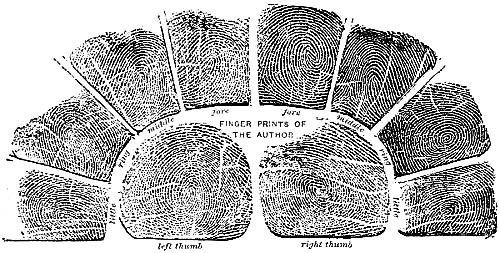
Table IV.
| Percentage frequency of Loops. | |||||
| Hand. | Thumb. | Fore-finger. | Middle finger. | Ring-finger. | Little finger. |
| Right | 53 | 53 | 78 | 66 | 86 |
| Left | 65 | 55 | 76 | 53 | 90 |
| Mean | 59 | 54 | 77 | 59·5 | 88 |
Whorls (Table V.) are most common on the thumb and the ring-finger, most
rare on the middle and little fingers.
Table V.
| Percentage frequency of Whorls. | |||||
| Hand. | Thumb. | Fore-finger. | Middle finger. | Ring-finger. | Little finger. |
| Right | 44 | 30 | 15 | 45 | 13 |
| Left | 30 | 28 | 16 | 31 | 8 |
| Mean | 37 | 29 | 15·5 | 38 | 10·5 |
The fore-finger is peculiar in the frequency with which the direction of
the slopes of its loops differs from that which is by far the most common
in all other digits. A loop must have a slope, being caused by the
disposition of the ridges into the form of a pocket, opening downwards to
one or other side of the finger. If it opens towards the inner or thumb
side of the hand, it will be called an inner slope; if towards the outer
or little-finger side, it will be called an outer slope. In all digits,
except the fore-fingers, the inner slope is much the more rare of the two;
but in the fore-fingers the inner slope appears two-thirds as frequently
as the outer slope. Out of the percentage of 53 loops of the one or other
kind on the right fore-finger, 21 of them have an inner and 32 an outer
slope; out of the percentage of 55 loops on the left fore-finger, 21 have
inner and 34 have outer slopes. These subdivisions 21-21 and 32-34
corroborate the strong statistical similarity that was observed to exist
between the frequency of the several patterns on the right and left
fore-fingers; a condition which was also found to characterise the middle
and little fingers.
It is strange that Purkenje considers the “inner” slope on the fore-finger to be more frequent than the “outer” (p. 86, 4). My nomenclature differs from his, but there is no doubt as to the disagreement in meaning. The facts to be adduced hereafter make it most improbable that the persons observed were racially unlike in this particular.
The tendencies of digits to resemble one another will now be considered in their various combinations. They will be taken two at a time, in order to learn the frequency with which both members of the various couplets are affected by the same A. L. W. class of pattern. Every combination will be discussed, except those into which the little finger enters. These are omitted, because the overwhelming frequency of loops in the little fingers would make the results of comparatively little interest, while their insertion would greatly increase the size of the table.
Table VIa.
Percentage of cases in which the same class of pattern
occurs in the same digits of the two hands.
(From observation of 5000 digits of 500 persons.)
| Couplets of Digits. | Arches. | Loops. | Whorls | Total. | |
| The two | thumbs | 2 | 48 | 24 | 74 |
| " | fore-fingers | 9 | 38 | 20 | 67 |
| " | middle fingers | 3 | 65 | 9 | 77 |
| " | ring-fingers | 2 | 46 | 26 | 74 |
| Mean of the Totals | 72 | ||||
Table VIb.
Percentage of cases in which the same class of pattern
occurs in various couplets of different digits.
(From 500 persons as above.)
| Couplets of Digits. | Of Same Hands. | Of Opposite Hands. | ||||||
| Arch. | Loops. | Whorls | Total. | Arch. | Loops. | Whorls | Total. | |
| Thumb and fore-finger | 2 | 35 | 16 | 53 | 2 | 33 | 15 | 50 |
| Thumb and middle finger | 1 | 48 | 9 | 58 | 1 | 47 | 8 | 56 |
| Thumb and ring-finger | 1 | 40 | 20 | 61 | 1 | 38 | 18 | 57 |
| Fore and middle finger | 5 | 48 | 12 | 65 | 5 | 46 | 11 | 62 |
| Fore and ring-finger | 2 | 35 | 17 | 54 | 2 | 35 | 17 | 54 |
| Middle and ring-finger | 2 | 50 | 13 | 65 | 2 | 50 | 12 | 64 |
| Means of the Totals | 59 | 57 | ||||||
A striking feature in this last table is the close similarity between
corresponding entries relating to the same and to the opposite hands.
There are eighteen sets to be compared; namely, six couplets of different
names, in each of which the frequency of three different classes of
patterns is discussed. The eighteen pairs of corresponding couplets are
closely alike in every instance. It is worth while to rearrange the
figures as below, for the greater convenience of observing their
resemblances.
Table VII.
| Couplet. | Arches in | Loops in | Whorls in | |||
| Same hand. |
Opposite hand. |
Same hand. |
Opposite hand. |
Same hand. |
Opposite hand. | |
| Thumb and fore-finger | 2 | 2 | 35 | 33 | 16 | 15 |
| Thumb and middle finger | 1 | 1 | 48 | 47 | 9 | 8 |
| Thumb and ring-finger | 1 | 1 | 40 | 38 | 20 | 18 |
| Fore and middle finger | 5 | 5 | 48 | 46 | 12 | 11 |
| Fore and ring-finger | 2 | 2 | 35 | 35 | 17 | 17 |
| Middle and ring-finger | 2 | 2 | 50 | 50 | 13 | 12 |
The agreement in the above entries is so curiously close as to have
excited grave suspicion that it was due to some absurd blunder, by which
the same figures were made inadvertently to do duty twice over, but
subsequent checking disclosed no error. Though the unanimity of the
results is wonderful, they are fairly arrived at, and leave no doubt that
the relationship of any one particular digit, whether thumb, fore, middle,
ring or little finger, to any other particular digit, is the same, whether
the two digits are on the same or on opposite hands. It would be a most
interesting subject of statistical inquiry to ascertain whether the
distribution of malformations, or of the various forms of skin disease
among the digits, corroborates this unexpected and remarkable result. I am
sorry to have no means of undertaking it, being assured on good authority
that no adequate collection of the necessary data has yet been published.
It might be hastily inferred from the statistical identity of the connection between, say, the right thumb and each of the two fore-fingers, that the patterns on the two fore-fingers ought always to be alike, whether arch, loop, or whorl. If X, it may be said, is identical both with Y and with Z, then Y and Z must be identical with one another. But the statement of the problem is wrong; X is not identical with Y and Z, but only bears an identical amount of statistical resemblance to each of them; so this reasoning is inadmissible. The character of the pattern on any digit is determined by causes of whose precise nature we are ignorant; but we may rest assured that they are numerous and variable, and that their variations are in large part independent of one another. We can in imagination divide them into groups, calling those that are common to the thumb and the fore-finger of either hand, and to those couplets exclusively, the A causes; those that are common to the two thumbs and to these exclusively, the B causes; and similarly those common to the two fore-fingers exclusively, the C causes.
Then the sum of the variable causes determining the class of pattern in the four several digits now in question are these:—
| Right thumb | A + B + an | unclassed | residue | called | X(1) |
| Left thumb | A + B + | " | " | " | X(2) |
| Right fore-finger | A + C + | " | " | " | Z(1) |
| Left fore-finger | A + C + | " | " | " | Z(2) |
The nearness of relationship between the two thumbs is sufficiently
indicated by a fraction that expresses the proportion between all the
causes common to the two thumbs exclusively, and the totality of the
causes by which the A. L. W. class of the patterns of the thumbs is
determined, that is to say, by
| A + B | (1). | |
| A + B + X(1) + X(2) |
Similarly, the nearness of the relationship between the two fore-fingers by
| A + C | (2). | |
| A + C + Z(1) + Z(2) |
And that between a thumb and a fore-finger by
| A | (3). | |
| A + B + C + X(1) (or X(2)) + Z(1) (or Z(2)) |
The fractions (1) and (2) being both greater than (3), it follows that the
relationships between the two thumbs, or between the two fore-fingers, are
closer than that between the thumb and either fore-finger; at the same
time it is clear that neither of the two former relationships is so close
as to reach identity. Similarly as regards the other couplets of digits.
The tabular entries fully confirm this deduction, for, without going now
into further details, it will be seen from the “Mean of the Totals” at the
bottom line of Table VIb that the average percentage of cases in which
two different digits have the same class of patterns, whether they be on
the same or on opposite hands, is 59 or 57 (say 58), while the average
percentage of cases in which right and left digits bearing the same name
have the same class of pattern (Table VIa) is 72. This is barely
two-thirds of the 100 which would imply identity. At the same time, the 72
considerably exceeds the 58.
Let us now endeavour to measure the relationships between the various couplets of digits on a well-defined centesimal scale, first recalling the fundamental principles of the connection that subsists between relationships of all kinds, whether between digits, or between kinsmen, or between any of those numerous varieties of related events with which statisticians deal.
Relationships are all due to the joint action of two groups of variable causes, the one common to both of the related objects, the other special to each, as in the case just discussed. Using an analogous nomenclature to that already employed, the peculiarity of one of the two objects is due to an aggregate of variable causes that we may call C+X, and that of the other to C+Z, in which C are the causes common to both, and X and Z the special ones. In exact proportion as X and Z diminish, and C becomes of overpowering effect, so does the closeness of the relationship increase. When X and Z both disappear, the result is identity of character. On the other hand, when C disappears, all relationship ceases, and the variations of the two objects are strictly independent. The simplest case is that in which X and Z are equal, and in this, it becomes easy to devise a scale in which 0° shall stand for no relationship, and 100° for identity, and upon which the intermediate degrees of relationship may be marked at their proper value. Upon this assumption, but with some misgiving, I will attempt to subject the digits to this form of measurement. It will save time first to work out an example, and then, after gaining in that way, a clearer understanding of what the process is, to discuss its defects. Let us select for our example the case that brings out these defects in the most conspicuous manner, as follows:—
Table V. tells us that the percentage of whorls in the right ring-finger is 45, and in the left ring-finger 31. Table VIa tells us that the percentage of the double event of a whorl occurring on both the ring-fingers of the same person is 26. It is required to express the relationship between the right and left ring-fingers on a centesimal scale, in which 0° shall stand for no relationship at all, and 100° for the closest possible relationship.
If no relationship should exist, there would nevertheless be a certain percentage of instances, due to pure chance, of the double event of whorls occurring in both ring-fingers, and it is easy to calculate their frequency from the above data. The number of possible combinations of 100 right ring-fingers with 100 left ones is 100 × 100, and of these 45 × 31 would be double events as above (call these for brevity “double whorls”). Consequently the chance of a double whorl in any single couplet is 45 × 31⁄100 × 100, and their average frequency in 100 couplets,—in other words, their average percentage is 45 × 31⁄100 = 13·95, say 14. If, then, the observed percentage of double whorls should be only 14, it would be a proof that the A. L. W. classes of patterns on the right and left ring-fingers were quite independent; so their relationship, as expressed on the centesimal scale, would be 0°. There could never be less than 14 double whorls under the given conditions, except through some statistical irregularity.
Now consider the opposite extreme of the closest possible relationship, subject however, and this is the weak point, to the paramount condition that the average frequencies of the A. L. W. classes may be taken as pre-established. As there are 45 per cent of whorls on the right ring-finger, and only 31 on the left, the tendency to form double whorls, however stringent it may be, can only be satisfied in 31 cases. There remains a superfluity of 14 per cent cases in the right ring-finger which perforce must have for their partners either arches or loops. Hence the percentage of frequency that indicates the closest feasible relationship under the pre-established conditions, would be 31.
The range of all possible relationships in respect to whorls, would consequently lie between a percentage frequency of the minimum 14 and the maximum 31, while the observed frequency is of the intermediate value of 26. Subtracting the 14 from these three values, we have the series of 0, 12, 17. These terms can be converted into their equivalents in a centesimal scale that reaches from 0° to 100° instead of from 0° to 17°, by the ordinary rule of three, 12:x::17:100; x=70 or 71, whence the value x of the observed relationship on the centesimal scale would be 70° or 71°, neglecting decimals.
This method of obtaining the value of 100° is open to grave objection in the present example. We have no right to consider that the 45 per cent of whorls on the right ring-finger, and the 31 on the left, can be due to pre-established conditions, which would exercise a paramount effect even though the whorls were due entirely to causes common to both fingers. There is some self-contradiction in such a supposition. Neither are we at liberty to assume that the respective effects of the special causes X and Z are equal in average amount; if they were, the percentage of whorls on the right and on the left finger would invariably be equal.
In this particular example the difficulty of determining correctly the scale value of 100° is exceptionally great; elsewhere, the percentages of frequency in the two members of each couplet are more alike. In the two fore-fingers, and again in the two middle fingers, they are closely alike. Therefore, in these latter cases, it is not unreasonable to pass over the objection that X and Z have not been proved to be equal, but we must accept the results in all other cases with great caution.
When the digits are of different names,—as the thumb and the fore-finger,—whether the digits be on the same or on opposite hands, there are two cases to be worked out; namely, such as (1) right thumb and left fore-finger, and (2) left thumb and right fore-finger. Each accounts for 50 per cent of the observed cases; therefore the mean of the two percentages is the correct percentage. The relationships calculated in the following table do not include arches, except in two instances mentioned in a subsequent paragraph, as the arches are elsewhere too rare to furnish useful results.
It did not seem necessary to repeat the calculation for couplets of digits of different names, situated on opposite hands, as those that were calculated on closely the same data for similar couplets situated on the same hands, suffice for both. It is evident from the irregularity in the run of the figures that the units in the several entries cannot be more than vaguely approximate. They have, however, been retained, as being possibly better than nothing at all.
Table VIII.
Approximate Measures of Relationship between the various Digits, on a Centesimal Scale.
(0° = no relationship; 100° = the utmost feasible likeness.)
| Couplets. | Loops. | Whorls. | Means. | |||
Digits of the same name. |
||||||
| Right | and | left | thumbs | 57 | 64 | 61 |
| " | " | fore-fingers | 37 | 59 | 48 | |
| " | " | middle fingers | 34 | 52 | 43 | |
| " | " | ring fingers | 61 | 70 | 65 | |
| Means | 47° | 61° | 54° | |||
Digits of different names on the same or on opposite hands. |
||||||
| Thumb and | fore-finger | 19 | 29 | 24 | ||
| " | middle finger | 19 | 34 | 27 | ||
| " | ring-finger | 33 | 44 | 39 | ||
| Fore and | middle finger | 52 | 68 | 60 | ||
| " | ring finger | 13 | 34 | 23 | ||
| Middle and | ring finger | 31 | 74 | 52 | ||
| Means | 28° | 47° | 37° | |||
The arches were sufficiently numerous in the fore-fingers (17 per cent) to
fully justify the application of this method of calculation. The result
was 43°, which agrees fairly with 48°, the mean of the loops and the
whorls. In the middle finger the frequency of the arches was only half the
above amount and barely suffices for calculation. It gave the result of
38°, which also agrees fairly with 43°, the mean of the loops and the
whorls for that finger.
Some definite results may be gathered from this table notwithstanding the irregularity with which the figures run. Its upper and lower halves clearly belong to different statistical groups, the entries in the former being almost uniformly larger than those in the latter, in the proportion of 54° to 37°, say 3 to 2, which roughly represents in numerical terms the nearer relationship between digits of the same name, as compared to that between digits of different names. It seems also that of the 6 couplets of digits bearing different names, the relationship is closest between the middle finger and the two adjacent ones (60° and 52°, as against 24°, 27°, 39° and 23°). It is further seen in every pair of entries that whorls are related together more closely than loops. I note this, but cannot explain it. So far as my statistical inquiries into heredity have hitherto gone, all peculiarities were found to follow the same law of transmission, none being more surely inherited than others. If there were a tendency in any one out of many alternative characters to be more heritable than the rest, that character would become universally prevalent, in the absence of restraining influences. But it does not follow that there are no peculiar restraining influences here, nor that what is true for heredity, should be true, in all its details, as regards the relationships between the different digits.
CHAPTER IX
METHODS OF INDEXING
In this chapter the system of classification by Arches, Loops, and Whorls described in Chapter V. will be used for indexing two, three, six or ten digits, as the case may be.
An index to each set of finger marks made by the same person, is needful in almost every kind of inquiry, whether it be for descriptive purposes, for investigations into race and heredity, or into questions of symmetry and correlation. It is essential to possess an index to the finger marks of known criminals before the method of finger prints can be utilised as an organised means of detection.
The ideal index might be conceived to consist of a considerable number of compartments, or their equivalents, each bearing a different index-heading, into which the sets of finger prints of different persons may be severally sorted, so that all similar sets shall lie in the same compartment.
The principle of the proposed method of index-headings is, that they should depend upon a few conspicuous differences of pattern in many fingers, and not upon many minute differences in a few fingers. It is carried into effect by distinguishing the A. L. W. class of pattern on each digit in succession, by a letter,—a for Arch, l for Loop, w for Whorl; or else, as an alternative method, to subdivide l by using i for a loop with an Inner slope, and o for one with an Outer slope, as the case may be. In this way, the class of pattern in each set of ten digits is described by a sequence of ten letters, the various combinations of which are alphabetically arranged and form the different index-headings. Let us now discuss the best method of carrying out this principle, by collating the results of alternative methods of applying it. We have to consider the utility of the i and o as compared to the simple l, and the gain through taking all ten digits into account, instead of only some of them.
It will be instructive to print here an actual index to the finger prints of 100 different persons, who were not in any way selected, but taken as they came, and to use it as the basis of a considerable portion of the following remarks, to be checked where necessary, by results derived from an index to 500 cases, in which these hundred are included.
This index is compiled on the principle shortly to be explained, entitled the “i and o fore-finger” method.
Table IX.—Index to 100 Sets of Finger Prints.
The sequence in which the digits have been registered is not from the thumb outwards to the little finger, but, on account of various good reasons that will be appreciated as we proceed, in the following order.
The ten digits are registered in four groups, which are distinguished in the Index by the letters A, B, C, D:—