
The Project Gutenberg eBook of France and England in North America, Part IV: The Old Régime In Canada
Title: France and England in North America, Part IV: The Old Régime In Canada
Author: Francis Parkman
Release date: September 7, 2016 [eBook #53000]
Most recently updated: October 23, 2024
Language: English
Credits: Produced by David Widger from page images generously
provided by the Internet Archive
FRANCE AND ENGLAND in NORTH AMERICA
FOURTH PART
THE OLD REGIME IN CANADA
TWENTY-SIXTH EDITION
BY FRANCIS PARKMAN
BOSTON: LITTLE, BROWN, AND COMPANY
1874
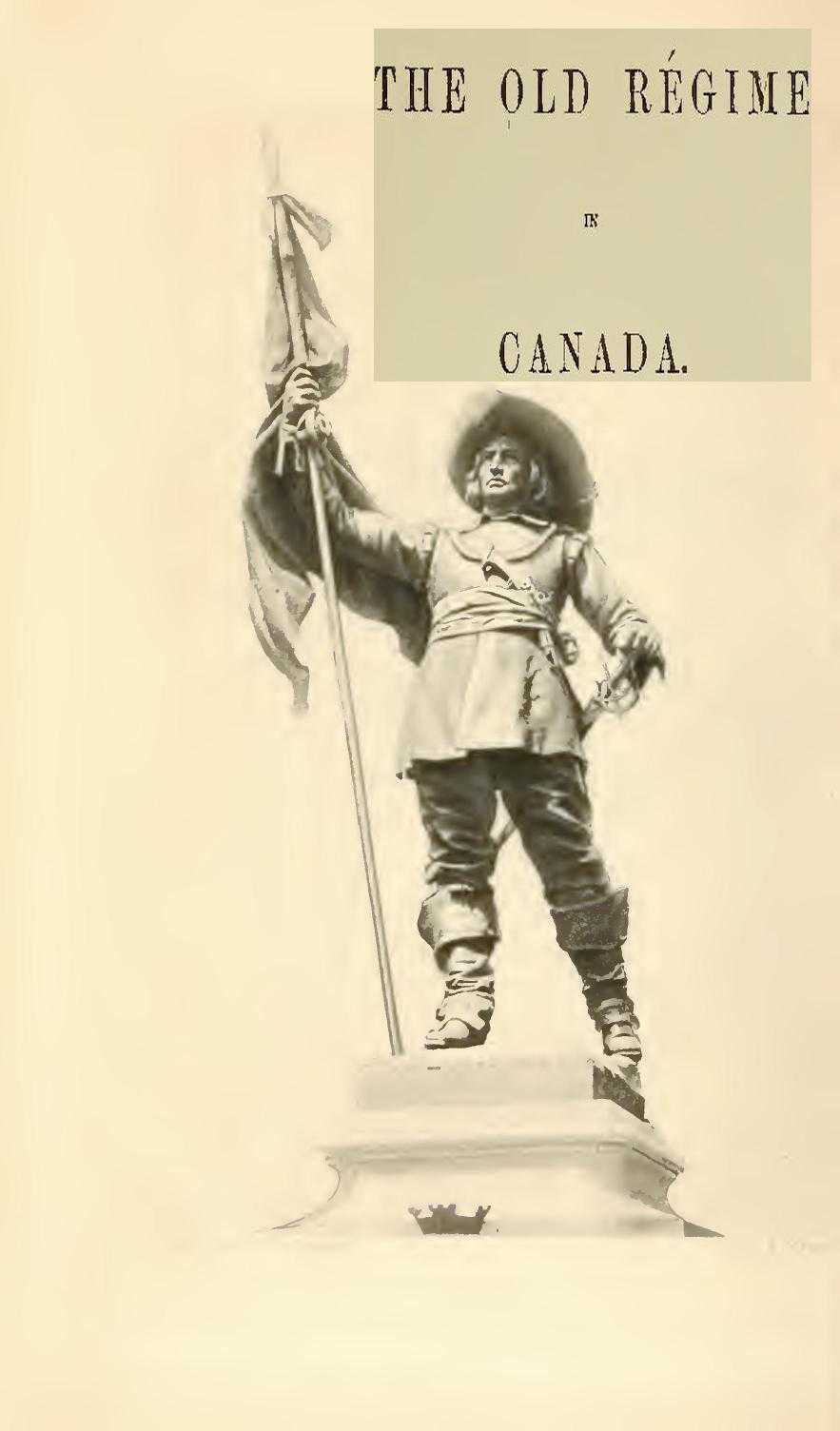
Figure of Chomedey de Maisonneuve .... Frontispiece
From the
Maisonneuve Monument by Philippe Hébert, in the Place D'Armes, Montreal.
The Death of Dollard
Bas-relief from the Maisonneuve Monument by
Philippe Hébert, in the Place D'Armes, Montreal.
GEORGE EDWARD ELLIS, D.D.
My dear Dr. Ellis:
When, in my youth, I proposed to write a series of books on the French in America, you encouraged the attempt, and your helpful kindness has followed it from that day to this. Pray accept the dedication of this volume in token of the grateful regard of
Very faithfully yours,
FRANCIS PARKMAN.
CONTENTS
CHAPTER I. 1653-1658. THE JESUITS AT ONONDAGA.
CHAPTER III. 1660, 1661. THE HEROES OF THE LONG SAUT.
CHAPTER IV. 1657-1668. THE DISPUTED BISHOPRIC.
CHAPTER V. 1659, 1660. LAVAL AND ARGENSON.
CHAPTER VI. 1658-1663. LAVAL AND AVAUGOUR.
CHAPTER VII. 1661-1664. LAVAL AND DUMESNIL
CHAPTER VIII. 1657-1665. LAVAL AND MÉZY.
CHAPTER IX. 1662-1680. LAVAL AND THE SEMINARY.
CHAPTER X. 1661-1665. ROYAL INTERVENTION.
CHAPTER XI. 1666, 1667. THE MOHAWKS CHASTISED.
CHAPTER XII. 1665-1672. PATERNAL GOVERNMENT.
CHAPTER XIII 1661-1673. MARRIAGE AND POPULATION.
CHAPTER XIV. 1665-1672. THE NEW HOME.
CHAPTER XV. 1663-1763. CANADIAN FEUDALISM.
CHAPTER XVI. 1663-1763. THE RULERS OF CANADA.
CHAPTER XVII. 1663-1763. TRADE AND INDUSTRY.
CHAPTER XVIII. 1663-1702. THE MISSIONS. THE BRANDY QUESTION.
CHAPTER XIX. 1663-1763. PRIESTS AND PEOPLE.
CHAPTER XX. 1640-1763. MORALS AND MANNERS.
CHAPTER XXI. 1663-1763. CANADIAN ABSOLUTISM.
PREFACE.
“The physiognomy of a government,” says De Tocqueville, “can best be judged in its colonies, for there its characteristic traits usually appear larger and more distinct. When I wish to judge of the spirit and the faults of the administration of Louis XIV., I must go to Canada. Its deformity is there seen as through a microscope.”
The monarchical administration of France, at the height of its power and at the moment of its supreme triumph, stretched an arm across the Atlantic and grasped the North American continent. This volume attempts to show by what methods it strove to make good its hold, why it achieved a certain kind of success, and why it failed at last. The political system which has fallen, and the antagonistic system which has prevailed, seem, at first sight, to offer nothing but contrasts; yet out of the tomb of Canadian absolutism come voices not without suggestion even to us. Extremes meet, and Autocracy and Democracy often touch hands, at least in their vices.
The means of knowing the Canada of the past are ample. The pen was always busy in this outpost of the old monarchy. The king and the minister demanded to know every thing; and officials of high and low degree, soldiers and civilians, friends and foes, poured letters, despatches, and memorials, on both sides of every question, into the lap of government. These masses of paper have in the main survived the perils of revolutions and the incendiary torch of the Commune. Add to them the voluminous records of the Superior Council of Quebec, and numerous other documents preserved in the civil and ecclesiastical depositories of Canada.
The governments of New York and of Canada have caused a large part of the papers in the French archives, relating to their early history, to be copied and brought to America, and valuable contributions of material from the same quarter have been made by the State of Massachusetts and by private Canadian investigators. Nevertheless, a great deal has still remained in France, uncopied and unexplored. In the course of several visits to that country, I have availed myself of these supplementary papers, as well as of those which had before been copied, sparing neither time nor pains to explore every part of the field. With the help of a system of classified notes, I have collated the evidence of the various writers, and set down without reserve all the results of the examination, whether favorable or unfavorable. Some of them are of a character which I regret, since they cannot be agreeable to persons for whom I have a very cordial regard. The conclusions drawn from the facts may be matter of opinion, but it will be remembered that the facts themselves can be overthrown only by overthrowing the evidence on which they rest, or bringing forward counter evidence of equal or greater strength; and neither task will be found an easy one. *
I have received most valuable aid in my inquiries from the great knowledge and experience of M. Pierre Margry, Chief of the Archives of the Marine and Colonies at Paris. I beg also warmly to acknowledge the kind offices of Abbé Henri Raymond Casgrain and Grand Vicar Cazeau, of Quebec, together with those of James LeMoine, Esq., M. Eugène Taché, Hon. P. J. O. Chauveau, and other eminent Canadians, and Henry Harrisse, Esq.
The few extracts from original documents, which are printed in the appendix, may serve as samples of the material out of which the work has been constructed. In some instances their testimony
opposite to mine cannot do better than consult the work of
the Jesuit Charlevoix, with the excellent annotation of Mr.
Shea. (History and General Description of New France, by the
Rev. P. F. X. de Charlevoix, S.J., translated with notes by
John Gilmary Shea. 6 vols. New York: 1866-1872.)
might be multiplied twenty-fold. When the place of deposit of the documents cited in the margin is not otherwise indicated, they will, in nearly all cases, be found in the Archives of the Marine and Colonies.
In the present book we examine the political and social machine; in the next volume of the series we shall see this machine in action.
Boston, July 1, 1874.
DETAILED CONTENTS
I. THE PERIOD OF TRANSITION.
CHAPT I. 1653-1658.
THE JESUITS AT ONONDAGA.
The Iroquois War.—Father Poncet.—His Adventures.—Jesuit Boldness.—Le Moyne’s Mission.—Chaumonot and Dablon.—Iroquois Ferocity.—The Mohawk Kidnappers.—Critical Position.—The Colony of Onondaga.—Speech of Chaumonot.—Omens of Destruction.—Device of the Jesuits.—The Medicine Feast.—The Escape.
CHAPT II. 1642-1661.
THE HOLT WARS OF MONTREAL.
Duversière.—Mance and Bourgeoys.—Miracle.—A Pious Defaulter.—Jesuit and Sulpitian.—Montreal in 1659.—The Hospital Nuns.—The Nuns and the Iroquois.—More Miracles—The Murdered Priests.—Brigeac and Closse.—Soldiers of the Holy Family.
CHAPT III. 1660, 1661.
THE HEROES OF THE LONG SAUT.
Suffering and Terror.—François Hertel.—The Captive Wolf.—The threatened Invasion.—Daulac des Ormeaux.—The Adventurers at the Long Saut.—The Attack.—A Desperate Defence.—A Final Assault.—The Fort taken.
CHAPT IV. 1657-1668.
THE DISPUTED BISHOPRIC.
Domestic Strife.—Jesuit and Sulpitian.—Abbé Queylus.—François de Laval.—The Zealots of Caen.—Gallican and Ultramontane.—The Rival Claimants.—Storm at Quebec.—Laval Triumphant.
CHAPT V. 1659, 1660.
LAVAL AND ARGENSON.
François de Laval.—His Position and Character.—Arrival of Argenson.—The Quarrel.
CHAPT VI. 1658-1663.
LAVAL AND AVAUGOUR.
Reception of Argenson.—His Difficulties.—His Recall.—Dubois d’Avaugour.—The Brandy Quarrel.—Distress of Laval.—Portents.—The Earthquake.
CHAPT VII. 1661-1661.
LAVAL AND DUMESNIL.
Péronne Dumesnil.—The Old Council.—Alleged Murder.—The New Council.—Bourdon and Villeray.—Strong Measures.—Escape of Dumesnil.—Views of Colbert.
CHAPT VIII. 1657-1665.
LAVAL AND MÉZY.
The Bishop’s Choice.—A Military Zealot.—Hopeful Beginnings.—Signs of Storm.—The Quarrel.—Distress of Mézy.—He Refuses to Yield.—His Defeat and Death.
CHAPT IX. 1662-1680.
LAVAL AND THE SEMINARY.
Laval’s Visit to Court.—The Seminary.—Zeal of the Bishop.—His Eulogists.—Church and State.—Attitude of Laval.
II. THE COLONY AND THE KING.
CHAPT X. 1661-1665.
ROYAL INTERVENTION.
Fontainebleau.—Louis XIV.—Colbert.—The Company of the West.—Evil Omens.—Action of the King.—Tracy, Courcelle, and Talon.—The Regiment of Carignan-Salières.—Tracy at Quebec.—Miracles.—A Holy War.
CHAPT XI. 1666, 1667.
THE MOHAWKS CHASTISED.
Courcelle’s March.—His Failure and Return.—Courcelle and the Jesuits.—Mohawk Treachery.—Tracy’s Expedition.—Burning of the Mohawk Towns.—French and English.—Dollier de Casson at St. Anne.—Peace.—The Jesuits and the Iroquois.
CHAPT XII. 1665-1672.
PATERNAL GOVERNMENT.
Talon.—Restriction and Monopoly.—Views of Colbert.—Political Galvanism.—A Father of the People.
CHAPT XIII. 1661-1673.
MARRIAGE AND POPULATION.
Shipment of Emigrants.—Soldier Settlers.—Importation of Wives.—Wedlock.—Summary Methods.—The Mothers of Canada.—Bounties on Marriage.—Celibacy Punished.—Bounties on Children.—Results.
CHAPT XIV. 1665-1672.
THE NEW HOME.
Military Frontier.—The Canadian Settler.—Seignior and Vassal.—Example of Talon.—Plan of Settlement.—Aspect of Canada.—Quebec.—The River Settlements.—Montreal.—The Pioneers.
CHAPT XV. 1663-1763.
CANADIAN FEUDALISM.
Transplantation of Feudalism.—Precautions.—Faith and Homage. —The Seignior.—The Censitaire.—Royal Intervention.—The Gentilhomme.—Canadian Noblesse.
CHAPT XVI. 1663-1763.
THE RULERS OF CANADA.
Nature of the Government.—The Governor.—The Council.—Courts and Judges.—The Intendant.—His Grievances.—Strong Government.—Sedition and Blasphemy.—Royal Bounty.—Defects and Abuses.
CHAPT XVII. 1663-1763.
TRADE AND INDUSTRY.
Trade in Fetters.—The Huguenot Merchants.—Royal Patronage.—The Fisheries.—Cries for Help.—Agriculture.—Manufactures.—Arts of Ornament.—Finance.—Card Money.—Repudiation.—Imposts.—The Beaver Trade.—The Fair at Montreal.—Contraband Trade.—A Fatal System.—Trouble and Change.—The Coureurs de Bois.-The Forest.—Letter of Carheil.
CHAPT XVIII. 1663-1702.
THE MISSIONS. THE BRANDY QUESTION.
The Jesuits and the Iroquois.—Mission Villages.—Michillimackinac.—Father Carheil.—Temperance.—Brandy and the Indians.—Strong Measures.—Disputes.—License and Prohibition.—Views of the King.—Trade and the Jesuits.
CHAPT XIX. 1663-1763.
PRIESTS AND PEOPLE.
Church and State.—The Bishop and the King.—The King ana the Cure's.—The New Bishop.—The Canadian Curé.—Ecclesiastical Rule.—Saint-Vallier and Denonville.—Clerical Rigor.—Jesuit and Sulpitian.—Courcelle and Châtelain.—The Recollets.—Heresy and Witchcraft.—Canadian Nuns.—Jeanne Le Ber.—Education.—The Seminary.—Saint Joachim.—Miracles of Saint Anne.—Canadian Schools.
CHAPT XX. 1640-1763.
MORALS AND MANNERS
Social Influence of the Troops.—A Petty Tyrant.—Brawls.—Violence and Outlawry.—State of the Population.—Views of Denonville.—Brandy.—Beggary.—The Past and the Present.—Inns.—State of Quebec.—Fires.—The Country Parishes.—Slavery.—Views of La Hontan.—Of Hocquart.—Of Bougainville—Of Kalm.—Of Charlevoix.
CHAPT XXI. 1663-1763.
CANADIAN ABSOLUTISM.
Formation of Canadian Character.—The Rival Colonies.—England and France.—New England.—Characteristics of Race.—Military Qualities.—The Church.—The English Conquest.
I. THE PERIOD OF TRANSITION.
CHAPTER I. 1653-1658. THE JESUITS AT ONONDAGA.
The Iroquois War.—Father Poncet.—His Adventures.—Jesuit Boldness.—Le Moyne’s Mission.—Chaumonot and Dablon.—Iroquois Ferocity.—The Mohawk Kidnappers.—Critical Position.—The Colony of Onondaga.—Speech op Chaumonot.—Omens of Destruction.—Device of the Jesuits.—The Medicine Feast.—The Escape.
In the summer of 1653, all Canada turned to fasting and penance, processions, vows, and supplications. The saints and the Virgin were beset with unceasing prayer. The wretched little colony was like some puny garrison, starving and sick, compassed with inveterate foes, supplies cut off, and succor hopeless.
At Montreal, the advance guard of the settlements, a sort of Castle Dangerous, held by about fifty Frenchmen, and said by a pious writer of the day to exist only by a continuous miracle, some two hundred Iroquois fell upon twenty-six Frenchmen. The Christians were outmatched, eight to one; but, says the chronicle, the Queen of Heaven was on their side, and the Son of Mary refuses nothing to his holy mother. * Through her intercession, the Iroquois shot so wildly that at their first fire every bullet missed its mark, and they met with a bloody defeat. The palisaded settlement of Three Rivers, though in a position less exposed than that of Montreal, was in no less jeopardy. A noted war-chief of the Mohawk Iroquois had been captured here the year before, and put to death; and his tribe swarmed out, like a nest of angry hornets, to revenge him. Not content with defeating and killing the commandant, Du Plessis Bochart, they encamped during winter in the neighboring forest, watching for an opportunity to surprise the place. Hunger drove them off, but they returned in spring, infesting every field and pathway; till, at length, some six hundred of their warriors landed in secret and lay hidden in the depths of the woods, silently biding their time. Having failed, however, in an artifice designed to lure the French out of their defences, they showed themselves on all sides, plundering, burning, and destroying, up to the palisades of the fort. **
Of the three settlements which, with their feeble dependencies, then comprised the whole of Canada, Quebec was least exposed to Indian attacks, being partially covered by Montreal and Three Rivers. Nevertheless, there was no safety this year, even
** So bent were they on taking the place, that they brought
their families, in order to make a permanent settlement.—
Marie de l’Incarnation, Lettre du 6 Sept., 1653.
under the cannon of Fort St. Louis. At Cap Rouge, a few miles above, the Jesuit Poncet saw a poor woman who had a patch of corn beside her cabin, but could find nobody to harvest it. The father went to seek aid, met one Mathurin. Franchetot, whom he persuaded to undertake the charitable task, and was returning with him, when they both fell into an ambuscade of Iroquois, who seized them and dragged them off. Thirty-two men embarked in canoes at Quebec to follow the retreating savages and rescue the prisoners. Pushing rapidly up the St. Lawrence, they approached Three Rivers, found it beset by the Mohawks, and bravely threw themselves into it, to the great joy of its defenders and discouragement of the assailants.
Meanwhile, the intercession of the Virgin wrought new marvels at Montreal, and a bright ray of hope beamed forth from the darkness and the storm to cheer the hearts of her votaries. It was on the 26th of June that sixty of the Onondaga Iroquois appeared in sight of the fort, shouting from a distance that they came on an errand of peace, and asking safe-conduct for some of their number. Guns, scalping-knives, tomahawks, were all laid aside; and, with a confidence truly astonishing, a deputation of chiefs, naked and defenceless, came into the midst of those whom they had betrayed so often. The French had a mind to seize them, and pay them in kind for past treachery; but they refrained, seeing in this wondrous change of heart the manifest hand of Heaven. Nevertheless, it can be explained without a miracle. The Iroquois, or, at least, the western nations of their league, had just become involved in war with their neighbors the Eries, * and “one war at a time” was the sage maxim of their policy.
All was smiles and blandishment in the fort at Montreal; presents were exchanged, and the deputies departed, bearing home golden reports of the French. An Oneida deputation soon followed; but the enraged Mohawks still infested Montreal and beleaguered Three Rivers, till one of their principal chiefs and four of their best warriors were captured by a party of Christian Hurons. Then, seeing themselves abandoned by the other nations of the league and left to wage the war alone, they, too, made overtures of peace.
A grand council was held at Quebec. Speeches were made, and wampum-belts exchanged. The Iroquois left some of their chief men as pledges of sincerity, and two young soldiers offered themselves as reciprocal pledges on the part of the French. The war was over; at least Canada had found a moment to take breath for the next struggle. The fur trade was restored again, with promise of plenty; for the beaver, profiting by the quarrels of their human foes, had of late greatly multiplied. It was a change from death to life; for Canada lived on the beaver, and, robbed of this,
be remembered, consisted of five “nations,” or tribes,—the
Mohawks, Oneidas, Onondagas, Cayugas, and Senecas. For an
account of them, see the work just cited, Introduction.
her only sustenance, had been dying slowly since the strife began. *
“Yesterday,” writes Father Le Mercier, “all was dejection and gloom; to-day, all is smiles and gayety. On Wednesday, massacre, burning, and pillage; on Thursday, gifts and visits, as among friends. If the Iroquois have their hidden designs, so, too, has God.
“On the day of the Visitation of the Holy Virgin, the chief, Aontarisati, ** so regretted by the Iroquois, was taken prisoner by our Indians, instructed by our fathers, and baptized; and, on the same day, being put to death, he ascended to heaven. I doubt not that he thanked the Virgin for his misfortune and the blessing that followed, and that he prayed to God for his countrymen.
“The people of Montreal made a solemn vow to celebrate publicly the fête of this mother of all blessings; whereupon the Iroquois came to ask for peace.
“It was on the day of the Assumption of this Queen of angels and of men that the Hurons took at Montreal that other famous Iroquois chief, whose capture caused the Mohawks to seek our alliance.
“On the day when the Church honors the Nativity of the Holy Virgin, the Iroquois granted Father
200,000 to 300,000 livres was yearly brought down to the
colony before the destruction of the Hurons (1649-50). Three
years later, not one beaver skin was brought to Montreal
during a twelvemonth, and Three Rivers and Quebec had barely
enough to pay for keeping the fortifications in repair.
** The chief whose death had so enraged the Mohawks.
Poncet his life; and he, or rather the Holy Virgin and the holy angels, labored so well in the work of peace, that on St. Michael’s Day it was resolved in a council of the elders that the father should be conducted to Quebec, and a lasting treaty made with the French.” *
Happy as was this consummation, Father Poncet’s path to it had been a thorny one. He has left us his own rueful story, written in obedience to the command of his superior. He and his companion in misery had been hurried through the forests, from Cap Rouge on the St. Lawrence to the Indian towns on the Mohawk. He tells us how he slept among dank weeds, dropping with the cold dew; how frightful colics assailed him as he waded waist-deep through a mountain stream; how one of his feet was blistered and one of his legs benumbed; how an Indian snatched away his reliquary and lost the precious contents. “I had,” he says, “a picture of Saint Ignatius with our Lord bearing the cross, and another of Our Lady of Pity surrounded by the five wounds of her Son. They were my joy and my consolation; but I hid them in a bush, lest the Indians should laugh at them.” He kept, however, a little image of the crown of thorns, in which he found great comfort, as well as in communion with his patron saints, Saint Raphael, Saint Martha, and Saint Joseph. On one occasion he asked these celestial friends for something to soothe his thirst, and for a bowl of broth to revive his strength. Scarcely had he framed the petition when an Indian gave
him some wild plums; and in the evening, as he lay fainting on the ground, another brought him the coveted broth. Weary and forlorn, he reached at last the lower Mohawk town, where, after being stripped, and, with his companion, forced to run the gauntlet, he was placed on a scaffold of bark, surrounded by a crowd of grinning and mocking savages. As it began to rain, they took him into one of their lodges, and amused themselves by making him dance, sing, and perform various fantastic tricks for their amusement. He seems to have done his best to please them; “but,” adds the chronicler, “I will say in passing, that as he did not succeed to their liking in these buffooneries (singeries), they would have put him to death, if a young Huron prisoner had not offered himself to sing, dance, and make wry faces in place of the father, who had never learned the trade.”
Having sufficiently amused themselves, they left him for a time in peace; when an old one-eyed Indian approached, took his hands, examined them, selected the left forefinger, and calling a child four or five years old, gave him a knife, and told him to cut it off, which the imp proceeded to do, his victim meanwhile singing the Vexilla Regis. After this preliminary, they would have burned him, like Franchetot, his unfortunate companion, had not a squaw happily adopted him in place, as he says, of a deceased brother. He was installed at once in the lodge of his new relatives, where, bereft of every rag of Christian clothing, and attired in leggins, moccasins, and a greasy shirt, the astonished father saw himself transformed into an Iroquois. But his deliverance was at hand. A special agreement providing for it had formed a part of the treaty concluded at Quebec; and he now learned that he was to be restored to his countrymen. After a march of almost intolerable hardship, he saw himself once more among Christians; Heaven, as he modestly thinks, having found him unworthy of martyrdom.
“At last,” he writes, “we reached Montreal on the 21st of October, the nine weeks of my captivity being accomplished, in honor of Saint Michael and all the holy angels. On the 6th of November the Iroquois who conducted me made their presents to confirm the peace; and thus, on a Sunday evening, eighty-and-one days after my capture,—that is to say, nine times nine days,—this great business of the peace was happily concluded, the holy angels showing by this number nine, which is specially dedicated to them, the part they bore in this holy work.” * This incessant supernaturalism is the key to the early history of New France.
Peace was made; but would peace endure? There was little chance of it, and this for several reasons. First, the native fickleness of the Iroquois, who, astute and politic to a surprising degree, were in certain respects, like all savages, mere grown-up children. Next, their total want of control over their fierce and capricious young warriors, any one of whom could break the peace with
also Moral Pratique des Jésuites, vol. xxxiv. (4to) chap.
xii.
impunity whenever he saw fit; and, above all, the strong probability that the Iroquois had made peace in order, under cover of it, to butcher or kidnap the unhappy remnant of the Hurons who were living, under French protection, on the island of Orleans, immediately below Quebec. I have already told the story of the destruction of this people and of the Jesuit missions established among them. * The conquerors were eager to complete their bloody triumph by seizing upon the refugees of Orleans, killing the elders, and strengthening their own tribes by the adoption of the women, children, and youths. The Mohawks and the Onondagas were competitors for the prize. Each coveted the Huron colony, and each was jealous lest his rival should pounce upon it first.
When the Mohawks brought home Poncet, they covertly gave wampum-belts to the Huron chiefs, and invited them to remove to their villages. It was the wolf’s invitation to the lamb. The Hurons, aghast with terror, went secretly to the Jesuits, and told them that demons had whispered in their ears an invitation to destruction. So helpless were both the Hurons and their French supporters, that they saw no recourse but dissimulation. The Hurons promised to go, and only sought excuses to gain time.
The Onondagas had a deeper plan. Their towns were already full of Huron captives, former converts of the Jesuits, cherishing their memory and constantly repeating their praises. Hence their
tyrants conceived the idea that by planting at Onondaga a colony of Frenchmen under the direction of these beloved fathers, the Hurons of Orleans, disarmed of suspicion, might readily be led to join them. Other motives, as we shall see, tended to the same end, and the Onondaga deputies begged, or rather demanded, that a colony of Frenchmen should be sent among them.
Here was a dilemma. Was not this, like the Mohawk invitation to the Hurons, an invitation to butchery? On the other hand, to refuse would probably kindle the war afresh. The Jesuits had long nursed a project bold to temerity. Their great Huron mission was ruined; but might not another be built up among the authors of this ruin, and the Iroquois themselves, tamed by the power of the Faith, be annexed to the kingdoms of Heaven and of France? Thus would peace be restored to Canada, a barrier of fire opposed to the Dutch and English heretics, and the power of the Jesuits vastly increased. Yet the time was hardly ripe for such an attempt. Before thrusting a head into the tiger’s jaws, it would be well to try the effect of thrusting in a hand. They resolved to compromise with the danger, and before risking a colony at Onondaga to send thither an envoy who could soothe the Indians, confirm them in pacific designs, and pave the way for more decisive steps. The choice fell on Father Simon Le Moyne.
The errand was mainly a political one; and this sagacious and able priest, versed in Indian languages and customs, was well suited to do it.
“On the second day of the month of July, the festival of the Visitation of the Most Holy Virgin, ever favorable to our enterprises, Father Simon Le Moyne set out from Quebec for the country of the Onondaga Iroquois.” In these words does Father Le Mercier chronicle the departure of his brother Jesuit. Scarcely was he gone when a band of Mohawks, under a redoubtable half-breed known as the Flemish Bastard, arrived at Quebec; and, when they heard that the envoy was to go to the Onondagas without visiting their tribe, they took the imagined slight in high dudgeon, displaying such jealousy and ire that a letter was sent after Le Moyne, directing him to proceed to the Mohawk towns before his return. But he was already beyond reach, and the angry Mohawks were left to digest their wrath.
At Montreal, Le Moyne took a canoe, a young Frenchman, and two or three Indians, and began the tumultuous journey of the Upper St. Lawrence. Nature, or habit, had taught him to love the wilderness life. He and his companions had struggled all day against the surges of La Chine, and were bivouacked at evening by the Lake of St. Louis, when a cloud of mosquitoes fell upon them, followed by a shower of warm rain. The father, stretched under a tree, seems clearly to have enjoyed himself. “It is a pleasure,” he writes, “the sweetest and most innocent imaginable, to have no other shelter than trees planted by Nature since the creation of the world.” Sometimes, during their journey, this primitive tent proved insufficient, and they would build a bark hut or find a partial shelter under their inverted canoe. Now they glided smoothly over the sunny bosom of the calm and smiling river, and now strained every nerve to fight their slow way against the rapids, dragging their canoe upward in the shallow water by the shore, as one leads an unwilling horse by the bridle, or shouldering it and bearing it through the forest to the smoother current above. Game abounded; and they saw great herds of elk quietly defiling between the water and the woods, with little heed of men, who in that perilous region found employment enough in hunting one another.
At the entrance of Lake Ontario they met a party of Iroquois fishermen, who proved friendly, and guided them on their way. Ascending the Onondaga, they neared their destination; and now all misgivings as to their reception at the Iroquois capital were dispelled. The inhabitants came to meet them, bringing roasting ears of the young maize and bread made of its pulp, than which they knew no luxury more exquisite. Their faces beamed welcome. Le Moyne was astonished. “I never," he says, “saw the like among Indians before.” They were flattered by his visit, and, for the moment, were glad to see him. They hoped for great advantages from the residence of Frenchmen among them; and, having the Erie war on their hands, they wished for peace with Canada. “One would call me brother,” writes Le Moyne; “another, uncle; another, cousin. I never had so many relations.”
He was overjoyed to find that many of the Huron converts, who had long been captives at Onondaga, had not forgotten the teachings of their Jesuit instructors. Such influence as they had with their conquerors was sure to be exerted in behalf of the French. Deputies of the Senecas, Cayugas, and Oneidas at length arrived, and, on the 10th of August, the criers passed through the town, summoning all to hear the words of Onontio. The naked dignitaries, sitting, squatting, or lying at full length, thronged the smoky hall of council The father knelt and prayed in a loud voice, invoking the aid of Heaven, cursing the demons who are spirits of discord, and calling on the tutelar angels of the country to open the ears of his listeners. Then he opened his packet of presents and began his speech. “I was full two hours," he says, “in making it, speaking in the tone of a chief, and walking to and fro, after their fashion, like an actor on a theatre.” Not only did he imitate the prolonged accents of the Iroquois orators, but he adopted and improved their figures of speech, and addressed them in turn by their respective tribes, bands, and families, calling their men of note by name, as if he had been born among them. They were delighted; and their ejaculations of approval—hoh-hoh-hoh—came thick and fast at every pause of his harangue. Especially were they pleased with the eighth, ninth, tenth, and eleventh presents, whereby the reverend speaker gave to the four upper nations of the league four hatchets to strike their new enemies, the Eries; while by another present he metaphorically daubed their faces with the war-paint. However it may have suited the character of a Christian priest to hound on these savage hordes to a war of extermination which they had themselves provoked, it is certain that, as a politician, Le Moyne did wisely; since in the war with the Eries lay the best hope of peace for the French.
The reply of the Indian orator was friendly to overflowing. He prayed his French brethren to choose a spot on the lake of Onondaga, where they might dwell in the country of the Iroquois, as they dwelt already in their hearts. Le Moyne promised, and made two presents to confirm the pledge. Then, his mission fulfilled, he set out on his return, attended by a troop of Indians. As he approached the lake, his escort showed him a large spring of water, possessed, as they told him, by a bad spirit. Le Moyne tasted it, then boiled a little of it, and produced a quantity of excellent salt. He had discovered the famous salt-springs of Onondaga. Fishing and hunting, the party pursued their way till, at noon of the 7th of September, Le Moyne reached Montreal. *
When he reached Quebec, his tidings cheered for a while the anxious hearts of its tenants; but an unwonted incident soon told them how hollow was the ground beneath their feet. Le Moyne, accompanied by two Onondagas and several Hurons and Algonquins, was returning to Montreal, when he and his companions were set upon by a war-party