
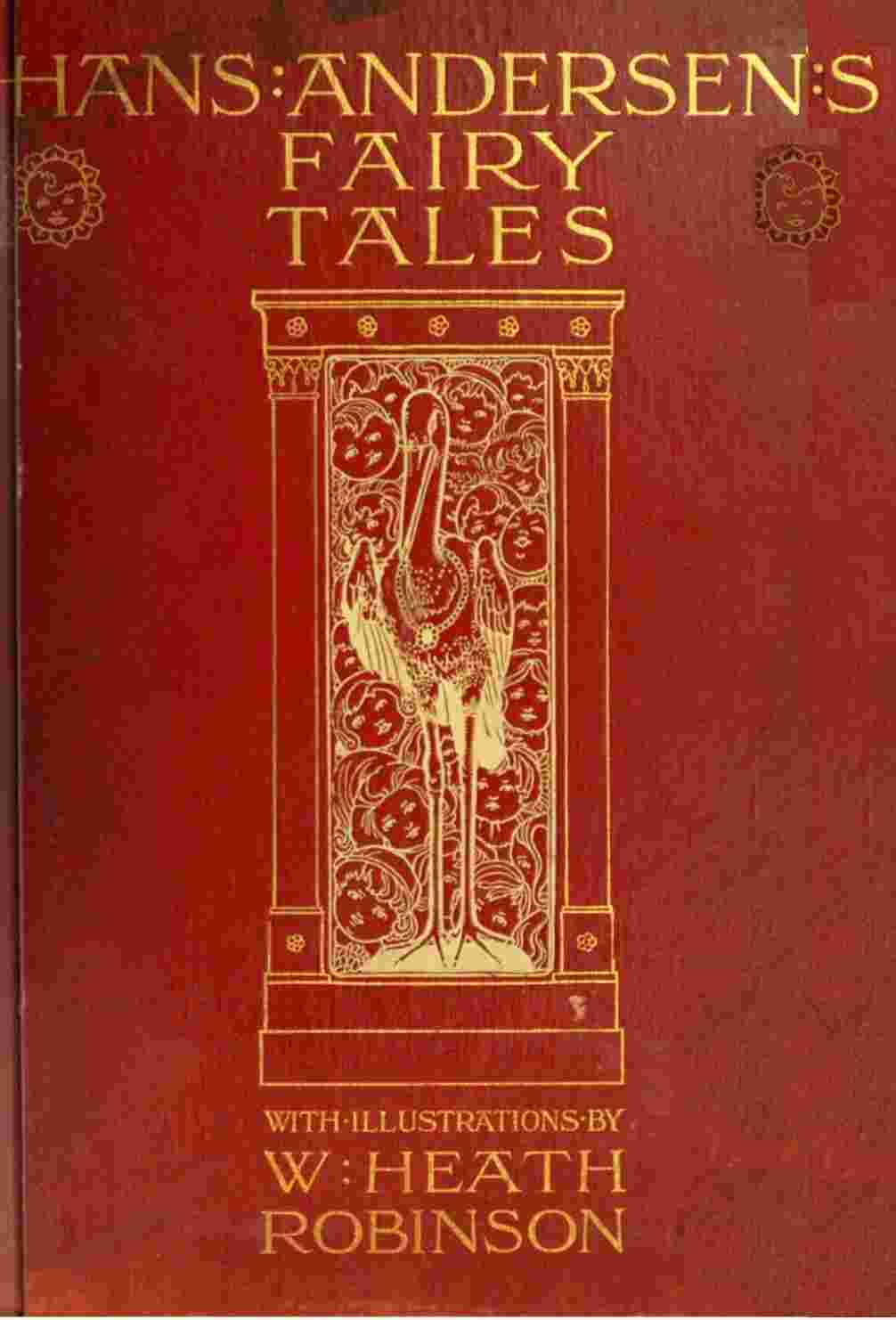
The Project Gutenberg eBook of Hans Andersen's Fairy Tales
Title: Hans Andersen's Fairy Tales
Author: H. C. Andersen
Illustrator: W. Heath Robinson
Release date: November 7, 2021 [eBook #66688]
Most recently updated: October 18, 2024
Language: English
Credits: Brian Coe, Chuck Greif and the Online Distributed Proofreading Team at https://www.pgdp.net (This file was produced from images generously made available by The Internet Archive)
|
List of Illustrations (etext transcriber's note) |
HANS ANDERSEN’S FAIRY TALES
HANS:ANDERSEN’S
FAIRY:TALES;WITH
ILLUSTRATIONS:BY
W:HEATH:ROBINSON
NEW:YORK
HENRY:HOLT:&:CO.
1913
CONTENTS
LIST OF ILLUSTRATIONS
LIST OF COLOURED ILLUSTRATIONS
SHE UNDERSTOOD THE SPEECH OF BIRDS
THE MARSH KING’S DAUGHTER
THE storks tell their young ones ever so many fairy tales, all of them from the fen and the moss. Generally the tales are suited to the youngsters’ age and understanding. The baby birds are pleased if they are told just ‘kribly, krably, plurry-murry!’ which they think wonderful; but the older ones will have something with more sense in it, or, at the least, a tale about themselves. Of the two oldest and longest tales which have been told among the storks, one we all know—that about Moses, who was placed by his mother in an ark on the waters of the Nile, was found by the king’s daughter, and then was taught all learning, and became a great man, and no one knows where he was buried. Everybody has heard that tale.
But the other story is not known at all even now; perhaps because it is really a chimney-corner tale. It has been handed down by mother-stork to mother-stork for hundreds of years, and each in turn has told it better, till now we are telling it best of all.
The first pair of storks who knew it had their summer quarters on a Viking’s log-house by the moor in Wendsyssel, which is in the county of Hjörring, near Skagen in Jutland, if we want to be accurate. To this day there is still an enormous great moss there. You can read all about it in your geography book. The moss lies where was once the bottom of the sea, before the great upheaval of the land; and now it stretches for miles, surrounded on all sides by watery meadows and quivering bog, with turf-moss cloudberries and stunted trees growing. A fog hangs over it almost continually, and till about seventy years ago wolves were still found there. It may certainly be called a wild moor, and you can imagine what lack of paths and what abundance of swamp and sea was there thousands of years ago. In that waste man saw ages back just what he sees to-day. The reeds were just as high, with the same kind of long leaves and purplish-brown, feathery flowers as they have now; the birches stood with white bark and fine, loose-hung leaves just as they now stand; and for the living creatures that came there, why, the fly wore its gauze suit of just the same cut as now, and the colour of the stork’s dress was white and black, with red stockings. On the other hand, the men of that time wore different clothes from those we wear. But whoever it was, poor peasant or free hunter, that trod on the quagmire, it happened thousands of years ago just as it does to-day—in he went and down he sank, down to the Marsh King, as they called him, who reigned beneath in the great Moss Kingdom. He was called also the Mire King, but we will call him by the stork’s name for him—Marsh King. People know very little about how he governed, but perhaps that is just as well.
Near to the moss, and right in the Liim Fjord, stood the Viking’s log-house, with paved cellar and tower two storeys high. On the roof the storks had built their nest. Mother-stork sat on her eggs, and was positive they would turn out well.
One evening father-stork had been out for a long time, and when he came home he seemed excited and flurried.
‘I’ve dreadful news for you!’ he said to mother-stork.
‘Don’t get excited,’ said she. ‘Remember I’m sitting on my eggs, and I might be upset by it, and then the eggs would suffer.’
‘You must know it!’ he answered. ‘She has come here, our landlord’s daughter in Egypt! She has ventured on the journey here, and she is lost!’
‘Why, she is of fairy descent! Tell me all about it; you know I can’t bear to wait at this time, when I’m sitting.’
‘Listen, mother. It’s as you told me. She has believed what the doctor said, that the moor-flowers here could do her sick father good, and so she has flown here in a feather-dress with the other winged princesses, who have to come to the north every year to bathe and renew their youth. She has come, and she is lost!’
‘You’re getting too long-winded!’ said mother-stork. ‘The eggs may be chilled! I can’t bear to be excited!’
‘I have watched,’ said father-stork, ‘and in the evening, when I went into the reeds, where the quagmire is able to bear me, there came three swans. Something in the way they flew told me, “Watch; that isn’t a real swan; it’s only swan feathers.” You know the feeling, mother, as well as I do; you can tell if it is right.’
‘Yes, certainly,’ said she; ‘but tell me about the princess. I’m tired of hearing about the swan’s feathers.’
‘Here, in the middle of the moor, you know,’ said father-stork, ‘is a kind of lake; you can see a part of it if you stand up. There, by the reeds and the green quagmire, lies a great elder-stump. The three swans lighted on it, flapped their wings, and looked round them. Then one of them threw off her swan’s plumage, and I saw it was our own princess, of our house in Egypt. Then she sat down, and she had no other covering than her own long, black hair. I heard her ask the two others to take great care of her swan-skin while she plunged under the water to gather a flower which she thought she saw. They nodded, and lifted up the loose feather-dress. “I wonder what they mean to do with it,” said I to myself; and no doubt she asked them the same. And she got an answer, something she could see for herself. They flew aloft with her feather-dress! “Sink down,” they cried; “you shall never fly in the swan-skin again; never see Egypt again! Stay in the moss!” And so they tore her feather-dress into a hundred pieces, till the feathers flew about as if it was snowing, and off flew the two good-for-nothing princesses.’
‘Oh, how dreadful!’ said mother-stork. ‘I can’t bear to hear it. But, tell me, what else happened?’
‘Our princess moaned and wept. Her tears fell on the elder-stump, and it was quite moved, for it was the Marsh King himself, who lives in the quagmire. I saw the stump turn itself, so it wasn’t only a trunk, for it put out long, muddy boughs like arms. Then the unhappy girl was frightened, and sprang aside into the quivering marsh, which will not bear me, much less her. In at once she sank, and down with her went the elder-stump—it was he who pulled her down. Then a few big black bubbles, and no trace of her left. She is engulfed in the marsh, and will never return to Egypt with her flower. You couldn’t have borne to see it, mother!’
‘You shouldn’t have told me anything of the sort just now; it may affect the eggs. The princess can take good care of herself. She’ll get help easily enough. Had it been you or I, there would have been an end of us.’
‘However, I’ll go day by day to see about it,’ said father-stork; and so he did.
The days and months went by. He saw at last one day that right from the bottom of the marsh a green stalk pushed up till it reached the surface of the water. Out of it grew a leaf, that grew wider and wider, and close to it a bud put out. Then one morning, as the stork was flying over it, it opened, with the sun’s warmth, into a full-blown flower, in the middle of which lay a beautiful child, a little girl, as if she were fresh from the bath. So like was the child to the princess from Egypt, that at first the stork believed it to be herself turned a child again. But when he thought it over, he decided that it was more likely to be the child of the princess and the Marsh King, and that was why she was lying in a water lily.
‘She mustn’t be left lying there,’ thought father-stork, ‘and there are too many already in my nest. But I have it! The Viking’s wife has no children, and she has often wished for a little one. Yes, I get the name for bringing the babies; I will do it in sober truth for once! I’ll fly to the Viking’s wife with the child. They’ll be delighted!’
So the stork took the little girl, flew to the log-house, made a hole with his beak in the window, with panes made of bladder, laid the child on the bosom of the Viking’s wife, and flew away