
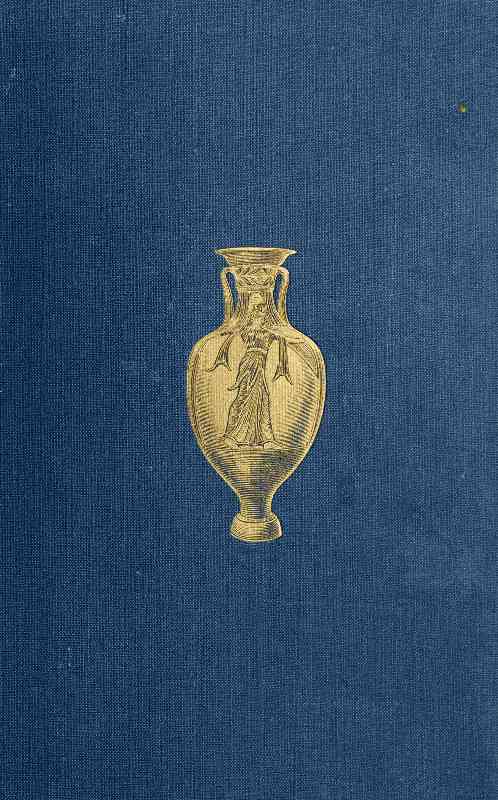
Melian Amphora (Athens Museum).
Mr. Hopkinson draws the conclusion, in which he may prove to be justified, that this pottery is of Delian manufacture, but if so, that the clay must have been imported, as the local clay is, and always has been, too poor in character. At all events, the Cycladic origin of the fabric can hardly be a matter of doubt, and it is clear that the intermediate position of these islands would account for a combination of Geometrical and Ionian elements, so far as such exists. But the strongly individualistic character of the vases compels us to seek some other influence for their real origin, and it seems on the whole probable that they represent a separate and independent descent from Mycenaean pottery, starting with the spiral as the basis of ornamentation. Some evidence of this descent may be traced in the native pottery of Phylakopi, to which allusion has been made in the previous chapter (p. 263).[1009]
§ 3. Corinth
Wilisch, Altkorinthische Thonindustrie (1892); Pottier, Louvre Cat. ii. p. 417 ff.; Dumont-Pottier, Céramiques, i. chaps. xi. and xvi.; Rayet and Collignon, p. 39 ff. For “Proto-Corinthian” pottery see references given in text.
As a commercial and artistic centre, no one city during the early archaic period entered into serious rivalry with Corinth, which was at a very remote date in relations with the East, and was one of the first of the Greek states to extend the system of colonisation in the Mediterranean, by the foundation of Corcyra, Syracuse, and other important outposts. The epoch of this supremacy and of its commercial prosperity extends from the eighth to the sixth century B.C., being coincident with the rule of the great tyrants, Periander, Kypselos, etc. In the course of the sixth century, when the Athenian tyranny rose to such a great height under Peisistratos, Corinth, with equal rapidity, sank to a subordinate position, and her artistic supremacy passed to the growing power of Athens. Hence it is fitting that Corinth and its famous potteries should be the subject of our next section.
Two causes contributed to the importance of Corinth as a centre of ceramic industry—the excellence of its clay (see p. 205), and its position as a commercial port at the junction of the Peloponnese and Central Greece. Pollux[1010] selects Corinthian clay for commendation, and other writers speak of different varieties of pottery as Corinthian. Hence it is not surprising that large quantities of pottery should have been found here, the local origin of which is established by the inscriptions in the Corinthian alphabet which are frequently painted upon them; and not only that, but similar pottery has been found almost all over the Mediterranean, being more widely distributed than any other fabric except the Athenian B.F. and R.F. vases. The list of sites as given by Wilisch is as follows: Athens, Eleusis, Aegina, Argos, Kleonae, Tiryns, Mycenae, Thebes, and Tanagra in Greece; Euboea (Karystos), Melos, Corfu, Crete, Rhodes,[1011] Samos, and Cyprus among the islands; Hissarlik, Smyrna, Pontus, and the Crimea; Alexandria, Naukratis, and Carthage; Syracuse and Selinus in Sicily, and Sardinia; and many places in Italy, such as Bari, Nola, Capua, Cumae, Beneventum, Cervetri, Vulci, Orvieto, Corneto, and Viterbo. M. Pottier thinks that this wide distribution is due, not to the merit of the vases themselves, which are often of poor style, but to the merchandise which they contained. This might, at any rate, account for the great preponderance of small oil-flasks, a form which took the place of the Mycenaean “false amphora.”
The Corinthian vases are not, however, strictly homogeneous, and, in fact, fall into certain distinct categories. The earliest class found at Corinth stands quite by itself, and has been termed “Proto-Corinthian,” though the justice of this title has been strongly combated by some scholars. On many of the Sicilian and Italian sites a class of small vases[1012] is found which differs from the authentic Corinthian examples of the same forms, and may not impossibly denote local fabrics. If this is so, they would stand in the same relation to the genuine Corinthian as the Boeotian Geometrical vases to those of the Dipylon, forming a sort of supplementary fabric. At all events, such imitations of a popular ware might reasonably be expected.
M. Pottier maintains that five distinct varieties of clay may be observed, which partially serve as a basis for classification, apart from questions of style and ornamentation. They are as follows: (1) small vases of a greenish-yellow clay found in Greece, especially at Corinth, but rare in Italy; (2) vases of cream-coloured clay from Boeotia, and large kraters from Cervetri; (3) vases of reddish clay from Boeotia, Euboea, and Etruria; (4) vases of white and grey clay, very numerous in Italy; (5) vases of yellow clay, chiefly found in Italy. Some of the “Proto-Corinthian” wares belong to Class (1), but as a rule they are marked off from the rest by technique as well as decoration. This first class is without doubt exclusively local, and represents the κέραμος Κορίνθιος of Pollux; the same clay is even used at Corinth at the present day. On one of the Penteskuphia pinakes (see p. 316), the clay of which differs from the rest, a potter is represented making an aryballos of “Proto-Corinthian” form[1013]; but the majority belong to the second class, which is also local, and includes the large kraters of advanced style with Corinthian inscriptions. In colour and porosity the clay resembles that of Boeotia. The red clay of Class (3) suggests a connection with Chalkis, a question which needs future consideration (see below, p. 321); (4) and (5) present analogies to the native clays of Italy, and include all the local imitative fabrics. The older varieties with merely linear decoration are most largely found at Corinth and Syracuse, and the later with incised lines and figures of animals or men are comparatively rare. But as far as the present state of our knowledge permits, it is certainly possible to claim as Corinthian, at least in a sense, all the varieties of fabrics which have been hitherto mentioned, except probably the “Proto-Corinthian.”
In describing these fabrics in detail, it will be found more convenient to ignore the technical differences, and adopt the more chronologically accurate system of classification which follows the development of the decoration. We thus obtain five distinct classes,[1014] which may be summarised as follows:—
1. “Proto-Corinthian” wares (called by M. Pottier the Corinthian Geometric style). 750–650 B.C., and later.
2. Corinthian vases with incised scale-patterns or imbrications.
3. Corinthian vases with floral decoration, ground-ornaments, and figures not incised.
4. Similar vases, but with figures incised. [Classes 2 to 4 roughly cover the seventh century.]
5. Corinthian vases without ground-ornaments, and with large friezes of animals or human figures; incised details. 600–550 B.C.
1. Although the priority of the so-called Proto-Corinthian or Corinthian Geometrical pottery is certain, the term is, strictly speaking, applied to vases of different dates, which are only connected by form with the original fabrics.[1015] The distinction lies in the fact that the earlier vases have linear decoration without purple accessories or incised lines, both of which occur in the more developed examples as the result of the revolution effected by the Corinthian painters.[1016] They therefore fall into two main classes, of which the earlier includes the larger vases with purely Geometrical decoration of a simple type, doubtless reflecting the original local Geometrical pottery, and sometimes with zones of animals. The figures are merely in black silhouette. In the later class the vases are small, sometimes diminutive, but of developed style, with zones of animals of the later Corinthian type, and with purple accessories and incised lines. The earlier class date from the eighth to the seventh century B.C.; the later cannot be older than the sixth. For the dating of the earlier group some evidence may be derived from the results of excavations at Syracuse, founded from Corinth in 735 B.C. In its earliest cemeteries, as also at Megara Hyblaea, numerous Proto-Corinthian vases of the earlier class have been found.[1017] In Italy Proto-Corinthian wares were found in trench-tombs of about 750–650 B.C., and in the earlier chamber-tombs (see Chapter XVIII.). The older class disappears by the end of the seventh century, when the typical Corinthian aryballos (see p. 197) takes its place.
Besides Corinth and Syracuse, Proto-Corinthian vases have been found in considerable numbers at the Argive Heraion, at Thebes, and in the island of Aegina, and more rarely at Tiryns, Athens, Eleusis, Tanagra, Smyrna, and Hissarlik. Out of thirty in the Berlin Museum, eight certainly came from Corinth. Taking this into consideration, and also the Corinthian origin of Syracuse, it is evident that there is, apart from their style, a strong presumption in favour of their Corinthian origin.[1018] As long ago, however, as 1877 Helbig cast doubts on this and proposed to locate them at the rival commercial centre of Chalkis.[1019] He was followed by Dümmler, Klein, and others,[1020] but recently Aegina[1021] and Boeotia[1022] have also been suggested, the latter at least for the earlier class. Yet more recently the pendulum has swung in another direction, that of Argos,[1023] chiefly in view of the extensive finds at the Heraion (not yet published). Two specimens have recently been made known which bear inscriptions, but neither yields very definite evidence. One is a signed vase (with the name of Pyrrhos[1024]), in which the alphabet is mixed, but mainly Chalcidian in character; in the other[1025] the inscriptions are fragmentary, but though the letter Σ appears in Argive, not Corinthian, form, the Λ is not of the peculiar Argive type, but . The Pyrrhos inscription cannot be much later than 700 B.C., and thus ranks as the earliest known “signature.” Mr. Hoppin,[1026] arguing from the Heraion finds, regards the Proto-Corinthian fabrics as a direct offshoot of Mycenaean pottery, not as forming a link between the Geometrical and the Corinthian. The term, however, may be preserved, as implying priority in point of time, and it cannot be said as yet that the Corinthian theory is absolutely disproved.
“Proto-Corinthian” and Early Corinthian Vases (British Museum).
1–3, 5, Early Corinthian; 4, 6, “Proto-Corinthian.”
The dominating form is that of the alabastron or lekythos, a pear-shaped vase with flat round lip and flat handle. The aryballos form is also known, as are the skyphos, pyxis, and a small krater. A characteristic shape is the jug with flat base rising in pyramidal form to a long cylindrical neck, with trefoil lip and handle.[1027] The earlier group, although of “Corinthian” technique, usually have only “Geometrical” ornament, such as water-birds or simple patterns; hence they have been held, for instance, by M. Pottier, to represent the true type of Corinthian Geometrical pottery. But it does not seem that the Geometrical style was ever popular at Corinth, and there are many signs that the Proto-Corinthian fabrics were to a great extent influenced directly by Mycenaean wares. The patterns, which are in black monochrome, are on the smaller vases limited to bands, rows of dots, or a kind of “tongue”-pattern of stylised leaves. The Proto-Corinthian vases found in Aegina[1028] form in some respects a class by themselves, being often of considerable size; they also include some unusual varieties, such as cups, and even amphorae.[1029] They usually have Geometrical decoration in the form of zigzags, maeander, chevrons, triangles, or parallel rays; on the larger ones are found friezes of animals, such as dogs pursuing deer, bulls, or water-fowl.
[Examples of this class are: B.M. A 487, 1050 ff. (see Plate XVII. figs. 4 and 6, XIX. fig. 1); Louvre E 13, 18, 32, 309, 375, 390, 396 (Atlas, pls. 39, 40); Berlin, 316–35; Ann. dell’ Inst. 1877, pls. C, D, U, V; Ath. Mitth. 1897, pl. 7 (B.M. A 1530, of Aegina type).]
The second class is one of considerable interest. It consists of a series of miniature vases, of which some twenty in all are known, of the pear-shaped lekythos form, with minute but skilfully-executed figures in a very advanced style. At their head for beauty and delicacy of execution stands the exquisite little Macmillan lekythos in the British Museum,[1030] a masterpiece of its kind. There is also a fine specimen in Berlin (No. 336), others in the Louvre[1031] and the Syracuse Museum (the latter from the local excavations), and three very fine ones have recently been acquired by the Boston Museum.[1032] But for size and richness, if not for beauty, all these are surpassed by a marvellous vase in the Chigi collection at Florence.[1033] This is a jug or oinochoë, decorated with no less than four friezes, two of which are broad, with numerous figures, the two alternate forming narrow borders to these, with hunting scenes. The colouring is most remarkable, the figures being painted in black, yellow ochre, and bright crimson on a cream ground, with a lavish use of incised lines, and on the upper narrow frieze the animals are actually painted in pale buff on a black ground. The upper large frieze represents a combat, with serried ranks of warriors and horsemen advancing to meet each other, those on the right all having elaborate emblems on their shields (birds, ox-heads, Gorgon-heads, etc.). On the lower friezes the figures fall into groups: a four-horse chariot and a row of boys on horseback; a Sphinx; hunters slaying a lion; and lastly a fragmentary group, clearly representing the Judgment of Paris (see Chapter XIV.). It is the figures of this group which bear the inscriptions alluded to above. As an instance of the extreme richness and delicacy of the painting, attention should be called to the chariot-horses in the lower frieze, which are drawn slightly in advance of each other, and painted respectively yellow, black, red, and yellow.
The Macmillan lekythos, in spite of its diminutive size, is decorated with no less than three friezes of human figures and animals, as well as other ornaments; the main design represents a combat of warriors; the next, a race of boys on horseback; the lowest, dogs pursuing a hare, and a crouching ape. The total height of the vase is barely 2¾ inches, and yet every detail in these friezes is marked with surprising care and accuracy, the shield-devices of the warriors, for instance, being drawn with wonderful minuteness. The three Boston vases are interesting for their subjects: on one is Bellerophon slaying the Chimaera; on the next, a hero attacking a lion with a human head on its back (a monster no doubt suggested by the Chimaera); the third has the favourite early subject of Herakles’ combat with the Centaurs. In all these vases the use of a red colour on the human figures should be noted, a technical device which we have already noted in the figures on the Melian amphorae (see above, p. 301).
It is abundantly clear that such work could not have been produced in the eighth, or even the seventh, century; the style is virtually that of the subsequent black-figured vases, and we are therefore forced to the conclusion that these miniature vases were made under the more or less direct influence of the later Corinthian wares proper, at a time when that style was developing into the black-figured.
With the Proto-Corinthian ware may be linked a series of vases in the form of animals, human heads, etc., which imitate Oriental porcelain vases and show an early development of the plastic art which is remarkable for its advanced style (see pp. 127, 492). The decoration of these vases is usually of a simple Geometrical character. They are found in Rhodes and on many other sites, such as Eretria, Vulci, and Nola.
2. Vases with incised imbrications.—The importance of this class is betokened by the appearance of the incised line, which as a matter of pure technique is of course only a revival from the primitive fabrics, but as an adjunct to figure-decoration in order to express details is an entirely new feature (see above, p. 306, and below, p. 313). It was probably derived from metal-work, in which it had long been familiar, as the Boeotian Geometrical fibulae and the early Corinthian or Chalcidian bronze reliefs testify. Although destined largely to revolutionise design, it was at first used with restraint. In the vases under consideration it is confined to the imbrications[1034] or scale-patterns with which the body is largely covered (Plate XIX. fig. 3). They were produced by means of a compass in which the graving-tool was fixed, the edge of each scale forming an arc of a circle, the centre points of which are usually visible. This scale-pattern is not a new feature in the decoration of vases; it appears in a painted form on many Mycenaean specimens,[1035] and was also adopted by the Ionian painters of Daphnae in the Egyptian Delta (see p. 352). But as a more satisfactory result was obtained by incising, the Corinthian variety soon became exceedingly popular. The effect is often enhanced by the use of red colour.[1036] In some cases this ornament is combined with painted friezes of animals (as in the Louvre vase E 421). The shapes employed are various, but a new and conspicuous variety is the large jug or olpe, with circular lip and large discs attached on either side to the tops of the handles. Attempts have been made to dissociate this fabric from Corinth, by attributing it to Rhodes, Ionia, and Sicily[1037]; but although it is certainly true that large numbers were found in Rhodes and in Sicily, the claims of neither prevail over those of Corinth, and the most that can be said with any certainty is that some are local imitations. It is, moreover, possible to discover their prototypes in the Proto-Corinthian wares.
3. Vases with floral decoration, but no incised lines (about 700–650 B.C.).—Towards the end of the eighth century may be observed an influx of Oriental motives, transforming the Corinthian style, just as at Athens it transformed the local style, producing the Phaleron ware. Its effect can also be observed in Etruria (Chapter XVIII.). It is largely due to historical causes, such as the development of Greek commerce and colonial expansion, and generally to the fusion of Dorian and Ionian elements. Hence the prominent characteristic which distinguishes the new variety from the Proto-Corinthian; namely, the employment of vegetable ornament, not from direct observation of nature, but conventionalised. These patterns seem to be largely drawn from Oriental textile embroideries, and mainly take the form of rosettes, leaves, and flowers strewn all over the field; according to some writers, this is the explanation of the phrase spargentes lineas intus,[1038] used in connection with the Corinthian painters Aridikes and Telephanes. Ground-ornaments are almost unknown in Oriental art; but their adoption from the embroideries would only exemplify the principle, universal in early art, of imitating in one material the salient features of another. It has been suggested that these flowers and leaves are intended to represent the ground on which the animals are walking. If this is so, the effect is due to a principle already existing in Mycenaean art—the conventional rendering of perspective by placing objects whose real position is beyond the principal subjects in the same vertical plane with them. Another favourite pattern, either as a ground-ornament or as part of the subordinate decoration, is a combination of the palmette and lotos-flower, picked out with purple accessories[1039]; this pattern is purely conventional, and often assumes colossal dimensions in relation to the size of the vase. The purple accessories, which now become very common, may possibly be connected with another traditional Corinthian invention, that of Ekphantos, who used a red pigment made from pounded earth (see p. 395).[1040]
As regards shapes, the alabastron and aryballos[1041] are preeminently popular; the flat-bottomed jug, the pyxis or covered jar, and the skyphos or kotyle, are also found (see Plate XIX. figs. 1, 2, 5). There arises now a tendency in the larger vases to divide the body into zones or friezes, which henceforth become a characteristic feature. The subjects are strictly limited to animals such as the lion, or various types of birds; and friezes of running dogs and other quadrupeds now become the typical Corinthian motive.
To face page 312
1. COVERED JAR OF CORINTHIAN FABRIC.
2. “RHODIAN” OINOCHOE.
(British Museum).
4. Vases with floral decoration and figures with incised lines (about 650–600 B.C.).—In this next stage, the date of which corresponds with the later trench-tombs and older chamber-tombs of Etruria (see Chapter XVIII.), there is a marked tendency of the vases to increase in size, and several new forms are either introduced for the first time or increase in popularity. Besides the ever-popular aryballos and alabastron, there are various forms of covered jars, the cylindrical pyxis, and the so-called lekane, a sort of tureen; also various drinking-cups, the kotyle, the so-called kothon, and the kylix, the last a new type. Its prototype is perhaps to be sought in the shallow four-handled bowls of the Boeotian Geometrical ware, and it is marked by its bent-over rim and low foot.[1042]
The decoration loses all restraint, and the prevailing idea with the artist is the horror vacui which impels him to fill up every vacant part of the surface, at the expense of utterly conventionalising his figures and ornaments and distorting their forms (cf. Plate XIX. figs. 1, 5, and XX. fig. 1). The vases contrast unfavourably with their Ionian contemporaries, in which, however profuse the ground-ornaments, the importance of the figures is never lost sight of, and they never fail to strike the eye. Incised lines and purple accessories are employed freely, and even the rosettes are always marked by cross-wise incisions.
Incision as a method of ornamenting vases was of course always known from the earliest times, but it was not until now employed within and round painted designs. Hitherto the only alternatives were plain silhouettes (as in Geometrical vases) or half-opaque, half-outlined figures (as in Mycenaean and some early Ionian vases). The former, however, were too conventional, the latter too elaborate, and the new method of painting plus engraving reconciled the two, being at once more realistic and more rapid. It is generally supposed that this method was a Corinthian invention (compare its use in the imbricated vases, p. 311), but it is not unknown in early Attic vases, and Böhlau attributes its origin to an early Ionian tendency to imitate metal ware.[1043] But this was an anomaly, and the Ionians never took to the incising method, preferring outline designs or inner lines of white paint (see p. 331). In any case the Corinthians were the first to adopt it and popularise it.
The subjects, which now begin to present greater interest, include all kinds of animals and monsters, arranged in friezes, and by degrees human figures, and even scenes from mythology, make their appearance. Some vases have only decorative ornament, such as a flower of four long, pointed petals, which is frequently found on the aryballi.[1044] The animals include the lion, panther, boar, bull, ram, deer, goat, swan, and eagle; the monsters are Gryphons, Sphinxes, or Sirens, and a sea-deity of which the upper part is human (both male and female), the lower is in the form of a sinuous fish-tail, and the figure is often winged in addition.[1045] It is possible that in these figures we may see the local sea-deities Palaemon and Ino-Leukothea. The human figures are either single, ranged in friezes, or in groups; the favourite types are combats of two warriors and Bacchanalian dances; hunting scenes; and warriors setting out in chariots. The mythological scenes include the combat of Herakles with the Centaurs,[1046] and scenes from the Trojan War, such as the combat of Ajax and Aeneas, or the episode of Dolon.[1047]
So far, then, in the three groups of Corinthian fabrics proper, we are able to trace the working of M. Pottier’s law of the hiérarchie des genres,[1048] the law which was made by M. Dumont the basis of his work Les Céramiques de Grèce propre (vol. i., dealing with the earlier fabrics). According to this law, the decoration of vases advances by a logical process from linear patterns to floral ornament, and then from animals to human, and finally mythological, figures. Another feature in this group is that inscriptions now appear for the first time. They became exceedingly popular at Corinth, and on most of the vases with figure-subjects they may be found, each person bearing a name, whether the scene is mythological or not.[1049] The fashion seems to have received an impetus from the chest of Kypselos, which was largely a Corinthian work, and often shows close parallel with the vases (see below). We have a signed vase with figures in this style by Chares (Louvre E 609), and others by Timonidas (Athens 620), and Milonidas (a pinax in Louvre).[1050] The abundance of these inscriptions has done much to increase our knowledge of the somewhat peculiar Corinthian alphabet (see Chapter XVII.).
Among the vases of this period one of the most remarkable is the so-called Dodwell vase in Munich (Fig. 90),[1051] found at Mertese, near Corinth, about the year 1800, and purchased by the explorer Dodwell. It is a cylindrical jar or box (pyxis), with cover, decorated round the sides and on the top. Round the body are two friezes of animals, with numerous flowers as ground-ornaments; on the top of the cover is a frieze representing a boar-hunt, in which eight fancifully-named personages take more or less active part. Of these Philon lies dead under the boar’s feet; Thersandros attacks it with a sword in front, and Pakon discharges an arrow at it from behind. Behind him Andrytas hurls a spear, and he is followed by four inactive figures, all draped and unarmed—Dorimachos, Sakis, Alka ... and Agamemnon. The scene is closed by a heraldic group of two Sphinxes. It will be observed that here, as in other contemporary scenes with human figures, the ground-ornaments are already showing a tendency to die out; perhaps under the influence of Ionia, where it was soon discovered that they interfered with the effect of figures in action. The alphabet of the inscriptions enables us to date this vase about 650–620 B.C.
FIG. 90. THE DODWELL PYXIS (COVER).
The pinakes, or votive tablets, from Penteskuphia, of which mention has been made elsewhere (p. 51), form an important feature in this group, both from their subjects, their inscriptions, and the method of painting. They appear to range in date from 650 to 550 B.C., and fall into three classes in point of style. The earliest have designs in rude silhouette without incised lines; in the second only the contours of the figures are incised; the third are like the vases, with incised lines and purple details. In a few cases the clay is red, not drab-coloured. Some are decorated on both sides, but the majority on one only, and they were clearly intended for hanging up in a temple. Two of them are signed by artists, Timonidas and Milonidas,[1052] and there are other interesting inscriptions, besides the ordinary dedications to Poseidon and Amphitrite (see Chapter XVII.). The subjects are partly the same as on the vases, but the majority fall under two heads: (a) Poseidon and Amphitrite, standing or in a chariot (Fig. 115); (b) genre scenes from Corinthian industries, such as miners digging out clay, potters and painters at work, and vessels exporting pottery over the sea (cf. pp. 207, 216, and Chapter XV. § 5). Of the subjects common to the vases, Oriental animal-types and horses occur most frequently; also rosettes and floral ground-ornaments.
1. Imitation Corinthian Krater, Return of Hephaistos; 2, Corinthian Krater with Boar-hunt (British Museum).
5. The vases of the fifth class (600–550 B.C.) are characterised by the prevalence of human and mythological subjects, with large friezes of animals, a general use of incised lines, and an absence of ground-ornaments. They are mostly of considerable size, but small vases still continued to be made during the sixth century, as is seen in the “Proto-Corinthian” lekythi. The amphora and hydria now first make their appearance; the later lekythi approach more to the Attic form.[1053] One or two other typical shapes may also be noticed, such as the column-handled krater (Plate XXI.) and the trefoil-mouthed jug with a panel on one side of the vase only; the prototype of the former we have seen in the krater of Aristonoös. Another important feature is the general use of a red ground in the place of the old creamy white; and yet another, the use of white accessories, especially for the flesh of female figures. It should be noted that this white is always applied directly on the clay, as in Ionian fabrics, not as in the Attic, upon the black varnish. We may bear in mind that it was about this time that the Athenian Eumaros marem a femina discrevit, according to Pliny; but his date is uncertain, and the bearing of this invention on the vase-paintings is not to be accepted without hesitation. For the faces of male figures purple is often used, and, generally speaking, the vases tend to present a polychrome appearance. This again is an Ionian characteristic.
The subjects now take a much wider range, and include almost every variety known in the earlier part of the sixth century. Friezes of animals seldom form the main motive of decoration, but are placed in subordination either on the shoulder or low down on the body. Some of the older types still linger, such as the monsters and fish-tailed sea-deities, and also that of a heraldic group of two animals with a palmette and lotos pattern between, suggesting the old Assyrian motive of two animals guarding the sacred tree. Generally, there is a great advance in composition; but two traditional principles are still observed—the juxtaposition of figures turned in the same direction, as in Oriental compositions, and a symmetrical disposition of the two sides converging to a centre, a “Continental” principle already seen in the Dipylon vases. The subjects taken from daily life include combats, banquets, Bacchic or grotesque dances, hunting-scenes, warriors setting out for battle, and processions. Some appear now for the first time, as, for instance, the banquets. Among the mythological scenes, Herakles and his adventures find most favour; scenes from the Trojan cycle are far from uncommon; and other myths of more isolated character are those of Amphiaraos, Perseus, and the Theban cycle (Tydeus killing Ismene). Many of the mythological scenes are really only genre scenes with names added; for instance, the krater in the Louvre with Herakles’ reception by Eurytos (E 635), is only an ordinary banquet-scene in composition, but for the inscriptions; and so with many others, as we have also observed in the preceding class.
It may suffice to describe one vase in detail as typical of the later Corinthian wares. This is the so-called Amphiaraos krater in Berlin,[1054] a column-handled krater of considerable size and very richly decorated. It belongs to a series exceptionally well represented in the Louvre (E 613–39; all found, like this, at Cervetri), and illustrating the absolutely latest development of Corinthian pictorial art. Its special interest is that it affords a close comparison in several points with the chest of Kypselos. The subjects are disposed in two rows all round the vase, of which the upper is the more important, containing two mythological subjects. These, which are unequally divided, one occupying more of the circumference than the other, are the Departure of Amphiaraos and the Funeral Games for Pelias,[1055] the ἀγὼν ὁ ἐπὶ Πελίᾳ of Pausanias.[1056] On the lower frieze are seven boys taking part in a horse-race, seven groups of combatants, and two marching hoplites. It will be noted that there is no frieze of animals.
The Amphiaraos scene depicts that hero in the act of ascending his war-chariot, in which the driver Baton stands; he turns to look at his family behind, consisting of two daughters, a son, and an infant in the nurse’s arms, and last of all his wife Eriphyle, who stands in the rear with the pearl necklace, the price of her treachery. Her children seem to be supplicating for her. In the background Amphiaraos’ house is indicated by a Doric building. The correspondence of this scene with the description of the Kypselos chest[1057] is extraordinary; the latter might almost be a description of the vase. An interesting feature of this painting is formed by the animals which are scattered over the scene: a hare, a hedgehog, an owl and another bird, a serpent, a scorpion, and a lizard or salamander.[1058]
The funeral games for Pelias adjoined the Amphiaraos scene on the chest, just as they do here, except that the scene on the vase is only an excerpt from the contest of the Pentathlon, which is there complete. We have here only the wrestling (by Peleus and Hippalkimos), and in place of the other scenes a chariot-race, with the judges waiting to decide the result; as on the chest, tripods are standing ready as prizes for the victor. It must not, of course, be supposed that these scenes are directly copied from the chest—the discrepancies are too great, although the parallels are very interesting; but the only object of such comparisons is to assist us to an idea of the appearance of these great contemporary works of art.[1059]
One of the chief features of this class is the almost total disappearance of the ground-ornaments. Sometimes indeed a frieze of animals with the old profusion of rosettes is combined on the same vase with a design of figures on a clear field; but, generally speaking, rosettes are not found with the figure subjects. Their place is almost supplied by the inscriptions, which become more and more extensively employed, even for animals. Accessory colours are used in a purely conventional fashion, not to reproduce nature, but—probably—to reproduce metal-work. Thus we may surmise that white is intended to give the effect of silver (or ivory) and red that of copper (or gold), just as such substances were used on the chest of Kypselos in order to give variety and picturesqueness to the surface. The black then represents the ground of bronze or wood.
The sixth-century Corinthian vase-paintings have a special importance at the present day, because they are almost the only remnant left to us of the artistic products of the city at that time.[1060] Though not of course to be reckoned as examples of the higher art, they yet reflect it in some measure, and help us to reconstruct such works as the chest of Kypselos, almost every subject on which finds a parallel in the Corinthian vases. And it is possible that they are important in another respect. We know from Pliny that there was a very influential school of painting centred at Corinth in this century, which is represented by the names of Kleanthes and Aridikes, Ekphantos, Aregon, and perhaps also Kimon of Kleonae. Although Professor Robert[1061] has endeavoured to show that the traditions are untrustworthy, and places Kimon in the seventh century, Kleanthes later, the probability is that they may fairly be upheld, and Pliny’s dates accepted. Allusion has already been made to the inventions traditionally associated with Aridikes and Ekphantos; but Kimon belongs to a later development of painting altogether, and must be reserved for a later chapter. Of Kleanthes it is only stated that he “invented linear drawing,” whatever that may mean; Pliny, our informant, was perhaps hardly aware himself, and is no more definite as to the period at which he lived. We can only, therefore, assume that he marks the epoch of some new departure or advance in contour or outline drawing.[1062]