
The Project Gutenberg eBook of Ireland under the Stuarts and During the Interregnum, Vol. 1 (of 3), 1603-1642
Title: Ireland under the Stuarts and During the Interregnum, Vol. 1 (of 3), 1603-1642
Author: Richard Bagwell
Release date: November 7, 2016 [eBook #53473]
Most recently updated: October 23, 2024
Language: English
Credits: Produced by Brownfox and the Online Distributed Proofreading
Team at http://www.pgdp.net (This file was produced from
images generously made available by The Internet Archive)
The cover image was created by the transcriber and is placed in the public domain.
IRELAND UNDER THE STUARTS
Vol. I.
By the same Author
IRELAND UNDER THE TUDORS
Vols. I. and II.—From the First Invasion of the Northmen to the year 1578.
8vo. 32s.
Vol. III.—1578-1603. 8vo. 18s.
LONGMANS, GREEN, & CO.
London, New York, Bombay, and Calcutta
IRELAND
UNDER THE STUARTS
AND
DURING THE INTERREGNUM
BY
RICHARD BAGWELL, M.A.
AUTHOR OF ‘IRELAND UNDER THE TUDORS’
Vol. I. 1603-1642
WITH MAP
LONGMANS, GREEN, AND CO.
39 PATERNOSTER ROW, LONDON
NEW YORK, BOMBAY, AND CALCUTTA
1909
All rights reserved
PREFACE
These volumes have been written at such times and seasons as could be made available during an active life in Ireland, and this may induce critics to take a merciful view of their many shortcomings. I have been diligent, but there is still much extant manuscript material which I have been unable to use. Ireland is the land of violent and persistent party feeling, and no party will be pleased with the present work, for I hold with an ancient critic that the true function of history is to bring out the facts and not to maintain a thesis. If I am spared to finish the third volume, it will bring the narrative down to the Revolution, and will contain chapters on the Church or Churches and on the social state of Ireland.
The dates of all documents relied on have been given, and unless it is otherwise stated they are among the Irish State Papers calendared from 1603 to 1660. Many papers, chiefly, but not exclusively, from the Carte manuscripts, were printed by Sir J. T. Gilbert in the ‘Contemporary History of Affairs in Ireland,’ or in the ‘History of the Confederation and War in Ireland.’ As these collections are more generally accessible than the Bodleian Library, I have referred to them as far as they go. The ‘Aphorismical Discovery,’ which forms the nucleus of the first, is cited under that title, and the narrative of Bellings in the second under his name. The original Carte papers at Oxford have been often consulted, as well as the transcripts in the Public Record Office, while the manuscripts in the British Museum and in Trinity College, Dublin, have not been neglected. In the case of old tracts and newsletters, of which I have read a great many, dates and titles are given.
The late Lord Fitzwilliam did not consider it consistent with his duty to let Dr. Gardiner see the Strafford correspondence preserved at Wentworth Woodhouse, and my application to his successor has also been refused. No restriction seems to have been imposed on the editors of Laud’s works, of which the last instalment was published as late as 1860. All the Archbishop’s letters are printed, Strafford’s being omitted only because they would have taken too much room. In 1739 Dr. William Knowler, working under Lord Malton’s directions, published the well-known Strafford Letters, and Mr. Firth has thrown fresh light upon them by printing some of the editor’s correspondence in the ninth volume of the ‘Camden Miscellany.’ ‘There is,’ Knowler wrote, ‘four or five times the number of letters uncopied for one transcribed, and yet I believe those that shall glean them over again won’t find many things material omitted.’ Yet Laud’s editors thought it worth while to publish a good deal of what had been left out, and probably there is still something to be done.
I have made some examination of the famous depositions in Trinity College, Dublin, concerning the rebellion of 1641, but it is unnecessary to repeat Miss Hickson’s arguments, which appear to me conclusive. The documents may be pronounced genuine in the sense that they really are what they profess to be, but they are all more or less ex parte statements, and the witnesses were not cross-examined. Deductions may be made on these grounds, especially in the case of numerical estimates, but there is a vast mass of other evidence as to the main facts. The matter is discussed pretty fully in Chapter XX.
It is unnecessary to describe here the various contemporary histories and memoirs referred to in the text and notes. Sir Richard Cox’s ‘Hibernia Anglicana’ should be used with caution. Cox was a strong partisan, but he was not a liar, and he wrote at a time when there were still living witnesses.
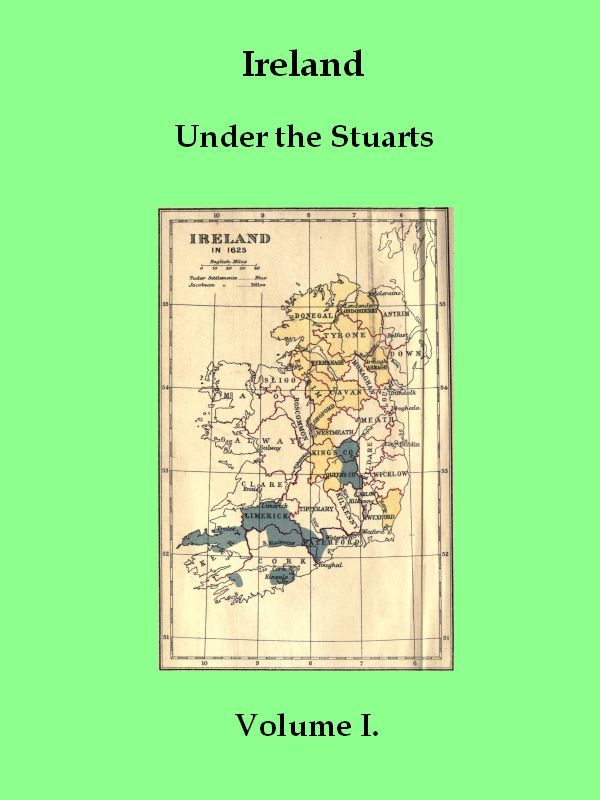
The maps at the beginning of each volume are intended as helps to the reader, and make no pretension to completeness. Fuller details as to the various colonies or plantations may be found in Mr. Dunlop’s map, No. 31 in the Oxford Historical Atlas. As to the short-lived Cromwellian settlement much may be learned from the map in Gardiner’s ‘Commonwealth and Protectorate,’ iii. 312, and from that in Lord Fitzmaurice’s ‘Life of Petty.’ The more lasting arrangements made after 1660 will be the subject of full discussion in my third volume. The innumerable sieges, battles and skirmishes from 1641 to 1653 may be traced in any large map of Ireland, and cannot be shown in a small one. The state of affairs at the critical moment of the first truce in 1643 is illustrated by the map in Gardiner’s ‘Great Civil War,’ i. 264.
My best thanks are due to Mrs. Shirley for lending me fourteen volumes of tracts concerning the rebellion from the library at Lough Fea. They have been very useful.
I received some valuable hints from my friend, the late C. Litton Falkiner, whose untimely death is a loss to Ireland.
Marlfield, Clonmel:
December 26, 1908.
CONTENTS
OF
THE FIRST VOLUME
| CHAPTER I | |
| MOUNTJOY AND CAREY, 1603-1605 | |
| PAGE | |
| Accession of James I. | 1 |
| Agitation in Irish towns | 2 |
| Insurrection at Cork | 8 |
| Reform of the currency | 14 |
| Chichester made Lord Deputy | 15 |
| CHAPTER II | |
| CHICHESTER AND THE TOLERATION QUESTION, 1605-1607 | |
| The laws against Recusancy | 17 |
| Proclamation against toleration | 19 |
| Cases of Everard and Lalor | 21 |
| Attempt to enforce uniformity—the Mandates | 23 |
| Bacon on toleration—Sir P. Barnewall | 27 |
| The Mandates given up | 29 |
| CHAPTER III | |
| THE FLIGHT OF THE EARLS, 1607 | |
| Tyrone at Court | 30 |
| O’Cahan’s case | 31 |
| Death of Devonshire | 33 |
| Earldom of Tyrconnel created | 34 |
| Departure of Tyrone, Tyrconnel, and Maguire | 37 |
| The fugitives excluded from France and Spain | 39 |
| Reasons for Tyrone’s flight—Lord Howth | 41 |
| Uncertainty as to the facts | 42 |
| Lord Delvin’s adventures | 44 |
| Royal manifesto against the Earls | 47 |
| Tyrone leaves the Netherlands | 48 |
| He reaches Rome | 49 |
| CHAPTER IV | |
| REBELLION OF O’DOGHERTY, 1608 | |
| The settlement at Derry | 51 |
| O’Dogherty and Paulet | 53 |
| Derry surprised and sacked | 54 |
| Flight and death of O’Dogherty | 56 |
| A ‘thick and short’ war | 58 |
| A Donegal jury | 60 |
| Forfeitures | 61 |
| CHAPTER V | |
| THE SETTLEMENT OF ULSTER | |
| The tribal system | 63 |
| Chichester’s plan of colonisation | 66 |
| Bacon on the settlement | 67 |
| The Scots in Ulster—Bishop Montgomery | 68 |
| Church and Crown | 70 |
| Chichester and Davies | 71 |
| British settlers invited | 72 |
| The natives neglected | 74 |
| The survey | 75 |
| Londonderry and Coleraine | 76 |
| Sir Thomas Phillips | 77 |
| Slow progress | 78 |
| English and Scots compared | 79 |
| Carew’s prophecy | 81 |
| Settlers and natives | 82 |
| Bodley’s and Pynnar’s surveys | 85 |
| The Londoners’ settlement | 87 |
| English, Scotch, and Irish | 88 |
| Optimism at Court | 90 |
| CHAPTER VI | |
| CHICHESTER’S GOVERNMENT TO 1613 | |
| Sir John Davies on circuit | 91 |
| Uniformity in Ulster—Bishop Knox | 97 |
| Irish swordsmen deported to Sweden | 99 |
| Piracy on the Irish coast | 101 |
| CHAPTER VII | |
| THE PARLIAMENT OF 1613-1615 | |
| No Parliament for 27 years | 108 |
| A Protestant majority | 109 |
| Roman Catholic opposition | 110 |
| Violent contest for the Speakership | 112 |
| Sir John Davies on the constitution | 114 |
| Patience of Chichester | 116 |
| Royal commission on grievances | 117 |
| Election petitions—new boroughs | 118 |
| Opposition delegates in London | 120 |
| Doctrines of Suarez: Talbot, Barnewall, and Luttrell | 122 |
| Rival churches—neglect of religion | 122 |
| Ploughing by the tail | 124 |
| Chichester found upright by the Commissioners | 126 |
| The King verbally promises toleration | 127 |
| But tries to explain away his language | 128 |
| Bacon as philosopher and Attorney-General | 129 |
| The King’s speech on parliamentary law | 130 |
| Legislation | 132 |
| The Protestant majority insufficient | 134 |
| Taxes not easily collected | 135 |
| Legislation against the Recusants abandoned | 136 |
| James falls back upon prerogative | 137 |
| CHAPTER VIII | |
| LAST YEARS OF CHICHESTER’S GOVERNMENT, 1613-1615 | |
| The Ormonde heritage | 139 |
| The MacDonnells in Antrim | 141 |
| Irish expedition to the Isles | 142 |
| Plot to surprise the Ulster settlements | 145 |
| Chichester recalled; his position and character | 147 |
| Death of Tyrone and Tyrconnel | 149 |
| CHAPTER IX | |
| ST. JOHN AND FALKLAND, 1616-1625 | |
| St. John tries to enforce uniformity | 150 |
| Charter of Waterford forfeited | 152 |
| Plantation of Wexford | 153 |
| General dissatisfaction | 156 |
| Bishop Rothe’s strictures | 160 |
| Plantation in Longford and King’s County | 162 |
| The new plantations not successful | 164 |
| Plantation of Leitrim | 166 |
| Irish swordsmen in Poland | 167 |
| Unpopularity of St. John | 168 |
| Lord Deputy Falkland | 169 |
| Ussher and the civil power | 170 |
| Effect of the Spanish match in Ireland | 171 |
| Falkland’s grievances | 173 |
| Death and character of James I. | 174 |
| CHAPTER X | |
| EARLY YEARS OF CHARLES I., 1625-1632 | |
| Accession of Charles I. | 175 |
| Quarrel between Falkland and Loftus | 175 |
| The case of the O’Byrnes | 176 |
| Alleged plot of Lord Thurles | 180 |
| The ‘graces’ | 180 |
| The bishops declare toleration sinful | 181 |
| Irish soldiers in England | 182 |
| Poynings’s law | 183 |
| Falkland recalled | 184 |
| Wentworth as a judge | 185 |
| The religious orders attacked | 186 |
| St. Patrick’s Purgatory | 188 |
| CHAPTER XI | |
| GOVERNMENT OF WENTWORTH, 1632-1634 | |
| Wentworth’s antecedents | 190 |
| His alliance with Laud—‘thorough’ | 192 |
| His other friends | 193 |
| Conditions of Wentworth’s appointment | 195 |
| His journey delayed by pirates | 198 |
| His arrival in Ireland | 199 |
| His opinion of the officials | 201 |
| First appearance of Ormonde | 203 |
| Reforms in the army | 203 |
| Church and State—Bishop Bramhall | 205 |
| Wentworth, Laud, and the Earl of Cork | 206 |
| Algerine pirates—sack of Baltimore | 207 |
| Wentworth suppresses piracy | 209 |
| CHAPTER XII | |
| THE PARLIAMENT OF 1634 | |
| Wentworth’s parliamentary policy | 211 |
| Wentworth and the Irish nobility | 213 |
| How to secure a majority | 214 |
| Parliamentary forms and ceremonies | 215 |
| Wentworth’s speech | 216 |
| Supply voted | 219 |
| Wentworth refused an earldom | 220 |
| The ‘graces’ not confirmed | 221 |
| Parliamentary opposition overcome | 222 |
| Judicial functions of Parliament—Gookin’s case | 223 |
| Taxation | 226 |
| Parliament dissolved | 227 |
| Convocation | 227 |
| The Thirty-nine Articles adopted | 228 |
| Wentworth successful in all directions | 229 |
| CHAPTER XIII | |
| STRAFFORD AND THE ULSTER SCOT | |
| Rise of Presbyterianism in Ulster | 231 |
| Wentworth, Laud, and Bramhall | 232 |
| Bishop Adair’s case | 233 |
| The Covenant | 236 |
| The Black Oath | 238 |
| Repression of the Presbyterians | 239 |
| A ‘desperate doctrine’ | 242 |
| Wentworth wishes to drive out the Scots | 243 |
| CHAPTER XIV | |
| WENTWORTH’S PLANS OF FORFEITURE AND SETTLEMENT | |
| Defective titles | 245 |
| Large colonisation schemes | 246 |
| Roscommon, Sligo, and Mayo submit | 247 |
| Resistance of Galway | 249 |
| Treatment of the Galway people—Clanricarde | 250 |
| Injustice of Wentworth’s policy | 251 |
| Attack on the Londoners’ plantation | 252 |
| CHAPTER XV | |
| CASES OF MOUNTNORRIS, LOFTUS, AND OTHERS | |
| Lord Wilmot’s case | 255 |
| The Mountnorris case | 256 |
| Martial law in time of peace | 257 |
| Hard treatment of Mountnorris | 261 |
| Case of Lord Chancellor Loftus | 264 |
| Judgment of Royalist contemporaries | 267 |
| Wentworth and Lord Cork | 268 |
| Vindictive action of Wentworth | 270 |
| Sir Piers Crosbie’s case | 271 |
| Wentworth and Trinity College | 273 |
| Provost Chappell | 274 |
| The Irish lecture abandoned | 275 |
| CHAPTER XVI | |
| STRAFFORD’S GOVERNMENT, 1638-1640 | |
| Wentworth’s account of his services | 276 |
| His power practically unchecked | 278 |
| Country life and game laws | 279 |
| Wentworth chief minister | 281 |
| Made Lord Lieutenant and Earl of Strafford | 282 |
| Meeting of an Irish Parliament | 283 |
| Supply voted | 283 |
| Declaration in praise of Strafford | 284 |
| CHAPTER XVII | |
| STRAFFORD’S ARMY | |
| Lord Antrim’s plot against Scotland | 285 |
| Wentworth garrisons Carlisle | 287 |
| The new Irish army | 288 |
| Muster and disbanding | 291 |
| Danger from disbanded soldiers | 292 |
| Recruits for France and Spain | 293 |
| Owen Roe O’Neill and Preston | 295 |
| CHAPTER XVIII | |
| TRIAL AND DEATH OF STRAFFORD | |
| Wandesford as Strafford’s Deputy | 297 |
| The Irish Parliament refractory | 298 |
| Strafford commander-in-chief | 299 |
| Strafford at York | 300 |
| His arrest | 301 |
| The Irish Parliament repudiate Strafford | 302 |
| Death of Wandesford | 303 |
| Trial of Strafford | 304 |
| Death and character of Strafford | 308 |
| CHAPTER XIX | |
| THE REBELLION OF 1641 | |
| Parsons and Borlase Lords Justices | 312 |
| Roman Catholic majority in Parliament | 313 |
| Apprehensions of a rising | 315 |
| Rory O’More, Lord Maguire, and others | 317 |
| The plot to seize Dublin is frustrated | 319 |
| Outbreak in Ulster | 320 |
| The government weak | 321 |
| Ulster fugitives in Dublin | 323 |
| State of the Pale | 326 |
| Ormonde made general—Sir H. Tichborne | 327 |
| The Irish Parliament after the outbreak | 329 |
| The news reaches the English Parliament | 330 |
| And the King | 330 |
| Relief comes slowly | 331 |
| Monck, Grenville, Harcourt, and Coote | 332 |
| CHAPTER XX | |
| PROGRESS OF THE REBELLION | |
| Savage character of the contest | 333 |
| Conjectural estimates | 334 |
| The rising in Tyrone | 335 |
| In Armagh and Down | 336 |
| In Fermanagh | 337 |
| In Cavan—the O’Reillys | 338 |
| In Monaghan | 342 |
| The Portadown massacre | 342 |
| Imprisonment and death of Bedell | 344 |
| Irish victory at Julianstown | 347 |
| Belfast and Carrickfergus | 348 |
| The Pale joins the Ulster rebels | 349 |
| Meeting at Tara | 350 |
| Defence of Drogheda | 351 |
| Fire and sword in the Pale | 357 |
MAP
| Ireland in 1625, to illustrate colonization projects | to face p. 1 |