
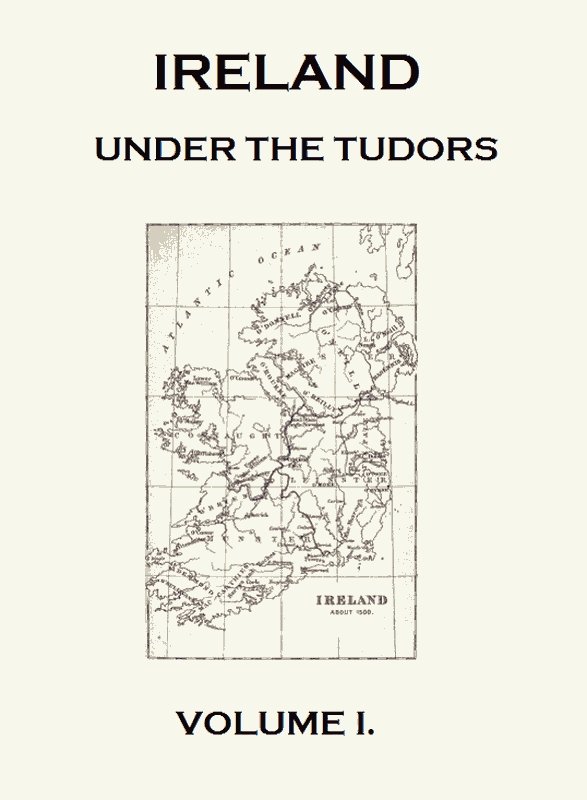
The Project Gutenberg eBook of Ireland under the Tudors, with a Succinct Account of the Earlier History. Vol. 1 (of 3)
Title: Ireland under the Tudors, with a Succinct Account of the Earlier History. Vol. 1 (of 3)
Author: Richard Bagwell
Release date: February 8, 2013 [eBook #42046]
Most recently updated: October 23, 2024
Language: English
Credits: Produced by Brownfox and the Online Distributed Proofreading
Team at http://www.pgdp.net (This file was produced from
images generously made available by The Internet Archive)
TRANSCRIBERS' NOTE
The cover image for this e-book was created by Distributed Proofreaders and is being placed in the Public Domain
IRELAND UNDER THE TUDORS
VOL. I.
PRINTED BY
SPOTTISWOODE AND CO., NEW-STREET SQUARE
LONDON
IRELAND UNDER THE TUDORS
WITH A SUCCINCT ACCOUNT OF THE
EARLIER HISTORY
BY
RICHARD BAGWELL, M.A.
IN TWO VOLUMES
VOL. I.
LONDON
LONGMANS, GREEN, AND CO.
1885
All rights reserved
PREFACE.
‘Irish policy,’ said Mr. Disraeli in the House of Commons, ‘is Irish history, and I have no faith in any statesman, who attempts to remedy the evils of Ireland, who is either ignorant of the past or who will not take lessons from it.’ This is most true, and history, if it is to be of any use, should be written for instruction, and not merely for the confirmation of existing prejudices. This is especially so in the present case, for, as Sir George Stanley told Cecil in 1565, ‘the practises of Ireland be great, and not understood to all men that seem to have knowledge thereof.’ The writer who enters the arena as an advocate may produce an interesting party pamphlet, but he will hardly make the world either wiser or better. The historian’s true office is that of the judge, whose duty it is to marshal all the material facts with just so much of comment as may enable his hearers to give them their due weight. The reading public is the jury.
Starting with this conception of the task before me, I have not attempted to please any party or school. The history of Ireland is at the best a sad one; but its study, if it be really studied for the truth’s sake, can hardly fail to make men more tolerant. In Ireland, as in other countries, a purely Celtic population was unable to resist the impact of the Teutonic race. First came the pagan Northmen, with power to ruin, but without power to reconstruct. Then followed the Anglo-Normans, seeking for lands and lordships, but seeking them under the patronage of the Catholic Church. For a time it seemed as though the conquest would be complete; but the colony proved too weak for its work, and the mail-clad knights failed almost as completely as the Scandinavian corsairs.
The main cause of this second failure was the neglect or jealousy of the kings. They feared the growth of an independent power within sight of the English shore, and they had neither means nor inclination to do the work of government themselves. Little gain and less glory were to be had in Ireland, and Scotch, Welsh, or Continental politics engrossed their attention in turn. They weakened the colony, partly of set purpose, and partly by drawing men and supplies from thence. In short, they were absentees; and, to use an expression which has gained currency in modern times, they were generally content to look upon Ireland as a mere drawfarm.
The Wars of the Roses almost completed the ruin of the work which Henry II. had begun. For a moment it seemed as if the colony was about to assert its independence. But this could not have been done without an understanding with the native race, and it does not appear that any such understanding was possible. The upshot was that Yorkist and Lancastrian parties were formed in Ireland, that the colony was thus still further weakened, and that the English language and power seemed on the point of disappearing altogether.
The throne of Henry VIII. was erected on the ruins of mediæval feudalism, and guarded by a nation which longed for rest, and which saw no hope but in a strong monarchy. The King saw that he had duties in Ireland. Utterly unscrupulous where his own passions were concerned, the idea of a patriot King was not altogether strange to him. Irish chiefs were encouraged to visit his court, and were allowed to bask in the sunshine of royal favour; and it is conceivable that the ‘Defender of the Faith,’ had he continued to defend it in the original sense, might have ended by attaching the native Irish to the Crown. By respecting for a time their tribal laws, by making one chief an earl and another a knight, by mediating in their quarrels, and by attending to their physical and spiritual wants, a Catholic Tudor might possibly have succeeded where Anglican and Plantagenet had failed. The revolution in religion changed everything, and out of it grew what many regard as the insoluble Irish question.
Henry II. had found Ireland in the hands of a Celtic people, for the intermixture of Scandinavian blood was slight and partial. Henry VIII. found it inhabited by a mixed race. From the beginning there had been rivalry and ill-feeling between men of English blood born in Ireland, and those of English birth who were sent over as officials or who went over as adventurers. During the fifteenth century England did nothing to preserve the ties of kinship, and the Celtic reaction tended to swallow up the interlopers. The degenerate English proverbially became more Irish than the Irish themselves, but the distinction would scarcely have been so nearly obliterated had it not been for the change in religion. The nobles of the Pale, the burghers of the walled towns, and the lawyers in Dublin were equally disinclined to accept the new model. Neither Irish chieftains nor Anglo-Irish lords found much difficulty in acknowledging Henry’s supremacy both in Church and State; but further than that they would not go. The people did not go so far, and, in the words of the annalists, regarded the Reformation simply as a ‘heresy and new error.’
Religion itself was at an extremely low ebb, and only the friars preserved the memory of better days. Henry may have imagined that he could lead the people through the bishops and other dignitaries: if so, he was entirely mistaken. The friars defied his power, and the hearts of the poor were with them. In Ireland, at least, it was Rome that undertook the work of popular reformation. The Franciscans and Jesuits endured cold and hunger, bonds and death, while courtly prelates neglected their duties or were distinguished from lay magnates only by the more systematic nature of their oppressions. And thus, as the hatred of England daily deepened, the attachment of the Irish to Rome became daily closer. Every effort of Henry to conciliate them was frustrated by their spiritual guides, who urged with perfect truth that he was an adulterer, a tyrant, and a man of blood. Holding such cards as these, the friars could hardly lose the game, and they had little difficulty in proving to willing ears that the King’s ancestors received Ireland from the Pope, and that his apostasy had placed him in the position of a defaulting vassal.
Henry’s vacillations and the early deaths of Edward and Mary for a time obscured the true nature of the contest, but it became apparent in Elizabeth’s time. She was an excommunicated Queen. From a Catholic point of view she was clearly illegitimate. Many English Catholics ignored all this and served her well and truly, but those who carried dogmas to their logical conclusions flocked to the enemy’s camp. Spain, Belgium, and Italy were filled with English refugees, who were willing enough that the Queen should be hurt in Ireland, since England was beyond their reach. But even here national antipathies were visible, and Irish suitors for Spanish help came constantly into collision with Englishmen bent upon the same errand.
Desmond, Shane O’Neill, and Hugh O’Neill seem to have cared very little for religion themselves. The first was a tool of Rome; the two latter rather made the Church subservient to their own ambition. But in these cases, and in a hundred others of less importance, the religious feeling of the people was always steadily opposed to the English Crown. Elizabeth was by nature no persecutor, yet she persecuted. Her advisers always maintained, and her apologists may still maintain, that in hanging a Campion or torturing an O’Hurley she did not meddle with freedom of conscience, but only punished those who were plotting against her crown. The Catholics, on the other hand, could plead that they had done nothing worthy of death or of bonds, nor against lawful authority, and that they suffered for conscience’ sake. And the Continental nations, who were mainly Catholic, sided on the whole with the refugees. Ireland, it is true, was only a pawn in their game, and Philip II. was probably wrong in not making her much more. At Cork or Galway the Armada might have met with scarcely any resistance, and a successful descent would have taxed Elizabeth’s resources to the utmost.
The poverty of the Crown is the key to many problems of the Elizabethan age. The Queen had to keep Scotland quiet, to hold Spain at bay, and to maintain tolerable relations with France. She saw what ought to be done in Ireland, but very often could not afford to do it. The tendency to temporise was perhaps constitutional, but it was certainly much increased by want of money. Her vacillating policy did much harm, but it was caused less by changes of opinion than by circumstances. When the pressure at other points slackened she could attend to her troublesome kingdom; when it increased she was often forced to postpone her Irish plans. Ireland has always suffered, and still suffers sorely, from want of firmness. In modern times party exigencies work mischief analogous to that formerly caused by the sovereign’s necessities.
The dissolution of the monasteries was followed by no proper provision for education. In the total absence of universities and grammar-schools, certain monks and nuns had striven nobly to keep the lamp of knowledge burning, but they were ruthlessly driven from house and home. Elizabeth was alive to all this, but she could not give Ireland her undivided attention, and such remedies as were applied came too late. The oppressed friars kept possession of the popular ear, and the Jesuits found the crop ready for their sickle. Denied education at home, many sons of good families sought it abroad, and the natural leaders of the Irish acquired habits of thought very different from those of English gentlemen. Archbishop Fitzgibbon, one of the most important champions of Catholic Ireland, saw clearly that his country could not stand alone. He would have preferred the sovereignty of England, but she had become aggressively Protestant, and he turned to Spain, to France, to Rome, anywhere rather than to the land whence his own ancestors had sprung. The lineage of the United Irishmen and their numerous progeny may be easily traced back to Tudor times.
A few words now to the critics whom every writer hopes to have. The spelling both of Irish names and English documents has throughout been modernised, from regard to the feelings of the public. Irish history is already sufficiently repulsive to that great unknown quantity the general reader, and it would be cruel to add to its horrors. Etymologists will always go for their materials to originals, and not to modern compositions. When, therefore, such names as Clandeboye or Roderic O’Connor are met with in the text, it is not to be supposed that I have never heard of Clann-Aedha-Buidhe or Ruaidhri O’Conchobair.
Of the first 123 pages of this book, I need only say that original authorities have as much as possible been consulted. In the third and four following chapters, much use has been made of Mr. Gilbert’s ‘Viceroys,’ a debt which I desire to acknowledge once for all. In so succinct a review of more than three centuries, it has not been thought necessary to quote the authority for every fact.
For the reign of Henry VIII. I have chiefly relied on the second and third volumes of the ‘State Papers,’ published in 1834. They are sometimes cited as ‘S. P.’ or ‘State Papers,’ and when only the date of a letter or report is given it must be understood that this collection is referred to. The great calendar of letters and papers begun by Dr. Brewer and continued by Mr. Gairdner contains some items not included in the older publication; it is referred to as Brewer. Other sources of information have not been neglected, and are indicated in the footnotes.
The account of the reigns of Edward VI., Mary, and Elizabeth is chiefly drawn from the ‘State Papers, Ireland’—all documents preserved in the Public Record Office and calendared by Mr. Hans Claude Hamilton. How excellently the editor has done his work can only be appreciated by one who has entered into his labours as closely as I have done. Except where a document has already been printed, I have nearly always referred to the original MS. All documents cited by date or number without further description must be understood as being in this collection. The late Dr. Brewer’s calendar of the Carew MSS. at Lambeth often fills up gaps in the greater series; it is referred to as Carew. Many papers, both in Fetter Lane and at Lambeth, are copies; but their authenticity is not disputed. The Carew calendar is on so full a plan that it has not been thought necessary to consult the manuscripts; indeed, except for local purposes, it is not likely that they will be much consulted in the future. Other collections are referred to in their places, but it may be well to mention specially the journal of the Irish (Kilkenny) Archæological Society, whose editor, the Rev. James Graves, has done as much as any man to lay a broad foundation for Irish history.
O’Donovan’s splendid edition of the ‘Four Masters’ has generally been consulted for the Irish version of every important fact. O’Clery and his fellow-compilers wrote under Charles I., and are not therefore strictly contemporary for the Tudor period. They appear to have faithfully transcribed original annals, but to this one important exception must be made. The old writers never hesitated to record facts disagreeable to the Church; the later compilers were under the influence of the counter-reformation which produced Jesuitism. Making some allowance for this, the ‘Four Masters’ must be considered fair men. Michael O’Clery spent much time at Louvain, but he wrote in Ireland, and had native assistants. Philip O’Sullivan, on the other hand, was a Spanish officer, and published his useful but untrustworthy ‘Compendium’ at Lisbon. The ‘Annals of Lough Cé’ are preferable in some ways to the ‘Four Masters,’ but they do not cover so much ground. All the native annalists are jejune to an exasperating degree. Genealogy seems to have been the really important thing with them, and they throw extremely little light on the condition of the people. We are forced therefore to rely on the accounts, often prejudiced and nearly always ill-informed, of English travellers and officials.
The Anglo-Irish chronicles in ‘Holinshed’ were written by Richard Stanihurst, who dedicated his work to Sir Henry Sidney, for the reign of Henry VIII., and after that by John Hooker. Stanihurst, a native of Dublin, was not born till 1545. He has been thought an unpatriotic writer, and excited the violent antipathy of O’Donovan; but he appears to have been pretty well informed. The speeches which he puts into the mouths of his characters must be considered apocryphal, but as much may be said of like compositions in all ages. Hooker was an actor in many of the events he describes. He was a Protestant and an Englishman, prejudiced no doubt, but not untruthful, and his statements are often borne out by independent documents. Edmund Campion, the Jesuit, wrote in Ireland under Sidney’s protection; his very interesting work is less a history than a collection of notes.
Other books, ancient and modern, are referred to in the footnotes. Among living scholars, I desire to thank Dr. W. K. Sullivan, of Cork, who had the great kindness to correct the first chapter, and to furnish some valuable notes. Hearty thanks are also due to the gentlemen at the Public Record Office, and especially to Mr. W. D. Selby and Mr. J. M. Thompson.
In making the index a few errors were discovered in the text, and these have been noted as errata. Some mistakes may still remain uncorrected, but I am not without hope that they are neither many nor of much importance.
Marlfield, Clonmel:
August 13, 1885.
CONTENTS
OF
THE FIRST VOLUME.
CHAPTER I.
INTRODUCTORY.
| PAGE | |
| Early notices of Ireland | 1 |
| The Celtic constitution | 2 |
| The tribal system | 5 |
| The Celtic land law | 7 |
| Common origin of Celtic and Teutonic institutions | 11 |
| The ancient Irish Church | 12 |
| Gradual introduction of Roman ecclesiastical polity | 14 |
CHAPTER II.
THE SCANDINAVIAN ELEMENT.
| First inroads of the Northmen | 17 |
| Turgesius | 17 |
| Danes and Norwegians | 18 |
| Danish power in Ireland | 19 |
| Its limits | 21 |
| Revival of the Celts | 22 |
| Brian Borumha | 23 |
| Battle of Clontarf | 28 |
| Conversion of the Danes | 29 |
| Superiority of their civilisation | 30 |
| Brian’s monarchy not permanent | 31 |
| Danish Christianity in Ireland | 32 |
| Conflict between Canterbury and Armagh | 33 |
| Papal supremacy fully established | 34 |
CHAPTER III.
THE REIGN OF HENRY II.
| Ireland given to England by the Popes | 37 |
| First interference of Henry II. | 39 |
| An Anglo-Norman party in Ireland | 40 |
| Strongbow | 41 |
| Anglo-Norman invasion | 42 |
| Henry II. in Ireland | 47 |
| Difficulties of the invaders | 49 |
| Henry was unable to carry out his own policy | 52 |
| An Irish kingdom contemplated | 54 |
| Viceroyalty of John | 55 |
| No conquest of Ireland under Henry II. | 56 |
CHAPTER IV.
FROM JOHN’S VISIT IN 1210 TO THE INVASION BY THE BRUCES IN 1315.
| John Lord of Ireland | 58 |
| King John in Ireland | 59 |
| Leinster divided after Strongbow’s death | 61 |
| The De Burgos in Connaught | 61 |
| The colony declines under Henry III. | 62 |
| Results of Edward I.’s policy | 64 |
| The Bruces invade Ireland | 65 |
CHAPTER V.
FROM THE INVASION OF THE BRUCES TO THE YEAR 1346.
| Why the Bruces failed | 69 |
| Decline of the colony | 70 |
| The colonists become Hibernis ipsis Hiberniores | 71 |
| Creation of the great earldoms | 71 |
| Irish corporate towns | 73 |
| Anglo-Norman families | 75 |
| Further decline of the colony under Edward III. | 76 |
| Dissensions among the colonists | 77 |
CHAPTER VI.
FROM THE YEAR 1346 TO THE ACCESSION OF HENRY VII.
| Lionel, Duke of Clarence | 80 |
| The statute of Kilkenny | 81 |
| Its effect in dividing the rival races | 83 |
| Richard II.’s first visit | 85 |
| His second visit | 86 |
| His complete failure | 87 |
| Henry IV. and V. neglect Ireland | 87 |
| Foreign wars fatal to Ireland | 89 |
| Richard of York made Lord-Lieutenant | 90 |
| A Yorkist party in Ireland | 91 |
| The colony reduced to the utmost | 93 |
CHAPTER VII.
THE IRISH PARLIAMENT.
| A close copy | 94 |
| Growth of representative institutions | 95 |
| The sphere of English law contracted under Edward III. | 96 |
| The Parliament of Kilkenny not representative of Ireland | 97 |
| The peerage | 98 |
| The clergy as an estate | 99 |
| The Viceroy | 100 |
CHAPTER VIII.
THE REIGN OF HENRY VII.
| The Fitzgeralds were Yorkists, the Butlers Lancastrians | 102 |
| Lambert Simnel crowned in Ireland | 104 |
| The Irish Yorkists cut to pieces at Stoke | 105 |
| Mission of Sir Richard Edgcombe | 106 |
| The Irish nobility in England | 108 |
| The Butlers and Geraldines | 109 |
| Perkin Warbeck | 110 |
| Sir Edward Poynings holds a Parliament at Drogheda | 111 |
| Poynings’ Acts | 112 |
| Second visit of Perkin Warbeck | 113 |
| Weakness of the Government | 114 |
| Third visit of Perkin Warbeck | 115 |
| Power of the Kildare family | 115, 117-120 |
| Battle of Knocktoe | 120 |
| Henry VII. wished to separate the two races | 122 |
CHAPTER IX.
FROM THE ACCESSION OF HENRY VIII. TO THE YEAR 1534.
| The Kildare family in power | 124-128 |
| The Ormonde family much reduced | 125 |
| Viceroyalty of Surrey | 128-139 |
| The Pale a very small district | 129 |
| Misery of the country | 131 |
| O’Donnell and O’Neill | 132 |
| Desmond and the MacCarthies | 133 |
| Policy of Henry VIII. | 134 |
| Unsteadiness of English policy | 136 |
| The Irish constantly at war | 140 |
| The Butlers and Geraldines were scarcely more peaceable | 145 |
| Wolsey’s policy | 148 |
| A Viceroy captured by the Irish | 150 |
| The rivalry between Ormonde and Kildare | 149-152 |
| Skeffington Viceroy | 152 |
| Overshadowed by Kildare | 154 |
| Results of the Kildare power | 154-158 |
| Fall of Kildare | 161 |
CHAPTER X.
THE GERALDINE REBELLION—SKEFFINGTON’S ADMINISTRATION, 1534-1535.
| The Geraldine rebellion | 163 |
| Loyalty of the Butlers | 164 |
| Geraldine siege of Dublin | 166 |
| Failure of the rebellion | 169 |
| Surrender of Kildare | 177 |
| The Desmonds and MacCarthies | 180 |
| Desmond intrigues with France | 181 |
| The Butlers and the Desmond Geraldines | 182 |
| Desmond intrigues with Charles V. | 184 |
| State of the South of Ireland | 189 |
| Modern spirit of the Tudor monarchy shown by promoting new men | 194 |
CHAPTER XI.
FROM THE YEAR 1536 TO THE YEAR 1540.
| Administration of Lord Leonard Grey | 195-220 |
| The royal supremacy established by law | 196 |
| The Act of Absentees | 197 |
| The O’Neills | 198 |
| Poverty of the Crown | 199 |
| Grey in the West of Ireland | 200 |
| Want of money | 204 |
| Grey and the O’Connors | 206 |
| Vague good intentions of Henry VIII. | 210 |
| The O’Neills and O’Donnells | 212 |
| Grey and the O’Connors | 213 |
| Seizure of the five Geraldines | 215 |
| Eclipse of the Kildare family | 216 |
CHAPTER XII.
END OF GREY’S ADMINISTRATION.
| Ormonde proposes to reform his country | 221 |
| Grey almost constantly engaged in war | 222 |
| His quarrel with the Butlers | 223 |
| The O’Carrolls | 223 |
| The O’Mores | 224 |
| Rash expedition of Grey | 226 |
| His dispute with the Butlers | 229 |
| The revenue | 233 |
| Cromwell’s Irish policy | 234 |
| The royal supremacy acquiesced in | 236 |
| A Catholic movement nevertheless makes itself felt | 238 |
| Grey routs the O’Neills | 240 |
| Fall and fate of Grey | 243 |
CHAPTER XIII.
1540 AND 1541.
| Confusion after Grey’s recall | 247 |
| Sir Anthony St. Leger Lord Deputy | 249-261 |
| His policy | 250 |
| Case of the O’Tooles | 251 |
| The King will not allow a military brotherhood | 254 |
| Desmond abjures the Pope | 255 |
| Success of St. Leger with the Irish chiefs | 256 |
| Henry VIII. made King of Ireland by Act of Parliament | 259 |
CHAPTER XIV.
1541 TO THE CLOSE OF THE REIGN OF HENRY VIII.
| St. Leger Lord Deputy | 262-287 |
| O’Donnell abjures the Pope | 262 |
| O’Neill abjures the Pope | 264 |
| Other chiefs follow suit | 266 |
| The Munster nobles do likewise | 267 |
| O’Neill made Earl of Tyrone | 268 |
| O’Brien made Earl of Thomond | 270 |
| MacWilliam Burke made Earl of Clanricarde | 271 |
| The MacDonnells in Antrim | 271 |
| Financial dishonesty | 274 |
| An Irish contingent in Scotland | 276 |
| And in France | 277 |
| Dissensions between St. Leger and Ormonde | 278 |
| An English party in Scotland | 279 |
| The Lord of the Isles in Ireland | 280 |
| Abortive attempt to invade Scotland from Ireland | 281 |
| Intrigues of Irish officials—St. Leger and Ormonde | 282 |
| Ormonde is murdered in England | 285 |
| Permanent causes tending to weaken Irish Governments | 286 |
CHAPTER XV.
THE IRISH CHURCH UNDER HENRY VIII.
| Points at issue between King and Pope | 288 |
| See of Armagh | 289 |
| Dublin | 290 |
| Meath | 290 |
| Cashel | 291 |
| Tuam | 292 |
| Remoter sees | 292 |
| King and Pope in Leinster, Munster, and Connaught | 293 |
| Corrupt state of the Church | 294 |
| Miserable condition of four sees particularly described | 295 |
| General corruption of the clergy | 296 |
| Evils of Papal patronage | 297 |
| Many of the religious houses out of order | 298 |
| Excellent service rendered by others | 299 |
| Ecclesiastical legislation in 1536 | 300 |
| The Crown could procure the passing of Acts, but the people remained unaffected by them | 301 |
| Archbishop Browne | 302 |
| His quarrel with Bishop Staples | 303 |
| Lord Leonard Grey gave general offence | 303 |
| Images, relics, and pilgrimages | 304 |
| The Munster bishops conformed | 305 |
| But this does not prove any real conversion | 306 |
| Origin of a double succession | 306 |
| Wauchop made Primate by the Pope | 306 |
| First appearance of the Jesuits | 307 |
| The friars oppose the royal supremacy | 310 |
| The Reformation hateful to the Irish | 311 |
| Henry attacks the monasteries | 312 |
| Account of the different orders | 313 |
| Cistercian abbeys | 314 |
| Hospitallers | 315 |
| Pensions to monks | 317 |
| The monks were not really driven out | 317 |
| Property of the religious houses | 318 |
| The mendicant orders | 319 |
| Their suppression scarcely decreased the number of friars | 320 |
| The plunder of the monasteries shared by all classes | 320 |
| The educating monasteries not replaced | 321 |
| Early attempts at an Irish university | 321 |
| Archbishop Browne | 322 |
| Bishop Staples | 323 |
CHAPTER XVI.
FROM THE ACCESSION OF EDWARD VI. TO THE YEAR 1551.
| St. Leger still Deputy | 325 |
| Education of Irish nobles at Court | 326 |
| Sir Edward Bellingham Lord Deputy | 327-345 |
| His efforts to protect the Pale | 328 |
| Pirates on the Irish coast | 329 |
| Bellingham puts down the O’Mores | 331 |
| And the O’Connors | 332 |
| He bridles Connaught | 333 |
| A remarkable adventure | 334 |
| The Irish mint | 335 |
| Bellingham’s haughty bearing towards great men | 337 |
| He offends his own council | 339 |
| He tames Desmond | 339 |
| Ireland quiet | 340 |
| The Reformation—Browne and Staples | 341 |
| Bellingham and Dowdall | 342 |
| The royal supremacy | 343 |
| Death and character of Bellingham | 344 |
| Lord Justice Bryan | 345 |
| Lord Justice Brabazon | 346 |
| Foreign intrigues | 347 |
| St. Leger Lord Deputy | 348-353 |
| His conciliatory policy | 349 |
| The Reformation hangs fire | 349 |
| Causes of this | 350 |
| Want of money | 351 |
| The French discourage the Irish refugees | 352 |
| English settlers not always a civilising influence | 353 |
CHAPTER XVII.
FROM THE YEAR 1551 TO THE DEATH OF EDWARD VI.
| St. Leger Lord Deputy | 354-359 |
| Protestantism officially promulgated | 354 |
| Doctrinal conference | 355 |
| Browne and Dowdall | 356 |
| Tolerant views of St. Leger | 357 |
| Sir James Croft Lord Deputy | 359-383 |
| Colonisation projects | 360 |
| The Ulster Scots | 361 |
| The O’Neills | 362 |
| Shane O’Neill and his competitors | 363 |
| Another doctrinal conference | 365 |
| The primacy removed to Dublin | 367 |
| Church patronage | 368 |
| The coinage | 370 |
| Sufferings from a debased currency | 371 |
| Attempts at mining | 372 |
| French and Scotch intrigues | 373 |
| Connaught | 374 |
| Leinster | 375 |
| Ulster | 376 |
| Protestant bishops | 379 |
| Bale | 381 |
| Catholic reaction after Edward’s death | 382 |