
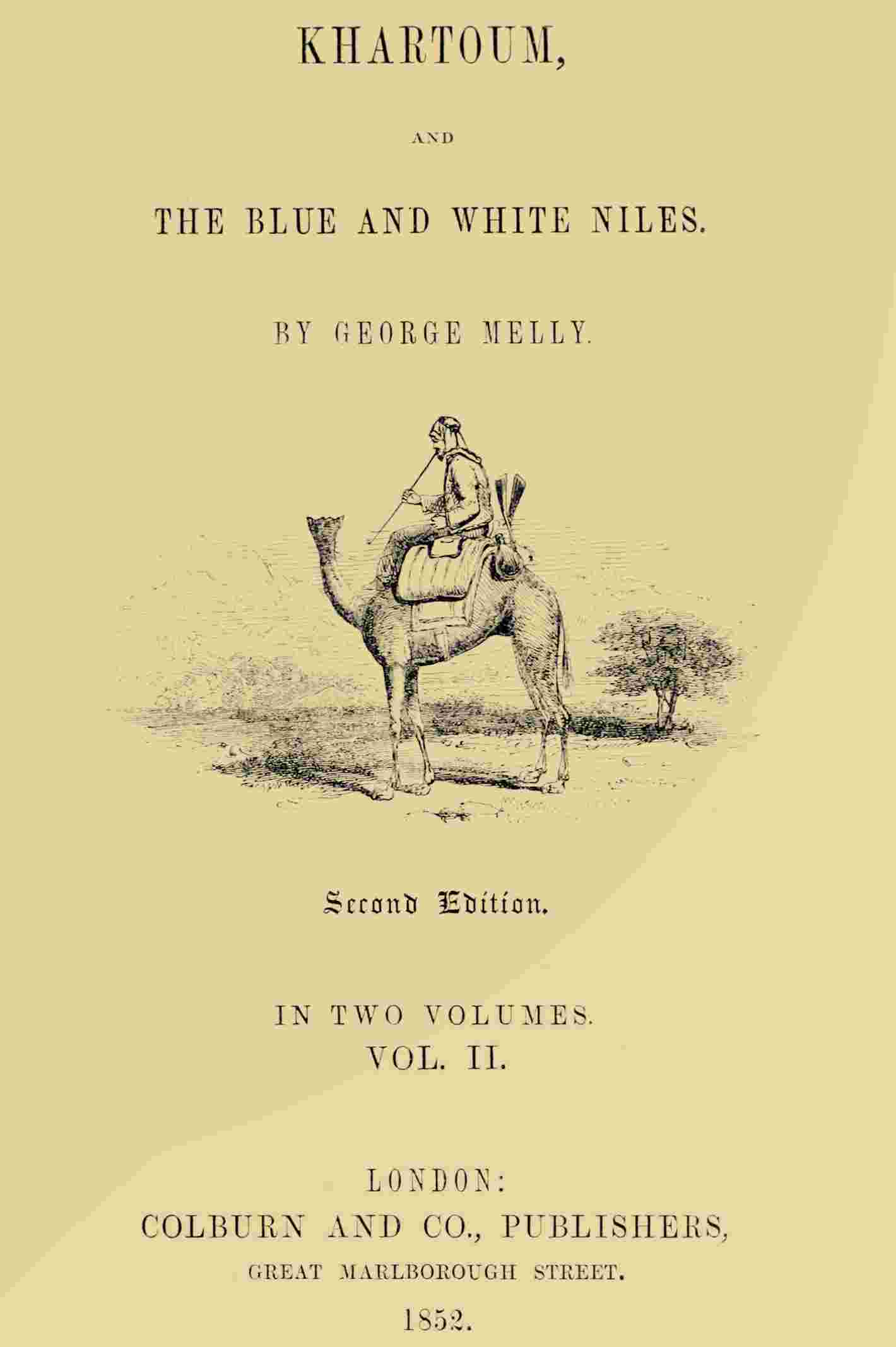
KHARTOUM,
AND
THE BLUE AND WHITE NILES.
VOL. II.
KHARTOUM,
AND
THE BLUE AND WHITE NILES.
BY GEORGE MELLY.
Second Edition.
IN TWO
VOLUMES.
VOL. II.
LONDON:
COLBURN AND CO., PUBLISHERS,
GREAT MARLBOROUGH STREET.
1852.
LONDON:
Printed by Schulze and Co., 13, Poland
Street.
CONTENTS
OF
THE SECOND
VOLUME.
| CHAPTER I. | |
| Preparations for a start — Camel-riding — Our encampment — Partridges — Temple at Samneh — A jackall hunt — Eagles — Picturesque country — Alkaline hot springs | 1 |
| CHAPTER II. | |
| Waking the Bedouins — Camels of the Nursery and Camels of the Desert — Travelling — Nubian children — Dinner | 18 |
| CHAPTER III. | |
| Sakkut — desert vegetation — Arab village — A one-eyed Venus — Dates at Derr Hamed — Nubian faith in European medicine — Ruined temple — Gazelles — Lost in the Desert — Flowers and birds — School | 28 |
| CHAPTER IV. | |
| Governor of Dongola — Embarkation of camels — Well in the desert — Camel drivers — Iron fragments — Effects of cold on the Bedouins — An Arab superstition — Verdure on the banks of the Nile — Pastoral scene | 42 |
| CHAPTER V. | |
| Gebel Berkel — Antiquities — Appearance of the country — Hawks — A pastoral scene — Illustrations of Holy Writ — Arab dwellings — Wady Bashana — Bedouin revels — Christmas Day in the desert | 59 |
| CHAPTER VI. | |
| Khartoum — Introduction to the Governor, Latiffe Pasha — His extreme civility — The Regent’s Park — Hippopotamus — Europeans settled at Khartoum — Interior of the desert — Collection of curiosities — The Governor of Berber — Bayoumi Effendi, and the School at Khartoum | 82 |
| CHAPTER VII. | |
| The illustrious strangers — Something about costume — Houses at Khartoum — Mahometans, Christians, and Jews — Trade and Commerce — Scheme for colonizing the White Nile, latitude 4° — Morals — The rainy season — Superstition — Military | 103 |
| CHAPTER VIII. | |
| Visit from the Governor — Catholic mission and school — A Colonel of Cavalry — Our grand banquet given to Latiffe Pasha, and Ali Bey Hassib — Turkish custom of dressing the table — The Governor’s statements — New dromedary saddles and bridles — An excursion — An interesting group — A Visit to Madame Latiffe Pasha — Farewells | 116 |
| CHAPTER IX. | |
| The Governor’s dahabeeyeh — A Bedouin feast — Tickling a crocodile — Pyramids at Meroe — A frightened Hippopotamus — Their manners — Arrival at Berber — A very pretty investment | 131 |
| CHAPTER X. | |
| Romance of Oriental life — Summary justice and Latiffe Pasha — His despotism — Hatred of Europeans — A box on the ear — Visit to the hareem of Ah Bey Hassib — Juvenile costume — Marabouts | 146 |
| CHAPTER XI. | |
| Prejudices of Nubian parents — Egyptian youths sent for education to Paris and London — Unsatisfactory result — Story of a Perversion — Its tragic end — Jealousy of the Egyptian Government — A grand prospect | 161 |
| CHAPTER XII. | |
| Mesmerism in Nubia — An Arab Seer — Awkward disclosures — Journey from Berber — Effects of taxation — Scenery of the desert — Gagee — The comfortable point of temperature — Intense heat — Giraffes | 175 |
| CHAPTER XIII. | |
| 192 | |
| CHAPTER XIV. | |
| Additions to our party — Skeleton guides — Lost in the desert — Surefootedness of the camel — The well — A horrible story — Nubian despotism — An Arab’s revenge | 203 |
| CHAPTER XV. | |
| Extreme cold — Milanese Refugees in the desert — A camel lost — An extraordinary day — Arab merchants — Making up a small parcel — Rain in the desert — The mirage — First rate calculators — English weather — In sight of the Nile — Arrival at Korosko | 215 |
| CHAPTER XVI. | |
| The Cataracts — Fogs — Keneh — A gang of convicts — Nile thieves — Domestic merchants — Shadoofs — Taxation — Ossioot — The Conscription — Female relations — Coffee shops | 228 |
| CHAPTER XVII. | |
| Tombs at Benihassan — Boat aground — Cairo — The Esbekya — Abbas Pasha and the Porte — The Census — Cairene ladies — Their evening parties — Palaces of the Pasha — The Overland Route — An American — Mehemet Ali’s Palace | 253 |
| CHAPTER XVIII. | |
| Barrage — Cotton-boats on the Nile — The bazaars at Atfeh — Interior of a coffee shop — Villages on the banks of the Mahmoudieh Canal — Nile locomotion — Illuminations — An Eastern scene — A striking contrast | 277 |
| CHAPTER XIX. | |
| Sale by auction — Dinner and ball — Ride from Alexandria — Rain-water lakes — Effects of distance — Ancient house — A wonderful Englishwoman — A midnight serenade — A parting scene — Farewell to Egypt | 290 |
KHARTOUM,
AND
THE BLUE AND WHITE NILES.
CHAPTER I.
Preparations for a start — Camel-riding — Our encampment — Partridges — Temple at Samneh — A jackall hunt — Eagles — Picturesque country — Alkaline hot springs.
The bargain for conveying us across the desert had already been struck, and we had arranged everything to start at day-break; but the camels had not arrived when it wanted but an hour of noon, and then there was the process of loading to accomplish.
We were not allowed to have the scene entirely to ourselves. Every ferry-boat had brought at least a dozen gazers from Wadeh Halfea, and the bank could boast an unusual collection of picturesque objects, looking in the distance like bundles of white linen, surmounted by curly heads; while here and there a camel lay groaning, in apparent anticipation of the coming burthen. Prominent in the fore-ground, was the Camel Sheik, sedately smoking his tchibouque, while enduring our united abuse for having shown so little respect to the terms of his agreement. The space all around us that was not occupied by living packages, was strewn with baggage of every description.
At last, the camels having arrived, the men begin to display considerable activity in removing our belongings, and a great deal of ingenuity in adjusting them in nicely-balanced heaps across the backs of the poor beasts that had been engaged for their transport, whose melancholy howls proclaimed their protest against the heaviness of their task. Happy, above all his fellows, must have been the poor wretch to whom had been assigned our respectable hen-coop, containing three turkeys, and fifty hens, which was balanced on the other side by a capacious bag of rice, and triumphantly surmounted by the kitchen-table: wretched beyond the whole wretched lot, must have been he who bore the huge boxes of culinary utensils swung on each side of him. But he did not seem an object of pity, for he was a magnificent fellow, quite white, and standing twelve hands high at the lower point of the shoulder; and though he kept up a tremendous uproar, while his burthen was being adjusted to his back, no sooner was the process complete, than he stalked away to the Desert under eight hundred weight and a half, apparently as much at his ease as a London dray-horse with an empty barrel.
The noise increases, the more restive of the camels being assailed with terrible shouts, and sometimes with severe blows; but the whole eleven are at last accommodated, some with tents, some with water-casks and provisions, necessary to last our numerous party for two months; and all with a freight worthy of their well-deserved title, “Ships of the Desert.” And now the travellers must as quickly as possible reconcile themselves to their own mode of transit.
Our servant Mahomed, and our cook Abbas—the former sufficiently grotesque in his desert costume, the latter rendered formidable by the addition of a pair of monstrous pistols—looked wonderfully picturesque, as they passed slowly along on the top of their dromedary; six others await our selection: a small brown one falls to my share. On him my immense saddle-bags are fastened, containing my wardrobe and bedding: upon these are fixed my mattrass and pillow, with my gun secured behind. The pummel is hung with a satchel, in which are deposited various travelling resources—a Shakspeare, powder and bullets, tobacco and biscuit, pipe, whip, and water-bottle. What I resembled I cannot pretend to say, but I thought my brother appeared very like a travelling pedlar; his rifle, double-barrelled gun, powder-horn, water-skin, and last not least in request, “Macaulay’s England,” constituting but a very small portion of his stock. The ladies, mattrassed up, looked at least very cosy on their pillowy nest.
The process necessary towards obtaining that elevation must here be detailed, in deference to those of our readers who may be curious to know how a lady secures a seat on a steed so very different to those with whose backs she is expected to be more familiar. The pack-saddle is laid across the rump, and ought to be low enough to be steady, and long enough to afford a good seat; saddle-bags, carrying small-sized portmanteaus, in which were apparel, a few books, medicines, and instruments for observation, are then nicely balanced upon it; over this a light mattrass is either thrown across, or the ends turned up at each end, forming a sort of chair, the rider’s feet resting either on the animal’s neck, or in stirrups suspended from the pack-saddle. The camel also carries the personality of his driver, which, however, did not greatly increase his load. With some animals, their walk or amble is tolerably easy, but the long trot and the slow walk of the larger species jolts awfully; and any other pace is intolerable.
All our preparations having been completed, our crew gave us a cheer—not quite an English one, but the best their Eastern lungs could produce. The Reises, and some others, offered us their hands to shake, and numerous were the parting salaams and adieux we received, as we stalked majestically away.
The high road to Dongola, is as broad as you can see on one side, and has the river on the other. During the first three miles, we beheld nothing more lively than the skeletons of some camels, who had died under their burthens—a common feature in the landscape. At last, we met a caravan of twenty-five living camels, each bearing two packages of gum-arabic; they were accompanied by four Bedouins, naked to the waist, bearing a striking resemblance to those very imaginative portraits that adorn the wrappers—
Our first encampment had considerable pretensions to the picturesque. It was pitched beside a small lake with rocky banks—a portion of the Nile—where the date-trees looked luxuriantly verdant, and the refreshing aspect of the water suggested the bath I was very soon enjoying. The three white tents were arranged in a semi-circle, another being formed by the numerous boxes—a principal object was the fire, bearing four or five copper-pans, in which our dinner was cooking. Standing by, were the swarthy Arabs, peeling onions and potatoes, like English kitchen-maids; a little further on, a group of camels were devouring fresh-cut grass, whilst their drivers, at a convenient distance in another group, were eating with equal relish dates and bread. On the other side, the rest of the camels, and their drivers, were similarly occupied; near me the fifty hens were proceeding to devour the beans, that had been scattered for them, displaying a most pugnacious spirit at every heap, and making a prodigious noise and fluttering, to show their enjoyment of their liberty. The turkeys had selected the top of the hen-coop for their own place of rest, but some of the hens appeared to entertain the same ideas of its comfort, and then the former took violent measures to dispossess the intruders.
The next morning we began our first regular day’s journey during a beautiful sunrise, and with a deliciously cool atmosphere. We saw a covey of partridges, but they were out of shot—then another came flying overhead—we dismounted to hold acquaintance with a third, and managed to kill a brace; though they are so extremely difficult to approach, that we rarely got within forty yards of them. They were very like our friends of the same species in England, but smaller in size and stronger in flavour.
Our road led us across numberless hills interrupted by plains of sand, thickly strewn with white quartz, and granite of a very crumbly nature—the quartz resembling pieces of common soap. A small gum caravan, and the partridges, were the only living creatures we met. We found, however, many traces of hyenas, gazelles, jackalls, and of a large species of vulture, which had no doubt assisted in preparing the numerous skeletons that lay far and wide over the hills.
On the third day, after passing over a succession of small hills divided by valleys of very deep sand, we arrived at Samneh, where there is a small temple, on the top of a hill overlooking the river, which is very narrow, and rushes between high black rocks with prodigious force. This temple consists of one oblong chamber about fifteen yards in length, built of large stones, covered with hieroglyphics inside and out; on both sides there is a species of covered balcony, supported by columns—three square ones on one side, and one fluted round one on the other—and pedestals remain for two more. The interior is in excellent preservation; the border round the side looking remarkably gay with its bright red, green, and yellow. There are numerous hieroglyphics still retaining the sharpness of their original carving, particularly those with the gondola; the paddle, and other features reminding us strongly of our old acquaintances at Venice.
While our antiquarian enthusiasm was at its height, our attention was directed to a wounded jackall ascending the opposite hill pursued by a crow pecking at him as he ran. In a moment, Egypt and all her wonderful relics were forgotten—we pocketed our dilettanteism with the greatest possible dispatch, and followed by a Bedouin chief from the neighbouring village, my brother and I set off in pursuit. The chase was very severe, but the scent i.e. footsteps in the sand, was good, and we passed hill and dale at a clipping pace for about half an hour, when we ran our game to earth in a narrow valley among a heap of huge stones.
He gave chase again while I mounted a hill to mark down a covey of partridges, and I saw him stealing along the opposite hill; but, though I followed at full speed, after ascending two of the hills, I found it such hard work that I was forced to give in, dead-beat. My brother, however, kept up the chase half an hour longer, being rewarded every now and then for his perseverance by a sight of his game. At last, he found himself on a rock, but of the whereabouts of the jackall he had not the most remote conception; when suddenly the fellow started up almost from under his feet, and was walking away apparently quite at his leisure, when the gun was levelled at his head. Three caps were exploded in succession—the rifle would not go off—and the jackall did. So we returned to the temple, very little satisfied with our experience of hunting in the desert.
Among the sculptures we found the names of Wilkinson, Holroyd, Hanbury, Lessep, and Hyde. In such good company, I was proud to inscribe my own.
The Bedouins did not manifest much curiosity upon seeing European ladies, though they beheld them for the first time; but as they never exhibit any feelings whatever, this apparent indifference was not so surprising. We heard of ruins upon an island on the river which some travellers had recently visited; but the account of them that was related to us did not sufficiently excite our curiosity to induce us to dare the rays of the blazing sun on the dazzling waters of the river.
Soon after resuming our journey, we discovered three eagles making a repast on a camel; its demise had been more recent than that of his brethren whose bones lay bleaching on the sand. My brother killed one of these birds. It was of a white and black colour, with a yellow beak and a handsome crest, and measured five feet five inches from tip to tip.
We passed a fine vein of quartz, and a considerable tract of country, covered with what very much resembled petrified forests; also a hill, having the appearance of an immense pile of slates, with vast quantities of the same useful material scattered about. The road was hard and stony all the way.
After arriving at the station of Dangour, our path was a continued ascent over very high hills. We noticed some fine veins of quartz, with red and white granite mixed. The country then became remarkably picturesque—a very broad river being seen rushing by numerous islands, and among bold black rocks, with the opposite shore singularly verdant with date trees; whilst above towered a majestic mountain. The desert is covered for miles around with enormous boulders in striking positions, and of very irregular shape: sometimes like a colossal torso, sometimes like a wall, but always appearing as if the strange heap would fall at the first breadth of wind, notwithstanding that it had evidently retained its position for at least a thousand years.
In the middle of the day, we were agreeably surprised by the sight of a tent, from out of which, at our approach, came a rather handsome Frenchman, M. Y——, a gentleman-like and intelligent man, formerly in the service of Clot Bey. He had made a journey which had united pleasure with profit, from Cairo to the Obaid Kordofan, &c., taking manufactures and returning with gum. He was waiting for some of his camels, of which he had three hundred en route. We were almost as glad as he was to meet Europeans, though he had not seen one for seven months.
There was a hot spring in the neighbourhood, composed of a series of small springs gushing from the ground round the remains of a Roman well, which in its fall has blocked up the principal spring. It produces fifty or sixty gallons a minute; possesses a temperature of 124°, is alkaline in flavour, and covers the surrounding plants and rocks with a white salt that tastes like potash.
CHAPTER II.
Waking the Bedouins — Camels of the Nursery and Camels of the Desert — Travelling — Nubian children — Dinner.
Our mode of living in the desert possessed features that require to be given more in detail than has yet been attempted. At four o’clock in the morning a slight stir might be heard by any one who chanced to be awake at that early hour. Daireh, our invaluable dragoman, who was never known to forget himself, any thing or any one, was getting up. This did not take him long to accomplish, as he had only to throw off his coverlet, composed of a mackintosh lined blanket, and he was ready. He then proceeded to rouse our other two servants, which was also a very easy affair. They went to wake the Bedouins—but this proved a very different thing. Poor fellows, what work it was; for tired, and awfully cold, the thermometer often standing at thirty degrees lower than during the day time, they shivered every time they were turned over and excited to rise.
Then followed the groaning of the camels as their pack saddles were secured—a music which was not rendered more agreeable for having become familiar.
They are considered the most patient of all beasts of burthen. My earliest recollections of them are based on those veracious publications, in which elephants pick up young children and place them carefully on their backs, and camels gallop for days unrepiningly over sandy deserts, never halting, though without both food and water—such are the camels of our tender years, such are not the camels of our experience. Instead of this poetic patience, they growl savagely, making one of the most disagreeable noises I ever heard, and turn round striving to get up as you load them. But when once their burthen is properly adjusted they are perfectly quiet, and become tractable as soon as you have taken your seat.
I had a camel from Dongola to Gebel Berkel, who would not let me turn on my saddle, or put my hand in my pocket without turning viciously round with a fierce growl. I had another, that by way of contrast would walk quietly to within shot of a covey of partridges; then stop, and allow me a good aim at them. All camels, however, stand fire.
The loading having been nearly completed, Mahomet pops his head into our tent and encourages us to get up, bringing in the very small quantum of water that can be spared for our ablutions; and the breakfast things. Toilet despatched, we retire to the back door of the tent to examine the condition of our desert steeds.
The rest of the party now join us, and we sit down to breakfast. By the time we have finished our meal the other tents begin to disappear, and our own is gradually being prepared to follow; and then we mount our ladies, and fill our short pipes of war in contradistinction to our long pipes of peace left behind in our dahabeeyehs; and we are off.
What a scene we leave behind: the ground is covered with our baggage—the fire in which our omelette was prepared, is flickering out; a few Bedouins run from their work to warm their hands from time to time at its last embers. The camels are wandering forward—those that are ready, and those that are loading as usual groaning horridly. It is nearly dark—the first gleam of sunrise is just apparent over the distant mountains.
At about half-past six the sun rises; it then becomes deliciously cool, and of all atmospheres, the pleasantest I know. Presently our dragoman approached us, having stayed behind to give his last orders. He gallops merrily up with his usual good humour, for he always looks on the bright side of all things. Our sheik rides in advance, the small tent for the servants swinging half on each side of him; and we are in fine marching order.
In a few hours our Shakspeare readings are over, we relapse into silence, as we ride along under the burning sun, my head protected by an enormous turban, and the ladies sheltering themselves under white-covered umbrellas. Thus we proceed till mid-day; perhaps without adventure or incident, till the word is given to ride forward, and prepare luncheon. Some palm-tree, favourable for our purpose is soon found, and in a few minutes we are seated in our little tent, on mattresses and rugs, while our unloaded camels are browsing about. Daireh brings out his meal of partridges, his biscuits, and all sorts of good things, not forgetting delicious lemonade, and excellent ale, to which we do full justice.
After luncheon, we often had visits of Nubian children, if we were near the river, or a Bedouin encampment in the desert, accompanied by their timid mammas, in all the beauty of youth, and the elegance of nature; and the little creatures used to come and play with us, without the slightest shyness, notwithstanding that ours were the first European costumes they had ever beheld, and evinced as eager a disposition for Cairo biscuits and white sugar as the best educated English children could have displayed.
At about two o’clock, the caravan passes in front of our tent, Abbas sitting on his gay rug, smoking his pipe, advances for his orders respecting our next halt. These having been fully explained, we presently behold the procession crossing the mirage, which, in the distance, makes the members of it appear to be walking on water.
Some of the Bedouins are sleeping on the camels with the lighter loads, and some hallooing with all their might to make the imperturbable beasts jog along quicker. Presently all assume the appearance of spots, as they disappear in the horizon.
At four o’clock, having had three or four hours’ rest, we are again on our way. The sun is hotter between three and four than at any other portion of the day. We are, of course, sufficiently delighted when, towards seven, we are in sight of our tents, probably on a bank near the river, with a beautiful prospect of blue rocks and luxuriant grass, which cannot fail of looking pleasant after the desert of all day. Possibly, however, the encampment may be in the midst of some arid plain, or under some sterile rocks; but wherever we may be, there is our home. The Bedouins are walking about, or are lying here and there quietly smoking. Our servants are cooking our desert dinner—everlasting Irish stews, and never-ending soupe à la Julienne. Appetite, however, seasons the humblest meal; and, therefore, it was seldom that either soup or stew was neglected. Indeed, to say nothing more than the truth, on many occasions the novelty of the scene, the sense of adventure, and the fatigue of the day’s journey, lent such a relish to our unpretending cuisine, that we enjoyed ourselves a great deal more than it is probable we should have done, had we dined at the best-arranged table in Belgravia.
After dinner, appeared journals, books, and dried flowers; these, with stuffing birds, and a little social conversation, filled up the hours till our early bed-time. Then the sleep, upon our mattresses on the hard ground, was sleep such as I have rarely enjoyed before or since.
CHAPTER III.
Sakkut — Desert vegetation — Arab village — A one-eyed Venus — Dates at Derr Hamed — Nubian faith in European medicine — Ruined temple — Gazelles — Lost in the desert — Flowers and birds — School.
Our sixth day was the most cloudy we had had since leaving Cairo. On, however, we proceeded; on our way observing some fine scenery—a remarkable feature of which appeared in the shape of rocks, formed of grotesque masses of black stones, having a bloom upon them like that of a ripe plum, which had a very curious effect.
We had entered the country Sakkut. After a march of about five hours, we came to a tract of desert of the most legitimate desert character, being a flat expanse of white sand, mixed with pebbles, some of which were pretty, dark-red and green stones, mixed with agates in abundance.
Nevertheless, there exists some vegetation. I noticed three sorts of herbage: a grass, apparently always dried up by heat; a solitary plant about five inches high, of a rich green, and bearing a small blue or yellow flower; and a dwarf creeper light as hair, yet easily distinguished by a good-sized yellow blossom. The camels can eat the first, do eat the second, but very much prefer the third, to which they hasten long before it becomes visible to the keenest human sight.
Our encampment was in a grove of palms, through which the wind rather shouted than “whispered,” as it happened to be blowing something like a gale. A small village is between us and the river, consisting of three sheds made of straw and palm-leaves, interwoven with the trunks of the trees. The inhabitants consist of a tolerably large family, of whom one young lady was pretty for a Nubian girl, with beautifully rounded limbs, fine shape, and an intelligent face. Having sufficiently admired her, I was informed that she lacked an eye; a deficiency I had not been able to discover in the doubtful twilight. My estimate of her attractions fell prodigiously on gaining this intelligence, for, however great an enthusiast in the beautiful I may be—especially as regards the female face divine—I agree with Captain Absolute in thinking that, though “one eye may be very agreeable, yet, as the prejudice has always run in favour of two, I should not like to affect a singularity in that article.”
Again over a sandy plain, and along the side of the river, passing the largest island in the Nile—Say Island. It is several miles in length, is covered with thick palm-groves, and boasts of considerable cultivation, which appears also on the banks; a sight we have seen for the first time since leaving Wady Halfa, the river having been too rapid, and the shore too rocky to admit of irrigation. Signs of an increasing population also made themselves manifest—a refreshing contrast to the solitude of the desert—every palm grove having given forth its dozen of swarthy gazers, its beautifully-shaped girls, its fine men, and its droll-looking children.
At Derr Hamed, a large village, we bought some dates, which are famous here, and made a closer acquaintance with the people. One of the women entered our tent in their naturally graceful way, and presented my mother with a basket full of the best dates, like those that are sold in England, moist and sticky, but unlike those that are eaten in such numbers here, which are left to dry on the trees; they become hard and dry, yet, without being so sugary as the others, are better flavoured. The former, when ripe, are placed in jars, and when a friend or stranger enters the house of a Nubian, he is offered a dozen of them.
We wanted this woman to accept a knife, but she preferred piastres, which she afterwards got Daireh to change for copper. My father, having been seen securing a beetle with a pin, was soon surrounded with petitioners for this small article of luxury, which he presently distributed in considerable numbers for the purpose, as was alleged, of fastening up innumerable rents.
As we mounted to pursue our journey, an old man brought his daughter for medicine. The faith of these people in the Cawaghi’s power is very great.
Our next encampment was in a large village, almost a town, called Sudrenzu, where we shot three dozen doves; they were flying about the place in swarms. Here an infant, in an almost hopeless state, was brought in to us, and some medicine having been given, the father presently presented himself with a basket of dates, as backsheesh for the doctor. This was declined, but we gladly purchased some milk of him—fresh bread and milk being our greatest luxuries in the desert.
The camp is in a square field of sand, by the side of the village, with rice, cotton, wheat, and castor-oil fields between us and the grove of dates that border the river, which here is as smooth, as wide, and as monotonous as in Lower Egypt. If the least picturesque of our encampments, it is undoubtedly the most interesting. A crowd of notables, two of them wearing tarbooshes, came to see us; and then followed throngs of shiny, black children, some carrying younger ones, but all very graceful, except in their remarkable little bread-baskets, which are unnaturally distended with durra-corn. They were merry as crickets, followed us when we went shooting, and were never so happy as when they could make themselves of the slightest possible use to any of us.
Leaving our encampment at dawn, we soon reached a ruin consisting of the fragments of a temple: one column alone remained standing among heaps of stone and disfigured sphinxes. We proceeded on for a couple of hours, and then came upon the remains of the very fine temple of Samneh the pylon half entire, the propylon only partly destroyed, and two or three fragments of marble sphinxes scattered about. Seven columns remain standing; others are lying imperfect on the ground. It must have been a very fine edifice—second only to Carnac.
The road from this temple led direct to the desert, over a large tract of country, resembling the gravel roads of a gentleman’s park in England.
We unsuccessfully followed a covey of partridges, and then observing something in motion, gave chase, and suddenly came upon ten gazelles, of which animals we had previously been allowed to see nothing but their traces. They started off at a great pace, and we followed for about half an hour. My brother fired at two hundred yards. They scampered off, taking prodigious leaps, and were soon three miles off, leaving us planté là without ammunition, water, or compass. Eager sportsmen as we were, we found ourselves obliged to give up the chase, and endeavoured to return; but, not knowing the proper direction, shortly lost ourselves, and began to experience uncomfortable misgivings respecting the result of our adventure. Having a decided dislike to add to the collection of beautifully bleached skeletons the desert contained, we renewed our endeavours to recover our lost track, and by great good fortune at last succeeded in finding it, then gained sight of our encampment, and in a few minutes had the further satisfaction of beholding our Bedouins—taking our alarming absence in a philosophical way, worthy of their race, by helping themselves to our pipes, tobacco, and water.
These gazelles were very beautiful, of a rich brown colour, with white streaks, and were quite as large as English deer. As some compensation for our disappointment in suffering them to escape, we afterwards shot six brace of partridges out of five coveys; this made the day decidedly the gamest day we had had.
We resumed our journey, the road leading between the river and the desert, on a smooth, gravelly soil. Now and then we discovered several new blossoms, some very large convolvuluses, and some exquisite creepers; we had not seen so many flowers before. We also met with various new and beautiful birds, among others a red and a sky-blue one, many varieties of small flower-birds, finches, and a few of larger size. We only saw one covey of partridges, a brace of which I brought down.
Having arrived at our tents at Hafir, and dined, we sallied forth to witness a marriage-feast; the conviviality, the music and dancing, that formed part of it, having been heard in our encampment too distinctly to be resisted. It appeared, however, as if the revellers did not desire our company, for, before our lamp had well made itself visible, the sounds were hushed, and when we reached the place, all the party had fled.
We then proceeded to the school, where we heard passages from the Koran repeated in grand style. We visited the Dervish, who received us very hospitably, immediately preparing some coffee. He informed us that the inhabitants of Hafir were innumerable; that he had two thousand under his charge, all of whom could read and write the Koran.
It was a curious scene—a mud-room, with one large window, filled with the faces of the pupils; the flickering light of the fire illumining in a singularly striking manner the fine face and long grey beard of the Patriarch, and crowds of natives were picturesquely grouped about. He told us that taxation had increased since Ibrahim’s time, as the Dongola Government taxed them as much as they could, aware that Cairo was too far off for complaints. The instant we left, the lessons were resumed; and I can almost fancy that I still hear the hum of the boys repeating their tasks.
The next morning, we suddenly came upon a large covey of partridges, basking in one of the many deserted buildings, which, all along the road from Hafir and Dongola, direct attention to the wealth to civilization that existed in the country before the Government had driven away the most respectable inhabitants by the intolerable weight of its taxation.
A decided attack of opthalmia made it necessary that my eyes should be bandaged, and my camel led. Many new birds were seen by our party, singing on the trees; among the most beautiful, were one of sky-blue plumage, a bright-red one, with a white beak, and one that was dark-red and black. The flowers also became more numerous; among the novelties were a sweet-scented jasmine, and some more fine convolvuluses.
In my condition, the day seemed unusually long; my satisfaction may therefore be imagined on at last arriving at our tents at Dongola. We had made a journey of eleven days across the desert, and had ridden eighty-one hours.
CHAPTER IV.
Governor of Dongola — Embarkation of camels — Well in the desert — Camel drivers — Iron fragments — Effect of cold on the Bedouins — An Arab superstition — Verdure on the banks of the Nile — Pastoral scene.
During the first two days of the four we unwillingly passed at Dongola, my chief employment was lying on my back applying a lotion to my eyes. This treatment succeeded wonderfully, and I at length got rid of the inflammation.
We visited the Governor, to whom we had letters of recommendation, and a firman, about three times a day. We found him polite, extremely obliging, and gentleman-like; he had travelled much in Europe, and was well acquainted by name with all the leading statesmen of England and France.
He at once sent a soldier to collect camels for us, and afterwards sent four more on the same errand, as there was some difficulty, the Camel Sheik being ill of the small-pox, and no one liking to interfere in his duties. Notwithstanding all the Governor’s exertions in our favour, only nine camels had made their appearance by the third day. An express was sent to order a fresh supply at Argo island, about twenty miles distant—and these were brought to a place near the river, where the banks were sufficiently low to embark them and the luggage, that we might determine their different employments. It was not till between two and three o’clock of the following afternoon that we were able to effect a start.
We broke up our camp; had everything transported by camels to the water’s side, to be shipped in two crazy boats, for the purpose of crossing to the opposite bank. I watched the embarking of our unfortunate beasts, who, much to my disgust, were tormented with more than Smithfield cruelty. After having been dragged down the bank on their knees, they were hoisted into the boat by the aid of ropes.
The scene was further enlivened by the soldiers thrashing the Bedouins with whips, made of hippopotamus’s hide; and as each of the sufferers had a wife, and each possessed the power of screaming, their united concert in that way defies description.
Dongola is a large mud town, with capacious streets, and pieces of ground without buildings. In one of these I counted sixteen large white and black eagles, moving about as unconcernedly as barn-door fowls. They are almost tame, and quite impudent, for some of them came swooping down upon our hen-coop with a rush that nearly made the inmates die of fright. We were obliged to shoot a couple of the most audacious.
The dogs too had to be ran after and stoned for being too inquisitive respecting our dinner. We found them great connoisseurs of soup, and possessed of a respectable taste for more solid cookery. A superstition prevails which prevents these curs from been destroyed; so they multiply at a considerable rate, and though perfectly harmless and cowardly, are an immense nuisance to strangers.
Crowds of children visited our tents, and a few very pretty little girls, uncommonly unlike their mammas. One wore a girdle of agate, badly cut, from which hung a fringe of leather. Several necklaces were round her neck; from one a Spanish dollar was suspended.
My brother and I, well supplied with five-para pieces, went into the houses. We were soon surrounded by crowds of mothers and children; but the young girls, from seven to eighteen, were so shy, that they invariably ran away directly we made our appearance.
We killed about seven brace of partridges during our stay at this place; they were very wild, but exceedingly numerous. The only day I could go out, we saw at least two thousand, yet only succeeded in bagging a brace, and this was quite a chance, as we were never allowed to approach within sixty yards.
The next morning we climbed the steep banks, then turning our backs on the river and its verdant shore, emerged on the desert. We had started for a journey—some said of three days, some said of six—with no track to guide us—nothing but hills and valleys of sand, and rocks half-covered with sand—occasionally a watercourse with its scanty herbage—occasionally heaps of stones. One placed on a point of rock betrayed, by its artificial character, an attempt to form a land-mark; but generally these heaps were so numerous as completely to confuse those who sought guidance from them—sometimes leading them hopelessly about till they became bewildered. To add to the comfort of our prospects, we were told that we should meet with no water, except one well, at which in due time we arrived. We found it about six feet in diameter, and thirty deep; the water, though not very fresh, was clear, and of a good flavour; a skin and a rope were ready to pour a supply into a mud-basin for the camels. Here we lunched, under the shade of some thorny acacias that grew round the well, and formed a most acceptable promenade for our beasts.
All my interest about these animals is lessening fast. It is impossible to imagine how provoking they can make themselves, and did contrive to make themselves day after day. Some would run away—some, by way of contrast, not only would not run, they would not move. Some were always lying down—some could not be persuaded to kneel: but mine beat all the rest in camel-like amiability. On an average he howled six hours a day—a kind of music such as no one can conceive who has not heard it. He would stand doggedly still, till forced by blows to lie down; and every time I turned round, he howled fiercer than ever.
Of these we again have eighteen, but our caravan is increased by a soldier, or cavass, whose appearance (armed as he is with one of the matchlocks sold by the English Government to Mehemet Ali, bearing the Tower mark) could affright only the most timid of Bedouins.
Our camel-drivers are the wildest-looking men I ever met with; with their dishevelled hair, and their only garb a blanket, that covered as much or as little of their persons as the temperature made desirable. One of these was especially conspicuous by his large square shoulders, his miserable blanket, too scanty in its dimension to reach below the knee, whence it hung in a fringe of tatters; his hair hung about him like a brood of snakes, and his aspect was singularly wild, if not maniacal. Sometimes a kind of mirthful frenzy seized these fellows, and they would suddenly fling their limbs about in the strangest attitudes, as they danced around their camels, shouting, singing, and finally begging for backsheesh.
We have also in our train a young camel, a dog of the gazelle hunting species, and a Nubian who is returning to his home at Gebel Berkel. He was, by his own account, to have accomplished the distance—one hundred and twenty miles, as the crow flies—between sunrise and sunset, but as his camel ran away, and he was some hours in finding it, he is still with us, enjoying the reputation of being a humbug.
The ground was everywhere strewn with fragments, as it were, of iron cups, vessels, and immense bowls, which had a very curious appearance; some pieces appeared, both in colour and weight, like the sediment at the bottom of iron boilers.
We passed three boundless plains of sand, with here and there gravel, covered with these ferruginous materials, mixed with innumerable cannon-balls and bullets. I could almost have fancied that we were approaching the forge of Vulcan, where he used, in the classic age, to manufacture thunderbolts.
The next day we had what, in England, would be called a bitter east wind, which brought us all the usual consequences of change of weather, such as colds, swelled lips, and sore faces: we were intensely cold all day on one side of our bodies, and intolerably hot on the other, as if we stood by a bonfire at Christmas.
The Bedouins declared that they would not work: as fast as our servants fetched them, they slunk back again to the fire, swearing that we might kill them, but that they could not endure the cold. They did, however, move away at last, and we started before sunrise.
We have seen no game, except a hare; but have discovered some recent gazelle marks. Our last pursuit of this species of game has not cooled our sporting ardour, and we only wait to obtain something like a chance.
We have been told that ninety guides have been lost on this hazardous road; the number is, no doubt, a figure of speech, but the difficulties and uncertainties of the path are evidently sufficient to account for a very considerable loss of life. After four days’ diligent travelling, from dawn to dusk, we arrived at the verge of these elevated regions, and welcomed the sight of the Nile, as the face of an old friend. To say the truth, we existed in a kind of dependence on the river, from the dread of having to endure the sufferings which we had heard often befel travellers wandering in the desert, looking in vain for water.
Our way had been, as usual, over vast plains, gravelly and sandy. We saw four or five petrified trees, like immense oaks, lying, some entire, some in fragments, on the ground.
Two women, and a few young calves, comprised all the living objects we met with at Merawah, our last stage, the men being absent with their herds. The females brought out large calabashes of excellent butter-milk, which they presented to us, refusing all payment. They said that they never sold milk, as it was considered unlucky. We relished the draught extremely, expressed our gratitude, and made them a present at parting, which we had some difficulty in getting them to accept.
All bushes and trees here possess thorns; among them, one shrub, like a broom, which grows to a large size, seemed entirely without leaves. The euphorbia, or a plant closely resembling it, when broken in any part, exudes a thick white juice, of a sweet flavour, and of a poisonous quality, which, we were informed, was sometimes mixed in cakes, to give the unwary traveller, that he might be the more easily robbed.
Along the banks of the river lay a luxuriant belt of verdure of considerable breadth, edged by palm and other trees. At a little distance, rose the singular-shaped mountain, Gebel Berkel, with a ruined temple at its base; a cluster of pyramids formed the background, and in the distance, a pile of hills, tinged by the last rays of the setting sun, bounded the prospect.
We were at first at a loss how to descend to the lovely garden at our feet; but, before attempting to proceed, lingered for our caravan, that we could observe winding its course along a narrow pathway of broken rocks, among the curiously-shaped calcareous banks, full of holes, rising like a wall from the lower plain. When we had reached the bottom, our eyes were regaled with a view of singularly pastoral beauty, perfectly Eastern in character: some hundreds of camels, of various ages and sizes, had been brought down to the banks to water, by their proprietors, whom we found to consist of but eight individuals. The owner of numerous flocks lives very much like the humblest Arab, and dresses in a blanket, neither less greasy nor less dirty than that worn by his poorer brother. He rarely kills any of his flock, except on occasions of great festivity, nor will he sell any; therefore, they are sure to increase rapidly.
Flocks of goats and cattle succeeded the camels, to drink of the refreshing river, to which they make weekly expeditions—often from a considerable distance.
We were invited by the people we found here, to pitch our tents under a wide-spreading tree in the centre of the village; but this being too public for our taste, we requested to be led to the river side, whence we must embark on the morrow. A guide soon presented himself, and we followed, not only with a feeling of weariness, but doubtful whither we were going, as we passed field after field, tired with striving to prevent our hungry camels from cropping the tempting heads of corn.
At length, we found a road to the river, and an open space in the stubble of durra corn, where the Governor, to whom we had sent a letter from the Governor of Dongola, by our cavass, joined us, followed by people bearing bedsteads—rude frames supporting leather mats—a luxury, however, with which we had long been unfamiliar. We had also a good supply of fresh bread and milk, that was quite as acceptable; and having got comfortably housed, passed a remarkably pleasant evening.
The Governor was very civil, obtained us thirty-three camels, and accompanied us while we remained in his district. The fact was, Kirchid Pacha, our friend the Governor of Dongola, had, in his letter, promised him a bastinado, or as Daireh translated it, “five hundred stick,” when he next had the pleasure of meeting him, if anything unpleasant should happen to any of us; and the poor fellow, as Tony Lumpkin says, was “in a concatenation accordingly.”
CHAPTER V.
Gebel Berkel — Antiquities — Appearance of the country — Hawks — A pastoral scene — Illustrations of Holy Writ — Arab dwellings — Wady Bashava — Bedouin revels — Christmas Day in the desert.
The next morning we were again in full march upon Gebel Berkel, which is a hill with a flat summit, rising perpendicularly from the plain on one side—with its upright face of bare rock facing the river.
The antiquities comprise the remains of a small temple at the foot, built of the yellow stone common to all the temples, and two chambers inside the mountain that were full of nothing but dust and bats. The hieroglyphics are worthy of observation, and the sculpture is painted blue. These inscriptions appear to be of the same character as those we observed at Carnac and Aboosimbel, but the industry of mason bees is here throwing that of man a little in the background. There are two double rows of columns at the entrance under the rock, and fragments of many more; proving it to have been an important place. A very large slab of black marble, covered with hieroglyphics, was taken from these ruins.
On the south side of the mountain are seven stone pyramids, four of which are perfect; one of the small ones I found thirty-nine feet square at the base, and forty-three feet high: and a large one was fifty-four feet at the base, and about sixty-two feet high. Almost all of them may be ascended within a short distance of the summit—the immense stones of which they are constructed, affording considerable assistance to the climber, till he reaches the top ones, which are polished. All the pyramids have doors; but access was impossible.
Some time since there was an eighth pyramid, but one was pulled down by Lepsius, who, there is no doubt, anticipated all sorts of grand discoveries. The Arabs watched him with immense interest, as they were fully satisfied that he was searching for treasures, which as soon as he had found, probably, they determined he should lose. Fortunately for him he found nothing, and, therefore, got away with a whole skin.
There is an extensive view from the top of the mountain, like the plains of Lombardy from the Simplon in extent, though very unlike in general features: the principal objects in our prospect was plain after plain of sand stretched on every side, except where the broad river serpentined about, with a belt of cultivation on either bank of waving corn, date-trees, cotton, senna, and castor oil; sakeias innumerable, each watering seven acres of land: and the straggling village of Merowah, stretching from below, two miles off, with boats crossing the river, and our three white tents.
Our next halt was made at Gazelle, where are the remains of an extensive building of red burnt brick, probably Coptic. While looking for partridges, I came suddenly upon four gazelles in a small valley. I loaded one barrel with ball, lay down, and as one of the beautiful creatures passed within fifteen yards I fired. Unfortunately the ball only grazed his back, close to the shoulder: he fell, but rose again immediately, and galloped up the hill. I consoled myself for my disappointment, by returning to the partridges, of which covey after covey rose on every side. They are of two kinds: yellow-necked and grey, and some are very prettily ringed on the wings with maroon. They fly very fast, and separate much.
We now met with extremely pleasant travelling, passing valley after valley full of verdure, with high mountains all around. The trees were of three or four kinds, some resembling large gooseberry-bushes, some thorny sycamores, some the cut trees in Dutch gardens, while others were the size of large apple-trees. The ground was covered with what some weeks ago was a luxuriant vegetation, but is now beginning to look much scorched. Beautiful red creepers, a parasite resembling mistletoe, hang from the highest branches, where the ring-doves are flying from bough to bough, and among the roots are large yellow flowers, bearing a strong resemblance to gigantic asparagus. Numerous little birds of plumage unknown to us sing among the branches. Hares and partridges not unfrequently make their appearance, and sometimes, but very rarely, a gazelle trots quietly by.
We passed a well, where a prodigious hole had been dug, the earth being supported by branches. Herds of flocks and goats were gathered round it, and some very wild-looking Bedouins were drawing skins of water, and emptying them into large tanks dug in the sand. We meet these flocks more frequently, each belonging to one person, who wanders with them from desert to desert, and from valley to valley, wherever there is a promise of food and water.
We had much desired to go straight from Merowah to Khartoum, but our Bedouins insisted during the first two days, in proceeding from the former place to Metamneh, a town on the river, sixty miles north of Khartoum. This is a considerable circuit, and occupies two additional days. They declared that the other road was full of grass and water, which brought there many bad Bedouins. In the summer season it is considered safe, but merchants have preferred the road to Metamneh, since a party were murdered there six years ago:—notwithstanding this statement, our fellows suddenly changed their minds, and were more anxious to go the shorter road than we had been.
Our way was through a chain of high black mountains, very like an alpine pass. The scenery was remarkably wild, and we helped to make it more picturesque, as camel followed camel in the path which has been made by caravans constantly passing over the loose stones. The heat was intense. After four hours we arrived at a pool among some rocks, but the water was of a blackish-green colour, that would have suited an artist much better than a traveller. A few yards further, we came to a well into which the water slowly filtered through the sand. I tasted it, but found it very bad. The camels, however, drank freely, and then we proceeded though a chain of low hills, so covered by cinders and volcanic matter, that the track of our beasts was not perceptible.
While we were shooting, a wounded bird was pursued by three hawks: they made swoop after swoop upon their intended prey with a prodigious rush of their wings, but he dodged with success till my brother shot him. As he fell, one of the hawks rushed upon him like lightning, but by a small distance only missed his prey: and then the whole party disappeared.
It is curious to observe the prevalence of the sandy colour of the soil in the creatures that have to exist upon it. Sandy coloured eagles devour sandy coloured vipers and lizards, which in their turn prey on grasshoppers and slugs of the same complexion: and partridges and sparrows, by means of their resemblance to the ground, avoid the prying eyes of the falcons and hawks.
One evening, remarking several parties of Arabs mounted on asses, or on foot, winding down the low mountains, that surrounded us, our guide assured us that they were in search of water; and in the next turn of the road, we entered a wooded amphitheatre, in the centre of which was a well, and around it, various flocks with their shepherds, waiting their turn. A timid boy, with his little flock of black goats crowded close behind him, remained at a distance till the men had withdrawn.
The scene reminded us strongly of certain pastoral passages in the Bible; for we beheld the specked and ring-striped sheep of Jacob, with drooping ears, some marked brown and white, black or fawn-coloured, like cows. The more to enjoy this interesting spectacle, we turned aside, and rode across to the well. We found it very deep; the mouth at the bottom of a steep hollow, roofed with earth, so as to be entirely sheltered; the water being drawn in leathern buckets, and emptied into troughs formed on the ground.
Nor did we wonder at Rachel’s fearing to approach such formidable-looking men, as were those we beheld watering the thirsty animals, that were clustered at the brink of the hollow. They were, however, very civil: brought us some of the water to taste, which was extremely good, and furnished us with a bottle of milk from their herds—an addition to our coffee and biscuits, we never missed an opportunity of securing.
We left this spot with reluctance, for we found it suggestive of the most sacred thoughts, realizing every inspired description of patriarchal times.
Travelling in this desert of Bayiouda, the pleasantest part of our desert journey, and, as Daireh informed us, the most like the deserts in Syria, we were continually struck with the resemblance to places described in the Bible, or to manners and anecdotes related there. Every day brought some new scene, which explained some passage we had hardly understood, or gave force to some other one we had scarcely appreciated.
One day we met a Bedouin, rich in herds, who was pursuing a single sheep, or camel, across the sandy wastes, tracking the animal by its footsteps; the next, we came on the ninety and nine left without their shepherd. We have felt the disappointment of arriving at a well and finding the waters bitter. And the cup of cold water cannot be fully appreciated, except in a country like this, where the liquid, rare to get at any time, can hardly ever be obtained even tepid, and generally has a taste of the skin it is kept in, which would disgust any, but the most thirsty.
Our Lord’s command is still obeyed by these people—indeed, throughout the East—and you may always drink any quantity of water, to whomever it may belong. I was surprised once at seeing a Bedouin walk up to my camel, and drink a whole bottlefull, my supply for the day; and I have often, when out shooting, gone into a hut or tent, and asked for water, which the poor people have had to carry a great distance. Not only have I never been refused, but my offer of a piastre or two was never accepted; they gave it me, as a Nubian woman once beautifully expressed it, for her “God’s sake.”
One of our guides once told us how he was ruined last year; for entrusting his flocks to a “hireling,”—they were all eaten by a wolf (hyena), and scattered over the desert, while he was away leading some merchants over the sandy plains.
When, after a march of ten days over stony hills, and arid plains of deep sand, we came suddenly upon the broad river, winding through the rich green of the durra-covered banks, we could exclaim with the Psalmist, “He maketh me to lie down in green pastures; He leadeth me beside still waters;” and as a Bedouin in advance of us called his servant, who was walking before him with his sandals, that he might put them on before he reached the village, we remembered that John the Baptist did not deem himself worthy to unloose the latchet of our Saviour’s shoes.
These are but a few of the innumerable passages of the Bible, which desert travelling daily brought to our remembrance.
Further we observed some genuine Arab tents: and again we went out of our way to visit them. Though the desert is thickly inhabited during this season, we had only on two occasions met with any dwellings. The fear of Turkish oppression, and the necessity of hospitality, makes the Arabs avoid all frequented routes; concealing themselves in the most retired valleys, wherever they can find pasture for their flocks.
Here there were three tents, if such they could be styled, being blankets stretched over some branches, and supported by bushes—open on one side.
In the course of our journey we were most agreeably surprised by the appearance of the country—which sometimes much more nearly resembled an English park than an African desert. Where the situation was low, the air was milder, and there was considerable vegetation; trees appeared occasionally of a large size, singly, and in groves. And where there were trees there were birds; some of singular beauty, their plumage gaining additional brilliancy from the brightness of the sunlight. Among them a large humming bird floated rather than flew round the bushes, where it found its insect food; then there was the widow bird with its long black tail feathers, generally set almost upright; there were also doves in great numbers, and frequently pigeons.
At one time we passed some extensive prairies of grass of exquisite fineness, among which we found numbers of gazelle horns; and every now and then surprised numerous herds of these beautiful creatures. Then we beheld camels, that had been turned out by their owners to find their own subsistence where they could, returning once a week for a supply of water.
We passed large fields of rich land from which the Bedouins raise fine crops of maize and millet after the rains: but they are obliged to drive their flocks and herds to a lake of rain-water in the hills every four days. Sometimes the road was over vast plains of sand thickly covered with grass and minute plants, full of briers that stuck to our clothes; with here and there small trees. Flocks of gazelles ran up the sand hills as we entered the valley: we saw also hares, partridges, and quails, with lizards; and serpents, three feet long.
We came upon the river at the town of Wady Bashava, which consists of about a hundred and thirty summer-house looking tents, made of durra corn-stacks and mud. We purchased two sheep at ten piastres (2s.) each—and a liberal quantity of weak beer, brewed from durra—that loses the little appreciation you are inclined, at your first trial to give it, on a second acquaintance: but both beer and mutton were for the Bedouins, and as they contrived to make an immense jollification with them—devouring the meat cut into slices, before it could be thoroughly warm, and swallowing the liquid in awful gulps as soon as it got near enough to their throats, I do not consider myself called upon to criticize either very narrowly. After stuffing themselves to their hearts’ content, they danced round the fire, with tremendous shouts, apparently frantic with delight.
I have seen the Ojibbeways, but our friends beat them hollow in uncouthness, as with their spears in their hands, they whirled about, each performing his particular pas, as the others kept time, and every dance ending with an embrace, for myself and my brother. Such a ballet would be a monstrous novelty at her Majesty’s Theatre.
To-day being Christmas-day, we determined on having a Christmas feast. It was certainly intolerably hot, the thermometer being at 93°. Yet, with this exception, we managed to enjoy ourselves very much after our good old English fashion. French champagne and Scotch ale, a plum-pudding surmounted by an acacia branch, and dashed with a liberal supply of brandy, and “last, not least, in our dear love,” a bowl of excellent punch, manufactured by Abbasis, helped us to get through the evening very comfortably. Of course we did not forget absent friends.