
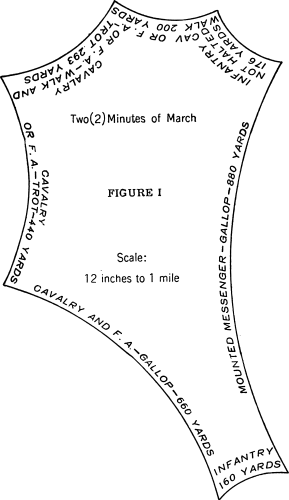
1030. Reserve. An advance guard large enough to have a reserve would be distributed as follows:
The distance Z would be greater than Y and Y would be greater than X. For example, a regiment acting as the advance guard of a brigade would, under ordinary conditions, be distributed about as follows:
As only large commands have a reserve, which would always be commanded by an officer, noncommissioned officers need not give this much consideration, but it must be understood that while this fourth subdivision of the advance guard is the only one officially termed reserve, the last subdivision of any advance guard actually is a reserve, no matter what its official designation.
The advance guard of a cavalry command adopts formations similar to those described above, except that the distances are increased because of the rapidity with which the command can close up or deploy. An advance party with a few patrols is usually enough for a squadron, and precedes it from 600 to 1,000 yards.
1031. Reconnaissance. In reconnaissance the patrols are, as a rule, small (from two to six men).
The flanking patrols, whether of the advance cavalry or of the advance party, are sent out to examine the country wherever the enemy might be concealed. If the nature of the ground permits, these patrols march across country or along roads and trails parallel to the march of the column. For cavalry patrols this is often possible; but with infantry patrols and even with those that are mounted, reconnaissance is best done by sending the patrols to high places along the line of march to overlook the country and examine the danger points. These patrols signal the results of their observations and, unless they have other instructions, join the columns by the nearest routes, other patrols being sent out as the march proceeds and as the nature of the country requires.
Deserters, suspicious characters and bearers of flags of truce (the latter blindfolded), are taken to the advance guard commander.
1032. Advance Guard Order. On receipt of the order for a march designating the troops for the advance guard, the commander of the latter makes his estimate of the situation; that is, he looks at the map or makes inquiries to determine what sort of a country he must march through and the nature of the roads; he considers what the chances are of encountering the enemy, etc., and then how he should best arrange his advance guard to meet these conditions, and what time the different elements of his advance guard must start in order to take their proper place in the column. He then issues his order at the proper time—the evening before if possible and he deems it best, or the morning of the march.
The order for a large advance guard would ordinarily be written; for a small command it would almost invariably be verbal, except that the commander or leader of each element should always make written notes of the principal points, such as the road to be followed, time to start, distances, etc.
ADVANCE GUARD PROBLEMS
Problem No. 1. (Infantry)
1033. Captain (to one platoon of his company): We will assume that our battalion camped last night at Oxford (Elementary Map) in the enemy's country. It is now sunrise, 5:30 A. M.; camp has been broken and we are ready to march. The officers have returned from reporting to the major for orders and I fall in the company and give the following orders:
"A regiment of the enemy's cavalry is thought to be marching towards Salem from the south. Our battalion will march at once towards Salem to guard the railroad trestle over Sandy Creek, following this road (pointing southeast along the road out of Oxford) and the Chester Pike Which is one and three-quarters miles from here.
"This company will form the advance guard.
"Sergeant Adams, you will take Corporal Baker's squad and form the point, followed by the remainder of the company at about 400 yards. Patrols and connecting files will be furnished by the company.
"The company wagon will join the wagons of the battalion.
"I will be with the company.
"Move out at once."
The weather is fine and the roads are good and free from dust. It is August and nearly all the crops are harvested. Bushes and weeds form a considerable growth along the fences bordering the road.
Sergeant, give your orders.
Sergeant Adams: 1st squad, 1. Right, 2. FACE, 1. Forward, 2. MARCH. Corporal Baker, take Carter (Baker's rear rank man) and go ahead of the squad about 200 yards. Move out rapidly until you get your distance and then keep us in sight.
I would then have the two leading men of the rest of the squad follow on opposite sides of the road, as close to the fence as possible for good walking. This would put the squad in two columns of files of three men each, leaving the main roadway clear and making the squad as inconspicuous as possible, without interfering with ease of marching or separating the men. [Par. 1028 (c).] What sort of crops are in the fields on either side of the road?
Captain: The field on the right (south) is meadow land; that on the left, as far as the railroad, is cut hay; beyond the railroad there is more meadow land.
Sergeant Adams: I would have told Corporal Baker to wait at the cross roads by the Baker house for orders and—
Captain: If you were actually on the ground you probably could not see the cross roads from Oxford. In solving map problems like these do not take advantage of seeing on the map all the country that you are supposed to go over, and then give orders about doing things at places concerning which you would not probably have any knowledge if actually on the ground without the map.
Besides, in this particular case, it was a mistake to have your point wait at the cross roads. If there was any danger of their taking the wrong road it would be a different matter, but here your mission requires you to push ahead. (Par. 1029.) The major is trying to get south of the trestle towards Salem before the cavalry can arrive and destroy it.
Sergeant Adams: I would march steadily along the road, ordering the last man to keep a lookout to the rear for signals from the connecting file (Par. 511a), and I would direct one of the leading men to watch for signals from Corporal Baker.
Captain: You should have given the direction about watching for signals earlier, as this is very important. You also should have ordered two men to follow along the timber by the creek to your south until you signaled for them to come in. The trees along the creek would obstruct your view over the country beyond the creek.
Sergeant Adams: But I thought, Captain, that the patrolling was to be done by the company.
Captain: Yes, the patrolling is to be done by the company, but the creek is only a quarter of a mile, about 400 yards, from the road you are following and the men sent there are merely flankers, not a patrol. You have eight men under your command and you are responsible for the ground within several hundred yards on either side of your route of march. Long Ridge is almost too far for you to send your men, because they would fall far behind in climbing and descending its slopes, but it would not be a great mistake if you sent two men there. As Long Ridge affords an extended view of the valley through which the Chester Pike runs, a patrol should go up on it and remain there until the battalion passes, and this would be more than the leading squad could be expected to attend to. The creek is almost too far from the road in places, but as it is open meadow land you can keep the men within easy touch of you and recall them by signal at any moment you desire. In this work you can see how much depends on good judgment and a proper understanding of one's mission.
Corporal Baker, explain how you would move out with Carter.
Corporal Baker: We would alternate the walk and double time until we had gotten about 200 yards ahead of the squad. I would then say, "Carter, walk along this side of the road (indicates side), keeping on the lookout for signals from the squad. I will go about fifty yards ahead of you." I would keep to the opposite side of the road from Carter, trying to march steadily at the regular marching gait, and keeping a keen watch on everything in front and to the flanks.
Captain: Very good. When you arrive at the cross roads you see a man standing in the yard of the Baker house.
Corporal Baker: I would not stop, but would continue on by the cross roads, as I have no time to question the man and the Sergeant will want to do that. I would call to him and ask him if he had seen any of the enemy about and how far it was to the Chester Pike. If anything looked suspicious around the house or barnyard, I would investigate.
Captain: Sergeant, you arrive at the cross roads, and see the Corporal and Carter going on ahead of you.
Sergeant Adams: I would have already signaled to the two men following the creek to come in and would send a man to meet them with the following order: "Tell Davis to move along the railroad fill with Evans, keeping abreast of us. Then you return to me." I would then say, "Fiske, look in that house and around the barn and orchard and then rejoin me down this road (pointing east)." I would have the civilian join me and walk down the road with me while I questioned him.
Captain: Do you think you have made careful arrangements for searching the house, etc., by leaving only one man to do the work?
Sergeant Adams: I have not sufficient men nor time enough to do much more. I simply want to make sure things are reasonably safe and I thought that a couple of men from the main body of the advance guard would do any careful searching, questioning, etc., that might be deemed necessary. I must not delay the march.
Captain: That is right. You learn nothing from the civilian and he does not arouse any suspicion on your part. You continue along the road. The fields to the north of the road are in wheat stubble; the ground to the south, between your road and the railroad, is rough, rocky grass land with frequent clumps of bushes. Davis and Evans, your right flankers on the railroad fill, are just approaching the cut; Fiske has rejoined; Corporal Baker and his men are about 200 yards from the road forks at Brown's, and you and your four men are 200 yards in their rear, at the turn of the road. At this moment a half dozen shots are fired down the road in your direction from behind the wall along the edge of the orchard on the Brown farm. This firing continues and your two leading men are lying down at the roadside returning the fire. Tell me quickly just what you are going to do?
Sergeant Adams: I order my four men to deploy as skirmishers in that field (pointing to the rough ground south of the road); I go under the fence with the men and lead them forward at a fast run, unless the fire is very heavy.
Captain (interrupting the Sergeant): Davis, you had just reached the cut on the railroad when this happened. What do you do?
Private Davis: I take Evans forward with me at a run through the cut. What do I see along the Chester Pike or Sandy Creek?
Captain: You see no sign of the enemy any place, except the firing over the wall.
Private Davis: I run down the south side of the fill and along towards the road with Evans to open fire on the enemy from their flank, and also to see what is in the orchard. I will probably cross the road so that I can see behind the stone wall.
Captain: That's fine and shows how you should go ahead at such a time without any orders. There is usually no time or opportunity at such a moment for sending instructions and you must use common sense and do something. Generally it would have been better to have tried to signal or send word back that there was nothing in sight along the road or in the valley, but in this particular case you could probably do more good by going quickly around in rear as you did, to discover what was there and assist in quickly dislodging whatever it was. If there had been no nose of the ridge to hide you as you came up and a convenient railroad fill to hurry along behind as you made for the road, your solution might have been quite different.
Sergeant, continue with your movements.
Sergeant Adams: I would attempt to rush the wall. If the fire were too heavy, I would open fire (at will) with all my men, and, if I seemed to get a little heavier fire than the enemy's, I would start half of my men forward on a rush while the others fired. I would try to rush in on the enemy with as little delay as possible, until it developed that he had more than a small detachment there. I assumed it was a delaying patrol in front of me, and as my mission requires me to secure the uninterrupted march of the main body, I must not permit any small detachment to delay me. If, however, it proves to be a larger force, for instance, the head of an advance guard, I will lose some men by plunging in, but as I understand it, that is the duty of the point. Then again, if it be the head of a hostile advance guard, I will want to rush them out of their favorable position under cover of the stone wall, buildings and orchard, before any more of their force can come up. This would give the favorable position to our force; by acting too cautiously we would lose the valuable moments in which the enemy's reënforcements (next elements of the advance guard) were coming up, with this desirable position being weakly held by a small part of the enemy.
Captain: That is all correct. What messages would you have sent?
Sergeant Adams: Up to the present time I would not have sent any. I could not have sent any. I could not afford to take the time to send a man back, nor could I spare the man. Besides, all I could say was that we were fired on, and you should be able to see and hear that from where the company is.
Captain: About the time you reached the position of Corporal Baker the firing ceases, and when you reach the wall you see five mounted men galloping northeast up Farm Lane. The Brown farm appears to be deserted.
Sergeant Adams: I would turn to one of the men and say, "Run back to the Captain and tell him we were fired on from this orchard by a mounted patrol of five men who are galloping off up a lane to the northeast. I am going south." When he had repeated the message I would start south down the Chester Pike, directing Corporal Baker to follow this road south and to tell Davis to follow the high ridge west of the road, going through the clump of woods just ahead. I would send one man as a left flanker to follow the west bank of Sandy Creek. This would leave me with two men, one watching for signals from the front and along Sandy Creek, the other from Davis and from the rear. I would expect to see a patrol from the company moving across towards Boling Woods. Had I not been mixed up in a fight as I approached the Brown farm I would have sent two men as left flankers across country to the cut on the Chester Pike on the western edge of the Boling Woods.
Captain: Very good. That is sufficient for this problem. All of you should have caught the idea of the principal duties of the point and flankers of an advance guard. You must watch the country to prevent being surprised and you must at the same time manage to push ahead with the least possible delay. The point cannot be very cautious so far as concerns its own safety, for this would mean frequent halts which would delay the troops in rear, but it must be cautious about reconnoitering all parts of the ground near the road which might conceal large bodies of the enemy.
The leader of the point must be careful in using his men or he will get them so scattered that they will become entirely separated and he will lose all control of them. As soon as the necessity for flankers on one side of the line of march no longer exists, signal for them to rejoin and do not send them out again so long as you can see from the road all the country you should cover.
Problem No. 2. (Infantry)
1034. Captain (to one platoon of his company): Let us assume that this platoon is the advance party of an advance guard, marching through Salem along the Chester Pike [Par. 1028 (b)]. One squad is 350 yards in front, acting as the point. The enemy is thought to be very near, but only two mounted patrols have been seen during the day. The command is marching for Chester. The day is hot, the roads are good but dusty, and the crops are about to be harvested.
Sergeant Adams, explain how you would conduct the march of the advance party, beginning with your arrival at the cross roads in Salem.
Sergeant Adams: The platoon would be marching in column of squads and I would be at the head. Two pairs of connecting files would keep me in touch with the point. (Par. 1025.) I would now give this order: "Corporal Smith, take two men from your squad and patrol north along this road (pointing up the Tracy-Maxey road) for a mile and then rejoin the column on this road (Chester Pike), to the west of you." I would then say to Private Barker, "Take Carter and cut across to that railroad fill and go along the top of that (Sandy) ridge, rejoining the column beyond the ridge. Corporal Smith with a patrol is going up this road. Keep a lookout for him." When we reached the point where the road crosses the south nose of Sandy Ridge and I saw the valley in front of me with the long high ridge west of Sandy Creek, running parallel to the Chester Pike and about 800 yards west of it, I would give this order: "Corporal Davis, take the three remaining men in Corporal Smith's squad, cross the creek there (pointing in the direction of the Barton farm) go by that orchard, and move north along that high ridge, keeping the column in sight. Make an effort to keep abreast of the advance guard, which will continue along this road."
I gave Corporal Davis the remaining men out of Corporal Smith's squad because I did not want to break up another squad and as this is, in my opinion, a very important patrol, I wanted a noncommissioned officer in charge of it. Unless something else occurs this will be all the patrols I intend sending out until we pass the steel railroad trestle over Sandy Creek.
Captain: Your point about not breaking up a squad when you could avoid it by using the men remaining in an already broken squad, is a very important one. Take this particular case. You first sent out two pairs of connecting files between the advance party and your point—four men. This leaves a corporal and three men in that squad. If we assume that no patrols were out when we passed through Salem, this corporal and two of his men could have been sent up the Tracy-Maxey road, leaving one man to be temporarily attached to some squad. From the last mentioned squad you would pick your two men for the Sandy Ridge patrol and also the corporal and three men for the Barton farm, etc., patrol. This would leave three men in this squad and you would have under your immediate command two complete squads and three men. As the patrols return, organize new squads immediately and constantly endeavor to have every man attached to a squad. This is one of your most important duties, as it prevents disorder when some serious situation suddenly arises. Also it is one of the duties of the detachment commander that is generally overlooked until too late.
The direction you sent your three patrols was good and their orders clear, covering the essential points, but as you have in a very short space of time, detached nine men, almost a third of your advance party, don't you think you should have economized more on men?
Sergeant Adams: The Sandy Ridge patrol is as small as you can make it—two men. I thought the other two patrols were going to be detached so far from the column that they should be large enough to send a message or two and still remain out. I suppose it would be better to send but two men with Corporal Davis, but I think Corporal Smith should have two with him.
Captain: Yes, I agree with you, for you are entering a valley which is, in effect, a defile, and the Tracy-Maxey road is a very dangerous avenue of approach to your main body. But you must always bear in mind that it is a mistake to use one more man than is needed to accomplish the object in view. The more you send away from your advance party, the more scattered and weaker your command becomes, and this is dispersion, which constitutes one of the gravest, and at the same time, most frequent tactical errors.
To continue the problem, we will suppose you have reached the stone bridge over Sandy Creek; the point is at the cross roads by the Smith house; you can see the two men moving along Sandy Ridge; and Corporal Davis' patrol is just entering the orchard by the Barton farm. Firing suddenly commences well to the front and you hear your point reply to it.
Sergeant Adams: I halt to await information from the point.
Captain: That is absolutely wrong. You command the advance party of an advance guard; your mission requires you to secure the uninterrupted march of the main body; and at the first contact you halt, thus interrupting the march (Par. 1021). The sooner you reach the point, the better are your chances for driving off the enemy if he is not too strong, or the quicker you find out his strength and give your commander in the rear the much desired information.
Sergeant Adams: Then I push ahead with the advance party, sending back the following message—
Captain (interrupting): It is not time to send a message. You know too little and in a few minutes you will be up with the point where you can hear what has happened and see the situation for yourself. Then you can send back a valuable message. When but a few moments delay will probably permit you to secure much more detailed information, it is generally best to wait for that short time and thus avoid using two messengers. When you reach the cross roads you find six men of the point deployed behind the fence, under cover of the trees along the County Road, just west of the Chester Pike, firing at the stone wall along the Mills' farm lane. The enemy appears to be deployed behind this stone wall, from the Chester Pike west for a distance of fifty yards, and his fire is much heavier than that of your point. You think he has at least twenty rifles there. You cannot see down the Chester Pike beyond the enemy's position. Your patrol on Sandy Ridge is midway between the 68 and 66 knolls, moving north. The ground in your front, west of the road, is a potato field; that east of the road as far as the swamp, is rough grass land.
Sergeant Adams: I give order, "Corporal Gibbs, deploy your squad to the right of the Pike and push forward between the Pike and the swamp. Corporal Hall (commands the point), continue a heavy fire. Here are six more men for your squad." I give him the four connecting files and two of the three men in the advance party whose squad is on patrol duty. "Corporal Jackson, get your squad under cover here. Lacey, run back to the major and tell him the point has been stopped by what appears to be twenty of the enemy deployed behind a stone wall across the valley 500 yards in our front. I am attacking with advance party."
Captain: Corporal Davis (commands patrol near Barton farm), you can hear the firing and see that the advance is stopped. What do you do?
Corporal Davis: I would head straight across for the clump of woods on the ridge just above the Mills' farm, moving as rapidly as possible.
Captain: That is all right. Sergeant, Corporal Hall's squad keeps up a heavy fire; Corporal Gibb's squad deploys to the right of the pike, rushes forward about 75 yards, but is forced to lie down by the enemy's fire, and opens fire. Corporal Gibbs, what would your command for firing be?
Corporal Gibbs: AT THE BOTTOM OF THAT WALL. BATTLE SIGHT. CLIP FIRE.
Captain: Why at the bottom of the wall?
Corporal Gibbs: The men are winded and excited and will probably fire high, so I gave them the bottom of the wall as an objective.
Captain: The enemy's fire seems as heavy as yours. Sergeant, what do you do?
Sergeant Adams: I give this order. "Corporal Jackson, deploy your squad as skirmishers on the left of Corporal Hall's squad and open fire." What effect does this additional fire have on the enemy?
Captain: His bullets seem to go higher and wider. You appear to be getting fire superiority over him.
Sergeant Adams: If I do not see any signs of the enemy being reënforced, dust in the road behind his position, etc., I take immediate command of the squads of Corporals Hall and Jackson, and lead them forward on a rush across the potato field.
Captain: Corporal Gibbs, what do you do when you see the other two squads rush?
Corporal Gibbs: I order, FIRE AT WILL, and urge the men to shoot rapidly in order to cover the advance.
Captain: Sergeant Adams' squads are forced to halt after advancing about 150 yards.
Corporal Gibbs: I keep up a hot fire until they can resume their firing, when I lead my squad forward in a rush.
Captain: What do you do, Sergeant?
Sergeant Adams: I would have the Corporals keep up a heavy fire. By this time I should think the support would be up to the cross roads.
Captain: It is, but have you given up your attack?
Sergeant Adams: If it looks as if I could drive the enemy out on my next rush, I do so, but otherwise I remain where I am, as I have no reserve under my control and the action has gotten too serious for me to risk anything more when my chief is practically on the ground to make the next decision. He should have heard something about what is on the Pike behind the enemy, from the patrol on Sandy Ridge.
Captain: Your solution seems correct to me. Why did you send Corporal Gibbs' squad up between the pike and the swamp?
Sergeant Adams: It looked as if he would strike the enemy from a better quarter; there appeared to be better cover that way, afforded by the turn in the road, which must have some weeds, etc., along it, and the swamp would prevent him from getting too far separated from the remainder of the advance party.
Captain: The Sergeant's orders for the attack were very good. He gave his squad leaders some authority and attached his extra men to a squad. He did not attempt to assume direct control of individual men, but managed the three squads and made the squad leaders manage the individual men. This is the secret of successful troop leading. His orders were short, plain and given in proper sequence.
Problem No. 3 (Infantry)
(See Fort Leavenworth map in pocket at back of book.)
1035. Situation.
A Blue battalion, in hostile country, is in camp for the night, August 5–6, at Sprong (ja'). At 9:00 P. M., August 5th, Lieutenant A, Adjutant gives a copy of the following order to Sergeant B:
1st Battalion, 1st Infantry,
Sprong, Kansas,
5 Aug., '09.
Field Orders No. 5.
1. The enemy's infantry is six miles east of FORT LEAVENWORTH. His cavalry patrols were seen at F (qg') today.
Our regiment will reach FRENCHMAN'S (oc') at noon tomorrow.
2. The battalion will march tomorrow to seize the ROCK ISLAND BRIDGE (q) at FORT LEAVENWORTH.
3. (a) The advance guard, consisting of 1st platoon Co. A and mounted orderlies B, C, and D, under Sergeant B, will precede the main body at 400 yards.
(b) The head of the main body will march at 6:30 A. M., from 19 via the 17 (jc')—15 (jg') 1—5 (lm')—FORT LEAVENWORTH (om') road.
4. The baggage will follow close behind the main body under escort of Corporal D and one squad, Co. B.
5. Send reports to head of main body.
C,
Major, Comdg.
Copies to the company commanders, to Sergeant B and Corporal D.
A. Required, 1. Give Sergeant B's estimate of the situation. (The estimate of the military situation includes the following points:
- His orders or mission and how much discretion he is allowed.
- The ground as it influences his duty.
- The position, strength and probable intentions of the enemy.
- Sergeant B's decision.)
Answer. 1. The size of the advance guard, its route and the distance it is to move in front of the main body are prescribed by Major C. Sergeant B is free to divide up the advance as he sees fit, to use the various parts so as to best keep open the way of the main body, maintain the distance of 400 yards in front of it, and protect it from surprise by the enemy.
2. The ground may be such as to make easy or to hinder reconnaissance, such as hills or woods; to impede or hasten the march, such as roads, streams, defiles; to offer good or poor defensive positions; to offer good or poor opportunities for an attack. Sergeant B sees from his map that the ground is rolling and open as far as Kern (ji') with good positions for reconnaissance and for defense or attack. There is a bridge over Salt Creek (ig') which has steep banks and will be a considerable obstacle if the bridge has been destroyed. From this creek to Kern the advance would be under effective fire from Hancock Hill (ki'), so that these heights must be seized before the main body reaches 15 (jg').
Beyond Kern the heavy woods make reconnaissance difficult and must be treated somewhat like a defile by the point. (Par. 991.)
3. There is little to fear from the main body of the enemy which is 11/2 miles farther from the Rock Island bridge than we are, but we know the enemy has cavalry. The size of the cavalry force is not known, and may be sufficient to cause us considerable delay, especially in the woods. The enemy's evident intention is to keep us from seizing the bridge.
4. Having considered all these points, Sergeant B comes to the following decision: ... (Before reading the decision as contained in the following paragraph, make one of your own.)
Answer: To have only an advance party with which to throw forward a point of 5 men 200 yards to the front and send out flankers, as needed (Par. 983); to send the three mounted orderlies well to the front of the point to gain early information of the enemy, especially on Hancock Hill (ji') and the ridge to the north of 11 (jj').
Required, 2. Sergeant B's order. (Par. 963.)
Answer. Given verbally to the platoon and mounted orderlies, at 9:30 P. M.
"The enemy's cavalry patrols were seen at F (qh') today; no hostile infantry is on this side of the Missouri river. The battalion will move tomorrow to Fort Leavenworth, leaving 19 (ja') at 6:30 A. M.
"This platoon and orderlies B, C, and D will form the advance guard, and will start from the hedge 400 yards east of 19 at 6:30 A. M. via the 17 (jc')—15 (jg')—5 (lm') road.
"The point, Corporal Smith and 4 men of his squad, will precede the remainder of the advance guard at 200 yards.
"I will be with the advance party. Privates X and Y will act as connecting files with the main body."
The flankers will be sent out from time to time by Sergeant B as necessary.
Required, 3. The flankers sent out by Sergeant B between 19 (ja') and 15 (jg').
Answer. A patrol of 3 men is sent to Hill 900 southeast of 19 (ja'), thence by Moss (kc') and Taylor (lc') houses to Hill 840 east of Taylor, thence to join at 15 (jg').
Two men are sent from the advance party as it passes Hill 875.5 (ie') to the top of this hill to reconnoiter to the front and northeast. These men return to the road and join after the advance party has reached Salt Creek. Two men are sent ahead of the advance party at a double time take position on "Hill 875 northeast of J. E. Daniels" place (jf') and reconnoiter to the northeast and east.
Reasons. The patrol sent out on the south moves out far enough to get a good view from the hills which an enemy could observe or fire into the column. There is no necessity of sending out flankers north of the road at first, because from the road itself a good view is obtained. Hills 875.5 and 875 give splendid points for observing all the ground to the north and east. (Don't send flankers out unless they are necessary.)
Required, 4. When the advance party reaches J. E. Daniels' house (je') a civilian leaves the house and starts toward 15. What action does Sergeant B take?
Required, 5. When the advance party reaches Salt Creek bridge (jg') the point signals "enemy in sight," and Private H reports that he saw about 6 or 8 mounted men ride up to the edge of the woods at Kern, halt a moment, and disappear. What action does Sergeant B take?
Answer. He at once sends a message back by Private H stating the facts. He then orders the advance party to move forward, hastens up to the point and directs it to continue the march, seeking cover of fences and ravines and hill top.
Required, 6. When the point reaches Schroeder (jh') it receives fire from the orchard at Kern. What action is taken?
Answer. The men in the point are moved rapidly down the hill and gain shelter in the ravines leading toward Kern. Two squads are rapidly placed in line along the ridge west of Schroeder and under cover of their fire the remainder of the advance party run down the hill at 10 yards distance to join the point. A squad of this force is then hurried forward to the Kern house. Here the squad is stopped by fire and Sergeant B deploys two more squads which advance by rushes and drive out the enemy, found to be 10 cavalrymen. The squads left at Schroeder now join at double time and the advance party moves forward, without having delayed the march of the main body.
Problem No. 4 (Infantry)
1036. Situation:
A Blue force of one regiment of infantry has outposts facing south on the line Pope Hill (sm')—National cemetery (pk')—E (qh'). A Red force is reported to have reached Soldiers' Home (3 miles south of Leavenworth) from the south at 7:00 o'clock this morning. Corporal A is directed by Sergeant B, in command of the left support at Rabbit Point (tn'), to take out a patrol toward the waterworks and south along the Esplanade (xo') to the Terminal bridge.
Required, 1. Give Sergeant B's orders to Corporal A.
Answer. "The enemy, strength unknown, was at Soldiers' Home at 7:00 o'clock this morning. Another patrol will advance along Grant avenue (tm').
"Our outposts will remain here for the day.
"Select from the first section a patrol and reconnoiter this road (Farragut avenue) as far as the waterworks (vn'), thence by Esplanade to the Terminal bridge, and report on the ground in our front. When you reach the Terminal bridge return if no enemy is seen.
"Send reports here."
Required, 2. How many men does Corporal A select, and why? (Par. 456.)
Answer. Five men are taken because the patrol is to reconnoiter, not to fight, and on account of the distance to go and lack of information of the enemy, 2 or 3 messages may have to be sent.
Required, 3. What equipment should Corporal A have? (Par. 457.)
Required, 4. State the points to be noted by Corporal A in selecting his patrol and what inspection does he make? (Par. 964.)
Answer. He selects Privates C, D, E, F and G, on account of their bravery, attention to duty and discretion. He directs them to carry one meal in their haversacks, full canteen and fifty rounds of ammunition. He then inspects them as to their physical condition, sees that they have proper equipment and that nothing to rattle or glisten is carried.
Required, 5. What does Corporal A next do? (Par. 965.)
Answer. He gives them their instructions as follows: "The enemy, strength unknown, was at Soldiers' Home (about three miles south of Leavenworth) at 7 o'clock this morning. There will be a friendly patrol along that road (pointing to Grant avenue). We are to reconnoiter along this road and down toward that bridge (pointing). Be very careful not to be seen, take advantage of all cover, and keep in touch with C and myself on this road at the point of the patrol. In case we get separated meet at the waterworks (vn')."
He then explains the signals to be used, and moves the patrol in, close order out along the road until it passes the sentinel at the bridge XV (un'), to whom he gives the direction to be taken by the patrol.
Required, 6. Upon leaving XV, what formation would the patrol take, and reasons for same. (Par. 968.)
Answer. Corporal A and Private C form the point on the road leading southwest of the waterworks; Private D moves on the left overlooking the railroad; Private E moves promptly up Corral creek (um') to the top of Grant Hill (um') to observe the country toward the southwest; Private F moves about 50 yards in rear of the point, followed at 50 yards by Private G.
Corporal A forms his patrol as stated because of the necessity of getting a view from the hill on each side. Only one man is sent out on each side because they can be plainly seen by the patrol on the road, and no connecting file is necessary. The distances taken along the road assure at least one man's escape, and Corporal A is in front to get a good view and to signal the flankers.
Problem No. 5 (Infantry)
1037. Situation:
The head of the patrol is now at the bridge, XVI (un') northwest of the waterworks.
Private E has reached the top of Grant Hill and signals the enemy in sight; the patrol halts and Corporal A moves out to meet Private E who is coming down toward the patrol. He says he saw three mounted men ride up to Grant and Metropolitan avenues (wm') from the south and after looking north a moment move west.
Required, 1. Corporal A's action. (Pars. 979 and 981.)
Answer. Corporal A at once writes the following message and sends it back by Private E:
"No. 1 Patrol, Company B,
Farragut Avenue,
Northwest of Waterworks,
10 May, '09, 8:30 A. M.
To Commander Blue Left Support,
Rabbit Point.
Three mounted Reds, seen by Private E, just now reconnoitered at Grant and Metropolitan avenues; they are moving west on Metropolitan avenue; the patrol will continue toward the Terminal bridge.
A,
Corporal."
Reasons. The message is sent because this is the first time the enemy has been seen, and they have not been reported north of Soldiers' Home before. The message should state who saw the enemy, and the man seeing them should always carry the message telling of the facts. The patrol would not allow this small hostile patrol to stop its advance, but would proceed on its route cautiously to avoid being seen, and to see if the Red cavalrymen are followed by others of the enemy.
Required, 2. Give the method of reconnoitering the buildings at the waterworks and coal mine. (Par. 996.)
Answer. Private D carefully examines the east side of the enclosures and buildings, while Private C examines the west side. The remainder of the patrol halts concealed in the cut west of the north enclosure, until C and D signal no enemy in sight, whereupon the patrol moves forward along the road (XV—3rd St.), C and D advancing rapidly between the buildings to the town where they join the patrol.
Required, 3. Give the route followed by E from Grant Hill to edge of Leavenworth.
Answer. He moves down the east slope of Grant Hill to the ravine just east of the old R. R. bed (um'), being careful to keep concealed from the direction of Leavenworth. He moves up the ravine, keeping a sharp lookout to the front, and moving rapidly until abreast, if he has fallen behind. He takes the branch ravine lying just west of Circus Hill (vm'), and moves up to its end. Here he halts and makes careful inspection of Metropolitan avenue and the street south into the city. Being sure the coast is clear, he darts across the narrow ridge south of Circus Hill to the ravine to the east and then joins the patrol. He reports to Corporal A any indication of the enemy he may have seen.
Problem No. 6 (Infantry)
1038. Situation:
A Blue force holds Fort Leavenworth (om') in hostile country. Outposts occupy the line Salt Creek Hill (gh')—13 (ij')—Sheridan's Drive, (mi') against the Reds advancing from the northwest.
At 4:30 P. M., June 25th, Sergeant A is given the following orders by Captain B, commanding the support:
"The enemy will probably reach Kickapoo late today. Our outposts extend as far north as Salt Creek Hill. There were six of our men prisoners at 45 (de') this afternoon at 1 o'clock, being held by 15 home guards at Kickapoo. Take —— men from the company and move to Kickapoo, recapture the prisoners and gain all the information you can of the enemy north of there."
Required, 1. How many men does Captain B name, and why? (Par. 960.)
Answer. Thirty men are assigned.
Reason. This is twice as many as the enemy holding the prisoners, and to secure secrecy no larger force than is absolutely necessary should be taken. This force will allow men to surround the enemy while the remainder rush them.
Required, 2. Give the order of Sergeant A to his patrol. (See 6th requirement, Problem 4.)
Required, 3. What route will the patrol take?
Answer, 11 (jj')—13 (ij')—Salt Creek Hill (gh')—and along the edge of the woods east of the M. P. R. R. (fg') as far as the bridge opposite Kickapoo Hill—thence up Kickapoo Hill toward 45 (de').
Reasons. Since the patrol's orders do not require any reconnaissance before reaching Kickapoo the shortest and most practical route is chosen. The route as far as Salt Creek Hill lies behind our outpost line and is thus protected. The main roads are avoided because they will be carefully watched by the enemy. The edge of the woods east of the M. P. Ry. (beginning about ff') gives good cover and by moving to the bridge the patrol can probably sneak close in on the enemy and capture them by surprise.
Problem No. 7 (Infantry)
1039. Situation:
The patrol reaches the top of Kickapoo Hill (cd'). Sergeant A and Private C move cautiously to the top and see the six prisoners in the cemetery (cd') just west of Kickapoo Hill, and a Red sentinel at each corner. Just west of the cemetery are about 10 more Reds. No others are visible.
Required, 1. What decision does Sergeant A make and what does he do?
Answer. He decides to capture the enemy by surprise. He leaves Private C to watch and, moving cautiously back to his patrol, makes the following dispositions: Corporal D with 10 men to move up to Private C and cover the enemy, remaining concealed. He takes the remainder of the patrol with fixed bayonets around the northeast slope of Kickapoo Hill in the woods and moves up the ravine toward 29. When his detachment arrives within about 100 yards of the enemy, they charge bayonet and rush them. Corporal D's party at the same time rush in from the opposite side. (Note: The enemy are demoralized by the surprise and are captured without a shot being fired.)
Required, 2. What action does Sergeant A now take?
Answer. He causes the enemy to be kept apart while he and his noncommissioned officers question them separately. He then questions the Blue prisoners, and furnishing them the guns taken from the Reds, sends them and the captured Reds back to our line under Corporal D, with a written message giving the information secured from his questions. (Par. 984.)
Required, 3. What does he then do?
Answer. Places his main body in concealment at the Cemetery (cd') and sends a patrol under Corporal H via 35–41–43 and one under Corporal F via 29–27–23 west to learn further of the enemy in execution of the second part of his orders.
The patrol under Corporal H sends back the following message:
"No 1. Patrol, Company A, 1st Infantry,
21 June, '09; 5:30 P. M.
Commander Expeditionary Patrol at 45:
A column of infantry is moving east about 1 mile west of Schweizer (aa'); about 800 yards in front of this body is another small body with 8 to 10 men 300 yards still farther east. It took the main body 2 min., 45 sec. to pass a point on the road. I remain in observation.
H,
Corporal."
Required, 3. The size of the command reported by Corporal H and its formation. (Par. 983.)
Answer. One battalion infantry (512 men), preceded by 1 section at advance guard. The advance guard having only advance party and point, 23/4 minutes × 175 = 481 men in the main body, leaving about 32 men for the advance men for the advance guard.
Problem No. 8 (Infantry)
1040. General Situation:
A Blue force of one regiment of infantry has outposts facing south on the line Pope Hill (sm'), National Cemetery (qk')—E (qi'). A Red force moving north reached Soldiers' Home at 7 o'clock this morning.
Special Situation:
Corporal B is chosen by Sergeant A, commander of the right support at the National Cemetery, to take a patrol south as far as 20th street (yf') and Metropolitan avenue (wh'), to report on the ground along the route, and to reconnoiter the enemy. A friendly patrol moves along Sheridan's Drive (i)—Atchison Hill (rg')—Southwest Hill (ue'), and one on Prison Lane (rk').
Required, 1. Sergeant A's orders, verbatim (that is, word for word).
2. Give the various details attended to by Corporal B before he moves out with his patrol.
3. What is the formation of the patrol when its point is at E (qh')?
4. When the patrol reaches 14 (ug'), how are the intersecting roads reconnoitered?
5. Four mounted men are seen riding west at a walk at 64 (wb'). What action does Corporal A take?
6. Describe the ground passed over by the patrol.
Problem No. 9 (Infantry)
1041. Situation:
The enemy is moving east toward Frenchman (oc') and is expected to reach there early tomorrow. A company at 72 (uj') forms the left support of an outpost in hostile country, on the line 70 (vj')—National Cemetery (qj'). At 4 P. M. Sergeant A is ordered to take a patrol of 12 men and go to Frenchman and destroy the bridge there, and remain in observation in that vicinity all night.
Required, 1. His orders to the patrol.
2. The route the patrol will follow, and its formation crossing the Atchison Hill—Government Hill ridge.
3. Give the conduct of the patrol from Atchison Hill (rg')—Government Hill (tf') to its position at the bridge at Frenchman.
General Situation:
A Blue squadron is camped for the night at Waterworks (vn'), Fort Leavenworth, and has outposts on the line XIV (un')—Grant Hill (um')—Prison Hill (wk'). A Red force is reported to be advancing from the north on Kickapoo (cb').
Problem No. 10 (Cavalry)
1042. Special Situation:
Lieutenant A, commanding the left support on Prison Hill, at 5 P. M., directs Sergeant Jones to take a patrol of 5 men from his platoon and move via Atchison Cross (ug') to the vicinity of Kickapoo and secure information of any enemy that may be in that locality. Another patrol is to go via Fort Leavenworth (ol').
Required, 1. The order given by Lieutenant A, verbatim. (Pars. 963 and 965.)
Answer. "Sergeant Jones, the enemy is north of Kickapoo, moving on that place. This squadron will remain here tonight; Sergeant B will take a patrol through Fort Leavenworth.
"Select a patrol of 5 men from your platoon and move out via Frenchman's (oc') toward Kickapoo.
"Secure any information you can of the enemy in that locality.
"Report on the condition of the bridges between here and 47 (fd').
"You may have to stay out over night.
"Send messages here."
Sergeant Jones selects five good men, directs them to take one cooked ration each and canteen full of water. He inspects the men and horses carefully; sees that no horse of conspicuous color or that neighs is taken. Explains the orders to his men, etc., as was done in the infantry patrol.
Required, 2. What route does the patrol take, and why?
Answer. Metropolitan avenue (w)—70 (vj')—72 (vj')—14 (ug')—Frenchman (oc')—17 (jc')—47 (ec').
Reasons. The enemy is distant and Kickapoo, the objective of the patrol, is seen from the map, which Sergeant Jones has, to be over an hour's ride at a walk and trot. It is not at all probable that the enemy will be met until the patrol reaches the vicinity of Kickapoo and Sergeant Jones decides to take the shortest and best road though it is a main highway, instead of Sheridan's Drive (j) of the F (qg')—15 (jg') lane.
It is always well for a patrol to avoid main highways when the enemy is near, especially in hostile country, but here the time saved more than justifies the use of the direct route.
Problem No. 11 (Cavalry)
1043. Same situation as Problem 1.
Required, 1. The formation and conduct of the patrol as far as Frenchman's.
Answer. Sergeant Jones determines to move at a walk and trot (5 miles per hour) in order to reach the vicinity of Kickapoo and take up a position of observation before night. Sergeant Jones and Private B are in the lead, 2 men about 100 yards to the rear, the remaining 2 men about 75 yards in the rear of these. They move out at a trot along the road until Atchison Cross is reached. The two cross roads are reconnoitered without halting the patrol, inasmuch as from the cross roads a good view is had north and south.
From Atchison Cross to 16 (sf') the patrol moves at a walk, being up a slope from 4 to 6 degrees. Usually such a place would be rushed through, but the distance of the enemy makes this unnecessary. No scouting is done off the road through the woods, because of the distance of the enemy. On reaching the top of the hill the patrol is halted while Sergeant Jones moves up to the high ground south of the road at the crest, and in concealment searches with his glasses the road as far as Frenchman's, especially the village beyond G (qf'). Seeing no signs of the enemy he moves the patrol down the hill at a walk until the cut is passed and there takes a fast trot, so as to avoid being long in a position where they could be seen from the direction of Kickapoo. The same formation and gait are maintained as far as Gauss' (pd'), where a walk is taken to rest the horses and to gain opportunity to see if any enemy are holding the bridge at Frenchman's.
Situation:
Just as the patrol comes to a walk Sergeant Jones sees what appears to be a dismounted patrol moving south over the ridge about 650 yards north of Frenchman's. He can see three men.
Required, 2. Action taken by Sergeant Jones.
Answer. The patrol is moved into the orchard just off the road, while Sergeant Jones moves quickly to the top of the hill and, concealed by the trees, examines the road north to see if the 3 men are followed by others forming a part of a larger patrol or column. He finds the three men are not followed.
Required, 3. What does he do next?
Answer. He determines to capture the patrol by surprise. He has the horses led over south of the orchard hill so as not to be visible to the enemy. He then distributes his men along the north edge of the orchard, himself nearest the bridge, 2 men 75 yards back along the road toward G (qf'), then 2 men 75 yards farther along toward G. As the third man comes opposite him, Sergeant Jones cries "Halt," which is the signal for the other parties to similarly hold up their men.
Reasons. Sergeant Jones might either capture the hostile patrol or let it pass, and then proceed on his road. Since they are the first enemy seen and there is such a good chance to capture them, and as they may furnish definite information of the enemy's main force, he decides as stated. There is an objection in capturing them that he will have to send one or two men to take them to camp. The patrol is placed as described above so as to have the two men opposite each of the enemy, except for Sergeant Jones, who is alone. By thus covering each man of the hostile patrol by two of our men, they will at once see the folly of an effort to escape and no shot need be fired. One man is holding the horses.
Problem No. 12 (Cavalry)
1044. Same situation as Problem 10.
Required:
1. What action does Sergeant Jones take before leaving the vicinity of Frenchman's?
2. Give the formation and conduct of the patrol after leaving here.
3. Give the report submitted by Sergeant Jones under his instructions in regard to bridges. (Par. 1000.)
At 6:30 P. M. (it is dark at 7:30) the patrol reaches 17 (jc').
4. Give the route followed from here and the disposition of the patrol made for the night.
Problem No. 13 (Cavalry)
1045. Situation:
The Missouri river is the boundary between hostile countries.
A Blue separate brigade (3 regiments infantry, 1 squadron cavalry, 1 battery field artillery) is moving from Winchester (19 miles west of Leavenworth) to seize the Rock Island bridge (q) across the Missouri river at Fort Leavenworth. The cavalry squadron is camped at Lowemont, 8 miles west of Leavenworth, for night June 4–5. At 3 P. M. Sergeant Jones is directed to take a patrol of six men and move via the Rock Island bridge into Missouri and gain information of the enemy reported to be now just east of the river.
Required, 1. Give the formation of the patrol when it first comes on the map.
Required, 2. Give the conduct of the patrol from Mottin's (oa') to G (qf').
At Frenchman's, Sergeant Jones met a farmer coming from Fort Leavenworth, who said about 200 hostile cavalry were seen just east of the Missouri about 2 P. M., moving towards the Terminal Bridge (z).
Required, 3. Action of Sergeant Jones. (Does he hold the man? Does he send a message? Does he change his plans or direction of march?)
The patrol reaches the top of the hill, Sheridan's Drive—Government Hill (tf').
Required, 4. What action does Sergeant Jones take before proceeding east?
FLANK GUARDS
1046. The flanks of a column are ordinarily protected by the advance guard, which sends out patrols to carefully examine the country on both sides of the line of march. In some cases, however, the direction of march of the column is such that there is a great danger of the enemy's striking it in flank and some special provision is necessary to furnish additional security on the threatened flank. This is done by having a detachment, called a flank guard, march off the exposed flank. The flank guard usually follows a road, parallel to the one on which the column is marching and at least 1,000 yards (effective rifle range) beyond it. If hostile artillery is feared this distance is much greater.
The flank guard regulates its march so as to continue abreast of the advance guard of the main column. It takes a formation similar to an advance guard, does most of its patrolling to the front and on the exposed flank, and keeps in constant touch with the main column by means of mounted or dismounted messengers.
In case the enemy is encountered the flank guard drives him off if practicable or takes up a defensive position, protecting the march of the main column, and preventing the enemy from disturbing the latter's march.
REAR GUARD
1047. Definition and Duties. A rear guard is a detachment of a marching column following in rear to protect the main column from being surprised and to prevent the march from being delayed or interrupted.
When the main column is marching toward the enemy the rear guard is very small and its duties relatively unimportant. It is principally occupied in gathering up stragglers.
When the main column is marching away from the enemy (retreating) the rear guard is all important. It covers the retreat of the main body, preventing the enemy from harassing or delaying its march.
1048. Strength. The strength of a rear guard is slightly greater than that of an advance guard, as it cannot expect, like the latter, to be reinforced in case it is attacked, as the main column is marching away from it and avoiding a fight.
1049. Form of Order. The rear guard commander, on the receipt of the retreat order, issues a rear guard order, according to the form given in the Field Service Regulations.
The distance of a rear guard from the main body and its formation are similar to those of an advance guard. The elements corresponding to the advance cavalry, the point, and the advance party of an advance guard are termed the rear cavalry, rear point and rear party, respectively. The support and reserve retain the same designations.
A rear guard formed during an engagement to cover the withdrawal or retreat of the main body, may first be compelled to take up a defensive position behind which the main body forms up and moves off. It may be forced to withdraw from this position by successive skirmish lines, gradually forming up in column on the road as it clears itself from fighting contact with the enemy.
The rate of march of the rear guard depends upon that of the main body. The main body may be much disorganized and fatigued, necessitating long halts and a slow marching rate.
1050. Action of the Rear Guard. The withdrawal of defeated troops is delayed, if possible, until night. If it becomes necessary to begin a retreat while an engagement is in progress, the rear guard is organized and takes up a defensive position generally behind the fighting line; the latter then falls back and assembles under cover of the rear guard.
The rear cavalry gives away before the enemy's pursuit only when absolutely necessary, maintains communication with and sends information to the rear guard commander, and pays special attention to the weak points in the retreat, namely, the flanks. It makes use of every kind of action of which it is capable, according to the situation, and unless greatly outnumbered by hostile cavalry, it causes considerable delay to the enemy.
When the enemy is conducting an energetic pursuit the rear guard effects its withdrawal by taking up a succession of defensive positions (that is, where the nature of the ground enables the rear guard to defend itself well) and compelling the enemy to attack or turn them. (It should be understood that these successive defensive positions must, in the case of a large force, be from two to four miles apart and in the case of a small force at least one-half mile apart—not a few hundred yards as is frequently attempted in peace maneuvers.)
When the enemy's dispositions for attack are nearly completed, the rear guard begins to fall back, the cavalry on the flanks being usually the last to leave. The commander designates a part of the rear guard to cover the withdrawal of the remainder; the latter then falls back to a new position in rear, and in turn covers the withdrawal of the troops in front. These operations compel the enemy continually to deploy or make turning movements, and constantly retard his advance.
The pursuit may be further delayed by obstacles placed in the enemy's path; bridges are burned or blown up; boats removed or destroyed; fords and roads obstructed; tracks torn up; telegraph lines cut, and houses, villages, woods and fields fired. Demolitions and obstructions are prepared by engineers, assisted, if necessary, by other troops detailed from the reserve, and are completed by the mounted engineers of the rear party at the last moment.
The instructions of the supreme commander govern in the demolition of important structures.
OUTPOSTS
(See "Outpost," Par. 887)
1051. Definition and Duties. Outposts are detachments thrown out to the front and flanks of a force that is in camp or bivouac, to protect the main body from being surprised and to insure its undisturbed rest. In fact, an outpost is merely a stationary advance guard. Its duties, in general, are to observe and resist—to observe the enemy, and to resist him in case of attack. Specifically its duties are:
(a) To observe toward the front and flanks by means of stationary sentinels and patrols, in order to locate the enemy's whereabouts and learn promptly of his movements, thus making it impossible for him to surprise us.