
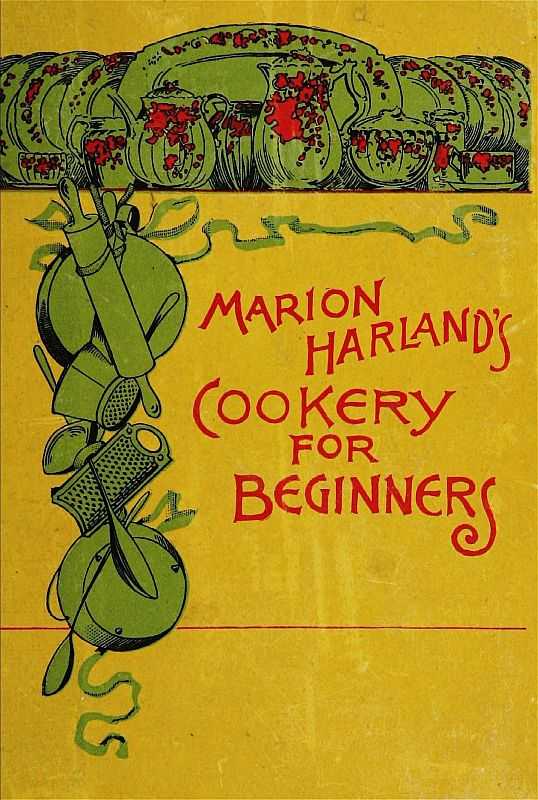
The Project Gutenberg eBook of Marion Harland's Cookery for Beginners
Title: Marion Harland's Cookery for Beginners
Author: Marion Harland
Release date: June 7, 2015 [eBook #49155]
Most recently updated: October 24, 2024
Language: English
Credits: Produced by Emmy, Chris Curnow and the Online Distributed
Proofreading Team at http://www.pgdp.net (This file was
produced from images generously made available by The
Internet Archive)
MARION HARLAND’S
COOKERY FOR BEGINNERS
COOKERY FOR BEGINNERS
A SERIES OF FAMILIAR LESSONS FOR
YOUNG HOUSEKEEPERS
BY THE
Author of “Common Sense in the Household,” “The
Dinner Year Book,” “The Cottage Kitchen,” etc.
BOSTON
D. LOTHROP COMPANY
PUBLISHERS
Copyright, 1884,
by
D. Lothrop & Co.
—————
Copyright, 1893,
by
D. Lothrop Company.
CONTENTS.
| 1. | Home-made Yeast and the first Loaf | 7 |
| 2. | Bread Sponge and Breakfast Breads | 16 |
| 3. | Breakfast Breads | 28 |
| 4. | Other Breakfast Breads | 37 |
| 5. | Eggs | 42 |
| 6. | Broiled Meats | 54 |
| 7. | Fried Meats | 60 |
| 8. | What to do with Left-overs | 69 |
| 9. | Other Dinner Dishes | 81 |
| 10. | Meats | 94 |
| 11. | Vegetables | 107 |
| 12. | Desserts | 118 |
| 13. | Cake-making | 131 |
| 14. | Jellies, Creams, and other fancy Dishes for Tea and Luncheon, or Supper-Parties |
143 |
COOKERY FOR BEGINNERS.
1
HOME-MADE YEAST AND THE FIRST LOAF.
THE question is often asked, “What is the most important branch of culinary knowledge? What the chief requisite in supplying the table well and healthfully?”
The experienced housewife cannot hesitate as to the reply.
Beyond doubt, the ability to make good bread. No one need rise hungry from a table on which is plenty of light, sweet bread, white or brown, and good butter. For the latter item many of us are dependent upon market and grocery. It is hardly just to hold the cook responsible for imperfections in this regard when she has bought the best articles these supply. She is culpable if she fails to see that her board furnishes three times a day a bountiful allowance of what I hope none of my friends in council will ever call “healthy bread.” The eater may be made or kept healthy by the consumption of nutritious, wholesome, healthful or healthsome food; but the most careful philologists do not speak of edibles as subject to such diseases as may afflict living creatures.
While it is always wise to use none except the best flour in bread-making, it is true that skilful management of an inferior brand will often produce better loaves and biscuits than careless treatment of fine family flour. I say this that none may be discouraged. So far as my observation and experience extend, nothing can remedy the disadvantage of indifferent yeast.
Let me earnestly advise, therefore, as the foundation of successful baking, the manufacture of
HOME-MADE YEAST.
Four large mealy potatoes, peeled.
Two quarts of cold water.
One teacupful of loose, dry hops, or, half a cake of the pressed hops put up by the Shakers and sold by druggists.
Two tablespoonfuls of white sugar.
Four tablespoonfuls of flour.
Half a cupful lively yeast, or a yeast-cake dissolved in a little warm water.
Put water, potatoes, and the hops tied up in a bit of coarse muslin, over the fire in a clean pot or kettle. Boil until the potatoes break apart when a fork is stuck into them. Unless they are very old or very new, this should be half an hour after the boiling begins. Take out the potatoes, leaving water and hops on the range where they will boil slowly. Mash the potatoes smooth in a wooden tray or large crockery bowl, with a wooden spoon, and work in the sugar. When these are well-mixed wet the paste with three tablespoonfuls of the boiling hop-tea, then stir in a tablespoonful of flour. Do this four times, beating and stirring to get rid of lumps. When the flour is all in, add, a little at a time, the rest of the hop-tea, squeezing the bag hard to get every drop. Throw the boiled hops away, and wash the cloth or bag well before putting it aside for the next yeast-making.
Strain the thick, grayish liquid through a colander into a bowl and let it get almost but not quite cold before you stir in the half cupful of made yeast that is to “raise” it. Set aside out of the dust and wind, put a sieve or throw a bit of mosquito netting over it, and leave it to work. It is a good plan to set the bowl in a large pan or dish to catch what may run over the sides. When the yeast ceases to sing or hiss, and the bubbles no longer rise and break on the surface, the fermentation is complete. Four or five hours in July, seven in January, usually bring this to pass. Pour the yeast into glass fruit-jars with close covers, or stone-jars fitted with corks, or common bottles, tying the corks down with twine. Keep in a cool, dark place, and do not open except to draw off the quantity needed for a baking. In the refrigerator it will keep good for a month. Shake up the bottle before pouring out what you want into a cup.
The creamy, foamy product thus obtained is quite another thing from the dark, bitter stuff pedled from one kitchen door to another as brewer’s or baker’s yeast, unfit for use unless strained, and then too frequently “unprofitable” because “stale” and “flat.”
THE FIRST LOAF.
One quart and a cupful of sifted flour (a half pint cup)
One even teaspoonful dry salt.
Two full cups of blood-warm water.
Five tablespoonfuls of yeast (good ones).
Sift the flour and salt together into a wooden or stoneware bowl. Make a hole in the middle and pour in the yeast, then a cupful of the water. With clean hands begin to work down the flour into the liquid, and as it stiffens add the rest of the water. When the dough is all wet dust your fingers with dry flour, and rub off the paste into the bowl. Scrape the sides of this, dust your fingers again, and make all the dough into a lump or ball. Dredge your pastry or bread-board well with flour, put the dough upon it and sift flour lightly over it. Ask your mother or some experienced person whether or not it is of the right consistency. There is so much difference in various brands of flour that only practice can teach one when the dough is just right. Do not get it too stiff. Add flour very cautiously even should it stick to your fingers. Knead the bread for fifteen minutes—not so fast as to tire yourself out of breath, but steadily and hard, working it away from you all the time, turning the ball over and around so as to reach every part of the mass. It should leave the board without stickiness at the end of this time, be smooth, firm, and elastic. Strike it hard with a tight fist, and if the dent thus made fills up at once, you have kneaded it sufficiently.
Sprinkle your bread-bowl with flour, put the dough in the bottom, sift flour lightly over the top, cover with a clean thick cloth and set, in cold weather, in a moderately warm place, in summer, out of the draught, but away from the fire and sun. It should be light in four hours in warm weather, in six in winter. If you wish to have it for breakfast, set at bedtime, and get up early to work it over for the second rising.
This must not be done until the dough has swollen immensely, and cracked over the top like “crazed” china. Flour the board and knead as before, now for ten minutes. Grease two “brick” or round bread-pans well with sweet lard or butter, make out the dough in two oblong or round loaves, and pat these down in the pans to fit the corners. Prick the tops with a sharp fork, cover with a clean cloth, and let them stand for an hour before putting them into the oven.
The oven must be steady, but not too hot. You should be able to hold your bare arm in it while you count twenty regularly. Should the bread rise very fast at first, lay stout paper over the top to prevent it from browning before the heart is done. Do not allow the stove or range to be filled with fresh coal or wood while your bread is in the oven, or it will be “slack-baked.” Should you need to increase the heat, put in a stick or two of wood to get up a brisk blaze. Do not open the oven for ten or twelve minutes after the bread goes in, and very seldom afterward. A peep should suffice to see how it is getting on. If the loaf rises higher at the back or at one side than in front or on the other side, turn the tin quickly, and do not jar it, or it will “fall” into heavy streaks. If the oven is right, your loaves should be done in about thirty-five minutes.
Set the loaves up on the edge of one end, leaning against the wall or an upright board, that the air may dry the bottom, throw a dry cloth over them and leave them to cool. When quite cold wrap in a clean thick cloth and keep in a tin box or stone crock.
In this, as in other first attempts, let me warn you against being disheartened by failure, partial or total. It would be far more strange were you to accomplish perfection in one, or in half a dozen lessons, than if your early efforts should be only moderately successful.
See that your yeast is lively and not sour, the flour good and dry, then follow directions implicitly, and I think I can engage that the result will not mortify you.
2
BREAD SPONGE AND BREAKFAST BREADS.
BREAD raised with what is known to bakers as a “sponge,” requires more time and a trifle more work than the simpler form for which I have just already given directions. But it keeps fresh longer, is softer and more nutritious, and a second-rate brand of flour thus treated produces a better loaf than when mixed up with yeast and water only. Sponge-making is, therefore, an important if not an essential accomplishment in a cook, be she novice or veteran.
Bread Sponge.
Three potatoes of fair size, peeled and boiled mealy.
Five tablespoonfuls of yeast.
One tablespoonful of white sugar.
One tablespoonful of butter.
Three cups of lukewarm water in which the potatoes were boiled—strained through a coarse cloth.
One heaping cup of sifted flour.
Put the potatoes into a large bowl or tray and mash them to powder with a potato beetle, or a wooden spoon. While still hot, mix in the sugar and butter, beating all to a lumpless cream.
Add a few spoonfuls at a time, the potato-water alternately with the flour by the handful, beating the batter smooth as you go on until all of the liquid and flour has gone in. Beat hard one minute before pouring in the yeast. In hot weather, it is well to stir into the yeast a bit of soda no larger than a grain of corn already wet up in a teaspoonful of boiling water.
Now whip up the batter with a wooden spoon for another minute, and the sponge is made.
Throw a cloth over the bowl and set by for five or six hours to rise. If you intend to bake in the forenoon, make the sponge at bedtime. If in the afternoon, early in the morning.
When the sponge is light sift a quart and a cup of flour into a bowl or tray with two teaspoonfuls of salt. Into a hollow, like a crater in the middle of the flour, empty your sponge-bowl, and work the flour down into it. Wash out the bowl with a little lukewarm water and add this to the dough. If it should prove too soft, work in, cautiously, a little more flour. If too stiff, warm water, a spoonful at a time until you can handle the paste easily. The danger is in getting it too stiff.
Now, knead and set for risings first and second, as you have already been instructed. This sponge will be found especially useful in making
Graham Bread.
One quart of Graham flour, one cup of white flour.
One half cup of Indian meal.
One half cup of molasses.
Two teaspoonfuls of salt.
Soda, the size of a pea.
Half the quantity of sponge given in preceding receipt.
Warm water for rinsing bowl—about half a cup.
Put the brown or Graham flour unsifted into the bread-bowl. Sift into it white flour, meal and salt, and stir up well while dry. Into the “crater” dug out in the middle, pour the sponge, warm water, the molasses, and soda dissolved in hot water. Knead as you would white bread, and set aside for the rising. It will not swell so fast as the white, so give yourself more time for making it.
When light, knead well and long; make into two loaves, then put into well-greased pans and leave for an hour, or until it becomes more than twice the original size of the dough.
Take care that it does not burn in baking. The molasses renders it liable to scorching. The oven must be steady, but not so hot as for white bread, nor will the Graham bread be done quite so soon as that made of bolted flour. Turn the pans once while baking, moving them as gently as possible. If rudely shaken or jarred, there will be heavy streaks in the loaves.
Graham bread is wholesome and sweet, and ought to be eaten frequently in every family, particularly by young people whose bones and teeth are in forming.
The phosphates which the process of “bolting” removes to a large extent from white flour, go directly to the manufacture of bone, and these also tend to nourish and strengthen the brain.
Tea-Rolls.
After mixing your bread in the morning either with sponge or with yeast, divide the kneaded dough into two portions. Mould one into a round ball, and set aside for a loaf as already directed. Make a hole in the middle of the other batch and pour into it a tablespoonful of butter, just melted, but not hot. Close the dough over it, dust your hands and kneading-board with flour and work in the shortening until the dough is elastic and ceases to be sticky. Put it into a floured bowl, cover with a cloth and set away out of draught and undue heat, for three hours. Knead it again, then, and wait upon its rising for another three hours. The dough should be as soft as can be handled.
When it is light for the second time flour your board, rubbing in the flour and blowing lightly away what does not adhere to the surface. Toss the lump dough upon it and knead thoroughly for five minutes. Flour a rolling-pin and roll the dough into a sheet not more than half an inch thick. Cut this into round cakes with a biscuit-cutter or a sharp-edged tumbler and fold, not quite in the middle, in the form of turnovers, pinching the corners of the fold pretty hard to hinder the flap of dough from flying up as the rising proceeds. Rub the bottom and sides of a baking-pan with sweet lard or butter. Do this with a bit of clean soft rag or tissue-paper, visiting every corner of the pan, but not leaving thick layers and streaks of grease after it. Arrange the rolls in regular rows in the pan about a quarter of an inch apart.
Cover with a cloth and set nearer the fire than you dared trust the dough, and let them rise for an hour. Peep under the cloth two or three times to see whether they rise evenly, and turn the pan around once that all may be equally exposed to the heat.
When the time is up and the rolls are puffy and promising, set them in a pretty quick oven and bake half an hour, turning the pan once in this time, and covering with clean—never printed—paper, should they brown too fast. Break the rolls apart from one another and eat warm. They are also good cold, and if the directions be followed implicitly, very good always.
Graham Rolls
Are made by treating the dough mixed for Graham bread as above and following the foregoing receipt in every section, but allowing more time for rising and baking. They are even better when cold than hot.
Breakfast Biscuit.
Two cups of fresh milk slightly warmed.
One quart and a cup of flour sifted.
Five tablespoonfuls of yeast.
One even tablespoonful of white sugar.
One even teaspoonful of salt.
Bit of soda as large as a pea, dissolved in hot water.
One tablespoonful of butter, just melted, not hot.
Yolk of one egg beaten light.
Sift the flour, salt and sugar into a bowl, hollow the heap in the centre and pour in the milk, working down the flour into the liquid with a spoon or your hands until it is thoroughly melted. Into a second hollow pour the yeast and knead thoroughly for fifteen minutes. Wrap bowl and biscuit in a thick cloth and set to rise where it will neither become chilled nor sour over night. (Study the temperature in different parts of the kitchen and kitchen closets to the end of finding the best places for raising dough and sponge.)
Do all this at bedtime. Early in the morning turn out the dough upon a floured board, work it for a minute into manageable shape; drill several finger-holes in it and fill them with the melted butter, the dissolved soda and the beaten yolk of egg. Pinch the dough hard to stop the mouths of these cavities, and knead for ten minutes, carefully at first, lest the liquids should be wasted, and more boldly when they are absorbed by the paste. Roll out into a sheet half an inch thick with a floured rolling-pin; cut into round cakes, set these closely together in a well-greased pan; prick each with a fork and let them rise near the fire for half an hour, covered with a light cloth.
Bake from twenty to twenty-five minutes in a quick oven, turning the pan around once, quickly and lightly. Break apart from one another and pile on a plate, throwing a clean doily or a small napkin over them. Break open at table. Hot rolls and muffins should never be cut.
One word with regard to getting up early in order to give dough a chance for the second rising. It is not a wholesome practice for any woman—least of all a young girl to be out of bed two hours before she eats her breakfast. Studying upon an empty stomach provokes dyspepsia and injures the eyes. Active exercise in like circumstances tempts debility and disease. Yet our bread and rolls must be looked after at the proper time. Have yourself called on biscuit mornings an hour earlier than usual. Rise, wash face and hands, rinse the mouth out and brush back the hair. Put on stockings and slippers, such underclothing as may be needed to prevent cold, a wrapper and the kitchen apron. Cover your hair entirely with a handkerchief or sweeping cap. Before beginning operations down-stairs eat a half-slice of dry bread or a biscuit. You will not relish it, but take it all the same to appease the empty, discontented stomach. Having made out your rolls and tucked them up snugly for the final rise, return to your chamber for a comfortable bath and toilet. When habited for the day in all except the outer gown, collar, etc., slip on the wrapper again and run down to put the biscuits in the oven. Unless it is too hot, they will get no harm while you finish dressing in ten minutes, just in season to turn the pan.
From the beginning of your apprenticeship in housewifery, learn how to “dovetail” your duties neatly into one another. A wise accommodation of parts and angles, and compactness in the adjustment of “must-be-dones” are better than mere personal strength in the accomplishment of such tasks as fall to women to perform. Master these, and do not let them master you. Weave the little duties in and under and among what seem to be the greater. While your bread is taking a three hours’ rise, you are free in body and mind for other things. The grand secret of keeping house well and without worry, lies in the art of packing and fitting different kinds of work and in picking up the minutes. Other things besides rising dough get on quite as well without your standing by to watch them.
3
BREAKFAST BREADS.
UNDER this head may be classed muffins, griddle-cakes, crumpets, corn bread, Sally Lunn, quick biscuits, and a dozen other varieties of warm bread suitable for breakfast and tea. They furnish a very pleasant variety in the daily bill of fare, and are extremely popular.
Nor are they unwholesome if properly made and cooked, and eaten by well people. To weak and impaired digestive organs all kinds of warm bread are hurtful.
English Muffins.
One quart of sifted flour.
Two cups of lukewarm water.
Half a cup of yeast.
One tablespoonful of butter melted, but not hot. One teaspoonful of salt sifted with the flour.
Sift the flour and salt into a bowl, make a hole in the middle and pour in yeast and warm water. Stir down the flour gradually into the liquid, and when all is in, beat hard with a wooden spoon. Should the mixture be too stiff for this, add a little more water. It should be about half as thick as bread-dough. Beat for five minutes and set aside to rise, with a cloth thrown over the bowl, in a moderately warm corner.
Early in the morning stir the melted butter into the dough, beat hard for two minutes, and leave for half an hour in the covered bowl in a warm place—such as on a stool near the fire—turning it several times.
Grease muffin-rings well with sweet lard, arrange them upon a greased griddle set over the fire and already warmed (not really hot), fill about half-way to the top with batter, and bake quickly. When the dough fills the rings and begins to look firm on the top, slip a knife under one and peep at the under side. If it is delicately browned, turn the rings over with a spatula or cake-turner. This must be done quickly and dexterously, so as not to spill the batter.
When quite done, wrap a thick cloth about your fingers, take up the muffin-rings one by one; pass a sharp knife around the inside of each, to loosen the muffin, and shake it out upon a hot plate. Pile them up neatly and cover with a clean napkin. These muffins must be broken, not cut open, and buttered while hot.
The English split, toast and butter cold muffins.
Crumpets.
Two cups of lukewarm milk.
Two thirds of a cup of lukewarm water.
One quart of sifted flour.
One tablespoonful of white sugar.
Half a teaspoonful of salt.
Two tablespoonfuls of melted butter.
Half a cupful of yeast.
Soda the size of a pea, dissolved in a teaspoonful of boiling water.
Mix milk, yeast, water, sugar and salted flour as directed in former receipt. Beat hard, and set to rise over night. In the morning work in the butter and soda, beat up for one whole minute until the mixture is light throughout, and half-fill greased patty-pans with it. Set these in a baking-pan, cover with a cloth, and let them stand in a warm place fifteen minutes before putting them into a steady oven. They should be done in from twelve to fifteen minutes if the oven is right. If they brown too fast, cover them with paper.
Quick Muffins.
One quart of sifted flour.
One tablespoonful of salt.
Three cups lukewarm milk.
Two eggs.
One tablespoonful of melted butter.
Two teaspoonfuls of baking powder.
Sift flour, baking-powder and salt twice through the sieve, to make sure these are well mixed together. Beat the eggs very light. (By all means have a Dover Egg-Beater for this purpose. It whips eggs to a lovely froth with less labor and in less time than any other yet invented.)
Stir melted butter, eggs and milk together in a large bowl, and to this add the flour, a cupful at a time, stirring very quickly and lightly down toward the middle of the bowl. Beat hard up one minute at the last, to break flour-lumps; half-fill greased patty-pans with the batter, and then bake in a quick oven.
Turn out and eat while puffy and hot.
Sally Lunn. (The “Genuine Article.”)
One quart of sifted flour.
One cup of warm milk.
One of warm water.
Four large tablespoonfuls of yeast.
Two tablespoonfuls of melted butter.
Four eggs.
One tablespoonful of salt sifted with the flour.
Soda the size of a pea, dissolved in a teaspoonful of boiling water.
Beat the eggs steadily four minutes. Have ready in a bowl the warmed milk, water, melted butter and soda. Into this stir the salted flour, cupful by cupful, until all is in. Beat smooth from lumps and add the yeast. The eggs should now be whipped three minutes with the “Dover,” in a cool bowl. They will not froth in a hot or warm one. When light, beat well into the batter, and then beat up hard for a full minute. A wooden spoon is best for this purpose. Butter a tin cake-mould well in every part, and put in the batter. If there is more than enough to half-fill the mould have two prepared, that the contents may not overflow in rising.
Set in a moderately warm place for six hours at least, and then bake in the mould for three quarters of an hour if there is but one loaf, half an hour if there are two.
The oven must be steady and not very hot at first. Turn the mould twice in this time keeping the oven door open as short a time as possible. When you think the loaf is done, thrust a clean straw down into the thickest part.
If it comes up as clean as when it went in, take out the bread. Slip a knife around the edge to loosen it, and turn out upside down on a warm plate.
Cut in triangular slices at table, holding the knife upright to avoid crushing and making it heavy.
Quick Biscuits.
One quart of sifted flour.
Two heaping tablespoonfuls of sweet, firm lard.
Two cups of new milk (warm from the cow if you can get it.)
Two tablespoonfuls of baking powder.
One teaspoonful of salt.
Sift salt, flour, and baking-powder twice into a bowl or tray. With a clean sharp chopping-knife work the lard into this, turning and chopping until no lumps are left. Into a hollow in the middle pour the milk, working the flour downward until you have a soft, wet mass, using the chopper for this purpose. Flour your pastry-board and your hands, make the dough into a ball, handling it as little as possible, and lay on the board. Roll out with a floured rolling-pin into a sheet half an inch in thickness, and with very few strokes. Cut into round cakes, sift flour lightly over the bottom of a baking-pan, and set your biscuits—just not touching one another—in even rows within it.
Bake about twelve minutes in a quick oven. The dough should have a rough appearance before it is baked, like what is known as “pebbled morocco.” Too much handling will make it sleek without and tough within.
You can make excellent quick biscuits by the above receipt, by substituting Hecker’s Prepared Flour for the barreled family flour, and omitting the baking-powder. You will, however, probably be obliged to add a little more milk, as prepared flour “thickens up” rather more than other brands.
4
OTHER BREAKFAST BREADS.
Griddle Cakes.
IN making these, let quickness be the first, second and third rules. Beat briskly and thoroughly; mix just as you are ready to send the cakes to the table (except when yeast is used), bake, turn, and serve promptly. Have all your materials on the table, measured and ready to your hand. The griddle must be perfectly clean and wiped off with a dry cloth just before you lay it on the stove. Heat it gradually at one side of the stove or range, and when it is warm grease with a bit of fat salt pork stuck firmly on a fork. The fat should be hissing hot, but not scorching, when the batter is poured on. Before putting the cakes on to fry, slip the griddle to the hottest part of the stove. Drop the batter in great, even spoonfuls, and be careful not to spill or spatter it.
M. H. Phillips and Co., of Troy, N. Y., manufacture a griddle with three shallow cups sunken in an iron plate which moves on a hinge. When the cakes are done on the lower side the turn of a handle reverses the plate upon a heated surface. This makes the cakes of equal size and thickness and saves the trouble of watching, spatula in hand, to turn each one. It greatly simplifies the process of baking cakes, and, lessens the heating labor of attending to them.
Be sure that each cake is done before you turn it. A twice-turned “griddle” is spoiled.
Sour-milk Cakes.
One quart of “loppered,” or of buttermilk.
Three cups of sifted flour.
One cup of Indian meal.
One “rounded” teaspoonful of soda free from lumps.
One teaspoonful of salt.
Two tablespoonfuls of molasses.
Sift flour, salt and meal into a bowl. In another mix the milk, molasses and soda. Stir these last to a foam, and pour into the hollow in the middle of the flour. Work down the flour into the liquid with a wooden spoon until you have a batter, and beat hard with upward strokes, two minutes. Bake at once. These are cheap, easy and good cakes.
Hominy Cakes.
Two cups of fine hominy boiled and cold. (Take the tough skin from the top before mixing in the batter.)
One heaping cup of sifted flour.
One quart of milk.
Three eggs beaten very light.
One tablespoonful of molasses.
One teaspoonful of salt.
Rub the hominy with the back of a wooden spoon until all the lumps are broken up. Wet it little by little with the milk and molasses, working it smooth as you go on. Sift flour and salt together, and put in next. Beat for a whole minute before adding the whipped eggs, and another minute very hard, before baking. Stir up well from the bottom before putting each fresh batch of cakes on the griddle.
These cakes if properly made, are tender, wholesome and delightful.
Graham Cakes.
Two cups of Graham flour.
One of sifted white.
One heaping tablespoonful of Indian meal.
Three cups of buttermilk, or loppered milk.
One rounded teaspoonful of soda.
Two tablespoonfuls of molasses.
One teaspoonful of salt sifted with the flour.
Two eggs whipped very light.
One tablespoonful melted butter.
Put Graham and salted white flour into a bowl with the Indian meal. Stir up in another milk, molasses, soda and melted butter, and while foaming pour into the hollowed flour. Work to a good batter and beat in the eggs already whipped to a froth.
Beat one minute and bake at once.
This is a good standard breakfast hot bread.
5
EGGS.
MANY people do not know a well-boiled egg by sight or taste, yet a fresh egg, boiled to a nicety, is one of the simplest, most nutritious of breakfast dishes.
Boiled Eggs.
Select the cleanest eggs, wash them well, and lay them in lukewarm water for five minutes. Have ready on the fire a saucepan of water on a fast boil, and in quantity sufficient to cover the eggs entirely. Into this put one egg at a time with a spoon, depositing each gently on the bottom, and quickly.
Four minutes boils an egg thoroughly, if one likes the white set and the yolk heated to the centre. Five minutes makes the white firm and sets the yolk. Ten minutes boils both hard.
Take up the eggs with a split spoon or wire whisk. If you have no regular egg dish, lay a heated napkin in a deep dish or bowl (also warmed), put in the eggs as in a nest, cover up with the corners of the napkin, and send directly to the table. They harden in the shells if left long without being broken.
The best way to manage a boiled egg at the table is the English way of setting it upright in the small end of the egg-cup, making a hole in the top large enough to admit the egg-spoon, and eating it from the shell, seasoning as you go on. Heat and taste are undoubtedly better preserved by this method than by any other. Those who cannot afford gold-washed spoons, can procure pretty ivory ones at a trifling cost, or small teaspoons will serve the purpose.
Spoons smeared with eggs should be laid to soak in cold water directly you have finished using them.
Custard Eggs.
Put the washed eggs in a saucepan of cold water and let them just come to a boil, then take them up.
Or, lay them in a hot tin pail, cover them with boiling water, put the top on the pail and leave them on the kitchen table for five minutes. Drain off the water, pour on more boiling hot and replace the top. Wrap a hot towel about the pail, and leave it four minutes before dishing the eggs. They will be like a soft custard throughout, and more digestible than if cooked in any other way.
Poached, or Dropped Eggs.
Into a clean frying-pan, pour plenty of boiling water, and a teaspoonful of salt. Let it boil steadily, not violently. Wipe a cup dry, break an egg into it, and pour, very cautiously and quickly, on the surface of the water. Avoid spreading or breaking it. It will sink to the bottom for an instant, but if the water is boiling hot, will rise soon and be cooked in about three and a half minutes. Do not put more than three into the pan at one time, or they will run into one another.
Take them up with a perforated skimmer and lay on a hot, flat dish in which a teaspoonful of butter has been melted. If the whites have ragged edges, trim neatly with a sharp knife. When all are done, pepper and salt lightly, put a bit of butter on each egg and send up very hot.
Eggs on Toast.
Cut out with a sharp-edged tumbler or a cake cutter as many round slices of stale bread as there are eggs to be cooked. Toast these nicely, butter thinly; cover the bottom of a heated dish with them, and pour on each a tablespoonful of boiling water. Set in the plate-warmer or an open oven while you poach eggs as directed in the last receipt.
Lay each when done on a round of toast, pepper, salt and butter, and serve.
Eggs on Savory Toast.
Toast rounds of stale bread as directed in preceding receipt, but instead of moistening them with hot water, pour upon them, as they lie in the dish, two tablespoonfuls of boiling gravy to each slice. A half-cupful of gravy left over from yesterday’s roast or stew skimmed free of fat, heated, thinned with a very little boiling water, well-seasoned, then strained and boiled up quickly, makes this a tempting dish.
Poach as many eggs as you have rounds of toast, and lay on these, with pepper, salt and bits of butter.