
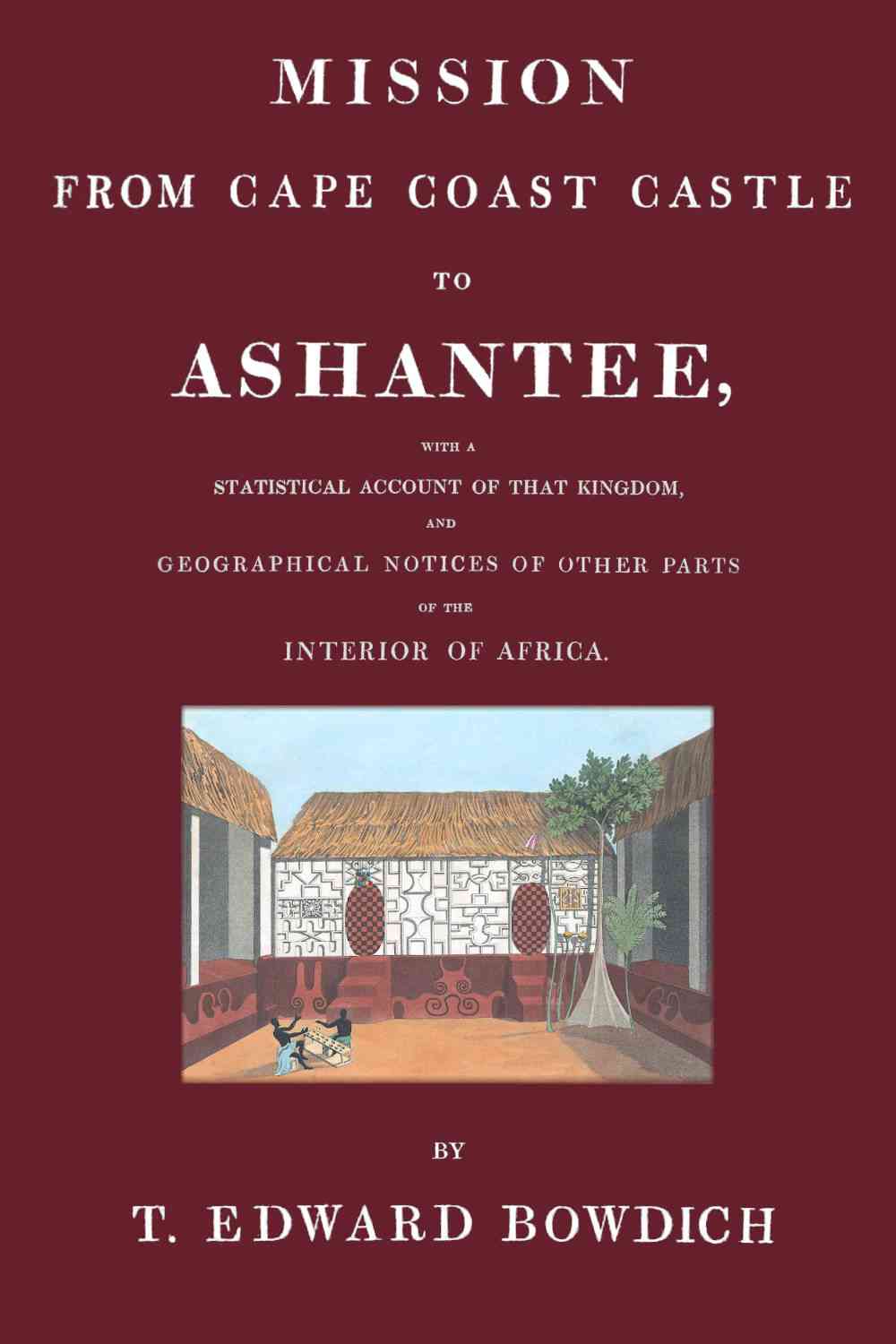
MISSION
TO
ASHANTEE.
A Map shewing the Discoveries & Improvements in the Geography of Western Africa resulting from the Mission to Ashantee by T. E. Bowdich Conductor 1817
Reported Courses of the Niger to the Nile, Gambaroo to Caudee, Oogooawai to the Congo.
| London published as the Act directs by John Murray Albemarle Street 4th. Jany. 1819. | J. Walker Sculpt. |
MISSION
FROM CAPE COAST
CASTLE
TO
ASHANTEE,
WITH A
STATISTICAL ACCOUNT OF THAT KINGDOM,
AND
GEOGRAPHICAL NOTICES OF OTHER
PARTS
OF THE
INTERIOR OF AFRICA.
BY T. EDWARD
BOWDICH, ESQ.
CONDUCTOR.
“Quod si præ metu et formidine pedem referemus, ista omnia nobis adversa futura sunt.”
LONDON:
JOHN MURRAY,
ALBEMARLE-STREET.
1819.
London: printed by W. Bulmer and Co.
Cleveland-Row, St. James’s.
INTRODUCTION.
A curiosity throughout Europe, proportionate to the ignorance of the Interior of Africa, exacts the publication of the proceedings and researches of every Exploratory Mission, from its Conductor, as a duty to the Public: “mandat fieri sibi talia.”
The Public, in acknowledgment of the performance of the duty, reflecting that it constrains literary efforts which the Author otherwise might never have presumed to expose, should sympathise in his diffidence and anxiety, and receive and review them as a task imposed, and not as a spontaneous essay.
If this indulgence is due even to gentlemen who have had the most enviable opportunities of qualifying themselves at the expense of a liberal Government, it is surely secure to one who never enjoyed those advantages; but, being suddenly called to the immediate conduct of a Mission, originated by a public Board of very contracted means, when estranged from all facilities, had no resource to aid his realization of the scientific desiderata, beyond the acquirements common to most private gentlemen.
The vessel in which I am making my passage to England having been chartered to trade in the River Gaboon, which is immediately on the Line, I diverted a tedious delay of seven weeks in so unhealthy a situation, by visiting Naängo, a town about fifty miles from the mouth of the River, where I collected Geographical Accounts of the Interior, from several intelligent traders, and numerous slaves from different countries. I have added this compilation, (as it may borrow some interest from the adjacency of the Congo,) with a few notices of the customs and productions of this ruder part of Africa.
CONTENTS.
| PART I. | |
| Chap. I.—The Objects and Departure of the Mission. | 3 |
| Chap. II—The Route and Reception of the Mission. | 14 |
| Chap. III.—Proceedings and Incidents until the Third Dispatch to Cape Coast Castle. | 42 |
| Chap. IV.—Proceedings and Incidents until the Signing of the Preliminaries to a General Treaty. | 101 |
| Chap. V.—Proceedings and Incidents until the Ratification of a General Treaty. | 118 |
| Chap. VI.—Proceedings and Incidents until the completion of the Mission and its return to Cape Coast Castle. | 131 |
| PART II. | |
| Chap. I.—Geography. | 161 |
| Chap. II.—History. | 228 |
| Chap. III.—Constitution and Laws. | 252 |
| Chap. IV.—Superstitions. | 261 |
| Chap. V.—Customs. | 274 |
| Chap. VI.—Architecture, Arts, and Manufactures. | 304 |
| Chap. VII.—Climate, Population, Revenue, City, Market, &c. | 315 |
| Chap. VIII.—Trade. | 330 |
| Chap. IX.—Language. | 344 |
| Chap. X.—Music. | 361 |
| Chap. XI.—Materia Medica and Diseases. | 370 |
| Chap. XII.—Mr. Hutchison’s Diary. | 381 |
| Chap. XIII.—Sketch of Gaboon, and its Interior. | 422 |
| Chap. XIV.—Suggestions for future Missions to the Interior of Africa. | 453 |
| APPENDIX. | |
| No. I.—Extract from Meredith’s Account of the Gold Coast. | 463 |
| No. II.—Translations of an Arabic MS. Descriptive of Mr. Park’s Death. | 478 |
| No. III.—Arabic Routes. | 482 |
| No. IV. Dr. Leach’s Notice of Reptiles, Insects, &c. | 493 |
| No. V.—Thermometer Account. | 497 |
| No. VI.—Vocabularies. | 504 |
DIRECTIONS FOR PLACING THE PLATES.
| Map | to front the Title. | ||
| 1. | A Captain in his War-dress | to face p. 32 | |
| Arabic Circular | 128 | ||
| Map from Dapper | 211 | ||
| 2. | The first Day of the Yam Custom | 275 | |
| 3. | The oldest House in Coomassie | 307 | |
| 4. | Quarters of the Chief of the Embassy | ib. | |
| 5. | Odumata’s sleeping room | 307 | |
| 6. | Inner square of Apokoo’s house | ib. | |
| 7. | Piazzas of the palace | 308 | |
| 8. | |||
| 9. | Part of Adoom Street | ib. | |
| 10. | Exterior of the King’s bed room | ib. | |
| Ichnographical Sketch of Coomassie | 323 | ||
| Ashantee Music | 365 | ||
| Empoöngwa Music | 449 |
- Map.—Affix the name Leeasa to the river flowing from the Niger by Boussa.
- Page 9.—After Frederick James, Esq. add, Member of Council, and Governor of Accra.
- Page 72.—For dated, read dictated.
GLOSSARY.
- Croom. A town or village.
- Caboceer. A chief or magistrate.
- Pynin. An elder or counsellor.
- Palaver. A dispute, debate, argument, or suit.
- Book or Note. A certificate of a monthly pension of the African Committee, paid in trade to the Fantee Kings and Chiefs in the neighbourhood of the British settlements, in consideration of their attachment, influence, and services; which Books or Notes were claimed by the King of Ashantee, as his by right of conquest.
- Stool. Throne, seat in council, inheritance.
- Custom. A festival, carnival, public ceremony, funeral rite.
- Panyar. To seize or kidnap.
- A Benda. Two ounces four ackies, or £9. currency.
- A Periguin. Two ounces eight ackies, or £10. currency.
- An Ackie. Five shillings currency.
- A Tokoo. Ten pence.
- A Dash. A present.
- Fetish. A charm, amulet, deity. Any supernatural power or influence. Any thing sacred.
MISSION TO ASHANTEE.
CHAPTER I.
The Objects, and Departure of the Mission.
Bosman and Barbot mention the Ashantees as first heard of by Europeans about the year 1700; the latter calls it Assiantee or Inta, and writes, that it is west of Mandingo, and joins Akim on the east; he asserts its pre-eminence in wealth and power. Issert, a physician in the Danish service, who meditated a visit to Ashantee, writes, “this mighty king has a piece of gold, as a charm, more than four men can carry; and innumerable slaves are constantly at work for him in the mountains, each of whom must collect or produce two ounces of gold per diem. The Akims formerly dug much gold, but they are now forbidden by the King of Ashantee, to whom they are tributary, as well as the Aquamboos, previously a very formidable nation.” Mr. Dalzel heard of the Ashantees at Dahomey, as very powerful, but imagined them, the Intas, and the Tapahs, to be one and the same nation. Mr. Lucas, when in Mesurata, was informed that Assentai was the capital of the powerful kingdom of Tonouwah. In Mr. Murray’s enlarged edition of Dr. Leyden’s discoveries in Africa, we find, “the northern border of Akim extends to Tonouwah, denominated also Inta, Assientè, or Assentai, from its capital city of that name, which stands about eighteen days journey from the Gold Coast.”
In 1807 an Ashantee army reached the Coast for the first time. I would refer the reader to the extract in the Appendix, from Mr. Meredith’s account of the Gold Coast, as the particulars are introductory as well as interesting; and also serve to correct the misstatement in the work last quoted, that in 1808 the King of Ashantee destroyed the English fort of Annamaboe; originating, probably, from the storm of the Dutch fort at Cormantine, at that time.
The Ashantees invaded Fantee again in 1811, and the third time in 1816. These invasions inflicted the greatest miseries on the Fantees. Few were slain in battle, for they rarely dared to encounter the invaders; but the butcheries in cold blood were incredible, and thousands were dragged into the interior to be sacrificed to the superstitions of the conquerors. Famines, unmitigated by labour, succeeded the wide waste of the Fantee territory, the wretched remnant of the population abandoning itself to despair; and the prolonged blockade of Cape Coast Castle in the last invasion, engendered so much distress and hazard, that the Government having averted imminent danger by advancing a large sum of gold on account of the Fantees, earnestly desired the Committee to authorise and enable them to venture an Embassy, to deprecate these repeated calamities, to conciliate so powerful a monarch, and to propitiate an extension of commerce. By the store ship which arrived in 1817, the African Committee forwarded liberal and suitable presents, and associated scientific with the political objects of the Mission, in their instructions, which I submit in explanation.
“In order to enable you to redeem the promise to the King of Ashantee (and as we are sanguine in our hopes of the good that may result from it), we send you sundry articles as presents for him, to which you may add such others from the public stores as you may deem desirable, provided they will not materially increase the expense. The Committee are extremely anxious (and in this respect the wishes of all classes of people in this country go with them) that no exertions should be spared to become better acquainted with the Interior of Africa; and we consider the existing state of things to be most favourable for undertaking an exploratory Mission into the dominions of the King of Ashantee. If, therefore, nothing shall have transpired in the interim of this dispatch being received by you, to make the measure objectionable, we wish you to obtain permission from the King to send an Embassy to his capital: if granted, you will select three Gentlemen (one of them from the medical department[1]) for that service; and let them be accompanied by a respectable escort, you giving them the fullest instructions for their government. In particular, it will be necessary for them to observe, and report upon, the nature of the country; its soil and products; the names, and distances, and the latitude and longitude of the principal places; and its most remarkable natural objects: the appearance, distinguishing characters, and manners of the natives; their religion, laws, customs, and forms of government, as far as they can be ascertained; and by whom each place is governed. When at Ashantee, they should endeavour to obtain the fullest information of the countries beyond, in each direction; particularly whether any high mountains, lakes, or large rivers are known; and the width, depth, course, and direction of the latter; and whether the water, as well of the lakes as the rivers, is salt or fresh: and how far, and under what circumstances, white men may travel with safety, especially in a northerly direction. They should collect the most accurate information possible of the extent, population, and resources of the Ashantee dominions, and should report fully their opinion of the inhabitants, and of the progress they may have made in the arts of civilized life. They should be directed also, to procure and bring away (with the consent of the chiefs) any specimens of vegetable and mineral productions they may be able: and to ascertain where and how the natives collect the gold, and the extent to which the trade in that article, and in ivory, might be carried on. It would, we conceive, be a most important advantage, if the King of Ashantee, and some of his chiefs, could be prevailed upon to send one or more of their children to the Cape, to be educated at the expense of the Committee (to be attended by their own servants, if required), under the guarantee of the Governor and Council for their personal safety, and that they should be sent back when required.
“Another great object would be, to prevail upon the King to form, and keep open, a path not less than six feet wide, from his capital, as far as his territories extend towards Cape Coast, you engaging on the part of the Committee, to continue it from that point to Cape Coast, which we presume may be done at a very small expense, by means of monthly allowances to the chiefs of such villages as be in that line; upon condition that they shall not allow the path to be overgrown with underwood, or otherwise obstructed.
“It may perhaps be found, that high mountains, or a large river, may be not many days journey beyond Ashantee; in which case, if the Gentlemen composing the Embassy feel themselves secure in the attempt, they may probably be disposed to proceed so far. In such event, we authorize you to pay their drafts for any moderate sums which they may find it necessary to expend, as well as for the general objects of the Mission.
“Besides the escort of which we have spoken, we think it necessary, or at least extremely important, that the Embassy should be accompanied by natives of character and consequence, conversant with the Ashantee language, in whom you have perfect confidence, selected, one from each of the towns of Cape Coast, Accra, and Apollonia, to whom you may make reasonable allowances for their time and trouble.
“We have said that you should obtain the permission of the King of Ashantee to send the Embassy: we have doubts of the expediency of requiring hostages; but, we presume you will concur with us in thinking, it will be necessary, before it leaves Cape Coast, that a man of consequence should be specially sent down by the King, to serve as a guide and protector; and who, on his journey to Cape Coast, may arrange with the messenger whom you may send to the King, respecting the places at which the Embassy may stop to refresh, and give directions to open the paths that may be overgrown.
“The Gentlemen whom you may select, will of course be well advised by you not to interfere with any customs of the natives, however absurd; or in any way to give them offence. And they cannot too strongly impress upon the minds of the King and people of Ashantee, that the only objects his Britannic Majesty has in view, are, to extend the trade with that country; to prevent all interruption to their free communication with the waterside; and to instruct their children in reading, writing, &c. from which, as may be easily pointed out, the greatest advantages must arise to the Ashantees.
“From what has been said, you, Gentlemen, will perceive, that in selecting the Embassy, it is important that one of the persons composing it should be able to determine the latitude and longitude of places, and that both shall be seasoned to the climate; of ability, physical and mental; of cool tempers, and moderate habits; and possessed of fortitude and perseverance; and that in the selection of their escort also, regard be had to the qualifications of the parties in those respects. Among them there should be a bricklayer, carpenter, blacksmith, gunsmith, and cooper, with proper tools; if these persons can be spared for the purpose. We wish also they should take with them a number of certificates regarding Major Peddie, and his companions, to be circulated as distinctly as possible in the Interior; for though the period may be past when they might have been useful to those travellers, it is yet possible that they may be of use in making generally known the object of Government in sending white men to explore that country.”
The suggestion of hostages was wholly impracticable, for there was not even time for a communication with the King. A variety of circumstances conspired to urge the immediate dispatch of the Mission; our interests, to say the least, imperiously demanded its early interference; and had we waited for a formal permission from the King to relieve the difficulties of the enterprise, the rainy season would have been too far advanced, and the critical moment have escaped us. The Governor thought it more advisable to dispatch the Mission without an escort, and two native soldiers only were added to the bearers of the baggage. The perusal of the Governor’s instructions will be satisfactory to the reader:
Cape Coast Castle, April 19th, 1817
Frederick James, Esq. Member of Council, and Governor of Accra.
Sir,
In accepting your voluntary offer of conducting the Embassy to the King of Ashantee, I have every reason to believe, that from your long experience in this country, and your knowledge of the manners and habits of the natives, it will terminate in a manner highly creditable to yourself, and eventually prove of the greatest importance to the commercial interest of Great Britain, which is the more immediate object of the Mission; however, as many subjects of scientific research may be associated with it, they are particularly recommended to your attention. For this purpose Mr. Bowdich will accompany you; and I have no doubt he will be found perfectly qualified to make the necessary observations, in which you will afford him every facility and assistance. He is provided with instruments for determining the latitude and longitude of places. Mr. Hutchison, writer, and Mr. Tedlie, assistant surgeon, will also be attached to the expedition.
The Ashantees, who are appointed your guides, have been selected by the Ashantee Captain who is now here. They will, I hope, aid and assist you in every thing that lays in their power.
In addition to the Committee’s instructions, a copy of which you have herewith, you will attend to the following:
On the subject of your journey, I have nothing to observe further, than, that I hope you will take every opportunity of travelling when there will be the least exposure to the sun, as the officers who accompany you have been but a short time in the country, and every precaution will be necessary for the preservation of their health.
As soon as may be convenient after your arrival at the Ashantee capital, you will of course see the King, and deliver him the various presents in the name of the African Company, to be received by him as pledges of the harmony and friendship which is ever to subsist between them; and also of his good will towards the natives residing under the protection of their different forts. You will not fail to impress upon his mind, the great power, wealth, and consequence of the British nation, and how much it is the interest of himself and his subjects, to promote and perpetuate their present free intercourse with the water side. In the course of your interview many circumstances will doubtless occur, which will suggest various other matters proper to be mentioned to the King, all which I shall leave entirely to your own discretion.
You will acquaint the King, that in order to secure a correct communication between him and myself, I request his permission to allow an officer to reside constantly at Commassey, who will defray all his own expenses, and for whom you will build a house without loss of time. A carpenter, bricklayer, and cooper are sent with you, and you will leave them with Mr. Hutchison, who will remain as Resident. On your departure you will give him full instructions in writing for his future government, a copy of which you will deliver me upon your return.
You will keep an exact diary of every circumstance possessing the least interest, a copy of which you will transmit me by every opportunity.
In the course of your stay in the Ashantee country, you will embrace every occasion of becoming acquainted with the politics of that nation, of ascertaining its extent and boundaries, the power of the King over the lives and property of his subjects, the probable force he could bring into the field, the number of his allies, the sources and amount of his revenues. Whether he is tributary to any other power, and what nations in his neighbourhood are tributary to him? The amount of tribute, and in what articles paid? The rule of succession to the throne? What are the punishments for crimes of all descriptions? Who are the persons of most consequence next to the King? The names of their offices, and the extent of their power: by whom, or how paid? What are the most prominent features in the character, manners, and habits of the people, &c. &c. &c.?
Are any human sacrifices made? Upon what occasions, and to what extent? How are prisoners of war now disposed of?
Of what nation are the Moors that frequent the Ashantee country, and for what purpose do they go there?
Ascertain the current medium of exchange, whether gold, or cowries; also the usual prices at which the Ashantees sell the goods they purchase from the Europeans on the sea coast; and the extent of their commercial relations with the Interior.
You will enquire whether any European travellers have ever been seen or heard of in any of the countries to the northward; and what became of them? Whether any thing be known of the river Niger, or Joliba, as it is called by the natives? This information you will probably obtain from the Moors.
Ascertain the position of the Doncoe country, and the city of Kong; also the mountains of that name. Refer to Park’s Travels, and acquire as much information as possible of the regions lying between Ashantee and the last places he visited. In short, leave nothing undone that may add to our present imperfect geographical knowledge of the Interior.
You will receive herewith copies of certificates relative to Major Pedde’s expedition, which you will distribute amongst any persons you find travelling into the Interior from Ashantee.
It would be of the first importance to have a road cut directly down to Cape Coast; and this you will urge to the King in the strongest manner. Your observations will, of course, enable you to point out the proper directions.
I inclose a sketch of a treaty, and it would be highly desirable if you could procure its ratification by the King. He might perhaps make some objection at first, but may be persuaded at length, by your address, and reasoning. If he wished any trifling alteration made, you might use your discretion in this respect.
You will acquaint the King, it is my wish that in future he receive his company’s pay at this Castle, and not at Accra, as formerly. Should he say any thing of an increase to his present allowance, you may give him hopes that it will be granted to a reasonable extent, provided the objects of this Mission be fulfilled, and after twelve months experience shall have proved the sincerity of his friendship to the British Government, and to the natives resident under its protection at the various forts on the Coast.
From the jealous disposition of the natives of Africa, it is highly probable, that in the prosecution of your enquiries, you will be subject to many unfavourable suspicions. These you will take all possible care to remove, by the most candid explanations on every point that may be required.
You will particularly explain to the King, the ill treatment the people of Cape Coast have experienced from those of Elmina, which has added very much to the distresses they have for some time suffered from the extreme scarcity of provisions; and there is reason to believe, that this unjust persecution has been induced, from their presuming on their connection with the Ashantees. Being perfectly aware that it has been done without the concurrence of the King; I have no doubt but he will, by a proper representation of the affair from you, exert his influence, and prevent what is at present to be apprehended, and what the Elminas are endeavouring to provoke—a war between the two people.
In all cases not provided for in these Instructions, you have of course a discretionary power, which I am convinced you will make use of with deliberation and prudence, and with becoming zeal for the service upon which you are employed.
Wishing you a prosperous journey and a safe return,
I am, Sir, your most obedient Servant,
JOHN HOPE SMITH.
[1]We recommend his being well supplied with dressings, &c. for wounds, and bruises, so that he may be able to assist any natives whom he may meet with requiring his aid: services of this sort give Negroes an exalted idea of white men, and are always gratefully remembered.
CHAPTER II.
The Route, and Reception of the Mission.
The Mission left Cape Coast Castle on the morning of the 22d of April, with the intention of quitting the water side at Moree, three miles and a half to the eastward; but on reaching it, we were told that the path thence to Payntree’s croom, always bad, was then impassable from the rains; and that we must proceed to Annamaboe before we struck into the bush for the Interior.
The reluctance of the carriers, who had been pressed into the service by the authorities of the town, became thus early almost insuperable; the consideration of pay and subsistence, and the reflection, that the dearth inflicted by the invasions the Mission was to deprecate, allowed them but a bare existence at home, were entirely lost in their aversion to the undertaking, which was equally influenced by jealousy and indolence: eleven deserted the first day; and the slender authority of the King and caboceers of Annamaboe, delayed the procuring of others to replace them until the next evening. One party was then started, attended by a soldier and a messenger, as they persisted in laying down their loads, even in the town; and many of the Annamaboes who had been procured, after lifting their packages, which were of moderate weight, walked off again, with the most insolent indifference. The devices by which these people displayed their ill will were peculiarly their own, and none could be more ingeniously tormenting. At four o’clock on Thursday morning we started the remainder of the packages, and followed them at half past six. Proceeding about two miles in a N.N.W. direction, we descended a steep hill, a quarter of a mile in length, and entered a beautiful valley, profusely covered with pines, aloes, and lilies; and richly varied with palm, banana, plantain, and guava trees: the view was refreshed by gentle risings crowned with cotton trees of a stupendous size. I never saw soil so rich, or vegetation so luxuriant.
The first croom we reached was Quama’s, about three miles and a half from Annamaboe; it presented but a few hovels; and we passed through three others, Simquoi, Taphoo, and Nasmam, just as wretched and insignificant, before we reached Booka, romantically situated amidst the luxuriant foliage of a high hill, terminating the valley. Abra is about three miles eastward of this croom: it has been entirely deserted since the last invasion, the Ashantee army under Appia Nanu having made it their head quarters. It formerly exceeded Annamaboe, but the little that now remains is in ruin, the inhabitants having retired to the small crooms of their caboceer, or Captain Quaggheree.
Passing through Tachradi, which scarcely existed but in name, we ascended a gentle rising, with a small croom, called Acroofroom, on the left hand. The astonishment of its miserable inhabitants engaging our attention, the extensive area of the summit burst upon us with the more effect. It was environed by small groves; and clumps of cotton trees rose so happily in frequent spots, as to afford all the scenery of a romantic little park; the broken rays of the sun stealing through the small trees in the distance, to make the deep shade of the foreground more imposing. The path then became more hilly, and the landscape fuller of wood: our descents and risings frequently through long vistas, so richly gilded with the sun on the summits, that, impressed with the description of Issert, we naturally yielded to the expectation, in ascending each eminence, that it would afford us the delightful prospect of an open country; but we were disappointed, and passing through Dunnasee and Assoquah, both small crooms, the latter situated on a long level, about three miles and a half from Acroofroom, we shortly after arrived at Payntree’s.
On the higher hills the soil was generally gravel, with large stones; on the lesser, white flint and whinstone abounded: the levels presented few stones, and the earth was black, strong, and rich, producing grass from four to ten feet high. The country was very thinly inhabited, and more sparingly cultivated, the cassada frequent, but producing little from the want of cultivation.
I made Payntree’s croom barely fifteen miles from Annamaboe; judging from time, it was guessed to be eighteen or twenty; but the impediments which the path almost incessantly presented to a hammock, the inequalities of the ground, and many delays which insensibly consumed the time, conspired to make such a calculation of distance very fallacious. The plan I adopted throughout, though laborious, entitled me to more confidence; and the observations confirmed the pretension. Mr. Tedlie, who was always just ahead of myself, took the angles of the path by his compass, which I pencilled as he uttered them, with their several lengths, allowing four yards and a half for every six paces. It is allowed too by the natives to be an easy four hours walk. Several hours elapsed before all the carriers came up; most of those who had been started by us the preceding day, slept in the bush, and one more had deserted.
The prevailing courses and their proportions were N.¼; N.bW.⅛; N.N.W.⅛; N.N.E.⅛; the rest of the distance being made up of small lengths, in every point of the compass, from S.W. to S.E.; the variation 17¾° W. The latitude of Payntree, by two altitudes of the sun, was 5° 20′ 30″ N.; the longitude, by the course and distance, as afterwards corrected, 1° 47′ W.
We received the compliments of Payntree and several caboceers, under a large tree, and were then conducted to a neat and comfortable dwelling, which had been prepared for us: a small square area afforded a shed for cooking in on one side, and a sleeping room in each of the others, open in front, but well thatched, and very clean: from this we passed to our sitting room, the floor of which was elevated about two feet from the ground.
The croom was prettily situated on a level, encircled by very fine trees, and consisted of a very broad and well cleaned street of small huts, framed of bamboo, and neatly thatched. Just beyond the north end of the croom, there was a stream running to the N.N.E and more than a mile of marshy ground was distinguished by the deeper shade and luxuriance of the foliage. We observed a great number of small birds, which were even more beautiful from their delicate symmetry, than their brilliant plumage; they were generally green, with black wings, and their nests hanging from the trees.
The Ashantee captain, who expected to continue there some months, on the king’s business, sent us a sheep, pleading the scarcity, and his being a stranger, as apologies for so small a present. Old Payntree was attentive and obliging; he dashed us some fowls, yams, and palm wine. We remained there the next day, to allow our people to procure four days subsistence, as they would not be able to meet with provision on the path during that period.
I walked with Mr. Tedlie along a very neat path well fenced, and divided by stiles, to a corn plantation of at least twenty acres, and well cultivated. Payntree’s farm house was situated here, and afforded superior conveniences; a fowl house, a pigeon house, and a large granary raised on a strong stage. As we returned we paid him a visit, and were refreshed with some excellent palm wine: his dwelling was a square of four apartments, which were entered from an outer one, where a number of drums were kept; the angles were occupied by the slaves, and his own room, which had a small inner chamber, was decked with muskets, blunderbusses, cartouch belts fantastically ornamented, and various insignia. The order, cleanliness, and comfort, surprised us; the sun had just set, and a cheerful fire on a clean hearth supported the evening meal. The old man was seated in his state chair, diverting himself with his children and younger wives, the elder one was looking on from the opposite apartment with happy indifference; it was the first scene of domestic comfort I had witnessed among the natives. There was a small plantation or garden neatly fenced in, near the house, for the supply of the family.
On Saturday the 26th we left Payntree’s croom, and proceeded through two romantic little valleys, with a few huts in each: the variety of trees increased with the number, and ornamented the hills with almost every tint and character of foliage: the path was frequently covered with water. Just before we reached Cottacoomacasa, a most beautiful landscape opened, the fore-ground darkly shaded with large cotton trees, and the distance composed of several picturesque little hills; their fanciful outlines, and the beautiful variety of fresh and sombre tint of the small groves which encircled them, forcibly reminded me of the celebrated ride by Grongar hill, from Carmarthen to Llandilo.
Cottacoomacasa is about six miles and a quarter from Payntree’s croom, and consisted but of a few miserable huts and sheds, which scarcely afforded shelter, and were close and filthy. I took the angles of a cotton tree near us, and the height proved to be 139 feet; generally speaking, those we had passed were, to appearance, much higher. The bearers had all settled themselves here, and not contented with a long rest, refused for some time to proceed until the next day; several were intoxicated with the rum from some ankers they had designedly broken. We started again however about half past three, and almost immediately entered a large forest impervious to the sun; the risings were frequent but gentle; the path, crooked and overgrown, presented such constant obstacles to a hammock, that Mr. Hutchison, Mr. Tedlie, and myself, were glad to dismount, and found it was much more comfortable as well as more expeditious to walk; the only inconvenience was the troops of large black ants, which were too thick to be avoided, and stung us sadly. We passed two little streams running E.N.E. About six miles from Cottacoomacasa we found all the baggage, the people making their fires, and settling themselves for the night; it was almost dark; Quamina, our Ashantee guide, had gone on without us, and Mr. James we knew must be far behind; we therefore determined to halt for the night, and our hammocks were slung to the trees. The distance marched this day was twelve miles. The longitude of Cottacoomacasa was one mile E. of that of Payntree by account, that of our resting place 1° 46′ 30″ W. and the lat. 5° 28′ N.
The next morning we continued our march through the same dark solitude, and passing three small streams running E. we reached Mansue soon after ten o’clock. We had scarcely seated ourselves under a tattered shed, which could not defend us from the burning sun, when we were encircled by the cooking fires of the party, and nothing but violence could remove them to a proper distance.
Mansue had been the great Fantee market for slaves from the Interior, and its former consequence was evident from the extent of its site, over which a few sheds only were now scattered.
We proceeded again at one o’clock, and passing through a small river, Assooneara, running eastward, we came to a second, called Okee, running in the same direction to the Amissa, which falls into the sea between Annamaboe and Tantum. We passed five or six swamps, one nearly half a mile long; in these the soil was a dark clay, but otherwise gravelly. We halted in the woods at a spot where our guide Quamina was busied in cutting down the underwood to accommodate himself and his women; the bearers, resolute in their perverseness, had gone on with our provisions and clothes. The ground of our resting place was very damp, and swarmed with reptiles and insects; we had great difficulty in keeping up our fires, which we were the more anxious to do after a visit from a panther: an animal which, the natives say, resembles a small pig, and inhabits the trees, continued a shrill screeching through the night; and occasionally a wild hog bounced by, snorting through the forest, as if closely pursued. This day’s distance was eight miles, and the course N.¼N. b. E.⅙. Lat. and long. by account 5° 34′ N. and 1° 48′ W. Thermometer in shade 6 A.M. 74.
We started the next morning at seven o’clock, and after three miles and a half crossed a small river called Gaia, and sometimes Aniabirrim, from a croom of that name being formerly in its neighbourhood; it was ten yards wide and two feet deep, and ran to the E. just across the path, but afterwards N.N.E. to the Amissa. Here Mr. Hutchison waited for Mr. James to come up, whilst Mr. Tedlie and myself walked on to overtake the people. The doom and iron-wood trees were frequent; the path was a labyrinth of the most capricious windings, the roots of the cotton trees obstructing it continually, and our progress was generally by stepping and jumping up and down, rather than walking; the stems or caudices of these trees projected from the trunks like flying buttresses, their height frequently 20 feet. Immense trunks of fallen trees presented constant barriers to our progress, and increased our fatigues from the labour of scaling them: we were also frequently obliged to wait the cutting away of the underwood before we could proceed, even on foot. The large trees were covered with parasites and convolvuli, and the climbing plants, like small cables, ascending the trunks to some height, abruptly shot downwards, crossed to the opposite trees, and threaded each other in such a perplexity of twists and turnings, that it soon became impossible to trace them in the general entanglement. We passed through two small streams running S. and several swamps, richly covered with palm trees. Parrots and crown birds were numerous. At the end of ten miles we came to a small river called Quatoa, four yards wide, also running eastward to the Amissa; and immediately after to a few sheds bearing the same name, where we found the last party of the bearers all lying down, and a soldier ineffectually endeavouring to rouse them: we started them with difficulty. A mile and a half thence we met with the Okee again, running over its rocky bed in a transparent stream, which reflected the richest foliage; its course S.W.½W., the breadth nine yards, and we stepped across it from rock to rock. We soon afterwards walked through the Antoonso, a smaller river running W.S.W., which probably crossed the path to the eastward in one of the small streams near Cottacoomacasa, as every report confirmed its also running to the Amissa; it was very near Fousou, where we had scarcely arrived, before the Fantees, such was their perverseness, insisted upon going on, the Cape Coast messengers either had no influence or would not exert it; we soon stopped them with the assistance of Quamina, our Ashantee guide, Mr. James not coming up until late in the evening. Fousou was formerly a large town, but had been destroyed by the Ashantee invasion of 1807; it presented but a few sheds, in one of which we observed the Ashantee traders to deposit yams and plantains to subsist them on their return; so severe was the scarcity in the Fantee country: we could purchase nothing, and were admitted to the best hovel with reluctance. This day’s distance was 14 miles. The courses N.½, N.N.W.¼, N.bW.⅛. The latitude of Fousou by observation, was 5° 43′ 20″ N. and the longitude by account 1° 52′ W.
The next morning, the 29th of April, we marched seven miles to Ancomassa, a name given to half a dozen sheds; the path was still of the same rugged nature, and the gloom unvaried. A strong fragrance was emitted from the decaying plants and trees of the mimosa kind, whilst others in the same incipient state of putrefaction were very offensive. We passed through two small rivers, Bettensin and Soubin, six yards wide, and shallow; they both ran eastward to the Owa, of which I could not learn more than that it emptied itself into the Boosempra.
We proceeded at four o’clock, and had not gone two miles on our gloomy route before it became dark. The path was level, but very swampy, and generally covered with water. The fire-flies spangled the herbage in every direction, and from the strength of their light, alternately excited the apprehension of wild beasts, and the hope that we approached the resting place our guide, whom we never saw after starting, had told us of in the morning. The greatest fear of the people was of the spirits of the woods, (whom Mr. Park’s interpreter, Johnson, propitiated by a sacrifice between Jing and Gangaddi) and the discordant yells in which they rivalled each other to keep up their courage, mingled with the howls and screeches from the forest, imposed a degree of horror on this dismal scene, which associated it with the imaginations of Dante. Three or four times we suddenly emerged from the most awful gloom into extensive areas, on which the stars shed a brilliancy of light gradually softened into the deep shade which encompassed them; they were the sites of large and populous crooms destroyed in the Ashantee invasions. About nine o’clock we discovered a few miserable sheds, which the noise of the bearers, who had long arrived, convinced us to be Accomfodey. We had passed two small rivers, the Aprinisee and Annuia, both running to the Boosempra. This day’s distance was 11 miles, and the courses N.⅓, N.bW.⅕. The lat. and long. by account 5° 49′ N. and 1° 55′ W. Thermometer 11 a.m. 80.
We marched early the next morning. The scenery of the forest, excepting on the banks of the small rivers, was very naked of foliage, and only presented a harsh and ragged confusion of stems and branches intricately blended. We passed a small river soon after leaving Accomfodey, bearing the same name and running eastward; and shortly after another, six yards wide and two feet deep (the Berrakoo), running N.E. to the Boosempra. The path was sometimes trackless, and appeared to have been little used since the invasion of 1807; several human skulls were scattered through this dark solitude, the relics of the butchery. We halted about two o’clock by Mr. James’s direction, and passed the night in the forest. This day’s distance was eight miles, the prevailing courses N.¼, N.bW.⅛, N.N.W.⅛, N.bE.⅛. The latitude and longitude by account 5° 53′ N. 1° 55′ W. Thermometer 2 p.m. 88½, 7 p.m. 82½.
The next morning we passed some sheds, on the sites of the crooms Dansamsou and Meakirring. At the end of five miles and a quarter, the herbage to the right disclosed the cheerful reflections of the sun from the water; and we descended through a small vista of the forest, to the banks of the Boosempra or Chamah river. Nothing could be more beautiful than its scenery: the bank on the south side was steep, and admitted but a narrow path; that on the north sloping; on which a small Fetish house, under the shade of a cachou tree, fixed the eye; whence it wandered over a rich variety of tint and foliage, in which light and shade were most happily blended: the small rocks stole through the herbage of the banks, and now and then ruffled the water: the doom trees towering in the shrubbery, waved to the most gentle air a rich foliage of dark green, mocking the finest touch of the pencil; the tamarind and smaller mimosas heightening its effect by their livelier tint, and the more piquant delicacy of their leaf: the cotton trees overtopped the whole, enwreathed in convolvuli, and several elegant little trees, unknown to me, rose in the background, intermixed with palms, and made the coup d’oeil enchanting. The bright rays of the sun were sobered by the rich reflections of the water; and there was a mild beauty in the landscape, uncongenial to barbarism, which imposed the expectation of elegance and refinement. I attempted a sketch, but it was far beyond my rude pencil; the expression of the scene could only have been traced in the profile of every tree; and it seemed to defy any touches, but those of a Claude or a Wilson, to depict the life of its beauty. I took two angles from a base on the south side, which gave the width of the river, forty three yards; the depth was 7 feet, and the course N.W.½W. with a very strong current. A small river called Nimeä, ran into it, close to our right as we landed: we crossed in the hollow trunk of a tree, thirty feet long, the ends plastered up with sticks and swish.
Mansue was said to have been the last town of the Fantee territory; but we had no opportunity for comparison until we passed the river, the country thitherto presenting all the gloom of depopulation, and the forest fast recovering the sites of the large towns destroyed in the Ashantee invasions. The inhabitants of the few wretched hovels, remotely scattered, seemed as if they had fled to them as outcasts from society; they were lost even to curiosity, and manners were brutal and sullen.[2] We could purchase nothing for our subsistence.
The scene brightened from our crossing the Boosempra; the path improved, and Prasoo, the first town, only three quarters of a mile from the river, presented a wide and clean street of tolerably regular houses; the inhabitants clean and cheerful, left their various occupations to gratify their curiosity, and saluted us in a friendly and respectful manner: indeed the Assins may be considered, collectively, a more mannerly and orderly people than the Ashantees. Kickiwherree, one mile and a half distant, was a larger town, not so regular, but presenting the same neat appearance, improved by the white-washing of many of the houses. We halted here under the ganian[3] tree, used, generally speaking, for recreation only, palavers being talked in the open fronts of the houses. We were conducted to a comfortable dwelling, affording us four very clean rooms, about 12 feet by 7, in which there were shelves containing many articles of superior domestic comfort; a curtain or skreen of bamboo let down in the open front, and the floors raised about a foot and half from the ground, were washed daily with an earth of the neighbourhood, which coloured them Etruscan red. The iron stone abounded. Kickiwherree was 7 miles from the previous resting place, and the prevailing courses N.¼ N.b.W.⅐. The latitude by observation was 5° 56′ 40″ N; the longitude by account 1° 57′ W. Thermometer 8 a.m. 77; 1 p.m. 91.
My observations had not been so frequent as I wished; the nature of the country, and the season of the year were both very unfavourable to them. I worked the double altitudes, invariably by Dr. Pemberton’s rule in Keith’s trigonometry, which requires no assumed latitude, and is in all cases accurate.
Mr. James having determined to rest the next day at Kickiwherree, we did not proceed until Saturday the 3rd of May. We passed through a small river close to the town, called the Ading, six yards wide and two feet deep; and soon after a second, the Animiasoo, nine yards wide, and three feet deep, both running to the Boosempra; close to the latter was a large croom of the same name, the seat of Cheboo’s government. Pagga and Atobiasee were also large crooms near each other, and within four miles of Kickiwherree. At Atobiasee was a small river called Prensa, five yards wide, and two feet deep, which ran E.S.E. to the Boosempra: two miles thence we came to Becquama, a very old croom, with a river nine yards wide, called Prapong, running E. by S. to the Boosempra; and at the end of nine miles we halted at Asharaman, a small croom on an eminence, where the Assins under Apootey and Cheboo, first engaged the Ashantees in 1807. There was a small plot of corn near this croom, the first we had seen since we left Payntree, though every croom was surrounded by a tract of cultivated land, or plantation of plantains. The path continued through forest. Distance 8 miles. Courses N.¼. Latitude by observation, 5° 59′ 20″. Longitude by course and distance 1° 57′ 40″ W. Thermometer 6 a.m. 76, p.m. 89.
The next day we passed through Ansa, a large croom, where Amoo had governed; north-west of which, at a little distance, was Aboiboo, the residence of his enemy Apootey. A small river near Ansa, called Parakoomee, eleven yards wide, and three feet deep, ran south to a larger, called Ofim or Foom, which rises six days northward of Coomassie, and falls into the Boosempra some miles westward of our crossing. The path was very swampy, and we did not reach Akrofroom until three o’clock: this was by far the largest croom we had seen. The heavy rains during the night floated us in our lodgings, and, as Quamina reported, rendered the path to Moisee impassable for the next day; consequently we did not proceed until Tuesday the 6th. Distance 12 miles. Courses N.⅕, N.N.W.¼. Latitude by observation, 6° 5′ 40″. Long: C and D 2° 2′. W. The path still through forest, presented frequent acclivities, and the iron stone, and a soft grey rock abounded; the soil was sometimes gravelly, but generally of a red coloured clay used in the native pottery. We passed the Parakoomee again twice, and at the end of 11 miles halted at Moisee,