

On the Evolution of Language / First Annual Report of the Bureau of Ethnology to the Secretary of the Smithsonian Institution, 1879-80, Government Printing Office, Washington, 1881, pages 1-16
Explore more books like this:
About This Book
The essay argues that languages evolve by combining a small stock of words into many expressions through three principal grammatical processes: combination (juxtaposition, compounding, agglutination, inflection), vocalic mutation, and intonation. It explains how themes and formative elements, such as affixes and incorporated pronouns, serve to mark tense, number, person, gender, and case, and how repetitive paradigmatic use wears and reduces forms. Comparative examples from Chinese, English, Hebrew, and various Native American languages illustrate stages in the specialization of grammatical processes, the differentiation of parts of speech, and the gradual integration of sentence structure.
About the Author

More Books by This Author
6 picks
 Canyons of the Colorado
by John Wesley Powell
Canyons of the Colorado
by John Wesley Powell
 First through the Grand Canyon
by John Wesley Powell
First through the Grand Canyon
by John Wesley Powell
 Indian Linguistic Families of America, North of Mexico / Seventh Annual Report of the Bureau of Ethnology to the Secretary of the Smithsonian Institution, 1885-1886, Government Printing Office, Washington, 1891, pages 1-142
by John Wesley Powell
Indian Linguistic Families of America, North of Mexico / Seventh Annual Report of the Bureau of Ethnology to the Secretary of the Smithsonian Institution, 1885-1886, Government Printing Office, Washington, 1891, pages 1-142
by John Wesley Powell
 On Limitations to the Use of Some Anthropologic Data
by John Wesley Powell
On Limitations to the Use of Some Anthropologic Data
by John Wesley Powell
 Report on the lands of the arid region of the United States, with a more detailed account of the lands of Utah
by John Wesley Powell
Report on the lands of the arid region of the United States, with a more detailed account of the lands of Utah
by John Wesley Powell
 Sketch of the Mythology of the North American Indians / First Annual Report of the Bureau of Ethnology to the Secretary of the Smithsonian Institution, 1879-80, Government Printing Office, Washington, 1881, pages 17-56
by John Wesley Powell
Sketch of the Mythology of the North American Indians / First Annual Report of the Bureau of Ethnology to the Secretary of the Smithsonian Institution, 1879-80, Government Printing Office, Washington, 1881, pages 17-56
by John Wesley Powell
You May Also Like
6 picks
 "Stops", Or How to Punctuate / A Practical Handbook for Writers and Students
by Paul Allardyce
"Stops", Or How to Punctuate / A Practical Handbook for Writers and Students
by Paul Allardyce
 1001 Questions and Answers on Orthography and Reading
by B. A. Hathaway
1001 Questions and Answers on Orthography and Reading
by B. A. Hathaway
 1811 Dictionary of the Vulgar Tongue
by Francis Grose
1811 Dictionary of the Vulgar Tongue
by Francis Grose
 A Blind Esperantist's Trip to Finland and Sweden, to Attend the Fourteenth International Esperanto Congress
by W. Percy Merrick
A Blind Esperantist's Trip to Finland and Sweden, to Attend the Fourteenth International Esperanto Congress
by W. Percy Merrick
 A Book About Words
by G. F. Graham
A Book About Words
by G. F. Graham
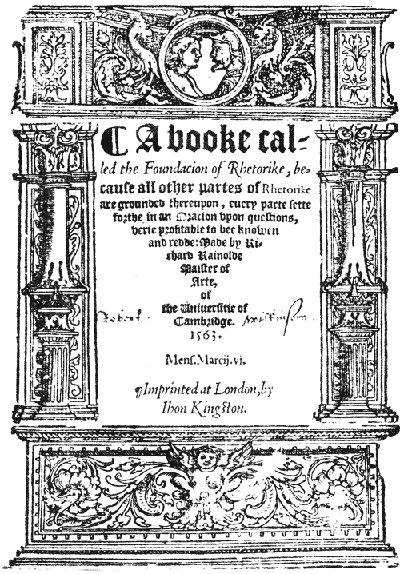 A booke called the Foundacion of Rhetorike / because all other partes of Rhetorike are grounded thereupon, euery parte sette forthe in an Oracion vpon questions, verie profitable to bee knowen and redde
by Richard Rainolde
A booke called the Foundacion of Rhetorike / because all other partes of Rhetorike are grounded thereupon, euery parte sette forthe in an Oracion vpon questions, verie profitable to bee knowen and redde
by Richard Rainolde