
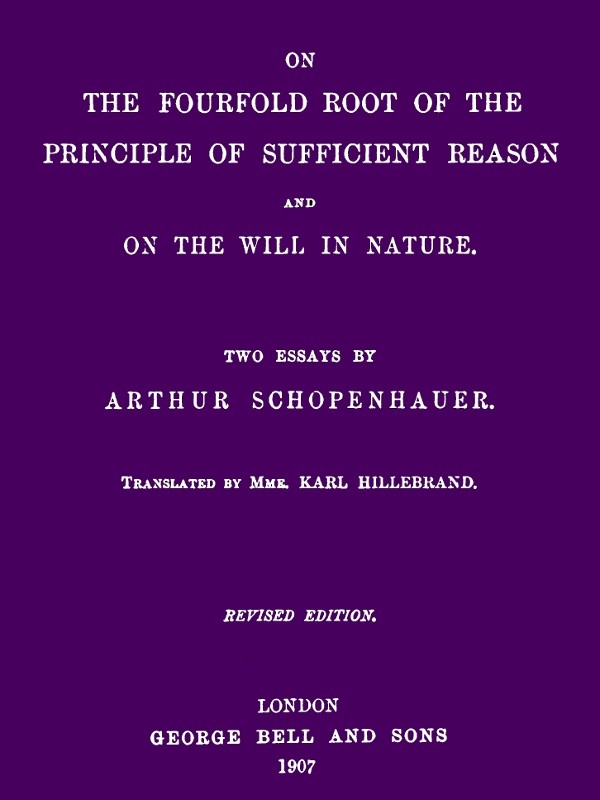
On the Fourfold Root of the Principle of Sufficient Reason, and On the Will in Nature: Two Essays (revised edition)
Explore more books like this:
About This Book
The first essay offers an analytic account of the principle that every fact requires a sufficient reason, distinguishing four distinct forms of that principle corresponding to different domains of explanation — grounding causation, the conditions of perception and spatial/mathematical relations, logical inference, and practical motivation — and showing how these forms delimit what can be known. The second essay treats natural phenomena as manifestations of a blind, striving will immanent in organisms and physical processes, arguing that teleology appears only as an expression of underlying will and exploring implications for biology, psychology, and the philosophy of nature.
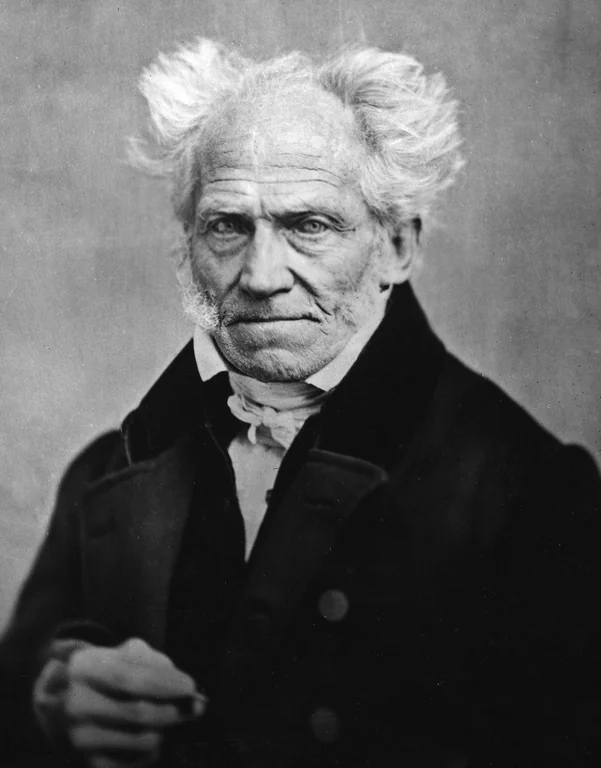
About the Author
More Books by This Author
6 picks
 Aphorismen zur Lebensweisheit
by Arthur Schopenhauer
Aphorismen zur Lebensweisheit
by Arthur Schopenhauer
 Aphorismes sur la sagesse dans la vie
by Arthur Schopenhauer
Aphorismes sur la sagesse dans la vie
by Arthur Schopenhauer
 Az akarat szabadságáról
by Arthur Schopenhauer
Az akarat szabadságáról
by Arthur Schopenhauer
 Essays of Schopenhauer
by Arthur Schopenhauer
Essays of Schopenhauer
by Arthur Schopenhauer
 Index of the Project Gutenberg Works of Arthur Schopenhauer
by Arthur Schopenhauer
Index of the Project Gutenberg Works of Arthur Schopenhauer
by Arthur Schopenhauer
 Kuolema ja kuolematon
by Arthur Schopenhauer
Kuolema ja kuolematon
by Arthur Schopenhauer
You May Also Like
6 picks
 "About My Father's Business": Work Amidst the Sick, the Sad, and the Sorrowing
by Thomas Archer
"About My Father's Business": Work Amidst the Sick, the Sad, and the Sorrowing
by Thomas Archer
 "Beautiful Thoughts"
by Henry Drummond
"Beautiful Thoughts"
by Henry Drummond
 "Bethink Yourselves!"
by graf Leo Tolstoy
"Bethink Yourselves!"
by graf Leo Tolstoy
 "How Can I Help to Abolish Slavery?" or, Counsels to the Newly Converted
by Maria Weston Chapman
"How Can I Help to Abolish Slavery?" or, Counsels to the Newly Converted
by Maria Weston Chapman
 "I Believe" and other essays
by Guy Thorne
"I Believe" and other essays
by Guy Thorne
 "Imperialism" and "The Tracks of Our Forefathers"
by Charles Francis Adams
"Imperialism" and "The Tracks of Our Forefathers"
by Charles Francis Adams