
WeRead Powered by ReaderPub
Printers' Marks: A Chapter in the History of Typography cover

Printers' Marks: A Chapter in the History of Typography

Chapter 1: PRINTERS’ MARKS.
Open in WeRead

Explore more books like this:

About This Book

A concise handbook surveying the origin, design, and use of printers’ marks, explaining how these devices evolved from simple trade emblems into ornamental and bibliographical features. The work documents and reproduces many examples, outlines criteria for selection, and treats regional varieties with chapters on England, France, Germany and Switzerland, the Low Countries, Italy, and Spain. It discusses artistic influences, links to book-plates and book illustration, and includes a substantial list of illustrations, notes on modern examples, and a bibliography to guide further study.

The Project Gutenberg eBook of Printers' Marks: A Chapter in the History of Typography

This ebook is for the use of anyone anywhere in the United States and most other parts of the world at no cost and with almost no restrictions whatsoever. You may copy it, give it away or re-use it under the terms of the Project Gutenberg License included with this ebook or online at www.gutenberg.org. If you are not located in the United States, you will have to check the laws of the country where you are located before using this eBook.

Title: Printers' Marks: A Chapter in the History of Typography

Author: W. Roberts

Release date: June 1, 2008 [eBook #25663]
Most recently updated: January 3, 2021

Language: English

Credits: Produced by Louise Hope, Stephen Hope and the Online
Distributed Proofreading Team at https://www.pgdp.net (This
file was produced from images generously made available
by The Internet Archive/American Libraries.)

*** START OF THE PROJECT GUTENBERG EBOOK PRINTERS' MARKS: A CHAPTER IN THE HISTORY OF TYPOGRAPHY ***

This text uses utf-8 (unicode) file encoding. If the apostrophes and quotation marks in this paragraph appear as garbage, you may have an incompatible browser or unavailable fonts. First, make sure that the browser’s “character set” or “file encoding” is set to Unicode (UTF-8). You may also need to change your browser’s default font.

Page numbers in italics show the original location of illustrations. Those in bold italics were full-page illustrations. In the body text and the List of Illustrations, links lead to the specific illustration, not to its original location.

Inconsistent capitalization of “mark” is as in the original. Other typographical errors are shown with mouse-hover popups.

The texts of most pictured Marks will appear in plain type if you hover your mouse over the picture. Expanded abbreviations are shown in [brackets]. Words split across line breaks are shown with or without hyphens, as originally printed. Texts that were too long or complicated to display in this way are collected at the end of the e-text.

Technical Note: The illustrations were scanned at 400ppi and scaled to 25% by pixel count. In most browsers they will therefore appear a little larger than originally printed.

PRINTERS’ MARKS.

Printers’ Marks

A Chapter in the History of
Typography by W. Roberts

Editor of “The Bookworm”

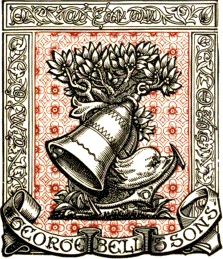
London: George Bell & Sons, York Street,
Covent Garden, & New York. Mdcccxciij.

CHISWICK PRESS: C. WHITTINGHAM AND CO., TOOKS COURT,
CHANCERY LANE.
TO

T. B. BOLITHO, ESQ., M.P.,

THIS VOLUME IS RESPECTFULLY
DEDICATED.