
Mercurii, 28º die Maij, 1823.
SIR THOMAS BARING, BART.
In the Chair.
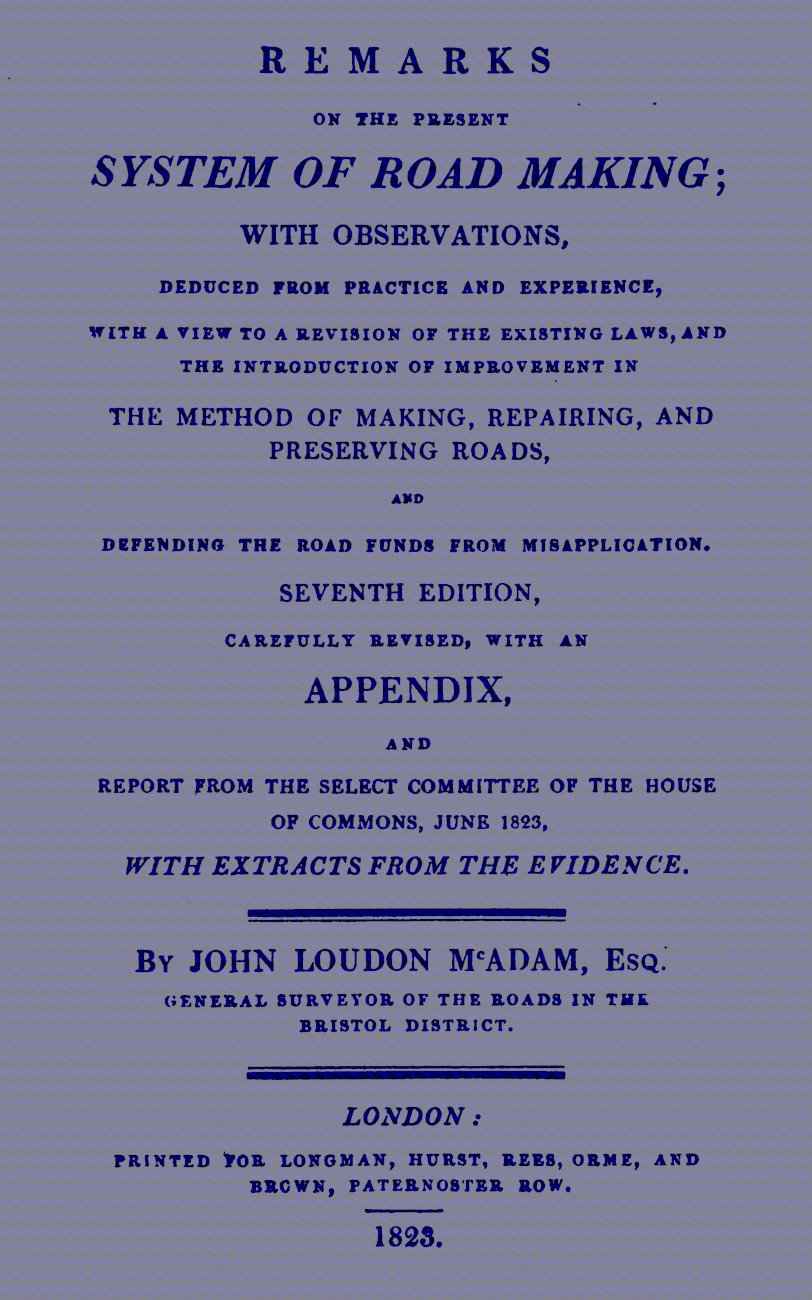
John Loudon MᶜAdam, Esquire, called in; and Examined.
You were formerly a magistrate, and commissioner of the roads in Scotland, were you not?—I was.
When did you first turn your attention to road making?—I was a commissioner and trustee of the roads in Scotland from the time of my return from America in the year 1783; and I naturally turned my attention to it there, because they had begun about twelve years before to make the roads turnpike, and they were carrying them on with considerable activity when I returned from America; and it appeared to me at that time, and all the time I was trustee, that there was a great deal of money expended needlessly, and with very little effect, on the roads, and that of course turned my attention to the cause. I began then to travel through different parts of the country to inspect the different managements of different parts of the road, first in Scotland, and then I went into England. In the year 1798, I came to live in England, at Bristol. I have no documents to prove my travelling before I came to reside in England in the year 1798. In 1798 I began to make it a sort of business. Without saying to any one what my object was, I travelled all over the country in different parts. I have a list of such of those places I travelled to that I happened to keep memorandums of, but I cannot possibly say all the places I travelled to.
How long were you occupied in travelling for the purpose of obtaining information for the construction of roads?—It was only occasional travelling of course. I had some other occupations and private affairs to look into. I began in the year 1798 to travel as often as I had leisure and convenience down to the time I took the charge of the Bristol roads, down to the year 1816, the beginning of 1816 or latter end of the year 1815.
What was the result of your observations and inquiry of the state of the roads?—I found the roads were extremely bad in all parts of Great Britain, as far back as the year 1798, and that very little improvement took place in them between that time and the year 1815, which I attributed to the ignorance of the persons who had the charge of them, the ignorance of the surveyors, the total want of science.
What were the objections which you found?—I found the materials so applied that the roads were all loose, and carriages, instead of passing over the roads, ploughed them; that was the general fault of the roads, and the loose state of the materials, I apprehend, was owing to the bad selection, the bad appropriation, and the unskilful laying of them. I came to that conclusion first, from observing that in some parts of the country where things were better managed, there were better roads; and I instanced the roads between Cross and Bridgewater, in Somersetshire; there I saw a better road than in most other parts of the country, and having inquired into their management, I found that they prepared their materials better. The next improvement that I saw in roads, was at Kendal, in Westmoreland, where I think the same result proceeded from the same cause. That led me to the conclusion, that under a better system of management a better road would be produced; and having gone to every part of the country, and inquired into the manner in which they made the roads, I formed a theory in my own mind. This theory I got leave to put in practice by being appointed to the care of the Bristol roads, of which I was a commissioner in January 1816.
Did you make any inquiry into the expenditure of money upon those roads, that you found in so bad a state?—I did.
What was the result of that inquiry?—I generally found that the expense was in proportion to the badness of the roads, not to their good quality, but as the roads were bad and badly managed the expense increased, and I found few roads that were not deeply in debt and in distress for money.
In what did the improvident expenditure consist?—I think principally in carting great quantities of unprepared materials, and putting them into the roads where they were not wanted; that was one source of needless expense; and then the materials being put in so bad a state did not last; the road went soon to pieces. I believe there was a great deal of other kind of prodigality, of a worse character than carelessness.
Did you find a larger quantity of materials put in the road than was necessary?—I did, in most instances; a much larger quantity than was necessary.
Did you discover, in any of the roads, that there were materials sufficient, if raised, to make a good road, without putting on the additional, quantity?—In a very great number, I think the greater number, I found a sufficient quantity of materials for giving them one good making, without any further addition.
Were these the whole of your observations on the state of the roads?—No. It is not very easy to explain to gentlemen, exactly, the particulars that I know to be wrong in roads; I found the water-ways, and things connected with keeping the roads dry, exceedingly neglected in the country.
Be so good as to state what defects you observed in the construction of the roads, besides those you have already mentioned?—I think the water-ways were extremely neglected, and the roads in general were covered with water, and many of them standing in wet. It was a practice formerly to dig a trench when they made the new road. There was a hollow way, and a great deal of the bad quality of roads in general was owing to the circumstance that the road was standing in water. I think that was one very great error formerly; but the roads were made upon no principle; there seemed to be no object; the persons who made them did not seem to understand there was some object to be gained; they had no other idea of mending a road than bringing a great quantity of material, and shooting it on the ground. When a road got into entire disrepair, the next thing was to bring a quantity of the same kind of unprepared material, and to shoot it upon the road.
Did you find that they made use of bad material when a better was to be procured?—I found that to be very universally the case, that the tops of the quarries, and that to be easily procured, was taken in general, and the best stone left behind. I am afraid that is too much the custom in the country still.
Did you find they put these materials on the road in an unprepared and unfit state?—I did; they were not broken, nor in many cases cleaned.
Have you any thing further to state with regard to the construction of the road?—No; I do not recollect any thing further I can state.
What inquiry did you make into the management of the funds of the different trusts?—I made it a business to inquire generally of the surveyors, workmen, and people on the roads, as to the expense of materials, cartage, day-labour, and then I took what pains I could with gentlemen of the country, to inquire into the state of the funds: with surveyors and other officers of trusts, I found a jealousy and an unwillingness every where to give me information. An unauthorized individual finds it extremely difficult to procure information of that sort, and I found it so; a very great unwillingness to inform.
What class of persons did you find in the situation of surveyors on the road?—Always, I think, almost without exception, very low people, many of them old servants, ruined tradesmen, people without that kind of energy and character which I think is absolutely necessary for such a service.
Did you make any inquiry into the mode of the performance of statute labour?—Yes; I inquired very particularly about that, and I found the statute labour, when called for, was sent by the farmer to the roads, but the people seldom did above half a day’s work; and though the farmer lost the service of his servants and team, the public did not get it; it was a heavier oppression on the country than benefit to the roads.
Did you find, in collecting the materials, that there was any deficiency, or any mismanagement, on the part of those who superintended it?—I had very great reason to believe, that in most instances the country was imposed on.
Have you any knowledge of it?—No, I have no knowledge; I had no legal means of taking such measures as should have made me so certain as to be able to give evidence to it.
What extent of turnpike road is there in England and Wales?—On my first examination before a Committee of this House, I stated my opinion to be 25,000 miles; but I see, from a corrected state of the returns made to parliament, which I made out, that the number is 24,599 miles.
Do you know what sum is annually expended upon these roads?—The annual income has been ascertained by the same returns to be 1,282,715l.
Can you state what part of the sum goes to the payment of the interest of the debt, and what is applied to the improvement of the road?—The mortgage debt in the kingdom is 6,036,502l.; but there is a large sum due to treasurers, and balances of interest, which is also bearing interest, amounting to 569,041l. The whole debt that bears interest is 6,605,543l.
What is the amount of tolls?—1,282,715l.
What do you compute the expense of statute labour at?—I never have made any guess at it; for two reasons, statute labour is so difficult to guess at; and the proportion given to the turnpike roads is so different in different parts of the country, under local Acts, and under the general Act; but in the roads under my management it amounts to about five per cent. of the toll-duty.
Mr. James MᶜAdam, Examined.
Have you in any instance tried the experiment of converting paved streets into roads?—I have in several instances taken up small pieces of pavement that I found upon the several road trusts, and substituted road. In the town of Stamford I took a piece up of considerable extent, which is now road instead of the pavement.
What has been the effect of the conversion of the pavement into road?—The expense has considerably diminished, and facility of travelling very considerably increased.
Has any suggestion been made to you of converting the pavement of any part of the streets of London into road?—I have been ordered, by the Parliamentary commissioners having charge of Westminster Bridge, to prepare an estimate and report, with a view to convert that pavement into a broken stone road, which documents I have furnished; and I have reason to believe that the same will be immediately carried into effect. I have been also directed by the trustees and proprietors of St. James’s square, to prepare (which I have done) the same documents, with a view to substitute a broken stone road in St. James’s square, in lieu of the present pavement.
What is your opinion of the effect that would be found from its being carried into execution in all the streets of London, as to the reduction of expense, and benefit generally to the public?—I consider that the expense would be most materially reduced; the convenience of passing over the surface, there could be no doubt, would be generally facilitated, and made more convenient, particularly in the great leading streets, such as Piccadilly, Pall-mall, Parliament street and Whitehall, and others of that description; the expense of the same weight of stone now put upon those streets as pavement would be obtained at infinitely less expense, in a different form, for the purpose of road-making.
Is it your plan to raise the present pavement, and convert that pavement into materials for making the road, or to bring new materials and dispose of the pavement?—For Westminster Bridge I recommended to the trustees to sell the present pavement, because as long as pavements continue to be generally used, stone in that shape and size will always be valuable, and the same weight of granite I could obtain for the formation of the road over the bridge at 10s. 6d. per ton, the present pavement being worth a guinea per ton; but were the streets of London generally taken up, pavement would of course become of less value, and it might be broken for the formation of the roads.
Is that pavement of a quality calculated to make good roads?—The best material in the kingdom.
What proportion would the pavement now used in the streets of London bear to the materials necessary to the formation of the roads?—There would be sufficient for the formation of a strong durable road in the first instance; and I estimate that a supply of materials for the future care of the road, for a considerable time, would be left.
Would that answer in all the small streets of the metropolis as well as for the large and open streets?—I think not so well in the very narrow streets, which are liable to water, and where, from the width of the street, the thoroughfare must necessarily be upon one given spot. I beg, however, to observe, that the thoroughfare in those streets is extremely small.
Would the dust be increased or diminished by this alteration?—I consider, that upon a well made stone road, with the same care of cleansing and watering that is given to the streets, that the annoyance from dust would be infinitely less; and a road is more susceptible of retaining the water than pavement.
What would be the proportion of the annual expense between the paved street and the road?—Taking seven years, during which time I calculate that the pavement gets worn out, I should think the annual expense of the road would not be one fifth part, because in that seven years the whole value of the pavement is nearly lost.
What would be the effect produced upon the necessity of raising the road for the purpose of alteration of the pipes and other works under the street?—At present, when this operation is necessary, a paviour, whose wages are from five to six shillings a-day, is required. Were the streets converted into stone roads, a labourer at eighteen-pence a-day would perform the same service; and by due care in laying the materials on one side, and the earth on the other, the injury to the road would be extremely small, and the spot would very soon become obliterated; whereas in raising a part of a paved street it is quite impossible ever to unite the piece so raised with the rest of the pavement.
Supposing the pavement to be converted into a road, in that case, would it be necessary, when any pipe was repairing, to stop up the way to prevent carriages and horses passing?—Certainly not more so than at present, as that circumstance must always depend upon the width of the street. In very narrow streets, where the pipe lies in the centre, a large opening is necessary; it would follow as a matter of course that the street must be stopped; but upon large streets one side would be left free.
Would not a repair be more rapidly executed, supposing the way to be a road instead of a street?—Were the streets converted into roads, the repair of the roads would be almost unknown to the public, and no stoppage whatever would take place; the repair of such roads would be limited to a one-inch coat at a time, which would scarcely be known to persons passing in carriages, and the great inconvenience at present constantly felt in every part of this large metropolis by the necessity of repaving the streets would cease.
You assume that the roads for the streets in London must be made with granite?—Most assuredly, I should never recommend any other material to be made use of for the roads in the town.
Mr. William MᶜAdam, further Examined.
Have you, in the course of your practice, converted any paved street into a road?—Yes, I have; Fore-street Hill, in Exeter, forms part of that turnpike trust; it is very steep, and was exceedingly slippery, so much so, that I never rode on horseback down it myself till it was converted into a stone road; it has been so for a year or two; it has answered every purpose, and stood remarkably well, and by being watered a little in very dry weather, I believe there is less inconvenience found from dust than when it was paved. I have heard some gentlemen say, that in coming up that hill with their carriages, it not being above a furlong and a half or two furlongs in length, they have saved from five to ten minutes time since it was made road; and I have heard coachmen say, that when they brought their horses quite cool to the bottom of that hill, they have been quite in a lather by the time they got to the top of it, from the terror of the horses in slipping about.
That was when it was paved?—Yes.
What kind of stone do you use for making that road?—The pebble of the country, picked from the gravel pits.
Have you converted any other part of Exeter from pavement into road?—There is no other part of Exeter under the care of the trust; but in consequence of the effect which the Chamber of Exeter saw in Fore-street, they have broken up a great many of the streets in Exeter, and, I believe, are proceeding gradually to do them all. In the town of Newton-Abbot there is a county bridge; the county have broken up the bridge bands, and converted it in a similar manner.
John Loudon MᶜAdam, Esq. further Examined.
Have you, in any instance, made the alteration stated by your sons?—Yes, I have; I found the suburbs of Bristol were entirely paved when I took charge of the roads of the district; those suburbs are within the jurisdiction of the commissioners for the care of turnpike roads; and I found the expense of paving was very heavy, and the effect very bad, and I at once took the whole pavement up, and broke the stone that I found there into a stone road, up to the jurisdiction of the magistrates.
Was that granite stone?—No, a kind of stone called the blue pennet in that county, and part of a light stone called Brandon Hill stone; both tolerably good stones: the blue pennet is certainly not so good as granite; the Brandon Hill stone, when broken, is pretty nearly as good as granite. But those suburbs having been taken up, and given great satisfaction the year before last, the magistrates took up half of the street, called Stoke’s Croft, which is the great entrance of the town from Gloucestershire. The inhabitants were very much afraid of dust; and therefore they requested the magistrates not to take up the whole of the street, but to make an experiment on one half of it, and after a year’s experiment they consented to the whole being taken up. When I left Bristol, which is now three months ago, they were busy taking up the remainder of that street; and I understood it was the intention of the magistrates to proceed gradually to take up a great number of other streets in the town.
Do you know what difference it has made in the expense?—That part of the suburbs that was lifted, and laid again with the same stone broken, cost 5d. a square yard for doing it. I took up the stone; I had nothing to purchase; the stone that came out of the streets fully made the road, and we had a little remaining for repair afterwards, and that operation cost 5d. a square yard; paving, in the city of Bristol, cost 5s. 6d. a square yard when stone is found by the paviour, and I believe they reckon the laying down to be eighteen-pence of that.
What would be the difference of expense annually between & paved street and a road?—I think that road required no repair for the first three years after it was done.
A paved street would require no repair for seven years after it was done?—I think we repaired it for about a fifth part of the money, when it required repair, that a pavement would have cost. We seldom find our streets in Bristol last above three years; the pavements become rugged, and full of holes, and so on; they are obliged to be taken up, and they relay them generally once in three years. There is another street in Bristol which has been taken up, but I cannot recollect the name of it; it goes from Stoke’s Croft to Kingston; it has been taken up by the magistrates, not under my direction.
Has any objection been taken by any person to the alteration that has been made at Bristol?—No, except the alarm that the inhabitants of Stone Croft had when it was begun to be done, and they got the magistrates to delay doing more than half of it till they were satisfied that it would not inconvenience them; and the circumstance of their sending a request to the magistrates to finish it induces me to believe that they were very much satisfied with the experiment. Park-street, in Bristol, has been done in that way for, I think, seventeen years; I was then a commissioner for watching and paving the streets of Bristol.
Who did it?—It was done at the expense of the commissioners for watching and paving, at my wish, and I certainly did superintend it, though I had nothing to do with it more than any other commissioner had. It is a street many gentlemen know very well; it is a public road from Bristol to the Park, and very steep; I believe it is a rise of three inches in a yard, and when paved was so very dangerous and slippery that many accidents arose from it, and now it is a very good road indeed, and I do not believe that it cost upon an average, since that alteration, more than one fourth of what it used to do.
What stone was it paved with before?—Black rock-stone, a species of limestone.