WeRead Powered by ReaderPub
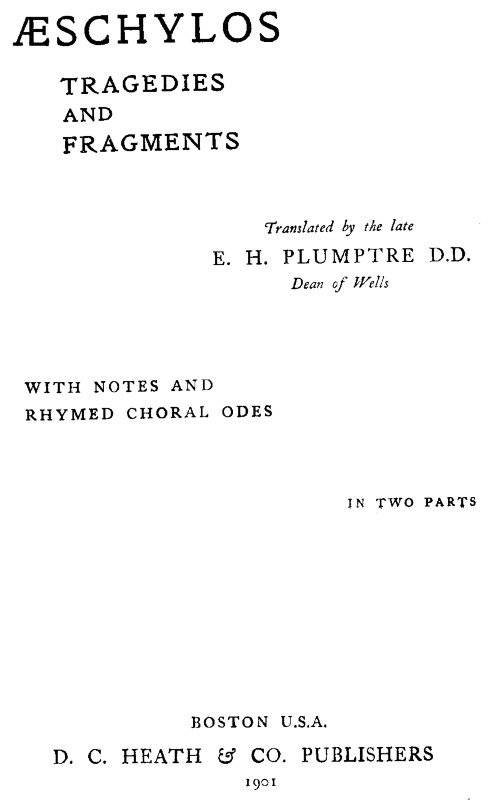
Æschylos Tragedies and Fragments cover

Æschylos Tragedies and Fragments

Chapter 13: DRAMATIS PERSONÆ
Open in WeRead

Explore more books like this:

About This Book

A curated edition gathers the seven surviving tragedies of an early Greek dramatist, accompanied by fragmentary remains, translator’s notes, and alternative choral renderings. The dramas range from a firsthand-style account of military catastrophe to mythic treatments of divine resistance, enforced exile, supplication, and the transition from private vengeance to public adjudication. Formal features include prominent choral odes, austere staging effects, and elevated poetic rhetoric, with the translator experimenting in metre and providing annotations. Recurring concerns are the tension between divine law and human agency, communal ritual, and the foundations of civic order.

THE SUPPLIANTS

DRAMATIS PERSONÆ

Danaos
Herald
Pelasgos, king of Argos
Chorus of the daughters of Danaos

ARGUMENT.—When Io, after many wanderings, had found refuge in Egypt, and having been touched by Zeus, had given birth to Epaphos, it came to pass that he and his descendants ruled over the region of Canôpos, near one of the seven mouths of Neilos. And in the fifth generation there were two brothers, Danaos and Ægyptos, the sons of Belos, and the former had fifty daughters and the latter fifty sons, and Ægyptos sought the daughters of Danaos in marriage for his sons. And they, looking on the marriage as unholy, and hating those who wooed them, took flight and came to Argos, where Pelasgos then ruled as king, as to the land whence Io, from whom they sprang, had come. And thither the sons of Ægyptos followed them in hot pursuit.

Scene.—Argos, the entrance of the gates. Statues of Zeus,
Artemis, and other Gods, placed against the walls

Enter Chorus of the Daughters of Danaos,[206] in the dress of Egyptian women, with the boughs of suppliants in their hands, and fillets of white wool twisted round them, chanting as they move in procession to take up their position round the thymele

Zeus, the God of Suppliants, kindly
Look on this our band of wanderers,
That from banks at mouths of Neilos,
Banks of finest sand, departed![207]
Yea, we left the region sacred,
Grassy plain on Syria's borders,[208]
Not for guilt of blood to exile
By our country's edict sentenced,
But with free choice, loathing wedlock,
Fleeing marriage-rites unholy
With the children of Ægyptos.
10
And our father Danaos, ruler,
Chief of council, chief of squadrons,
Playing moves on fortune's draught-board,[209]
Chose what seemed the best of evils,
Through the salt sea-waves to hasten,
Steering to the land of Argos,
Whence our race has risen to greatness;
Sprung, so boasts it, from the heifer
Whom the stinging gadfly harassed,
By the touch of Zeus love-breathing:[210]
And to what land more propitious
Could we come than this before us,
20
Holding in our hand the branches
Suppliant, wreathed with white wool fillets?
O State! O land! O water gleaming!
Ye the high Gods, ye the awful,
In the dark the graves still guarding;
Thou too with them, Zeus Preserver,[211]
Guardian of the just man's dwelling,
Welcome with the breath of pity,
Pity as from these shores wafted,
Us poor women who are suppliants.
And that swarm of men that follow,
Haughty offspring of Ægyptos,
30
Ere they set their foot among you
On this silt-strown shore,[212]—oh, send them
Seaward in their ship swift-rowing;
There, with whirlwind tempest-driven,
There, with lightning and with thunder,
There, with blasts that bring the storm-rain,
May they in the fierce sea perish,
Ere they, cousin-brides possessing,
Rest on marriage-beds reluctant,
Which the voice of right denies them!
Strophe I
And now I call on him, the Zeus-sprung steer,[213]
40
Our true protector, far beyond the sea,
Child of the heifer-foundress of our line,
Who cropped the flowery mead,
Born of the breath, and named from touch of Zeus.
*And lo! the destined time
*Wrought fully with the name,
And she brought forth the “Touch-born,” Epaphos.
Antistrophe I
And now invoking him in grassy fields,
50
Where erst his mother strayed, to dwellers here
Telling the tale of all her woes of old,
I surest pledge shall give;
And others, strange beyond all fancy's dream,
Shall yet perchance be found;
And in due course of time
Shall men know clearly all our history.
Strophe II
And if some augur of the land be near,
Hearing our piteous cry,
Sure he will deem he hears
The voice of Tereus' bride,[214]
Piteous and sad of soul,
The nightingale sore harassed by the kite.
60
Antistrophe II
*For she, driven back from wonted haunts and streams,[215]
Mourns with a strange new plaint
The home that she has lost,
And wails her son's sad doom,
How he at her hand died,
Meeting with evil wrath unmotherly;
Strophe III
E'en so do I, to wailing all o'er-given,
In plaintive music of Ionian mood,[216]
*Vex the soft cheek on Neilos' banks that bloomed,
And heart that bursts in tears,
And pluck the flowers of lamentations loud,
Not without fear of friends,
70
*Lest none should care to help
This flight of mine from that mist-shrouded shore.
Antistrophe III
But, O ye Gods ancestral! hear my prayer,
Look well upon the justice of our cause,
Nor grant to youth to gain its full desire
Against the laws of right,
But with prompt hate of lust, our marriage bless.
*Even for those who come
As fugitives in war
The altar serves as shield that Gods regard.
Strophe IV
May God good issue give![217]
80
And yet the will of Zeus is hard to scan:
Through all it brightly gleams,
E'en though in darkness and the gloom of chance
For us poor mortals wrapt.
Antistrophe IV
Safe, by no fall tripped up,
The full-wrought deed decreed by brow of Zeus;
For dark with shadows stretch
The pathways of the counsels of his heart,
And difficult to see.
Strophe V
And from high-towering hopes He hurleth down
90
To utter doom the heir of mortal birth;
Yet sets He in array
No forces violent;
All that Gods work is effortless and calm:
Seated on holiest throne,
Thence, though we know not how,
He works His perfect will.
Antistrophe V
Ah, let him look on frail man's wanton pride,
With which the old stock burgeons out anew,
By love for me constrained,
In counsels ill and rash,
100
And in its frenzied, passionate resolve
Finds goad it cannot shun;
But in deceivèd hopes,
Shall know, too late, its woe.
Strophe VI
Such bitter griefs, lamenting, I recount,
With cries shrill, tearful, deep,
(Ah woe! ah woe!)
That strike the ear with mourner's woe-fraught cry.
Though yet alive, I wail mine obsequies;
Thee, Apian sea-girt bluff,[218]
I greet (our alien speech
Thou knowest well, O land,)
110
And ofttimes fall, with rendings passionate,
On robe of linen and Sidonian veil.
Antistrophe VI
But to the Gods, for all things prospering well,
When death is kept aloof,
Gifts votive come of right.
Ah woe! Ah woe!
Oh, troubles dark, and hard to understand!
Ah, whither will these waters carry me?
Thee, Apian sea-girt bluff,
120
I greet (our alien speech
Thou knowest well, O land,)
And ofttimes fall, with rendings passionate,
On robe of linen and Sidonian veil.
Strophe VII
The oar indeed and dwelling, timber-wrought,
With sails of canvas, 'gainst the salt sea proof
Brought me with favouring gales,
By stormy wind unvexed;
Nor have I cause for murmur. Issues good
May He, the all-seeing Father, grant, that I,
130
Great seed of Mother dread,
In time may 'scape, still maiden undefiled,
My suitor's marriage-bed.
Antistrophe VII
And with a will that meets my will may She,
The unstained child of Zeus, on me look down,
*Our Artemis, who guards
The consecrated walls;
And with all strength, though hunted down, uncaught,
May She, the Virgin, me a virgin free,
140
Great seed of Mother dread,
That I may 'scape, still maiden undefiled,
My suitor's marriage-bed.
Strophe VIII
But if this may not be,
We, of swarth sun-burnt race,
Will with our suppliant branches go to him,
Zeus, sovereign of the dead,[219]
The Lord that welcomes all that come to him,
Dying by twisted noose
150
If we the grace of Gods Olympian miss.
By thine ire, Zeus, 'gainst Io virulent,
The Gods' wrath seeks us out,
And I know well the woe
Comes from thy queen who reigns in heaven victorious;
For after stormy wind
The tempest needs must rage.
Antistrophe VIII
And then shall Zeus to words
Unseemly be exposed,
Having the heifer's offspring put to shame,
160
Whom he himself begat,
And now his face averting from our prayers:
Ah, may he hear on high,
Yea, pitying look and hear propitiously!
By thine ire, Zeus, 'gainst Io virulent,
The Gods' wrath seeks us out,
And I know well the woe
Comes from thy queen, who reigns in heaven victorious;
For after stormy wind
170
The tempest needs must rage.
Danaos. My children, we need wisdom; lo! ye came
With me, your father wise and old and true,
As guardian of your voyage. Now ashore,
With forethought true I bid you keep my words,
As in a tablet-book recording them:
I see a dust, an army's voiceless herald,
Nor are the axles silent as they turn;
And I descry a host that bear the shield,
And those that hurl the javelin, marching on
With horses and with curvèd battle-cars.
Perchance they are the princes of this land,
180
Come on the watch, as having news of us;
But whether one in kindly mood, or hot
With anger fierce, leads on this great array,
It is, my children, best on all accounts
To take your stand hard by this hill of Gods
Who rule o'er conflicts.[220] Better far than towers
Are altars, yea, a shield impenetrable.
But with all speed approach the shrine of Zeus,
The God of mercy, in your left hand holding
The suppliants' boughs wool-wreathed, in solemn guise,[221]
And greet our hosts as it is meet for us,
190
Coming as strangers, with all duteous words
Kindly and holy, telling them your tale
Of this your flight, unstained by guilt of blood;
And with your speech, let mood not overbold,
Nor vain nor wanton, shine from modest brow
And calm, clear eye. And be not prompt to speak,
Nor full of words; the race that dwelleth here
Of this is very jealous:[222] and be mindful
Much to concede; a fugitive thou art,
A stranger and in want, and 'tis not meet
That those in low estate high words should speak.
Chor. My father, to the prudent prudently
200
Thou speakest, and my task shall be to keep
Thy goodly precepts. Zeus, our sire, look on us!
Dan. Yea, may He look with favourable eye!
Chor. I fain would take my seat not far from thee.
[Chorus moves to the altar not far from
Danaos
Dan. Delay not then; success go with your plan.
Chor. Zeus, pity us with sorrow all but crushed!
Dan. If He be willing, all shall turn out well.
Chor. . . . . .
Dan. Invoke ye now the mighty bird of Zeus.[223]
Chor. We call the sun's bright rays to succour us.
Dan. Apollo too, the holy, in that He,
210
A God, has tasted exile from high heaven.[224]
Chor. Knowing that fate, He well may feel for men.
Dan. So may He feel, and look on us benignly!
Chor. Whom of the Gods shall I besides invoke?
Dan. I see this trident here, a God's great symbol.[225]
Chor. Well hath He brought us, well may He receive!
Dan. Here too is Hermes,[226] as the Hellenes know him.
Chor. To us, as free, let Him good herald prove.
Dan. Yea, and the common shrine of all these Gods
Adore ye, and in holy precincts sit,
Like swarms of doves in fear of kites your kinsmen,
220
Foes of our blood, polluters of our race.
How can bird prey on bird and yet be pure?
And how can he be pure who seeks in marriage
Unwilling bride from father too unwilling?
Nay, not in Hades' self, shall he, vain fool,
Though dead, 'scape sentence, doing deeds like this;
For there, as men relate, a second Zeus[227]
Judges men's evil deeds, and to the dead
Assigns their last great penalties. Look up,
And take your station here, that this your cause
May win its way to a victorious end.
Enter the King on his chariot, followed by Attendants
King. Whence comes this crowd, this non-Hellenic band,
230
In robes and raiment of barbaric fashion
So gorgeously attired, whom now we speak to?
This woman's dress is not of Argive mode,
Nor from the climes of Hellas. How ye dared,
Without a herald even or protector,
Yea, and devoid of guides too, to come hither
Thus boldly, is to me most wonderful.
And yet these boughs, as is the suppliant's wont,
Are set by you before the Gods of conflicts:
By this alone will Hellas guess aright.
Much more indeed we might have else conjectured,
240
Were there no voice to tell me on the spot.
Chor. Not false this speech of thine about our garb;
But shall I greet thee as a citizen,
Or bearing Hermes' rod, or city ruling?[228]
King. Nay, for that matter, answer thou and speak
Without alarm. Palæchthon's son am I,
Earth-born, the king of this Pelasgic land;
And named from me, their king,[229] as well might be,
The race Pelasgic reaps our country's fruits;
*And all the land through which the Strymon pours
250
Its pure, clear waters to the West I rule;
And as the limits of my realm I mark
The land of the Perrhæbi, and the climes
Near the Pæonians, on the farther side
Of Pindos, and the Dodonæan heights;[230]
And the sea's waters form its bounds. O'er all
Within these coasts I govern; and this plain,
The Apian land, itself has gained its name
Long since from one who as a healer lived;[231]
For Apis, coming from Naupactian land
That lies beyond the straits, Apollo's son,
Prophet and healer, frees this land of ours
260
From man-destroying monsters, which the soil,
Polluted with the guilt of blood of old,
By anger of the Gods, brought forth,—fierce plagues,
The dragon-brood's dread, unblest company;
And Apis, having for this Argive land
Duly wrought out his saving surgery,
Gained his reward, remembered in our prayers;
And thou, this witness having at my hands,
May'st tell thy race at once, and further speak;
Yet lengthened speech our city loveth not.
Chor. Full short and clear our tale. We boast that we
Are Argives in descent, the children true
270
Of the fair, fruitful heifer. And all this
Will I by what I speak show firm and true.
King. Nay, strangers, what ye tell is past belief
For me to hear, that ye from Argos spring;
For ye to Libyan women are most like,[232]
And nowise to our native maidens here.
Such race might Neilos breed, and Kyprian mould,
Like yours, is stamped by skilled artificers
On women's features; and I hear that those
Of India travel upon camels borne,
280
Swift as the horse, yet trained as sumpter-mules,
E'en those who as the Æthiops' neighbours dwell.
And had ye borne the bow, I should have guessed,
Undoubting, ye were of th' Amâzon's tribe,
Man-hating, flesh-devouring. Taught by you,
I might the better know how this can be,
That your descent and birth from Argos come.
Chor. They tell of one who bore the temple-keys
Of Hera, Io, in this Argive land.
King. So was't indeed, and wide the fame prevails:
And was it said that Zeus a mortal loved?
290
Chor. And that embrace was not from Hera hid.
King. What end had then these strifes of sovereign Ones?
Chor. The Argive goddess made the maid a heifer.
King. Did Zeus that fair-horned heifer still approach?
Chor. So say they, fashioned like a wooing steer.
King. How acted then the mighty spouse of Zeus?
Chor. She o'er the heifer set a guard all-seeing.
King. What herdsman strange, all-seeing, speak'st thou of?
Chor. Argos, the earth-born, him whom Hermes slew.
300
King. What else then wrought she on the ill-starred heifer?
Chor. She sent a stinging gadfly to torment her.
[Those who near Neilos dwell an æstros call it.]
King. Did she then drive her from her country far?
Chor. All that thou say'st agrees well with our tale.
King. And did she to Canôbos go, and Memphis?
Chor. Zeus with his touch, an offspring then begets.
King. What Zeus-born calf that heifer claims as mother?
Chor. *He from that touch which freed named Epaphos.
310
King. [What offspring then did Epaphos beget?][233]
Chor. Libya, that gains her fame from greatest land.
King. What other offspring, born of her, dost tell of?
Chor. Sire of my sire here, Belos, with two sons.
King. Tell me then now the name of yonder sage.
Chor. Danaos, whose brother boasts of fifty sons.
King. Tell me his name, too, with ungrudging speech.
Chor. Ægyptos: knowing now our ancient stock,
Take heed thou bid thine Argive suppliants rise.
King. Ye seem, indeed, to make your ancient claim
To this our country good: but how came ye
320
To leave your father's house? What chance constrained you?
Chor. O king of the Pelasgi, manifold
Are ills of mortals, and thou could'st not find
The self-same form of evil anywhere.
Who would have said that this unlooked-for flight
Would bring to Argos race once native here,
Driving them forth in hate of wedlock's couch?
King. What seek'st thou then of these the Gods of conflicts,
Holding your wool-wreathed branches newly-plucked?
Chor. That I serve not Ægyptos' sons as slave.
King. Speak'st thou of some old feud, or breach of right?
330
Chor. Nay, who'd find fault with master that one loved?
King. Yet thus it is that mortals grow in strength.[234]
Chor. True; when men fail, 'tis easy to desert them.
King. How then to you may I act reverently?
Chor. Yield us not up unto Ægyptos' sons.
King. Hard boon thou ask'st, to wage so strange a war.
Chor. Nay, Justice champions those who fight with her.
King. Yes, if her hand was in it from the first.
Chor. Yet reverence thou the state-ship's stern thus wreathed.[235]
King. I tremble as I see these seats thus shadowed.
340

Strophe I
Chor. Dread is the wrath of Zeus, the God of suppliants:
Son of Palæchthon, hear;
Hear, O Pelasgic king, with kindly heart.
Behold me suppliant, exile, wanderer,
*Like heifer chased by wolves
Upon the lofty crags,
Where, trusting in her strength,
She lifteth up her voice
And to the shepherd tells her tale of grief.
King. I see, o'ershadowed with the new-plucked boughs,
*Bent low, a band these Gods of conflict own;
And may our dealings with these home-sprung strangers
350
Be without peril, nor let strife arise
To this our country for unlooked-for chance
And unprovided! This our State wants not.
Antistrophe I
Chor. Yea, may that Law that guards the suppliant's right
Free this our flight from harm,
Law, sprung from Zeus, supreme Apportioner,
But thou, [to the King,] though old, from me, though younger, learn:
If thou a suppliant pity
Thou ne'er shall penury know,
So long as Gods receive
Within their sacred shrines
Gifts at the hands of worshipper unstained.
King. It is not at my hearth ye suppliant sit;
But if the State be as a whole defiled,
360
Be it the people's task to work the cure.
I cannot pledge my promise to you first
Ere I have counselled with my citizens.[236]
Strophe II
Chor. Thou art the State—yea, thou the commonwealth,
Chief lord whom none may judge;
'Tis thine to rule the country's altar-hearth,
With the sole vote of thy prevailing nod;
And thou on throne of state,
Sole-sceptred in thy sway,
Bringest each matter to its destined end;
Shun thou the curse of guilt.
King. Upon my foes rest that dread curse of guilt!
370
Yet without harm I cannot succour you,
Nor gives it pleasure to reject your prayers.
In a sore strait am I; fear fills my soul
To take the chance, to do or not to do.
Antistrophe II
Chor. Look thou on Him who looks on all from heaven,
Guardian of suffering men
Who, worn with toil, unto their neighbours come
As suppliants, and receive not justice due:
For these the wrath of Zeus,
Zeus, the true suppliant's God,
Abides, by wail of sufferer unappeased.
380
King. Yet if Ægyptos' sons have claim on thee
By their State's law, asserting that they come
As next of kin, who dare oppose their right?
Thou must needs plead that by thy laws at home
They over thee have no authority.[237]
Strophe III
Chor. Ah! may I ne'er be captive to the might
Of males! Where'er the stars
Are seen in heaven, I track my way in flight,
As refuge from a marriage that I hate.
But thou, make Right thy friend,
And honour what the Gods count pure and true.
390
King. Hard is the judgment: choose not me as judge.
But, as I said before, I may not act
Without the people, sovereign though I be,
Lest the crowd say, should aught fall out amiss,
“In honouring strangers, thou the State did'st ruin.”
Antistrophe III
Chor. Zeus, the great God of kindred, in these things
Watches o'er both of us,
Holding an equal scale, and fitly giving
To the base evil, to the righteous blessing.
Why, when these things are set
In even balance, fear'st thou to do right?
400
King. Deep thought we need that brings deliverance,
That, like a diver, mine eye too may plunge
Clear-seeing to the depths, not wine-bedrenched,
That these things may be harmless to the State,
And to ourselves may issue favourably:
That neither may the strife make you its prey,
Nor that we give you up, who thus are set
Near holy seat of Gods, and so bring in
To dwell with us the Avenger terrible,
God that destroyeth, who not e'en in Hades
410
Gives freedom to the dead. Say, think ye not
That there is need of counsel strong to save?
Strophe I
Chor. Take heed to it, and be
Friend to the stranger wholly faithful found;
Desert not thou the poor,
Driven from afar by godless violence.
Antistrophe I
See me not dragged away,
O thou that rul'st the land! from seat of Gods:
Know thou men's wanton pride,
420
And guard thyself against the wrath of Zeus.
Strophe II
Endure not thou to see thy suppliant,
Despite of law, torn off,
As horses by their frontlets, from the forms
Of sculptured deities,
Nor yet the outrage of their wanton hands,
Seizing these broidered robes.