
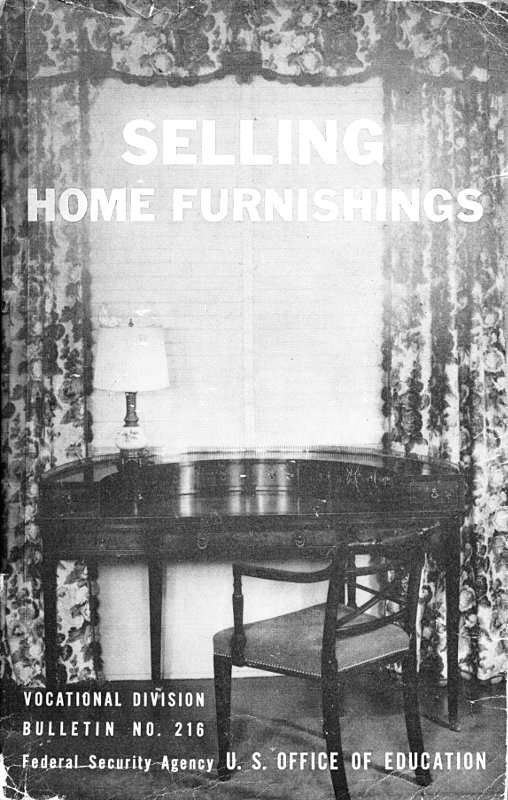
Unit I
THE SALESMAN AS A BUSINESS BUILDER
- Specialized Selling of Home Furnishings as a Career
- Increasing Sales and Earnings
- Fundamentals for Good Selling
- The Daily Check-up—A Perpetual Inventory
Figure 1.—Contemporary French grouping is expressed in this attractive chair with natural finished wood frame, tufted back, and rust figured beige damask upholstery. The combined lamp stand and plant table is a modern favorite.
SELLING HOME FURNISHINGS
Unit I.—THE SALESMAN AS A BUSINESS BUILDER
SPECIALIZED SELLING OF HOME FURNISHINGS AS A CAREER
Selling home furnishings at retail is one of the most pleasant and fascinating of occupations. It is clean work, physically agreeable, mentally stimulating, and free from deadening routine. Moreover, it is a growing field with limitless possibilities. True, there always will be malcontents who proclaim that the people of America are losing interest in their homes, that restless excitement is their god. Facts indicate, however, that our people are turning their thoughts and aspirations, in increasing measure, to the enduring satisfactions of the home.
MODERN METHODS ARE DESIGNED TO MEET CHANGING CONDITIONS
All available data on buying habits indicate that selling methods should be revised to meet the buyer's interest as it shifts from what furniture is to what furniture will do. This is a logical development. For many years American women have been influenced by the cleverest advertising in the world to desire and to buy finished products on the basis of performance and with little or no concern as to how they are made. To these women, rugs, chairs, tables, and lamps are parts whose interest depends chiefly on how they are combined with other parts to form harmonious wholes. According to a number of comprehensive surveys, three out of every five women who are interested in furniture are concerned chiefly with its effect in making their homes more attractive. If this is true, those who sell home furnishings must have a sound knowledge not only of their merchandise but also of the art of arranging and combining that merchandise to insure comfort and beauty in completely furnished rooms.
This specialized selling of home furnishings as a career, therefore, means mastery of the art of interior decoration. If interior decoration be defined as the sum of the processes by which a home is made beautiful to look at and comfortable to live in, then all who sell home furnishings must understand style, design, materials, and construction. Every furniture salesman who consistently maintains a high sales volume as a result of his own skill will be found to employ the methods of the interior decorator whether he adopts the professional title or not.
Figure 2.—A suggestive progress-program for those who sell home furnishings which may be modified in terms of situations. Promotion steps are shown on five training levels of increasing difficulty and responsibility.
The fighter who carries a punch in one hand only will lose a good many bouts. The carpenter uses a ripsaw for one operation and a crosscut for another. The salesman is in precisely the same situation. He always can make some sales merely by showing furniture and quoting prices. He always can make more sales by a skillful presentation of style, design, materials, and construction. But in order to build a personal following and to sell to the highest possible percentage of his customers the largest possible amount of merchandise, he must become a competent adviser in the creative processes of home furnishings.
Figure 2 is a diagram of an educational program which, starting with preparatory training in the early years of the secondary school, continues through a period of cooperative part-time training which combines education in the school and on the job, until full-time employment assures continued opportunity to study progressively on three training levels of increasing difficulty and responsibility. Mastery in ability to sell home furnishings implies adequate understanding of materials and selling techniques acquired at each of these training levels.
INCREASING SALES AND EARNINGS
There are three ways by which one can increase his sales and earnings:
1. Increase the daily average number of customers waited on.
2. Increase the average percentage of customers sold.
3. Increase the average volume of each sale.
INCREASE THE DAILY AVERAGE NUMBER OF CUSTOMERS
In order to increase your daily average of people waited on, you must (a) arrange to secure customers for the otherwise idle hours of the day; and (b) develop the ability to speed up the selling process, which will enable you to sell to more people during the active hours.
(a) To secure customers for the otherwise idle hours of the day, begin with the "lookers" and your "call trade." The woman who has been planning what is to her an important purchase frequently will want to consult her husband or a friend in whose judgment she has confidence. If you have been successful in creating real interest in your merchandise, it will not be difficult to make an evening appointment, obviously as a means of saving the time of the husband or the friend.
When you suggest an early or late appointment you may readily promise exceptional service. You will be assured of the individual attention of your group under conditions removed from the confusion of regular store traffic. If the appointment is during the early morning hours or during evening hours, it will be easy to group the pieces as they are to be used and thus show them as they might actually look in the home.
Then, too, you always will have some sales under way or coming up with old customers, and in many cases you can, by acting in advance, arrange appointments which will occupy otherwise empty time, thus leaving the more active periods of the business day open for routine selling. Time which cannot be spent with customers should be devoted to developmental work.
(b) Among many ways to speed up the selling process are the following:
1. Get down to business, and stay there. Much time is wasted both before the sale is made and afterward in purely extraneous talk, not calculated in any way to advance the sale or build confidence. Within the limits imposed by courtesy, confine the conversation to the business in hand. And don't yield to the easy temptation to talk about yourself.
2. So far as is possible, eliminate the element of guesswork in showing merchandise. Find out enough about your customer's room and what is in it, and about her tastes and plans, to enable you to avoid confusion and resistance, and to cut down the amount of time spent in showing goods there is no chance to sell.
3. Be sure that your appearance, manner, and language are such as to inspire quick confidence. This will make it unnecessary to spend too much time in demonstrating the fitness and value of your merchandise. Alertness, faultless courtesy, and unfeigned interest in the customer's comfort and convenience are vital.
4. Know your stock, including the small occasional pieces whose location is often shifted, so thoroughly that you can go directly to any piece you want to show. In a sale involving several articles, particularly if they must be shown on different floors, plan and route the selling process to eliminate unnecessary movement, and if the display is made during regular store hours, try to close the sale somewhere above the first floor, with its noise, confusion, and beckoning suggestion of the open door.
INCREASE THE AVERAGE PERCENTAGE OF CUSTOMERS SOLD
Much of our study will be directed toward discussing methods for increasing the percentage of sales made to customers waited on. Everything is important, and every improvement in equipment will help. Doubtless what is most needed is more knowledge, which we can acquire; more patience, which we can force ourselves by a sheer effort of the will to summon and employ; and more energy, which we can and will develop in the degree that we recognize and desire its rewards.
INCREASE THE AVERAGE VOLUME OF EACH SALE
Trade Up Consistently.
The first requirement of one who would increase the size of individual sales is that he shall trade up consistently. Obviously, this does not mean that the salesmen should disregard prudence and common sense and try to sell a $100 article to the buyer who can afford to spend only $50 or $75, nor does it mean use of high-pressure selling methods. It does mean that he should develop the ability to estimate the buyer's tastes, means, and real needs, and to present elements of value in his merchandise other than price.
Ten years ago a woman who made a shopping tour through 12 department and furniture stores reported that 8 out of 10 salesmen quoted the price of every article immediately, with strong emphasis upon its low price. A number of salesmen mentioned the wood and finish of the article, quoted the price with the usual comments, and stopped—their entire stock of ideas apparently exhausted by this effort. This same kind of selling is still too prevalent. Today's emphasis upon service for specific needs rather than upon low price to build sales volume has given us an ever-increasing number of salespersons who understand that it is foolish to start a sale from the bottom, foolish to assume that no one desires or can afford to buy good things, and not only foolish but dishonest to discuss furniture of poor quality and low price in terms which fairly could be applied only to better quality and higher price.
Suggest Related Merchandise.
A second and extremely important way to increase the size of your average sale is by the skillful suggestion of related merchandise.
A great many persons buy home furnishings only when they need them as a physical utility. Quite naturally, they get along with the minimum number of pieces and buy for the lowest prices consistent with their ideas of desirable quality.
To be prepared for this type of emergency or "suggestion selling" each salesman should work out for himself, with the help of other salesmen, and by wide reading of trade journals, magazines, newspaper articles, and books in his field, a list of articles in the home-furnishings field which naturally belong together. These lists of "naturals" should be memorized for ready recall at any moment.
"Specials," modern accessories, new designs in small occasional pieces, when advertised to the public, lend themselves to a suggestion-selling program used in connection with a carefully selected call list. In suggestion selling, emphasis should be upon the quality of charm or fitness to be added to a particular room, with the furnishings of which the salesman already is familiar.
Sell More Than Utility and Price.
Those who buy furniture for satisfactions other than utility naturally buy—insofar as their means will permit—whatever pieces they believe to be necessary in order to insure those satisfactions. It is clear that salesmen in order to sell to this type of customer must be able to arouse the interest of these utility and price buyers in other satisfactions.
To do this, they must be able to sell something more than furniture. They must sell on the basis of the enticement of comfort and cushioned ease, the lure of beauty, the appeal of smartness and style. They must sell distinction, the acclaim of friends and guests, the pride and pleasure of the children, and the joy of living in an attractive home.
Does this tend to provoke a skeptical smile from those who have been selling furniture for years? Well, let those smile whose earnings have been wholly satisfactory. As for the others, let them remember that in diminished volume is told the story of those who consistently have attempted to sell furniture as nothing more than furniture and who have stolidly ignored the power of imagination and sentiment in quickening interest and deepening desire.
FUNDAMENTALS FOR GOOD SELLING
Sales experts are agreed that it is impossible to formulate a selling plan that will apply to all salespersons. There are no magic words to be spoken in the presence of potential buyers that will cause them to call loudly for an order blank and reach for a fountain pen. There are certain fundamentals which will help a man to become a better salesman.
BE TACTFUL
Webster defines tact as "a nice discernment of delicate skill in saying and doing what is expedient or suitable in given circumstances." Tact is one of the most valuable assets in salesmanship and must be exercised at all times. Many sales of home furnishings have been lost in discussions with a prospect who was inclined to be belligerent. Under no circumstances enter into an argument. You have heard the well-known axiom, "Win an argument and lose a sale." The fact that you have sound sales arguments to use in presenting your sales story does not mean that you must argue with the prospect to prove your point. Explain tactfully your side of the story and, if your statement is questioned, try to prove it. But rather than enter into an argument about it, pass on to another point, and, if necessary, refer later to the point in question from a different angle.
DON'T INTERRUPT AND DON'T EXAGGERATE
Some salesmen are so anxious to tell all they know about their product that unquestionably they develop a habit of interrupting a prospect every time he speaks. This reflects adversely on the salesman; often it prevents the prospect from telling of the features particularly liked or the real objection to the proposition. When your prospective customer starts to speak, listen, and above all, when answering a question, don't exaggerate. Many a sad failure in selling has resulted from an exaggeration of facts to the point where the prospect will not believe anything the salesman has said.
BE SINCERE
Sincerity breeds conviction and if you are convinced of the statement you make, your attitude will go a long way in making your prospective customer believe your story. Know your product and its advantages; be sincere and enthusiastic when you are presenting them. Be natural. It will pay.
DON'T TALK TOO MUCH
All have known salesmen who have talked themselves out of sales. This is a fault common to many. Some types evidently believe that if they talk fast enough, do not permit the prospect to bring up objections or say anything, and put the pen in the prospect's fingers and get him to sign on the dotted line, a good sale has been made. The day for this kind of selling is gone. Today's buyer wants information and she wants a chance to think about that information after she gets it. Make your statement about your product and let your customer think about it. Be careful not to bury one important sales feature by showering several more on top of it before the customer has had time to decide on the merits of the first. Give your customer an opportunity to ask questions and express her opinion. Often, if allowed to talk, the prospect will sell herself.
BE READY TO ANSWER OBJECTIONS
An objection or reason for not buying may be real or it may be merely an excuse. In any event, the salesman must be able to answer it effectively in order to close the sale. If the customer raises an objection, be sure you understand it. Don't jump at conclusions as to what the objection is going to be. After you understand it clearly, repeat it. Sometimes when an objection is repeated the customer immediately can see for herself that it is not a valid objection.
POINTS TO REMEMBER IN SELLING
Salesmen interested in fundamentals will do well to remember four points of value in selling:
1. Talk to your customer as though she knows about the product but explain everything as though she knew nothing about it.
2. Treat your customer with unfailing courtesy.
3. Assume that she is able financially to buy anything on the floor even if her general appearance leaves room for some doubt. When basic facts are established, suggest justifiable time-payment plans as an arrangement she might prefer—but do this tactfully since many women are sensitive about money and credit ratings.
4. Make your sales story complete. Tell it simply, directly, earnestly, and honestly.
THE DAILY CHECK-UP—A PERPETUAL INVENTORY
Elementary fundamentals should be brought up time and again. You may know you are beyond the stage where you need to be told to keep the ears clean, the hair combed, the shoes polished, and suits pressed, but there are some angles on this matter of keeping a perpetual personal inventory which may be reviewed profitably many times. Consider the advantages of a daily check-up.
Some women are inclined to trust to first impressions of appearance and manner. A salesman may find it difficult and sometimes impossible to win their confidence if there is anything in his appearance, manner, language, or actions to detract attention or arouse prejudice. If these important personal matters are neglected, it means reduced income through the loss of some sales and an unnecessary loss of time in many others.
One of the best ways to guard against these losses is to work out a sort of perpetual inventory of your own good and bad points, and to keep this inventory up to date, making a systematic check-up.
Certain principles as to proper dress for men in home-furnishing stores of dignity have been established. One metropolitan store insists that salesmen wear dark suits; black shoes always; white collars either attached or detached, not necessarily starched; neckties, dark preferably, and in harmony with the suit. This store never permits removal of coat or vest even in summer. Many stores, however, permit vests off in summer and supply uniform coats to all salesmen—dark palm beach or similar material. Arbitrary rules without reason are worse than none. The store mentioned above feels that the factors listed as important simply conform to the laws of good taste in reflecting the store to its clientele. No store can afford to tolerate slovenly attire, shoddy language, or indifferent effort.
If, in good faith, interested salesmen will run through the following list of questions before they go to work each morning for 2 or 3 months, they will find the results in increased sales unexpectedly profitable.
APPEARANCE
Have I had the food, sleep, and exercise necessary to enable me to meet all customers, even on the longest and busiest day, with energy and enthusiasm?
Do I feel and look fit, alert, competent, and prosperous?
Is there anything to attract unpleasant attention to my hair, fingernails, teeth, tie, or shoes?
MANNER
Do I meet all customers without reference to age, sex, or dress, as if I were genuinely glad to see them and sincerely interested in serving them intelligently and well?
Am I businesslike without being brusque? dignified without being stiff? unvaryingly polite but never oily or servile?
Do I treat all customers with real courtesy, and none with cheap or offensive familiarity?
Do I ever permit myself to look or act bored, tired, indifferent, or sullen?
LANGUAGE
Is my voice pleasant?
Do I talk enough, or too much?
Do I talk carefully and well, without grammatical blunders or slang, and with an adequate command of words, or do I stumble, use poorly chosen words, and repeat myself until my customers are bored or repelled?
ACTION
Do I slouch, or get into awkward and ungraceful postures, or sit on the arms of chairs or sofas?
Do I play with a pencil, watch chain, or sales book, or jingle keys or money in my pocket?
Do I ever show merchandise carelessly, as if it were of no value or importance?
Do I ever get into an argument with a customer when there is the slightest possibility of giving offense?
Whatever your present earning power may be, wide experience warrants the belief that you can raise it appreciably by improving your present rating in these factors which together give outward expression to your personality as your customers see it.
QUESTIONS
1. Do you think a salesman can be sincere and use "high pressure" methods at the same time?
2. Do you feel you are doing a customer a favor or imposing on her in urging her to come to a decision, particularly when grading-up?
3. A customer says: "I like this suite, but the price is a little more then I'd counted on paying." What is the best way of handling this customer to close a sale?
4. A customer says: "I've just about decided on this one, but I'd like my husband to see it." What is the right way to handle this situation? Should an attempt be made to close the sale then and there? What has been your experience?
5. A customer is sold on a modern suite, and has her mother with her. Her mother is not sold on modern furniture. How would you handle this situation?
6. A customer wants an Early American bedroom, is apparently satisfied with the suite, which happens to be birch, and asks: "Is it solid maple?" How do you answer?
7. If the president of the First National Bank and his wife came in at 5:30 to look at a dining-room suite, how would you handle the first 5 minutes of the conversation?
8. Select a bedroom suite from the floor selling for $99 and one selling at $179, and demonstrate the points of superiority in the more costly set?
SUGGESTED READING LIST
Bolling, Cunliffe L. Retail Salesmanship. Sir Isaac Pitman & Sons, Ltd., London, 1930.
- The Spirit of Salesmanship, II, pp. 14-26.
- Aptitude for Salesmanship, III, pp. 26-37.
- Sales Demonstration, X, pp. 152-165.
Kenagy, H. G. and Yoakum, C. S. The Selection and Training of Salesmen. McGraw-Hill Book Co., Inc., New York, N. Y. 1925.
- The Measures of Successful Selection, XI, pp. 215-249.
- Mental Alertness Tests for Salesmen, XII, pp. 249-277.
- Personality and Aptitude Tests, XIII, pp. 277-300.
- Training Salesmen, XIV, pp. 300-319.
Kelsey, Clark. Furniture: Its Selection and Use. National Committee on Wood Utilization, United States Department of Commerce. Superintendent of Documents, United States Government Printing Office, Washington, D. C.
- Budget, Buying Plans, Need, Utilities, I, pp. 1-19.
National Retail Dry Goods Association, 101 West Thirty-first Street, New York, N. Y. 1935. Furniture Sales Manual.
Pelz, V. H. Selling At Retail. McGraw-Hill Book Co., Inc., New York, N. Y. 1926.
- Personal Qualifications of the Retail Salesman, VIII, pp. 119-139.
- How to Make Sales-Talk Effective, XI, pp. 185-215.
- Sales by Suggestion, XVIII, pp. 293-313.
- Following Up the Sale, XIX, pp. 313-315.
Reyburn, Samuel W. Selling Home Furnishings Successfully. Prentice-Hall, Inc., New York, N. Y.
Simmons, Harry. How To Get The Order. Harper & Bros., New York, N. Y. 1937.
- Sales, Leads, Customers, I, II, III, V, VII, VIII, pp. 1-78.
Stewart, Ross and Gerald, John. Home Decoration. Garden City Publishing Co., Inc., Garden City, N. Y. 1938.
- Buying Furniture, XII, pp. 219-230.
Whitehead, Harold. How To Run a Store. The Thomas Y. Crowell Co., New York, N. Y. 1921.
- Developing Organized Loyalty, XXI, pp. 253-265.
----. The Business of Selling. American Book Co., New York, N. Y. 1923.
- The Mental Law of Sale, V, pp. 44-51.
- The Salesman's Personality, XVIII, pp. 221-234.
- How To Develop Personality, XIX, pp. 234-242.