
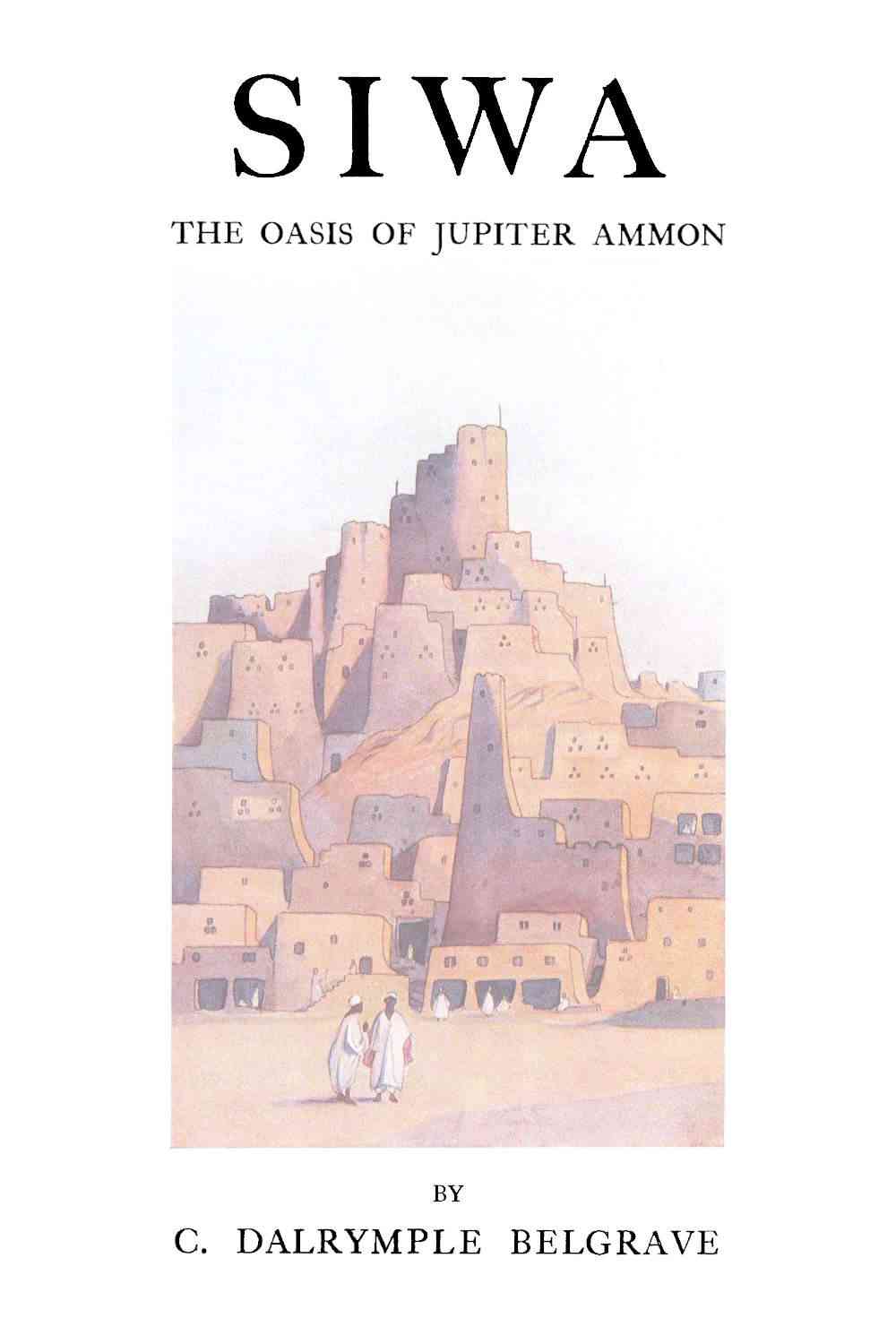
SIWA
THE WALLS OF SIWA
SIWA
THE OASIS OF JUPITER AMMON
BY C. DALRYMPLE BELGRAVE
WITH AN INTRODUCTION
BY
GENERAL SIR REGINALD WINGATE
BART., G.C.B., ETC. ETC. ILLUSTRATED
WITH SKETCHES AND PHOTOGRAPHS
BY THE AUTHOR
JOHN LANE THE BODLEY HEAD LTD.
LONDON: VIGO STREET, W. 1
First Published in 1923
Printed in Great Britain
at
The Mayflower Press, Plymouth. William Brendon & Son,
Ltd.
TO
MY MOTHER
CONTENTS
| CHAPTER I | |
| THE COAST | |
| Siwa — Whereabouts — The ex-Khedive and Germans — The ancient Libyans — The coastal belt — The Mariut Railway — Mersa Matruh — The Bay — Antony and Cleopatra — Greek Traders — Motor Maniacs — Sponge fishers — From Matruh to Sollum — Barrani and Bagbag — Sollum Bay — Western Desert Arabs, characteristics, tents, carpets, appearance, marriage customs, women — An Arab meal — “Gold tooth” — Buried money — Horses — Hawking — Silugi hounds — Hunting — Shooting — The Scarp — Flowers — The Rains — Houses — The Cruiser Abdel Moneim — A tripper | 1 |
| CHAPTER II | |
| THE DESERT | |
| The Frontier Districts Administration — The Camel Corps — Harimat — Story of a stove — The Booza Camp — The men — Diary of trek from Sollum to Siwa — Departure — Augerin, a Roman cistern — Bir Hamed — A desert dance — Ascent of Scarp — Qur el Beid — Camel riding — Evening on the desert — Camp — Utter desert — Mud pans — Mirage — “Khuz” bread — Desert tracks — Bisharin trackers — Night marching — A caravan — “The country of Dogs” — Among the ravines — The Megahiz Spring — Siwa — District Officer’s House — “Taking over” wives — A typical day — Siwan manners — The Sheikhs — The staff — View from Siwa — Aghourmi village — A slave woman — A rifle raid | 37 |
| CHAPTER III | |
| THE HISTORY OF SIWA | |
| FIRST PERIOD. THE TEMPLE OF JUPITER AMMON | |
| The Siwan Deity — A local religion — Legendary origin of the God — Herodotus — The Kingdom of the Ammonians — Lysander’s visit — Cambyses — A lost army — Cimon’s death foretold — The “Fountain of the Sun” — The temples — The King’s court — The temple to-day — Alexander visits Siwa — His adventures on the way — Ritual of the temple — Decline of its fame — Strabo’s theory — The Romans — Christianity | 74 |
| SECOND PERIOD. MEDIÆVAL SIWA | |
| Arab invasion of Egypt — Attempts to subjugate the oasis — Arab historians — The marvels of Siwa — Hidden cities — Emerald mines — Siwans become Mohammedans — King Rashwan — “The Thirty” — Sidi Suliman — Legends about him — Style of living — Quarrel between east and west — Civil wars — Recent disturbance — Browne at Siwa — Hornemann | 89 |
| THIRD PERIOD. THE TURKISH RULE | |
| Invasion of Siwa — Hassein Bey — Colonel Butin — Ali Balli, the Omda — Hamilton at Siwa, his imprisonment — Punitive expedition — Death of Yousif Ali — Turkish mamurs — A desert firebrand — “The Widow’s War” — Osman Habun — Abdel Arti, smuggler — Death of “The Habun” | 102 |
| FOURTH PERIOD. SIWA AND THE WAR | |
| The Italians in Tripoli — German intrigues — The Senussi confraternity — Mohammed el Senussi, his life at Siwa — Caves of the Kasr Hassuna — Growth of the Senussi — Mohammed el Mahdi — Sayed Ahmed — The situation in 1915 — Evacuation of Sollum — Capture of the crew of the Tara — Matruh — Battle on Christmas Day — Wadi Majid — Battle of Agagia and occupation of Barrani — Sayed Ahmed at Siwa — Occupation of Sollum — Sayed Ahmed goes to Dakhla and back — Siwans revolt — Battle of Girba — Occupation of Siwa — Rescue of Tara crew by Duke of Westminster — Sayed Ahmed retires to Constantinople | 117 |
| CHAPTER IV | |
| SIWA TOWN | |
| The town — Architecture — Wells — Custom of whitewash — Date Markets — Mosques — School — Shops — Interior of houses — The Roofs — “Dululas” — The Siwan race — Men — Women — Appearance — Clothes — Religious sects — Springs, gardens, irrigation, water rights — Salt lakes — Fever — Spring cleaning — “Sultan Mousa” — A luncheon party — The ceremony of tea — Appetites — Dog eaters — Life of an Englishman in Siwa — Two “cases” — Women witnesses — Bakshish | 133 |
| CHAPTER V | |
| SUBURBAN OASES | |
| Zeitoun and Kareished — The oasis of Gara — The village — The curse of Sheikh Abdel Sayed — A legend of Gara — The Mejberry pass — El Areg and Bahrein — The Arabs of Maragi — The northern oases — Jerabub — Sheikh Ithneini and his treasures — Terra incognita — Kufra — Excavating in Siwa — The “Oldest Inhabitant” his wedding — Industries, baskets, mats, and earthenware — The “Bedouin Industries” — Animals and birds — Snakes, snake charming | 177 |
| CHAPTER VI | |
| CUSTOMS AND SUPERSTITIONS | |
| Belief in Superstitions — Divine and Satanic magic — Demons — A birthday — Naming the child — Women — Marriage and divorce — A wedding, the bride’s bath, fetching the bride, presents — “Ghrula,” customs of a widow — The Town Crier — Funerals — Cemeteries — Evil Eye, charms to avert the curse — A visit to a witch — Methods used to obtain a husband — Invoking demons — Discovering stolen property — Exposing a thief — Divination and fortune telling — Sacrificing a bull — The Pilgrimage, rolling the bangles, to ensure a safe journey — “Yom el Asher,” the children’s “Christmas” | 207 |
| CHAPTER VII | |
| “FANTASIAS” | |
| Social life in Siwa — Games — “Lubki” drinkers — Giving alms to the poor — Sheikhs in fiction and in fact — “Beit el Mal” — Ramadan, the Mohammedan Lent — The Mulid of Sidi Suliman — Paying calls — Etiquette of eating — The religious dance of the Medinia — The “Zikr” — Bacchanalian revels — Siwan music and singing — Women dancers | 239 |
ILLUSTRATIONS
| The Walls of Siwa | Frontispiece | ||
| Col. The Honble. M. G. Talbot, C.B.; Sheikh Idris el Senussi; and The Idrisi of Luxor | to face | foreword | |
| The Author | „ | page | 2 |
| A Falconer outside a Bedouin Camp | „ | „ | 26 |
| Silugi Hounds | „ | „ | 30 |
| Camel Corps | „ | „ | 44 |
| Camel Corps trekking to Siwa, near Megahiz Pass | „ | „ | 58 |
| Sheikh Mahdi Abdel Nebi, of Aghourmi, with his Daughter and Cousin | „ | „ | 70 |
| Ruins of “Omm Beyda,” The Temple of Jupiter Ammon | „ | „ | 86 |
| The Citadel and Mosque of El Atik | „ | „ | 98 |
| Gate into the Western Quarter | „ | „ | 112 |
| “Kasr Hassuna,” The District Officer’s House | „ | „ | 120 |
| Sheikh Mohammed Idris, the Chief of the Senussi | „ | „ | 132 |
| The Western Quarter from an Eastern Roof | „ | „ | 144 |
| Cleaning Tamousy Spring | „ | „ | 160 |
| In the Western Quarter | „ | „ | 176 |
| The Spring of Zeitoun | „ | „ | 178 |
| Siwa Town from the South | „ | „ | 200 |
| A Bride—The Daughter of Bashu Habun before her Wedding | „ | „ | 214 |
| The Town-Crier’s Daughter | „ | „ | 222 |
| A Little Siwan Girl | „ | „ | 238 |
| A “Fantasia” at the tomb of Sidi Suliman | „ | „ | 252 |
| Map. | |||
COL. THE HONBLE. M. G. TALBOT, C.B.; SHEIKH IDRIS EL SENUSSI; AND THE IDRISI OF LUXOR
FOREWORD
Knockenhair,
Dunbar,
2nd November, 1922.
Dear Mr. Belgrave,
When you begged me to write a “Foreword” for your first book on Siwa, you asked me if I remembered you as a Junior Officer in the British Camel Company at Khartoum in the early days of the Great War—and later in the Camel Corps of the Frontier Districts Administration of Egypt. My answer is that I remember you well in both capacities, and I have a very happy recollection of the excellent services rendered by both the units in which you served. The appearance of British soldiers patrolling on camels up the White and Blue Niles had the best possible effect in cementing and consolidating the good relations existing between the Sudanese populations and our troops and confirming that spirit of loyalty and goodwill which, throughout the war, characterized the once fanatical Dervishes of Mahdist times—a truly marvellous transformation which had changed them from a fierce and ruthless enemy into loyal and brave soldiers and peaceful inhabitants, who were enabled to render the British cause wholehearted and ready support at a most critical period of our history.
Your transfer to the Frontier Districts Administration of Egypt also interests me, for it may not be known to you that one of the first reforms I instituted on my own transfer from the Governor-Generalship of the Sudan to the High Commissionership of Egypt at the end of 1916 was the organization of the new Administration to which you were appointed.
Before our reconquest of the Sudan I had, as Director of Military Intelligence in Egypt, some connection with the oases of the Libyan Desert and the activities of the Senussi, as well as with the government of the Sinai Peninsula. In those early days of the British occupation of Egypt, Turkish rule prevailed in Tripoli, and the actual frontier between that province and Egypt was often in dispute—whilst a somewhat similar condition existed on Egypt’s eastern frontier in Sinai. It was thought politically desirable at that time to maintain the status quo and to avoid trouble with the Turkish authorities to whom Egypt still owed a nominal Suzerainty—that this was not always feasible is evidenced by the celebrated “Akaba incident” which at one time threatened to disturb the peace between the two countries. The preservation of the status quo to which I refer, meant the maintenance on the extreme eastern and western frontiers of Egypt of the purely Egyptian administrative control which, owing to the almost total absence of supervision, was of the lightest and could hardly be designated as efficient. The necessity of inaugurating some improvement in both directions had frequently been mooted, but it was not until the advent of the Great War and the military operations against the Turks in Sinai, on the one hand, and against the Senussi invasion of Egypt, on the other, that the long-postponed reorganization became possible. By that time Italian had given place to Turkish control in Tripoli, whilst it was also evident that Palestine and Arabia were no longer to remain an integral portion of the Turkish Empire.
These facts made it very desirable to establish a closer Administrative Control in both directions, and it is to me a matter of great satisfaction that an organization known as the Frontiers District Administration materialized, under the able direction of Colonel G. G. Hunter and his efficient staff of British and Egyptian officers and officials, with its well-equipped Camel Corps, its patrolling system, and its more intimate and sympathetic government of the oases and of the somewhat unruly nomad tribes on both western and eastern frontiers.
The mere fact that you, as one of these District Officers, have been resident for nearly two years in the important, though remote and little-known, Oasis of Siwa, and have been able to write a very interesting and useful account of your experiences—together with an admirable survey of its ancient, mediæval and recent history—its customs, superstitions and its social life, is but one proof amongst many others of the value of this new organization which, in spite of the various political changes in Egypt, has, I hope, come to stay.
As an ex-officer and one who was lately in Egypt, you are wise to avoid in your book all reference to recent political events and the complicated situations to which they have given rise. In this letter I shall observe a similar reticence, and the more so having regard to the positions I have held in Egypt and the Sudan. Remarks on so controversial a subject must be complete and detailed if they are to assist the general public in forming a true estimate of the “tangled skein” which the political situation now represents—a situation in which truth and fiction are almost inextricably involved.
The perusal of the proof sheets you have sent me, together with your excellent series of illustrations (and here may I congratulate you on the artistic skill of the charming sketches displayed in the coloured reproductions?), recall that “lure of the desert” which is so fascinating to all of us whose lot has been cast in those countries bordering on the Great Nile waterway and the illimitable stretches of sandy desert beyond. Your apt quotations at the beginning of each chapter show that the “lure” has seized you also, and I can well understand your desire to undertake further service in those regions which so evidently attract you, and in which you have won the sympathy and respect of the nomad Arab and sedentary Berber tribes of the Western Desert.
The title of your book is well explained in Part I, Chapter III, and you are wise to add a bibliography of the various works you have consulted, for there is no subject more debatable than the origin of the Berber tribes of whom you write. “This crossing to Africa by the Northern Mediterranean peoples,” says Professor Breasted in his History of Egypt, “is but one of the many such ventures which in prehistoric ages brought over the white race whom we know as Libyans.” His remarks refer to events in the thirteenth century B.C., when people known as the Tehenu lived on the western borders of the Delta of Egypt, beyond them were the Libyans, and still further to the west were the Meshwesh or Maxyes of Herodotus—all of them doubtless ancestors of the great Berber tribes of North Africa.
In the reign of the Pharaoh Mereneptah, the successor of Rameses the Great, it appears that one Meryey, King of the Libyans, forced the Tehenu to join him, and supported by roving bands of maritime adventurers from the coast (the Sherden or Sardinians, the Sikeli, natives of early Sicily, the Lysians and the Etruscans), invaded Egypt. It is with these wandering marauders that the peoples of Europe emerge for the first time upon the arena of history.
It is probable that not long before this invasion a great Canaanite migration into Libya had taken place, for it is recorded by the historian Procopius, a native of Cæsarea (565 B.C.), how the Hebrews, after quitting Egypt, attacked Palestine from beyond Jordan under Joshua. After the capture of Jericho they advanced westwards, drove out the Gergazites, Jebusites and other tribes inhabiting the eastern shores of the Mediterranean, and forced them to flee into Egypt, where they were not allowed to settle, but were obliged to move westwards along the North African coast and into the oases. There is also evidence that some of these emigrants, under Roman pressure, were forced further westwards to Morocco and were called Moors. Later on they, in their turn, were followed by a similar migration of Jews from Palestine.
Thus it would appear that as far back as the thirteenth century B.C. the original Libyans, a warlike race, became co-mingled with maritime adventurers from Southern Europe, with Canaanites, Jews and Egyptians—a truly wonderful admixture of Asiatics, Africans and Europeans, and it is with the ancestors of this international potpourri that you deal so interestingly when you trace onwards, through the ages down to the present day, the history of those desert nomads and those sedentary dwellers of the Oasis of Jupiter Ammon. Surely your story will stimulate interest not only in the archæologist, but in all who desire to trace the manners, customs and characteristics of present-day peoples to their original sources. Those Siwans of whom you make a special study are of all people perhaps the most interesting, for, living, as it were, on an island, in a sea of desert, they—like the Abyssinians on the east—have been less affected by the world-changes than those who inhabit the main highways of the great African continent. The cult of Ammon and the seat of the Great Oracle, it is true, brought countless hordes of strangers to that mystic depression lying some seventy feet below the level of the Mediterranean, but the leading characteristics of the inhabitants have probably altered little, and religion—from Ammon worship to Islam, with an occasional admixture of Christian, Jewish and Pagan rites (the last brought by countless slaves from Central Africa)—has remained the all-absorbing interest of these oases dwellers.
As you truly say, the origin of the branching-horned ram as the fleshly symbol of the great God Ammon, “the King of the Gods,” “the unrevealed,” “the hidden one,” still remains a mystery. We know that the solar god Ra, whose supremacy in the “Old Kingdom” was so marked, from the Fifth Dynasty onwards and was at its zenith in the Twelfth Dynasty, became linked in the religion of the “Middle Kingdom” with Ammon, hitherto an obscure local god of Thebes who attained some prominence in the political rise of the city and was called by the priests Ammon-Ra. His cult gradually spread over the civilized world, and in the Roman period he was worshipped as Jupiter Ammon. He was essentially the god of Oracles, but how he came to have his special sanctuary in the Western Desert is still a mystery, though your account of this in the legends of the Arabic history of Siwa (Chapter III) throws an interesting light on the subject. Herodotus, we know, gave to Siwa the name of Oasis (probably derived from the Coptic word Ouahe, to dwell, from which the Arabic Wa is derived)—that is to say a fertile spot surrounded by desert, and thus from Siwa all other oases have derived their names.
To Siwa then came kings and wise men of the East, merchants and pilgrims, all bringing offerings to the temple of the god and soliciting the advice of the Oracle on their mundane affairs. For a thousand years and more these treasures were accumulating, but where are they now? As Egyptian research has yielded up unexpected buried treasure, may not the ancient god still have something in reserve for the archæologist and treasure-seeker who is bold enough to undertake excavation work in the little village of Aghourmi, some two miles east of Siwa, where the ruins of the Temple of Ammon still exist? Your interesting account of these ruins and the legends you have so sedulously culled from the Siwans, cannot fail again to create interest in the hidden treasures of the desert. One who has had some terrible experiences at the hands of the Senussi Arabs during the war—I refer to the gallant and gifted author of that thrilling story, Prisoners of the Red Desert, Captain Gwatkin-Williams, R.N.—writes, “It may be that this twentieth century of ours, this era of fish and bird men, may see lifted the mystery which shrouds the hidden treasure of Ammon, the ‘Unrevealed,’ for, so far as our limited modern information goes, those treasures have never yet been discovered.”
Your interesting account of the visit of Alexander the Great (331 B.C.) to the Oracle, when, marching along the coast to Matruh, he turned south and underwent great hardships before reaching his destination, recalls a very different journey I made to Sollum in 1917. Leaving Alexandria by train for Behig, I there found a fleet of armoured motorcars awaiting me, and the journey to and from Sollum, then garrisoned by British troops, was comfortably accomplished in four days. To my great regret I was too pressed for time to be able to visit Siwa, where, “on all hands springs of water gushed forth . . . that human ants’ nest, fabricated for the most part of rock-salt, mud and palm trunks . . . to which the Great War surging round the world had brought the drone of aeroplanes, the hum of armoured cars and rattle of machine guns.”
Your reference in Chapter V to the wonderful work carried on by Miss Nina Baird amongst the bedouin women and children rendered destitute in consequence of the Senussi invasion, recalls several visits Lady Wingate and I made to Amria—the village in the desert west of Alexandria and not far from Lake Mariut, where, as you say, this courageous lady worked practically singlehanded in teaching these desert waifs and strays to make carpets—thus starting an industry and giving the women and children a means of livelihood and a form of protection which for ever will be remembered with gratitude by the Western Arabs. A daughter of that well-known and greatly respected Scotsman, Sir Alexander Baird, an excellent horsewoman, a good Arabic scholar, and one who performed important services in the Egyptian troubles in the spring of 1919, Miss Baird’s energetic efforts throughout the war utterly exhausted her strength, and she fell an easy victim to typhoid soon after—to be followed a few months later by her talented father, and thus was the British community in Egypt deprived of two valuable lives who had endeared themselves to Europeans and natives alike and whose loss is deplored by all. On my last visit the carpet-making industry was about to be removed from Amria to an imposing structure built by Captain Jennings Bramley at Behig, the headquarters of the Eastern District of the Western Desert. Here this energetic official had also constructed, out of the ruins of an old building, a mediæval-looking stronghold, where we spent a few days and visited the ruined church of St. Menas, to which you make a passing reference in Chapter I. This buried Christian city is locally known as Abu Menas, and for long defied discovery, as it had not occurred to those in search of it to connect it with the Arab name of Abumna, until the German explorer, Kauffmann, and his companion lighted on the historic spot, which lies from fifty to fifty-five miles south-west of Alexandria. Your readers may be interested to know that Menas was an Egyptian in the Roman army who became a Christian and took the opportunity of a great public function to make an avowal of his faith which was proscribed under the Emperor Diocletian. He was tortured and eventually beheaded. His friends begged or stole his body, tied it on a camel and determined to found a settlement wherever the camel should lie down. Menas before death had expressed a wish to be buried near Lake Mariut, and here surely enough the camel insisted on lying down, and could not be induced to go further—so his followers buried the body on the spot. Many miracles were reported of his tomb, the settlement became a large Christian city with a magnificent cathedral built of granite from Assuan and marble from Italy. For some centuries the place became a resort for pilgrimage from all parts of the near East, but soon after the Arab conquest it was despoiled to provide material for the mosques in Alexandria and Cairo. Gradually the ruins were silted up with the ever-shifting sand, becoming mere mounds, and it was the chance discovery of a small terra-cotta plaque imprinted with the figure of Menas, standing erect with arms outstretched between two kneeling camels and a rough inscription, that led Herr Kauffmann and his friend to unearth the great basilica which had contained the tomb. The walls of the cathedral appear to have been lined with marble, whilst small pieces of mosaic on the floor give the impression that the dome was probably adorned in the same way. Some of the bases and capitals of the pillars are decorated after the Greek style with acanthus leaf ornaments, others in the stricter Roman method of straight panels. The dwelling-houses are small and constructed in blocks separated by narrow streets. Not far distant, on the coast, stand the ruins of Abusir (the Taposiris Magna of the Romans) which was evidently used as a port of arrival and departure by the thousands of pilgrims who came across the sea to pay their vows in this hallowed sanctuary. When I visited this place it was garrisoned by the very efficient Indian Camel Corps which the Maharajah of Bikaner had sent as his contribution to the Egyptian Expeditionary Force.
Your interesting sketch of the rise of the great Senussi, the establishment of his now widespread confraternity and his invasion, at the instigation of German and Turkish officers and officials, of Egypt in 1915; his hostile occupation of the oases and the successful campaign so ably directed by General Sir W. Peyton, which finally drove his forces across the frontier and re-established Egyptian domination in the Western Desert, merits careful perusal if the reader wishes to understand the last of that series of invasions from the West which began in the days of the Pharaoh Mereneptah, nearly three thousand five hundred years ago, and which, given favourable conditions, may yet be repeated.
All you so interestingly describe recalls my long connection with the doings of the Confraternity when Sayed Mohammed el Mahdi, the son of Sayed Ben Ali, the virtual founder of the order, was its titular head. To him, in 1883, the Sudan Mahdi wrote, offering the position of third Khalifa in his new hierarchy. Had Sayed Mohammed accepted, it is possible that, in addition to the Sudan revolt, the whole of North Africa might have been ablaze; but the Senussi Mahdi aimed at peaceful penetration rather than military occupation: his zawias (religious rest-houses) had gradually been extended to Central and West Africa, they “were neutral meeting-places where difficulties, tribal, commercial, legal or religious, could be settled by an unbiassed authority. His akhwan were judges as well as missionaries. They defined tribal areas, settled water and grazing rights as well as meting out the justice of the Koran to those who infringed the code of Islam.”
The interest of the Turkish Government in this great movement dates back many years, and I well remember when the late Ghazi Mukhtar Pasha (then Turkish High Commissioner in Egypt) procured the original manuscript Senussi prayer-book, had one thousand copies lithographed in a private printing press in Cairo, and dispatched them as a present to the Senussi with a request in the title-page for the great religious leader’s “help in prayer.”
Sayed Mohammed died on the 1st June, 1902. I had full knowledge of the dispatch to Kufara—the then headquarters of the Order—of his tombstone which had been secretly cut and engraved in Cairo by an expert native stonemason; but if I digress in this manner I shall soon exceed the limits of a “Foreword,” and so must rapidly pass over these early experiences which, nevertheless, proved useful when the Great War let loose all the hidden forces of hostility and revealed the immense influence of Islamic teaching for good or ill as applied in the interests of the various opponents. That, on the one hand, Sayed Ahmed, the uncle and successor of Sayed Mohammed, should have espoused the Turco-German cause and harboured Enver Pasha and other notable Turkish officers who had crossed to the north coast of Africa in submarines, to organize the Senussi campaigns against Egypt and the Sudan; whilst, on the other hand, British influence and British officers were enabled to assist the Sherif of Mecca—the Guardian of the Holy Places of Islam—in his successful revolt against Turkish rule in Arabia, are interesting and little-understood features in the history of the great world upheaval from which we have but recently emerged, and no doubt they will be chronicled in due course by those concerned in these “side-shows,” as they are somewhat inadequately described. It must not, however, be forgotten that—insignificant as they may appear in comparison with the terrific clash of arms in Western Europe—they have resulted in giving Egypt tranquillity on its western frontier, in restoring to the Sudan the great lost province of Darfur, and in freeing the Arabian Peninsula—results which in pre-war days would have been characterized as epoch-making events, but which have passed almost unnoticed in the great changes which have taken place in the territorial redistributions of the Treaty of Versailles.
To touch on but one little-known detail, you refer to the Talbot Mission. This has not attracted the attention it deserves, but I venture to think history will credit Colonel Milo Talbot with no mean achievement when it is realized that his mission effected the triangular treaties between Great Britain, Italy and the present head of the Senussi Confraternity, Sayed Mohammed el Idrisi, whereby both Egypt and Tripoli have secured, let us hope, a trusted ally.
Incidentally—through the good offices of Colonel Talbot’s able Egyptian coadjutor, Hassanein Bey— that intrepid lady, Rosita Forbes, accompanied by the Bey, was enabled to penetrate to the Oasis of Kufara in 1921. Another member of the Talbot Mission—Mr. Francis Rodd—is also utilizing his experiences of the Senussi Confraternity and the Western Desert by making a prolonged and important journey with Mr. Buchanan from West Africa, which should throw much new and interesting light on many still obscure localities.
In these days of improved communications—when the two ends of the great iron road destined to connect South with North Africa are gradually approaching one another, and when other railways are either under construction or projected to connect the Atlantic with the Indian Ocean and the Red Sea—the time may not be far distant when the great Sahara and Libyan Deserts, too, will be traversed from north to south and east to west, and the undoubted mineral wealth and raw products of Central Africa will be brought to the nearest ports for shipment to all parts of the world. Your remarks, therefore, on mining, industries, trade and the means of communication southwards from the Mediterranean through the oases which you and others have visited, will doubtless prove of value and merit careful consideration.
Meanwhile, much good work remains to be done by officers and officials like yourself who take a keen interest in the welfare of the sparse nomad and sedentary populations of these still remote districts, fostering amongst them those feelings of confidence and goodwill which will go far towards preparing them for the advent of the amenities of civilization which must come with the inevitable development of the no longer Dark Continent. Now, however, that the clash of arms is past and, let us hope, a new era of peaceful development set in, I might well have prefaced my remarks with this quotation:
The immortal poet’s words seem to me not only to synchronize with the pleasantly conversational style of your own narrative which has induced the somewhat novel method I have adopted of writing you a letter by way of an introduction—but they also express the spirit which will, I trust, animate us in our present and future relations with those nations and peoples of the Near East who unfortunately for themselves espoused our enemies’ cause in the Great War, but whose best interests lie—now and henceforth—in the friendship and goodwill of the Allies.
Your chapters on the customs, superstitions and “fantasias” of the Siwans recall much that is similar amongst the Sudan tribes and peoples—especially those of the Moslem Faith—and your account of the “zikr” is particularly interesting. In the words of an Islamic writer, by means of this religious exercise “the whole world and all its attractions disappears from the vision of the faithful worshipper, and he is enabled to behold the excellence of the Most High. Nothing must be allowed to distract his attention from its performance, and ultimately he attains by its medium a proper conception of the Tauhid, or unity of God. . . . To enter Paradise one must say after every prayer ‘God is Holy’ ten times, ‘Praised be God’ ten times, and ‘God is great’ ten times.”
If the age of miracles has not gone for ever then these Moslem devotees—the descendants of the ancient warriors of the Libyan Desert, side by side with their courageous and resourceful British helpers—may yet cause the great Oracle of Jupiter Ammon to reveal the secrets of that old-time sanctuary with which your book deals so interestingly.
Yours sincerely
Reginald Wingate.
SIWA
SIWA
THE OASIS OF JUPITER AMMON
CHAPTER I
THE COAST
SIWA—pronounced “Seewah”—is a little-known oasis in the Libyan Desert on the borders of Egypt and Tripoli. It lies 200 miles south of Sollum, the Egypt-Tripoli frontier port on the Mediterranean coast, and almost 400 miles west of the Nile Valley. Siwa is the northernmost oasis of a string of oases which stretch from Egypt into the middle of Tripoli. These “Islands of the Blessed”—as they were called by the ancients—are natural depressions in the great Libyan table-land which are preserved from the inroads of shifting sand by the high limestone cliffs that surround them, and are made fertile and habitable by numbers of sweet water springs. Siwa consists of a little group of oases in a depression about 30 miles long and 6 miles wide, lying 72 feet below the level of the sea, surrounded by a vast barren table-land, parched and featureless, where rain rarely falls, which can only be crossed if one carries sufficient water for the whole journey.
Siwa is one of the least known and most interesting places in North Africa, but owing to its inaccessibility very few Europeans had visited it prior to the outbreak of the Great War. It has a population of between three and four thousand inhabitants, who are not Arabs but the remains of an older race, of Berber origin. They have a language of their own, which is only spoken, not written, and has survived among the dwellers of the oasis from many centuries before the Arab invasion, owing to the remoteness of the country and the slight communication between Siwa and the outer world. At present the birth-rate is considerably lower than the death-rate, so it appears likely that in course of time the Siwan race will become extinct.
It was my fortune, after spending a year or so on the coast, to be stationed at Siwa, during 1920-21, in command of a section of the Frontier Districts Administration Camel Corps, and for some time as the District Officer of the oasis. Under the present regime there has been one British officer, seconded from the Army for service under the Egyptian Government, posted alone in the Siwa oasis. While I was there I spent my spare time in discovering as much as possible about the history of the place, and the manners and customs of this desert community, which differ very considerably from those of the Arabs or the people of Egypt. No history, from its earliest times to the present day, has ever been written of this strange place, and it appears probable that now, when British officials are being withdrawn from Egypt, Siwa will once more sink back into obscurity.
THE AUTHOR
The oasis is most easily reached from Sollum, or from Matruh, another port on the Mediterranean coast west of Alexandria. The journey can be done in two days by car, when the rough desert track that is called a road is in good order; it takes six days on a trotting camel, and about ten days with a bedouin caravan of slow walking camels. The Arab covers the whole distance on foot, living on a surprisingly small quantity of dates, water and camel milk. The desert is quite waterless, except for the first few miles, where there are occasional rock cisterns which fill during the rains and provide a little water during the first few months of the hot weather.
The coastal belt of Western Egypt was comparatively unknown country before the war, though by no means as remote as the inland oases. Strangely enough, excepting the few officials of the Egyptian Coastguards Administration, the Europeans who seemed to know most about this country before the war were Germans, who were encouraged by Abbas Helmi, the ex-Khedive, in their attempts to exploit the commercial and agricultural possibilities of the coast. In 1913 Herr Ewart Falls published a book called Three Years in the Libyan Desert which was an account of some archæological works carried out by him and his colleagues—Germans—on the site of the ancient city of St. Menas, south-west of Alexandria. In this book he describes how he accompanied the Khedive on his visit to Siwa in 1905. He gives a flamboyant description of the Royal progress. The party consisted of the Khedive, four Europeans, twenty soldiers, a number of servants, 62 riding camels, horses, and 288 baggage camels, which seem an incredibly large number. The Khedive drove the whole way—200 miles—in a carriage, a species of phaeton, constantly changing horses. Herr Falls mentions the intense enthusiasm of the natives on the occasion of the Kaiser’s birthday, and discusses the possibilities of a Pan-islamic rising against the much hated English who “curtail the Khedive’s political activities.” He gives statistics on the fighting forces of the Arabs, and considers that the time is ripe for stirring up sedition. One of his theories is that the Arab tribe “Senagra” originate from a German boy, called Singer, who was wrecked on the coast. There is a photograph in his book of one of the main streets in the old town of Siwa which he calls “Interior of an ancient tomb”! It is really a very remarkable book and gives one a good insight into German ideas in Egypt before the war.
In ancient days the coast west of Alexandria was inhabited by various Libyan tribes, the most famous being the Nasamonians, who lived by the plunder of wrecks, and the Lotophagi, who are immortalized in Tennyson’s famous poem “The Lotus-Eaters,” dwellers of a land “In which it seemed always afternoon.” These two tribes lived on the coast that lies west of the present frontier. The coast which lies between the present frontier and Alexandria was thinly populated by wandering tribes of Libyans, a nomadic people, who depended, as the bedouins do now, on the rains to feed their flocks. The inland country was a land of mystery vaguely described as being the haunt of strange wild beasts, although nowadays this waterless tract nourishes few wild creatures of any description. In later times Persians, Greeks, Romans and Byzantines established some centres of civilization on the coast, but this strip immediately west of Alexandria was never thickly populated, and one finds few signs of any former civilization. The Arabs, after planting Mohammedanism in Egypt, continued their victorious course westward along the coast, forcing their religion on the people at the point of the sword, or driving the natives inland to the oases, which remained unconquered till a later date. Thus, the Arabs of the desert have always considered themselves to be the conquerors, and the oasis dwellers to be the conquered.
The coastal belt from Alexandria to the sea slopes gently upwards in strips of undulating country till it reaches the foot of the ledge of the great Libyan plateau. This narrow strip of fairly fertile country between the desert and the Mediterranean gradually diminishes in width, from east to west, till at Sollum the cliffs of the Libyan plateau reach the sea. At its widest part, near Alexandria, the coastal belt stretches inland for nearly 40 miles before merging into the desert. The coast is inhabited by Arabs of the Awlad Ali tribe, who move about with their flocks and camels from well to well, having only a transitory interest in the soil, which they sow with a little barley in the places where it will grow, and depending on the rains, which are very heavy on the coast, to fill their wells and cisterns, and to water the wild vegetation that feeds their herds. The land is most fertile close to the sea, but for the first 10 or 20 miles on the high desert plateau above the cliffs there is flat scrub-covered country that makes a good grazing-ground for sheep and camels. Farther south one sees less vegetation, and very soon the real desert begins, which stretches hard and dry under the blazing sun for 200 miles down to Siwa, and beyond Siwa over unexplored country till it reaches the distant Sudan.
As one goes farther west from Alexandria the country becomes wilder and one sees fewer people, but there are several little towns, or settlements, along the coast. The ex-Khedive had a project of opening up this district and, aided by German enterprise, he built a railway which was destined to connect Alexandria with his western frontier at Sollum, and shorten the sea journey from Europe to Egypt. But the line only got as far as Bir Fuca, about 100 miles west of Alexandria. The Khedive found that his agricultural experiments in the Western Desert were not a success and, realizing this, he tried to sell the railway to a German firm, but Lord Kitchener, who was then High Commissioner, stepped in and secured it for Egypt. There is a motor road, known as the Khedival Road, from Alexandria to beyond Matruh, and another road, of very inferior quality, from Matruh to Sollum.
Mersa Matruh—Mersa means a harbour—a small town on the coast about 200 miles west of Alexandria, is where the Governor of the Western Desert has his headquarters. Matruh is the ancient Parætonium, sometimes called Ammonia, and was the port for Siwa in the days when that place was known as the oasis of Ammon. Matruh consists of a few dozen little one-storied stone houses, plastered and painted white, with gay shutters, yellow, green and blue, inhabited by Greek colonists who do a thriving business by trading with the Arabs, and exporting barley and sheep to Alexandria. There is a picturesque mosque on the cliffs above the bay, whose minaret forms a landmark for many miles, a hospital, police barracks, the Governor’s house, and a number of Government offices and houses of Government officials. There are large numbers of resident Arabs in the neighbourhood who remain near Matruh, as it is the commercial centre of the desert. At most times, especially in the summer, Matruh is a singularly attractive little place, but when it is visited by a “khamsin” wind, which blows up the fine white sand—and this is not unfrequent—it becomes a more detestable spot than anywhere else on the desert. The cliffs at Matruh suddenly cease and are carried on by a reef of partly submerged jagged rocks which protect the large harbour. The entrance—between two rocks—is so narrow that only ships of moderate size can pass, and when a heavy sea is running outside the entrance is impassable. The bay is 1½ miles long and half a mile wide, but in places where there are shoals the water is only 2 fathoms deep. To the east and west of the harbour there are a series of lagoons separated from the sea by a line of low cliffs, and divided from each other by narrow spits of sand. On the cliff above the bay, commanding the entrance, there is an old ruined Turkish fort, a yellow castellated building, which was occupied during the war by a detachment of Royal Artillery. The houses are on the southern shore, behind them there is a low rocky ridge crowned with some little forts which were built during the Senussi rising in 1916, when Matruh was for some time the British base. The bay is surrounded by firm white sands sloping gently down to the brilliantly coloured water. It is well sheltered and, consequently, never very rough; the varying depths of the water cause it to assume different colours—in some cases almost as brilliant as those of the kingfishers who fly up and down the shore; at times it is incredibly blue, so blue that the open sea outside looks black in comparison, and at other times it is vividly green, with long streaks of purple where the dark seaweed shows through the water. Matruh is a pleasant place in summer-time, the bathing is ideal, and the climate is cooler than Alexandria, which is the summer resort of all Egypt. But the great disadvantage is the lack of water; there are several wells, but the water in them is of an indifferent quality, so at present it is brought by boat from Alexandria, at great expense, and pumped into tanks on the shore.
Some signs of former civilization are still visible, and it is evident that the Romans, with their usual appreciation of beautiful places, realized the attraction of this smooth, brilliant bay. There are ruins of several villas on the banks of the lagoons, and in places flights of steps have been cut through the rock leading down to the water. The Governor’s bungalow is built on the site of a villa that was once inhabited by Cleopatra. According to tradition, Antony retired there after his defeat at Actium and found solace in the embraces of Cleopatra. One can scarcely imagine a more ideal spot than this for the site of the villa. It stood among low sand-hills a few feet above the harbour, right on the edge of the bay, so near that the rippling water must have sounded through the marble halls of the villa. From the windows of the present building one looks over the gorgeously blue bay to a line of sharp black rocks where the white waves break, and beyond to the deep blue open sea. At night, when the water shines silver in the moonlight, and the little waves creep up the white shore and break with phosphorescent splashes on the sands, one can easily picture Antony and Cleopatra gliding smoothly in a boat through the lagoons, which were connected by channels in those days, or feasting superbly to the sound of