
Like every other novelty the coupon ticket, when first introduced, did not hit the mark when aimed at the understanding of certain travellers. A United States Senator-elect had come on by sea from the Pacific Coast who had never seen a railroad till he reached the Atlantic seaboard. With a curiosity to test the workings of the new means of transportation, of which he had heard so much, he bought a coupon ticket and set out for a railway journey. He entered a car, took a seat next to the door, and was just beginning to get the "hang of the school-house" when the conductor, who was then not uniformed, came in, cried "Tickets!" and reached out his hand toward the Senator. "What do you want of me?" said the latter. "I want your ticket," answered the conductor. Now it occurred to the Senator that this might be a very neat job on the part of an Eastern ticket-sharp, but it was just a little too thin to fool a Pacific Coaster, and he said: "Don't you think I've got sense enough to know that if I parted with my ticket right at the start I wouldn't have anything to show for my money during the rest of the way? No, sir, I'm going to hold on to this till I get to the end of the trip."
"Oh!" said the conductor, whose impatience was now rising to fever heat, "I don't want to take up your ticket, I only want to look at it."
The Senator thought, after some reflection, that he would risk letting the man have a peep at it, anyhow, and held it up before him, keeping it, however, at a safe distance. The conductor, with the customary abruptness, jerked it out of his hand, tore off the first coupon, and was about to return the ticket, when the Pacific Coaster sprang up, threw himself upon his muscle, and delivered a well-directed blow of his fist upon the conductor's right eye, which landed him sprawling on one of the opposite seats. The other passengers were at once on their feet, and rushed up to know the cause of the disturbance. The Senator, still standing with his arms in a pugnacious attitude, said:
"Maybe I've never ridden on a railroad before, but I'm not going to let any sharper get away with me like that."
"What's he done?" cried the passengers.
"Why," said the Senator, "I paid seventeen dollars and a half for a ticket to take me through to Cincinnati, and before we're five miles out that fellow slips up and says he wants to see it, and when I get it out, he grabs hold of it and goes to tearing it up right before my eyes." Ample explanations were soon made, and the new passenger was duly initiated into the mysteries of the coupon system.
The uniforming of railway employees was a movement of no little importance. It designated the various positions held by them, added much to the neatness of their appearance, enabled passengers to recognize them at a glance, and made them so conspicuous that it impressed them with a greater sense of responsibility and aided much in effecting a more courteous demeanor to passengers.
Many conveniences have been introduced which greatly assist the passenger when travelling upon unfamiliar roads. Conspicuous clock-faces stand in the stations with their hands set to the hour at which the next train is to start, sign-boards are displayed with horizontal slats on which the stations are named at which departing way-trains stop, and employees are stationed to call out necessary information and direct passengers to the proper entrances, exits, and trains. A "bureau of information" is now to be seen in large passenger-stations, in which an official sits and with a Job-like patience repeats to the curiously inclined passengers the whole railway catechism, and successfully answers conundrums that would stump an Oriental pundit.
The energetic passenger-agent spares no pains to thrust information directly under the nose of the public. He uses every means known to Yankee ingenuity to advertise his regular trains and his excursion business, including large newspaper head-lines, corner-posters, curb-stone dodgers, and placards on the breast and back of the itinerant human sandwich who perambulates the streets.
Many conveniences have been introduced which greatly assist the passenger when travelling upon unfamiliar roads. Conspicuous clock-faces stand in the stations with their hands set to the hour at which the next train is to start, sign-boards are displayed with horizontal slats on which the stations are named at which departing way-trains stop, and employees are stationed to call out necessary information and direct passengers to the proper entrances, exits, and trains. A "bureau of information" is now to be seen in large passenger-stations, in which an official sits and with a Job-like patience repeats to the curiously inclined passengers the whole railway catechism, and successfully answers conundrums that would stump an Oriental pundit.
The energetic passenger-agent spares no pains to thrust information directly under the nose of the public. He uses every means known to Yankee ingenuity to advertise his regular trains and his excursion business, including large newspaper head-lines, corner-posters, curb-stone dodgers, and placards on the breast and back of the itinerant human sandwich who perambulates the streets.
Railway accidents have always been a great source of anxiety to the managers, and the shocks received by the public when great loss of life occurs from such causes deepen the interest which the general community feels in the means taken to avoid these distressing occurrences.
American railway officials have made encouraging progress in reducing the number and the severity of accidents, and while the record is not so good on many of our cheaply constructed roads, our first-class roads now show by their statistics that they compare favorably in this respect with the European companies.
The statistics regarding accidents[26] are necessarily unreliable, as railway companies are not eager to publish their calamities from the house-tops, and only in those States in which prompt reports are required to be made by law are the figures given at all accurately. Even in these instances the yearly reports lead to wrong conclusions, for the State Railroad Commissioners become more exacting each year as to the thoroughness of the reports called for, and the results sometimes show an increase compared with previous years, whereas there may have been an actual decrease.
In 1880, the last census year, an effort was made to collect statistics of this kind covering all the railways in the United States, with the following result:
| To whom happened. | Through causes beyond their control. | Through their own carelessness. | Aggregate. | Total accidents. | |||
| Killed. | Injured. | Killed. | Injured. | Killed. | Injured. | ||
| Passengers | 61 | 331 | 82 | 213 | 143 | 544 | 687 |
| Employees | 261 | 1,004 | 663 | 2,613 | 924 | 3,617 | 4,541 |
| All others | 43 | 103 | 1,429 | 1,348 | 1,472 | 1,451 | 2,923 |
| Unspecified | 3 | 62 | 65 | ||||
| Total | 365 | 1,438 | 2,174 | 4,174 | 2,542 | 5,674 | 8,216 |
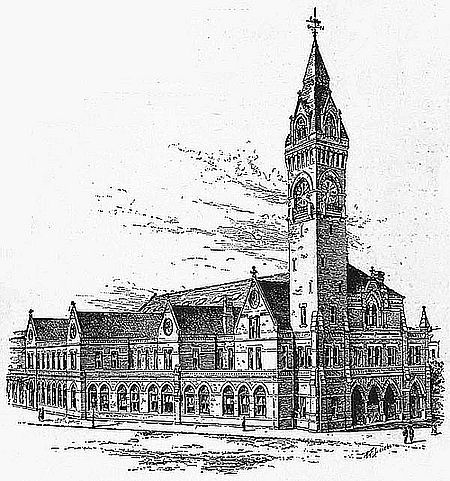
(Passenger Station, Philadelphia.)
Mulhall, in his "Dictionary of Statistics," an English work, uses substantially these same figures and makes the following comparison between European and American railways:
Accidents to Passengers, Employees, and Others.
| Killed. | Wounded. | Total. | Per million passengers. | |
| United States | 2,349 | 5,867 | 8,216 | 41.1 |
| United Kingdom | 1,135 | 3,959 | 5,094 | 8.1 |
| Europe | 3,213 | 10,859 | 14,072 | 10.8 |
That the figures given above are much too high as regards the United States, there can be no doubt. For the fiscal year 1880–81 the data compiled by the Railroad Commissioners of Massachusetts and published in their reports give as the total number of persons killed and injured in the United States 2,126, as against 8,216 upon which the comparisons in the above table are based. If we substitute in this table the former number for the latter, it would reduce the number of injured per million passengers in the United States to 10.6, about the same as on the European railways.
Edward Bates Dorsey gives the following interesting table of comparisons in his valuable work, "English and American Railroads Compared:"
Passengers Killed and Injured from Causes beyond their own Control on all the Railroads of the United Kingdom and those of the States of New York and Massachusetts in 1884.
| Total length of line operated. | Total mileage. | Killed. | Injured. | |||
| Train. | Passengers. | |||||
| United Kingdom | 18,864 | 272,803,220 | 6,042,659,990 | 31 | 864 | |
| New York | 7,298 | 85,918,677 | 1,729,653,620 | 10 | 124 | |
| Massachusetts | 2,852 | 32,304,333 | 1,007,136,376 | 2 | 42 | |
| In 1,000,000,000 | { United Kingdom | 5.15 | 143 | |||
| passengers trans- | { New York | 5.78 | 70 | |||
| ported 1 mile. | { Massachusetts | 2.00 | 42 | |||
| Miles. | ||||
| The average number of miles a passenger can travel without being killed. | { United Kingdom | 194,892,255 | ||
| { New York | 172,965,362 | |||
| { Massachusetts | 503,568,188 | |||
| The average number of miles a passenger can travel without being injured. | { United Kingdom | 6,992,662 | ||
| { New York | 13,940,754 | |||
| { Massachusetts | 23,955,630 | |||
From this it will be seen that in the United Kingdom the average distance a passenger may travel before being killed is about equal to twice the distance of the Earth from the Sun. In New York he may travel a distance greater than that of Mars from the Sun; and in Massachusetts he can comfort himself with the thought that he may travel twenty-seven millions of miles farther than the distance of Jupiter to the Sun before suffering death on the rail.
The most encouraging feature of these statistics is the fact that the number of railway accidents per mile in the United States has shown a marked decrease each year. Taking the figures adopted by the Massachusetts commissions, the number of persons injured in the year 1880–81 was 2,126, and in 1886–87, 2,483, while in the same time the number of miles in operation increased from 93,349 to 137,986.
The amounts paid annually by railways in satisfaction of claims for damages to passengers are serious items of expenditure, and in the United States have reached in some years nearly two millions of dollars. About half of the States limit the amount of damages in case of death to $5,000, the States of Virginia, Ohio, and Kansas to $10,000, and the remainder have no statutory limit.
In the year 1840 the number of miles of railway per 100,000 inhabitants in the different countries named was as follows: United States, 20; United Kingdom, 3; Europe, 1; in the year 1882, United States, 210; United Kingdom, 52; Europe, 34.
In the year 1886 the total number of miles in the United States was 137,986; the number of passengers carried, 382,284,972; the number carried one mile, 9,659,698,294; the average distance travelled per passenger, 25.27 miles.
In Europe the first-class travel is exceedingly small and the third class constitutes the largest portion of the passenger business, while in America almost the whole of the travel is first class, as will be seen from the following table:
| Percentage of passengers carried. | |||
| First Class. | Second Class. | Third Class. | |
| United Kingdom | 6 | 10 | 84 |
| France | 8 | 32 | 60 |
| Germany | 1 | 13 | 86 |
| United States | 99 | ½ of 1 | ½ of 1 |
The third-class travel in this country is better known as immigrant travel. The percentages given in the above table for the United States are based upon an average of the numbers of passengers of each class carried on the principal through lines. If all the roads were included, the percentages of the second- and third-class travel would be still less.
That which is of more material interest to passengers than anything else is the rate of fare charged.
The following table gives an approximate comparison between the rates per mile in the leading countries in the world:
| First Class. | Second Class. | Third Class. | |
| Cents. | Cents. | Cents. | |
| United Kingdom | 4.42 | 3.20 | 1.94 |
| France | 3.86 | 2.88 | 2.08 |
| Germany | 3.10 | 2.32 | 1.54 |
| United States | 2.18 | — | — |
The rates above given for the United Kingdom, France, and Germany are the regular schedule-rates. An average of all the fares received, including the reduced fares at excursion rates, would make the figures somewhat less.
The rate named as the first-class fare for the railways in the United States is, strictly speaking, the average earnings per passenger per mile, and includes all classes; but as the first-class passengers constitute about ninety-nine per centum of the travel the amount does not differ materially from the actual first-class fare. In the State of New York the first-class fare does not exceed two cents, which is not much more than the third-class fare in some countries of Europe, and heat, good ventilation, ice-water, toilet arrangements, and free carriage of a liberal amount of baggage are supplied, while in Europe few of these comforts are furnished.
On the elevated railroads of New York a passenger can ride in a first-class car eleven miles for 5 cents, or about one-half cent a mile, and on surface-roads the commutation rates given to suburban passengers are in some cases still less.
The berth-fares in sleeping-cars in Europe largely exceed those in America, as will be seen from the following comparisons, stated in dollars:
| Route. | Distance in Miles. | Berth fare. |
| Paris to Rome | 901 | $12.75 |
| New York to Chicago | 912 | 5.00 |
| Paris to Marseilles | 536 | 11.00 |
| New York to Buffalo | 440 | 2.00 |
| Calais to Brindisi | 1,373 | 22.25 |
| Boston to St. Louis | 1,330 | 6.50 |
While it would seem that the luxuries of railway travel in America have reached a maximum, and the charges a minimum, yet in this progressive age it is very probable that in the not far distant future we shall witness improvements over the present methods which will astonish us as much as the present methods surprise us when we compare them with those of the past.