
M’PHUN’S
SERIES OF POCKET GUIDES.
Tastefully done up, gilt edges, price 1s. 6d. sewed, and 2s. bound.
The object the publisher had in view in projecting these little works was to produce a Series of distinct Treatises on all subjects of general interest—in the smallest possible compass, and at the smallest possible price. How far he has been successful in carrying into effect what he projected, may be learned in the gratifying fact, that since the first appearance of the series in 1834, upwards of
TWENTY THOUSAND COPIES
have been purchased by the public. From this it will be seen the Editor of the Dumfries Courier, in reviewing them, was not far wrong in saying the publisher was “the most extensive Pocket Guide Book maker in the three Kingdoms.” In his usual happy style he added they were the best exemplification he had seen of the best maxim of the Bentham school, viz.—the maximum of utility in the minimum of space.
The Tourist’s Guide, and the Guide to the Picturesque Scenery of Scotland, are books that have been much wanted. They do not profess to give a detailed History of Scotland, nor yet a detailed History of the Highlands, like all their predecessors in this department of literature, but to Guide the Tourist to all that is worthy of his admiration. A very minute description of this is given; and that is all that one wants when they set out on a travelling excursion. Their size adapts them peculiarly for this purpose; they are hand books, in fact, that cannot incommode a lady in her reticule, or a gentleman in his vest pocket.
I.
Mechanics.
Dedicated to Robert Napier, Esq.,
THE PRACTICAL MECHANIC’S POCKET GUIDE;
A Concise Treatise on the Prime Movers of Machinery, and the Weight and Strength of Materials, with numerous Practical Rules and Tables, with illustrative Plates.
By Robert Wallace, A.M.,
Blythswood Hill Mathematical Academy.
II.
Commercial.
THE MERCHANT’S AND BANKER’S COMMERCIAL POCKET GUIDE,
Being a Manual of the principles of Banking, Broking, Fairs, Foreign Coins, Foreign Exchange, Insurance, Market Prices, Public Funds, and Commercial Transactions in general. Dedicated to Alexander Goodsir, Esq., Secretary to the British Linen Bank. Third Edition improved.
III.
THE SHORT-HAND WRITER’S POCKET GUIDE.
IV.
POCKET GUIDE THROUGH GLASGOW,
With Plates and a Map, price only 2s. 6d.
V.
Cookery.
THE POCKET GUIDE TO DOMESTIC COOKERY.
By a Lady. To which are added, Instructions for Trussing and Carving, with Plates.
Fourth Edition much improved. To this Edition has been added an entire chapter on Preserves; thus making the work the cheapest, most complete, and most concise treatise on Cookery extant.
VI.
Medical.
THE POCKET MEDICAL GUIDE.
Being a popular Treatise on Diet and Regimen, Cold and its effects, and the use and doses of Medicine; the whole selected from the latest and best authorities, and carefully adapted for the use of families and non-professed readers. Fourth edition.
VII.
Management of Children.
THE MOTHER’S POCKET MEDICAL GUIDE.
A Treatise on the Physical Education and Diseases of Children. Compiled for popular use from the writings of Drs. Eberle, Dewees, Burns, Ryan, Kennedy, and others. By a Physician. Second Edition.
VIII.
Price only 2s. 6d.
THE POCKET GUIDE TO THE PICTURESQUE SCENERY OF SCOTLAND.
Embracing the sublime of Perthshire, the splendid of Invernessshire, and the beautiful of Dumbartonshire, including the Falls of Clyde, and many other such romantic scenes.
IX.
A Companion to the above, price 2s. 6d.
The Highlands of Scotland.
Embellished with Plates, and illustrated with Maps of the Western Coast, including the Hebride islands.
THE SCOTTISH TOURIST’S STEAM-BOAT POCKET GUIDE.
Being an account of all that is worthy of the Stranger’s notice in the Western Highlands and Islands of Scotland.
This volume, when accompanied by the above, its Travelling Guide to the Picturesque, will be sufficient to lead the Stranger to all that is worthy of being seen in Scotland!!
X.
Price 1s. 6d. sewed, 2s. bound.
THE POCKET GUIDE TO COMMERCIAL BOOKKEEPING.
THE PRACTICAL ENGINEER’S POCKET GUIDE.
THE YOUNG HOUSEWIFE’S POCKET GUIDE.
XI.
The Scottish Worthies.
BIOGRAPHIA SCOTICANA; a Brief Historical Account of the most eminent SCOTS WORTHIES, Noblemen, Gentlemen, Ministers, and others, who Testified or Suffered for the Cause of the Reformation in Scotland, from the beginning of the Sixteenth Century to the Year 1688; originally collected by Howie of Lochgoin; now Revised, Corrected, and Enlarged, by a Clergyman of the Church of Scotland, and enriched with a Preface and Notes, by Wm. M’Gavin, Esq., Author of the “Protestant,” &c.
In Two large Volumes 8vo. Price 24s. Boards.
Volume I. contains Memoirs of the Lives of the Worthies. Volume II. contains the “Last Words and Dying Testimonies,” “Cloud of Witnesses,” “Naphtali,” &c. &c.—To those who are already in possession of the first volume of this work, the second will be found an indispensable requisite, as without it the book is incomplete, and is deficient in by far the most important and interesting portion of the Biography of the Scottish Reformers.
“This is by far the best edition of this remarkable work that has ever seen the light. He is not worthy the name of a Scot, who can be indifferent to the story of these immortal champions.”—Evangelical Magazine.
“We hail with pleasure this new and greatly improved edition. The external appearance is very creditable to the Publisher, and we have no doubt his well-meant zeal in publishing an improved edition of a work that must ever be dear to pious minds, will meet with the encouragement which it unquestionably deserves.”—Edinburgh Christian Instructor.
XII.
A Brief History of the Protestant Reformation.
New Edition, with Corrections and Additions, in One Volume, Price 4s. boards.
In a Series of Letters addressed to WILLIAM COBBETT, in consequence of the Misrepresentation and Aspersions contained in his “History of the Protestant Reformation in Britain and Ireland.” By Wm. M’Gavin, Esq., Author of “The Protestant.”
“Those who wish to see Mr. Cobbett more than matched, should possess themselves of this valuable publication. It is not saying too much of Mr. M’Gavin to assert that he is one of the most enlightened Protestants in Christendom. The whole controversy stands before his mind in the order of perfect arrangement, and Mr. Cobbett appears like a child in the hands of a giant. Posterity will gratefully acknowledge its obligations to this incomparable advocate.”—Evangelical Magazine.
XIII.
The Glasgow Mechanics’ Magazine.
New Edition, Revised and Corrected, of the First Series, complete in Five Volumes 8vo., price £2.
From the great sale which this work continued to have, long after the completion of the Series, the proprietors were induced to have the whole of it revised throughout from the commencement. In doing this, the plan they adopted was to exclude any article which appeared of less value to the scientific inquirer, and such as were more of a temporary interest. They are happy to say this has met with the approbation of the public, by a sale unprecedented in the annals of periodical literature. The work should, in fact, be now viewed more in the light of
“A STANDARD BODY OF PRACTICAL SCIENCE,”
which it in reality is, than in that of “a Magazine” of the times, the utility of which, in most cases, lasts but for a day. The most eminent scientific men have contributed to these volumes, and numerous have been the laudatory notices from all quarters, that have appeared of it. Amongst numerous others which might be adduced, they may mention, that the celebrated Dr. Gregory, in his Mathematics for Practical Men, quotes numerous articles from it, and refers his readers to “that useful publication.” Lord Brougham characterises the work as having been “carried on with great spirit;” and he farther adds, that he found it “remarkably full of useful information,” no small recommendation from an authority so high. The Leeds Mercury, under the management of Mr. Baines, M.P., among a host of other Journals which reviewed this work, in noticing it, remarked, “It appears to be conducted by a set of practical men, who understand well what they are about, and who are well calculated to execute the task they have undertaken.”
XIV.
Natural History.
Just Published, price 2s.
THE YOUTH’S BOOK OF NATURAL HISTORY,
Adapted to the use of English Schools, Infant Schools, and Nurseries, containing a Lithographic Sketch of every Animal in the relative proportion that one stands in point of size to another.
XV.
In Foolscap 8vo., price 5s.
The Book of Aphorisms;
By a MODERN PYTHAGOREAN.
“The Book of Aphorisms is certainly the most amusing of all Mr. M’Nish’s books.”—Kilmarnock Journal.
“There is no subject, however various, upon which we have not an aphorism strictly original.”—Caledonian Mercury.
XVI.
Now complete, Vols. I. and II., price 7s. each, bound in cloth,
The Church of Scotland Magazine.
The Publisher of this Work begs to call the attention of the Friends of the Institutions of the Country, both in Scotland and England, to the contents of the Volumes now completed. He has no hesitation in expressing his perfect confidence, that, on the great leading question of the day, so essentially affecting the Religious and Civil welfare of the Empire—viz., the question of
CHURCH ESTABLISHMENTS.
They will find an extent and variety of information not to be equalled in any work of the same compass in the English language.
It has received, and continues to receive, the contributions and support of the most eminent and talented Clergy of the Church of Scotland, and of the sound and well-affected portion of the Seceding Ministers, as well as the right-minded Laity in the Church and among Dissenters. It originated at a period of the most violent hostility to the settled institutions both of Church and State. It entered on the defence with the boldness, decision, and energy of truth, and continues to be carried on with a nerve and vigour worthy of the noble cause in which it is embarked.
The Friends of the Connexion of Church and State will find in it every variety of argument drawn from Scripture and reason—from history and experience—from the nature of man, and the necessities of human society, in proof of the duty and expediency of maintaining that connexion. They will obtain ample and minute statistical information on all the great facts of the question, both as relating to the Church and Dissenters in Scotland—the revenues and numbers of the Church and Dissenters in England—the past and present state of the Church in Ireland—its property and numbers—and the present condition of Popery and Presbyterianism in that country. The numerous able papers of the Rev. Mr. Lorimer which it contains on the state of the question, in America, it is confessed, on all hands, are unequalled and unanswerable. The able series of papers by Captain Gordon have been generally admired; while the not less talented and vigorous contributions from the pen of the Editor have called forth universal commendation, extending even to those hostile to the cause.
The Publisher again repeats his unhesitating conviction, that, in no other work of the same compass, will the Churchman find so complete an armour for the sound defence of Church Establishments.
“Two volumes are now completed, by looking at the index of which it will be at once seen that every one wishing well to Church Establishments ought to be in possession of the work.”—Aberdeen Advertiser.
XVII.
Twelfth Edition, Price One Shilling,
A Catechism of Phrenology,
Illustrative of the Principles of that Science. By a Member of the Phrenological Society of Edinburgh.
“Since the publication of the first edition of this Catechism, in 1831, the science of Phrenology has taken an astonishing hold upon the public mind. This is attributable, no doubt, chiefly to the intrinsic value of the science itself; but it is also partly owing to the means that have been adopted to render the science known to the mass of society. This Catechism, from its comprehensiveness, admitted accuracy, cheapness and portability, has been in no slight degree conducive to this end. Both Author and Publisher have reason to be proud of the success of the book. Within the last six years 12,000 copies have been sold; and the increasing sale of the work not only indicate the high estimation in which it is held, but also the ardent longing of the public for phrenological knowledge. In this edition the Author and Publisher have made some alterations and additions, both in the getting up and matter of the book, which they hope will render it still more worthy of public patronage.”—Preface to the Twelfth Edition.
“The utility of this manual is unquestionable, for whatever progress the science it is intended to illustrate may be making, it is evident that, its study should not be entirely omitted even in the most general education. The arrangement of the work is admirable. The utmost perspicuity prevails in every page. The public may be assured of its high claims to their attention, from the facility with which the principles of the science are unfolded before them; from the philosophic tone in which the subject is treated, and from the unassuming, modest manner in which its appeals are made.”—Alexander’s East India Magazine.
XVIII.
One Volume 8vo., price 2s. 6d. bound in cloth,
Church Establishments Defended,
Being a Review of the Speeches delivered in Dr. Beattie’s Chapel, by the leading men of the Voluntary Church Association,
By the Rev. J. G. Lorimer, of St. David’s Church, Glasgow.
“For a more particular refutation,” says Dr. Patrick M’Farlane, in a note to his speech, “of the argument of the Voluntaries from America, let the reader peruse that unanswerable work, entitled ‘a Defence.’”
XIX.
Treatise on Baptism.
A Practical Treatise on the Spiritual Import of Baptism, and the Duties connected with the Observance of the Ordinance. By the Rev. John Thomson, Minister of Shettleston.
“This is a work which will, and ought to make its way, where many more ponderous and learned treatises on the subject will be refused admittance. The truths regarding the nature and practical bearing of the ordinance of baptism are correctly and clearly stated; and the duties binding both upon parents and children, in connexion with the solemn ordinances, are enforced in some instances with a natural eloquence which cannot fail to reach the heart, because every reader will feel that the sentiments come from the heart.”—Presbyterian Review.
Price 1s. 6d. in boards.
XX.
The SIXTH EDITION, in Foolscap 8vo. Price 6s. boards, of
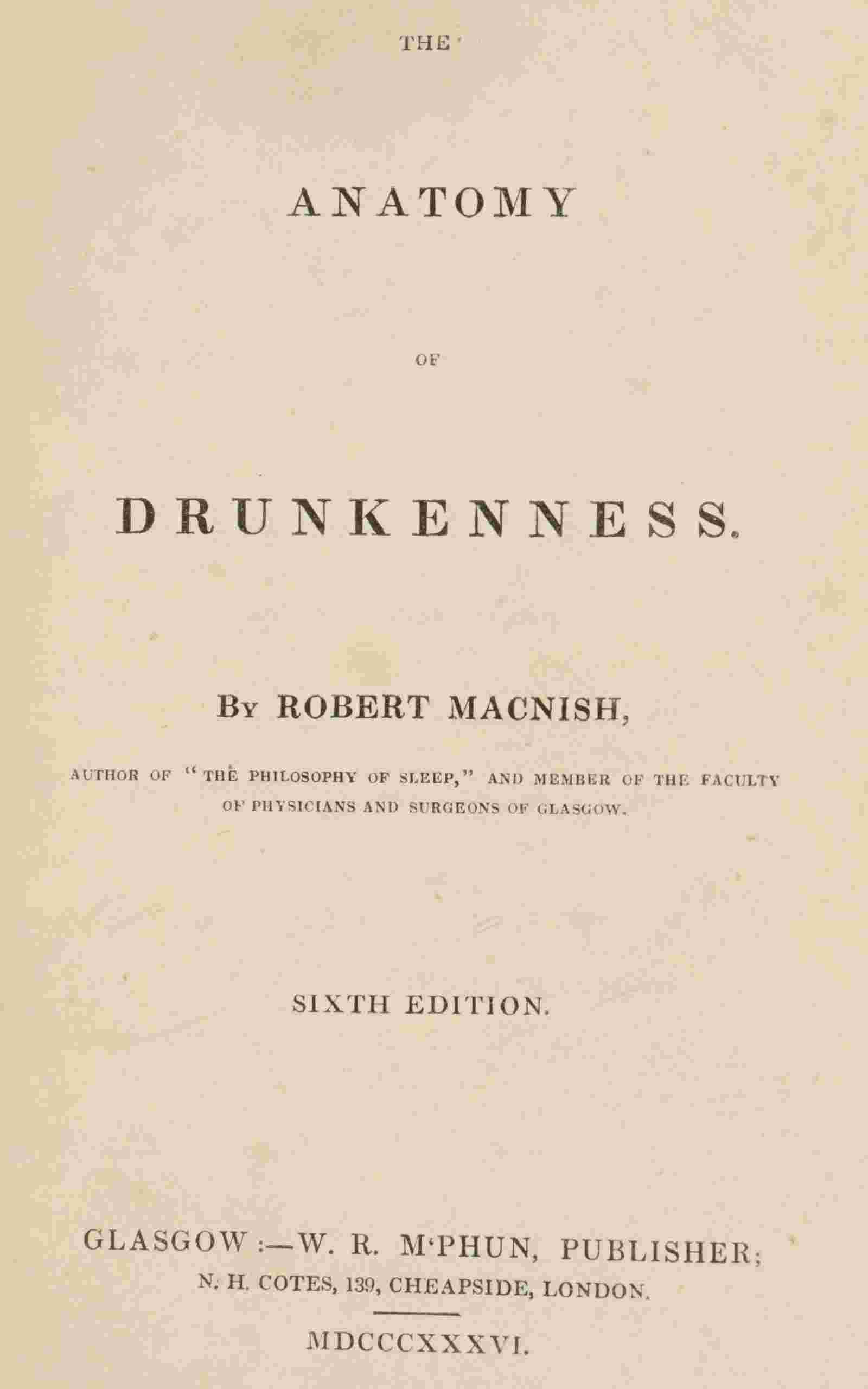
The Anatomy of Drunkenness;
By Robert Macnish, Member of the Faculty of Physicians and Surgeons of Glasgow.
Contents:—Chap. 1. Preliminary Observations. 2. Causes of Drunkenness. 3. Phenomena of Drunkenness. 4. Drunkenness modified by Temperament. 5. Drunkenness modified by the inebriating agent. 6. Enumeration of the less common intoxicating agents. 7. Differences in the Action of Opium and Alcohol. 8. Physiology of Drunkenness. 9. Method of Curing the Fit of Drunkenness. 10. Pathology of Drunkenness. 11. Sleep of Drunkards. 12. Spontaneous Combustion of Drunkards. 13. Drunkenness Judicially considered. 14. Method of Curing the Habit of Drunkenness. 15. Temperance Societies. 16. Advice to Inveterate Drunkards. 17. Effects of Intoxicating Agents on Nurses and Children. 18. Liquors not always hurtful.
“We are happy to announce a fifth edition of this most useful and intelligent work. The author, Mr. Robert Macnish, has done more service to the cause of sobriety, by describing in this book the lamentable results of immoderate indulgence in intoxicating fluids, than all the Temperance Societies in England. In fact, if Mr. Buckingham and his fellow-twaddlers of the celebrated drunken committee, instead of recommending absurd and impracticable legal enactments for the prevention of drunkenness, had prevailed on parliament to grant a sum of money for the dissemination of Macnish’s ‘Anatomy,’ they would have taken the most effectual means to check an evil which is really of a sad and devastating character. We remember once hearing a worthy gentleman advise an unhappy infidel to read Bishop Watson’s reply to Tom Paine’s Age of Reason, remarking, ‘if you study that book, Sir, you cannot be an unbeliever.’ Without seeking to weaken the force of the good Christian’s injunction, we say to all who are in danger of contracting the truly horrible habit of intoxication, read Macnish on Drunkenness.”—London Weekly Despatch.
XXI.
M’Phun’s Catechisms of Useful Knowledge.
Seventh Edition, price Sixpence, sewed; One Shilling, bound in Red Leather, Gilt Edges,
No. I. MISCELLANEOUS ELEMENTARY KNOWLEDGE.
“This little Catechism contains a very great quantity of information upon subjects of which nobody ought to be ignorant, and arranged in such a manner that it may be taught with advantage to, and learned with ease by, children at a very early period. The simpler questions are left without any answer, so that the children may exercise their own ingenuity in solving them. This we think a decided improvement. We are glad also to see so considerable a portion of it devoted to an account of the Books of Scripture, and to an explanation of some of the most important words which frequently occur in them. We are quite sure that this will be found extremely useful ‘in fixing the outline of Scripture History in the youthful mind, and in exciting the desire of a more extensive acquaintance with the Inspired Records.’ While we can very strongly recommend this Catechism to schools for the use of children, we may add, that there are many who are children no longer who might read it over with no small advantage.”—Edinburgh Christian Instructor.
XXII.
Price Sixpence,
No. II. THE SHORTER CATECHISM,
With NOTES; CATECHISMS for CHILDREN, by Isaac Watts, D. D.; and a Collection of HYMNS, by various Authors.
XXIII.
FOR THE USE OF ITALIAN STUDENTS.
Second Edition, price 2s. 6d.
Economy of Human Life—in Italian.
L’ECONOMIA DELLA VITA UMANA DI DODSLEY.
Tradotta Da B. Aloisi.
“This is one of those useful initiatory works which tend to facilitate so much the progress of the Student, while it renders his path smoother and more easy. We recommend it to the attention of both master and scholar. The private student will, in particular, derive benefit from its perusal. We know of no book better fitted to put into the hands of those willing to learn Italian than this is.”—Edinburgh Literary Gazette.