
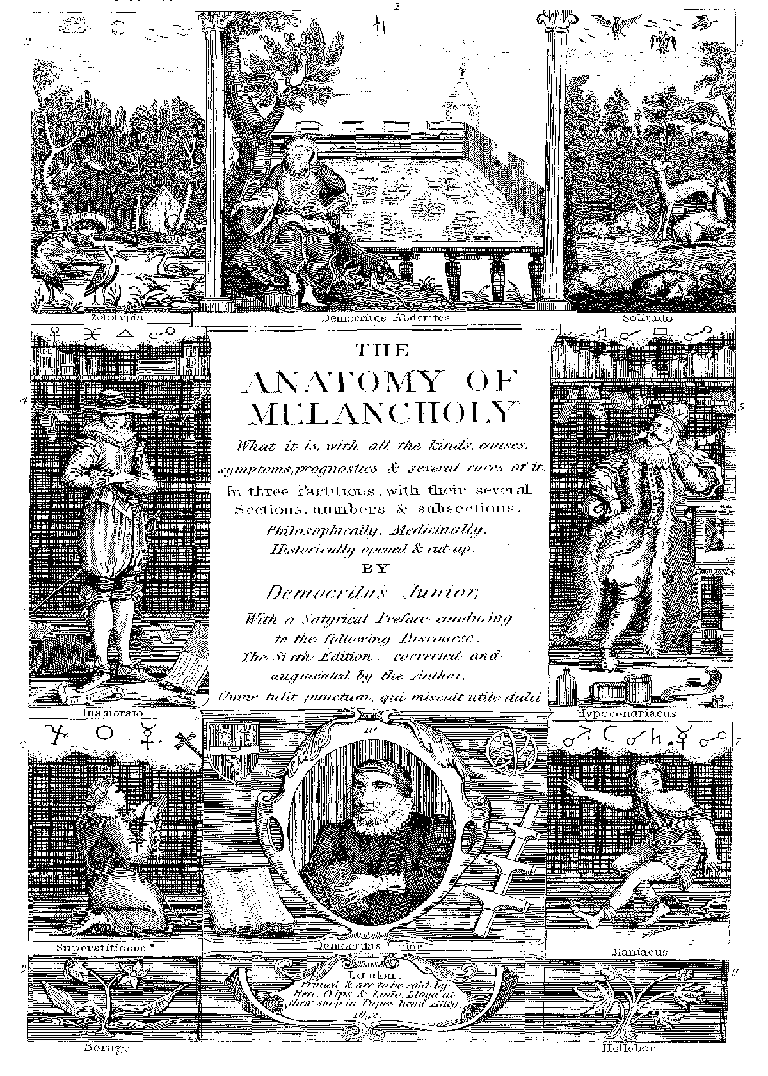
MEMB. IV.
SUBSECT. I—Non-necessary, remote, outward, adventitious, or accidental causes: as first from the Nurse.
Of those remote, outward, ambient, necessary causes, I have sufficiently discoursed in the precedent member, the non-necessary follow; of which, saith [2104]Fuchsius, no art can be made, by reason of their uncertainty, casualty, and multitude; so called “not necessary” because according to [2105]Fernelius, “they may be avoided, and used without necessity.” Many of these accidental causes, which I shall entreat of here, might have well been reduced to the former, because they cannot be avoided, but fatally happen to us, though accidentally, and unawares, at some time or other; the rest are contingent and inevitable, and more properly inserted in this rank of causes. To reckon up all is a thing impossible; of some therefore most remarkable of these contingent causes which produce melancholy, I will briefly speak and in their order.
From a child's nativity, the first ill accident that can likely befall him in this kind is a bad nurse, by whose means alone he may be tainted with this [2106]malady from his cradle, Aulus Gellius l. 12. c. 1. brings in Phavorinus, that eloquent philosopher, proving this at large, [2107] “that there is the same virtue and property in the milk as in the seed, and not in men alone, but in all other creatures; he gives instance in a kid and lamb, if either of them suck of the other's milk, the lamb of the goat's, or the kid of the ewe's, the wool of the one will be hard, and the hair of the other soft.” Giraldus Cambrensis Itinerar. Cambriae, l. 1. c. 2. confirms this by a notable example which happened in his time. A sow-pig by chance sucked a brach, and when she was grown [2108]“would miraculously hunt all manner of deer, and that as well, or rather better, than any ordinary hound.” His conclusion is, [2109]“that men and beasts participate of her nature and conditions by whose milk they are fed.” Phavorinus urges it farther, and demonstrates it more evidently, that if a nurse be [2110]“misshapen, unchaste, dishonest, impudent, [2111]cruel, or the like, the child that sucks upon her breast will be so too;” all other affections of the mind and diseases are almost engrafted, as it were, and imprinted into the temperature of the infant, by the nurse's milk; as pox, leprosy, melancholy, &c. Cato for some such reason would make his servants' children suck upon his wife's breast, because by that means they would love him and his the better, and in all likelihood agree with them. A more evident example that the minds are altered by milk cannot be given, than that of [2112]Dion, which he relates of Caligula's cruelty; it could neither be imputed to father nor mother, but to his cruel nurse alone, that anointed her paps with blood still when he sucked, which made him such a murderer, and to express her cruelty to a hair: and that of Tiberius, who was a common drunkard, because his nurse was such a one. Et si delira fuerit ([2113]one observes) infantulum delirum faciet, if she be a fool or dolt, the child she nurseth will take after her, or otherwise be misaffected; which Franciscus Barbarus l. 2. c. ult. de re uxoria proves at full, and Ant. Guivarra, lib. 2. de Marco Aurelio: the child will surely participate. For bodily sickness there is no doubt to be made. Titus, Vespasian's son, was therefore sickly, because the nurse was so, Lampridius. And if we may believe physicians, many times children catch the pox from a bad nurse, Botaldus cap. 61. de lue vener. Besides evil attendance, negligence, and many gross inconveniences, which are incident to nurses, much danger may so come to the child. [2114]For these causes Aristotle Polit. lib. 7. c. 17. Phavorinus and Marcus Aurelius would not have a child put to nurse at all, but every mother to bring up her own, of what condition soever she be; for a sound and able mother to put out her child to nurse, is naturae intemperies, so [2115]Guatso calls it, 'tis fit therefore she should be nurse herself; the mother will be more careful, loving, and attendant, than any servile woman, or such hired creatures; this all the world acknowledgeth, convenientissimum est (as Rod. a Castro de nat. mulierum. lib. 4. c. 12. in many words confesseth) matrem ipsam lactare infantem, “It is most fit that the mother should suckle her own infant”—who denies that it should be so?—and which some women most curiously observe; amongst the rest, [2116]that queen of France, a Spaniard by birth, that was so precise and zealous in this behalf, that when in her absence a strange nurse had suckled her child, she was never quiet till she had made the infant vomit it up again. But she was too jealous. If it be so, as many times it is, they must be put forth, the mother be not fit or well able to be a nurse, I would then advise such mothers, as [2117]Plutarch doth in his book de liberis educandis and [2118]S. Hierom, li. 2. epist. 27. Laetae de institut. fil. Magninus part 2. Reg. sanit. cap. 7. and the said Rodericus, that they make choice of a sound woman, of a good complexion, honest, free from bodily diseases, if it be possible, all passions and perturbations of the mind, as sorrow, fear, grief, [2119]folly, melancholy. For such passions corrupt the milk, and alter the temperature of the child, which now being [2120] Udum et molle lutum, “a moist and soft clay,” is easily seasoned and perverted. And if such a nurse may be found out, that will be diligent and careful withal, let Phavorinus and M. Aurelius plead how they can against it, I had rather accept of her in some cases than the mother herself, and which Bonacialus the physician, Nic. Biesius the politician, lib. 4. de repub. cap. 8. approves, [2121]“Some nurses are much to be preferred to some mothers.” For why may not the mother be naught, a peevish drunken flirt, a waspish choleric slut, a crazed piece, a fool (as many mothers are), unsound as soon as the nurse? There is more choice of nurses than mothers; and therefore except the mother be most virtuous, staid, a woman of excellent good parts, and of a sound complexion, I would have all children in such cases committed to discreet strangers. And 'tis the only way; as by marriage they are engrafted to other families to alter the breed, or if anything be amiss in the mother, as Ludovicus Mercatus contends, Tom. 2. lib. de morb. haered. to prevent diseases and future maladies, to correct and qualify the child's ill-disposed temperature, which he had from his parents. This is an excellent remedy, if good choice be made of such a nurse.
SUBSECT. II.—Education a Cause of Melancholy.
Education, of these accidental causes of melancholy, may justly challenge the next place, for if a man escape a bad nurse, he may be undone by evil bringing up. [2122]Jason Pratensis puts this of education for a principal cause; bad parents, stepmothers, tutors, masters, teachers, too rigorous, too severe, too remiss or indulgent on the other side, are often fountains and furtherers of this disease. Parents and such as have the tuition and oversight of children, offend many times in that they are too stern, always threatening, chiding, brawling, whipping, or striking; by means of which their poor children are so disheartened and cowed, that they never after have any courage, a merry hour in their lives, or take pleasure in anything. There is a great moderation to be had in such things, as matters of so great moment to the making or marring of a child. Some fright their children with beggars, bugbears, and hobgoblins, if they cry, or be otherwise unruly: but they are much to blame in it, many times, saith Lavater, de spectris, part. 1, cap. 5. ex metu in morbos graves incidunt et noctu dormientes clamant, for fear they fall into many diseases, and cry out in their sleep, and are much the worse for it all their lives: these things ought not at all, or to be sparingly done, and upon just occasion. Tyrannical, impatient, hair-brain schoolmasters, aridi magistri, so [2123]Fabius terms them, Ajaces flagelliferi, are in this kind as bad as hangmen and executioners, they make many children endure a martyrdom all the while they are at school, with bad diet, if they board in their houses, too much severity and ill-usage, they quite pervert their temperature of body and mind: still chiding, railing, frowning, lashing, tasking, keeping, that they are fracti animis, moped many times, weary of their lives, [2124]nimia severitate deficiunt et desperant, and think no slavery in the world (as once I did myself) like to that of a grammar scholar. Praeceptorum ineptiis discruciantur ingenia puerorum, [2125] saith Erasmus, they tremble at his voice, looks, coming in. St. Austin, in the first book of his confess. et 4 ca. calls this schooling meliculosam necessitatem, and elsewhere a martyrdom, and confesseth of himself, how cruelly he was tortured in mind for learning Greek, nulla verba noveram, et saevis terroribus et poenis, ut nossem, instabatur mihi vehementer, I know nothing, and with cruel terrors and punishment I was daily compelled. [2126]Beza complains in like case of a rigorous schoolmaster in Paris, that made him by his continual thunder and threats once in a mind to drown himself, had he not met by the way with an uncle of his that vindicated him from that misery for the time, by taking him to his house. Trincavellius, lib. 1. consil. 16. had a patient nineteen years of age, extremely melancholy, ob nimium studium, Tarvitii et praeceptoris minas, by reason of overmuch study, and his [2127]tutor's threats. Many masters are hard-hearted, and bitter to their servants, and by that means do so deject, with terrible speeches and hard usage so crucify them, that they become desperate, and can never be recalled.
Others again, in that opposite extreme, do as great harm by their too much remissness, they give them no bringing up, no calling to busy themselves about, or to live in, teach them no trade, or set them in any good course; by means of which their servants, children, scholars, are carried away with that stream of drunkenness, idleness, gaming, and many such irregular courses, that in the end they rue it, curse their parents, and mischief themselves. Too much indulgence causeth the like, [2128]inepta patris lenitas et facilitas prava, when as Mitio-like, with too much liberty and too great allowance, they feed their children's humours, let them revel, wench, riot, swagger, and do what they will themselves, and then punish them with a noise of musicians;
SUBSECT. III.—Terrors and Affrights, Causes of Melancholy.
Tully, in the fourth of his Tusculans, distinguishes these terrors which arise from the apprehension of some terrible object heard or seen, from other fears, and so doth Patritius lib. 5. Tit. 4. de regis institut. Of all fears they are most pernicious and violent, and so suddenly alter the whole temperature of the body, move the soul and spirits, strike such a deep impression, that the parties can never be recovered, causing more grievous and fiercer melancholy, as Felix Plater, c. 3. de mentis alienat. [2136]speaks out of his experience, than any inward cause whatsoever: “and imprints itself so forcibly in the spirits, brain, humours, that if all the mass of blood were let out of the body, it could hardly be extracted. This horrible kind of melancholy” (for so he terms it) “had been often brought before him, and troubles and affrights commonly men and women, young and old of all sorts.” [2137]Hercules de Saxonia calls this kind of melancholy (ab agitatione spirituum) by a peculiar name, it comes from the agitation, motion, contraction, dilatation of spirits, not from any distemperature of humours, and produceth strong effects. This terror is most usually caused, as [2138]Plutarch will have, “from some imminent danger, when a terrible object is at hand,” heard, seen, or conceived, [2139]“truly appearing, or in a [2140]dream:” and many times the more sudden the accident, it is the more violent.
SUBSECT. IV.—Scoffs, Calumnies, bitter Jests, how they cause Melancholy.
It is an old saying, [2161]“A blow with a word strikes deeper than a blow with a sword:” and many men are as much galled with a calumny, a scurrilous and bitter jest, a libel, a pasquil, satire, apologue, epigram, stage-play or the like, as with any misfortune whatsoever. Princes and potentates, that are otherwise happy, and have all at command, secure and free, quibus potentia sceleris impunitatem fecit, are grievously vexed with these pasquilling libels, and satires: they fear a railing [2162]Aretine, more than an enemy in the field, which made most princes of his time (as some relate) “allow him a liberal pension, that he should not tax them in his satires.” [2163]The Gods had their Momus, Homer his Zoilus, Achilles his Thersites, Philip his Demades: the Caesars themselves in Rome were commonly taunted. There was never wanting a Petronius, a Lucian in those times, nor will be a Rabelais, an Euphormio, a Boccalinus in ours. Adrian the sixth pope [2164]was so highly offended, and grievously vexed with pasquillers at Rome, he gave command that his statue should be demolished and burned, the ashes flung into the river Tiber, and had done it forthwith, had not Ludovicus Suessanus, a facete companion, dissuaded him to the contrary, by telling him, that pasquil's ashes would turn to frogs in the bottom of the river, and croak worse and louder than before,—genus irritabile vatum, and therefore [2165]Socrates in Plato adviseth all his friends, “that respect their credits, to stand in awe of poets, for they are terrible fellows, can praise and dispraise as they see cause.” Hinc quam sit calamus saevior ense patet. The prophet David complains, Psalm cxxiii. 4. “that his soul was full of the mocking of the wealthy, and of the despitefulness of the proud,” and Psalm lv. 4. “for the voice of the wicked, &c., and their hate: his heart trembled within him, and the terrors of death came upon him; fear and horrible fear,” &c., and Psal. lxix. 20. “Rebuke hath broken my heart, and I am full of heaviness.” Who hath not like cause to complain, and is not so troubled, that shall fall into the mouths of such men? for many are of so [2166]petulant a spleen; and have that figure Sarcasmus so often in their mouths, so bitter, so foolish, as [2167]Balthazar Castilio notes of them, that “they cannot speak, but they must bite;” they had rather lose a friend than a jest; and what company soever they come in, they will be scoffing, insulting over their inferiors, especially over such as any way depend upon them, humouring, misusing, or putting gulleries on some or other till they have made by their humouring or gulling [2168]ex stulto insanum, a mope or a noddy, and all to make themselves merry:
Such scurrilous jests, flouts, and sarcasms, therefore, ought not at all to be used; especially to our betters, to those that are in misery, or any way distressed: for to such, aerumnarum incrementa sunt, they multiply grief, and as [2178]he perceived, In multis pudor, in multis iracundia, &c., many are ashamed, many vexed, angered, and there is no greater cause or furtherer of melancholy. Martin Cromerus, in the Sixth book of his history, hath a pretty story to this purpose, of Vladislaus, the second king of Poland, and Peter Dunnius, earl of Shrine; they had been hunting late, and were enforced to lodge in a poor cottage. When they went to bed, Vladislaus told the earl in jest, that his wife lay softer with the abbot of Shrine; he not able to contain, replied, Et tua cum Dabesso, and yours with Dabessus, a gallant young gentleman in the court, whom Christina the queen loved. Tetigit id dictum Principis animum, these words of his so galled the prince, that he was long after tristis et cogitabundus, very sad and melancholy for many months; but they were the earl's utter undoing: for when Christina heard of it, she persecuted him to death. Sophia the empress, Justinian's wife, broke a bitter jest upon Narsetes the eunuch, a famous captain then disquieted for an overthrow which he lately had: that he was fitter for a distaff and to keep women company, than to wield a sword, or to be general of an army: but it cost her dear, for he so far distasted it, that he went forthwith to the adverse part, much troubled in his thoughts, caused the Lombards to rebel, and thence procured many miseries to the commonwealth. Tiberius the emperor withheld a legacy from the people of Rome, which his predecessor Augustus had lately given, and perceiving a fellow round a dead corse in the ear, would needs know wherefore he did so; the fellow replied, that he wished the departed soul to signify to Augustus, the commons of Rome were yet unpaid: for this bitter jest the emperor caused him forthwith to be slain, and carry the news himself. For this reason, all those that otherwise approve of jests in some cases, and facete companions, (as who doth not?) let them laugh and be merry, rumpantur et illa Codro, 'tis laudable and fit, those yet will by no means admit them in their companies, that are any way inclined to this malady: non jocandum cum iis qui miseri sunt, et aerumnosi, no jesting with a discontented person. 'Tis Castilio's caveat, [2179]Jo. Pontanus, and [2180]Galateus, and every good man's.
SUBSECT. V.—Loss of Liberty, Servitude, Imprisonment, how they cause Melancholy.
To this catalogue of causes, I may well annex loss of liberty, servitude, or imprisonment, which to some persons is as great a torture as any of the rest. Though they have all things convenient, sumptuous houses to their use, fair walks and gardens, delicious bowers, galleries, good fare and diet, and all things correspondent, yet they are not content, because they are confined, may not come and go at their pleasure, have and do what they will, but live [2187]aliena quadra, at another man's table and command. As it is [2188]in meats so it is in all other things, places, societies, sports; let them be never so pleasant, commodious, wholesome, so good; yet omnium rerum est satietas, there is a loathing satiety of all things. The children of Israel were tired with manna, it is irksome to them so to live, as to a bird in his cage, or a dog in his kennel, they are weary of it. They are happy, it is true, and have all things, to another man's judgment, that heart can wish, or that they themselves can desire, bona si sua norint: yet they loathe it, and are tired with the present: Est natura hominum novitatis avida; men's nature is still desirous of news, variety, delights; and our wandering affections are so irregular in this kind, that they must change, though it must be to the worst. Bachelors must be married, and married men would be bachelors; they do not love their own wives, though otherwise fair, wise, virtuous, and well qualified, because they are theirs; our present estate is still the worst, we cannot endure one course of life long, et quod modo voverat, odit, one calling long, esse in honore juvat, mox displicet; one place long, [2189]Romae Tibur amo, ventosus Tybure Romam, that which we earnestly sought, we now contemn. Hoc quosdam agit ad mortem, (saith [2190]Seneca) quod proposita saepe mutando in eadem revolvuntur, et non relinquunt novitati locum: Fastidio caepit esse vita, et ipsus mundus, et subit illud rapidissimarum deliciarum, Quousque eadem? this alone kills many a man, that they are tied to the same still, as a horse in a mill, a dog in a wheel, they run round, without alteration or news, their life groweth odious, the world loathsome, and that which crosseth their furious delights, what? still the same? Marcus Aurelius and Solomon, that had experience of all worldly delights and pleasure, confessed as much of themselves; what they most desired, was tedious at last, and that their lust could never be satisfied, all was vanity and affliction of mind.
Now if it be death itself, another hell, to be glutted with one kind of sport, dieted with one dish, tied to one place; though they have all things otherwise as they can desire, and are in heaven to another man's opinion, what misery and discontent shall they have, that live in slavery, or in prison itself? Quod tristius morte, in servitute vivendum, as Hermolaus told Alexander in [2191]Curtius, worse than death is bondage: [2192]hoc animo scito omnes fortes, ut mortem servituti anteponant, All brave men at arms (Tully holds) are so affected. [2193]Equidem ego is sum, qui servitutem extremum omnium malorum esse arbitror: I am he (saith Boterus) that account servitude the extremity of misery. And what calamity do they endure, that live with those hard taskmasters, in gold mines (like those 30,000 [2194]Indian slaves at Potosi, in Peru), tin-mines, lead-mines, stone-quarries, coal-pits, like so many mouldwarps under ground, condemned to the galleys, to perpetual drudgery, hunger, thirst, and stripes, without all hope of delivery? How are those women in Turkey affected, that most part of the year come not abroad; those Italian and Spanish dames, that are mewed up like hawks, and locked up by their jealous husbands? how tedious is it to them that live in stoves and caves half a year together? as in Iceland, Muscovy, or under the [2195]pole itself, where they have six months' perpetual night. Nay, what misery and discontent do they endure, that are in prison? They want all those six non-natural things at once, good air, good diet, exercise, company, sleep, rest, ease, &c., that are bound in chains all day long, suffer hunger, and (as [2196]Lucian describes it) “must abide that filthy stink, and rattling of chains, howlings, pitiful outcries, that prisoners usually make; these things are not only troublesome, but intolerable.” They lie nastily among toads and frogs in a dark dungeon, in their own dung, in pain of body, in pain of soul, as Joseph did, Psal. cv. 18, “they hurt his feet in the stocks, the iron entered his soul.” They live solitary, alone, sequestered from all company but heart-eating melancholy; and for want of meat, must eat that bread of affliction, prey upon themselves. Well might [2197]Arculanus put long imprisonment for a cause, especially to such as have lived jovially, in all sensuality and lust, upon a sudden are estranged and debarred from all manner of pleasures: as were Huniades, Edward, and Richard II., Valerian the Emperor, Bajazet the Turk. If it be irksome to miss our ordinary companions and repast for once a day, or an hour, what shall it be to lose them for ever? If it be so great a delight to live at liberty, and to enjoy that variety of objects the world affords; what misery and discontent must it needs bring to him, that shall now be cast headlong into that Spanish inquisition, to fall from heaven to hell, to be cubbed up upon a sudden, how shall he be perplexed, what shall become of him? [2198] Robert Duke of Normandy being imprisoned by his youngest brother Henry I., ab illo die inconsolabili dolore in carcere contabuit, saith Matthew Paris, from that day forward pined away with grief. [2199]Jugurtha that generous captain, “brought to Rome in triumph, and after imprisoned, through anguish of his soul, and melancholy, died.” [2200]Roger, Bishop of Salisbury, the second man from King Stephen (he that built that famous castle of [2201]Devizes in Wiltshire,) was so tortured in prison with hunger, and all those calamities accompanying such men, [2202]ut vivere noluerit, mori nescierit, he would not live, and could not die, between fear of death, and torments of life. Francis King of France was taken prisoner by Charles V., ad mortem fere melancholicus, saith Guicciardini, melancholy almost to death, and that in an instant. But this is as clear as the sun, and needs no further illustration.