
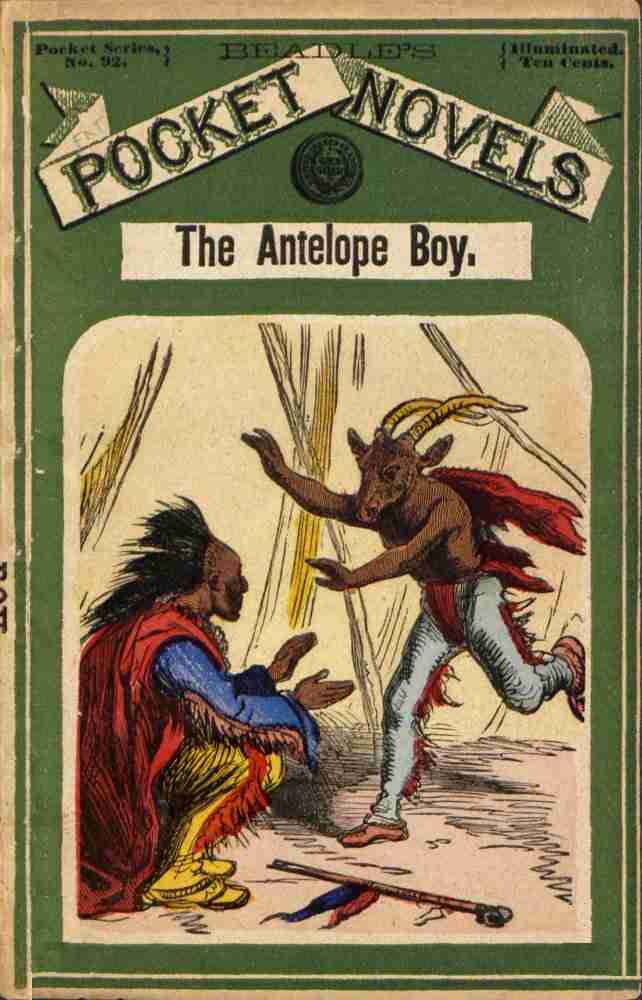
The Project Gutenberg eBook of The Antelope Boy; or, Smoholler the Medicine Man
Title: The Antelope Boy; or, Smoholler the Medicine Man
Author: George L. Aiken
Release date: August 31, 2021 [eBook #66190]
Most recently updated: October 18, 2024
Language: English
Credits: David Edwards, Stephen Hutcheson, and the Online Distributed Proofreading Team at https://www.pgdp.net (Northern Illinois University Digital Library)
THE ANTELOPE BOY;
OR,
SMOHOLLER, THE MEDICINE-MAN
A TALE OF INDIAN ADVENTURE AND MYSTERY.
BY GEORGE L. AIKEN.
NEW YORK.
BEADLE AND ADAMS, PUBLISHERS,
98 WILLIAM STREET.
Entered according to Act of Congress, in the year 1873, by
FRANK STARR & CO.,
In the office of the Librarian of Congress, at Washington.
CONTENTS
- I The Surveyors’ Camp 9
- II The Arrow Message 14
- III Smoholler’s Fiend 19
- IV Smoholler’s Angel 24
- V The Scouting Party 28
- VI Finding the Trail 32
- VII A Desperate Encounter 35
- VIII The Prophet-Chief 39
- IX Conjuration 42
- X Oneotah 46
- XI A Silvan Repast 50
- XII The Tree-Ladder 54
- XIII Multuomah 59
- XIV The Chief’s Bride 63
- XV The Old Hunter’s Idea 67
- XVI Holding a Council 70
- XVII The Boy Embassadors 75
- XVIII The White Lily 80
- XIX On the Way 84
- XX Oneotah’s Memories 88
- XXI The Mystic Cavern 91
- XXII The Search is Ended 95
THE ANTELOPE BOY;
OR,
SMOHOLLER, THE MEDICINE-MAN.
CHAPTER I.
THE SURVEYORS’ CAMP.
The surveying party were camped upon the banks of the Columbia River, a short distance from the mouth of its confluent, the Yakima.
This party consisted of the two surveyors—Owen Blaikie, a bluff, middle-aged Scotchman, long since “naturalized” to this country, and Cyrus Robbins, a shrewd young Yankee, twelve United States soldiers under command of Lieutenant Charles Gardiner, detailed expressly from the nearest fort to protect the surveying party from predatory bands of Indians, an old hunter, generally known under the name of “Gummery Glyndon,”—his prefix of Montgomery having suffered this abbreviation at the hands of his associates—whose duty it was to act as guide, and keep the surveyors supplied with fresh meat; and two boys, the chain-bearers of the expedition.
These boys merit more than a passing notice here, as they are destined to play conspicuous parts in the events which were to follow the advance of the surveying party into the country of the Yakimas.
There was this peculiarity about them, that they were first cousins, and were both called Percy—Percy Vere and Percy Cute.
But despite their relationship and the similarity of their surnames, there was very little resemblance between the two.
Percy Vere was a slender youth, graceful and active, with a frank, honest face, and regular features, his hair being a dark chestnut, thick and curly, and his eyes a clear hazel, giving evidence of courage and decision of character in their glances. He looked quite picturesque in his coarse suit, with the trowsers tucked into high-topped boots, and his crispy curls straggling from beneath his broad-leafed felt hat.
Percy Cute was full a head shorter, and his figure was decidedly dumpish. He had a fat, good-natured face, light flaxen hair, and a laughing blue eye. Indeed, a grin appeared to be the prevailing expression of his features. He was sluggish-looking, and appeared like one who would not put forth exertion unless compelled to do so. He was dressed after the fashion of his cousin and comrade, with heavy boots, coarse trowsers, a striped shirt, with a broad collar, and a kind of roundabout, which was short for a coat, and too long for a jacket; and like him, he wore a revolver in a belt buckled around his waist, the pistol resting convenient to hand, upon his right hip, while on the left side the handle of a bowie knife made itself conspicuous.
All in this party carried arms, for the service was one of danger, and at any moment the emergency for their use might arise.
The boys were quite favorites in the party, the first by his frank, manly bearing, and accommodating spirit, and the other by his unvarying good nature, and the drollery in which he was so fond of indulging. His humor appeared to be inexhaustible, and his quaint manner of giving vent to it was irresistible.
In fact, Percy Cute had, at a very early age, been forcibly impressed by the antics of a clown in a circus, and his great delight had been to play clown from that eventful moment.
The culinary department of the expedition was attended to by a colored individual who combined the two functions of cook and barber for the party. He was a jolly little darky, but terribly afraid of the Indians. The fear of his life was that he might have his “wool lifted”—as the old hunter phrased it—before he got out of the wilderness. But he had one consolation even in this apprehension: he had, like a great many other barbers, invented a HAIR RESTORATIVE, which he considered infallible.
“Never you mind, boys,” he would tell the soldiers, “if de Injines does gobble us, an’ lift our ha’r, as Gummery says, I can make it grow ag’in—hi yah-yah! I jist kin!”
Whereupon he would exhibit a small bottle in a mysterious manner, adding, “Dar’s de stuff dat can do it—you bet!” And then he would consign it to his pocket again.
This assurance afforded much amusement to the “high privates” of the party, who made a standing joke of the Professor’s Hair Restorative—for Isaac Yardell had prefixed the word “Professor” to his name when he was a tonsorial artist in Chicago, before the spirit of adventure had seized upon him and led him after gold among the mountains of Montana.
Gummery Glyndon had brought in an antelope. Some of the soldiers had captured a few fish from the river, a fire had been built in the center of the camp, and preparations were going on briskly for the evening meal.
In this Isaac had four assistants, he having contrived to transfer the drudgery of his office, with true Ethiopian cunning, to others. A colored servitor will always shirk all the work he can. Thus two of the soldiers, a German named Jacob Spatz—Dutch Jake, was his camp name—and one Irishman, Cornelius Donohoe—Corney for short—were always available for services at meal-time, and the two boys—the Percys—collected the wood for the firing. By this arrangement Isaac had little to do but the cooking, which he performed to the entire satisfaction of the party.
Even the rough old hunter—Glyndon—a gaunt, grizzly man of fifty years of age, bestowed his meed of praise upon him.
“It don’t matter what I bring in,” he told Lieutenant Gardiner, “game, fish or fowl—antelope, mountain sheep, or b’ar meat, that Ike can just make it toothsome. These darkies take to cooking, ’pears to me, just as naturally as ducks do to water.”
Ike had only one grievance in the camp, Percy Cute was continually playing jokes upon him. Such little pranks as putting powder in his pipe, nipping at the calves of his legs and imitating a dog’s growl, and grasping his wool at night, and shouting a war-whoop in his ear, had a damaging effect upon Ike’s temper, and he vowed deadly vengeance. But his vengeance never extended beyond a chase after Percy Cute with a ladle, with the laudable intention of administering a severe spanking; but in these onslaughts the redoubtable Isaac always came to grief; for, just as he would overtake the flying youth, Cute, with a nimbleness that his sluggish look and dumpy figure never led any one to expect, would suddenly fall upon his hands and knees, and pitch his pursuer over him. But as Isaac invariably alighted upon his head, he received no injury from these involuntary dives. A shout of laughter would herald his defeat, and he would pick himself up, and return to his camp-kettle, in a crest-fallen manner, swearing to himself until every thing got blue around him, and vowing that he would “fix him de next time, suah!”
These little episodes enlivened the camp, and nobody enjoyed them better than Gummery Glyndon. The old hunter had, generally, a morose look upon his seamed and weather-beaten countenance, and his hatred of every thing in shape of an Indian was well known.
Nor was the cause of that hatred a secret. He had been the victim of one of those forest tragedies so frequently enacted upon the frontier. It was the old story which has been told so often, and will be repeated until the extermination of the red-man—which has been going on slowly but surely for years—is completed.
While absent upon a hunting and trapping expedition, his cabin had been surprised, his wife and only child, a little girl some three years of age, cruelly murdered, and their mutilated remains consumed in the fire that destroyed his home.
A blackened ruin was all that was left of the spot that was so dear to him, and he found himself alone in the world, with only one thought in the future—vengeance upon the murderers.
In the drear solitude of that heart-sickening scene, and beside the ashes of all that he had treasured in the world, he breathed that vow of vengeance, which the lips of so many bereaved settlers in the Far West have sent up to heaven—death to the destroyers.
That was fifteen years before the time in which I introduce him here. In all those years he had pursued the Indians with a deadly malignity. He had taken part in every Indian war that had broken out, and the number of his victims had been many.
As the years passed away this feeling of vengeance grew fainter, and though he never spared an Indian who came against him with hostile intent, yet he did not go out of his way to seek for them, as he had done. The Yakimas were supposed to be the destroyers of his home and family, and against that nation he cherished an undying enmity. Yet circumstances had led him away from their country, to the hunting-grounds of the Apaches, with whom he had many encounters.
He had gladly accepted the service that would take him back to the land of the Yakimas. In all these years he had gained experience as a guide, in wood-craft, and as an Indian-fighter. No hunter of the plains bore a better reputation for skill, prudence, and knowledge of the Indians than Gummery Glyndon.
His face bore a somewhat morose expression, as I have said, but he was far from being a morose man. Indeed, there was quite a fund of dry humor in his disposition, which was an agreeable surprise to those who judged the man by his saturnine countenance.
Percy Cute was a particular favorite of his, and none in the party enjoyed the boy’s drolleries more than he did. Indeed, both the boys were prime favorites with him, and often accompanied him upon his hunts. He looked upon them in the light of proteges, as he had got them their places in the expedition.
He had met them at Fort Benton, where they had come from Omaha up the Missouri river, on one of the steamboats that ply on that stream, and was rather surprised to hear what had brought them there.
Though partly led by a spirit of adventure, they had a mission, and one of some importance.
CHAPTER II.
THE ARROW MESSAGE.
Percy Vere explained this mission to the old hunter. His father had been missing for years. He was an eccentric character, and professed spiritualism, astrology, ventriloquism, and kindred sciences, dabbling a little in magic and chemistry. In fact, he was a universal genius—a jack-of-all-trades, and not doing well with any.
Percy’s mother was a woman of ability and good sense, a first rate milliner, and her industry kept the wolf, which the father’s eccentricities brought to the door, away. In other words, she was obliged to support herself and son, and often furnish money to the genius, who could not make it for himself with all his diverse talents.
He did not appear to be able to concentrate his forces so as to produce any good from them. He was full of wild theories and startling speculations, but he failed signally whenever he attempted to put them to an application.
His wife expressed her opinion of him freely one day, and told him she could no longer expend her savings in his wild schemes. He replied that it was the fate of genius to be misunderstood, that he was destined to be a great man, and she would live to see it; and having uttered this ambiguous prophecy, left her.
He did not return the next day, or the next—a year passed away without bringing Guy Vere home. His wife became alarmed at his prolonged absence. She reproached herself with being too harsh with him and having driven him away from her. He was a handsome man, and she had cherished a warm affection for him, which his eccentricities had not destroyed. She feared that she had driven him to commit suicide. But no tidings came of his death.
She was obliged to keep her little millinery shop going for the support of herself and son, and her sister’s child, who being left an orphan, fell to her care. This was Percy Cute—who was just one year younger than his cousin, his mother having been so pleased with the name of her sister’s child, that she had bestowed it upon her own.
The little shop prospered, and the boys grew in years. Mrs. Vere could not drive the image of her husband from her mind. If she could have satisfied herself that he was dead, she would have been more content, but she could not do that.
The impression among Guy’s neighbors when he was at home, was that he was not in his right mind—“Luny,” they called him.
But many years passed away before she got any tidings of the missing man, and then it came in a very vague shape.
Percy Vere got an Omaha Herald one day, which had been sent as an exchange to a St. Louis paper, and in it was the advertisement of an astrologer who called himself “Professor Guy.”
He took it home to his mother, and said to her, “That’s father!”
These words put her all in a flutter. She took the paper and scanned the advertisement eagerly.
“What makes you think so?” she asked.
“Father’s name was Guy, and he was a ‘professor’ of astrology!”
She smiled. “He was a professor of almost everything.”
“Suppose I go and see if it is my father,” he suggested.
She pondered over this.
“Would you know him, do you think?”
“Oh, yes, if the picture you have in your locket is any thing like him.”
“It was when it was taken.”
She took out the locket, which she wore constantly around her neck, sprung it open, and regarded the two portraits it contained earnestly, for it held her miniature likeness as well as his.
“I have not changed much,” she said, “and perhaps he has not, either. I should really like to know if he is alive. Suppose I was to write to this Professor Guy?”
Percy, who was a bright youth, shook his head dissentingly.
“If he is staying away of his own accord, it is no use to write to him to come back,” he replied.
She breathed a sigh. “I suppose not,” she said.
“But if I was to go after him and have a talk with him, I might prevail upon him to come back.”
Mrs. Vere was impressed by these words, but she answered: “How could I trust you so far away from home?”
He smiled, and drew himself proudly up.
“Don’t you think I am big enough to take care of myself?”
She surveyed his tall, graceful figure, with a mother’s pride, saying:
“Perhaps; but you are so young.”
“I’m seventeen, and I feel quite a man.”
“But I don’t like to trust you so far from home alone.”
“Oh! I needn’t go alone; Percy can go with me.”
Mrs. Vere laughed.
“A great protection he would be—another boy like yourself!” she cried. “There, there—let us not talk any more about it.”
But they did talk about it upon several occasions afterward, and Mrs. Vere’s desire to hear from her missing husband overcame all other considerations, and she consented to Percy’s request to go in search of him. She thought that the sight of his boy would induce him to return home.
Her business had proved prosperous, as I have said, and she was able to fit out the boys in good style. She hung the locket that contained her own and husband’s likeness around her son’s neck, and bade him a tearful “good speed.”
The boys took passage upon a steamboat bound for Omaha, and steamed up the Big Muddy, as the Missouri is called by the dwellers on its banks, and reached that ambitious city in due season.
Upon making inquiries, Percy Vere learned that Professor Guy had found Omaha dull for the exercise of his profession, and had joined a party of adventurers—a mixture of hunters and gold-seekers—and gone with them to Fort Benton.
The very eccentricity of this proceeding was a convincing proof to Percy that this Professor Guy was indeed his father So he wrote to his mother, and then he and Percy Cute sailed up the river in one of the light-draught steamboats.
They reached Fort Benton without misadventure, but here, instead of being at the end of their journey, they found it was just the starting-point. The party to which the Professor had attached himself had taken the trail that led into the wilderness, and it was necessary to follow it, or abandon the search.
Percy Vere chose the former alternative, for he could never think of the latter, and Percy Cute was always of his way of thinking—in fact, thinking was irksome to his sluggish nature.
“I just tumble to any thing you say,” he told his cousin. “Follow your leader—that’s my maxim. You lead and I’ll follow. Say! we might have some high old fun among the Injuns, and bears, and things. Let’s invest in a revolver and bowie-knife, and travel on our muscle!”
So Percy Vere, filled with a true spirit of boyish adventure, wrote his intentions to his mother, and he and Cute made their preparations for a journey into the wilderness.
At this juncture of affairs they made the acquaintance of the old hunter, Gummery Glyndon. They told him their story, (or rather young Vere did, for he was the spokesman on all occasions) and he promised to aid them, and fulfilled his promise by attaching them to the surveying party, though in the capacity of chain bearers; but the boys did not mind that.
Such an opportunity to penetrate into the Indian country was not to be neglected, and the first Percy, who was treasurer, wished to husband their means, for there was no telling how long their search might last, or whither it would lead them.
They made rapid journeys at first, as a portion of the “Northern Pacific Railroad” had already been surveyed, and they were to take it up at, or near, that point, where it was to connect in a south-easterly direction with the “Union Pacific.”
As they passed the different Government forts their escort was changed, until they were joined by Lieutenant Gardiner and his squad, from Fort Walla Walla. He was to remain with them until they were through the Yakima country.
Hitherto their journey had led through the land of the Nez Perces, who were a friendly tribe, and they had been undisturbed; but when they made this new camp Gummery Glyndon told them they might now expect trouble from the Indians.
“There’s three tribes through here,” he said, “and there ain’t much choice between ’em. There’s the Cayuses, the Yakimas, and the Umatillas—a pesky set of murdering thieves the lot of ’em. They all belong to the great Snake Nation, I believe—red sarpints, every mother’s son of ’em.”
When he returned from his hunt he told them that he had seen “Indian sign.”
“There’s Injuns watching us, and we shall hear from them,” he said. “We’ll have to keep a sharp watch to-night, or they’ll stampede our animals.”
The lieutenant and the surveyors did not neglect this warning. They had great confidence in the old hunter’s judgment.
When the supper was disposed of the camp was placed in as good a condition of defense as the locality would permit. The ground had been well selected; it was a little grove on the river’s bank, a kind of oasis among the cliffs, which rose beetling upon either side, precipitously, and, apparently, inaccessible. These cliffs were some distance—a long rifle-shot—from the little grove, and a kind of rocky valley lay between them, devoid of vegetation in many places, where the hard rocks cropped up. Through this valley must the foe come, or else risk their necks, or a plunge into the river, by attempting to skirt the cliffs.
The horses belonging to the party were secured in the grove. In the center of the grove, in a kind of natural fireplace formed by the rocks, the fire had been built, and its red embers were still glowing. Two sentinels were posted at either extremity of the camp. Around the fire the hunter, the surveyors, and the lieutenant were stretched in easy attitudes, enjoying their pipes of tobacco—the great luxury of the wilderness.
A short distance from them the two boys reclined upon a mossy bowlder, listening to their conversation.
The sun had sunk, and the glorious twilight of that western land was upon them. The scene was of calm tranquillity. But that tranquillity was broken in a singular manner.
There came a hurtling sound in the air, and an arrow descended, apparently from the heavens, and stuck quivering in the turf at Lieutenant Gardiner’s head.
All started and grasped their weapons, instinctively, for the trusty rifles were close at hand.
“An attack?” cried Gardiner.
“No—a message. See, there’s a scroll upon the arrow,” answered Gummery. “Read it.”
He threw some brush upon the coals which speedily burst into a flame. Lieutenant Gardiner undid the scroll of bark from the arrow, and spread it open. It contained characters which he had no difficulty in deciphering, for they were written in English.
“White men, begone! If you advance further into the land of the Yakimas, certain destruction awaits you.
“Smoholler, the Prophet.”
CHAPTER III.
SMOHOLLER’S FIEND.
“What does this mean?” added Lieutenant Gardiner, having read this singular scroll aloud.
“A game of bluff!” answered the irrepressible Percy Cute. “Let’s see him, and go two better!”
“It’ll be more than a bluff game,” rejoined Gummery Glyndon, shaking his head gravely. “This means business. It’s a notice to quit, and if we don’t take it, these Injuns will do their best to put us out.”
“Rub us out entirely, I guess you mean,” cried Surveyor Robbins, laughingly. “But we won’t take the back track on such a notice as that. Who is this Smoholler?”
“Yes, that’s what I want to know,” chimed in Blaikie and Lieutenant Gardiner.
“I have heard tell of him, though I never met him,” replied Glyndon. “He’s a great gun among the Injuns hereabouts. He’s a kind of red Brigham Young—calls himself a Prophet, and has started a new religion among the red-skins.”
“What is this religion like?”
“That’s more than I can say; though, from what I’ve heard, there appears to be a deal of trickery about it. He’s a great Medicine-man, and can raise the Old Boy, generally. He has his familiar fiends, and makes ’em appear to his followers whenever he likes. He works miracles, and all that sort of thing. And when he predicts the death of any one, they just go, sure pop, at the time mentioned.”
“A singular man, this,” remarked Lieutenant Gardiner, thoughtfully.
“He’s more smart than sing’lar; he just keeps these benighted heathen right under his thumb. They don’t dare to say their souls are their own when he’s around.”
“Where did he come from?”
“He is said to be a Snake Indian of the Walla Walla tribe. He started a village on the river, above here, at a place they call Priest’s Rapids, and his followers increased like magic. He is said, by the Nez Perces, to have a couple of thousand of believers, renegades from all the other tribes in this region, and he can put three hundred fighting men in the field, and then the Cayuses, Yakimas and Umatillas all stand in dread of him, and wouldn’t dare to do any thing else but join him in a war against the whites if he called on ’em. I believe he’s got a reg’lar stronghold at Priest’s Rapids.”
“Is it named so on his account?” asked Robbins.
Glyndon shook his head dubiously.
“I s’pose so, but I couldn’t say for sure. I don’t know the place; was never up there.”
“What kind of a place is it—did you ever hear?”
“Oh, yes. It is north of the Oregon line, and is a great place for salmon-fishing. The Injuns have a great time catching ’em in the season.”
“This Smoholler, then, is a kind of independent chief among the other tribes?”
“Yes; and his tribe is a conglomeration of all the other tribes, and the pick of ’em, too. They are called Smohollers by the other Injuns, but there’s Cayuses, Yakimas, Umatillas, Modocs, Snakes, and Piutes amongst them.”
“A mongrel set!”
“But tough customers to deal with.”
Lieutenant Gardiner turned to Percy Vere.
“You and your chum send the sentinels in to me, and take their places—young eyes are sharp.”
The two boys, who had been listening attentively to this conversation, obeyed at once, and the two sentinels soon appeared before the lieutenant. But they had not seen any one approach the camp, and were surprised to hear that an arrow had been shot into it.
Gummery Glyndon surveyed the nearest cliff critically. Its base was about a stone’s throw from where he sat. The rising moon threw a silvery radiance upon its peak, disclosing an irregularity near its top, that looked like a cavity in its face, though it might have been only a shadow.
“It’s my opinion the arrow came from there,” he exclaimed, giving utterance to this thought suddenly.
All eyes were turned in the direction indicated.
“But how could any one get up there? A cat couldn’t climb that. It’s as steep and as smooth as a wall.”
“Just you wait,” returned the old guide, coolly. “If this Smoholler is the kind of man he’s said to be, we ain’t done with him yet. Just keep your weather eye peeled in the direction of that cliff, and have your rifles handy. That arrow was only the commencement. I saw plenty of Injun sign to-day, and there may be a hundred of Smoholler’s braves beyond there. I opine that he is not going to let us travel much further into this country, if he can help it.”
“But, man, what harm does our surveying do him?” asked Blaikie.
“He don’t want any railroad through this country—all Injuns are down on railroads—sp’ils their hunting-grounds, and settles up the country. And the white settlers settle the Injuns. We’ve had a genteel notice to leave, and if we don’t take it, we’ll have ’em swarming round us like enraged hornets.”
“You would not advise a retrograde movement?” asked Lieutenant Gardiner.
“Who said any thing about taking the back-track?” somewhat tartly rejoined Glyndon. “Did I? I never saw Injuns enough to back me down yet.”
The lieutenant laughed, as he added:
“The suggestion of a backward movement came from me,” he said, “and by so doing I am not afraid to have my courage called into question. Discretion is said to be the better part of valor. We appear to have reached a critical position here. Our party is small—nineteen in all, counting the two boys. If the Indians oppose us in force—and from what Glyndon says it seems that this Indian Prophet Smoholler can put three hundred warriors in the field—shall we be justified in advancing against such odds?”
The surveyors looked at Glyndon, but he was silent, gazing reflectively at the cliff, upon whose summit the moonbeams now played in a fantastic manner.
“I confess I don’t like the idea of retreating,” said Blaikie. “I don’t want to be turned back by such a scarecrow as that.”
“No more do I,” added Robbins.
“I don’t say go back, and I don’t say go on,” replied Glyndon, in his deliberate manner; “but I say, just hold on for a while here, where we are, until we can see how the cat jumps.”
“How long will it be before the feline animal indulges in her gymnastic exercise, do you think?” asked Robbins.
“Before you can smoke another pipe,” answered Glyndon. “I have an idea that something is going to happen right away—kind o’ feel it in my bones. Get the men ready, leftenant—there’s no telling what is— Hello! it’s coming! Fireworks—by king!”
The amazement of the old hunter was shared by the whole camp, and the two boys came running in from their posts.
“See—see—look there!”
A strange fire issued from the face of the cliff, disclosing a little shelf or platform, backed by a cavity. From this cavity the fire came forth with crimson luster, and rose colored smoke rolled upward toward the heaven, obscuring the moon-rays.
The entire force of the whites clustered in front of the grove, clutching their rifles, and gazing with wondering eyes upon this singular sight, and exclamations burst spontaneously from their lips.
“Ach Gott! what ish dat?” cried the Dutch private.
“It’s a volcayano!” explained the Irishman.
“It’s the debble’s fireplace!” mumbled Isaac, and his teeth chattered together with superstitious awe.
“It’s some of Smoholler’s deviltry!” said Glyndon.
The fire grew in intensity, and then a dark body seemed to grow up in the midst of it. A black, unearthly figure of a man, with eyes of fire, a tongue of flame, and livid horns projecting from his head, of a deep-red color.
“The devil!” was the cry that burst from the lips of the astonished whites.
He held what appeared to be a thunderbolt in his hand, and suddenly launched it like a javelin at the astonished gazers. It whizzed past Isaac’s head, singeing his wool in its passage, and exploding at his heels, and the tonsorial professor sprawled upon his back with one heart-rending yell that evinced his firm belief that he had received his quietus.
“Fiend or man, I’ll have a try at him!” cried Glyndon, and he took a rapid sight along the barrel of his rifle, and fired at the apparition on the cliff.
Two other rifles echoed his, for Blaikie and Robbins had impulsively followed his example. The three rifles sent forth their contents, and the smoke clouded their vision for a moment. But following the reports came an unearthly, soul-curdling laugh, and then something pattered down among them like heavy drops of rain.
Robbins stooped and picked up a round object that struck at his feet.
“Good heavens! here’s my bullet sent back to me!” he cried.
These words sent a thrill through every heart. Isaac, still lying curled up in a heap where he had fallen, uttered a plaintive howl.
Percy Cute went to him.
“Are you dead, Ike? If you are, say so, and tell us where you would like to be buried,” he said.
Isaac sat up on end, resenting this question.
“Glory!” he cried. “S’pose de debble had shot you, how would you like it?”
“Well, if I warn’t hurt any more than you are, I shouldn’t mind it much. Singed your wool a little, but your Hair Restorer will fix that all right, you know.”
A roar of laughter followed this remark, and in the midst of it Isaac scrambled sheepishly to his feet.
CHAPTER IV.
SMOHOLLER’S ANGEL.
When the smoke of the rifles cleared away the fiend had vanished from the cliff, and the crimson light had died away. The silvery beams of the moon played hide and seek among the projections and depressions of the cliff’s peak.
The gazers rubbed their eyes. What they had seen appeared to them already like a fantastic dream. But a new vision awaited them, a new wonder was to be presented to their eyes.
Another light began to glow from the cliff, but this time it was of a bluish tint, and the smoke that arose from it was white and fleecy. And this light grew dense, as the other had done, and assumed a form and shape—a shape of ethereal loveliness.
As the other vision thrilled the beholders with a kind of supernatural awe, so did this one excite their wondering admiration. It bore the shape they supposed an angel would wear.
The face was that of a girl, angelic in its beauty. Her long black hair floated in wavy masses upon her neck and shoulders, and was confined upon the forehead by a golden coronet in the center of which gleamed a diamond star, which emitted scintillating rays of light. Her arms and legs were bare, revealing their faultless perfection, and the alabaster purity of her skin. Her only garment was a long white tunic, of some snowy, fleecy fabric, confined at the waist by a golden cestus, which was studded with large rubies glittering with blood-red rays.
This angelic vision held in her right hand a kind of glittering dart. For a minute she transfixed their wondering gaze, then hurled the dart into their midst.
The fire around her grew more vivid, the volume of white smoke increased in density, obscured her figure from view, and then began to roll away. When the light of the fire faded and the smoke lifted from the face of the rock, the platform was vacant, the lovely vision had disappeared.
The surveying party gaze inquiringly into each other’s faces. Lieutenant Gardiner expressed the general opinion by asking the hunter, Glyndon:
“What do you think of that?”
Glyndon shook his head dubiously.
“Did you ever see a girl as pretty as that one was?” he asked.
“Well, no, I can’t say that I ever did,” the lieutenant admitted, with a smile; “and if she is a human I should like to become better acquainted with her.”
“All women have something angelic about them,” said Glyndon, reflectively, and his voice had a strange touch of pathos to it as he spoke—“particularly when they are good and true women. I knew one once—an angel couldn’t have had a better disposition, and she—” His voice broke here. “Well, well, the murdering red-skins sent her to heaven before her time!” he resumed, huskily. “And our little one went with her. Perhaps it was best so—but I’ve often thought I could have stood it better if she had been spared. Do you know, leftenant—it was an odd idea, but when I looked at that bright spirit-angel or whatever it was—up on the cliff yonder—I thought to myself, my little girl, maybe, looks just like that up in heaven.”
The hunter turned away his head and wiped his eyes with the back of his bony hand. His hearers respected his grief for they knew the story of Glyndon’s bereavement.
Percy Cute picked up the javelin and the dart, if they could be called by these names, for they were of singular construction, as we shall see anon.
“Here’s the telegrams,” he said; “they may tell us what the meaning of the diorama was. A piece of birch bark is wrapped around each.”
“I must examine them,” exclaimed Gardiner, taking possession of them. “Freshen up the fire, my boy, so we can have a little more light upon the subject.”
“Better post the sentinels again,” suggested Glyndon. “This deviltry may be only the forerunner of mischief.”
“You are right. It behoves us to use every precaution.”
Two other sentinels were posted, and then the balance of the party returned to the camp-fire in the grove, which the two boys had started into a blaze again.
One of the missiles hurled from the cliff was about four feet in length, the other two. The javelin was a stout stick of wood, apparently the shoot of a tree, about an inch in diameter, and was painted a blood-red color. It was blackened at one end, as if it had been loaded with some kind of firework, on the rocket principle. Around the middle of it a strip of flexible bark was secured by a leathern string.
The dart was formed of the bone of the fore leg of an antelope, and was gilded, as if by the application of that kind of gold-leaf known to printers as “Dutch Metal.” This also had a strip of bark around it, but it was secured by a long black hair, soft and glossy, as if plucked from a woman’s head.
“Funny gim-cracks, those,” said Glyndon, as Lieutenant Gardiner unfastened the strips of bark.
“Yes; nothing very supernatural about these,” he replied. “But let us see what Smoholler has to say this time.”
He read the words upon the strip of bark taken from the javelin first:
“Begone, or fear my vengeance!”
“Good! So speaks the Fiend. Let’s hear what the Angel has to say.”
He read the second strip:
“Depart in peace, and escape the destruction that threatens you.”
Lieutenant Gardiner passed the pieces of bark to the surveyors for their inspection.
“Well, gentlemen, what do you think of this?” he asked.