
NOTES
BALDESAR CASTIGLIONE
COUNT OF NOVILLARA
1478-1529
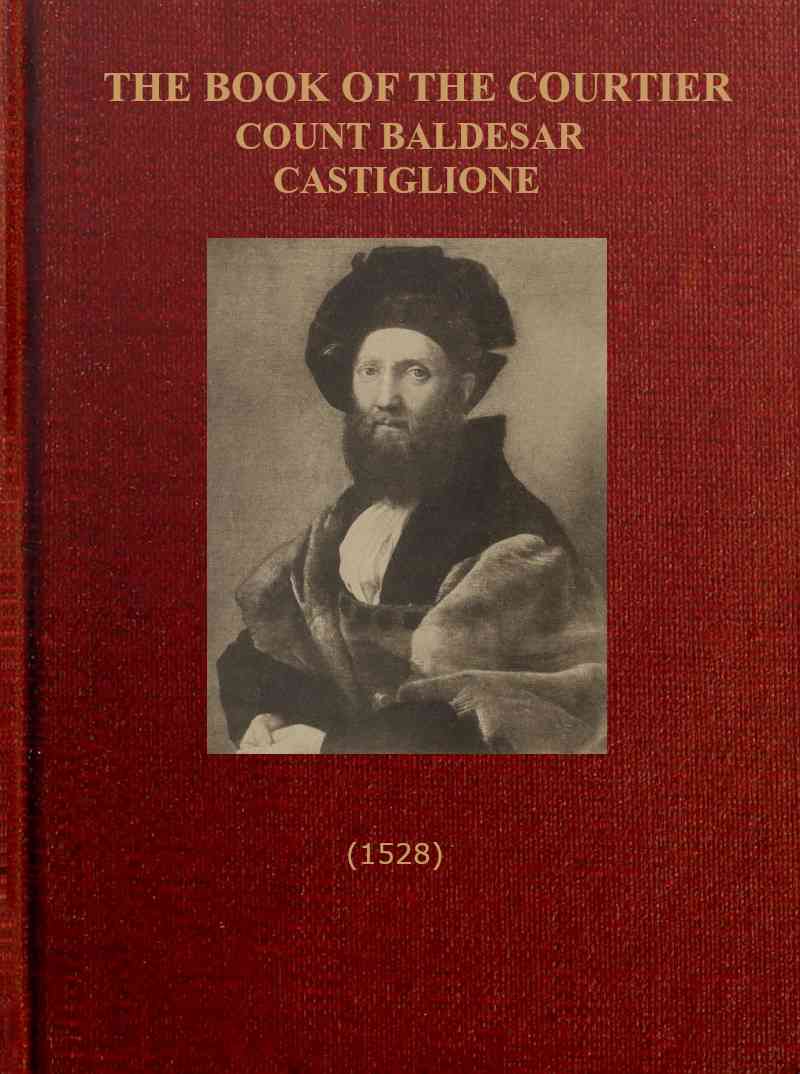
Reduced from Anderson’s photograph (no.2955) of the anonymous portrait in the Corsini Gallery at Rome. This may possibly be a copy of a second portrait that Raphael is said to have painted of Castiglione, in 1519.
PRELIMINARY NOTES
Baldesar Castiglione was born on his father’s estate of Casatico in the Mantuan territory, 6 December 1478. Michelangelo was his senior by four years; Leo X by three years; Titian by one year; Giorgione and Cesare Borgia were born in the year of his birth, while his friend Raphael and also Luther were his juniors by five years.
His surname is said to be derived from the little town at which Bonaparte defeated the Austrians near Mantua in 1796, and which is by some supposed to have taken its name from Castrum Stiliconis, Camp of Stilico, a Roman general of the 4th century. One Tealdo Castiglione was Archbishop of Milan as early as 1074, from which time the family is often and honourably mentioned in the annals of northern Italy.
Baldesar’s parents were Count Cristoforo Castiglione, a soldier-courtier, and Luigia Gonzaga, a near kinswoman of the Marquess of Mantua. The boy studied at Milan,—learning Latin from Giorgio Merula and Greek from Demetrios Chalcondylas, an erudite Athenian who had fled from Byzantium about 1447, and of whom another pupil wrote: “It seems to me that in him are figured all the wisdom, the civility and the elegance of those ancients who are so famous and so illustrious. Merely seeing him, you fancy you are looking on Plato; far more when you hear him speak.”
Having spent some time at the splendid court of Ludovico Sforza at Milan, Castiglione lost his father in 1499, and (the Sforzas being expelled the same year) he returned to Mantua and entered the service of his natural lord, the Marquess Gianfrancesco Gonzaga; he accompanied this prince to Milan to witness the entry of Louis XII of France, and afterwards on an expedition to aid the French in their vain effort to hold the kingdom of Naples against the Aragonese. When Gonzaga abandoned the French cause (after being defeated by Ferdinand the Catholic’s “Great Captain,” Consalvo de Cordova, near the Garigliano in 1503), Castiglione obtained leave to go to Rome, and there met Duke Guidobaldo di Montefeltro, who had come to pay homage to the newly elected Pope Julius II. He entered the duke’s service, and soon became one of the brightest ornaments of that brilliant company of statesmen, prelates, scholars, poets, wits and ladies, known as the Court of Urbino.
In 1504 he took part, under Duke Guidobaldo, in the papal siege of Cesena against the Venetians. The next year he attended the duke on a diplomatic visit to Rome. In 1506 he was sent to the court of Henry VII of England to receive the insignia of the Order of the Garter on the duke’s behalf. As appears from a letter to his mother, he returned to Urbino as early as 5 March 1507, notwithstanding his mention of himself in The Courtier as still absent in England at the date (8-11 March) of the dialogues he professes to report at second hand. In the same year he was sent on a mission to Louis XII at Milan.
On Guidobaldo’s death in 1508, Castiglione continued in the service of the new duke, Francesco Maria della Rovere (“my lord Prefect” of The Courtier), who appointed him governor of Gubbio. In the following year he served in his master’s campaign against the Venetians, and contracted a dangerous illness, during which he was tenderly nursed by the dowager duchess, Elisabetta Gonzaga. In 1511 he accompanied the duke to Rome on the occasion of the latter’s trial for the murder of Cardinal Alidosi, and was active in Francesco Maria’s successful defence. In 1513 the duke created him Count of Novillara and gave him an estate of that name, which however he soon lost through the Medici usurpation of the duchy, and never regained. At the death of Julius II, Castiglione was ambassador to the sacred college, and continued in that office during nearly the whole of Leo X's pontificate. His numerous letters show the variety and importance of the diplomatic business in which he was engaged.
Several plans for his marriage came to nothing, and on one occasion, when the lady’s father hesitated, the suitor broke off negotiations, saying: “The wife that I am to take, be she who she may, I desire that she should be given to me with as good will as I take her withal,—yea, if she were the daughter of a king.”
Pope Leo having in 1516 basely deprived Francesco Maria of the Duchy of Urbino, Castiglione accepted an invitation to Mantua and there married Ippolita, daughter of Count Guido Torello di Montechiarugolo and Francesca Bentivoglio, a daughter of the former ruler of Bologna. This union proved exceptionally happy and was blessed by three children: a son Camillo, a daughter Anna, and a second daughter Ippolita, at whose birth the young mother lost her life in 1520. His son attained the age of eighty years, and is said to have been the true embodiment of the qualities described in The Courtier.
Castiglione resided alternately at Mantua and at Rome, where he served as Mantuan ambassador, and where his learning, wit, taste, gentle disposition and integrity earned for him an almost unique eminence at the papal court.
In 1524 he was sent by Pope Clement VII as ambassador to the Emperor Charles V (who was waging war against the French in Italy), but while his counsel and high qualities were appreciated, he was too honest a man to cope with the tortuous politics of the time, and proved unable to avert the capture and sack of Rome (1527) or the imprisonment of the pope. These catastrophes, together with a malicious and easily disproved charge of treason brought against him, preyed upon his health, and despite the many honours conferred upon him by Charles, he failed to rally, and finally died at Toledo, 7 February 1529, without again seeing his native land. His body was afterwards brought to Italy and buried in the church of the Madonna delle Grazie near Mantua, where his tomb was erected from designs by his young friend Giulio Romano.
Besides The Courtier, his writings comprise: Tirsi, an eclogue of fifty-five stanzas in ottava rima, written and recited at the court of Urbino for the carnival of 1506; a prologue and epilogue for his friend Bibbiena’s Calandra; a few Italian lyrics of moderate merit; and some better Latin elegies and epigrams; nearly all composed during his embassy at Rome. A large number of his letters also have been preserved.
CASTIGLIONE'S TOMB
CHURCH OF THE MADONNA DELLE GRAZIE NEAR MANTUA
Reduced from a water-colour drawing made by the architect Patricolo and the painter Zanetti from the monument designed by Giulio Pippi, better known as Giulio Romano, (1492-1546). The water-mark of the paper on which this volume is printed is copied from a drawing, by Zanetti, of Castiglione’s arms as they appear in the upper left-hand panel of the monument.
His fine character is reflected in that of his Courtier, who (as Symonds says) “is, with one or two points of immaterial difference, a modern gentleman, such as all men of education at the present day would wish to be.” It may perhaps aid the reader to realize the time in which the author lived, to recall that when Castiglione was born, printing had been practised in Italy for thirteen years, that the earliest Greek grammar had been printed two years, that America was discovered when he was a boy, that the Reformation began when he was in the prime of life, and that the Lutherans were first called Protestants in the year of his death.
The first (Aldine) edition of The Courtier was issued thirteen years after the death of Teobaldo Manucci, the illustrious founder of the press that continued to bear his name, and consisted of one thousand and thirty-one copies, of which thirty were on large paper and one on vellum. It is a small folio of one hundred and twenty-two leaves, the type-page measuring almost precisely nine and one-quarter inches by five and one-eighth inches. In its ordinary form the book can hardly be called rare, as in 1895 the present translator secured a good copy from Leipsic for forty-five francs.
The earliest Spanish translator, Boscan, (born at Barcelona about 1493; died in France about 1542), was of gentle birth. Early becoming a soldier, he served with credit in Charles V's Italian campaigns, and thus acquired familiarity with the language and literature of Italy. He is said to have known Castiglione personally. Having been for some time tutor to the young prince who was later known as the Duke of Alva, he married and devoted the rest of his short life to letters. As a writer he is best known as the founder of the Italian poetical school in Spain. Ticknor says that Boscan’s version of The Courtier hardly professes to be literal, but that perhaps nothing in Castilian prose of an earlier date is written in so classical and finished a style. It has been often reprinted (as recently as 1873), and was found useful by the present translator in doubtful passages.
The earliest French translator, Colin, (died 1547), was a native of Auxerre and enjoyed the favour of Francis I, whom he served as reader and almoner, and who bestowed upon him the abbotship of St. Ambrose at Tours, as well as other ecclesiastical offices. In his prosperity he showed much kindness to his less fortunate brother authors, but he was too free of speech to be permanently successful as a courtier, and lost his preferments. His translation of The Courtier, which some writers erroneously ascribe to Jean Chaperon, is little esteemed, was soon issued with corrections by another hand, and then followed by another French version. He translated also parts of Homer and Ovid, and composed original verse in Latin and French. For an account of Castiglione’s influence upon French literature and of his many French imitators, consult Pietro Toldo’s “Le Courtisan dans la littérature française et ses rapports avec l'œuvre du Castiglione,” (Archiv für das Studium der Neueren Sprachen und Litteraturen, C. iv, pp. 75 and 313, and C. v, p. 60).
The earliest English translator, Hoby, (born 1530; died 1566), was the son of William and Katherine (Forden) Hoby of Herefordshire. Having studied at Cambridge, he visited France, Italy and other foreign countries. In 1565-6 he was knighted by Queen Elizabeth and sent as ambassador to France, where he soon died, leaving several children and a widow. This lady was the third of Sir Anthony Cooke’s five learned daughters, of whom the eldest married Sir William Cecil (afterwards Lord Burleigh), while the second became the mother of Francis Bacon, Lord Verulam. Interesting details of Hoby’s life and of the manners of the time are given in his unpublished diary, preserved in the British Museum. His version of The Courtier was carefully made, and although rough to our ears and occasionally obscure, it became very popular and was several times republished. A beautiful reprint of the original edition has recently been issued (1900), in a scholarly introduction to which Professor Walter Raleigh traces the influence of the book upon Elizabethan writers. The Courtier, and especially Hoby’s translation of it, are the subject of a very interesting study by Mary Augusta Scott, Ph.D., printed in the Publications of the Modern Language Association of America, vol. xvi (1901), no. 4. In 1570 Roger Ascham wrote in his “Schoolmaster:” “To join learning with comely exercises, Count Baldesar Castiglione in his book Cortegiano doth trimly teach: which book, advisedly read and diligently followed but one year at home in England, would do a young gentleman more good, I wis, than three years’ travel abroad in Italy. And I marvel this book is not more read in the Court than it is, seeing it is so well translated into English by a worthy gentleman, Sir Thomas Hobbie, who was many ways well furnished with learning, and very expert in knowledge of divers tongues.”
Of the first German translator, Lorenz Kratzer, little more is known than that he was an officer of customs at Burckhausen, in Bavaria, from 1565 to 1588, and that he speaks of having devoted to letters the ample leisure which his duties permitted. Although said to be meritorious, his work can hardly have gained wide currency, as both Noyse (whose German translation of The Courtier was published at Dilingen in 1593) and a third German translator (whose version was issued at Frankfort in 1684 under the initials “J. C. L. L. J.”) seem to have regarded themselves each as the earliest in the field.
The first Latin translator, Turler, (born 1550; died 1602), was a Doctor Juris, and became burgomaster of his native town of Lössnitz, near Leipsic. Besides The Courtier, he translated several of Machiavelli’s works into Latin.
NOTES TO THE DEDICATORY LETTER
Note 1 page 1. Dom Miguel de Silva, (born about 1490; died 1556), was the second son of Diego de Silva and Maria de Ayola, Count and Countess of Portalegre, a province of central Portugal. Having studied at the universities of Paris, Siena and Bologna, he was soon called to the court of Emanuel of Portugal, held various ecclesiastical posts, and was made Bishop of Viseu in the Province of Beira. As ambassador to Popes Leo X, Adrian VI and Clement VII, he paid long visits to Rome, where his friendship with Castiglione probably began. During the twenty years that followed 1521 he served John III of Portugal as Escribano de la Puridad; then, having been made a cardinal by Paul III, he spent the remainder of his life in the papal service, died in Rome, and was buried in the church of Santa Maria in Trastevere. Eminent as a prelate and a diplomatist, he also enjoyed no small repute as an author and an elegant Latinist.
Note 2 page 1. Guidobaldo di Montefeltro, Duke of Urbino, (born 1472; died 1508), was the only son of Duke Federico di Montefeltro and Battista Sforza, an accomplished niece of the first Sforza duke of Milan. Precocious as a child, he was elaborately yet judiciously educated, and much of the praise bestowed upon him in The Courtier is shown by contemporary evidence to have been just. On his father’s death in 1482, both he and his State were confided to his cousin Ubaldini (see note 273), who seems to have been loyal to the trust, although next heir to the duchy. From records that have survived, Dennistoun extracts some details of the young duke’s court: “To all persons composing the ducal household, unexceptionable manners were indispensable. In those of higher rank there were further required competent talents and learning, a grave deportment, and fluency of speech. The servants must be of steady habits and respectable character; regular in all private transactions; of good address, modest and graceful; willing and neat handed in their service. There is likewise inculcated the most scrupulous personal cleanliness, especially of the hands, with particular injunctions as to frequent ablutions, and extraordinary precautions against the unpleasant effects of hot weather on their persons and clothing; in case of need, medical treatment is enjoined to correct the breath. Those who wore livery had two suits a year, generally of fustian, though to some silk doublets were given for summer use.”
In 1489 Guidobaldo married Elisabetta Gonzaga, a sister of the Marquess of Mantua. All hopes, however, of an heir were soon abandoned, apparently owing to the young duke’s physical infirmities, which were increased by over exercise and in time unfitted him for all active occupations. Nevertheless he was able to take part in the vain resistance to Charles VIII's invasion of Italy, and later in the expulsion of the French from the kingdom of Naples. While fighting in the service of Pope Alexander VI in 1497, he was taken prisoner and forced to pay a ransom of 30,000 ducats, a sum then equivalent to about twice that number of modern pounds sterling, and raised only at the sacrifice of his duchess’s jewels. In 1501 he aided rather than opposed Louis XII's invasion of Naples.
In 1502 the pope’s son Cesare Borgia treacherously seized the Duchy of Urbino. To spare his people bloodshed and ruin, Guidobaldo fled in disguise to his brother-in-law at Mantua, and after a vain appeal to Louis XII, found an honourable asylum at Venice. In the same year he regained his dominions for a short time, but was again forced to take flight. On the death of Alexander VI (August 1503), Cesare’s power crumbled, Guidobaldo easily recovered his duchy, and his position was soon assured by the election of Julius II, who was not only his personal friend, but also the brother of his sister Giovanna’s husband. In 1504 he formally adopted as his heir this sister’s son, Francesco Maria della Rovere, and (as we have seen) took into his service the future author of The Courtier. His learning, amiability and munificence attracted choice spirits to his court, which came to be regarded as the first in Italy. Pope Julius was splendidly entertained there on his way both to and from his Bologna campaign, and the Courtier dialogues are represented as taking place immediately after his departure for Rome in March 1507.
Long an invalid, Guidobaldo became more and more a martyr to his gout, which was aggravated by a season of exceptional drought and cold and brought him final relief from suffering in April 1508. His fame rests, not upon his military and political achievements, but upon the beauty of his character, the variety of his intellectual accomplishments, the patience with which he endured reverses, illness and forced inaction, and upon the culture and refinement that characterized his court.
Note 3 page 1. Francesco Maria della Rovere, Duke of Urbino, (born 1490; died 1538), was the son of Giovanni della Rovere and Duke Guidobaldo’s sister Giovanna di Montefeltro. Giovanni was a nephew of Pope Sixtus IV (who had made him Prefect of Rome), and a younger brother of Cardinal Giuliano della Rovere, afterwards Pope Julius II.
On his father’s death in 1501, Francesco was brought to the court of his uncle Guidobaldo, who secured for him a renewal of the Prefecture and superintended his education. In The Courtier he appears as “my lord Prefect.” During the Borgian usurpation of the duchy, he found refuge at the court of Louis XII; and soon after the fall of the Borgias and his uncle Julius II's accession, he was adopted as Guidobaldo’s heir, while through the mediation of Castiglione a marriage was arranged for him with Eleanora, daughter to the Marquess of Mantua and niece to the Duchess of Urbino. He now resided chiefly with his uncle, acquainting himself with his future subjects and duties. Although he possessed many of the good qualities ascribed to him in The Courtier, his temper was ungovernable, and before reaching the age of eighteen he slew one of the members of the court, who was accused of seducing his sister.
Having become duke in 1508, he was married on Christmas Eve of that year. In the following spring he commanded the papal forces in the League of Cambray, and despite the obstacles put in his way by his colleague Cardinal Alidosi (see note 268), he soon reduced the Romagna towns, the recovery of which from Venice was Julius II's chief object in forming the league. In a later campaign against the French, Bologna was lost to the Church (1511) through the treachery of Alidosi, who craftily contrived to have the blame fall upon Francesco, and was murdered by the latter at Ravenna. After a long trial before six cardinals, in which ample proof of the dead man’s treason was presented, and an eloquent appeal made by Beroaldo (see note 235),—the young duke was acquitted and restored to the pope’s favour.
Although both Francesco and his predecessor had generously befriended the Medici during their exile from Florence (1494-1512), Leo X (Giovanni de' Medici) seized his duchy in 1516, to bestow it on a nephew, Lorenzo de' Medici. It is needless to speak here of Francesco’s restoration in 1521, of his failure to relieve Pope Clement VII when Rome was sacked in 1527, or of his later life.
While small in person, Francesco was active and well formed. His manners were gentle and his character forgiving, in spite of his fiery temper. Strict in religious observances and an enemy to blasphemous language, he was also creditably intolerant of those outrages upon womanly honour with which war was then fraught. He was famous chiefly as a soldier, and by so competent a judge as the Emperor Charles V was regarded as master of the military science of his day.
Note 4 page 1. This disclaimer of careful authorship is not to be taken too literally. At least a draft of Books I-III seems to have been made at Urbino between April 1508 and May 1509, while Book IV was probably written at Rome in the earlier part of the interval between September 1513 and March 1516. Castiglione apparently continued to revise his work until 1518, when he sent his MS. to Bembo. See Silvestro Marcello’s pamphlet, “La Cronologia del Cortegiano di Baldesar Castiglione.” Pisa, 1895.
Note 5 page 1. As has been seen, Castiglione resided at the Spanish court from 1524 until his death in 1529.
Note 6 page 1. Vittoria Colonna, (born 1490; died 1547), was the daughter of Fabrizio Colonna (grand-nephew of Pope Martin V) and Agnese di Montefeltro, a sister of Duke Guidobaldo. At the age of four she was betrothed to the Marquess of Pescara, whom she married in her nineteenth year at Ischia (the fief and residence of his family), and who afterwards became a famous soldier. During his long absences in the field, she consoled herself with books, and after his death in 1525, her widowhood was spent in retirement and finally in semi-monastic seclusion at Rome. The time spared from pious exercises she devoted to study, the composition of poetry, correspondence with illustrious men of letters, and the society of learned persons. Although she never became a convert to Protestantism, the liberality of some of her friends’ belief exposed her to ecclesiastical censure in her old age. Her celebrated friendship with Michelangelo began when he was past sixty and she had nearly reached fifty years. They frequently exchanged verses, and he is said to have visited her on her death-bed. Her poems are chiefly sonnets to the memory of her husband or verses on sacred and moral subjects.
Note 7 page 7. The following passage is from a letter written by Castiglione to the Marchioness: “I am the more deeply obliged to your Ladyship, because the necessity you have put me under, of sending the book at once to the printer, relieves me from the trouble of adding many things that I had already prepared in my mind,—things (I need hardly say) of little import, like the rest of the book; so that your Ladyship has saved the reader from tedium, and the author from blame.”
Despite the many decrees of popes, emperors and other potentates, literary piracy seems to have been quite as common in Castiglione’s time as in ours. He was obviously none too prompt in his precautions, as an apparently unauthorized edition of The Courtier was issued at Florence by the heirs of Filippo di Giunta in the October following its first publication at Venice in April 1528.
Note 8 page 8. Alfonso Ariosto, (died 1526), was a cousin of the poet Ludovico. Little more seems to be known of him than that his father’s name was Bonifazio, that he was a gentle cavalier and brave soldier in the service of the Este family, and that he was a friend of Castiglione and of Bembo. His name appears at the head of each of the four dialogues composing The Courtier, and they purport to have been written at his suggestion. Señor A. M. Fabié, in his notes to the 1873 reprint of Boscan’s translation, affirms that Alfonso Ariosto had nothing to do with the poet Ludovico, belonged to a noble Bolognese family, and enjoyed much favour at the court of Francis I of France.
Note 9 page 9. Giuliano de' Medici, (born 1478; died 1516), was the third son of Lorenzo the Magnificent and Clarice Orsini. His education seems to have been for a time entrusted to the famous scholar-poet Poliziano (see note 105). During his family’s exile from Florence (1494-1512), he resided much at the court of Urbino, where he was known as “the Magnifico Giuliano,” and where one wing of the great palace was reserved to his use and is still called by his name. He became the father of a boy afterwards known as Cardinal Ippolito de' Medici,—the original of Titian’s fine portrait in the Pitti Gallery. On the restoration of the Medici, Giuliano was placed at the head of affairs in his native city and succeeded in winning the good will of the Florentines, but his gentle disposition and love of ease thwarted other ambitious projects formed for his advancement by his brother Leo X, and he was too grateful to the dukes of Urbino for their hospitality to accept the pope’s intended appropriation of their duchy for his benefit. In 1515 he married Filiberta of Savoy and was created Duke of Nemours by her nephew Francis I of France. In the same year he was appointed Captain General of the Church, but failing health prevented his actual service, and he soon died of fever at Florence, not without suspicion of poison at the hands of his nephew Lorenzo.
Several of his sonnets have survived, and are said to show no mean poetic faculty. Apart, however, from his appearance as an interlocutor in The Courtier and in Bembo’s Prose, his memory is best preserved by Michelangelo’s famous tomb at Florence.
VITTORIA COLONNA
MARCHIONESS OF PESCARA
1490-1547
Much enlarged from a cast, kindly furnished by M. Pierre Valton, of an anonymous medal in his collection at Paris.
Note 10 page 2. “Messer Bernardo” (Dovizi), better known by the name of his birthplace Bibbiena, (born 1470; died 1520), was of humble parentage. His elder brother Pietro was secretary to Lorenzo de' Medici, and secured his admission to the Magnifico’s household, where he shared the education of the young Giovanni and became a devoted friend of that future pope. Following the Medici into exile, he travelled about Europe with Giovanni and attended Giuliano to Urbino, where he received the warm welcome always accorded there to such as combined learning with courtly manners. By the Duke of Urbino he seems to have been so commended to the favour of Julius II, that he was able to aid Michelangelo in securing part payment for the Sistine Chapel frescoes, of which payment, however, he accepted five per cent. as a gift from the painter. At the death of Julius, he was secretary to his friend Cardinal Giovanni de' Medici, and in that capacity had access to the conclave, where his adroitness was largely helpful in effecting his patron’s election as pope. Leo at once made him Cardinal of Santa Maria in Portico and loaded him with lucrative offices. During the Medicean usurpation of the Duchy of Urbino, he showed no gratitude for the kindness enjoyed by him at that court. He became very rich, and was a liberal patron of authors and artists. Raphael devised to him the house of the architect Bramante, which the painter had bought for a sum equivalent to about £6,000, and which was afterwards demolished in extending the piazza in front of St. Peter’s.
Besides a large number of his letters, for the most part unpublished, we have his play, Calandra, founded upon the Menæchmi of Plautus and once esteemed as the earliest Italian prose comedy.
Although he was bald, and although his friend Raphael’s portrait hardly justifies the epithet, he was known as the “Bel Bernardo.” A contemporary MS. in the Vatican describes him as “a facetious character, with no mean powers of ridicule, and much tact in promoting jocular conversation by his wit and well-timed jests. He was a great favourite with certain cardinals, whose chief pursuit was pleasure and the chase, for he thoroughly knew all their habits and fancies, and was even aware of whatever vicious propensities they had. He likewise possessed a singular pliancy for flattery, and for obsequiously accommodating himself to their whims, stooping patiently to be the butt of insulting and abusive jokes, and shrinking from nothing that could render him acceptable to them. He also had much readiness in council, and was perfectly able seasonably to qualify his wit with wisdom, or to dissemble with singular cunning.” On the other hand, Bembo wrote of him to their friend Federico Fregoso: “The days seem years until I see him, and enjoy the pleasing society, the charming conversation, the wit, the jests, the features and the affection of that man.”
Note 11 page 2. Ottaviano Fregoso, (died 1524), belonged to a noble Genoese family that had long distinguished itself in public service and had furnished several doges to the Republic. His parents were Agostino Fregoso and Gentile di Montefeltro, a half-sister of Duke Guidobaldo. Driven from Genoa as early as 1497, he entered his uncle’s court at Urbino and rendered important military services, especially during the struggle with Cesare Borgia, in which he gallantly defended the fortress of San Leo (see note 275), and was rewarded with the lordship of Santa Agata in the Apennines. In 1506 he commanded the papal forces for the recovery of Bologna, and later in the League of Cambray against Venice. In 1513 he succeeded in putting an end to French domination in Genoa, was elected doge, and ruled so beneficently for two years that when Francis I regained the city, Fregoso was continued as governor. In 1522 Genoa was captured and sacked by Spanish and German troops, and Fregoso given over to the Marquess of Pescara, treated harshly (despite Castiglione’s intercession on his behalf), and carried to Ischia, where he died.
Several stories of his absent-mindedness are narrated by Dennistoun, and one illustrates the freedom of intercourse at the court of Urbino. His uncle Guidobaldo appearing one day in a beautiful violet satin jerkin, Ottaviano exclaimed: “My lord Duke, you really are the handsome Signor!” and then, on being reproved for flattery, he replied: “I did not mean that you are a man of worth, though I pronounced you a fine man and a handsome nobleman.”
Note 12 page 2. “My lady Duchess,” Elisabetta Gonzaga, (born 1471; died 1526), was the second daughter of the Marquess Federico Gonzaga of Mantua and Margarita of Bavaria. She married Duke Guidobaldo in 1489. In 1502 she reluctantly attended the festivities for the marriage, at Ferrara, of Lucrezia Borgia to Alfonso d'Este, and some of her costumes are thus described by an eye-witness: On entering Ferrara, she rode a black mule caparisoned in black velvet embroidered with woven gold, and wore a mantle of black velvet strewn with triangles of beaten gold, a string of pearls about her neck, and a cap of gold; another day indoors she wore a mantle of brown velvet slashed, and caught up with chains of massive gold; another day a gown of black velvet striped with gold, with a jewelled necklace and diadem; and still another day, a black velvet robe embroidered with gold ciphers.
During the Borgian usurpation of their duchy in the same year, she shared her husband’s exile at Venice, and on returning to Urbino earlier than Guidobaldo, she amused herself with a scenic representation of the chief events that had occurred during their absence. She cared for her husband tenderly in his illnesses, administered his government wisely when he was called away, and on his death acted as regent and guardian for his nephew and successor, with whom she maintained affectionate relations as long as she lived, and from appropriating whose dominions she strove to the utmost to dissuade Leo X.
Next to her husband’s niece by marriage, Emilia Pia (see note 37), her closest friend seems to have been her brother’s wife, the famous Isabella d'Este (see note 397), with whom she often travelled and continually corresponded by letter. Although still young and accounted beautiful at her husband’s death, she remained faithful to his memory, and the years of her widowhood were cheered by the companionship of her niece, the young duchess Eleanora of Urbino (see note 432). If we may trust universal contemporary opinion of her virtues and beauty, the author of The Courtier flattered her as little as did the painter of her portrait in the Uffizi Gallery.
FEDERICO GONZAGA
MARQUESS OF MANTUA
FATHER OF “MY LADY DUCHESS”
1440-1484
Enlarged from a part of Alinari’s photograph (no. 18705) of the fresco, “The Return of the Exile,” in the Sala degli Sposi of the Gonzaga Palace at Mantua, painted not later than 1474 by Andrea Mantegna (1431-1506). See Heinrich Thode’s monograph on Mantegna, p. 56. For a notice of the Marquess’s life see note 263.
Note 13 page 3. Vittoria Colonna seems to have had this passage in mind when she wrote, 20 September 1524, to Castiglione in praise of his book: “It would not be fitting for me to tell you what I think of it, for the same reason which you say prevents you from speaking of the beauty of my lady Duchess.”
Note 14 page 3. Giovanni Boccaccio, (born 1313; died 1375), was the natural son of a Florentine tradesman and a Frenchwoman with whom his father had made acquaintance during a business residence at Paris. In early manhood he engaged in commerce at Naples, and had but little learning in his youth, although he studied law for a time. Erudition and authorship became the serious enthusiasm of his life, owing (it is said) to a chance visit to the supposed tomb of Virgil at Naples. In middle life he began the study of Greek at his friend Petrarch’s suggestion; and although he never acquired more than what would now be deemed a superficial knowledge of that language, as a Hellenist he had no precursor in Italy. An ardent if somewhat unappreciative admirer of Dante (whose Divina Commedia he transcribed with his own hands), he was the first Italian author to write for the common people, instead of composing books suited only to the learned and patrician classes. His style was formed by tireless study of classic models, and became a standard for imitation by his successors.
Note 15 page 3. It is now known that the considerations that led Boccaccio to underrate his poems and tales, were ethical rather than literary.
Note 16 page 5. Theophrastus, (born 374; died 287 B.C.), was a native of Lesbos, but resided at Athens. He was the chief disciple and successor of Aristotle, and wrote also upon a great variety of subjects other than philosophy. His best known work, the “Characters,” is a collection of sprightly sketches of human types. La Bruyère’s famous book of the same name was originally a mere translation from Theophrastus. The incident mentioned in the text is thus described in Cicero’s Brutus: “When he asked a certain old woman for how much she would sell something, and she answered him and added, 'Stranger, it can’t be had for less,'—he was vexed at being taken for a stranger although he had grown old at Athens and spoke to perfection.”
Note 17 page 5. I. e., pages 39-54.
Note 18 page 5. The reference here is to Plato’s “Republic,” Xenophon’s Cyropædia, and Cicero’s De Oratore.
Note 19 page 6. In the letter quoted in note 13, Vittoria Colonna wrote: “I do not marvel at your portraying a perfect courtier well, for by merely holding a mirrour before you and considering your inward and outward parts, you could describe him as you have; but our greatest difficulty being to know ourselves, I say that it was more difficult for you to portray yourself than another man.”
FEDERICO DI MONTEFELTRO
DUKE OF URBINO
1422-1482
Reduced from Alinari’s photograph (no. 2686) of a marble bas-relief, in the National Museum at Florence, by some attributed to Mino da Fiesole (1431-1484).
Note 20 page 6. More than 140 editions of The Courtier have been published. Most of these are mentioned in the list printed before the Index of this volume. A few of the editions there set down differ from one another only in title-page; a few others, perhaps, exist only in some bibliographer’s erroneous mention. Deductions to be made for such reasons, however, are probably offset by other editions that the present translator has failed to bring to light.
In the bibliographical notes appended by the brothers Volpi to their (1733) edition, The Courtier is said to have been translated into Flemish; while in his preface to the Sonzogno (1890) edition, Corio speaks of the introduction of the book into Japan in the 17th century, and also of a Russian translation by Archiuzow.
NOTES TO THE FIRST BOOK OF THE COURTIER
Note 21 page 7. “Courtiership” is a sadly awkward rendering of the Italian cortegiania, which implies not only courtesy and courtliness, but all the many other qualities and accomplishments essential to the perfect Courtier or (what in Castiglione’s time was the same) the perfect Gentleman.
Note 22 page 8. The extreme dimensions of the Duchy of Urbino were 64 miles from east to west, and 60 miles from north to south. Its population did not much exceed 150,000.
Note 23 page 8. The first of the four dialogues is represented as having been held on the evening of the day after the close of a certain visit paid by Pope Julius II to Urbino on his return from a successful campaign against Bologna. This visit is known to have lasted from 3 March to 7 March 1507. Castiglione returned from England as early as 5 March, on which date he wrote to his mother from Urbino: “We have had his Holiness here for two days.” It seems probable that this fictitious prolongation of his absence in England was simply a graceful excuse for not himself appearing in the dialogues.
Note 24 page 8. There were a fief and Count of Montefeltro as early as 1154, and his son was made Count of Urbino in 1216, from which time their male descendants ruled over a gradually increased territory until 1508, when the duchy passed to the female line. The name Montefeltro is said to have originated in that of a temple to Jupiter Feretrius, which in Roman times occupied the summit of the crag afterwards known as San Leo, in the Duchy of Urbino.
Note 25 page 9. Such a rule as that of the usurping Cesare Borgia (1502-3) can hardly have been welcome to a population accustomed to the mild sway of the Montefeltro family.
Note 26 page 9. “Duke Federico” di Montefeltro, (born 1422; died 1482), was a natural son of Count Guidantonio di Montefeltro, as appears from the act of legitimation issued by Pope Martin V and also from his father’s testament, by virtue whereof (as well as by the choice of the people) he succeeded his half-brother Count Oddantonio in 1444. In his boyhood he resided fifteen months as a hostage at Venice. Later he studied the theory and practice of war at the Mantuan court, and was trained in the humanities by the famous Vittorino da Feltre. In 1437 he married Gentile Brancaleone, who died childless in 1457. Nearly the whole of his life was spent in military service, as paid ally, now of one prince, now of another. In this capacity he became not only the most noted commander of his time, but always displayed perfect and exceptional fidelity to the causes that he undertook. In 1450 he lost an eye and suffered a fracture of the nose in a tournament; contemporary portraits represent his features in profile. In 1454 he began the construction of the great palace at Urbino. In 1460, at the suggestion of Francesco Sforza (whom he had aided to become Duke of Milan), he married the latter’s accomplished niece Battista Sforza, who bore him seven daughters and one son, Guidobaldo. In 1474 he was made Duke of Urbino and appointed Captain General of the Church by Pope Sixtus IV, and was unanimously elected a Knight of the Garter. He died of fever contracted during military operations in the malarial country near Ferrara. The vast sums spent by him on public buildings, art objects and books, and upon the maintenance of his splendid household, were not extorted from his subjects, but were received from foreign states in return for war service. Thus at the close of his life he drew a yearly stipend equivalent to about £330,000.
It is not easy to draw a picture of his character that shall seem unflattered. Vespasiano, who by years of labour collected his famous library for him, says that his “establishment was conducted with the regularity of a religious fraternity, rather than like a military household. Gambling and profanity were unknown, and singular decorum of language was observed, whilst many noble youths, sent there to learn good manners and military discipline, were reared under the most exemplary tuition. He regarded his subjects as his children, and was at all times accessible to hear them personally state their petitions, being careful to give answers without unnecessary delay. He walked freely about the streets, entering their shops and workrooms, and enquiring into their circumstances with paternal interest.... In summer he was in the saddle at dawn, and rode three or four miles into the country with half-a-dozen of his court ... reaching home again when others were just up. After mass, he went into an open garden and gave audience to all comers until breakfast-time. When at table, he listened to the Latin historians, chiefly Livy, except in Lent, when some religious book was read, anyone being free to enter the hall and speak with him then. His fare was plain and substantial, denying himself sweet dishes and wine, except drinks of pomegranates, cherries, apples, or other fruits. After dinner and supper, an able judge of appeal stated in Latin the causes brought before him, on which the duke gave judgment in that language;... When his mid-day meal was finished, if no one appeared to ask audience, he retired to his closet and transacted private business, or listened to reading until evening approached, when he generally walked out, giving patient ear to all who accosted him in the streets. He then occasionally visited ... a meadow belonging to the Franciscans, where thirty or forty of the youths brought up in his court stripped their doublets, and played at throwing the bar, or at wrestling, or ball. This was a fine sight, which the duke much enjoyed, encouraging the lads, and listening freely to all until supper-time. When that and the audiences were over, he repaired to a private apartment with his principal courtiers, whom, after some familiar talk, he would dismiss to bed, taxing them with their sluggish indulgence of a morning.”