
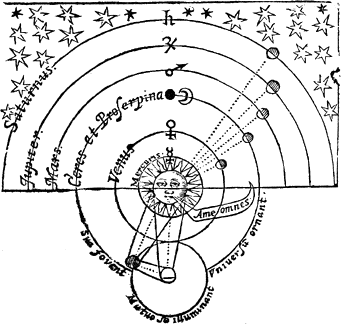
In answering to these objections, I shall first shew, that this light cannot be her owne, and then declare that which is the true reason of it.
That it is not her own, appeares
1. From the variety of it at divers times; for ’tis commonly observed, that sometimes ’tis of a brighter, sometimes of a darker appearance, now redder, and at another time of a more duskish colour. The observation of this variety in divers eclipses, you may see set downe by Keplar Opt. Astron. c. 7. num. 3. and many others, but now this could not be if that light were her owne, that being constantly the same, and without any reason of such an alteration: So that thus I may argue.
If there were any light proper to the Moone, then would that Planet appeare brightest when she is eclipied in her Perige, being neerest to the earth, and so consequently more obscure and duskish when she is in her Apoge or farthest from it; the reason is, because the neerer any enlightened body comes to the sight, by so much the more strong are the species and the better perceived. This sequell is granted by some of our adversaries, and they are the very words of noble Tycho, De nova stella lib. 1. c. 10. Si luna genuino gauderet lumine, utique cum in umbra terræ esset, illud non amitteret, sed eò evidentiùs exereret, omne enim lumen in tenebris, plus splendet cum alio majore fulgore non præpeditur. If the Moone had any light of her owne, then would she not lose it in the earths shadow, but rather shine more clearely, since every light appeares greater in the darke, when it is not hindered by a more perspicuous brightnesse.
But now the event falls out cleane contrary, (as observation doth manifest, and our opposites themselves doe grant) Reinhold comment. in Purb. Theor. pag. 164. the Moone appearing with a more reddish and cleare light when she is eclipsed being in her Apoge or farthest distance, and a more blackish yron colour when she is in her Perige or neerest to us, therefore shee hath not any light of her owne. Nor may we thinke that the earths shadow can cloud the proper light of the Moone from appearing, or take away any thing from her inherent brightnesse, for this were to thinke a shadow to be a body, an opinion altogether mis-becomming a Philosopher, as Tycho grants in the fore-cited place, Nec umbra terræ corporeum quid est, aut densa aliqua substantia, aut lunæ lumen obtenebrare possit, atque id visui nostro præripere, sed est quædam privatio luminis solaris, ob interpositum opacum corpus terræ. Nor is the earths shadow any corporall thing, or thicke substance, that it can cloud the Moones brightnesse, or take it away from our sight, but it is a meere privation of the Suns light, by reason of the interposition of the earths opacous body.
2. If shee had any light of her owne then that would in it selfe be, either such a ruddy brightnesse as appeares in the eclipses, or else such a leaden duskish light as wee see in the darker parts of her body, when shee is a little past the conjunction. (That it must be one of these may follow from the opposite arguments) but it is neither of these, therefore she hath none of her owne.
1. ’Tis not such a ruddy light as appeares in eclipses, for then why can wee not see the like rednesse, when wee may discerne the obscurer parts of the Moone?
You will say, perhaps, that then the neerenesse of that greater light, takes away that appearance.
I reply, this cannot be, for then why does Mars shine with his wonted rednesse, when he is neere the Moone? or why cannot her greater brightnesse make him appeare white as the other Planets? nor can there be any reason given why that greater light should represent her body under a false colour.
2. ’Tis not such a duskish leaden light, as we see in the darker part
of her body, when shee is about a sextile Aspect distant from the Sunne,
for then why does shee appeare red in the eclipses, since the more shade
cannot choose such variety, for ’tis the nature of darknesse by its
opposition, rather to make things appeare of a more white and cleare
brightnesse then they are in themselves, or if it be the shade, yet
those parts of the Moone are then in the shade of her body, and
therefore in reason should have the like rednesse. Since then neither of
these lights are hers, it followes that she hath none of her owne. Nor
is this a singular opinion, but it hath had many learned patrons, such
was Macrobius,
Somn. Scip. l. 1. c. 20.
Lect. antiq. l. 1. c. 15.
who being for this quoted of Rhodiginus, he calls him
vir reconditissimæ scientiæ,
a man who knew more than ordinary Philosophers, thus commending the
opinion in the credit of the Authour. To him assents the Venerable
Bede, upon whom the glosse hath this comparison.
In lib. de natur. rerum.
As the Looking-glasse represents not any image within it selfe, unlesse
it receive some from without; so the Moone hath not any light, but what
is bestowed by the Sun. To these agreed Albertus Magnus,
Scaliger, Mæslin, and more especially Malapertius,
De 4r. Coævis. Q. 4ª. Art.
21.
Exercit. 62.
1. Epitome. Astron. lib. 4. p. 2.
whose words are more pat to the purpose then others, and therefore I
shall set them downe as you may finde them in his Preface to his
Treatise concerning the Austriaca sydera; Luna, Venus, &
Mercurius, terrestris & humidæ sunt substantiæ ideoque de suo non
lucere, sicut nec terra. The Moone, Venus, and
Mercurie (saith he) are of an earthly and moyst substance, and
therefore have no more light of
their owne, then the earth hath. Nay, some there are who thinke that all
the other Starres doe receive that light, whereby they appeare visible
to us from the Sunne, so Ptolomie, Isidore Hispalensis,
Albertus Magnus and Bede, much more then must the Moone
shine with a borrowed light.
Originum l. 3. c. 60.
De Cœlo. l. 2.
De ratione tempor. c. 4.
But enough of this. I have now sufficiently shewed what at the first I promised, that this light is not proper to the Moone. It remaines in the next place, that I tell you the true reason of it. And here, I thinke ’tis probable that the light which appeares in the Moone at the eclipses is nothing else but the second species of the Sunnes rayes which passe through the shadow unto her body: and from a mixture of this second light with the shadow, arises that rednesse which at such times appeares unto us. I may call it Lumen crepusculum, the Aurora of the Moone, or such a kinde of blushing light, that the Sunne causes when he is neere his rising, when he bestowes some small light upon the thicker vapours. Thus wee see commonly the Sunne being in the Horizon, and the reflexion growing weake, how his beames make the waters appeare very red.
The Moabites in Iehorams time when they rose early in the morning, and beheld the waters a farre off, mistooke them for blood. 2 King. 3. 22. Et causa hujus est, quia radius solaris in aurora contrahit quandam rubedinem, propter vapores combustos manentes circa superficiem terræ, per quos radii transeunt, & ideo cum repercutiantur in aqua ad oculos nostros, trahunt secum eundem ruborem, & faciunt apparere locum aquarum, in quo est repercussio esse rubrum, saith Tostatus. 2ª. Quæst. in hoc cap. The reason is, because of his rayes, which being in the lower vapours, those doe convey an imperfect mixed light upon the waters. Thus the Moone being in the earths shadow, and the Sunne beames which are round about it, not being able to come directly unto her body, yet some second raies there are, which passing through the shadow, make her appeare in that ruddy colour: So that she must appeare brightest, when shee is eclipsed, being in her Apoge, of greatest distance from us, because then the cone of the earths shadow is lesse, and the refraction is made through a narrower medium. So on the contrary, she must be represented under a more darke and obscure forme when she is eclipsed, being in her Perige, or neerest to the earth, because then she is involved in a greater shadow, or bigger part of the cone, and so the refraction passing through a greater medium, the light must needes be weaker which doth proceed from it. If you aske now what the reason may be of that light which we discerne in the darker part of the new Moone: I answer, ’tis reflected from our earth which returnes as great a brightnesse to that Planet, as it receives from it. This I shall have occasion to prove afterward.
I have now done with these propositions which were set downe to cleare the passage, and confirme the suppositions implied in the opinion, I shall in the next place proceed to a more direct treating of the chiefe matter in hand.
Proposition 6.
That there is a world in the Moone, hath beene the direct opinion of many ancient, with some moderne Mathematicians, and may probably be deduced from the tenents of others.
Since this opinion may be suspected of singularity, I shall therefore first confirme it by sufficient authority of divers authours, both ancient and moderne, that so I may the better cleare it from the prejudice either of an upstart fancy, or an absolute errour. This is by some attributed to Orpheus, one of the most ancient Greeke Poets, who speaking of the Moone, saies thus, ἡ πολλ᾽ οὔρεα ἔχει, πολλ᾽ ἄστεα, πολλὰ μέλαθρα, Plut. de plac. phil. l. 2. c. 13. That it hath many mountaines and cities, and houses in it. To him assented Xenophanes, Anaxagoras, Democritus, and Heraclitus, Ibid. c. 25. all who thought it to have firme solid ground, like to our earth, Diog. Laert. l. 2. & l. 9. containing in it many large fields, champion grounds, and divers inhabitants, unto these agreed Pythagoras, who thought that our earth was but one of the Planets which moved round about the Sunne, (as Aristotle De Cœlo. l. 2. cap. 13. relates it of him) and the Pythagoreans in generall did affirme, that the Moone also was terrestriall, that she was inhabited as this lower world. That those living creatures & plants which are in her, exceed any of the like kind with us in the same proportion, as their daies are longer than ours: viz. by 15 times. This Pythagoras Plut. ibid. cap. 30. was esteemed by all, of a most divine wit, as appeares especially by his valuation amongst the Romans who being cõmanded by the Oracle to erect a statue to the wisest Grecian, the Senate determined Plin. Nat. Hist. l. 34. cap. 6. Pythagoras to be meant, preferring him in their judgements before the divine Socrates, whom their Gods pronounc’d the wisest. Some think him a Iew by birth, but most agree that hee was much conversant amongst the learneder sort, & Priests of that Nation, by whom he was informed of many secrets, and perhaps, this opinion, which he vented afterwards in Greece, where he was much opposed by Aristotle in some worded disputations, but never confuted by any solid reason.
To this opinion of Pythagoras
did Plato also assent, when hee considered that there was the
like eclipse made by the earth, and this, that it had no light of its
owne, that it was so full of spots. And therefore wee may often reade in
him and his followers,
Plat. de conviviis.
Macrob. Somn. Scip. lib. 1. ca. 11.
of an ætherea terra, and lunares populi, an æthereall
earth, and inhabiters in the Moone; but afterwards this was mixed with
many ridiculous fancies: for some of them considering the mysteries
implied in the number 3. concluded that there must necessarily bee a
Trinity of worlds, whereof the first is this of ours, the second in the
Moone whose element of water is represented by the spheare of
Mercury, the aire by Uenus, and the fire by the Sunne. And
that the whole Universe might the better end in earth as it began, they
have contrived it, that Mars shall be a spheare of the fire,
Iupiter of aire, Saturne of water; and above all these,
the Elysian fields, spacious
and pleasant places appointed for the habitation of those unspotted
soules, that either never were imprisoned in, or else now have freed
themselves from any commerce with the body. Scaliger
Exercit. 62.
speaking of this Platonicke fancie, quæ in tres trientes
mundum quasi assem divisit, thinks ’tis confutation enough, to say,
’tis Plato’s. However for the first part of this assertion, it
was assented unto by many others, and by reason of the grossnesse and
inequality of this planet, ’twas frequently called quasi terra
cœlestis, as being esteemed the sediment and more imperfect part of
those purer bodies, you may see this proved by Plutarch,
De facie Lunæ.
in that delightfull work which he properly made for the confirmition of
this particular. With him agreed Alcinous
Instit. ad discip. Plat. Cæl. Rhodig. l. 1. c. 4.
and Plotinus, later Writers. Unto these I might also adde the
imperfect testimony of Mahomet, whose authority of grant can adde
but little credit to this opinion,
because hee was an ignorant imposter, but yet consider that originall,
from whence hee derived most of his knowledge, and then, perhaps, his
witnesse may carry with it some probablity. He is commonly thought by
birth to be an Ismaelite, being instructed by the Jewes in the secrets
of their Philosophy,
Azoara. 57. & 65.
and perhaps, learned this from those Rabbies, for in his Alcaron,
hee talkes much of mountaines, pleasant fields, and cleare rivers in the
heavens, but because he was for the maine very unlearned, he was not
able to deliver any thing so distinctly as he was informed.
Cusa. de doct. ign. l. 2. cap. 12.
The Cardinall Cusanus and Iornandus Bunus, held a
particular world in every Starre, and therefore one of them defining our
earth, he saies, it is stella quædam nobilis, quæ lunam & calorem
& influentiam habet aliam, & diversam ab omnibus aliis
stellis; a “noble starre having a distinct light, heat and influence
from all
the rest.” Unto this Nichol. Hill, a country man of ours was
inclined, when he said Astrea terræ natura probabilis est: “That
’tis probable the earth hath a starry nature.”
Philos. epicur. part. 434.
But the opinion which I have here delivered was more directly proved
by Mæslin,
Keplar, and Galilæus, each of them late writers, and
famous men for their singular skill in Astronomy.
In Thesibus
dissertatio cum Nic.
Hill.
Nuncius Sydereus.
As for those workes of Mæslin and Keplar wherein they doe
more expresly treate of this opinion, I have not yet had the happinesse
to see them. However their opinions appeare plaine enough from their
owne writings, and the testimony of others concerning them. But
Iulius Cæsar, whom I have above quoted, speaking of their
testimony whom I now cite for this opinion,
De phænom. lunæ. c. 4.
viz. Keplar and Galilæus affirmes that to his
knowledge they did but jest in those things which they write concerning
this, and as for any such world, he assuredly
knowes they never so much as dreamt of it. But I had rather believe
their owne words, then his pretended knowledge.
’Tis true indeed, in many things they doe but trifle, but for the maine scope of those discourses, ’tis as manifest they seriously meant it, as any indifferent Reader may easily discerne; otherwise sure Campanella (a man as well acquainted with his opinion, and perhaps his person as Cæsar was) would never have writ an apologie for him. And besides ’tis very likely if it had beene but a jest, Galilæus would never have suffered so much for it as afterwards he did. But as for the knowledge which hee pretends, you may guesse what it was by his confidence (I say not presumption) in other assertions, and his boldnesse Cap. 7. in them may well derogate from his credit in this. For speaking of Ptolome’s Hypothesis he pronounces this verdict, Impossibile est excentricorum & epicyclorum positio, nec aliquis est ex Mathematicis adeo stultus qui veram illam existimet.
The position of Excentricks and Epicycles is altogether impossible, nor is there any Mathematician such a foole as to thinke it true.
I should guesse hee could not have knowledge enough to maintaine any other Hypothesis who was so ignorant in Mathematicks, as to deny that any good Authour held this. For I would faine know whether there were never any that thought the Heavens to be solid bodies, and that there were such kindes of motion as is by those feined Orbes supplyed; if so, then Cæsar la Galla was much mistaken. I thinke his assertions are equally true, that Galilæus and Keplar did not hold this, and that there were none which ever held that other.
But in my following discourse I shall most insist on the observation of Galilæus, the inventour of that famous perspective, whereby we may discerne the heavens hard by us, whereby those things which others have formerly guest at are manifested to the eye, and plainely discovered beyond exception or doubt, of which admirable invention, these latter ages of the world may justly boast, and for this expect to be celebrated by posterity. ’Tis related of Eudoxus, that hee wished himselfe burnt with Phaeton, so he might stand over the Sunne to contemplate its nature; had hee lived in these daies, he might have enjoyed his wish at an easie rate, and scaling the heavens by this glasse, might plainely have discerned what hee so much desired. Keplar considering those strange discoveries which this perspective had made, could not choose but cry out in a προσωποπεία and rapture of admiration. O multiscium & quovis sceptro pretiosius perspicillum! an qui te dextra tenet, ille non dominus constituatur operum Dei? And Johannes Fabricius De macula in sole obser. an elegant writer, speaking of the same glasse, and for this invention preferring our age before those former times of greater ignorance, saies thus; Adeo sumus superiores veteribus, ut quam illi carminis magici pronunciatu de missam representâsse putantur nos non tantum innocenter demittamus, sed etiam familiari quodam intuitu ejus quasi conditionem intueamur.
So much are wee above the ancients, that whereas they were faine by their magical charms to represent the Moones approach, wee cannot onely bring her lower with a greater innocence, but may also with a more familiar view behold her condition.
And because you shall have no occasion to question the truth of those experiments, which I shal afterwards urge from it; I will therefore set downe the testimony of an enemy, and such a witnesse hath alwaies beene accounted prevalent: you may see it in the abovenamed Cæsar la Galla, De phænom. c. 1. whose words are these: Mercurium caduceum gestantem, cœlestia nunciare, & mortuorum animas ab inferis revacare sapiens finxit antiquitas. Galilæum verò novum Iovis interpretem Telescopio caducæo instructum Sydera aperire, & veterum Philosophorum manes ad superos revocare solers nostra ætas videt & admiratur. Wise antiquity fabled Mercury carrying a rodde in his hand to relate newes from Heaven, and call backe the soules of the dead, but it hath beene the happinesse of our industrious age to see and admire Galilæus the new Embassadour of the Gods furnished with his perspective to unfold the nature of the Starres, and awaken the ghosts of the ancient Philosophers. So worthily and highly did these men esteeme of this excellent invention.
Now if you would know what might be done by this glasse, in the sight of such things as were neerer at hand, the same Authour will tell you, ibid. c. 5. when hee sayes, that by it those things which could scarce at all bee discerned by the eye at the distance of a mile and a halfe, might plainely and distinctly bee perceived for 16 Italian miles, and that as they were really in themselves, without any transposition or falsifying at all. So that what the ancient Poets were faine to put in a fable, our more happy age hath found out in a truth, and we may discerne as farre with these eyes which Galilæus hath bestowed upon us, as Lynceus could with those which the Poets attributed unto him. But if you yet doubt whether all these observations were true, the same Authour may confirme you, Cap. 1. when hee saies they were shewed, Non uni aut alteri, sed quamplurimis, neque gregariis hominibus, sed præcipuis atque disciplinis omnibus, necnon Mathematicis & opticis præceptis, optimè instructis sedulâ ac diligenti inspectione.
Not to one or two, but to very many, and those not ordinary men, but to those who were well vers’d in Mathematickes and Opticks, and that not with a meere glance but with a sedulous and diligent inspection.
And least any scruple might remaine unanswered, or you might thinke the men who beheld all this though they might be skilfull, yet they came with credulous minds, and so were more easie to be deluded. He addes that it was shewed, Cap. 5. vius qui ad experimenta hæc contradicendi animo accesserant.
To such as were come with a great deale of prejudice, and an intent of contradiction.
Thus you may see the certainety of those experiments which were taken by this glasse. I have spoken the more concerning it, because I shall borrow many things in my farther discourse, from those discoveries which were made by it.
I have now cited such Authors both ancient and moderne, who have directly maintained the same opinion. I told you likewise in the proposition that it might probably be deduced from the tenent of others: such were Aristarchus, Philolaus and Copernicus, with many other later writers who assented to their hypothesis, so Ioach. Rlelicus, David Origanus, Lansbergius, Guil. Gilbert, and (if I may believe Campanella) Apologia pro Galilæo. Innumeri alii Angli & Galli. Very many others both English and French, all who affirmed our Earth to be one of the Planets, and the Sunne to bee the Centre of all, about which the heavenly bodies did move, and how horrid soever this may seeme at the first, yet is it likely enough to be true, nor is there any maxime or observation in Opticks (saith Pena) that can disprove it.
Now if our earth were one of the Planets (as it is according to them) then why may not another of the Planets be an earth?
Thus have I shewed you the truth of this proposition: Before I proceede farther, ’tis requisite that I informe the Reader, what method I shall follow in the proving of this chiefe assertion, that there is a World in the Moone.
The order by which I shall bee guided will be that which Aristotle à 1º. cap. ad 10m. uses in his booke De mundo (if that booke were his.)
First, περὶ τῶν ἐν αὐτῇ of those chiefe parts which are in it; not the elementary and æthereall (as he doth there) since this doth not belong to the elementary controversie, but of the Sea and Land, &c. Secondly, περὶ αὐτὴν παθῶν, of those things which are extrinsecall to it, as the seasons, meteors and inhabitants.
Proposition 7.
That those spots and brighter parts which by our sight may be distinguished in the Moone, doe shew the difference betwixt the Sea and Land in that other World.
For the cleare proofe of this proposition, I shall first reckon up and refute the opinions of others concerning the matter and forme of those spots, and then shew the greater probability of this present assertion, and how agreeable it is to that truth, which is most commonly received; as for the opinions of other concerning these, they have beene very many, I will only reckon up those which are common and remarkeable.
Some there are that thinke those spots doe not arise from any deformity of the parts, but a deceit of the eye, which cannot at such a distance discerne an equall light in that planet, but these do but onely say it, and shew not any reason for the proofe of their opinion: Others think So Bede in d*.3 de Mund. constit. that there be some bodies betwixt the Sunne and Moone, which keeping off the lights in some parts, doe by their shadow produce these spots which wee there discerne.
Others would have them to be the figure of the mountaines here below represented there as in a looking-glasse. But none of those fancies can bee true, because the spots are stil the same, & not varied according to the difference of places, and besides, Cardan thinks it is impossible that any image should be conveyed so farre as there to be represented unto us at such a distance, De subtil. lib. 3. but tis commonly related of Pythagoras, that he by writing, what he pleased in a glasse, by the reflexiõ of the same species, would make those letters to appeare in the circle of the Moone, where they should be legible by any other, who might at that time be some miles distant from him.* * Occulta ad Philos. l. 1. cap. 6. Agrippa affirmes this to be possible, and the way of performing it not unknowne to himselfe, with some others in his time. It may be that our Bishop did by the like meanes performe those strange conclusions which hee professes in his Nuncius inanimatus, where hee pretends that hee can informe his friends of what he pleases, though they be an hundred miles distant, forte etiam, vel milliare millesimum, they are his owne words, and, perhaps, a thousand, and all this in a minutes space, or little more, quicker than the Sunne can move.
Now, what conveyance there should be for so speedy a passage, I cannot conceive, unlesse it be carried with the light, then which wee know not any thing quicker; but of this onely by the way; however, whether those images can be represented so or not, yet certaine it is, those spots are not such representations. Some thinke that when God had at first created too much earth to make a perfect globe, not knowing well where to bestow the rest, he placed it in the Moone, which ever since hath so darkened it in some parts, but the impiety of this is sufficient confutation, since it so much detracts from the divine power and wisedome.
The
* Plut. de placit. phil. l. 2. c. 25.
*Stoicks held that planet to be mixed of fire and aire, and in their
opinion, the variety of its composition, caused her spots:
Anaxagoras thought all the starres to be of an earthly nature,
mixed with some fire, and as for the Sunne, hee affirmed it to be
nothing else but a fiery stone; for which later opinion, the
Athenians sentenc’d him to death;
Iosephus l. 2. con. App.
August. de civit. Dei. l. 18. c. 41.
those zealous Idolaters counting it a great blasphemy, to make their
God a stone, whereas not withstanding, they were so senslesse in their
adoration of Idolls, as to make a stone their God, this
Anaxagoras affirmed the Moone to be more terrestriall then the
other, but of a greater purity then any thing here below, and the spots
hee thought were nothing else, but some cloudy parts, intermingled with
the light which belonged to that Planet, but I have above destroyed the
supposition on which this fancy is grounded: Pliny
Nat. Hist. lib. 2. c. 9.
thinkes they arise from some drossie stuffe, mixed with that moysture
which the Moone attracts unto her selfe, but hee was of their opinion,
who thought the starres were nourished by some earthly vapours, which
you may commonly see refuted in the Commentators on the bookes,
de Cœlo.
Vitellio and Reinoldus
Opt. lib. 9.
Comment. in Purb. pag. 164.
Ex qua parte luna est transpicua non
totum secundum superficiem, sed etiam
secundum substantiam, eatenus clara, ex qua autem parte opaca est,
eatenus obscura videtur.
De Phænom. cap. 11.
affirme the spots to be the thicker parts of the Moone, into which the
Sunne cannot infuse much light,
and this (say they) is the reason, why in the Sunnes eclipses, the spots
and brighter parts are still in some measure distinguished, because the
Sunne beames are not able so well to penetrate through those thicker, as
they may through the thinner parts of the Planet. Of this opinion also
was Cæsar la Galla, whose words are these,
The Moone doth there appeare clearest, where shee is transpicuous, not onely through the superficies, but the substance also, and there she seemes spotted, where her body is most opacous.
The ground of this his assertion was, because hee thought the Moone did receive and bestow her light by illumination onely, and not at all by reflexion, but this, together with the supposed penetration of the Sunne beames, and the perspicuity of the Moones body I have above answered and refuted.
The more common and generall opinion
Albert. mag. de coævis. Q. 4. Art.
21.
Colleg. Con.
is, that the spots are the thinner parts of the Moone, which are lesse
able to reflect the beames that they receive from the Sunne, and this is
most agreeable to reason, for if the starres are therefore brightest,
because they are thicker and more solid then their orbes, then it will
follow, that those parts of the Moone which have lesse light, have also
lesse thickenesse. It was the providence of nature (say some) that so
contrived that planet to have these spots within it, for since that is
neerest to those lower bodies which are so full of deformity, ’tis
requisite that it should in some measure agree with them, and as in this
inferiour world the higher bodies are the most compleat, so also in the
heavens perfection is ascended unto by degrees, and the Moone being the
lowest, must be the least pure, and therefore Philo the Jew
De Somniis.
interpreting
Iacobs dreame concerning the ladder, doth in an allegory shew,
how that in the fabricke of the world, all things grow perfecter as they
grow higher, and this is the reason (saith hee) why the Moone doth not
consist of any pure simple matter, but is mixed with aire, which shewes
so darkely within her body.
But this cannot be a sufficient reason, for though it were true that nature did frame every thing perfecter as it was higher, yet is it as true, that nature frames every thing fully perfect for that office to which shee intends it. Now, had she intended the Moone meerly to reflect the Sunne beames and give light, the spots then had not so much argued her providence, as her unskilfulnesse and imperfection, Scalig. exercit. 62. as if in the haste of her worke shee could not tell how to make that body exactly fit, for that office to which she appointed it.
Tis likely then that she had some other end which moved her to produce this variety, and this in all probability was her intent to make it a fit body for habitation with the same conveniencies of sea and land, as this inferiour world doth partake of. For since the Moone is such a vast, such a solid and opacous body like our earth (as was above proved) why may it not be probable, that those thinner and thicker parts appearing in her, doe shew the difference betwixt the sea and land in that other world; and Galilæus doubts not, but that if our earth were visible at the same distance, there would be the like appearance of it.
As for the forme of those spots, some of the vulgar thinke they represent a man, and the Poets guesse ’tis the boy Endimion, whose company shee loves so well, that shee carries him with her, others will have it onely to be the face of a man as the Moone is usually pictured, but Albertus thinkes rather, that it represents a Lyon with his taile towards the East, and his head the West, and * Eusebius Nioremb. Hist. Nat. lib. 8. c. 15. *some others have thought it to be very much like a Fox, & certainly ’tis as much like a Lyon as that in the Zodiake, or as Vrsa major is like a Beare.
I should guesse that it represents one of these as well as another, and any thing else as well as any of these, since ’tis but a strong imagination, which fancies such images as schoole-boyes usually doe in the markes of a wall, whereas there is not any such similitude in the spots themselves, which rather like our Sea, in respect of the land, appeares under a rugged and confused figure, and doth not represent any distinct image, so that both in respect of the matter and the forme it may be probable enough, that those spots and brighter parts may shew the distinction betwixt the Sea and Land in that other world.
Proposition 8.
The spots represent the Sea, and the brighter parts the Land.
When I first compared the nature of our earth and
water with those appearances in the Moone; I concluded contrary to the
proposition, that the brighter parts represented the water, and the
spots the land; of this opinion likewise was Keplar at the first;
but my second thoughts, and the reading of others,
Opt. Astro. c. 6. num. 9.
Dissert. cum nuncio Gal.
have now convinced me (as after he was) of the truth of that Proposition
which I have now set downe. But before I come to the confirmation of it,
I shall mention those scruples which at first made mee doubt of the
truth of this opinion.
1. It may be objected, ’tis probable, if there be any such sea and land as ours, that it bears some proportion and similitude with ours: but now this Proposition takes away all likenesse betwixt them, for whereas the superficies of our earth is but the third part of the whole surface in the globe, two parts being overspread with the water (as Scaliger Exercit. 38. observes) yet here according to this opinion, the Sea should be lesse then the Land, since there is not so much of the bespotted, as ther is of the enlightened parts, wherefore ’tis probable, that either there is no such thing at all, or else that the brighter parts are the Sea.
2. The water, by reason of the smoothnesse of its superficies, seemes better able to reflect the Sun beames then the earth, which in most places is so full of ruggednesse of grasse and trees, and such like impediments of reflection, and besides, cõmon experience shewes, that the water shines with a greater and more glorious brightnesse then the earth, therefore it should seeme that the spots are the earth, and the brighter parts the water.
But to the first it may be answered.
1. There is no great probability in this consequence, that because ’tis so with us, therefore it must be so with the parts of the Moone, for since there is such a difference betwixt them in divers other respects, they may not, perhaps, agree in this.
2. That assertion of Scaliger is not by all granted for a truth. Fromondus De Meteoris l. 5. c. 1. Art. 1. with others, thinke, that the superficies of the Sea and Land in so much of the world as is already discovered, is equall, and of the same extension.
3. The Orbe of thicke and vaporous aire which encompasses the Moone, makes the brighter parts of that Planet appeare bigger then in themselves they are; as I shall shew afterwards.
To the second it may be answered, that though the water be of a smooth superficies, and so may seeme most fit to reverberate the light, yet because ’tis of a perspicuous nature, therefore the beames must sinke into it, and cannot so strongly and clearely be reflected. Sicut in speculo ubi plumbum abrasum fuerit, (saith Cardan) as in Looking-glasses where part of the lead is raized off, and nothing left behind to reverberate the image, the species must there passe through and not backe againe; so it is where the beames penetrate and sinke into the substance of the body, there cannot be such an immediate and strong reflection as when they are beate backe from the superficies, and therefore the Sunne causes a greater heate by farre upon the Land then upon the water. Now as for that experiment, where ’tis said, that the waters have a greater brightness then the Land: I answer, ’tis true onely there where they represent the image of the Sunne or some bright cloud, and not in other places, as is very plaine by common observation.
So that notwithstanding those doubts, yet this Proposition may
remaine true, that the spots may be the Sea, and the brighter parts the
Land. Of this opinion was Plutarch: unto him assented
Keplar and Galilæus, whose words are these, Si quis
veterum Pythagoræorum sententiam exsuscitare velit,
lunam scilicet esse quasi
tellurem alteram, ejus pars lucidior terrenam superficiem, obscurior
verò aqueam magis congruè repræsentet. Mihi autem dubium fuit numquam terrestris globi à longè conspecti, atque a
radiis solaribus perfusi, terream superficiem clariorem, obscuriorem
verò aqueam sese in conspectum daturam.
De facie lun.
Dissertatio.
Nunc. Syd.
If any man have a minde to renew the opinion of the Pythagoreans, that the Moone is another earth, then her brighter parts may fitly represent the earths superficies, and the darker part the water: and for my part, I never doubted but that our earthly globe being shined upon by the Sunne, and beheld at a great distance, the Land would appeare brightest and the Sea more obscurely.
The reasons may be.
1. That which I urged about the foregoing Chapter, because the water is the thinner part, and therefore must give the lesse light.
2. Because observation tels us, that the spotted parts are alwaies smooth and equall, having every where an equality of light, when once they are enlightened by the Sunne, whereas the brighter parts are full of rugged gibbosities and mountaines having many shades in them, as I shall shew more at large afterwards.
That in this Planet there must be Seas, Campanella Apologia pro Galilæo. indeavours to prove out of Scripture interpreting the waters above the Firmament spoken of in Genesis to be meant of the Sea in this world. For (saith he) ’tis not likely that there are any such waters above the Orbes to moderate that heate which they receive from their swift motion (as some of the Fathers thinke) nor did Moses meane the Angells which may be called spirituall waters, as Origen and Austin Confession. l. 13. c. 32. would have it, for both these are rejected by the generall consent: nor could he meane any waters in the second region, as most Commentators interpret it. For first there is nothing but vapours, which though they are afterwards turned into water, yet while they remaine there, they are onely the matter of that element, which may as well be fire or earth, or aire. 2. Those vapors are not above the expansum, but in it. So that hee thinkes there is no other way to salve all, but by making the Planets severall worlds with Sea & Land, with such Rivers and Springs, as wee have here below: Especially since Esdras 2 Esdr. 4. 7. speakes of the springs above the Firmament, but I cannot agree with him in this, nor doe I thinke that any such thing can be proved out of Scripture.
Before I proceede to the next Position, I shall first answer some doubts which might be made against the generality of this truth, whereby it may seeme impossible that there should be either Sea or Land in the Moone; for since she moves so swiftly as Astronomers observe, why then does there nothing fall from her, or why doth shee not shake something out by the celerity of her revolution? I answer, you must know that the inclination of every heavie body, to its proper Center doth sufficiently tie it unto its place, so that suppose any thing were separated, yet must it necessarily returne againe, and there is no more danger of their falling into our world then there is feare of our falling into the Moone.
But yet there are many fabulous relations of such things as have dropped thence. There is a tale of the Nemean Lyon that Hercules slew, which first rushing among the heards out of his unknowne den in the Mountaine of Cytheron in Bœotia, the credulous people thought he was sent from their Goddesse the Moone. And if a whirle-winde did chance to snatch any thing up, and afterwards raine it downe againe, the ignorant multitude are apt to believe that it dropt from Heaven. Thus Avicenna relates the story of a Calfe which fell downe in a storme, the beholders thinking it a Moone-calfe, and that it fell thence. So Cardan travelling upon the Apennine Mountaines, a sudden blast tooke off his hat, which if it had beene carryed farre, he thinkes the peasants who had perceived it to fall, would have sworne it had rained hats. After some such manner many of our prodigies come to passe, and the people are willing to believe anything, which they may relate to others as a very strange and wonderfull event. I doubt not but the Trojan Palladium, the Romane Minerva, and our Ladies Church at Loretto, with many sacred reliques preserved by the Papists might droppe from the Moone as well as any of these.
But it may be againe objected, suppose there were a bullet shot up in that world, would not the Moone runne away from it, before it could fall downe, since the motion of her body (being every day round our earth) is farre swifter than the other, and so the bullet must be left behinde, and at length fall downe to us? To this I answer,
1. If a bullet could be shot so farre till it came to the circumference of those things which belong to our center, then it would fall downe to us.
2. Though there were some heavie body a great height in that ayer, yet would the motion of its centre by an attractive vertue still hold it within its convenient distance, so that whether their earth moved or stood still, yet would the same violence cast a body from it equally farre. That I may the plainer expresse my meaning, I will set downe this Diagramme.
Suppose this earth were A, which was to move in the circle C, D. and let the bullet be supposed at B. within its proper verge; I say, whether this earth did stand stil or move swiftly towards D, yet the bullet would still keepe at the same distance by reason of that Magneticke vertue of the center (if I may so speake) whereby all things within its spheare are attracted with it. So that the violence to the bullet, being nothing else but that whereby ’tis removed from its center, therefore an equall violence can carry a body from its proper place, but at an equall distance whether or no the center stand still or move.
The impartiall Reader may finde sufficient satisfaction for this and such other arguments as may be urged against the motion of that earth in the writings of Capernicus and his followers, unto whom for brevities sake I will referre them.
Proposition 9.
That there are high Mountaines, deepe vallies, and spacious plains in the body of the Moone.
Though there are some who thinke Mountaines to bee a deformity in the earth, as if they were either beate up by the flood, or else cast up like so many heaps of rubbish left at the creation, yet if well considered, they will be found as much to conduce to the beauty and conveniency of the universe as any of the other parts. Nature (saith Pliny) Nat. hist. l. 36. c. 1. purposely framed them for many excellent uses: partly to tame the violence of greater Rivers, to strengthen certaine joynts within the veines and bowels of the earth, to breake the force of the Seas inundation, and for the safety of the earths inhabitants, whether beasts or men. That they make much for the protection of beasts the Psalmist Psal. 104. v. 18. testifies, The highest hils are a refuge for the wilde Goats, and the rockes for Conies. The Kingly Prophet had learned the safety of these by his owne experience, when he also was faine to make a mountaine his refuge from the fury of his Master Saul, who persecuted him in the wildernesse.
True indeed, such places as these keepe their neighbours poore, as beeing most barren, but yet they preserve them safe, as being most strong, witnesse our unconquered Wales and Scotland, whose greatest protection hath beene the naturall strength of their Countrey, so fortified with Mountaines, that these have alwaies been unto them sure retraites from the violence and oppression of others, wherefore a good Authour doth rightly call them natures bulwarkes cast up at God Almighties owne charges, the scornes and curbs of victorious armies, which made the Barbarians in Curtius so confident of their owne safety, when they were once retired to an inaccessible mountaine, that when Alexanders Legate had brought them to a parley and perswading them to yeeld, told them of his masters victories, what Seas and Wildernesses hee had passed, they replyed that all that might be, but could Alexander fly too? Over the Seas he might have ships, and over the land horses, but hee must have wings before he could get up thither. Such safety did those barbarous nations conceive in the mountaines whereunto they were retyred, certainely then such usefull parts were not the effect of mans sinne, or produced by the Worlds curse the flood, but rather at the first created by the goodnesse and providence of the Almighty.
So that if I intend to prove that the Moone is such a habitable world as this is, ’tis requisite that I shew it to have the same conveniences of habitation as this hath, and here if some Rabbi or Chymicke were to handle the point they would first prove it out of Scripture, from that place in Moses his blessing, Deut. 33. 15 where hee speakes of the ancient mountaines and lasting hils, Deut. 33 הררי קדם וגבעות עולם for having immediately before mentioned those blessings which should happen unto Ioseph by the influence of the Moone, he does presently exegetically iterate thẽ in blessing him with the chiefe things of the ancient Mountaines and lasting hils; you may also see the same expression used in Iacobs blessing of Ioseph. Gen. 49. 26
But however we may deale pro or con in Philosophy, yet
we must not jest with divine truths, or bring Scripture to patronize any
fancy of our owne, though, perhaps, it be truth. For the better proofe
of this proposition, I might here cite the testimony of Diodorus,
who thought the Moone to bee full of rugged places, vel ut
terrestribus tumulis superciliosam, but he erred much in some
circumstances of this opinion, especially where he saies, there is an
Iland amongst the Hyperboreans, wherein those hils may to the eye
bee plainely discovered, and for this
reason.
* Lect. ant. l. 1. c. 15.
Plut. de plac. l. 2. c. 25.
De cœlo. l. 2. p. 49.
*Cælius calls him a fabulous Writer, but you may see more
expresse authority for the proofe of this in the opinions of
Anaxagoras and Democritus,
who held that this Planet was full of champion grounds, mountains and
vallies, and this seemed likewise probable unto Augustinus Nifus,
whose words are these: Forsitan non est remotum dicere, lunæ partes
esse diversas, veluti sunt partes terræ, quarum aliæ sunt vallosæ, aliæ
montosæ, ex quarum differentia effici potest facies illa lunæ; nec est
rationi dissonum, nam luna est corpus imperfectè Sphæricum, cum sit
corpus ab ultimo cœlo elongatum, ut supra dixit Aristoteles.
Perhaps, it would not be amisse to say that the parts of the Moone were divers, as the parts of this earth, whereof some are vallies, and some mountaines, from the difference of which, some spots in the Moone may proceed, nor is this against reason, for that Planet cannot be perfectly sphericall, since ’tis so remote a body from the first orbe, as Aristotle had said before.
You may see this truth assented unto by Blancanus the Jesuit,
De Mundi fab. pars 3ª. c. 4.
Astron. Opt. c. 6. num 9.
that the division of her enlightened part from the shaded, was made by a
and by him confirmed with with divers reasons. Keplar hath
observed in the Moones eclipses,
crooked unequall line, of which there cannot be any probable cause
conceived, unlesse it did arise from the ruggednesse of that planet, for
it cannot at all be produc’d from the shade of any mountains here upon
earth, because these would be so lessned before they could reach so high
in a conicall shadow, that they would not be at all sensible unto us (as
might easily be demonstrated) nor can it be conceived what reason of
this difference there should be in the Sunne. Wherefore there being no
other body that hath any thing to doe in eclipses, we must necessarily
conclude, that it is caused by a variety of parts in the Moone it selfe,
and what can there be but its gibbosities? Now if you should aske a
reason why there should be such a similitude of these in that Planet,
the same Keplar shall jest you out an answere, for supposing
(saith he) those inhabitants are bigger than any of us in the same
proportion, as their daies are longer than ours, viz. by fifteen times
it may bee for want of stones to erect such vast houses as were
requisite for their bodies, they are faine to digge great and round
hollowes in the earth, where they may both procure water for their
thirst, and turning about with the shade, may avoid those great heats
which otherwise they would be lyable unto; or if you will give Cæsar
la Galla leave to guesse in the same manner, he would rather think
that those thirsty nations cast up so many and so great heaps of earth
in digging of their wine cellars,
but this onely by the way.
I shall next produce the eye-witnesse of Galilæus, Nuncius Sydereus. on which I most of all depend for the proofe of this Proposition, when he beheld the new Moone through his perspective, it appeared to him under a rugged and spotted figure, seeming to have the darker and enlightned parts divided by a tortuous line, having some parcels of light at a good distance from the other, and this difference is so remarkable, that you may easily perceive it through one of those ordinary perspectives, which are commonly sold amongst us, but for your better apprehending of what I deliver, I will set downe the Figure as I find it in Galilæus:
Suppose ABCD to represent the appearance of the Moones body being in a sextile, you may see some brighter parts separated at a pretty distance from the other, which can bee nothing else but a reflexion of the Sunne-beames upon some parts that are higher then the rest, and those obscure gibbosities which stand out towards the enlightened parts must bee such hollow and deepe places whereto the rayes cannot reach, but when the Moone is got further off from the Sunne, and come to that fulnesse, as this line BD doth represent her under, then doe these parts also receive an equall light, excepting onely that difference which doth appeare betwixt their sea and land. And if you do consider how any rugged body would appeare, being enlightned, you would easily conceive that it must necessarily seeme under some such gibbous unequall forme, as the Moone is here represented. Now for the infallibility of these appearances, I shall referre the reader to that which hath beene said in the 6th Proposition.
But Cæsar la Galla affirmes, that all these appearances may consist with a plaine superficies, if wee suppose the parts of the body to be some of them, Diaphanous, and some opacous; and if you object that the light which is conveyed to any diaphanous part in a plaine superficies must be by a continued line, whereas here there appeare many brighter parts among the obscure at some distance from the rest. To this he answers, it may arise from some secret conveyances and channels within her body, that doe consist of a more diaphanous matter which being covered over with an opacious superficies, the light passing through them may breake out a great way off, whereas the other parts betwixt may still remaine darke. Just as the River Arethusa in Sicile which runnes under ground for a great way, and afterwards breakes out againe. But because this is one of the chiefest fancies whereby hee thinkes hee hath fully answered the arguments of this opinion, I will therefore set downe his answere in his owne words, lest the Reader might suspect more in them then I have expressed. Cap. 11. Non est impossibile cœcos ductus diaphani & perspicui corporis, sed opacâ superficie protendi, usque in diaphanam aliquam ex profundo in superficiem, emergentem partem, per quos ductus lumen longo postmodum interstitio erumpat, &c. But I reply, if the superficies betwixt these two enlightened parts remaine darke because of its opacity, then would it alwaies be darke, and the Sunne could not make it partake of light more then it could of perspicuity: But this contradicts all experience as you may see in Galilæus, who affirmes that when the Sunne comes nearer to his opposition, then that which is betwixt them, both is enlightned as well as either. Nay this opposes his owne eye-witnesse, for he confesses himselfe that he saw this by the glasse. He had said before that he came to see those strange sights discovered by Galilæus his glasse with an intent of contradiction, and you may reade that confirmed in the weakenesse of this answere, which rather bewrayes an obstinate then a perswaded will, for otherwise sure hee would never have undertooke to have destroyed such certaine proofes with so groundlesse a fancy.
But it may bee objected, that ’tis almost impossible, and altogether unlikely that in the Moone there should be any mountaines so high as those observations make them, for doe but suppose according to the common principles, that the Moones diameter unto the Earths is very neere to the proportion of 2. to 7, suppose withall that the Earths diameter containes about 7000 Italian miles, and the Moones 2000 (as is commonly granted) now Galiæus hath observed that some parts have been enlightened when they were the twentieth part of the diameter distant from the common terme of illumination, so that hence it must necessarily follow that there may bee some Mountaines in the Moone so high, that they are able to cast a shadow a 100 miles off. An opinion that sounds like a prodigie or a fiction; wherefore ’tis likely that either those appearances are caused by somewhat else besides mountaines, or else those are fallible observations, from whence may follow such improbable inconceiveable consequences.
But to this I answere:
1. You must consider the height of the Mountaines is but very little, if you compare them to the length of their shadowes. Sr. Walter Rawleigh Hist. l. 1. c. 7. § 11. observes that the Mount Athos now called Lacas casts its shadow 300 furlongs, which is above 37 miles, and yet that Mount is none of the highest, nay Solinus Poly. histor. c. 21. (whom I should rather believe in this kinde) affirmes that this Mountaine gives his shadow quite over the Sea, from Macedon to the Ile of Lemnos which is 700 furlongs or 84 miles, and yet according to the common reckoning it doth scarce reach 4 miles upwards, in its perpendicular height.
2. I affirme that there are very high Mountaines in the Moone. Keplar and Galilæus thinke that they are higher than any which are upon our earth. But I am not of their opinion in this, because I suppose they goe upon a false ground whilst they conceive that the highest mountaine upon the earth is not above a mile perpendicular.
Whereas ’tis the common opinion and found true enough by observation,
that Olympus, Atlas, Taurus and Emus4, with many others are
much above this height. Tenariffa in the Canary Ilands is proved
by computation to bee above 8 miles perpendicular, and about this height
is the mount Perjacaca in America. Sr.
Walter
Rawleigh seemes to thinke, that the highest of these is neere 30
miles upright: nay Aristotle
Meteor. l. 1. c. 11.
speaking of Caucasus in Asia, affirmes it to bee visible
for 560 miles, as some interpreters finde by computation, from which it
will follow, that it was 78 miles perpendicularly high, as you may see
confirmed by Jacobus Mazonius,
Comparatio Arist. cum Platone, Sect. 3. c. 5.
Exposi. in loc. Math. Artis. loc. 148.
and out of him in Blancanus the Jesuite. But this deviates from
the truth more in excesse then the other doth in defect. However though
these in the moone are not so high as some amongst us, yet certaine it
is they are of a great height, and some of them at the least foure miles
perpendicular. This I shall prove from the observation of
Galilæus, whose glasse can shew this truth to the senses, a
proofe beyond exception and certaine that man must needs be of a most
timerous faith who dares not believe his owne eye.
By that perspective you may plainely discerne some enlightned parts (which are the mountaines) to be distant from the other about the twentieth part of the diameter. From whence it will follow, that those mountaines must necessarily be at the least foure Italian miles in height.
For let BDEF be the body of the moone, ABC will be a ray or beame of the Sunne, which enlightens a mountaine at A and B is the point of contingency, the distance betwixt A and B must bee supposed to be the twentieth part of the diameter which is an 100 miles, for so far are some enlightened parts severed from the common terme of illumination. Now the aggregate of the quadrate from A B a hundred, and B G a 1000 will bee 1010000, unto which the quadrate arising from A G must be equall according to the 47th proposition in the first booke of elements. Therefore the whole line A G is somewhat more than 104, and the distance betwixt H A must be above 4 miles, which was the thing to be proved.5
But it may be againe objected, if there be such rugged parts, and so high mountaines, why then cannot wee discerne them at this distance, why doth the moone appeare unto us so exactly round, and not rather as a wheele with teeth?
I answere, by reason of too great a distance, for if the whole body appeare to our eye so little, then those parts which beare so small a proportion to the whole will not at all be sensible.
But it may be replied, if there were any such remarkeable hils, why does not the limbe of the moone appeare like a wheele with teeth to those who looke upon it through the great perspective on whose witnesse you so much depend? or what reason is there that she appeares as exactly round through it as shee doth to the bare eye? certainely then either there is no such thing as you imagine, or else the glasse failes much in this discovery.
To this I shall answere out of Galilæus.
1. You must know that there is not meerely one ranke of mountaines about the edge of the moone, but divers orders, one mountaine behind another, and so there is somewhat to hinder those void spaces which otherwise, perhaps, might appeare.
Now where there be many hils, the ground seemes even to a man that can see the tops of all. Thus when the sea rages, and many vast waves are lifted up, yet all may appeare plaine enough to one that stands at the shore. So where there are so many hils, the inequality will be lesse remarkable, if it be discerned at a distance.
2. Though there be mountains in that part which appeares unto us, to be the limbe of the Moone, as well as in any other place, yet the bright vapours hide their appearance: for there is an orbe of thicke vaporous aire that doth immediatly compasse the body of the Moone, which though it have not so great opacity, as to terminate the sight, yet being once enlightened by the Sunne, it doth represent the body of the Moone under a greater forme, and hinders our sight from a distinct view of her true circumference. But of this in the next Chapter.
I have now sufficiently proved, that there are hills in the Moone, and hence it may seeme likely that there is also a world, for since providence hath some speciall end in all its workes, certainly then these mountaines were not produced in vaine, and what more probable meaning can wee conceive there should be, than to make that place convenient for habitation.
Proposition 10.
That there is an Atmo-sphæra, or an orbe of grosse vaporous aire, immediately encompassing the body of the Moone.
As that part of our aire which is neerest to the earth, is of a thicker substance than the other, by reason tis alwaies mixed with some vapours, which are continually exhaled into it. So is it equally requisite, that if there be a world in the Moone, that the aire about that should be alike qualified with ours. Now, that there is such an orbe of grosse aire, was first of all (for ought I can reade) observed by Meslin, afterwards assented unto by Keplar and Galilæus, Vide Euseb. Nierem. de Nat. Hist. l. 2. c. 11. and since by Baptistae Cisatus, Sheiner with others, all of them confirming it by the same arguments which I shall onely cite, and then leave this Proposition.
1. ’Tis observed, that so much of the Moone as is enlightened, is alwaies part of a bigger circle then that which is darker. Their frequent experience hath proved this, and an easie observation may quickely confirme it. But now this cannot proceede from any other cause so probable, as from this orbe of aire, especially when we consider how that planet shining with a borrowed light, doth not send forth any such rayes as may make her appearance bigger then her body.
2. ’Tis observed in the Solary eclipses, that there is a great trepidation about the body of the Moone, from which we may likewise argue an Atmo-sphæra, since we cannot well conceive what so probable a cause there should be of such an appearance as this, Quod radii Solares à vaporibus Lunam ambientibus fuerint intercisi, Scheiner. Ros. Vrs. l. 4. pars 2. c. 27. that the Sun beames were broken and refracted by the vapours that encompassed the Moone.
3. I may adde the like argument taken from another observation which will be easily tried and granted. When the Sunne is eclipsed, wee discerne the Moone as shee is in her owne naturall bignesse, but then she appeares somewhat lesse then when shee is in the full, though she be in the same place of her supposed excentrick and epicycle, and therefore Tycho hath calculated a Table for the Diameter of the divers new Moones. But now there is no reason so probable to salve this appearance, as to place an orbe of thicker aire, neere the body of that Planet, which may be enlightened by the reflected beames, and through which the direct raies may easily penetrate.
But some may object that this will not consist with that which was before delivered, where I said, that the thinnest parts had least light.
If this were true, how comes it to passe then, that this aire should be as bright as any of the other parts, when as tis the thinnest of all?
I answer, if the light be received by reflection, then the thickest body hath most because it is best able to beare backe the raies, but if the light be received by illumination Hist. l. 1. c. 7. § 11. (especially if there be an opacous body behinde, which may double the beames by reflexion) as it is here, then I deny not but a thinne body may retaine much light, and perhaps, some of those appearances which wee take for fiery comets, are nothing else but a bright cloud enlightened, so that probable it is, there may be such aire without the Moone, and hence it comes to passe, that the greater spots are onely visible towards her middle parts, and none neere the circumference, not but that there are some as well in those parts as else where, but they are not there perceiveable, by reason of those brighter vapours which hide them.
Proposition 11.
That as their world is our Moone, so our world is their Moone.