
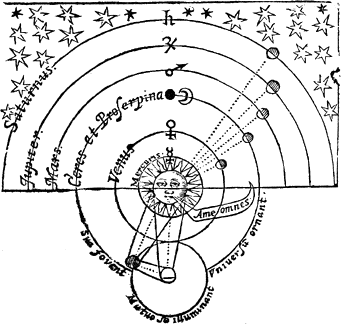
Ihave already handled the first thing that I promised according to the Method which Aristotle uses in his Booke de Mundo, and shew’d you the necessary parts that belong to this world in the Moone. In the next place ’tis requisite that I proceed to those things which are extrinsecall unto it, as the Seasons, the Meteors, and the Inhabitants.
1. Of the Seasons;
And if there be such a world in the Moone, ’tis requisite then that their seasons should be some way correspondent unto ours, that they should have Winter and Summer, night and day, as wee have.
Now that in this Planet there is some similitude of Winter and
Summer is affirmed by Aristotle
De gen. animal. l. 4. 12.
himselfe, since there is one hemispheare that hath alwaies heate and
light, and the other that hath darknesse and cold. True indeed, their
daies and yeeres are alwaies of one and the same length, but tis so with
us also under the Poles, and therefore that great difference is not
sufficient to make it altogether unlike ours, nor can we expect that
every thing there should be in the same manner as it is here below, as
if nature had no way but one to bring about her purposes. Wee may easily
see what great differences there are amongst us, betwixt things of the
same kinde. Some men (say they)
Plat. de fac.
De naturâ populorum. c. 3.
there are, who can live onely upon smells, without eating any thing, and
the same Plant, saith Besoldus, hath sometimes contrary effects.
Mandragora which growes in Syria inflames the lust, wheras
Mandragora which grows in other places doth coole the blood &
quench lust.
Now if with us there be such great difference betwixt things of the same kinde, we have no reason then to thinke it necessary that both these worlds should be altogether alike, but it may suffice if they bee correspondent in something onely, however it may be questioned whether it doth not seeme to be against the wisedome of providence, to make the night of so great a length, when they have such a long time unfit for worke? I answere no, since tis so, and more with us also under the poles; and besides, the generall length of their night is somewhat abated in the bignesse of their Moone which is our earth. For this returnes as great a light unto that Planet, as it receives from it. But for the better proofe of this, I shall first free the way from such opinions as might otherwise hinder the speede of a clearer progresse.
Plutarch Plut. de fac. lunæ. one of the chiefe patrons of this world in the Moone, doth directly contradict this proposition; affirming, that those who live there may discerne our world as the dregges and sediment of all other creatures, appearing to them through clouds and foggy mists, and that altogether devoid of light, being base and unmoveable, so that they might well imagine the darke place of damnation to be here situate, and that they onely were the inhabiters of the world, as being in the midst betwixt Heaven and Hell.
To this I may answere, ’tis probable that Plutarch spake this inconsiderately, and without a reason, which makes him likewise fall into another absurditie, when he sayes our earth would appeare immoveable, whereas questionlesse though it did not, yet would it seeme to move, and theirs to stand still, as the Land doth to a man in a Shippe; according to that of the Poet:
Provehimur portu, terræque urbesque recedunt.
And I doubt not but that ingenuous Authour would easily have recanted if hee had beene but acquainted with those experiences which men of latter times have found out, for the confirmation of this truth.
2. Unto him assents Macrobius, whose words are these; Terra accepto solis lumine clarescit, tantummodò, non relucet.
The earth is by the Sunne-beames made bright, but not able to enlighten any thing so farre.
And his reason is, because this being of a thicke and grosse matter, the light is terminated in its superficies, and cannot penetrate into the substance; whereas the moone doth therefore seeme so bright to us, because it receives the beames within it selfe. But the weaknesse of this assertion, may bee easily manifest by a common experience, for polished steele (whose opacity will not give any admittance to the rayes) reflects a stronger heate then glasse, and so consequently a greater light.
3. ’Tis the generall consent of Philosophers, that the reflection of the Sunne-beames from the earth doth not reach much above halfe a mile high, where they terminate the first region, so that to affirme they might ascend to the moone, were to say, there were but one region of aier, which contradicts the proved and received opinion.
Unto this it may be answered:
That it is indeed the common consent, that the reflexion of the Sunne-beames reach onely to the second region, but yet some there are, and those too Philosophers of good note, who thought otherwise. Thus Plotinus is cited by Cælius, Ant. lect. l. 1. c. 4. Si concipias te in sublimi quopiam mundi loco, unde oculis subjiciatur terræ moles aquis circumfusa, & solis syderumque radiis illustrata, non aliam profecto visam iri probabile est, quam qualis modo visatur lunaris globi species.
If you did conceive your selfe to bee in some such high place, where you might discerne the whole Globe of the earth and water, when it was enlightned by the Sunnes rayes, ’tis probable it would then appeare to you in the same shape as the moone doth now unto us.
Thus also Carolus Malapertius, whose words are these, Præfat. ad Austrica syd. Terra hæc nostra si in luna constituti essemus, splendida prorsus quasi non ignobilis planeta, nobis appareret.
If wee were placed in the moone, and from thence beheld this our earth, it would appeare unto us very bright, like one of the nobler Planets.
Unto these doth Fromondus assent, when he sayes, Meteor. l. 1. c. 2. Art. 2. Credo equidem quod si oculus quispiam in orbe lunari foret, globum terræ & aquæ instar ingentis syderis à sole illustrem conspiceret.
I believe that this globe of earth and water would appeare like some great Starre to any one, who should looke upon it from the moone.
Now this could not be, nor could it shine so remarkably, unlesse the beames of light, were reflected from it. And therefore the same Fromondus expresly holds, that the first region of ayre is there terminated, where the heate caused by reflexion begins to languish, whereas the beames themselves doe passe a great way further. The chiefe argument which doth most plainely manifest this truth, is taken from a common observation which may be easily tryed.
If you behold the Moone a little before or after the conjunction, when she is in a sextile with the Sunne, you may discerne not onely the part which is enlightned, but the rest also to have in it a kind of a duskish light, but if you chuse out such a scituation, where some house or chimney (being some 70 or 80 paces distant from you) may hide from your eye the enlightned hornes, you may then discerne a greater and more remarkeable shining in those parts unto which the Sunne beames cannot reach; nay there is so great a light, that by the helpe of a good perspective you may discerne its spots. Inso much that Blancanus the Jesuite speaking of it sayes De mundi fab. p. 3ª. c. 3. Hæc experientia ita me aliquando fefellit, ut in hunc fulgorem casu ac repente incidens, existimarim novo quodam miraculo tempore adolescentis lunæ factum esse plenilunium.
This experiment did once so deceive mee, that happening upon the sight of this brightnesse upon a sudden, I thought that by some new miracle the Moone had beene got into her full a little after her change.
But now this light is not proper to the Moone, it doth not proceed from the rayes of the Sunne which doth penetrate her body, nor is it caused by any other of the Planets and Starres. Therefore it must necessarily follow, that it comes from the earth. The two first of these I have already proved, and as for the last, it is confidently affirmed by Cælius, Progym. 1. Quod si in disquisitionem evocet quia, an lunari syderi lucem fœnerent planetæ item alii, asseveranter astruendum non fœnerare.
If any should aske whether the other Planets lend any light to the Moone; I answer they doe not.
True indeed, the noble Tycho l. 20. c. 5.6 discussing the reason of this light attributes it to the Planet Uenus, and I grant that this may convey some light to the Moone; but that it is not the cause of this whereof wee now discourse, is of itselfe sufficiently plaine, because Uenus is sometimes over the Moone, when as shee cannot convey any light to that part which is turned from her.
It doth not proceede from the fixed starres, for then it would retaine the same light in eclipses, whereas the light at such times is more ruddy and dull. Then also the light of the Moone would not be greater or lesser, according to its distance from the edge of the earths shadow, since it did at all times equally participate this light of the starres.
Now because there is no other body in the whole Universe, save the earth, it remaines that this light must necessarily be caused by that which with a just gratitude repaies to the Moone, such illumination as it receives from her.
And as loving friends equally participate of the same joy and griefe, so doe these mutually partake of the same light from the Sunne, and the same darkenesse from the eclipses, being also severally helped by one another in their greatest wants: For when the Moone is in conjunction with the Sunne, and her upper part receives all the light, then her lower Hemispheare (which would otherwise be altogether darke) is enlightened by the reflexion of the Sunne beames from the earth. When these two planets are in opposition, then that part of the earth which could not receive any light from the Sunne beames, is most enlightened by the Moone, being then in her full; and as she doth most illuminate the earth when the Sunne beames cannot, so the gratefull earth returnes to her as great, nay greater light when shee most wants it; so that alwaies that visible part of the Moone which receives nothing from the Sunne, is enlightened by the earth, as is proved by Galilæus, with many more arguments, in that Treatise which he calls Systema mundi. True indeed, when the Moone comes to a quartile, then you can neither discerne this light, nor yet the darker part of her body, but the reason is, because of the exuperancy of the light in the other parts. Quippe illustratum medium speciem recipit valentiorem, Scal. exerc. 62. the clearer brightnesse involves the weaker, it being with the species of sight, as it is with those of sound, and as the greater noise drownes the lesse, so the brighter object hides that which is more obscure. But they doe alwaies in their mutuall vicissitudes participate of one anothers light; so also doe they partake of the same defects and darknings, for when our Moone is eclipsed, then is their Sunne darkened, and when our Sunne is eclipsed, then is their Moone deprived of its light, as you may see affirmed by Mæslin. Epit. Astro. l. 4. part. 2. Quod si terram nobis ex alto liceret intueri, quemadmodum deficientem lunam ex longinquo spectare possumus, videremus tempore eclipsis solis terræ aliquam partem lumine solis deficere, eodem planè modo sicut ex opposito luna deficit,
If wee might behold this globe of earth at the same distance as we doe the Moone in her defects, wee might discerne some part of it darkened in the Sunnes eclipses, just so as the Moone is in hers.
For as our Moone is eclipsed by the interposition of our earth, so is their Moone eclipsed by the interposition of theirs. The manner of this mutuall illumination betwixt these two you may plainly discerne in this Figure following.
Where A represents the Sun, B the Earth, and C the Moone; Now suppose the Moone C to be in a sextile of increase, when there is onely one small part of her body enlightened, then the earth B will have such a part of its visible Hemispheare darkened, as is proportionable to that part of the Moone which is enlightened; and as for so much of the Moone, as the Sun beames cannot reach unto, it receives light from a proportionall part of the earth which shines upon it, as you may plainly perceive by the Figure.
You see then that agreement and similitude which there is betwixt our earth and the Moone. Now the greatest difference which makes them unlike, is this, that the Moone enlightens our earth round about, whereas our earth gives light onely to that Hemispheare of the Moone which is visible unto us, as may be certainly gathered from the constant appearance of the same spots, which could not thus come to passe, if the Moone had such a diurnall motion about its own axis, as perhaps our earth hath. And though some suppose her to move in an epicycle, yet this doth not so turne her body round, that we may discerne both Hemispheares, for according to that hypothesis, the motion of her eccentrick, doth turne her face towards us, as much as the other doth from us.
But now if any question what they doe for a Moone who live in the upper part of her body? I answer, the solving of this is the most uncertaine and difficult thing that I know of concerning this whole matter. But yet I will give you two probable conjectures.
1. Perhaps, the upper Hemispheare of the Moone doth receive a sufficient light from those planets about it, and amongst these Venus (it may be) bestowes a more especiall brightnesse, since Galilæus hath plainly discerned that she suffers the same increase and decreases, as the Moone hath, and ’tis probable that this may be perceived there without the help of a glasse, because they are farre neerer it than wee. When Venus (saith Keplar) lies downe in the Perige or lower part of her supposed Epicycle, then is she in conjunction with her husband the Sunne, from whom after she hath departed for the space of ten moneths, shee gets plenum uterum, and is in the full.7
But you’ll reply, though Venus may bestow some light when she is over the Moone, and in conjunction, yet being in opposition, she is not visible to them, and what shall they then doe for light?
I answer, then they have none: nor doth this make so great a difference betwixt those two Hemispheares as there is with us, betwixt the places under the poles, and the line, but if this bee not sufficient, then I say in the second place that
2. Perhaps there may be some other enlightened body above the Moone which we cannot discerne, nor is this altogether improbable because there is almost the like observed in Saturne, who appeares through this glasse with two lesser bodies on each side, which may supply the office of Moones, unto each hemispheare thus:
So in this world also there may be some such body, though wee cannot discerne it, because the Moone is alwaies in a streight line, betwixt our eye and that. Nor is it altogether unlikely that there should bee more moones to one Orbe, because Jupiter also is observed to have foure such bodies that move round about him.
But it may seeme a very difficult thing to conceive, how so grosse and darke a body as our earth, should yeeld such cleare light as proceedes from the Moone, and therefore the Cardinall de Cusa De doct. ig. l. 2. c. 12. (who thinkes every Starre to be a severall world) is of opinion that the light of the Sunne is not able to make them appeare so bright, but the reason of their shining is, because wee behold them at a great distance through their regions of fire which doe set a shining lustre upon those bodies that of themselves are darke. Vnde si quis esset extra regionem ignis, terra ista in circumferentia suæ regionis per medium ignis lucida stella appareret.
So that if man were beyond the region of fire, this earth would appear through that as a bright Starre.
But if this were the onely reason then would the Moone bee freed from such increases and decreases as shee is now lyable unto.
Keplar thinkes that our earth receives that light whereby it shines from the Sunne, but this (saith he) is not such an intended cleare brightnesse as the Moone is capable of, and therefore hee guesses, that the earth there is of a more chokie soyle like the Ile of Creete, and so is better able to reflect a stronger light, whereas our earth must supply this intention with the quantity of its body, but this I conceive to be a needlesse conjecture, since our earth if all things were well considered, will be found able enough to reflect as great a light. For
1. Consider its opacity, if you marke these sublunary things, you shall perceive that amongst them, those that are most perspicuous, are not so well able to reverberate the Sunne beames as the thicker bodies. The rayes passe singly through a diaphanous matter, but in an opacous substance they are doubled in their returne and multiplyed by reflexion. Now if the moone and the other Planets can shine so clearely by beating backe the Sunne beames, why may not the earth also shine as well, which agrees with them in the cause of this brightnesse their opacity?
2. Consider what a cleare light wee may discerne reflected from the earth in the middest of Summer, and withall conceive how much greater that must bee which is under the line, where the rayes are more directly and strongly reverberated.
3. Consider the great distance at which wee behold the Planets, for this must needs adde much to their shining and therefore Cusanus (in the above cited place) thinkes that if a man were in the Sunne, that Planet would not appeare so bright to him, as now it doth to us, because then his eye could discerne but little, whereas here wee may comprehend the beames as they are contracted in a narrow body. Keplar beholding the earth from a high mountaine when it was enlightned by the Sunne confesses that it appeared unto him of an incredible brightnesse, whereas then the reflected rayes entered into his sight obliquely; but how much brighter would it have appeared if hee might in a direct line behold the whole globe of earth and these rayes gathered together? So that if wee consider that great light which the earth receives from the Sunne in the Summer, and then suppose wee were in the Moone, where wee might see the whole earth hanging in those vast spaces where there is nothing to terminate the sight, but those beames which are there contracted into a little compasse; I say, if wee doe well consider this, wee may easily conceive, that our earth appeares as bright to those other inhabitants in the Moone, as theirs doth to us.
Proposition 12.
That tis probable there may bee such Meteors belonging to that world in the Moone, as there are with us.
Plutarch discussing this point affirmes that it is not necessary there should be the same meanes of growth and fructifying in both these worlds, since nature might in her policy finde out more waies then one how to bring about the same effect. But however he thinks its probable that the Moone her selfe sendeth forth warme winds, and by the swiftnesse of her motion there should breathe out a sweet and comfortable ayer, pleasant dewes and gentle moysture, which might serve for the refreshing and nourishment of the inhabitants and plants in that other world.
But since they have all things alike with us, as sea and land, and vaporous ayer encompassing both, I should rather therefore thinke that nature there should use the same way of producing meteors as she doth with us (and not by a motion as Plutarch supposes) because shee doth not love to vary from her usuall operations without some extraordinary impediment, but still keepes her beaten path unlesse she be driven thence.
One argument whereby I shall manifest this truth, may be taken from those new Starres which have appeared in divers ages of the world, and by their parallax have beene discerned to have been above the Moone, such as was that in Cassiopeia, that in Sagittarius, with many others betwixt the Planets. Hipparchus in his time tooke especiall notice of such as these, Plin. nat. hist. l. 2. c. 26. and therefore fancied out such constellations in which to place the Starres, shewing how many there were in every asterisme, that so afterwards posterity might know, whether there were any new Starre produced or any old one missing. Now the nature of these Comets may probably manifest, that in this other world there are other meteors also; for these in all likelihood are nothing else but such evaporations caused by the Sunne, from the bodies of the Planets. I shall prove this by shewing the improbabilities and inconveniences of any other opinion.
For the better pursuite of this ’tis in the first place requisite that I deale with our chiefe adversary, Cæsar la Galla, who doth most directly oppose that truth which is here to bee proved. Hee endeavouring to confirme the incorruptibility of the Heavens, and being there to satisfie the argument which is taken from these comets, He answers it thus: Aut argumentum desumptum ex paralaxi non est efficax, aut si est efficax, eorum instrumentorum usum decipere, vel ratione astri vel medii, vel distantiæ, aut ergo erat in suprema parte aeris, aut si in cœlo, tum forsan factum erat ex reflectione radiorum Saturni & Jovis, qui tunc in conjunctione fuerant.
Either the argument from the paralax is not efficacious, or if it be, yet the use of the instruments might deceive either in regard of the starre or the medium, or the distance, and so this comet might be in the upper regions of the aire, or if it were in the heavens, there it might be produced by the reflexion of the rayes from Saturne and Jupiter, who were then in conjunction.
You see what shifts hee is driven to, how he runnes up and downe to many starting holes, that hee may find some shelter, and in stead of the strength of reason, he answers with a multitude of words, thinking (as the Proverbe is) that hee may use haile, when hee hath no thunder, Nihil turpius (saith * Epist. 95. *Seneca) dubio est incerto, pedem modo referente, modo producente.
What can there bee more unseemely in one that should be a faire disputant, then to be now here, now there, and so uncertaine, that one cannot tell where to find him.
He thinkes that there are not Comets in the heavens, because there may be many other reasons of such appearances, but what he knowes not, perhaps (he saies) that argument from the parallax is not sufficient, or if it be, then there may be some deceit in the observation. To this I may safely say, that hee may justly be accounted a weake Mathematician who mistrusts the strength of this argument, nor can hee know much in Astronomy, who understands not the parallax, which is the foundation of that Science, and I am sure that hee is a timorous man, who dares not believe the frequent experience of his senses, or trust to a demonstration.
True indeed, I grant tis possible, that the eye, the medium, and the distance may al deceive the beholder, but I would have him shew which of all these was likely to cause an error in this observation? Meerely to say they might be deceived is no sufficient answer, for by this I might confute the positions of all Astronomers, and affirme the starres are hard by us, because ’tis possible they may be deceived in their observing that distance. But I forbeare any further reply; my opinion is of that Treatise, that either it was set forth purposely to tempt a confutation, that hee might see the opinion of Galilæus confirmed by others, or else it was invented with as much haste and negligence as it was printed, there being in it almost as many faults as lines.
Others thinke that these are not any new Comets, but some ancient starres that were there before, which now shine with that unusuall brightnesse, by reason of the interposition of such vapors which doe multiply their light, and so the alteration will be here onely, and not in the heavens. Thus Aristotle thought the appearance of the milkie way was produced, for he held that there were many little starres, which by their influence did constantly attract such a vapour towards that place of heaven, so that it alwaies appeared white. Now by the same reason may a brighter vapor be the cause of these appearances.
But how probable soever this opinion may seeme, yet if well considered, you shall finde it to be altogether absurd and impossible: for,
1. These starres were never seene there before, and tis not likely that a vapour being hard by us can so multiply that light which could not before be at all discerned.
2. This supposed vapour cannot be either contracted into a narrow compasse or dilated into a broad: 1. it could not be within a little space, for then that starre would not appeare with the same multiplied light to those in other climates: 2. it cannot be a dilated vapour, for then other starres which were discerned through the same vapour would seeme as bigg as that; this argument is the same in effect with that of the paralax, as you may see in this Figure.
Suppose A B to be a Hemispheare of one earth, C D to be the upper part of the highest region, in which there might be either a contracted vapour, as G, or else a dilated one, as H I. Suppose E F likewise to represent halfe the heavens, wherein was this appearing Comet at K. Now I say, that a contracted vapour, as G, could not cause this appearance, because an inhabitant at M could not discerne the same starre with this brightnesse, but perhaps another at L, betwixt which the vapour is directly interposed. Nor could it be caused by a dilated vapour, as H I, because then all the starres that were discerned through it would be perceived with the same brightnesse.
Tis necessary therefore that the cause of this appearance should be in the heavens. And this is granted by the most and best Astronomers. But, say some, this doth not argue any naturall alteration in those purer bodies, since tis probable that the concourse of many little vagabond starres by the union of their beames may cause so great a light. Of this opinion were Anaxagoras and Zeno amongst the ancient, and Baptista Cisatus, Blancanus, with others amongst our moderne Astronomers. For, say they, when there happens to be a concourse of some few starres, then doe many other flie unto them from all the parts of heaven like so many Bees unto their King. But 1. tis not likely that amongst those which wee count the fixed starres there should be any such uncertaine motions, that they can wander from all parts of the heavens, as if Nature had neglected them, or forgot to appoint them a determinate course. 2. If there be such a conflux of these, as of Bees to their King, then what reason is there that they doe not still tarry with it, that so the Comet may not be dissolved? But enough of this. You may commonly see it confuted by many other arguments. Others there are, who affirme these to be some new created stars, produced by an extraordinary supernaturall power. I answer, true indeed, tis possible they might be so, but however tis not likely they were so, since such appearances may be salved some other way, wherefore to fly unto a miracle for such things, were a great injury to nature, and to derogate from her skill, an indignitie much mis-becomming a man who professes himselfe to be a Philosopher, Miraculum (saith one) est ignorantiæ Asylum, a miracle often serves for the receptacle of a lazy ignorance which any industrious Spirit would be ashamed of, it being but an idle way to shift off the labour of any further search. But here’s the misery of it, wee first tie our selves unto Aristotles Principles, and then conclude, that nothing could contradict them but a miracle, whereas ’twould be much better for the Common-wealth of learning, if we would ground our Principles rather upon the frequent experiences of our owne, then the bare authority of others.
Some there are, who thinke that these Comets are nothing else, but exhalations from our earth, carried up into the higher parts of the Heaven. So Peno, Rothmannus & Galilæus, Tycho Progym. l. 1. cap. 9. but this is not possible, since by computation ’tis found that one of them is above 300 times bigger than the whole Globe of Land and Water. Others therefore have thought that they did proceed from the body of the Sun, and that that Planet onely is Cometarum officina, unde tanquam emissarii & exploratores emitterentur, brevi ad solem redituri: The shop or forge of Comets from whence they were sent, like so many spies, that they might in some short space returne againe, but this cannot be, since if so much matter had proceeded from him alone, it would have made a sensible diminution in his body. The Noble Tycho therefore thinkes that they consist of some such fluider parts of the Heaven, as the milkie way is framed of, which being condenst together, yet not attaining to the consistency of a Starre, is in some space of time rarified againe into its wonted nature. But this is not likely, for if there had beene so great a condensation as to make them shine so bright, and last so long, they would then sensibly have moved downewards towards some center of gravity, because whatsoever is condenst must necessarily grow heavier, whereas these rather seemed to ascend higher, as they lasted longer. But some may object, that a thing may be of the same weight, when it is rarified, as it had while it was condenst: so metalls, when they are melted, and when they are cold: so water also when it is frozen, and when it is fluid, doth not differ in respect of gravity. But to these I answer: First, Metalls are not rarified by melting, but molified. Secondly, waters are not properly condensed, but congealed into a harder substance, the parts being not contracted closer together, but still possessing the same extension.
And beside, what likely cause can we conceive of this condensation,
unlesse there be such qualities there, as there are in our ayre, and
then why may not the Planets have the like qualities, as our earth? and
if so, then ’tis more probable that they are made by the ordinary way of
nature, as they are with us, and consist of exhalations from the bodies
of the Planets. Nor is this a singular opinion; but it seemed most
likely to Camillus Gloriosus, Th. Campanella,
Fromondus,
De Comet. l. 5. c. 4.
Apolog.
Meteor. l. 3. c. 2. Art. 6.
Iohan. Fabr.
Carolus Malaptius de Heliocyc.
Scheiner. Rosa Vrsina.
with some others. But if you aske whither all these exhalations shall
returne, I answer, every one into his owne Planet: if it be againe
objected,
that then there will be so many centers of gravity, and each severall
Planet will be a distinct world; I reply, perhaps all of them are
so except the Sunne, though Cusanus thinkes there is one also,
and later times have discovered some lesser Planets moving round about
him. But as for Saturne, he hath two Moones on each side.
Jupiter hath foure, that incircle his body with their motion.
Venus is observed to increase and decrease as the Moone.
Mars, and all the rest, derive their light from the Sunne onely.
Concerning Mercury, there hath beene little or no observation,
because for the most part, he lies hid under the Sunne beames, and
seldome appeares by himselfe. So that if you consider their quantity,
their opacity, or these other discoveries, you shall finde it probable
enough, that each of them may be a severall world. But this would be too
much for to vent at the first: the chiefe thing at which I now
ayme in this discourse, is to
prove that there may be one in the Moone.
It hath beene before confirmed that there was a spheare of thicke vaporous aire encompasing the Moone, as the first and second regions doe this earth. I have now shewed, that thence such exhalations may proceede as doe produce the Comets: now from hence it may probably follow, that there may be wind also and raine, with such other Meteors as are common amongst us. This consequence is so dependant, that Fromondus De meteor. l. 3. c. 2. Art. 6. dares not deny it, though hee would (as hee confesses himselfe) for if the Sunne be able to exhale from them such fumes as may cause Comets, why not then such as may cause winds, and why not such also as cause raine, since I have above shewed, that there is Sea and Land as with us. Now raine seemes to be more especially requisite for them, since it may allay the heate and scorchings of the Sunne, when he is over their heads. And nature hath thus provided for those in Peru, with the other inhabitants under the line.
But if there be such great, and frequent alterations in the Heavens, why cannot wee discerne them?
I answer:
1. There may be such, and we not able to perceive them, because of the weaknesse of our eye, and the distance of those places from us, they are the words of Fienus, as they are quoted by Fromondus in the above cited place,8 Possunt maximæ permutationes in cœlo fieri, etiamsi a nobis non conspiciantur, hoc visus nostri debilitas & immensa cœli distantia faciunt. And unto him assents Fromondus himselfe, when a little after hee saies, Si in sphæris planetarum degeremus, plurima forsan cœlestium nebularum vellere toto æthere passim dispersa videremus, quorum species jam evanescit nimia spatii intercapedine.
If we did live in the spheares of the Planets, wee might there, perhaps, discerne many great clouds dispersed through the whole Heavens, which are not now visible by reason of this great distance.
2. Mæslin and Keplar affirme, that they have seene some of these alterations. The words of Mæslin are these (as I finde them cited.) Disser. 2. cum nunc. Galil.9 In eclipsi Lunari vespere Dominicæ Palmarum Anni 1605, in corpore Lunæ versus Boream, nigricans quædam macula conspecta fuit, obscurior cætero toto corpore, quod candentis ferri figuram repræsentabat; dixisses nubila in multam regionem extensa pluviis & tempestuosis imbribus gravida, cujusmodi ab excelsorum montium jugis in humiliora convallium loca videre non rarò contingit.
In that lunary eclipse which happened in the even of Palme-sunday, in the yeere 1605, there was a certaine blackish spot discerned in the Northerly part of the Moone, being darker than any other part of her body, and representing the colour of red hot yron; you might conjecture that it was some dilated cloud, being pregnant with showers, for thus doe such lower clouds appeare from the tops of high mountaines.
Unto this I may adde another testimony of Bapt. Cisatus, as he is quoted by Nierembergius, Hist. Nat. l. 2. c. 11. grounded upon an observation taken 23. yeeres after this of Mæslin, and writ to this Euseb. Nieremberg. in a letter by that diligent and judicious Astronomer. The words of it runne thus: Et quidem in eclipsi nupra solari quæ fuit ipso die natali Christi, observavi clarè in luna soli supposita, quidpiam quod valde probat id ipsum quod Cometæ quoque & maculæ solares urgent, nempe cœlum non esse à tenuitate & variationibus aeris exemptum, nam circa Lunam adverti esse sphæram seu orbem quendam vaporosum, non secus atque circum terram, adeoque sicut ex terra in aliquam usque sphæram vapores & exhalationes expirant, ita quoque ex luna.
In that late solary eclipse which happened on Christmas day, when the Moone was just under the Sunne, I plainly discerned that in her which may clearely confirme what the Comets and Sunne spots doe seeme to prove, viz. that the heavens are not solid, nor freed from those changes which our aire is liable unto, for about the Moone I perceived such an orbe of vaporous aire, as that is which doth encompasse our earth, and as vapours and exhalations, are raised from our earth into this aire, so are they also from the Moone.
You see what probable grounds and plaine testimonies have brought for the confirmation of this Proposition: many other things in this behalfe might be spoken, which for brevity sake I now omit, and passe unto the next.
Proposition 13.
That tis probable there may be inhabitants in this other World, but of what kinde they are is uncertaine.
I have already handled the Seasons and Meteors belonging to this new World: ’tis requisite that in the next place I should come unto the third thing which I promised, and to say somewhat of the inhabitants, concerning whom there might be many difficult questions raised, as whether that place be more inconvenient for habitation then our World (as Keplar thinkes) whether they are the seed of Adam, whether they are there in a blessed estate, or else what meanes there may be for their salvation, with many other such uncertaine enquiries, which I shall willingly omit, leaving it to their examination, who have more leisure and learning for the search of such particulars.
Being for mine own part content only to set downe such notes belonging unto these which have observed in other Writers. Cum tota illa regio nobis ignota sit, remanent inhabitores illi ignoti penitus, (saith Cusanus) De doct. ign. l. 2. c. 12. since we know not the regions of that place, wee must be altogether ignorant of the inhabitants. There hath not yet beene any such discovery concerning these, upon which wee may build a certainty, or good probability: well may wee guesse at them, and that too very doubtfully, but we can know nothing, for if we doe hardly guesse aright at things which be upon earth, if with labour wee doe finde the things that are at hand, Wisd. 9. 16. how then can wee search out those things that are in Heaven? What a little is that which wee know? in respect of those many matters contained within this great Universe, this whole globe of earth and water? though it seeme to us to be of a large extent, yet it beares not so great a proportion unto the whole frame of Nature, as a small sand doth unto it; and what can such little creatures as wee discerne, who are tied to this point of earth? or what can they in the Moone know of us? If wee understand any thing (saith Esdras) 2 Esd. 4. 22. ’tis nothing but that which is upon the earth, and hee that dwelleth above in the Heavens, may onely understand the things that are above in the heighth of the heavens.
So that ’twere a very needelesse thing for us, to search after any particulars, however, wee may guesse in the generall, that there are some inhabitants in that Planet: for why else did Providence furnish that place with all such conveniences of habitation as have beene above declared?
But you will say, perhaps, is there not too great and intollerable a heate, since the Sunne is in their Zinith every moneth, and doth tarry their so long before hee leaves it?
I answer, 1. This may, perhaps, be remedied (as it is under the line) by the frequencie of mid-day showers, which may cloud their Sunne, and coole their earth: 2. The equality of their nights doth much temper the scorching of the day, and the extreme cold that comes from the one, require some space before it can be dispelled by the other, so that the heate spending a great while before it can have the victory, hath not afterwards much time to rage in. Wherfore notwithstanding this, yet that place may remaine habitable. And this was the opinion of the Cardinal de Cusa, when speaking of this Planet, he saies, De doct. ign. l. 2. c. 12. Hic locus Mundi est habitatio hominum & animalium atque vegetabilium.
This part of the world is inhabited by men and beasts, and Plantes.
To him assented Campanella, but hee cannot determine whether there were men, or rather some other kinde of creatures. If they were men, then he thinkes they could not be infected with Adams sinne; yet, perhaps, they had some of their owne, which might make them liable to the same misery with us, out of which, perhaps, they were delivered by the same means as we, the death of Christ, and thus he thinkes that place of the Ephesians may be interpreted, where the Apostle saies, Eph. 1. 10. God gathered all things together in Christ, both which are in earth, and which are in the heavens: So also that of the same Apostle to the Colossians, where hee saies, Col. 1. 20. that it pleased the Father to reconcile all things unto himselfe by Christ, whether they be things in earth, or things in heaven.
But I dare not jest with Divine truthes, or apply these places according as fancy directs. As I thinke this opinion doth not any where contradict Scripture, so I thinke likewise, that it cannot be proved from it, wherefore Campanella’s second conjecture may be more probable, that the inhabitants of that world, are not men as wee are, but some other kinde of creatures which beare some proportion and likenesse to our natures, and Cusanus too thinkes they differ from us in many respects; I will set downe his words as they may bee found in the abovecited place, Suspicamus in regione solis magis esse solares, claros & illuminatos intellectuares habitatores, spiritu aliores etiam quam in lunâ, ubi magis lunatici, & in terra, magis materiales, & grossi, ut illi intellectualis naturæ solares sint multum in actu & parum in potentia; terreni vero magis in potentia, & parum in actu, lunares in medio fluctuantes. Hoc quidem opinamur ex influentia ignili solis aquatica simul & aeria lunæ, & gravedine materiali terræ, & consimiliter de aliis stellarum regionibus suspicantes, nullam habitatoribus carêre, quasi tot sint partes particulares mundiales omnius universi, quot sunt stellæ quarum non est numerus, nisi apud eum qui omnia in numero creavit.
Wee may conjecture (saith he) the inhabiters of the Sunne are like to the nature of that Planet, more cleare and bright, more intellectuall and spirituall than those in the Moone where they are neerer to the nature of that duller Planet, and those of the earth being more grosse and materiall than either, so that these intellectuall natures in the Sun, are more forme than matter, those in the earth more matter than forme, and those in the Moone betwixt both. This wee may guesse from the fiery influence of the Sunne, the watery and aereous influence of the Moone, as also the matereall heavinesse of the earth. In some such manner likewise is it with the regions of the other Starres, for wee conjecture that none of them are without inhabitants, but that there are so many particular worlds and parts of this one universe, as there are Stars which are innumerable, unlesse it bee to him who created all things in number.
For he held that the stars were not all in one equall Orbe as we commonly suppose, but that some were farre higher than others which made them appeare lesse and that many others were so farre above any of these, that they were altogether invisible unto us. An opinion (which as I conceive) hath not any great probability for it, nor certainty against it.
The Priest of Saturne relating to Plutarch (as he faignes it) the nature of the Selenites, told him they were of divers dispositions, some desiring to live in the lower parts of the Moone, where they might looke downewards upon us, while others were more surely mounted aloft, all of them shining like the rayes of the Sun, and as being victorious are crowned with garlands made with the wings of Eustathia or Constancie.
It hath beene the opinion amongst some of the Ancients, that their Heavens and Elysian fields were in the Moone where the aire is most quiet and pure. Thus Socrates, thus Plato, Nat. Com. lib. 3. c. 19. with his followers, did esteeme this to bee the place where those purer soules inhabit, who are freed from the Sepulchre, and contagion of the body. And by the Fable of Ceres, continually wandring in search of her daughter Proserpina, is meant nothing else but the longing desire of men, who live upon Ceres earth, to attaine a place in Proserpina, the Moone or Heaven.
Plutarch also seemes to assent unto this, but hee thinkes moreover, that there are two places of happinesse answerable to those two parts which hee fancies to remaine of a man when hee is dead, the soule and the understanding; the soule he thinkes is made of the Moone, and as our bodies doe so proceede from the dust of this earth, that they shall returne to it hereafter, so our soules were generated out of that Planet, and shall bee resolved into it againe, whereas the understanding shall ascend unto the Sunne, out of which it was made where it shall possesse an eternity of well being, and farre greater happinesse than that which is enjoyed in the Moone. So that when a man dies, if his soule bee much polluted, then must it wander up and downe in the middle regions of the aire where hell is, and there suffer unspeakable torments for those sinnes whereof it is guilty. Whereas the soules of better men, when they have in some space of time beene purged from that impurity which they did derive from the body, then doe they returne into the Moone, where they are possest with such a joy, as those men feele who professe holy misteries, from which place (saith he) some are sent downe to have the superintendance of Oracles, being diligent either in the preservation of the good, either from or in all perils, and the prevention or punishment of all wicked actions, but if in these imployments they mis-behave themselves, then are they againe to be imprisoned in a body, otherwise they remaine in the Moone till their body be resolved into it, & the understanding being cleared from all impediments, ascends to the Sunne which is its proper place. But this requires a diverse space of time according to the diverse affections of the soule. As for those who have beene retired and honest, addicting themselves to a studious and quiet life, these are quickly preferred to a higher happinesse. But as for such who have busied themselves in many broyles, or have beene vehement in the prosecution of any lust, as the ambitious, the amorous, the wrathfull man, these still retaine the glimpses and dreames of such things as they have performed in their bodies, which makes them either altogether unfit to remaine there where they are, or else keepes them long ere they can put off their soules. Thus you see Plutarchs opinion concerning the inhabitants and neighbours of the Moone, which (according to the manner of the Academickes) hee delivers in a third person; you see he makes that Planet an inferiour kind of heaven, and though hee differ in many circumstances, yet doth hee describe it to be some such place, as wee suppose Paradise to be. You see likewise his opinion concerning the place of damned spirits, that it is in the middle region of the aire, and in neither of these is hee singular, but some more late and Orthodox Writers have agreed with him. As for the place of hell, many thinke it may be in the aire as well as any where else.
True indeed, Saint Austin affirmes that this place cannot bee
discovered;
De civit. Dei. lib. 22. ca. 16.
But others there are who can shew the situation of it out of Scripture;
Some holding it to bee in some other world without this, because our
Saviour calls it σκότος
ἐξώτερον, outward darkenesse.
Mat. 25. 30
But the most will have it placed towards the Center of our earth,
because ’tis said,
Eph. 4. 9.
Christ descended into the lower parts of the earth, and some of these
are so confident, that this is its situation, that they can describe you
its bignes also, and of what capacity it is. Francis Ribera in
his Comment on the Revelations, speaking of those
words, where ’tis said,
Rev. 14. 20.
that the blood went out of the Wine-presse, even unto the horses
bridles by the space of one thousand and sixe hundred furlongs,
interprets them to bee meant of Hell, and that that number expresses
the diameter of its concavity, which is 200 Italian miles; but
Lessius thinkes that this opinion gives them too much
roome in hell,
De Morib. div. l. 13. c. 24.
and therefore hee guesses that ’tis not so wide; for (saith hee) the
diameter of one league being cubically multiplied, will make a spheare
capable of 800000 millions of damned bodies, allowing to each sixe foote
in the square, whereas (saies hee) ’tis certaine that there shall not be
one hundred thousand millions in all that shall bee damned. You see the
bold Iesuit was carefull that every one should have but roome
enough in hell, and by the strangenesse of the conjecture, you may
guesse that he had
rather bee absurd, than seeme either uncharitable or ignorant. I
remember there is a relation in Pliny, how that
Dionisiodorus a Mathematician, being dead, did send a letter from
his place to some of his friends upon earth, to certifie them what
distance there was betwixt the center and superficies: hee might have
done well to have prevented this controversie, and enformed them the
utmost capacity of that place. However, certaine it is, that that number
cannot bee knowne, and probable it is, that the place is not yet
determined, but that hell is there where there is any tormented soule,
which may bee in the regions of the aire as well as in the center; but
of this onely occasionally, and by reason of Plutarchs opinion
concerning those that are round about the Moone; as for the Moone it
selfe, hee esteemes it to bee a lower kinde of Heaven, and
therefore in another place hee cals it a terrestriall starre,
Cur silent oracula.
and an Olympian or celestiall earth answerable, as I conceive, to the
paradise of the Schoolemen, and that Paradise was either in or neere the
Moone, is the opinion of some later Writers, who derived it (in all
likelihood) from the assertion of Plato, and perhaps, this of
Plutarch. Tostatus
S. W. Raw. lib. 1. cap. 3. § 7.
in Gen.
laies this opinion upon Isioder. Hispalensis, and the venerable
Bede; and Pererius fathers it upon Strabus and
Rabanus his Master. Some would have it to bee situated in such a
place as could not be discovered, which causes the penman of
Esdras to make it a harder matter to know the outgoings of
Paradise, then to weigh the weight of the fire, or measure the blasts of
wind, or call againe a day that is past.
2 Esd. 4. 7.
But notwithstanding this, there bee some others who thinke that it is on
the top of some high mountaine under
the line, and these interpreted the torrid Zone to be the flaming Sword
whereby Paradise was guarded. ’Tis the consent of divers others, who
agree in this, that Paradise is situated in some high and eminent place.
In Genes.
So Tostatus: Est etiam Paradisus situ altissima, supra omnem
terræ altitudinem,
Paradise is situated in some high place above the earth:
and therefore in his Cõment upon the 49. of Genesis, hee understands the blessing of Iacob concerning the everlasting hills to bee meant of Paradise, and the blessing it selfe to bee nothing else but a promise of Christs comming, by whose passion the gates of Paradise should bee opened. Unto him assented Rupertus, Scotus, and most of the other Schoolemen, as I find them cited by Pererius, Comment. in 2. Gen. v. 8. lib 1. cap. 3. § 6 7. and out of him in Sr. W. Rawleigh. Their reason was this: because in probability this place was not overflowed by the flood, since there were no sinners there which might draw that curse upon it. Nay Tostatus thinkes that the body of Enoch was kept there, and some of the Fathers, as Tertullian and Austin have affirmed, that the blessed soules were reserved in that place till the day of judgement, and therefore ’tis likely that it was not overflowed by the flood; and besides, since all men should have went naked if Adam had not fell, ’tis requisite therefore that it should be situated in some such place where it might bee priviledged from the extremities of heat and cold. But now this could not bee (they thought) so conveniently in any lower, as it might in some higher aire. For these and such like considerations have so many affirmed that Paradise was in a high elevated place, which some have conceived could bee no where but in the Moone: For it could not be in the top of any mountaine, nor can we thinke of any other body separated from this earth which can bee a more convenient place for habitation than this Planet, therefore they concluded that it was there.
It could not bee on the top of any mountaine.
1. Because wee have expresse Scripture, that the highest of them was overflowed. Gen. 7. 19.
2. Because it must bee of a greater extension, and not some small patch of ground, since ’tis likely all men should have lived there, if Adam had not fell. But for a satisfaction of these arguments, together with a farther discourse of Paradise, I shall referre you to those who have written purposely upon this subject. Being content for my owne part to have spoken so much of it, as may conduce to shew the opinion of others concerning the inhabitants of the Moone, I dare not my selfe affirme any thing of these Selenites, because I know not any ground whereon to build any probable opinion. But I thinke that future ages will discover more; and our posterity, perhaps, may invent some meanes for our better acquaintance with these inhabitants. ’Tis the method of providence not presently to shew us all, but to lead us along from the knowledge of one thing to another. ’Twas a great while ere the Planets were distinguished from the fixed Stars, and sometime after that ere the morning and evening starre were found to bee the same, and in greater space I doubt not but this also, and farre greater mysteries will bee discovered. In the first ages of the world the Islanders either thought themselves to be the onely dwellers upon the earth, or else if there were any other, yet they could not possibly conceive how they might have any commerce with them, being severed by the deepe and broad Sea, but the after-times found out the invention of ships, in which notwithstanding none but some bold daring men durst venture, there being few so resolute as to commit themselves unto the vaste Ocean, and yet now how easie a thing is this, even to a timorous & cowardly nature? So, perhaps, there may be some other meanes invented for a conveyance to the Moone, and though it may seeme a terrible and impossible thing ever to passe through the vaste spaces of the aire, yet no question there would bee some men who durst venture this as well as the other. True indeed, I cannot conceive any possible meanes for the like discovery of this conjecture, since there can bee no sailing to the Moone, unlesse that were true which the Poets doe but feigne, that shee made her bed in the Sea. We have not now any Drake or Columbus to undertake this voyage, or any Dædalus to invent a conveyance through the aire. However, I doubt not but that time who is still the father of new truths, and hath revealed unto us many things which our Ancestours were ignorant of, will also manifest to our posterity, that which wee now desire, but cannot know. Veniet tempus (saith Seneca) Nat. Quæst. l. 7. c. 25. quo ista quæ nunc latent, in lucem, dies extrahet, & longioris ævi diligentia. Time will come when the indeavours of after-ages shall bring such things to light, as now lie hid in obscurity. Arts are not yet come to their Solstice, but the industry of future times assisted with the labours of their forefathers, may reach unto that height which wee could not attaine to. Ueniet tempus quo posteri nostri nos tam aperta nescisse mirentur. As wee now wonder at the blindnesse of our Ancestors, who were not able to discerne such things as seeme plaine and obvious unto us. So will our posterity admire our ignorance in as perspicuous matters. Keplar doubts not, but that as soone as the art of flying is found out, some of their Nation will make one of the first colonies that shall inhabite that other world. But I leave this and the like conjectures to the fancie of the reader; Desiring now to finish this Discourse, wherein I have in some measure proved what at the first I promised, a world in the Moone. However, I am not so resolute in this, that I thinke tis necessary there must be one, but my opinion is that ’tis possible there may be, and tis probable there is another habitable world in that Planet. And this was that I undertooke to prove. In the pursuit whereof, if I have shewed much weaknesse or indiscretion; I shall willingly submit my selfe to the reason and censure of the more judicious.
The Propositionsthat are provedin this Discourse. |
Proposition 1.
That the strangenesse of this opinion is no sufficient reason why it should be rejected, because other certaine truths have beene formerly esteemed ridiculous, and great absurdities entertayned by common consent.
By way of Preface.
Prop. 2.
That a plurality of worlds doth not contradict any principle of reason or faith.
Prop. 3.
That the heavens doe not consist of any such pure matter which can priviledge them from the like change and corruption, as these inferiour bodies are liable unto.
Prop. 4.
That the Moone is a solid, compacted opacous body.
Prop. 5.
That the Moone hath not any light of her owne.
Prop. 6.
That there is a world in the Moone, hath beene the direct opinion of many ancient, with some moderne Mathematicians, and may probably be deduced from the tenents of others.
Prop. 7.
That those spots and brighter parts which by our sight may be distinguished in the Moone, doe shew the difference betwixt the Sea and Land in that other world.
Prop. 8.
That the spots represent the Sea, and the brighter parts the Land.
Prop. 9.
That there are high Mountaines, deepe vallies, and spacious plaines in the body of the Moone.
Prop. 10.
That there is an Atmo-sphæra, or an orbe of grosse vaporous aire, immediately encompassing the body of the Moone.
Prop. 11.
That as their world is our Moone, so our world is their Moone.
Prop. 12.
That tis probable there may bee such Meteors belonging to that world in the Moone, as there are with us.
Prop. 13.
That tis probable there may be inhabitants in this other World, but of what kinde they are is uncertaine.