
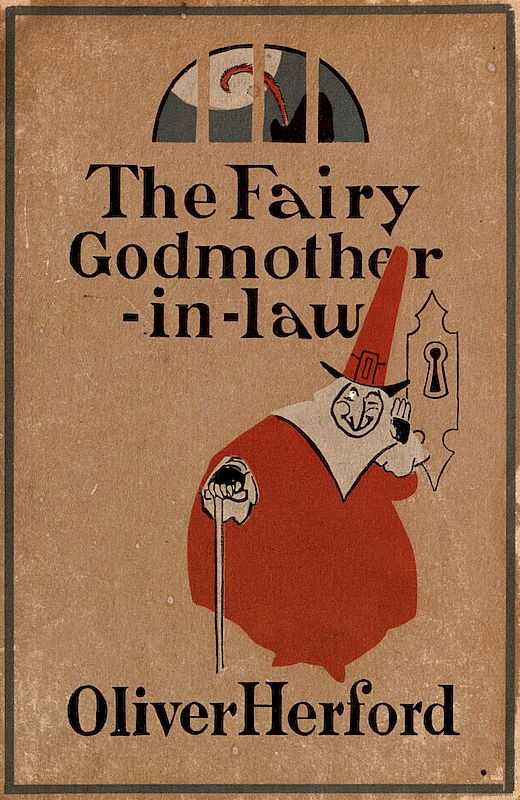
The Project Gutenberg eBook of The Fairy Godmother-in-law
Title: The Fairy Godmother-in-law
Author: Oliver Herford
Release date: July 5, 2019 [eBook #59858]
Language: English
Credits: Produced by David Edwards, John Campbell and the Online
Distributed Proofreading Team at http://www.pgdp.net
TRANSCRIBER’S NOTE
Some minor changes to the text are noted at the end of the book.
THE FAIRY
GODMOTHER-IN-LAW
BOOKS BY OLIVER HERFORD
WITH PICTURES BY THE AUTHOR
PUBLISHED BY CHARLES SCRIBNER’S SONS
| THE BASHFUL EARTHQUAKE | $1.25 |
| A CHILD’S PRIMER OF NATURAL HISTORY | $1.25 |
| OVERHEARD IN A GARDEN | $1.25 |
| MORE ANIMALS | net, $1.00 |
| THE RUBAIYAT OF A PERSIAN KITTEN | net, $1.00 |
| THE FAIRY GODMOTHER-IN-LAW | net, $1.00 |
The Fairy
Godmother-in-Law
By
Oliver Herford
With Some Pictures
By the Author
New York · Published by
Charles Scribner’s Sons
Copyright, 1905, by
OLIVER HERFORD
Published, November, 1905
THE TROW PRESS · NEW YORK
To M. H.
CONTENTS
| PAGE | |
| The Fairy Godmother-in-law | 1 |
| The Charm that Failed | 31 |
| The Silver Question | 41 |
| How the Lion Became King | 47 |
| The Wakeful Princess | 55 |
| A Modern Dialogue | 65 |
| The Heart of Ice | 71 |
| The Judgment of Bishop Valentine | 75 |
| The Bachelor Girl | 78 |
| Mephisto | 80 |
| A Corner in Curls | 83 |
| The Hydrant-Headed Monster | 93 |
| To My Toy Canary | 95 |
| The Hand of Time | 101 |
| Envoi | 103 |
THE FAIRY
GODMOTHER-IN-LAW
PREFACE
It is not always well to place
Unbounded Faith in Fairy Lore,
Believing that in every case
They all lived Happy evermore.
Stranger than Fiction though we deem
The Truth, it does not follow, too,
That Fairy Tales, because they seem
Still Stranger, must be still more True.
Far be it from me to assail
The Truthfulness of Fairy Writ,
But let us take a Well-Known Tale
And see what really came of it.
I
THE WEDDING
When Cinderella wed the Prince
She thought him all her Fancy Painted,
And this was not surprising since
They were not very Well Acquainted.
While he, not dreaming where she got
Glass slippers, counted on a Dot.
The Prince was Brave, Industrious, Wise:
Brave in bright Silks and Satins gay,
Wise in the Lore of Ladies’ Eyes,
And most Industrious—at Play;
A Leader, too—in Fashion’s Set;
And Deep—that is to say, in Debt.
Who was the Somebody of Note?
(I never could remember names)
Was it Mark Twain or Mr. Choate
Or Mrs. Ward or Henry James
That penn’d those words of Wise Import,
“Who weds in haste repents—in court”?
But let us not Anticipate.
The Princess wore a Plain Gold Frock;
No Fairy Dress to spoil the fête
By vanishing at Twelve o’clock.
This time no Spell her pleasure blighted—
Her god-mamma was not invited.
Not that she really meant to flout
Her Benefactress; but you see
She had not told the Prince about
Her Fairy Godmother, lest he
Might change his mind if he foresaw
A Fairy God-mamma-in-law.
A Fairy may be Good or Ill,
A Godmother Morose or Gay;
A Mother-in-law, say what you will,
Is not immortal any way.
But wouldn’t it a Bridegroom stun
To think of all three rolled in one?
II
THE LETTER
All day the envelope she scann’d.
But though her royal name it bore,
’Twas in an Unfamiliar Hand.
The Postmark puzzled her still more.
The Princess could not understand
Who’d write to her from——
She turned it Left, she turned it Right,
She pinched it, shook it to and fro,
She held it up against the Light,
And topsy-turvy wise—but no,
It still continued to preserve
Its air of Self-contained Reserve.
One day the Princess in a Pet,
It was her Last, her only hope,
Summoned her Trusty Cabinet,
To Sit upon the Envelope,
And at no matter what expense,
To end her Terrible Suspense.
She put the matter in the Hands
Of the Police; she went to see
Astrologers from Foreign Lands
And experts in Chirography;
And offered Large Rewards to all
Who furnished Clues, however small.
But no one came for the Reward,
Nor would the Envelope betray
The Secret in its bosom stored,
When by the Merest Chance one day
She overheard a Child, who cried,
“If it were mine, I’d look inside.”
Tossing the Tot a Thousand Pounds,
The Princess to her Chamber sped;
Her Joy and Rapture knew no bounds;
She tore the Envelope and read
A note from god-mamma, to say,
She might expect her any day.
III
THE VISIT
One day as Cinderella ate
Her Simple Lunch of sixteen courses,
A Golden Coach drove up in state,
Drawn by a team of Mouse-Grey horses,
And on the carriage door were scrolled
The Letters F. G. M., in gold.
The Princess dropped a Jelly Roll,
Which tipped with Pink her Crystal Shoe,
And cried, “O my prophetic soul!
My God-mamma! What shall I do?”
Then, Ladylike, she cut the knot
By simply fainting on the spot.
Strong Fairy Salts soon brought her to.
She looked up in a startled way.
“Why, God-mamma—can that be you?
How sweet! I hope you’ve come to stay.
The Prince will simply be enchanted.”
“Your Wish,” quoth God-mamma, “is granted.”
True to her word, the Fairy soon
Was quite at home. The royal Attic
She turned into a Grand Saloon,
Where with her cats she reigned ecstatic.
“Henceforth,” said she, “I’ll live at leisure,
And only work my Spells for pleasure.”
She had a Sense of Humor dry,
She loved her Little Joke—and tho’
None of her Tricks were prompted by
A spiteful heart or love of show,
To love one’s Joke does not, it’s true,
Imply that Others love it too.
She had a disconcerting way,
When Argument became a bore,
Of saying what she had to say
And disappearing through the Floor,
A joke that never failed to cause
A weird, if not side-splitting, Pause.
At meals, if there appeared a dish
God-mamma did not find appealing,
She’d wave her wand, and Fowl or Fish
Would promptly vanish thro’ the ceiling,
And in its place would be Fried Mole
Or Crocodile en casserole.
One day some Ladies of the Court
Performed a Play which bored her so,
She up and cried, “That’s not my sort!”
And changed it to a Ballet show.
A Tactless Joke, which caused, of course,
Much talk—and more than one Divorce.
But nothing gave her such delight,
Or keener Sense of Humor showed,
Than when the Prince came home at night;
She’d change his door-key to a Toad,
And laugh to see it hop about,
Or turn the Key-Hole inside out.
Once, weary of her Pesterings,
The Prince apostrophized a bird,
Exclaiming, “Would I too had wings!”
It chanced the Fairy overheard,
And, with the very best intentions,
Granted him wings of Large Dimensions.
Now wings (as any Naturalist
Will tell you) are but variations
Of arms, and cannot co-exist
With such-like Brachial Formations.
Accordingly, he lost his arms,
Which handicaps a Prince’s charms.
To his embarrassment and woe,
He had to be both dressed and fed
And brushed and bathed and put—but no,
That he was spared. His Wings when spread
Were Forty Feet from side to side;
Bed was a luxury denied.
He soon repented of his Whim.
With wings like windmill sails, of course,
No room was big enough for him.
So all night long, in Chill Remorse,
He perched upon the roof. At dawn
The spell was happily withdrawn.
About this time the Princess planned
A grand Subscription Ball, to aid
The Starving Shepherds of the land.
The Prince, when told the shepherds’ trade
Included Shepherdesses too,
Subscribed a Thumping I. O. U.
Upon the evening of the ball,
It chanced that God-mamma-in-law,
Flitting about the Palace Hall,
Passed by the Prince’s Suite, and saw
His gladsome Evening Robes outspread
In neat array upon the bed.
She eyed them sadly. Here in places
The silken pile was wearing thin;
And here were stains and here were traces
Of where the Moth had broken in.
“Aha! Aha! it’s plain to see
This is a little job for me!
“I’ll make him a new suit,” said she,
“A brave new suit without a flaw.
I’d like to know what Home would be
Without a God-mamma-in-law.”
And in its place upon the bed
A Fairy Substitute she spread.
All unobserved, she slipped away,
Delighted with her Little Game,
And, seeking some new trick to play,
To Cinderella’s closet came.
Where for her golden robe of state
She left a Fairy Duplicate.
Dressed for the ball, they drove in State,
Looking superlatively swell;
God-mamma pleaded mal de tête
And from her window waved farewell.
Her voice rose o’er the people’s cheers,
“Be back at twelve o’clock my dears!”
IV
THE BALL
Before the splendors of the Ball
The Boldest Metaphor grows tame;
Superlatives abjectly crawl
Back to their lexicon in shame,
And Synonyms in shrieking chorus
Take refuge in the deep Thesaurus.
But language has its Pioneers,
Who seek Fresh Words and Postures new,
Slang rushes in where Syntax fears
To tread—so I for Ade halloo,
And say (with George’s kind permission)
It was “A Heated Proposition.”
The Princess never dreamed her frock
Of gold was wrought by fairy power.
And set, like an alarming Clock,
To go off at the midnight hour.
Her childish laugh rang with delight:
“Thank God-mamma’s not here to-night.”
Prince Charming looked his very best
To—I mean at—the Ladies Fair;
No dread foreboding stirred his breast;
No Writing on the Wall was there
To Tell him of the Awful Shock
Awaiting him at Twelve O’clock.
V
MIDNIGHT
Again (see chapter on The Ball)
The Boldest Metaphor grows tame;
Superlatives abjectly crawl
Back to their lexicon in shame,
And Synonyms in shrieking chorus
Take refuge in the deep Thesaurus.
But every cloud that bars the sun
They say with silverwear is lined;
And tho’ they felt they were Undone,
Their Highnesses were cheered to find
At midnight when their Robes took wings,
They kept their—well, their Other Things.
Perchance, Dear Reader, you have noted
In that Department which to Trade is
By Monthly Magazines devoted,
Perchance, Dear Reader, you have noted
In that Department which to Trade is
By Monthly Magazines devoted,
The Pleasant Gentlemen and Ladies
Whose Union Suits our souls bewitch—
The Simple Flannels of the Rich.
The Pleasant Gentlemen and Ladies
Whose Union Suits our souls bewitch—
The Simple Flannels of the Rich.
Even arrayed as one of these,
In Homespun stood the Royal Twain,
While people cried, on bended knees,
“Long live their Majesties! who deign
Thus by example to Restore
Our Woolen Industry of Yore!”
Thro’ all the Land the Tidings sped
From Door to Door, from Wife to Wife,
Thro’ all the Land the Fashion spread
For Woolen and the Simple Life.
New looms sprang up on every hand
And shepherds prospered in the land.
Poor God-mamma, ’twas her last caper;
One night to throw some Light about
She changed herself into a Taper,
And Cinderella blew her out.
The Princess then divorced the Prince,
And Both lived Happy Ever Since.
THE CHARM THAT
FAILED
The Hero of my tale
The Hero of my tale
Was a serpent—don’t turn pale!
My snake was not the “serpent” of Theology
With an apple up his sleeve
To tempt some child of Eve,
Nor was he versed in deadly Toxicology.
No, his fangs were free from guile,
And he had a roomy smile.
There was no more harmless snake in all Zoology.
But since no creature known
Is perfect, I will own
He had one failing—vanity, alas! innate.
He was also fond of sport,
Though not a cruel sort:
His aim was more to charm than to assassinate.
He was often heard to say,
When feeling rather gay,
“I’d like to see the Bird I cannot fascinate!”
And one day
Some laughter-loving Fay
His boasting heard,
And sent a Bird.
It was sitting, stuffed and stiff on
A thing of straw and chiffon,
Ribbands and lace and jet and such like finery,
By a milliner begotten
And some careless maid forgotten,
In stuffed and lonely splendor in the Vinery,
When with expectant eye
Mr. Serpent, by and by,
Strolled forth in search of game from out the Pinery.
And the Bird
Never stirred
Or said a word.
“Aha!” said Mr. Snake,
“Unless I much mistake,
Here’s a charming subject for a Trance Hypnotic;
Soon I’ll have her in my toils!”
And with mysterious coils
He advanced with air complacent and despotic.
Then he rose up, and let fly
A glance from out his eye,
And watched for the effect of his narcotic.
And the Bird
Never stirred
Or said a word.
Said Mr. Snake, “My spell
Seems to work extremely well.”
And straightway with Majestic Pride he puffed,
But when an hour had pass’d,
And still the Bird stood fast,
I must confess he felt a trifle huff’d.
“There’s something wrong,” said he,
“With the Bird—or else with me.”
How should he know the wretched thing was stuffed?
That Bird,
Who never stirred
Or said a word.
“Confound the bird!” he said,
And he stood upon his head
And waved his long mysterious tail in air,
And he focussed all the rays
Of his esoteric gaze
Into one cold and petrifying glare.
But the Deadly Glance fell wide;
He might as well have tried
To hypnotize a table or a chair—
As that Bird,
Who never stirred
Or said a word.
“That settles it!” he cried.
“I will not be defied!”
And he coiled himself to spring—oh, rash proceeding!
Like an arrow from a bow
He sprang—how should he know
The Doom to which he was so swiftly speeding?
Next moment he lay dead,
With a Hat Pin through his head,
Whereat, with most commendable good-breeding—
The Bird
Never stirred
Or said a word.
THE SILVER
QUESTION
The Sun appeared so smug and bright,
One day, that I made bold
To ask him what he did each night
With all his surplus gold.
He flushed uncomfortably red,
And would not meet my eye.
“I travel round the world,” he said,
“And travelling rates are high.”
With frigid glance I pierced him through.
He squirmed and changed his tune.
Said he: “I will be frank with you:
I lend it to the Moon.
“Poor thing! You know she’s growing old
And hasn’t any folk.
She suffers terribly from cold,
And half the time she’s broke.”
That evening on the beach I lay
Behind a lonely dune,
And as she rose above the bay
I buttonholed the Moon.
“Tell me about that gold,” said I.
I saw her features fall.
“You see, it’s useless to deny;
The Sun has told me all.”
“Sir!” she exclaimed, “how can you try
An honest Moon this way?
As for the gold, I put it by
Against a rainy day.”
I smiled and shook my head. “All right,
If you must know,” said she,
“I change it into silver bright
Wherewith to tip the Sea.
“He is so faithful and so good,
A most deserving case;
If he should leave, I fear it would
Be hard to fill his place.”
When asked if they accepted tips,
The waves became so rough;
I thought of those at sea in ships,
And felt I’d said enough.
For if one virtue I have learned,
’Tis tact; so I forbore
To press the matter, though I burned
To ask one question more.
I hate a scene, and do not wish
To be mixed up in gales,
But, oh, I longed to ask the Fish
Whence came their silver scales!
HOW THE LION
BECAME KING
Once in the hazy days of Yore
(I cannot very well be more
Explicit, since it was before
Dates were invented).
Once on a time, as I began
To say, the Lion formed a plan
To undermine the rule of Man,
Which he resented.
In answer to the Lion’s call,
His fellow-creatures, great and small,
From earth and air came one and all
In Trepidation.
He then delivered a discourse,
And proved with eloquence and force
Man was their one and only source
Of Tribulation.
“What is he—taken at his best?
A mere pretence! Not even dressed,
If we his puny form divest
Of spoil he’s looted.
The fact that we can far excel
His boasted Strength and Speed, as well
As Hearing, Sight, and Taste and Smell,
Is undisputed.
“I am not boasting when I own
for Strength I’d back my claws alone
Against his battle-axe of stone;
While, as to Vision,
’Tis nothing more than idle talk
To mention Man beside the Hawk—
The swift Horse, too, his clumsy walk
Views with derision.
“Only Man’s Ignorance, I’m bound
To say, could possibly confound
The Scent and Hearing of the Hound
With his dull powers;
As well his Taste, that gluts on fare
Like half-burnt Antelope and Bear,
With the fastidious Bee compare,
That sips the flowers.
And so, in view of Public Need,
The Hawk, Hound, Bee, and Horse agreed
To pool their Sight, Scent, Taste, and Speed;
And in due season
They made, pro tem., the Lion King,
Intrusting him with everything
Upon condition he would bring
Proud Man to reason.
The crafty Lion then proposed
To send an Embassy composed
Of those same four. As none opposed,
They started straightway,
And, coming to Man’s portals wide,
They entered, but no trace espied
Of Man, until (from the outside)
He closed the gateway.
And there he kept them till they swore
To be his servants evermore,
And work his will, and bow before
His rod of iron:
The Dog to watch, the Hawk to kill,
The Horse to carry and to till,
The Bee with sweets his jars to fill.
All save the Lion—