
| PHOTOGRAPHS | |||
| Plate | To face page | ||
| I. | Bulghar-Madên: Approaching the Taurus Mountains, | Frontispiece | |
| II. | (i) A Valley in the Taurus, | 4 | |
| (ii) Headwaters of the Halys near Sivas, | |||
| III. | Aleppo: View of the city from the citadel, | 6 | |
| IV. | Karakul: A Kurd family at home, | 8 | |
| V. | Kartal: | (i) Verandah of a house, | 12 |
| (ii) Group of Turkoman women, | |||
| VI. | Bogche: A chief pass over the Amanus Mountains, | 14 | |
| VII. | Beilan: Summit of the pass, | 16 | |
| VIII. | Woodland on the south slopes of Taurus, | 18 | |
| IX. | Cæsarea: Cloister of a school, and citadel, | 22 | |
| X. | Injesu: Mosque and town, | 24 | |
| XI. | Halys River, between Chok Geuz and Bir Geuz, | 26 | |
| XII. | Yeni-Han, near Sekkili: Nomad encampment, | 28 | |
| XIII. | (i) Chesme Keupru: Interior of the han, | 30 | |
| (ii) Sekkili (near): Yuruk encampment, | |||
| XIV. | (i) Nefez-Keui: Women drawing water at the Spring, | 32 | |
| (ii) Tyana: Turkish women and child, | |||
| XV. | (i) Yuzgat: Dervish and vagabonds, | 34 | |
| (ii) Kulakly Keui: Types of inhabitants, | |||
| XVI. | Angora: Old houses on the outskirts, | 36 | |
| XVII. | Nefez-Keui; Carpet-weaving, | 38 | |
| XVIII. | (i) Nefez-Keui: Minaret of the village mosque, | 40 | |
| (ii) Anatolian Horses: Noonday halt, | |||
| XIX. | Bor: Bridge over the Kizilja-Su, | 42 | |
| XX. | Approaching the Cilician Gates, | 44 | |
| XXI. | Entrance of the Cilician Gates, | 46 | |
| XXII. | (i) Going south through the Cilician Gates, | 48 | |
| (ii) Tarsus: The gardens and the town, | |||
| XXIII. | Tarsus: | (i) The walls of Dunuk Tash, | 50 |
| (ii) Sacred stone at an Arab shrine, | |||
| XXIV. | (i) Bey-Keui: The Royal Road, | 56 | |
| (ii) Dimerli: A fallen Lion, | |||
| XXV. | (i) Dimerli: The Lion tomb, | 60 | |
| (ii) Ayazîn: Tomb with Lions, | |||
| (iii) Tyana: Phrygian inscription of Midas, | |||
| XXVI. | View near Sardis: Valley of the Pactolus, | 64 | |
| XXVII. | Cilicia: Roman aqueducts over the Eastern plain, | 68 | |
| XXVIII. | Kyrrhus: | (i) Roman Tomb, and | 70 |
| (ii) Ruined Bridge, | |||
| XXIX. | Baalbek: Sculpture and Temple Ruins, | 72 | |
| XXX. | Ephesus: The Library of Celsus, | 74 | |
| XXXI. | Angora: Temple of Rome and Augustus, | 76 | |
| XXXII. | Nigdeh: Portal of the White-Midresseh, 1223 A.D., | 78 | |
| XXXIII. | Nigdeh: Tomb of the Seljûk period, | 80 | |
| XXXIV. | (i) Ephesus: Mediæval fortress with Seljûk Remains, | 82 | |
| (ii) Konia; Zazadîn Han, of Seljûk work, | |||
| XXXV. | Rowanduz Kaleh; Mediæval fortress, | 84 | |
| XXXVI. | Cæsarea: Old Turkish cemetery, | 88 | |
| XXXVII. | Hamath: Inscription in Hittite hieroglyphs, | 94 | |
| XXXVIII. | Aleppo: Fortress on the Acropolis, | 98 | |
| XXXIX. | Sakje-Geuzi: Royal hunting scene, | 104 | |
| XL. | (i) Killiz: Bronze figures, | 106 | |
| (ii) Denek Maden; Ivory seal, | |||
| XLI. | Aintab: Inscription on sculptured corner-stone, | 108 | |
| XLII. | Marash: Architectural Lion corner-stone inscribed, | 110 | |
| XLIII. | Rowanduz: Camp scene in the Qurt Dagh, | 122 | |
| XLIV. | Malatia: | (i) Priest offering to lightning-god on bull, | 138 |
| (ii) Priestess offering to winged deity, | |||
| XLV. | Palanga: Inscribed columnar statue, | 142 | |
| XLVI. | Ekrek: Hittite inscription with Christian emblems, | 148 | |
| XLVII. | Fraktin: The rock-sculptures, | 150 | |
| XLVIII. | Bogche: Hittite inscription on round-topped stone, | 154 | |
| XLIX. | Yamoola: Giant eagle standing upon lions, | 156 | |
| L. | Angora: The acropolis, | 162 | |
| LI. | Ayazîn: Rock-hewn tombs and church, | 164 | |
| LII. | ” Roof of the church with dome, | 166 | |
| LIII. | Sipylus: Image of the Mother-goddess, | 168 | |
| LIV. | Kara-Bel: The Hittite God of Arms, | 172 | |
| LV. | Tyana: Ruined Roman aqueducts, | 184 | |
| LVI. | Bor: Hittite inscription and relief, | 186 | |
| LVII. | Ivrîz: Giant sculptures on the rock, | 192 | |
| LVIII. | Boghaz-Keui: Site of Pteria, | 200 | |
| LIX. | ” Gorge of the Beuyuk Kayanin Daresi, | 202 | |
| LX. | ” The Lion Gate, | 204 | |
| LXI. | ” | (i) The Fortress called Yenije-Kaleh, | 206 |
| (ii) Remains of the Lower Palace, | |||
| LXII. | ” Bird’s-eye View of the Lower Palace, | 208 | |
| LXIII. | ” | (i) Camp at the foot of Beuyuk Kaleh, | 210 |
| (ii) Iasily Kaya: Sculptures on the left, | |||
| LXIV. | ” General view of Iasily Kaya, | 212 | |
| LXV. | ” Central sculptures at, | 214 | |
| LXVI. | ” Group of two monstrous figures, | 218 | |
| LXVII. | ” One of the female figures, | 222 | |
| LXVIII. | ” The King-Priest at Iasily Kaya, | 224 | |
| LXIX. | ” | (i) The Small Gallery: view, | 226 |
| (ii) Hittite portraits, three figures, | |||
| LXX. | ” The dirk-deity, | 228 | |
| LXXI. | ” Hittite God embracing the priest, | 232 | |
| LXXII. | Eyuk: Sculptures decorating frontage of palace, | 252 | |
| LXXIII. | ” | (i) Shrine of the Mother-goddess, | 260 |
| (ii) Musicians with bagpipe and guitar, | |||
| LXXIV. | Coast Route round the Gulf of Issus, | 270 | |
| LXXV. | Sinjerli: | (i) Ceremonial Feast, | 280 |
| (ii) Warrior with spear, | |||
| LXXVI. | ” Sculptures of gateway in situ, | 286 | |
| LXXVII. | ” | (i) Hittite God of the Skies, | 292 |
| (ii) God of the Double Axe, | |||
| LXXVIII. | Sakje-Geuzi: Entrance to Palace, | 300 | |
| LXXIX. | ” Lion corner-stone (left), | 302 | |
| LXXX. | ” Lion and adjoining sculptures (right), | 304 | |
| LXXXI. | ” | (i) Sculptures of left flanking wall, | 306 |
| (ii) Continuation of the series, | |||
| LXXXII. | ” Sphinx-pedestal to central column, | 310 | |
| LXXXIII. | Hittite Allies: | (i) Mongoloid, | 318 |
| (ii) Proto-Greek, | |||
| LXXXIV. | Surviving Types: | (i) Amorite | 320 |
| (ii) Hittite, | |||
| LXXXV. | Nomads passing into Asia Minor, | 322 | |
| LXXXVI. | Cæsarea: Types of Semitic settlers, | 334 | |
| LXXXVII. | Yeni-Han: Group of nomad women, | 340 | |
| LXXXVIII. | Battle of Kadesh: Hittite chariotry charging, | 344 | |
| PLANS | |||
| Boghaz-Keui: Plan of the Rock Sanctuary called Iasily Kaya, | 221 | ||
| Eyuk: Plan of the Sphinx-Gate, | 247 | ||
| Sinjerli: Sketch Plan of Gateway, | 278 | ||
| MAPS | |||
| Hittite States after the Revival of the Tenth Century B.C., | 375 | ||
| Submergence of the Hittite States (Eighth Century B.C.), | 385 | ||
| Map of Hittite Sites in Asia Minor and Northern Syria, | To face 390 | ||
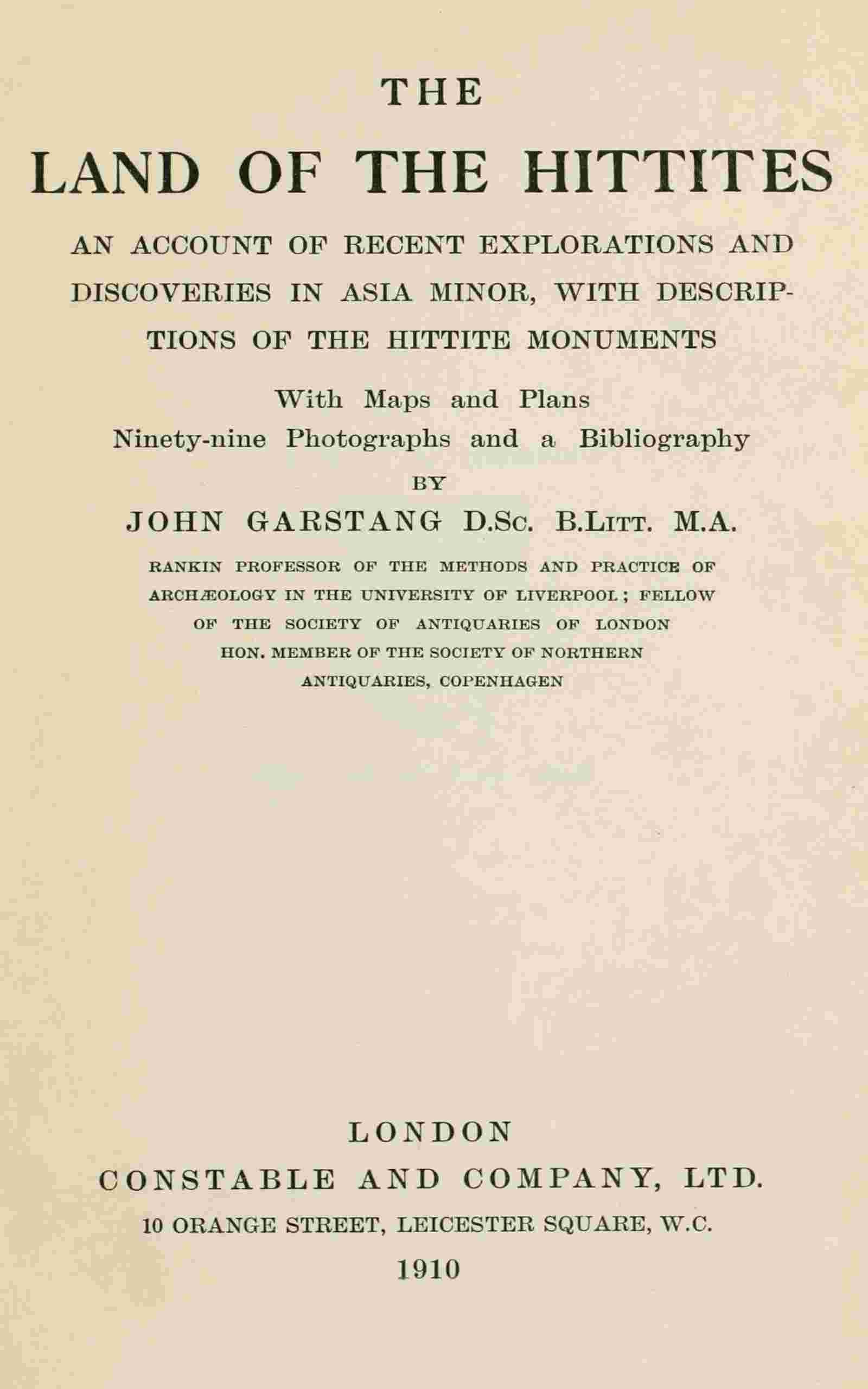
About This Book
A survey of recent archaeological exploration in Asia Minor and northern Syria that traces the emergence of Hittite civilization from scattered monuments and excavations. It combines an overview of the region and a chronological sketch of Hittite history with detailed descriptions of temples, reliefs, inscriptions, and other monuments, and includes accounts of fieldwork and discoveries. The text discusses Hittite art, religious practice, and material culture, and provides maps, plans, photographs, and a bibliography to support further investigation and interpretation.