
AMALIA MATERNA
Famous dramatic soprano who created the role of Brünnhilde in the original performance at Bayreuth
MAX ALVARY
Popular tenor who created the role of Siegfried in America in 1887 and sang it at the 100th American performance in New York, in 1895
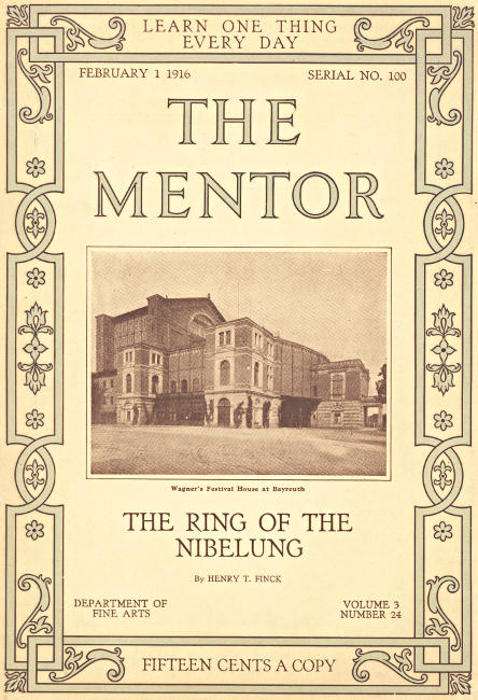
The inhabitants of Munich have had reason to regret their action in opposing the plans of their king and Wagner. Since Wagner’s death in 1883 a score or more of festivals have been held at Bayreuth, bringing millions of profit to that Bavarian town, all of which the Munichers might have had. Bayreuth was chosen partly because it was within the realm of Wagner’s royal friend, partly because of its picturesque surroundings, and partly because of its seclusion. Special inducements had been offered him to build the Nibelung Theater at the famous summer resort, Baden-Baden; but he did not wish to produce his great and revolutionary work before audiences of mere pleasure-seekers. He had spent a quarter of a century in creating an entirely new German artwork, free from all foreign elements and operatic fripperies, and he wanted to submit it to serious music lovers, who would be sufficiently interested to take a trip to remote Bayreuth.
Edison, the wizard inventor, who never spared himself in work, said not long ago that genius was one per cent inspiration and ninety-nine per cent perspiration.
Wagner’s “Ring” is certainly a miracle of inspiration; yet when one reads of how much hard work he bestowed on its production after the infinite pains he had taken in creating it, one feels tempted to say that Edison did not exaggerate. Monumental proof of Wagner’s indefatigable industry is afforded by two volumes, one containing his business letters, the other his letters to the artists during the preparations for the Bayreuth festivals of 1876 and 1882, over both of which he presided personally. He spent a whole summer visiting all the German opera houses and picking out the artists most suitable for each of the forty-nine solo parts in the “Ring.” With most of these he corresponded personally, and also went over their parts with them before the rehearsals on the stage. The orchestra was made up with the same attention to individual merit; while the scenic features were genuine works of art.
The Nibelung Festival of 1876 was a most important event in the history of music. Among those who attended it were two emperors (William I of Germany and Don Pedro of Brazil), King Ludwig II, the grand dukes of Weimar, Baden, and Mecklenburg, together with many other representatives of the European aristocracy; while among those who represented the musical nobility were Liszt, Grieg, and Saint Saëns. On all these, as on the ordinary mortals assembled, the “Ring” made an indelible impression.
THE PASSING OF SIEGFRIED. From the painting by Hermann Hendrich
CONQUEST OF EUROPE AND AMERICA
That there were shortcomings it is needless to say; for everything was so new and difficult to the artists. Nor were the funds sufficient to enable Wagner to realize all his intentions. The cost of seats ($75 for the four performances—which were thrice repeated) kept many enthusiasts from attending, and the result was a deficit of $37,500.
GUSTAV SIEHR
Who created the role of Hagen in Götterdämmerung, at Bayreuth, 1876
LILLI LEHMANN
Celebrated dramatic soprano, who took part in original Bayreuth performances and was the leading interpreter of Wagner roles in America for years
SIEGFRIED IN GÖTTERDÄMMERUNG
Photographed from Max Alvary
This deficit, while it was a cruel blow to Wagner, was for the world a blessing in disguise; for it made it impossible for him to carry out his plan of reserving the future performances of the Nibelung’s Ring for Bayreuth alone. There were no available funds; so King Ludwig, who had contributed $50,000 toward the expenses of the Nibelung scenery, got the privilege of producing the whole “Ring” in Munich. Other cities soon followed, and so great was the success that Wagner permitted Angelo Neumann, manager of the Leipsic Opera, to organize a traveling Wagner Theater for producing the “Ring” throughout the cities of Germany, as well as in Italy and other countries. These performances were, fortunately, given under the conductorship of Anton Seidl, who had been Wagner’s secretary for several years, and concerning whom Wagner wrote, “No other conductor knows as he does the proper tempi [changes of pace] of my music or how the action on the stage must be suited to the music. Seidl learned these things from me. He will conduct the Nibelungen better for you than anyone else.”
AMERICAN PERFORMANCES
Fortunately, also, it was this same Anton Seidl who conducted the first performances of the “Ring” in America, beginning with “Siegfried” in 1887. “Die Walküre” had previously been produced under Leopold Damrosch. The success in these cases was immediate; for the Metropolitan Opera House had imported the leading Wagnerian singers from Germany.
ANTON SEIDL
For years the leading conductor of Wagner opera in America
THEODORE THOMAS
Noted conductor who worked for years to make Wagner music known to the American public
The ground had been well prepared. Theodore Thomas had labored many years to educate the public up to Wagner; his activity culminating in the great Wagner festival of 1884, for which he imported three of the leading Bayreuth singers, Materna, Winkelmann, and Scaria. That same season Wagner’s operas and music-dramas began to lead the others at the Metropolitan, and among the singers who helped to popularize his works were Lilli Lehmann, Marianne Brandt, Milka Ternina, Albert Niemann, Heinrich Vogl (fo-gl), Max Alvary, Theodor Reichmann, Emil Fisher, most of whom had studied with Wagner, besides, somewhat later, Jean and Edouard de Reszke, Olive Fremstad, Johanna Gadski, and the Americans Lillian Nordica, Emma Eames, Louise Homer, and Geraldine Farrar.
The first of the Nibelung operas heard in New York was “Die Walküre.” It was sung at the Academy of Music eight months after the festival at Bayreuth, but the performance was in every way inadequate. In a way it was fortunate for the Wagner cause that Abbey and Grau lost $250,000 giving operas in Italian and French during the first season (1883-84) of the Metropolitan Opera House, just built at a cost of $1,732,978. That failure induced the directors to try German opera, and for seven years it ruled supreme; but the German singers, great as they were in their own sphere, could not, with a few exceptions (notably Lilli Lehmann) do justice to Italian and French works. The eager desire to hear those again, under more favorable conditions, led to a temporary cessation of German opera; but it so happened that one of the famous singers engaged for French and Italian opera was the great tenor, Jean de Reszke, who gradually became an ardent Wagnerite, eager to appear in the Nibelung operas. He induced the management to reengage Seidl and some of the best German singers, and once more Wagner flourished, side by side with Verdi and Meyerbeer, Gounod and Bizet. Wagner now leads in the number of performances, followed by Puccini and Verdi. Singers of every nationality now seek to appear in the Wagner operas, and an ambition of the great conductors, including the Italian, Toscanini, is to interpret the Nibelung’s Ring, of which Liszt wrote: “It overtops and commands our whole art-epoch as Mont Blanc does our mountains.”
SUPPLEMENTARY READING
| THE RING OF THE NIBELUNG | By G. Kobbé |
| GUIDE TO THE RING OF THE NIBELUNG | By H. von Wolrogen |
| RICHARD WAGNER | By Adolphe Jullien |
| 2 Vols. Fully illustrated | |
| STUDIES IN THE WAGNERIAN DRAMA | By H. E. Krehbiel |
| RICHARD WAGNER | By W. J. Henderson |
| WAGNER AND HIS WORKS | By H. T. Finck |
| A STUDY OF WAGNER | By Ernest Newman |
| LIFE OF WAGNER | By Houston S. Chamberlain |
| Fully illustrated | |
| THE MUSIC DRAMAS OF R. WAGNER AND HIS FESTIVAL THEATER IN BAYREUTH | By Albert Lavignac |
THE OPEN LETTER
Dear Mrs. B—n:
I know exactly how you feel about Wagner’s music. You write me that your club is to devote several afternoons to Wagner and that the preparatory study that you have to give to it is “too much like hard work.” You ask, “Why must it be so? Cannot Wagner’s music be appreciated without having to master a system of things as puzzling and difficult as bezique?”
A very good question. It has been asked many times. It was answered in a way some years ago when a very eminent New York music critic found a young friend at a Wagner Music Drama poring over a commentary and busily memorizing the leading motives instead of listening to the music. “Go as far with that as your enthusiasm will carry you,” said the critic. “Then forget it all—and let the music tell you its own story.” “But,” was the answer, “I want to listen intelligently and not miss any of the meaning of the music or the text.”
That, Mrs. B—n, is your attitude. You want to understand the principles of Wagner’s Art. Good. But don’t make hard work of it. I have been all through the experience and I know what it means. I was a young worshipper at Wagner’s shrine in the years when Anton Seidl was making the Music Drama known in America, and Max Alvary, Lilli Lehmann, and Emil Fischer filled the leading roles. Night after night, libretto and commentary in hand, I sat through hours of Music Drama until I knew every measure intimately. I could tick off unerringly each individual motive as it occurred. Sometimes four or five of them would be going at once, but none of them ever escaped me. By and by I got tired of this academic exercise and then I made a wonderful discovery. I found that my labors had been unnecessary. The music was plain enough to anyone who was sensitive to music and who followed the drama attentively. I discovered this through a friend whom I took to the Ring of the Nibelung for the first time. He had not studied as I had, but when he heard the quick tapping sound of the hammers in Rhinegold he did not have to be told that it was the Nibelung motive. The heavy tread of the music of the giants was perfectly plain to him, and so was the mad galop of the Valkyrs, while the solemn measures that accompanied the gods across the rainbow bridge made clear to him the majesty of Walhall. At one time he turned to me and said, “I don’t know what the text books call that musical theme, but it means ‘Pleading’ to me.” The “Magic Fire” and “Slumber” music were eloquently expressive to him, and whenever he heard the ominous beat of the kettle-drum he exclaimed without hesitation, “That means ‘Fate!’”
Of course this is easy in the case of the motives that are musically descriptive of their subjects. But it is true also of those that are merely arbitrary musical symbols, such, as the motives of the “Wälsung Family,” or “The Compact.” Your attention is called to these motives at the time when they are first played and instinctively you associate them with their subjects when they are repeated.
“But,” you may say, “that is not the way to master the score. A commentary is surely needed.” A commentary is indeed a material help. But, after all, you will have to go to the music finally, so why not start with the music? It is simply a question of the best method of learning. The handbook and commentary method is like the old grammar and speller—didactic and dry. Wagner music is a great deal better than Wagner explanations. So, go to the music at once and follow it closely. A great deal that makes up Wagner’s Art will quickly become apparent to you. Intelligent, appreciative commentaries written by scholarly critical writers are valuable reading, after you have heard the music. A course of handbook study before you are familiar with the music is indeed, as you say, very much “like hard work.”
Sincerely yours,
W. D. Moffat
Editor
The Mentor Association
ESTABLISHED FOR THE DEVELOPMENT OF A POPULAR INTEREST IN ART, LITERATURE, SCIENCE, HISTORY, NATURE, AND TRAVEL
THE ADVISORY BOARD
- JOHN G. HIBBEN, President of Princeton University
- HAMILTON W. MABIE, Author and Editor
- JOHN C. VAN DYKE, Professor of the History of Art, Rutgers College
- ALBERT BUSHNELL HART, Professor of Government, Harvard University
- WILLIAM T. HORNADAY, Director, New York Zoological Park
- DWIGHT L. ELMENDORF, Lecturer and Traveler
The purpose of The Mentor Association is to give its members, in an interesting and attractive way, the information in various fields of knowledge which everybody wants to have. The information is imparted by interesting reading matter, prepared under the direction of leading authorities, and by beautiful pictures, produced by the most highly perfected modern processes.
THE MENTOR IS PUBLISHED TWICE A MONTH
SUBSCRIPTION, THREE DOLLARS A YEAR. FOREIGN POSTAGE 75 CENTS EXTRA. CANADIAN POSTAGE 50 CENTS EXTRA. SINGLE COPIES FIFTEEN CENTS. PRESIDENT, THOMAS H. BECK; VICE-PRESIDENT, WALTER P. TEN EYCK; SECRETARY, W. D. MOFFAT; TREASURER, ROBERT M. DONALDSON; ASST. TREASURER AND ASST. SECRETARY, J. S. CAMPBELL
COMPLETE YOUR MENTOR LIBRARY
Subscriptions always begin with the current issue. The following numbers of The Mentor Course, already issued, will be sent postpaid at the rate of fifteen cents each.
- Serial No.
- 1. Beautiful Children In Art
- 2. Makers of American Poetry
- 3. Washington, the Capital
- 4. Beautiful Women in Art
- 5. Romantic Ireland
- 6. Masters of Music
- 7. Natural Wonders of America
- 8. Pictures We Love to Live With
- 9. The Conquest of the Peaks
- 10. Scotland, the Land of Song and Scenery
- 11. Cherubs in Art
- 12. Statues With a Story
- 13. Story of America in Pictures: The Discoverers
- 14. London
- 15. The Story of Panama
- 16. American Birds of Beauty
- 17. Dutch Masterpieces
- 18. Paris, the Incomparable
- 19. Flowers of Decoration
- 20. Makers of American Humor
- 21. American Sea Painters
- 22. Story of America in Pictures: The Explorers
- 23. Sporting Vacations
- 24. Switzerland: The Land of Scenic Splendors
- 25. American Novelists
- 26. American Landscape Painters
- 27. Venice, the Island City
- 28. The Wife in Art
- 29. Great American Inventors
- 30. Furniture and Its Makers
- 31. Spain and Gibraltar
- 32. Historic Spots of America
- 33. Beautiful Buildings of the World
- 34. Game Birds of America
- 35. Story of America in Pictures: The Contest for North America
- 36. Famous American Sculptors
- 37. The Conquest of the Poles
- 38. Napoleon
- 39. The Mediterranean
- 40. Angels in Art
- 41. Famous Composers
- 42. Egypt, the Land of Mystery
- 43. Story of America in Pictures: The Revolution
- 44. Famous English Poets
- 45. Makers of American Art
- 46. The Ruins of Rome
- 47. Makers of Modern Opera
- 48. Dürer and Holbein
- 49. Vienna, the Queen City
- 50. Ancient Athens
- 51. The Barbizon Painters
- 52. Abraham Lincoln
Volume 2
- 53. George Washington
- 54. Mexico
- 55. Famous American Women Painters
- 56. The Conquest of the Air
- 57. Court Painters of France
- 58. Holland
- 59. Our Feathered Friends
- 60. Glacier National Park
- 61. Michelangelo
- 62. American Colonial Furniture
- 63. American Wild Flowers
- 64. Gothic Architecture
- 65. The Story of the Rhine
- 66. Shakespeare
- 67. American Mural Painters
- 68. Celebrated Animal Characters
- 69. Japan
- 70. The Story of the French Revolution
- 71. Rugs and Rug Making
- 72. Alaska
- 73. Charles Dickens
- 74. Grecian Masterpieces
- 75. Fathers of the Constitution
- 76. Masters of the Piano
Volume 3
- 77. American Historic Homes
- 78. Beauty Spots of India
- 79. Etchers and Etching
- 80. Oliver Cromwell
- 81. China
- 82. Favorite Trees
- 83. Yellowstone National Park
- 84. Famous Women Writers of England
- 85. Painters of Western Life
- 86. China and Pottery of Our Forefathers
- 87. The Story of The American Railroad
- 88. Butterflies
- 89. The Philippines
- 90. Great Galleries of The World: The Louvre
- 91. William M. Thackeray
- 92. Grand Canyon of Arizona
- 93. Architecture in American Country Homes
- 94. The Story of The Danube
- 95. Animals in Art
- 96. The Holy Land
- 97. John Milton
- 98. Joan Of Arc
- 99. Furniture of the Revolutionary Period.
NUMBERS TO FOLLOW
Feb. 15. THE GOLDEN AGE OF GREECE.
By George Willis Botsford, Professor Ancient History, Columbia University.
The Golden Age of Greece was one of the high water marks of the world’s history. It was a time interesting in every way. Professor Botsford’s entertaining story will give an insight into the life of the period that will hold the interest of everyone.
Mar. 1. CHINESE RUGS
By John K. Mumford, Author and Expert on Oriental Rugs.
This will be one of the most interesting and beautiful numbers of The Mentor ever published. Its authority is the highest, and the color pictures of the rugs themselves are superb.
THE MENTOR ASSOCIATION, Inc.
52 EAST 19th STREET, NEW YORK, N. Y.
THE MENTOR
The Mentor Service
This service covers the needs of those who want to gain knowledge by an easy and agreeable method.
Send for our booklet descriptive of The Mentor Club Service. It presents many varied Mentor courses specially planned for the use of reading clubs.
The Mentor Association will supply to its members supplementary reading courses dealing with any or all of the subjects in The Mentor Courses. These courses of reading are prepared under the direction of the Advisory Board of The Mentor—all of them prominent educators.
The Mentor Association will also secure books for members, supplying them postpaid at publishers’ prices.
The Mentor Inquiry Department gives to its members a full and intelligent service in answering inquiries concerning books, reading, and all matters of general information having a bearing on The Mentor Courses.
MANY READERS HAVE COME TO KNOW THE VALUE OF THE MENTOR SERVICE. IN THE FULLEST SENSE IT SUPPLEMENTS AND ROUNDS OUT THE PLAN OF THE MENTOR. ALL MEMBERS OF THE ASSOCIATION ARE INVITED TO TAKE ADVANTAGE OF THIS SERVICE
THE MENTOR BINDER
Every page of The Mentor, cover included, contains matter that readers want to keep. The Mentor Association is now supplying to its members a binder which holds twelve or thirteen Mentors and has proved satisfactory in every way. This binder has been arranged so as to hold The Mentor complete and it has tapes to which the pictures are attached, so that they swing freely in their place and the pictures can be enjoyed as well as the text on the back.
The price of these binders is One Dollar each.
MAKE THE SPARE
MOMENT COUNT